Leviticus 26:1-13
Promised Blessings
Chapter 26 of Leviticus details the blessings and the curses which were to come upon the people of Israel based on obedience or disobedience to the words of law which have been laid down so far, and which will continue to be laid down as the law continues to be relayed to the people.
Because these promises have been so exactingly fulfilled in the later pages of Scripture, objections have been raised by naturalistic and rationalistic critics of the Bible that Moses could not be the author of this chapter. Instead, they claim that the words were written during the times of the kings of Israel, as late as the 8th or the beginning of the 7th century BC.
They have done this, because they do not accept prophetic revelation as something which is possible, and therefore what is presented must have been written at a much, much later date. In other words, to them neither God nor man can tell the future except as far as logical deductions can be made.
For example, we can logically deduce that a team will win tomorrow’s game because their opponents are simply not in the same league as those they will be facing. We can logically deduce that the stock market will crash in X number of months or years based on repeatable patterns which have been documented in the past. And so on.
But, for these scholars the words of Leviticus 26, like many of those of the prophets, are so exact and specific – and the fulfillment of them is so exactingly detailed, and in line with what is written here – that it is simply not possible that they could have been penned by Moses. No amount of logical deduction could bring the two into such absolute harmony.
If one holds to a naturalist view of the world, the prophecies contained here can have no other possible explanation than having been written at a later date. However, the stupidity of this view is all the more evident – even apart from both logic concerning God’s nature, and mere faith itself – when one understands that the words of Chapter 26 presuppose not one, but two or more exiles for the people of Israel. There is no doubt, by anyone in reasonable schools of biblical scholarship, that Leviticus predates the second exile of Israel by many hundreds of years.
Even if it wasn’t penned by Moses, and it was instead penned in the 8th or 7th century BC as claimed by these knuckleheads, their logic breaks down completely in that a second exile did take place. The words of Leviticus 26 continue to describe exactingly what has occurred to Israel during this second exile, and even more, that the return of Israel to their land in 1948 more exactingly reflects the promises of the Lord contained in this chapter.
This is one reason, among others, that the modern state of Israel is considered an aberration by many supposed scholars. Claims are even made that the people occupying the land are not the same people being addressed in Leviticus 26. But if one honestly looks at Israel of today, in the land of Israel today, no other conclusion can be realistically reached except that the prophetic words of Leviticus 26 are, in fact, realized in Israel, and are thus the words of the Lord, given as a prophetic basis for what has come about.
Text Verse: “Indeed you are to them as a very lovely song of one who has a pleasant voice and can play well on an instrument; for they hear your words, but they do not do them. 33 And when this comes to pass—surely it will come—then they will know that a prophet has been among them.” Ezekiel 33:32, 33
Prophecy, especially future prophecy, is an exceptionally tricky and complicated thing. Far too often, people claim they know what lies ahead based on what the Bible says about certain issues. However, it is an extremely rare thing that someone in the past would read Scripture and know exactly what would come to pass, and in the way and matter it in fact actually occurred.
Bible prophecy is given normally as a general outline of what lies ahead, and piecing together all of what is given on a future event is certainly both a challenge, and something which will be shown in error most of the time. In other words, the Bible is not intended for divination about what lies ahead. It is given in broad brushstrokes of what is coming, but not in minute detail.
However, when the event comes to pass, one can then look back on what has been prophesied and come to a truly “Aha” moment. All of the verses which pointed to what was coming suddenly come into crystal clear focus. In this, the prophet who relayed the words is seen to have been a true prophet, and the Lord who inspired the prophet, is seen as beyond the realm of the naturalist. Instead, He is the omniscient, sovereign Lord who transcends space and time.
In Leviticus 26, there are explicit prophecies which are obvious on the surface, and which were simply awaiting their obvious fulfillment. There are also portions of this chapter which, when taken together with other portions of Scripture, were only realized as prophetically fulfilled after the events took place.
Understanding this, for us in the church today, there are certain future prophecies which are obvious on the surface. We know they are coming, and we can simply await their fulfillment, fully trusting that they will come about because they are of the same reliable Source as other prophecies which have been exactingly fulfilled already. And then, there are things which are coming which will only be known as fulfilled after the events have taken place. The importance of not mixing the two types of prophecy together cannot be overstated. The Bible is not a tool for divination. Predictions about certain dates, and specific events occurring at specific times, are to be rejected outright. But those things which are said to be ahead, and which are carefully recorded for us to understand the broad outline of the future, are fair game to know that the future is set, and that those things will come about. As one example of hundreds, the Bible says there will be a rapture. That is open, explicit, and guaranteed.
However, the Bible does not tell us when that will occur. Therefore, no amount of study or speculation will ever bring us to an understanding of the timing of the event. Let us be wise in how we handle prophecy, and let us never set ourselves in the position where we claim to know what is reserved to God alone. These truths are to be found in His superior word. And so let’s turn to that precious word once again and… May God speak to us through His word today and may His glorious name ever be praised.
Promised Blessings to Israel
This chapter begins with no new introduction, such as, “The Lord spoke to Moses saying.” Thus, what is found here is a continuation of the discourse to Moses which has been ongoing since verse 25:1. Despite this, the chapter division here is appropriate because it will deal with the blessings and the curses which Israel can expect based on obedience to the Lord, or disobedience to Him.
The placement of the first two verses, however, are said by some scholars to be wholly inappropriate for starting this new chapter. Instead, it is claimed that they belong to the previous chapter. Charles Ellicott, in particular, finds this placement to be detrimental to our study of what is occurring. He says –
“The first two verses of this chapter are still a part of the previous section in the Hebrew original. By separating them from their proper position, and making them begin a new chapter, both the logical sequence and the import of these two verses are greatly obscured.” Charles Ellicott
He provides his logical reason for the claim by saying that the idolatry of verse 1, and the Sabbath law of verse 2, are tied into being a Hebrew slave in Chapter 25, warning them to abstain from idolatry and to keep the Sabbath, despite their indentured status.
This is a wholly unrealistic analysis. Both idolatry and Sabbath observance laws are given to all the people, regardless of their status as free men or slaves. Rather, the warnings of these two commands set the stage for all that will follow. In Leviticus 19, these same precepts are given at the beginning of the chapter, but the order of them is reversed. It first speaks of keeping the Sabbaths of the Lord in verse 3, and then not turning to idols in verse 4. From there, the rest of the chapter dealt with commands, statutes, and judgments for the people to follow.
The same is true here. The Lord is highlighting these particular commands at the outset of what is to follow, and then He will give the consequences for not following them. In other words, these two commands are being relayed again to call to mind all of the other laws which have been given. As Joseph Benson rightly says, “The substance of their religious laws are here recapitulated in two chief articles, on which all the rest very much depended; and God, by Moses, inculcates upon them.”
These two major precepts, along with reverence for the sanctuary which is also found in verse 3, are given to keep the Israelites from corrupt and superstitious practices. Further, the reversal of the order of these commands – idolatry and Sabbath-keeping between Chapter 19 and here is highlighted in the fact that back in Exodus 20, in the Ten Commandments, the commands are reversed from those in Chapter 19. Like here in Chapter 26, idolatry precedes the observance of the Sabbath in the Ten Commandments.
And so, not to beat the point to death, but so that you understand what is going on, the Lord is giving the first two verses of this chapter as a summary of all of the laws and precepts given to Israel. From this solemn reminder, He will then give them magnificent promises of blessing for obedience, and terrifying promises of curses for disobedience. The words of this chapter are exactingly revealed in the rest of the pages of the Old Testament, and in the second exile of Israel after their rejection of their Messiah, Jesus – just as the Lord promises here in Leviticus 26.
‘You shall not make idols for yourselves;
lo taasu lakem elilim – “no shall you make to you nothings.” The word elilim comes from the word al, or “no,” and thus it literally means “nothings.” These “nothings” then are set in contrast to that which is of the highest value, Yehovah, the One true God. Paul, understanding this nuance, repeats it in 1 Corinthians 8:4 –
“Therefore concerning the eating of things offered to idols, we know that an idol is nothing in the world, and that there is no other God but one.”
To make a nothing, and then to attribute value to it, reduces the maker of the nothing to the same level as the nothing they have made. In other words, to reverence the name of the Lord, is to bring glory to the Lord, who then returns His favor to that person. But to exalt a nothing will result in exactly the opposite. Psalm 115 explains that those who do such things hold the same value as what they produce. They become nothings –
“But our God is in heaven;
He does whatever He pleases.
4 Their idols are silver and gold,
The work of men’s hands.
5 They have mouths, but they do not speak;
Eyes they have, but they do not see;
6 They have ears, but they do not hear;
Noses they have, but they do not smell;
7 They have hands, but they do not handle;
Feet they have, but they do not walk;
Nor do they mutter through their throat.
8 Those who make them are like them;
So is everyone who trusts in them.” Psalm 118:3-8
1 (con’t) neither a carved image nor a sacred pillar shall you rear up for yourselves;
The pesel, or image was first mentioned in the giving of the Ten Commandments, and it has not been seen since. It comes from pasal which means “to cut or hew into shape.” Thus, this is specifically a carved image. Such an image could be of either a false god, or an attempt to represent the true God. Both of these were forbidden. A false god would be a challenge to Yehovah, and an image claiming to be His likeness would be an affront to Him. Nothing in creation could represent His infinite glory and being.
The pillar, or matstsebah, was first seen when Jacob set up such a pillar when he had his dream of a stairway rising to heaven in Genesis 28. In this case, it is any sacred pillar which is used for worship and/or fertility rites. Such pillars will be seen throughout the times of the kings of Israel, including those to Baal.
1 (con’t) nor shall you set up an engraved stone in your land, to bow down to it;
Here is a new word which will be seen six times in the Bible, maskith, or imagination. It is from sekvi which signifies the mind, and thus it is speaking of the imaginations of the mind in forming a carved image. Any carved stone image formed by a man’s mind, whether of something real like a bear, or something imagined, like a unicorn or a Sphinx, is surely included in this concept. This would be inclusive of images carved into stone as well, such as depictions in walls and the like. To have such images could, and would, inevitably lead the people to idolatry. This is made explicit with the words, “to bow down to it.”
1 (con’t) for I am the Lord your God.
The reason for the commands concerning the conduct of the people, which has been given to them countless times already, is that Yehovah is their God, they committed to this fact, and they are accountable to Him as such. This remains unchanged to this day. Though the law is set aside in Christ, they have – as a collective group of people – not come to Christ. They are thus as accountable today to this law as they were when these words were spoken.
This precept is not to be missed. What is said in this chapter concerning His anticipated treatment of them did not end with the coming of Christ. The blessing and the burden remains. This is revealed explicitly in Daniel 9 where seven more years are given to Israel, under this law, to come to Christ as the fulfillment of it. In the meantime, the words of Leviticus 26 have continued to be revealed in and through Israel, even for the last 2000 years.
2 You shall keep My Sabbaths and reverence My sanctuary:
I am the Lord.
These words are an exact repetition of Leviticus 19:30, word for word, and even letter for letter. These two laws were given to draw the people near to Him. The intent was that in especially following these precepts, they would be more likely to guard against idol worship, and instead focus on the Lord.
Unfortunately, Sabbath observance, and even the honor of having the Lord’s sanctuary among them became markers of perceived self-goodness and acceptability because of who they were, not because of who the Lord is. Ezekiel shows that this is true, even from their inception as a people. He says that they profaned the Lord’s sabbath from the start, and they did it by allowing their hearts to go after idols, a thing which profaned the very reason for the giving of the Sabbath –
So I also raised My hand in an oath to them in the wilderness, that I would not bring them into the land which I had given them, ‘flowing with milk and honey,’ the glory of all lands, 16 because they despised My judgments and did not walk in My statutes, but profaned My Sabbaths; for their heart went after their idols. Ezekiel 20:15, 16
Likewise, the prophet Jeremiah makes this perfectly clear to the people concerning their regard of the Lord’s sanctuary –
“Thus says the Lord of hosts, the God of Israel: “Amend your ways and your doings, and I will cause you to dwell in this place. 4 Do not trust in these lying words, saying, ‘The temple of the Lord, the temple of the Lord, the temple of the Lord are these.’
5 “For if you thoroughly amend your ways and your doings, if you thoroughly execute judgment between a man and his neighbor, 6 if you do not oppress the stranger, the fatherless, and the widow, and do not shed innocent blood in this place, or walk after other gods to your hurt, 7 then I will cause you to dwell in this place, in the land that I gave to your fathers forever and ever. Jeremiah 7:3-7
3 ‘If you walk in My statutes and keep My commandments, and perform them,
Verse 3 now begins what verses 1 & 2 prepared the people’s ears to hear. They were given the instructions on what to do in those verses as a summary of all of the laws they have thus far been presented, and of all the laws that are yet to be proclaimed. With that behind them, and yet as a reference for each section of what the Lord will now proclaim, the conditional statements of Leviticus 26 now begin with, “If you walk…” The Pulpit Commentary rightly says of these words, “The free will of man is recognized equally with God’s controlling power.” The statement is conditional – “IF.” It presupposes free will among the people. However, what follows will demonstrate that God will take those choices, and He will control the outcome of the people based on what they chose to do.
In this verse, the words are spoken to all of the people. In other words, the subject of the matter is not what individuals would do concerning their conduct, but what the people collectively would do in keeping the words of the covenant and adhering to the precepts of the Lord. If a miscreant was found among the people, would the people handle him in accord with the given law? It is the collective group to which these words are given.
The Lord will begin with explaining the blessings of what lay ahead if the choice was obedience to Him and to His word. The germ of this blessing was initially promised in the giving of the Ten Commandments. In Exodus 20:6 and 20:12 He gave promises of blessing for obedience to His word.
In Exodus 23, He continued with promises of what He would do for the people if they remained faithful and obedient to Him. These early references will now be fully developed and explained to the people. They are words of surety, they are words of encouragement, and they are words of warning. Israel must pay heed, or Israel will discover what it means to fail to pay heed.
4 then I
An important point right here at the giving of the first promise is that it is stated in the first person. This will continue all the way through the chapter. The Lord personally claims that He will fulfill His word in and towards the people – “I will do this,” and “I will do that.” This is in contrast to the comparable passage of blessings and curses noted in Deuteronomy 28. There Moses reiterates the main idea of what is stated here, but he does it in the third person – “The Lord will do this, and the Lord will do that.”
4 (con’t) will give you rain in its season,
Beginning the blessings with geshem, or rain, is not a word to be taken lightly. Without rain, everything else in the land would come to ruin. With rain, there would be the possibility of abundance and satisfaction. Unlike Egypt where they had left, the land of Israel did not have a massive river running through it which could then be diverted onto the flat surrounding countryside. Instead, it is a land of hills and valleys. Without rain, it would be a barren waste.
But in obedience to Him, and to His word, He promises the rain to come in its season. For Israel under ideal conditions, there are two major rains – the former and the latter rains which are noted in Deuteronomy 11:14. The former rains are those which come at the time after the autumnal equinox, normally around late October to early November. That is when the winter crops of wheat and barley would be sown. After this, heavier showers would fall in November and December.
The latter rains begin to fall in March, before the winter crops are harvested, but at the time when the summer seed is sown. These rains last a few days, or even a period of hours. The clouds which told of the coming of this latter rain were so welcomed to the people, that Solomon equates it to the favor of the king –
“In the light of the king’s face is life,
And his favor is like a cloud of the latter rain.” Proverbs 16:15
Joel 2 speaks of both of these rains, and the blessing of them –
“Be glad then, you children of Zion,
And rejoice in the Lord your God;
For He has given you the former rain faithfully,
And He will cause the rain to come down for you—
The former rain,
And the latter rain in the first month.
24 The threshing floors shall be full of wheat,
And the vats shall overflow with new wine and oil.”Joel 2:23, 24
James, in the New Testament, does so as well. He equates the coming of the former and latter rains in the land of Israel to the return of the Lord. As the cycle of rains in Israel was disrupted for 2000 years during their exile, and as these rains have returned to their normal cycle since their return in 1948, we find in the words of James comfort. The return of Christ is, in fact, near –
“Therefore be patient, brethren, until the coming of the Lord. See how the farmer waits for the precious fruit of the earth, waiting patiently for it until it receives the early and latter rain. 8 You also be patient. Establish your hearts, for the coming of the Lord is at hand.” James 5:7, 8
4 (con’t) the land shall yield its produce, and the trees of the field shall yield their fruit.
Here the word yebul, or produce is introduced. It signifies that which is brought forth out of the land, and thus we would say “produce.” Along with such things, the Lord promises that the trees would likewise be fruitful. One can see in this fields of tomatoes, rows of apple trees, and every type of abundance in every field. The words of all of verse 4 closely match Ezekiel 34:26, 27 –
“I will make them and the places all around My hill a blessing; and I will cause showers to come down in their season; there shall be showers of blessing. 27 Then the trees of the field shall yield their fruit, and the earth shall yield her increase.” Ezekiel 34:26, 27
5 Your threshing shall last till the time of vintage, and the vintage shall last till the time of sowing;
Here is a unique word in Scripture, dayish, or “threshing time.” That is derived from dush, or the act of threshing. Another new word, batsir, or vintage is introduced. That signifies the clipping off of clusters of grapes, and thus the time of vintage. The idea here is that there will be such abundance that the productivity of the field will simply go on and on. There will always be work, and it will always be abundantly productive and fruitful. This will be so much the case that while they are still tending to one harvest, the next would be calling out for their attention to tend to it.
These words closely match Amos 9:13. But even more than matching, just after that, in verse 9:15 as the book comes to a close, is a passage which is predictive prophecy, and which has never been fulfilled in history. Thus, it is something which belongs to our future, and which points to Israel’s return to their land in 1948 –
“Behold, the days are coming,” says the Lord,
“When the plowman shall overtake the reaper,
And the treader of grapes him who sows seed;
The mountains shall drip with sweet wine,
And all the hills shall flow with it.
14 I will bring back the captives of My people Israel;
They shall build the waste cities and inhabit them;
They shall plant vineyards and drink wine from them;
They shall also make gardens and eat fruit from them.
15 I will plant them in their land,
And no longer shall they be pulled up
From the land I have given them,”
Says the Lord your God. Amos 9:13-15
There has never been a time which Israel was planted and not pulled up. But the restoration of Israel in 1948 has made this prophecy possible. Other prophecies show us that before these promised blessings come about, many troubles and much loss of life will come to Israel, but the word of God states that they shall never again be uprooted. The word is faithful, and Israel will stand.
5 (con’t) you shall eat your bread to the full,
These words correspond to Ezekiel 34:29, “I will raise up for them a garden of renown, and they shall no longer be consumed with hunger in the land.” Again and again Ezekiel promises that which was promised by Moses. The people had rebelled, but the people would receive grace. For those at the time of Moses, however, when they left Egypt and were still on their way to Sinai, they complained against the Lord saying that in Egypt they ate bread to the full. It was at that time that the Lord gave them manna to sustain them. The Lord promises that in Israel, and in their obedience to His precepts, the people would be filled with bread, just as they were in Egypt. But they would be free, and they would be cared for in a better way. This is seen in the next words…
5 (con’t) and dwell in your land safely.
These words are again reflected in Ezekiel 34. There the prophet says, “They shall be safe in their land;” (v 27). As Israel was delivered from the bondage of Egypt, the Lord sent them into bondage again for their transgressions, but he promised that like Egypt, their time for this would also end.
6 I will give peace in the land, and you shall lie down, and none will make you afraid;
Once again, Ezekiel 34 repeats the beautiful promises of Leviticus 26 to the downtrodden of his day with, “I will make a covenant of peace with them, and cause wild beasts to cease from the land; and they will dwell safely in the wilderness and sleep in the woods” (v. 25). For obedient Israel, there was, and there is, the promise of safety in the land. Even with the immense abundance which overflows from the harvests, the Lord promises them safety. There was to be no terror at night that someone would come and steal their efforts away, or harm them as they peacefully lay sleeping.
6 (con’t) I will rid the land of evil beasts,
And again from the same verse as before, Ezekiel’s words are a restatement of the original promises of Leviticus 26. There we read, “I will make a covenant of peace with them, and cause wild beasts to cease from the land” (v. 25). The promise here is one of security, but the term “evil beasts,” means more than simply lions, bears, and jackals. Rather, the term khayah, or living, is used to describe the formation of man in Genesis 2:7. Therefore, this promise to Israel is to be taken euphemistically to include wicked men of the land who form plans and schemes against Israel.
The reference to Ezekiel’s prophecy of the future seems obvious when considering the many factions who are intent on Israel’s destruction, and who make them live in fear today – be they Fatah, Hamas, Hezbollah, or countless others who invade their land, terrify their souls, and swallow up the Lord’s people. Until Israel has set its heart on the Lord, meaning Jesus, this will not cease.
6 (con’t) and the sword will not go through your land.
The words of this clause are seen substantially repeated in Ezekiel 34 as well. There in verse 28 he says, “And they shall no longer be a prey for the nations, nor shall beasts of the land devour them.” The Lord has tied the “evil beasts” in with “the sword” going through the land. Thus, Ezekiel’s words concerning the “beasts of the land” is speaking of the enemies of Israel euphemistically. They are as evil beasts, come to destroy the flock of the Lord.
But the flock of the Lord can only be considered as such when they are right with the Lord. Today, the evil beasts within the land, and the evil beasts of the surrounding lands, do come and destroy. A day lies ahead when this will no longer be the case. Israel was the Lord’s, and they betrayed Him. They have now received grace and have been returned to their ancient land, but their lot for the immediate future is one of uncertainty and sure grief. When they return to Him, He will be waiting with open arms.
7 You will chase your enemies, and they shall fall by the sword before you.
The words here are fulfilled throughout the times of the judges and kings. When Israel was in favor with the Lord, they fell upon their enemies and destroyed them mightily. At one time, the power of Israel was so great that the Bible records this in 1 Kings –
“So Solomon reigned over all kingdoms from the River to the land of the Philistines, as far as the border of Egypt. They brought tribute and served Solomon all the days of his life.” 1 Kings 4:21
This had come about by the great battles won by Saul, and then his own father David. By the time Solomon reigned, there was peace on all sides because the enemies of Israel had been chased and destroyed by the hungry sword of Israel.
8 Five of you shall chase a hundred, and a hundred of you shall put ten thousand to flight;
your enemies shall fall by the sword before you.
The words here are proverbial and signify that a small number would be able to defeat a large multitude. The Hebrew word is revavah. It means a multitude. The Greek translation of the OT says murias, or a myriad. It is an unspecified number. At other times, different numbers are used to express the same thought. Further, they are given in relation to Israel defeating their enemies, and in Israel being defeated by their enemies. However, the precept, though proverbial, is found realized several times in Scripture. In Joshua 23:10, Joshua cites this precept as an assured promise of the Lord in order to spur on his people to battle. He says there that one could chase a thousand.
In Judges 3:31, Shamgar, the son of Anath had killed six hundred men of the Philistines with an ox goad. In Judges 15:15, Samson is said to have killed a thousand men with the jawbone of a donkey. In 1 Samuel 14, Jonathan and his armor bearer came against a Philistine garrison, killed many, and this led to Israel seizing the initiative and wiping out many Philistines. In 2 Samuel 23:8, Josheb-Basshebeth is said to have raised his spear against eight hundred men, whom he killed in one encounter.
Finally, when Gideon and 300 men came against a camp of 135,000, they led the enemy into such panic that they killed one another while Gideon pursued them, encouraging other Israelites to join them, and killing as they went. It says that at the end of the battle, over 120,000 warriors had fallen. These and other stories show that while this is a proverbial saying, it is also one which holds more than a grain, but a bucketful, of truth.
9 ‘For I will look on you favorably
The words literally say “And I will turn unto you.” It signifies a sign of grace from the Lord. This sentiment is seen in Psalm 25 –
“Turn Yourself to me, and have mercy on me,
For I am desolate and afflicted.” Psalm 25:16
In turning to them, he promises three positive things. The first is…
9 (con’t) and make you fruitful,
This is not merely multiplication, but abundant health, continuance, brilliance, renown, etc. It is one thing to have a whole brood of regular children, but another to have children who are warriors, kings, and the like. One cannot be considered a curse, but the other can be considered a blessing. This is the intent of these words.
9 (con’t) multiply you
In addition to being fruitful comes the second promise, that of multiplication. Not only would Israel flourish in brilliance, renown, and so on, but these would be many in number. When people came to the land, they would say, “Every man is a giant among men.” Such is the intent here. But these first two merely lead to the third…
9 (con’t) and confirm My covenant with you.
The Lord’s word to Israel refers back to His promises to Abraham. In Genesis 15:18, the first of such terminology is used –
“On the same day the Lord made a covenant with Abram, saying:
“To your descendants I have given this land, from the river of Egypt to the great river, the River Euphrates.” Genesis 15:18
After that, the covenant was solidified with the sign of circumcision, and the promises which went along with it. That was recorded in Genesis 17:4-8 –
“As for Me, behold, My covenant is with you, and you shall be a father of many nations. 5 No longer shall your name be called Abram, but your name shall be Abraham; for I have made you a father of many nations. 6 I will make you exceedingly fruitful; and I will make nations of you, and kings shall come from you. 7 And I will establish My covenant between Me and you and your descendants after you in their generations, for an everlasting covenant, to be God to you and your descendants after you. 8 Also I give to you and your descendants after you the land in which you are a stranger, all the land of Canaan, as an everlasting possession; and I will be their God.”
The scholar Keil notes rightly that the words now in Leviticus are not merely the preservation of this covenant, “but the continual realization of the covenant grace, by which the covenant itself was carried on further and further towards its completion.” The promises are intended to keep the people in the land and increase them as they continued toward the coming of Messiah. The curses, though negative in nature, are intended for the same purpose. Israel would be controlled by God, but it would be a controlling of their own making, for good or evil, as they moved into a future where Christ would someday be revealed.
10 You shall eat the old harvest, and clear out the old because of the new.
The words here are necessary. He has already promised this type of blessing, but after doing so, He said that He would multiply the people. At what point would that turn south and mean lack? The answer is, “At no point.” As they multiplied, the Lord would continue to provide. There would be no lack, even in great multiplication of the people.
This would be so much so, that even as they ate the old store of food, they would eventually have to remove the old on account of the new. One can imagine great stores of older grain being carried over to the herds and given to them. The food of kings would become fodder for the beasts because of the abundance.
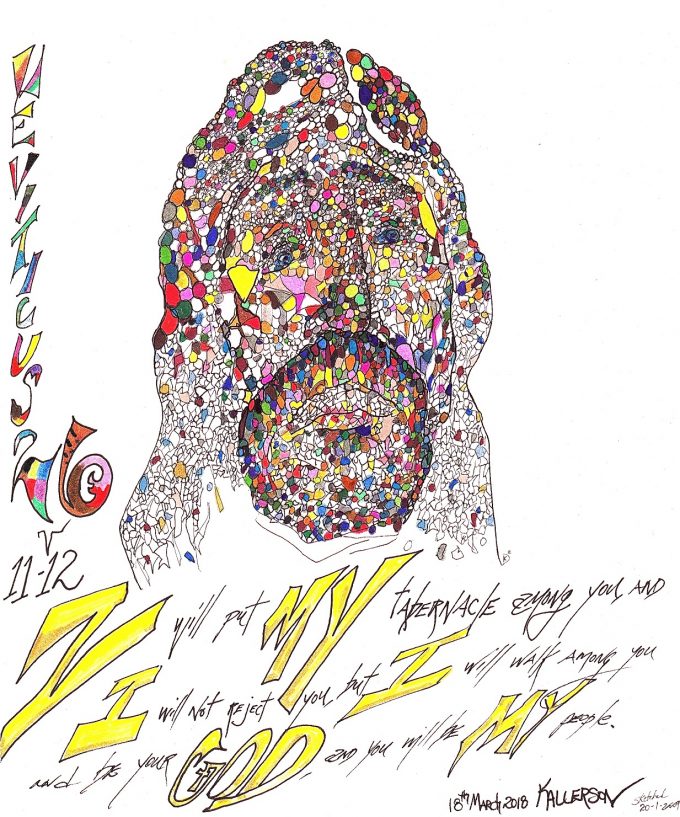
11 I will set My tabernacle among you,
Two promises are made in this verse. The first is that the Lord will set His mishkan, or tabernacle, among the people. This is the greatest promise of all, and it is one which gives the idea of reposing. He will dwell among the people. The Greek translation of this word is used in the New Testament when speaking of Jesus –
“And the Word became flesh, and did tabernacle among us, and we beheld his glory, glory as of an only begotten of a father, full of grace and truth.” John 1:14 (YLT)
The coming of Christ was to be the fulfillment of this for Israel, but they rejected Him. From there, Christ went to the Gentiles and has dwelt among them for 2000 years, dwelling in those who have called out to Him for salvation. The second promise is that…
11 (con’t) and My soul shall not abhor you.
The word gaal, or abhor, is introduced here. It is only used ten times in the Bible, but five of them are in this chapter. Four of those show an action by Israel, and a response by the Lord. If the people abhor His laws, He in turn will abhor them. The Lord, right at the beginning gave them the choice, and that choice is first given in the positive – “Obey Me, and I shall not abhor you.” Instead…
12 I will walk among you and be your God, and you shall be My people.
To abhor is to take that which is vile and cast it away. But the Lord promised Israel that if they obeyed His precepts, He would do just the opposite. He would set up His dwelling place among them, and He would walk among them and be their God. To walk with someone is to be in agreement with them. This is seen in Amos 3:3 where the question is asked, “Can two walk together, unless they are agreed?” The answer is, “No.”
The Lord did walk with Israel while they were obedient, and they were His people when this was true. However, in exile, the Lord was not among them, and they were separated from Him as His people. Instead, the promises given to Israel went to the Gentiles. In 2 Corinthians 6, we read this coming to pass –
For you are the temple of the living God. As God has said:
“I will dwell in them
And walk among them.
I will be their God,
And they shall be My people.”2 Corinthians 6:16
Paul cites Hosea with this same sentiment in Romans 9:25 to show that the Gentiles would replace Israel during their time of exile and punishment. However, Peter picks up on Paul’s words for the Jews of the end times, and he reapplies them to Israel saying that they were once “not a people, but are now the people of God, who had not obtained mercy but now have obtained mercy” (1 Peter 2:10). A time lies ahead when the favor of God will turn from Gentile to Jew once again. The rapture will occur, and then His eyes will be fully and entirely on completing His redemptive plans for them, and for the world at large.
13 I am the Lord your God, who brought you out of the land of Egypt, that you should not be their slaves;
The Lord has, on several occasions thus far, reminded Israel that He has brought them out of Egypt. They were brought from slavery to freedom, leaving a land of distress and heading to a land of peace and security. They had lived the former life and cried out in anguish because of it. Now they would be given a new direction and were admonished to take heed to the Lord’s word and live in that freedom; not return to bondage.
*13 (fin) I have broken the bands of your yoke and made you walk upright.
Here we have terminology which shows how highly oppressive life in Egypt was. The Lord uses a new term, motah, or bands, of a yoke to describe their previous plight. These were poles or rods which were laid upon the necks of animals as a type of yoke, or inserted into a yoke, to fasten their heads together to keep them level. In this, they would render the animal completely helpless to resist, and they would be incapable of straightening up.
The idea is that Israel was so oppressed with labor, that it was a yoke which bent their backs, and kept them from upright freedom of movement. The Lord had broken those yokes from the people, and this allowed them to walk in freedom. Our verses today finish with a word which is used only here in the Bible, qomemiyyuth, or upright. Where there was bondage, there was now to be freedom. Where there was affliction, there would now be blessing.
Israel has been given the choice, and the promises based on obedience are magnificent in the extreme. Unfortunately, as we see in the rest of Scripture, they failed to obey. Eventually, they went back under a yoke, and they have continued under it for millennia. But returning one more time to Ezekiel 34:27, we see that someday that will change –
“and they shall know that I am the Lord, when I have broken the bands of their yoke and delivered them from the hand of those who enslaved them.”
Their time of freedom lies ahead, and as always, these physical truths, which really occurred, have a greater spiritual meaning in Christ. Israel being brought out of Egypt pictures man’s being brought out from the power of sin and the devil. The yoke upon their necks is that which bound us. Some of us had afflictions of drugs, sex, or alcohol. Some have been addicted to work.
Anything we put above God is a source of idolatry, and it is a source of separation from God. But Christ can and does free us when we come to Him. He resolves the sin problem the moment He redeems us. From there, if we will allow Him to work in us, He resolves the other issues in our lives as well. The yoke is already broken, but too many of us continue to carry it.
And there is another yoke which many Christians continue to carry as well. It is the yoke of the law. Paul warns us to not get entangled again with a yoke of bondage, meaning the Law of Moses. Christ has fulfilled it, and thus He is the end of the law for all who believe. Instead, we are to put our faith, our trust, and our hope in the completed work of Christ.
Let us keep ourselves from falling back into sin, pictured by Egypt, which Christ has redeemed us from, and let us keep ourselves from falling back into bondage to the law which Christ has fulfilled for us. Instead, we are to now live our lives in holiness and in intimate fellowship with God, through Christ our Lord. If you have never been freed from the yokes of this world, today is the day, good friend. Call on Christ, and live in Him, for Him, and in anticipation of Him always.
Closing Verse: “ Come to Me, all you who labor and are heavy laden, and I will give you rest. 29 Take My yoke upon you and learn from Me, for I am gentle and lowly in heart, and you will find rest for your souls. 30 For My yoke is easy and My burden is light.” Matthew 11:28-30
Next Week: Leviticus 26:14-39 Surely worse than needle-poking nurses… (Assured Curses) (49th Leviticus Sermon)
The Lord has you exactly where He wants you. He has a good plan and purpose for you. Even if you have a lifetime of sin heaped up behind you, He can wash it away and purify you completely and wholly. So follow Him and trust Him and He will do marvelous things for you and through you.
Promised Blessings
‘You shall not make idols for yourselves
Not even of your favorite pup
Neither a carved image nor a sacred pillar
Shall you for yourselves rear up
Nor shall you set up an engraved stone in your land
To bow down to it
For I am the Lord your God
And so to you this rule I do submit
You shall keep My Sabbaths and reverence My sanctuary
I am the Lord; so shall it be
‘If you walk in My statutes and keep My commandments
———-and perform them
Then I will give you rain in its season, the right amount to suit
The land shall yield its produce
And the trees of the field shall yield their fruit
Your threshing shall last till the time of vintage
And the vintage till the time of sowing shall last
You shall eat your bread to the full
And dwell in your land safely, nor shall you be downcast
I will give peace in the land, and you shall lie down
And none will make you afraid, so understand
I will rid the land of evil beasts
And the sword will not go through your land
You will chase your enemies; so you shall do
And they shall fall by the sword before you
Five of you shall chase a hundred
And a hundred of you shall put ten thousand to flight
Your enemies shall fall by the sword before you
Such shall be your might
“For I will look on you favorably and make you fruitful
Multiply you and confirm My covenant with you
You shall eat the old harvest
And clear out the old because of the new
I will set My tabernacle among you
And My soul shall not abhor you
I will walk among you and be your God
And you shall be My people; to this word I will be true
I am the Lord your God
Who brought you out of the land of Egypt; that marvelous sight
That you should not be their slaves
I have broken the bands of your yoke and made you walk upright
Lord God, surely you have broken our yoke and set us free
And now You dwell in us and walk among us too
Such marvelous love! How can it be?
That we have received such blessing from You!
Thank You that You are our God because of Jesus
Thank You that we are now your people also
Such marvelous things You have done for us
Such gifts of love and mercy upon us You bestow
Hallelujah to You for Your kind and gracious hand upon us
Hallelujah to You, O God, for our King! Our glorious Lord Jesus!
Hallelujah and Amen…