Esther 1:1-12
Naughty Vashti
A Party Gone Bad
The book of Esther. Not having decided on what book we should do before returning to the Pentateuch, I asked my (our) friends Sergio and Rhoda to help me out. They never really gave me an answer until I had to know. Quite lazy of them I’m sure…
Friday before sermon typing is when I do the advanced work, such as typing poems and other non-sermon typing work. But one cannot type a poem for a book that they have not decided on. So I asked them that week. Sergio said, Esther; I wanted to do Song of Solomon. One had to give. Esther comes before the Song of Solomon, so at least they will have been done in the right order by choosing Esther. And so, I present to you the book of Esther.
Esther is the 17th of the 66 books in the Christian Bible. It thus corresponds to Malachi, the 39th book, and 2 Peter, the 61st book when the Bible is divided into three sets of 22 each. It is a part of the Old Testament known as the Ketuvim, or writings. The three major divisions are the Torah, meaning the five books of Moses, the Neviim, or the Prophets, and the Ketuvim, or the writings.
Esther is comprised of ten chapters and totals 167 verses.
Esther is also one of the five megillah scrolls. That comes from the word galal meaning “to roll,” and thus it is a story which is a detailed, or embroidered account; it rolls along. The five megillot are the Song of Songs, read each year at the Passover; Ruth, read each year at Shavuot; Lamentations, read each year on the mournful day of the Ninth of the month of Av; Ecclesiastes, read each year at Sukkoth; and Esther, which is read each year at Purim.
Esther was the last book of the Old Testament to have been canonized by the Jews, but it was canonized, and it was done so rightly. It is an important part of the canon of Scripture and also of Jewish history.
The writing of Esther dates to the 4th century BC, and the exact year will be given for the occurrences which it records. It is not sure who wrote the book, but it was probably not Mordecai, a main character of the story. The author distances himself from the person of Mordecai. However, several of the gospel writers do this as well, so it is not impossible that he authored it.
The purpose of the book is almost always cited as to bring to remembrance the people and events which brought about the feast of Purim for the Jews. Thus, it would be an anchor back to their history, and how they have remained a unified people.
A second, less-cited reason, but one which is made, is to show the conflict between the people of Israel and the Amalekites. This is certainly a highlight of the book – warring against and gaining victory over the enemies of the people. This will be explained when the main antagonist of the story, Haman, is introduced.
However, neither of these reasons is at all sufficient to describe the main purpose of the book. The book, and indeed all of the Bible, is not about the Jewish people. They are a main part of the subject matter, but the Bible is about the Lord – the Creator, the Sovereign, the Sustainer, the Protector of His people, the One who may not even be seen or acknowledged, and yet the One who is still there, working behind the scenes, to effect His purposes in redemptive history. In particular, the purpose of bringing to fruition His promise of a Redeemer – the true Subject of all of Scripture.
The people of Israel were the people through whom He would come, and therefore it was necessary to keep them as a people in order for Him to arrive. Further, promises were made to them that they would always be kept as a people, even after the arrival of the Messiah, and therefore, Esther shows the faithfulness of God to the stiff-necked and unfaithful group of people He had covenanted with.
Text Verse: “Therefore say to the house of Israel, ‘Thus says the Lord God: “I do not do this for your sake, O house of Israel, but for My holy name’s sake, which you have profaned among the nations wherever you went. 23 And I will sanctify My great name, which has been profaned among the nations, which you have profaned in their midst; and the nations shall know that I am the Lord,” says the Lord God, “when I am hallowed in you before their eyes.” Ezekiel 36:22, 23
It is kind of a depressing text verse for a sermon to start with, but it is the reality of what occurs in Esther. Ezekiel was specifically speaking about the second return from exile, meaning Israel’s return to the land in modern times. But the premise holds true for both exiles. Leviticus 26 explained what the Lord would do to the people if they failed to honor and obey Him. He did as He promised, especially the promise of exile.
It is the greatest tragedy of all of the curses for the Jewish people. They became a people without a land and without their God openly evident in their lives. The events in Esther actually occur after the return of the people to the land of Israel, but many Jews remained dispersed in the foreign lands willingly.
And so it is with the book of Esther that the Lord is not at all openly evident. He is never explicitly mentioned – as God or Lord. Other than fasting, which may not even have been to Him, there is no mention of prayer, worship, or sacrifice in the entire book. The people have all but left Him, and He has supposedly all but left them. And yet, the outcome of the book shows that to not be so.
Either extreme chance and happenstance directed the affairs, or the Lord was there, working behind the scenes to ensure things would come out as He covenanted with Israel. The truth of which is correct is obvious when searching the details of the book.
Deuteronomy 31 says that in disobedience, the Lord would hide his face from the people, and that many evils would befall them. He even repeats Himself saying, “And I will surely hide My face in that day because of all the evil which they have done, in that they have turned to other gods.” To hide His face means that they would not know He was there with them any longer. And thus it is in Esther. The Lord is hidden, they are not in their homeland, and they are about to face total annihilation.
But the Lord is there. Hidden, yes, but the Lord is there. Four times in the book of Esther the divine name, Yehovah, is secreted away in acrostics. Also, the name He proclaimed to Moses on Mount Sinai – EHYH or, I AM THAT I AM – is also hidden within the text. Though He has hidden His face from Israel, He has not hidden His face from His covenant with Israel. He is there, ensuring that all will turn out as it should.
In God, there is no lack, and for Israel who has forgotten the Lord, He has not forgotten them. His promise is to the people of the world. It is a promise of redemption, and restoration which goes back the very fall of man. Without Israel, Christ would not have come. Israel must stand, and Israel will stand. From them came Messiah, and to them Messiah will return. But it is not for Israel’s sake that these things have, and will, come about, but for the sake of the Lord’s holy name. This is the overarching purpose of the book of Esther – sanctifying the holy, and yet unseen name of the Lord. It’s all to be found in His superior word. And so let’s turn to that precious word once again and… May God speak to us through His word today and may His glorious name ever be praised.
I. A Feast of One Hundred and Eighty Days (verses 1-4)
Now it came to pass in the days of Ahasuerus
The book of Esther begins with the words v’hi bime Akhashverosh, or, “And it came to pass in the days of Ahasuerus.” Beginning a book with the word “and” might seem a bit unusual to our ears. It is as if we are reading and come to a new book and find it is merely a continuation of the same story we have been reading all along.
And for all intents and purposes it is. God is revealing to us a single story, unfolding it in a logical sequence which may or may not be chronological, but each section fits in a fashion as orderly as if it is chronological.
This same “and” begins the books of Exodus, Leviticus, Numbers, Joshua, Judges, Ruth, 1 and 2 Samuel, 1 and 2 Kings, 2 Chronicles, Ezra, Ezekiel, and Jonah. Beginning this way is certainly intended to show us an unraveling of a thought process which had already began elsewhere.
The name Akhashverosh, or as we transliterate it, Ahasuerus, is believed to come from the Persian Khshayarsha, signifying “mighty eye” or “mighty man.” The name here needs to be explained. The same name points to three different people in the Bible. One is found in Daniel 9:1, known as the father of Darius, and so he is identified as Cyaxares. Another is found in Ezra 4:6. He is identified as Cambyses, the son of Cyrus. The third is the person named here in Esther, believed to be Xerxes, a Greek name derived from the word Akhashverosh. Xerxes is believed to mean “warrior” or “hero among rulers.” Scholars do disagree on which Ahasuerus is being referred to, but Xerxes is generally accepted as correct. This is more probable because of…
1 (con’t) (this was the Ahasuerus who reigned over one hundred and twenty-seven provinces,
There is great specificity here in order to relay several things. The first is the greatness of the area over which Ahasuerus ruled. In this, it shows the magnitude of the danger in which the Jews would find themselves as a people in the coming narrative, and then also the greatness of the exaltation of the Jews because of the role of Esther and her cousin, the man Mordecai, both of whom will be introduced as we go on. The land he controls is inclusive of the land of Israel.
And secondly, the words are given to guide us to who the true Ahasuerus is. First, it says that he ruled over one hundred and twenty-seven provinces. Daniel 6:1 says that under Darius the Mede, there were one hundred and twenty satraps in the Persian empire. That could simply be a rounding down of the exact number, or it is that the empire expanded after that time. The latter is probably correct.
The word translated as “provinces” is medinah. It is derived from din, or “to judge.” This, in turn, comes from a root meaning to sail directly, in a straight course. Thus, one is to judge without deviating from what is proper. Herodotus writes that the nations of Xerxes were sixty, and so this is referring not to nations, but subdivisions of nations divided into provinces. In total, they equal one hundred and twenty seven. Thirdly…
1 (con’t) from India to Ethiopia),
Here it mentions Hodu, or India. The Hebrew Hodu is formed from the Persian Hidush, which speaks specifically of India. It was subdued by Darius Hystaspis, the father of Xerxes, and so Xerxes was inheritor of the rule of this province.
And then, finally, it mentions Kush or, Ethiopia. The name goes all the way back to Genesis 2:13 as a place identified with one of the four river heads which came from the river flowing from Eden. But that is only given to identify the name which later came from Kush, the son of Ham, noted in Genesis 10:6. Eventually, the name became associated with the people derived from this line who dwell in Ethiopia. The writings of Herodotus tell us that Kush, or Ethiopia, paid tribute to Xerxes.
The specificity of this first verse of Esther has been given to us to properly identify the right person named Ahasuerus here. It is Xerxes who most exactingly fits the details.
2 in those days
The words ba’yamim ha’hem, or “in days, the those,” signify a chronological explanation of the words of verse 1. Attention is being directed to this specific time of the reign of the Persian empire.
2 (con’t) when King Ahasuerus sat on the throne of his kingdom,
To sit on the throne of one’s kingdom means to rule. In this case, it indicates that he is ruling with full authority over the entire kingdom just named. To sit would normally imply peace, but Persian kings sat on a throne even when they went to battle. This is actually seen in the movie 300, where this same king fought against the 300 Spartans at Thermopylae.
At this point though, he had not only assumed the throne, but all areas under his authority would have been subdued. Otherwise, he would have sat on a throne in battle, not in the royal residence. But there he sat, on the throne of his kingdom…
2 (con’t) which was in Shushan the citadel,
The name Shushan is identical to the Hebrew word Shushan, meaning a lily. That, in turn, is derived from sus, meaning to exult or rejoice. In some Bibles, the name is translated as Susa, rather than Shushan. Aristotle apparently visited this city and called it “a wonderful royal palace, shining with gold, amber, and ivory.”
The word used to describe the citadel here is birah. It signifies a castle, but it probably includes the idea of a fortress. David uses the same word twice in 1 Chronicles 29 to describe the temple to be built for the Lord. The naming of the citadel Shushan then extends out to the naming of the entire city. This will be seen in Esther 3. This was the main royal palace of the Persian empire, but Ecbatana and Babylon were also residences of the Persian kings. This was Xerxes’ favorite palace, and the one he used during the winter and spring months. It was from this main royal citadel that the story now begins to come alive…
3 that in the third year of his reign
The words here belong as a continuation of verse 1. “Now it came to pass in the days of Ahasuerus … that in the third year of his reign.” With the identification of Xerxes being the king during this story, we can then identify the year that this is taking place as 483BC. In fact, this has been identified as the time when he had called his leaders to make arrangements for invading Greece. It is for this most important campaign that…
3 (con’t) he made a feast for all his officials and servants—
The feasts of the Persian kings were well-documented by those who participated. Some were said to have entertained as many as 15,000 subjects. The hall where this would have occurred is said to have been big enough for thousands to attend.
Here the word feast is mishteh. It isn’t a feast as “a feast of the Lord” in Leviticus 23. Rather, it is a feast where banqueting takes place. It comes from the word shatah, meaning “to drink.” In this case, it is speaking of a banqueting feast revolving around the drinking of wine and the like.
3 (con’t) the powers of Persia and Media, the nobles, and the princes of the provinces being before him—
The kingdom is one of both Persia and Media. The Hebrew for Media is the name Maday, who was first noted in Genesis 10:2. He was a son of Japheth, the oldest son of Noah. Within this kingdom of the powers of Persia and Media, a large group of people have been invited to participate in the feast.
The word translated as “powers” is khel. It signifies an army, and thus by extension, an entrenchment. Thus, the word “powers” looks to those people entrusted to maintain and safeguard the power of the empire. It probably included the military generals, as well as the royal bodyguards, and the like.
Along with them were included the elites, and the lower rulers of nations and provinces. One group of them here are called ha’partemim, or “the nobles.” It is a Persian word brought into the Hebrew which literally means “first.” It may be more info than you care to know, but the word is similar to the Greek word protos, and the Latin word primus, which we are all aware of. They are etymologically similar to this Persian word as all three cultures descended from the same son of Noah, Japheth.
4 when he showed the riches of his glorious kingdom and the splendor of his excellent majesty
There are a lot of superlatives used here to describe the scene – riches, glory, kingdom, splendor, excellence, majesty. Each is a noun in the Hebrew, one being heaped upon the next to show how great the scene was. One word is a new one in the Bible, yeqar – translated here as “splendor.” It will be used 17 times, but for the author of Esther, it is a favorite, being used 10 times in this small book. It comes from a verb meaning “precious,” and so it signifies wealth, but abstractly, it gives the sense of honor, costliness, dignity, and so on. All of this pomp was on display for, and lavished upon, the nobles of the land, and it went on and on…
4 (con’t) for many days, one hundred and eighty days in all.
yamim rabim – “days in abundance.” As it would be unlikely that he would have all of his nobles present at one time, except maybe at an opening and closing of the feast, he extended it so that all could come, party, enjoy, and certainly give their thoughts on the conquest of Greece. It was a party united to conduct a war-planning session. During this time, troops would have been arranged, plans would have been made, resources from the provinces would have been mandated and allocated, ships would have been prepared, and so on. All of this is in accord with Daniel’s prophecy of this coming great king named Xerxes, even pinpointing the reason for such a banquet in his prophecy in Daniel 11:2 –
“And now I will tell you the truth: Behold, three more kings will arise in Persia, and the fourth shall be far richer than them all; by his strength, through his riches, he shall stir up all against the realm of Greece.”
The riches of the King and of his kingdom
Are on display for all to see
And for those who are invited to come
A grand banquet for them there shall be
Those from near, and those from far away
All who are invited are instructed to come
The banquet is set, and it is a marvelous day
As arrive the subjects of the kingdom
To stand in the presence of the King!
What a thing to believe; what a thing to see
An honor that truly makes the heart sing
Yes, a grand banquet for the people there shall be
II. A Feast of Seven Days (verses 5-9)
5 And when these days were completed, the king made a feast lasting seven days for all the people who were present in Shushan the citadel, from great to small, in the court of the garden of the king’s palace.
After the one hundred and eighty days of feasting for the nobles, a feasting which was intended to prepare for the coming war with Greece, a larger feast of a week’s duration was then given for all of the citadel. This is defined as for the men of the realm in verse 9, but it included all, from the greatest to the least.
One might ask why he would do this, but if the previous feast was as a time of planning for war, now the plans have been made. In the military, planning is made by the higher ups, but eventually everyone is included in what has been decided. The king was probably so satisfied with the prospects of a successful engagement, that he held a feast to honor the battle to come, including everyone who would be affected by a win or a loss.
The word bitan, or “palace,” in this verse is not the same as “citadel” in verse 2. It is a rare word, found only three times in the book of Esther. It comes from the Hebrew word for “house,” and so it is actually at the residence of the king, and in his royal garden, that this feast took place. Hence, the amazing details of this royal palace are next given…
6 There were white and blue linen curtains fastened with cords of fine linen and purple on silver rods and marble pillars;
The scene being described here is one of outdoor garden luxury. There would have been hangings above and along the open areas, especially of the royal colors of Persia – white and blue. The blue was, however, more especially a violet. The word translated as “linen” for the curtains here, karpas, was incorrectly translated by earlier versions as “green.” It is from a Persian word, found only here in Scripture, indicating fine linen. So if you have “green” there, make a note. These curtains would have been fastened to pillars of silver in bases of marble by beautifully dyed cords.
6 (con’t) and the couches were of gold and silver
It is debated whether these couches were made of gold and silver, or if they were covered with cushions and cloths of gold and silver embroidered into them. Both are possible, and records of antiquity speak of couches with frameworks of gold and silver work.
6 (con’t) on a mosaic pavement of alabaster, turquoise, and white and black marble.
Three of the words used in this portion of the verse are found only here in the whole Bible. Thus translations will vary widely as to what the colors and stones actually are. Being dogmatic might not be the best option, as the words are simply obscure. The final one translated as “black marble” is the word sochereth. It may be from socherah, meaning bulwark, and thus it would be a border pavement. Regardless of the meanings, the beauty of the garden was certainly stunning.
7 And they served drinks in golden vessels,
Considering the size of the gathering, the wealth relayed here is astonishing. All of the cups for drinking were of gold. With the great attention on drinking here, and in other verses of the book, the term “banquet” is probably better than the word “feast.” Wine is the prominent item on display rather than the food. And the wine is highlighted by the drinking vessels, and of special note…
7 (con’t) each vessel being different from the other,
The banquet was a form of artwork. The curtains, pillars, and pavement were extravagant, but so were the vessels. No two were made alike in order to excite the eyes and bring a note of delight to the conversations which would arise. Everything was considered unique and magnificent due to its originality.
7 (con’t) with royal wine in abundance,
As the king had access to every wine from India to Ethiopia, the storehouse would have been full, and it would have been immensely varied in type and potency. For the wine connoisseur of the time, it would be more exciting than a trip through the finest wine store. And surely nothing one enjoyed would be in limited supply because it was…
7 (con’t) according to the generosity of the king.
ke’yad ha’melekh – “according to the hand of the king.” The hand is what bestows. When a person holds something out with their hand, it is an indication of their generosity. If he holds out an immense or valuable amount, it is according to his wealth. Thus, “according to the hand of the king” means that his great riches and generosity to his subjects was being placed in prominent display.
Before we continue, verse 7 has an interesting acrostic in it. In the words v’kelim mi’kelim shonim v’yen malkut rav ke’yad ha’melek, or “and vessels from vessels diverse, with wine royal, in abundance according to the hand of the king,” the first letter of each word backwards reads, “And his name is ‘the Vine.’” It is at first interesting because the verse deals with wine, and more, Jesus proclaimed, “I am the Vine” in John 15:5. It is surely a reference then to Jesus, the Lord, being the one to watch over the events of the produce of the vine, meaning wine, which will then affect the outcome of what transpires during this banquet. In the Bible, wine symbolizes the merging together of expressions into a result. The thing that ought to happen can happen, symbolized by wine.
8 In accordance with the law, the drinking was not compulsory;
The word translated as “law” is found 21 times in the Bible, with 20 of them in Esther. The only other time is in Ezra, still speaking of the edict of a Persian. It is a foreign word which indicates that the law was enacted just for this feast. The king had given special orders that anyone could drink as they saw fit, and without compulsion. It is then at complete variance with the tradition of the Greeks who had the motto: “Drink or begone.”
8 (con’t) for so the king had ordered all the officers of his household, that they should do according to each man’s pleasure.
In this, the king is showing exceptional care for his subjects. In essence, he is elevating each man’s choice of drinking to the level of anyone else. As it said earlier, “from the greatest to the least.” No boss would dare counter the king’s edict, and so those under him were able to drink more than him, or less than him, without fear of punishment. This goes with all stations and all men. It brought the people to an equality that would not exist at any other time, and it would have been a great motivator of them to love the king and to be willing to honor him all the more with their work and their lives.
9 Queen Vashti
The wife of Xerxes was a woman named by the Greeks as Amestris. Herodotus and others say that she was cruel and led a dissolute life. There is much speculation about whether this is Vashti or not. Maybe it is his later wife, Esther. If Vashti, it may be that Vashti is more of a nickname than her true name. This is possible based on its meaning.
This Vashti is the only woman in the Bible with a name starting with “V.” There is an obvious reason for this. First, she is the only Vashti in the Bible, and she will only be mentioned ten times. Secondly, Hebrew technically does not have a V. The V sound is used, such as in the name Avraham, or the desert known as the Arava, but this is simply a B that is pronounced as a V.
This is no different than our C being pronounced as a K
Everything is OK
When it happens this way
There’s really nothing to C
Her name is Persian, and it means in Old Persian, “The Best.” In more modern Persian, it would be “Beautiful Woman.” However, the name when transliterated into Hebrew carries a meaning all its own, a rather stunning pun in fact. First, to spell it, it must be initiated with the letter vav. Vav at the beginning of a word or sentence normally means “and.” However, it can also “introduce a circumstantial clause” (HAW). Nehemiah 2:2 does this when the king asked Nehemiah why his face was sad, where it says, v’attah enekha holeh – “since you are not sick.”
Taking the name Vashti, and dropping this vav, then leaves the word sheti, meaning “a drinking.” That word is found only once in the Bible, in Ecclesiastes 10:17 where it mentions “drunkenness.” By reading the vav where it should be in front of this word to spell the name Vashti, you then have the conditional statement, “When Drinking” What is implied is, “That’s what you get!” (Abarim). Remember that as we watch her seal her own fate, but it is the king who also suffers, as will later be seen. In other words, “This is what happens when someone drinks too much.”
9 (con’t) also made a feast for the women in the royal palace which belonged to King Ahasuerus.
It was custom of the Persians that the feasts of men and women would be kept separate, and so Vashti made her own banquet for the women at the royal house. The word beit, or house, used here is one different from both verse 2 and verse 5, although it is similar to that found in verse 5. Interestingly, the words in Hebrew, beit ha’malkut asher la’melek, or “house royal which belongs to king” forms a backward acrostic l’ahav, or “to love.” How that will play into the story is yet to be seen.
A palace garden, filled with delight
Beautiful stones and curtains to grace the eyes
Everything makes such a beautiful sight
To walk in the garden is its own special prize
Cups of gold, each marvelous and unique
It adds to the joy of the wine within
A banquet of wonder to last an entire week
It will be over almost before it does begin
And wine to enjoy, any amount desired will do
A wonderful banquet fit for a king
We shall enjoy the feast, through and through
Such a marvelous time; it makes the heart sing
III. The Fury of the King, or “Naughty Vashti” (verses 10-12)
10 On the seventh day, when the heart of the king was merry with wine,
This is the ending of the special banquet for the people. The king was doing well from his seven days of drinking wine, and decided that the best thing to do to close out the feast would be to elate the hearts of the men even beyond what wine could do, and so…
10 (con’t) he commanded Mehuman, Biztha, Harbona, Bigtha, Abagtha, Zethar, and Carcas, seven eunuchs who served in the presence of King Ahasuerus,
Sets of two’s occurring in Esther are rather common. This is the first of them. There are two sets of seven names of the king’s servants. The second set of seven names will be seen in verse 1:14. As we go through the book, I will try to remember to give you the other sets of twos that are included. Two’s in the Bible signify a contrast and yet a confirmation of something. These contrast as they are seven lowly eunuchs and then seven high nobles, but they confirm the orders of the king in regards to Queen Vashti.
With the exception of Harbona, the names of these seven eunuchs are all mentioned only this once in the Bible. They are all Persian names, and unfortunately, it is total speculation as to what they mean. If there is a secret code in their meaning, it will remain that way. One may force meaning into them in order to find something secret, but it will not be what the Bible intends for us to see.
The number seven, like with the Hebrews, was a sacred number to the Persians of old. It is the seventh day, there are seven eunuchs, and verse 10 is comprised of 21 words, or seven times three. That’s about the most I can give you concerning the number 7 in verse 10. What I can tell you, is that these seven eunuchs are selected to go to the queen on a mission…
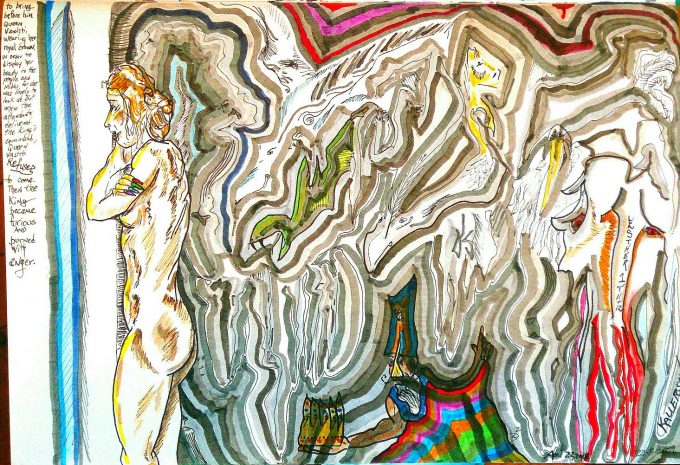
11 to bring Queen Vashti before the king, wearing her royal crown,
One eunuch was sufficient to accomplish the task unless it was an unusual task. We cannot read too much into this, but the king is merry with wine, and the command is rather odd – “bring Queen Vashti before the king in her royal crown.” The crown here is a unique word, kether. It will be seen three times in Esther, and not again in the Bible. It comes from the word kathar, meaning “to surround,” and thus it is a circlet. It would encircle her head as a beautiful highlight.
Albert Barnes says, “This command, though contrary to Persian customs, is not out of harmony with the character of Xerxes; and is evidently related as something strange and unusual. Otherwise, the queen would not have refused to come.”
The targums may explain the matter. They include the word “naked.” In other words, the king is tipsy, he is now at the end of a week of feasting, and he wants to end it in a way that the people would never forget, and thus he sends seven eunuchs as a protective measure because it is possible that the crown is all she was to wear. This would certainly be justification for Vashti’s response, and the following words make it a possibility…
11 (con’t) in order to show her beauty to the people and the officials, for she was beautiful to behold.
The king intended to show off her beauty. This is something she could do with all of her clothing on, and it is something that queens are famous for. And so unless she was being placed in a truly distressing situation, it makes little sense. Albert Barnes is right, something strange and unusual seems tied to the request. Additionally, the word “people” is plural. It would be an indication that there were people of all different races and cultures in attendance. This would make the request even more appalling, if this is what is being conveyed. It isn’t worth arguing over, but verses 10-12 each have their own subtleties that do point to this.
12 But Queen Vashti refused to come at the king’s command brought by his eunuchs;
The queen, for whatever reason, from innocently not wanting to be around a room full of wined-up men of different cultures and positions, to not wanting to be highly embarrassed in front of the same, refuses the command of the king. This is something that was far more serious than almost anything else that she could do. Her very life could be forfeit, and it shows that the request must have had something more than that which is explicitly stated.
Many scholars say that it was the custom of the time to keep women, and especially queens, from the view of other men. That is not at all borne out by either Scripture in general or the book of Esther in particular. Rather, Vashti’s refusal came from something which would have placed her in a truly undignified position. If the targums are correct, she has done the right thing. If not, then what comes upon her will be justly deserved. Either way…
*12 (fin) therefore the king was furious, and his anger burned within him.
This brings in another set of two’s. Here the king’s anger burns against Vashti. In verse 7:7, the king’s anger will burn against Haman. They contrast, one is to a woman, the other is to a man, but they confirm royal authority. One will lead to a new wife for the king, a Jewess, and the other will lead to a new second-ruler for the kingdom, a Jew. Of the anger of the king, Proverbs 16:13 says –
“As messengers of death is the king’s wrath,
But a wise man will appease it.”
Such is true here. It will take the wise counsel of others to resolve the situation, and also to save the queen’s life. For now, all we can do is wait and see what will transpire in the pages ahead. But the story begins as it does for a reason. It is to show how certain circumstances will lead, one to another, to bring about an end which is completely unsuspected at the beginning.
This is often how the Lord works in us, if we just pay attention to how things come out. We can look back on all of the mistakes and stupid decisions we’ve made, and yet, they seem to lead to the most marvelous events of our life. We can look back and say, “If I didn’t do that, I would never have met such and so.” Or maybe, “If that terrible day didn’t happen, I never would have gotten that promotion.”
For those who don’t know the Lord, it all seems like random chance and accidental luck or misfortune. But when God is put into the equation, we see that with everything that happens – good or bad – it suddenly comes out as it does for a reason. This will be one of the major themes of Esther, and it is a major theme of everyone before meeting the Lord. We don’t even consider that He’s there, but He is. How much more then should we realize that now that we know Him personally!
If your week was tough, know that it had a purpose. If your week ahead is tough, know that it will serve a purpose. In the end, the Lord is in the background tending to you with care that you can’t even fathom. That is even true for those who haven’t called on Jesus, but who are destined to do so. Who knows, maybe you don’t know the Lord, but you decided to hear this sermon because you were curious about the book. I’ll do my best to instruct you on the book, but it is the Lord you should be seeking. If you haven’t accepted God’s offer of peace though Christ Jesus, let today be the day. And then you will understand not just why you came to this sermon, but why everything in your life has happened as it has. I assure you, the Lord will reveal it all to you in due time.
Closing Verse: “Wine is a mocker,
Strong drink is a brawler,
And whoever is led astray by it is not wise.”Proverbs 20:1
Next Week: Esther 1:13-22 You’d better do as he says if you are his spouse… (Master of the House) (2nd Esther Sermon)
The Lord has you exactly where He wants you. He has a good plan and purpose for you. At times, you might feel as if he has no great design for you in life, but he has brought you to this moment to reveal His glory in and through you. So follow Him and trust Him and He will do marvelous things for you and through you.
A Party Gone Bad
Now it came to pass in the days of Ahasuerus
(This was the Ahasuerus who reigned
Over one hundred and twenty-seven provinces
From India to Ethiopia), as the Bible has explained
In those days when King Ahasuerus
Sat on his kingdom’s throne
Which was in Shushan the citadel
As the Bible to us makes known
That in the third year of his reign
He made a feast for all his officials and servants too
The powers of Persia and Media
The nobles, and the princes of the provinces being before him
———-so he did do
When he showed the riches of his glorious kingdom
And the splendor of his excellent majesty
For many days
Yes, days in all one hundred and eighty
And when these days were completed
The king made a feast lasting seven days
For all the people who were present
In Shushan the citadel, a feast surely to amaze
From great to small, so we are told this thing
In the court of the garden of the palace of the king
There were white and blue linen curtains
Fastened with cords of fine linen also
And purple on silver rods and marble pillars
And the couches were of gold and silver, as we now know
On a mosaic pavement of alabaster; turquoise also
And white and black marble; really quite a show
And they served drinks in golden vessels
Each vessel being different from the other
———-a most impressive thing
With royal wine in abundance
According to the generosity of the king
In accordance with the law
The drinking was not compulsory
For so the king had ordered all the officers
Of his household, that such was how it should be
That they should do according to each man’s pleasure
And serve freely, without measure
Queen Vashti also made a feast
For the women in the royal palace
Yes, in that royal place
Which belonged to King Ahasuerus
On the seventh day
When the heart of the king was merry with wine, he commanded
Mehuman, Biztha, Harbona, Bigtha, Abagtha, Zethar, and Carcas
Seven eunuchs who served in the presence of King Ahasuerus
———-so the kind demanded
To bring Queen Vashti before the king
Wearing her royal crown
In order to show her beauty to the people and the officials
For she was beautiful to behold; she could really knock ‘em down
But Queen Vashti refused to come
At the king’s command to be brought by the eunuchs of the king
Therefore the king was furious
And his anger burned within him, because Vashti refused this thing
Lord God, thank You for Your presence that is with us
Even when we don’t realize that You are there
Because You sent Your own Son Jesus
We can know that You truly do care
And so Lord, be real to us in a wonderful new way
Open our minds and our hearts to seeing You always
Through every step we take, and throughout every day
Be real to us, O God, and to You will shall give all of our praise
Hallelujah and Amen…
Now it came to pass in the days of Ahasuerus (this was the Ahasuerus who reigned over one hundred and twenty-seven provinces, from India to Ethiopia), 2 in those days when King Ahasuerus sat on the throne of his kingdom, which was in Shushan the citadel, 3 that in the third year of his reign he made a feast for all his officials and servants—the powers of Persia and Media, the nobles, and the princes of the provinces being before him— 4 when he showed the riches of his glorious kingdom and the splendor of his excellent majesty for many days, one hundred and eighty days in all.
5 And when these days were completed, the king made a feast lasting seven days for all the people who were present in Shushan the citadel, from great to small, in the court of the garden of the king’s palace. 6 There were white and blue linen curtains fastened with cords of fine linen and purple on silver rods and marble pillars; and the couches wereof gold and silver on a mosaic pavement of alabaster, turquoise, and white and black marble. 7 And they served drinks in golden vessels, each vessel being different from the other, with royal wine in abundance, according to the generosity of the king. 8 In accordance with the law, the drinking was not compulsory; for so the king had ordered all the officers of his household, that they should do according to each man’s pleasure.
9 Queen Vashti also made a feast for the women in the royal palace which belonged to King Ahasuerus.
10 On the seventh day, when the heart of the king was merry with wine, he commanded Mehuman, Biztha, Harbona, Bigtha, Abagtha, Zethar, and Carcas, seven eunuchs who served in the presence of King Ahasuerus, 11 to bring Queen Vashti before the king, wearing her royal crown, in order to show her beauty to the people and the officials, for she was beautiful to behold. 12 But Queen Vashti refused to come at the king’s command brought by his eunuchs; therefore the king was furious, and his anger burned within him.