Esther 6:1-14
The Man Whom the King Delights to Honor
By the end of the verses today, Mordecai is probably the most confused man on the planet. He and his people have been set for destruction, and yet, his mortal enemy has come to him with a royal robe, and the king’s horse, and after placing the robe on him and placing him on the king’s horse, he has conducted him through the city square honoring him as a town crier would – “Thus shall it be done to the man whom the king delights to honor.”
As soon as that was over, the robe was removed, the horse was led back to the royal stalls, and he went back to sit at the king’s gate as if nothing ever happened. His people are still set for destruction, and yet the king honored him. It’s hard to see how the king delighted to honor him while reveling in destroying him.
And many of us often feel the same way, or the opposite way, about the Lord, depending on our circumstances. We hear about the end which is anticipated, but we have frustrating events which inhibit our ability to be happy in the meantime. Why, if God wants us to have a good end, do we have such difficulties on the way there? Maybe we are just looking at things the wrong way. Yes, pain is real, trials are real, loss or conflict really affects us, but is that what we should be focusing on?
Text Verse: “For our light affliction, which is but for a moment, is working for us a far more exceeding and eternal weight of glory, 18 while we do not look at the things which are seen, but at the things which are not seen. For the things which are seen are temporary, but the things which are not seen are eternal.” 2 Corinthians 4:17, 18
The day before I typed this sermon was a Sunday. Sunday’s are long, tiring, busy days. They are – from the moment I get up, until right before bed – filled with activity, some of which is exceedingly stressful, especially the video work for the updates and sermons. It is complicated, tedious work which requires complete attention and no distractions.
However, 15 April was not such a day. It was very, very windy and raining. This meant the dogs were not happy about going outside to do what dogs must do. It was rather hectic. “No hectic please, I am working on videos.” While still working on the update video, Hideko came up to me and said, “The hot water heater is leaking.” She said it with no urgency at all.
My thought, “It is dripping at a fitting, and I will tighten it when I get a chance. Maybe tomorrow.” After an hour or two, while working on the sermon, she came and said, “The hot water heater is really leaking now.” Well, that can’t be a fitting, unless it has been unscrewing itself.
Up and to the garage. Yes, it was leaking. The garage was flooded, and the sermon wasn’t getting edited. First to turn off the water, which wasn’t possible as there was no shut off valve. What idiot put in the hot water heater without a shutoff valve? Don’t answer that Charlie. Things took a while to get cleaned up, and the water was shut off at the meter. By now, I was questioning. But when I dumped out my old box of PVC parts, I realized that I could seal everything off with no problem at all. I had just what I needed.
Questioning turned into praise. Thank You Lord! I don’t need to go to the store, the sermon work will get done, dinner will be eaten, bed will be waiting. I could wait until Wednesday or Friday to put in a new hot water heater (with a shut-off valve this time!) and because dad had left for a few days on vacation, Hideko could still take a hot shower at his house. All worked out well.
Despite the troubles, if we can look for the good, it is enough to set our minds on a different, happier path. And more, if we can look as to why the troubles came about, and fit them into the bigger picture, then we can really place it all in the Lord’s hands without care or concern.
This is the kind of thing we can learn from Esther. Mordecai had temporary difficulties which seemed overwhelming, but when things turned around, he was able to look back on the troubles and fit them into a much larger picture of redemption and safety for his people. Though the book never gives the Lord the credit for these things, meaning Mordecai’s acknowledgment of Him, we can hope that he saw things in that light. Even if he didn’t, we certainly can. And we should. Each step of the story leads us to that much fuller understanding of the Lord’s tender care for Israel, and for us. This a truth which is to be found in His superior word. And so let’s turn to that precious word once again and… May God speak to us through His word today and may His glorious name ever be praised.
I. A Sleepless Night (verses 1-6)
That night the king could not sleep.
The Hebrew words here are more descriptive – “In night the that fled sleep from the king.” It is purposefully showing us that the same specific night that Esther had brought him for the banquet, and then petitioned for a second banquet the next day, is when the king’s sleep fled away.
What is important to understand is that the king’s mind is consumed with Esther’s petition. It is the only thing in the narrative that is recorded which could bring him to this state. It shows that he really is concerned about what she desires to reveal. The fact that she was willing to risk her life in coming to him unannounced demonstrated that it was a matter of the highest urgency and importance.
It is this which caused his sleep to fly away. There are nights when we can’t sleep, and then there are nights when sleep flies away from us. The mind races, and the thoughts which consume the minutes away then lead to hours of turning. The chances of the mind slowing down are zero, and so there is nothing to do but either have the mind race while laying there, or find something to do to whittle away the remaining hours…
1(con’t) So one was commanded to bring the book of the records of the chronicles;
The English here is fine, whereas the Hebrew is a little more lengthy. It says, “and spoke to bring book the memorials, words the days.” The king knows that he will be unable to sleep, and so he decided to get a little work done. It is evident that he was a little behind on it too, because when he asks for the book, it is thumbed back to an earlier point. He isn’t simply being read the events of the day, but is maybe catching up on events since his last sleepless night. It’s speculation of course, but this is what one would do. Like reading a book, we will go to where the bookmark is and start reading once again. The result of this reading tends to show this is probably the case. He would listen until the sound of the words overwhelmed him and he fell back to sleep. From there, the bookmark would be replaced, awaiting his next sleepless night.
1 (con’t) and they were read before the king.
Some ancient commentators report that some of the kings of this time were illiterate. That may be true, but being king means that he had no need to read on his own. He could have someone do it for him. If compiled in a narrative or poetic form, such as has been seen in ancient records, the reading would be interesting, and it would calm his already-racing mind. Depending on the reader, it could also bring him to drowsiness.
2 And it was found written that Mordecai had told of Bigthana and Teresh, two of the king’s eunuchs, the doorkeepers who had sought to lay hands on King Ahasuerus.
The events referred to now are recorded in Esther 2:23 which is summed up with the words, “and it was written in the book of the chronicles in the presence of the king.” The only difference here is that the name Bigthan of verse 2:23 is changed to Bigthana here.
The timing of the events now occurring clearly shows the presence of the Lord. The king’s sleep fled away, the book of the chronicles was brought to him, and yet this reading contains the events concerning Mordecai, and Haman is expected to ask for Mordecai to be hanged on the next day. And more, Esther has a second banquet scheduled for the king and Haman in order to reveal what she did not reveal in the first meeting… On and on, the little details evolve into one grand theme – “The Lord is there, and He is directing the events for a determined outcome.”
This verse finishes a set of two’s. Here the words of the deeds of Bigthan and Teresh, the doorkeepers of Ahasuerus, are reported by Mordecai. The same words – Mordecai, Bigthan, Teresh, doorkeepers, and Ahasuerus – are all repeated in verse 2:21. The two accounts differ as one was recorded as it occurred, and one has been recorded concerning what occurred, but they confirm that what has occurred is crucial to the unfolding events in the lives of all concerned.
3 Then the king said, “What honor or dignity has been bestowed on Mordecai for this?”
The king has certainly not forgotten the deed of Mordecai. However, it was a reward for the deed that concerns him at this point. It is noted by Herodotus (Herod. viii. 85, 90) that in Persia there was a special list which was compiled and maintained of those who had done some special service for the king. It was considered a duty to acknowledge them for such things, and it would practically be a legal right for something noteworthy to be so conferred. The lack of any reward may have been that it was forgotten due to the development of other busy duties in the king’s life, or it could be that the court simply didn’t pursue reminding the king because Mordecai was a Jew. Whatever the reason, their response came back to the ears of the king…
3 (con’t) And the king’s servants who attended him said, “Nothing has been done for him.”
They would be the ones to know. As recorders of the chronicles, they would be responsible for knowing where such an act was recorded, and the exact details of what was done. Their response shows that the matter of recompense had not yet been completed. What is evident is that the king either decided to have the books read after much of a long sleepless night, or he had them read to him for many hours through the night. Probably the latter. Several scholars note that the Hebrew of verse 1 denotes that a lengthy period of reading is implied. Either way, morning arrived while the books were still being read…
4 So the king said, “Who is in the court?”
From the question, one can assume that there would always be attendants in the court. Or at least this would be the case for anytime the king was awake. As the king wanted something read to him, then the scribe would have been awoken to read to him. As the two were in the palace awake, others would stand ready to meet whatever request may be made.
It’s obvious from the previous verse that the king is looking to rectify the oversight of honoring Mordecai. It is on his mind, it is a new day, and whatever adviser or attendant was in the court could be inquired of, or directed, to attend to the matter. The circumstances which follow are more than ironic, but almost comical in how they play out. Man has a sense of humor, and man possesses nothing which God does not possess or understand. And so what follows, along with the exacting timing of all of the events, shows us that the Lord directed them for the sake of irony as much as anything else.
4 (con’t) Now Haman had just entered the outer court of the king’s palace
One can sense the urgency of Haman’s arrival at the palace. It is still early in the morning, and yet he has excitedly gone to the palace with all alacrity to have his plan executed at the earliest possible moment. He probably didn’t sleep any more than the king did, tossing and turning at the delightful thought of fulfilling his plan of the previous evening, which was…
4 (con’t) to suggest that the king hang Mordecai on the gallows that he had prepared for him.
An unused gallows is a pointless gallows. The thing had been prepared, and Mordecai wasn’t on it. All Haman needed was the king’s approval, and that would be quickly rectified. One can almost sense the eager anticipation which flowed through Haman’s pulsing veins.
5 The king’s servants said to him, “Haman is there, standing in the court.”
The NKJV unfortunately omits translating the word hineh, or “behold.” It more literally says, “Behold, Haman stands in the court.” Even though there were certainly other officers present, it seems that it was an unexpected surprise that Haman would be there at this time. Being the one who was granted the king’s signet ring back in Chapter 3, it seems that the timing of his coming was quite propitious. He would certainly be well-suited to attending to such an important duty of kingly matters. The irony increases…
5 (con’t) And the king said, “Let him come in.”
Both men are, at this time, intimately interested in this single Jew. One desires to have him honored in order to fulfill a royal responsibility for having saved the king’s life. One desired to have him executed to fulfill a personal vendetta which had become a kingly responsibility because of the edict concerning all the Jews. The irony is so heavy that it lays upon the royal court like a blanket of morning dew.
6 So Haman came in, and the king asked him,
Though Haman is there to make his petition, he must defer to the king first, responding to any need or question. Only after this, could he then make his request. Had he come at any other time and sought the king’s attention, he would have been the one to speak his desires first. “King Ahasuerus, Haman is seeking your presence.” “Send him in.” “Hey Haman, what’s on your mind.” The timing here is literally brought to the difference between one sentence – either initiated by the king, or initiated by Haman. The entire story pivots on the king’s question in this one verse.
6 (con’t) “What shall be done for the man whom the king delights to honor?”
It is Mordecai who is on the king’s mind. If the king had said, “Why are you up so early, what can I do for you there old boy?” the entire course of events may have taken a different turn. But the matter of Mordecai is preeminent on his mind, and therefore, pleasantries are dispensed with. The king feels a debt has been unfortunately left unpaid, and it must be dealt with first. The question is asked in a manner which seeks impartiality. No name is given, no circumstances are detailed. It could be for something small to something exceedingly great. However, it is really early in the morning, the royal chronicles are laid out with someone reading them, and the king is asking a question, probably based on them. Haman not knowing this considers the question, possibly in light of his having “saved” the empire by recommending the removal of the Jews. Of course! That must be it…
What honor has been bestowed upon this One?
What has been granted for His noble deed?
Surely something must have been done
But if not, we must correct that, and do so with speed
How can He be repaid for the thing He has done?
What He did was a noble thing indeed
We need to faithfully reward this One
What would bless him? What does he need?
What shall be done for the Man who has helped the King
Tell me if you can suggest anything that will do
What will to Him happiness bring
This is what I am asking of you
II. The Dog and His Bone (verses 6-9)
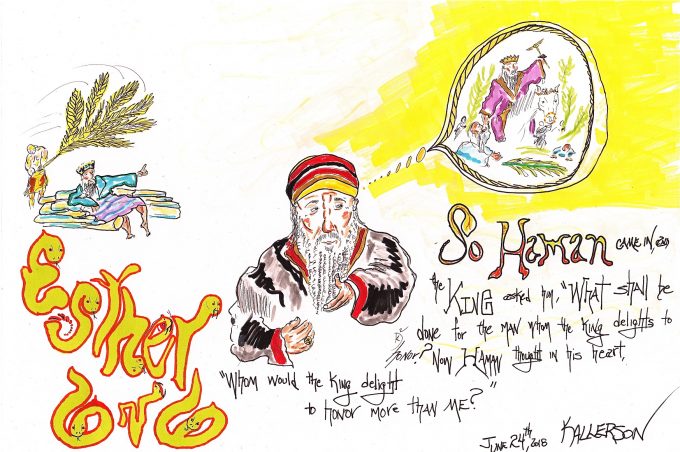
6 (con’t) Now Haman thought in his heart, “Whom would the king delight to honor more than me?”
Well of course! He is called into the king’s presence without having first requested an audience. He had been the brilliant architect behind the removal of the Jews. He was the only one invited to Esther’s banquet yesterday, and he was the only one who was invited for the second banquet later on this same day. His skill of leadership, obviously noted even by the queen, meant that the king’s high approval of him is what was on the king’s mind. With this obviously his thoughts, he suggests something truly fitting for himself, the great and awesome Haman…
7 And Haman answered the king, “For the man whom the king delights to honor,
If anyone else was on Haman’s mind as being a possibility to honor, he would have skipped these words entirely. However, he is thinking only of himself as the candidate for the honor to be presented, and so by repeating the words of the king, he is adding honor on top of honor. However, it simply says, “The man whom the king delights to honor.” The word “for” is inserted for supposed clarity, but it is unnecessary. The broken nature of the sentence shows the excitement in Haman’s response.
Q: “What shall be done for the man whom the king delights to honor?” A: The man whom the kings delights to honor… well let me tell you!”
8 let a royal robe be brought which the king has worn,
It is noted that wearing a kingly robe would be a breach of Persian law, but the king might allow it at his command. As it is a robe the king had worn, it is signifying a special robe, not necessarily the regular garments which he would wear from day to day. Here Haman is looking for the highest form of recognition, showing the king’s absolute favor of the individual by granting one of his own special robes to be placed upon the favored subject. This is similar to the bestowal of the garments by Pharaoh upon Joseph in Genesis 41, and the granting of Jonathan’s garment to David in 1 Samuel 18. It is also foreshadows the laying of kingly attire upon Christ as is seen in the gospels.
8 (con’t) and a horse on which the king has ridden,
A royal horse carries much the same symbolism of wearing a royal robe. It would be evident to all that the one being carried was truly highly honored. In Genesis 41, Joseph was made to ride in Pharaoh’s second chariot. And when Solomon was to be ordained as king in David’s place, David directed that he be taken on his own mule to Gihon for the ceremony. This honor would be made all the more distinct by another symbol of kingly authority…
8 (con’t) which has a royal crest placed on its head.
It is argued whether this is a royal crown for the rider’s head, a royal crown from the king’s head, or a royal crown for the horse’s head. The Hebrew, however, is specific. It is for the horse. Ancient Assyrian monuments depict the king’s horse wearing a sort of crown. A special crown or crest is something that would identify it as the king’s own horse. The honor would be great. This verse contains the last use of this word kether, or crown, in the Bible. It was first seen in verse 1:11, and now we can bid it adieu.
9 Then let this robe and horse be delivered to the hand of one of the king’s most noble princes,
Not only does Haman suggest that the royal robe and horse be furnished, but that it be first delivered to one of the king’s princes. It is the same word used to describe the nobles of the kingdom in verse 1:3, ha’partemim, or “the nobles.” It is a Persian word brought into the Hebrew which literally means “first.” In other words, Haman, thinking the king is speaking of honoring him, is looking to have some other noble act as his own footman. It is ironic that the noble prince selected for the task would, in fact, be him! This would include not only bringing the stated items, but actually placing them on the individual…
9 (con’t) that he may array the man whom the king delights to honor.
The verb is actually third person plural – “that they may array the man.” This is speaking of all involved in getting the things to him and ensuring he is attired in them. Haman is thinking of a fashion party, with himself being attended to by the king’s own servants and even his own noblemen. He would be the cat’s meow as others tended to him. As Adam Clarke says about these words, “Alas, Poor Haman! Never was the fable of the dog and shadow more literally fulfilled.”
9 (con’t) Then parade him on horseback through the city square, and proclaim before him: ‘Thus shall it be done to the man whom the king delights to honor!’”
Being arrayed in royal splendor would do no good if nobody saw it. And it would only be partial joy if only those in the royal palace saw it. But it would be high honor indeed if all were to see it. The man so honored would be forever adored by the people of Shushan if he were so honored in public. Haman’s greatest dreams were about to come true. He would be the hero of the common people among whom he passed. They would willingly bow to him and offer him praise and honor! These same types of honor were granted to Joseph in Genesis 41:43 –
“And he had him ride in the second chariot which he had; and they cried out before him, “Bow the knee!” So he set him over all the land of Egypt.”
Honors from the King for the Man
This is what our King chose to do
For the One who reported the treacherous plan
The king is pleased with this Man through and through
Rewards are waiting for those who also assist the King
His favor shall also be poured out on you
Honor and blessings upon yourself you shall bring
Yes, when you please the King, honors will ensue
Be pleased to know that your deeds will be seen
Nothing will be forgotten for those who please the King
From start to finish and all in between
Your faithfulness will to you favor and honor bring
III. The Fall of the Fallen (verses 10-14)
10 Then the king said to Haman, “Hurry, take the robe and the horse, as you have suggested,
The urgency of the command shows that the king felt as if a royal pardon for delaying such an honor would next be necessary. He had overlooked the saving of his own life by another, and he wanted that oversight rectified immediately. The advice given was appropriate to the situation, there was a noble ready and available to carry it out, and the implements were right there in the palace. In a short span of time, the debt to the throne would be repaid with honor to the subject who deserved his wages for his attentive care.
The words here tend to confirm that the crown, or crest, was for the horse and not for the rider. It was to accompany the horse. If it were otherwise, it would have been included in the list for the rider. Instead, it is simply a part of the words, “as you have suggested,” meaning that the horse would be so ornamented, and also conducted by a footman.
10 (con’t) and do so for Mordecai the Jew who sits within the king’s gate!
To ensure exactly who would be granted the honor, he signifies the name, the race, and the position held. All of this would have been recorded for him in the chronicles, and he is simply repeating what was just then relayed to him.
Some call into question the historical truth of the account because of these words. They ask how it is possible that the king would have forgotten that he had consigned all of the Jews to death and so honor a Jew in this way. However, Haman’s words in Chapter 3 never said anything about the Jews.
All he said to the king was, “There is a certain people scattered and dispersed among the people in all the provinces of your kingdom.” With a little more talk about them, he offered to have them eliminated and to place the money in the king’s treasuries to do so. The subject of who these people were was never mentioned. For all the king knew, Haman was speaking of gypsies, tramps, and thieves. It was Haman who harbored the ill will, and the recompense for his wickedness towards the Jews was now coming back upon him.
10 (con’t) Leave nothing undone of all that you have spoken.”
The great honors which Haman had longed to be heaped upon him, would now be lavished by him upon his mortal enemy. The hatred between the Amalekites and the Jews was ancient. Within only moments, his first battle in the war which would lead to victory over them was about to commence. But instead, he was now within moments of the most humiliating defeat of all.
11 So Haman took the robe and the horse, arrayed Mordecai and led him on horseback through the city square, and proclaimed before him, “Thus shall it be done to the man whom the king delights to honor!”
Haman had arrogantly assumed he would be the recipient of the honors. By asking for a noble to attend to the task, he had unknowingly appointed himself to accomplish it. He could no more ask to be left off from attending to it as any other noble could for Haman. The decision was made, and the duty was to be carried out without complaint or comment.
It would be hard to fully imagine the mental state of either man as the events unfolded, but it would have been a highly sorrowful day for Haman, and a day of joy, even if temporary while still facing extermination, for Mordecai. It is possible that he may have now felt the first twinge of hope for his people since the issuance of the edict against them.
This verse introduces another set of two’s. Mordecai is invested with special clothes and accompanying honors appropriate to his good deed toward the king. In verse 8:15, he will again be noted “in royal apparel of blue and white, with a great crown of gold and a garment of fine linen and purple.” They contrast in that here he is temporarily honored for a deed accomplished in the saving of the king. There it will be for a permanent appointment as a royal in the king’s palace. They contrast, and yet they confirm the honorable deeds and skill of Mordecai.
12 Afterward Mordecai went back to the king’s gate.
Since chapter two, it has been seen that Mordecai sat in the king’s gate. Thus he is either a eunuch or he filled some other employ within the king’s realm. The gate is from where he came when Haman came to collect him, and the gate is to where he returns upon the granting of his high honor. With that behind him, he now returns to his regular place of employ, seemingly not puffed up at all about what occurred. Instead, he quietly resumes his routine life, waiting to see if Esther will prevail in her own mission. On the other hand…
12 (con’t) But Haman hurried to his house, mourning and with his head covered.
While Mordecai took his honors in stride, Haman has not fared so well. There is urgency in returning to his house, as if he needed to shut himself in from the outside world. And on the way there he both mourned, a sign of deep distress, and he covered his head, a sign of exceeding shame. When David was overthrown by his son Absalom, it says in 2 Samuel 15:30 that as he fled, he ascended the Mount of Olives weeping as he went, and he had his head covered and went barefoot. Likewise, it says this in Psalm 44 –
“My dishonor is continually before me,
And the shame of my face has covered me,” Psalm 44:15
Jeremiah also speaks of the shame of drought, a sign of the Lord’s displeasure –
“Because the ground is parched,
For there was no rain in the land,
The plowmen were ashamed;
They covered their heads.”Jeremiah 14:4
This verse now introduces another set of two’s. Here Haman’s face is covered by himself at the beginning of his downfall as he flees to his house in shame, hoping for comfort. In verse 7:8, his face will be covered by others as he is led off to the gallows at his house in disgrace. They contrast in detail, but they confirm the full and final downfall of wicked Haman.
13 When Haman told his wife Zeresh and all his friends everything that had happened to him,
Haman was not one to keep his emotions to himself. If he were alive today, his Facebook post would include all the sad details of the day. Instead, he told his wife, and all of his friends what had occurred, probably hoping for them to say, “Don’t worry about a thing, every little thing is going to be alright.” But that is not the response he receives. Here it uses the same word as it did in verse 5:11, translated as “told.” It means to recount. Before he recounted all of the great things which had occurred to him. Now he recounts all the miserable things which have come about. What a difference a day makes. He is now hoping for consolation. Instead…
13 (con’t) his wise men and his wife Zeresh said to him, “If Mordecai, before whom you have begun to fall, is of Jewish descent, you will not prevail against him
Scholars have pondered over the words here, as if they are hard to explain. How could they know this? From there, commentaries go into detail about how it was understood that the Jews were under divine protection and that it was obvious that Haman has sealed his fate because of this. But they already knew he was a Jew when they recommended he be hung. That is seen in verse 5:13.
What has become obvious to them isn’t that there has been some sort of divine protection over the Jews that they knew about all along, but that there is the king’s favor resting on two of them. It is Haman who signed the decree and sealed it with the king’s signet. It is he who bore ill to an entire group of people because of his heritage and his hatred. But his hatred was directed at exterminating a group of people who had found the king’s favor, first through Esther the queen, and now through Mordecai who sat in the king’s gate.
Now, from this logical chain of events, they could then see that a divine force was at work. It was not before, but only after the event, that this was now evident. This is why they are termed “wise men.” They are able to discern the situation based on the observable facts which have led to where things are now. Because of this, they tell Haman that he will not succeed in his plans…
13 (con’t) but will surely fall before him.”
ki naphol tipol l’panav – “for falling you will fall before him.” The idea of these words is that “because of your fall, your total fall is assured.” What has begun will continue until it is completely finished. They are as certain of this as they are that honey is sweet.
This verse finishes a set of two’s. Starting in verse 5:10, he began to consult his friends. The two contrast one another. There, he consulted them to brag and to seek counsel. His friends gave him counsel in how to destroy Mordecai. In this, he called them for mourning, and they have revealed that it is Mordecai who will destroy him. The two accounts contrast, and yet they confirm that the enmity between the two will end in destruction. In Haman, we can see the truth of the proverb –
“Whoever digs a pit will fall into it,
And he who rolls a stone will have it roll back on him.” Proverbs 26:27
Haman had metaphorically dug a pit for Mordecai, and he will fall into it; and he had attempted to roll away Israel, but they will roll right back upon him.
*14 While they were still talking with him, the king’s eunuchs came, and hastened to bring Haman to the banquet which Esther had prepared.
There is a rapid succession of events which has come about in this chapter, culminating in this final verse. Whereas just one chapter before, he was bragging about being the only one invited to Esther’s banquet, now he is fearful of having made the wrong decision concerning the Jews. He needs time to think through what to do, but time is not his friend. Instead, the royal court has come to gather Haman for the second banquet of Esther. What was a point of bragging and hoped-for joy, would now be a tasteless time of trial and trepidation. One can almost anticipate the outcome, if not the events themselves, of what lies ahead at Esther’s banquet.
Again, as we have seen on numerous occasions already, the divine hand of the unseen Lord is directing the events for us to see and contemplate. If the account is true, and we can be assured it is, will we look at what has happened as random chance and dumb luck, or will we look at the events as marvelous markers of the Lord’s guiding hand, leading Israel to a good end?
The reason this is important to contemplate in a story like Esther, is because the story is mirrored throughout history in the Jewish people. Is everything that has happened to them simply one long string of chances happening to turn out as was prophesied at Mount Sinai by the Lord through Moses? Or, is it more than chance?
As humans, we are saved by faith in the finished work of Jesus Christ. The record of His life is sufficient to bring anyone to salvation if they will simply respond to the call. But God hasn’t just left that witness and said, “Take it or leave it.” He has confirmed the word which points to Christ not only in Christ, but in the people from whom Christ comes – and to whom He has promised to return.
Israel is more than a cosmic aberration. They are a divine marker of God’s faithfulness to His word. He chose them to lead to the Incarnate Word, Jesus, and He has promised to keep them until the end despite their rejection of that same Divine Word. The story of Esther is a story of the unseen Lord’s faithfulness. And it is a part of the greater, longer, and more intricate story which has been going on for thousands of years.
When your faith in the world around you is shaken, and if your own faith in the promises of the Lord are likewise shaken, take time to reflect on the unbelievable faithfulness of the Lord to His unfaithful people, Israel. They have been surrounded by so many enemies, and such great enemies, so often, that all reason should tell us they should be a long distant memory. But they are not.
And so, in His faithfulness to Israel, we can be encouraged of His faithfulness to us. Have faith in Christ, do not swerve in your love of His word as it applies to you, and be responsible to follow it, applying it to your life constantly. In this, your walk will be sound, and your days will be well spent.
Closing Verse: “The king’s favor is toward a wise servant,
But his wrath is against him who causes shame.” Proverbs 14:35
Next Week: Esther 7:1-10 It’s a cursed way to die… (Hang Him High) (9th Esther Sermon)
The Lord has you exactly where He wants you. He has a good plan and purpose for you. At times, you might feel as if he has no great design for you in life, but he has brought you to this moment to reveal His glory in and through you. So follow Him and trust Him and He will do marvelous things for you and through you.
The Man Whom the King Delights to Honor
That night the king could not sleep
So one was commanded to bring
The book of the records of the chronicles
And they were read before the king
And it was found written that Mordecai
Had told of Bigthana and Teresh, as he ought
Two of the king’s eunuchs
The doorkeepers who had, to lay hands on King Ahasuerus sought
Then the king said
“What honor or dignity has been bestowed for this on Mordecai?”
And the king’s servants who attended him said
“Nothing has been done for him.” This was their reply
So the king said, “Who is in the court?”
Now Haman had just entered the outer court of the king’s palace
To suggest that the king hang Mordecai
On the gallows that he had prepared for him: such was his malice
The king’s servants said to him
“Haman is there, standing in the court”
And the king said, “Let him come in”
To me, have that guy Haman report
So Haman came in, and the king asked him
“What shall be done for the man
———-whom the king delights to honor? Tell me plainly
Now Haman thought in his heart
“Whom would the king delight to honor more than me?”
And Haman answered the king
“For the man whom the king delights to honor” Yes, he said
Let a royal robe be brought which the king has worn
And a horse on which the king has ridden
———-which has a royal crest placed on its head
Then let this robe and horse be delivered
To the hand of one of the most noble princes of the king
That he may array the man whom the king delights to honor
Yes, you should commit to do this thing
Then parade him on horseback through the city square
And proclaim before him, you see:
‘Thus shall it be done to the man
Whom the king delights to honor!” So should it be
Then the king said to Haman
“Hurry, take the robe and the horse, as you have suggested
And do so for Mordecai the Jew who sits within the king’s gate!
Leave nothing undone of all that you have spoken
———-as I have now attested
So Haman took the robe and the horse
Arrayed Mordecai and led him on horseback
———-through the city square
And proclaimed before him
“Thus shall it be done to the man
———-whom the king delights to honor with fanfare
Afterward Mordecai went back to the king’s gate
But Haman hurried to his house
Mourning and with his head covered
And feeling like a louse
When Haman told his wife Zeresh and all his friends
Everything that had happened to him
His wise men and his wife Zeresh said to him
Words that were quite grim
“If Mordecai, before whom you have begun to fall
Is of Jewish descent
You will not prevail against him
But will surely fall before him; a bad end you cannot prevent
While they were still talking with him
The king’s eunuchs came, while he sat there scared
And hastened to bring Haman to the banquet
Which Esther had prepared
Lord God, thank You for Your presence that is with us
Even when we don’t realize that You are there
Because You sent Your own Son Jesus
We can know that You truly do care
And so Lord, be real to us in a wonderful new way
Open our minds and our hearts to seeing You always
Through every step we take, and throughout every day
Be real to us, O God, and to You will shall give all of our praise
Hallelujah and Amen…