Esther 9:1-17
Rest From Their Enemies
The verses today speak of rest twice. But there is a difference in what they are saying, as you will see. There is a place of rest, and there is a state of rest. The two are not the same, but they can be united when the conditions are right.
I live in a really nice place because my grandfather moved to where we are 70 years ago. It was his place of rest, even though he continued to work for many years after arriving there. My dad found that it suited him well, and he stayed. Even though he also continued to work, he had a place of rest.
And now, I live on that same beautiful island. It is a place of rest, but I assure you that I don’t get much rest. The mornings are early, the days are long, the dogs are many, and the grass never seems to stop growing. Add in four part-time jobs and full-time work for the church (times 27.3628) and rest, even when I’m asleep, isn’t a state of rest.
And yet, I have the same place of rest that dad and grandpa enjoyed. I hope that each of you has a place that you can call your place of rest, even if you haven’t yet begun to rest. But more than a house, I would hope you have found the true Place of rest…
Text Verse: “For indeed the gospel was preached to us as well as to them; but the word which they heard did not profit them, not being mixed with faith in those who heard it. 3 For we who have believed do enter that rest.” Hebrews 4:2, 3
What does this have to do with the book of Esther? Well, there is rest, and then there is a place of rest. The Bible says that for those who have believed in the gospel, they have entered their rest. I’m guessing that most of you have done this thing. And yet, I’m pretty sure that most of you also have lots to do from day to day. Is your Place of rest in Christ a respite from your labors? Surely it is so. And yet you still have work to do in Christ. Paul speaks about that in his epistles. Ephesians 6 is a great place to see that even though we have entered our rest, there is on-going work to do, and it is more than just mowing the lawn, it is an on-going battle. Someday the battle will end.
Israel found that out for a short time during the reign of the Persian empire. They will find it out in a more complete way some wondrous day ahead. We already know it is true, and we are just waiting on the day it occurs. These are truths which are to be found in His superior word. And so let’s turn to that precious word once again and… May God speak to us through His word today and may His glorious name ever be praised.
I. The Fear of Mordecai (verses 1-5)
Now in the twelfth month, that is, the month of Adar, on the thirteenth day, the time came for the king’s command and his decree to be executed.
As has been seen several other times with verses in the book of Esther, this opening verse of Chapter 9 is a long one. Several clauses preceded the actual narrative, thus setting up a suspenseful period of waiting between what occurred in Chapter 8, and what will occur in Chapter 9. Each additional word introduced adds to that suspense, and it makes the reader eagerly anticipate what will come about on the date set by the ruling edict.
This is especially suspenseful because nothing of the intervening months is spoken of. In verse 8:12, the giving of the date for the coming events was cited, and that was followed by a few verses concerning the transmission of the edict and the joy which accompanied it. Now, immediately after that, the date cited in the edict has arrived. It is the situation of this eagerly-anticipated date which is next described…
1 (con’t) On the day that the enemies of the Jews had hoped to overpower them,
The word translated as “hoped” is sabar. It is derived from a primitive root meaning “to scrutinize.” Thus, by implication, it signifies “to wait expectantly.” One can see the subjects of the kingdom who were hoping to enrich themselves off of the plunder of the Jews almost drooling at the chance to do so.
These Jews had moved into their area, established themselves, kept separate from them, and had probably become wealthy. Now, the people envied what they had not worked for, and they eagerly anticipated taking that which they had not earned. It is a story repeated often in the history of the Jewish people, and it is a story which is also often repeated in the history of the shiftless of many societies who desire to have what they are unwilling to earn.
In the case of these enemies of the Jews, the Bible next uses the word shalat, meaning “to domineer over” or “be empowered.” They had a royal decree which allowed them to take by force from those who had earned, and they hungrily waited to do so. Again, it is no different than any governmental decree which would redistribute from those who earn, to those who are unwilling to do so. The desire for unmerited gain leads to forceful seizure.
This is the state of things on the 13th day of the 12th month of Adar. The Persian empire had been anticipating this day, wondering who would prevail. The day had arrived, and the outcome was finally realized with the words…
1 (con’t) the opposite occurred,
The word is haphak. It means “to turn,” or “overturn.” Translations seem to revel in finding new ways of describing the marvelous turning of what was hoped for – the tables were turned; just the opposite happened; quite the opposite happened; but it turned out the opposite happened; the exact opposite happened; the reverse occurred; it was turned to the contrary; but instead, the Jews turned things around; things were turned around; contrary to expectations; the case being altered; and finally, “and it is turned.” The variety of translations shows the eager attempt by the translators to capture the epitome of the irony which occurred, which was…
1 (con’t) in that the Jews themselves overpowered those who hated them.
The same word for “overpowered” which was just used of the hope of the enemies, shalat, is used again here. Those looking for a bunch of freebies at the Jews’ expense, wouldn’t find what they were hoping for. They were looking to overpower the Jews and profit off of labors which they had not earned, but instead they were overpowered by the Jews. The apple cart had been upturned, the dice had been rolled and come up amiss, and the trap they had set instead sprang up and ensnared them. And the reason was because of the allowances of Mordecai’s second edict…
2 The Jews gathered together in their cities
This was exactly what was authorized in verse 8:11 – “…the king permitted the Jews who were in every city to gather together.” As a point of clarification, the term “their cities” means the cities wherever they lived, not cities which were Jewish cities.
2 (con’t) throughout all the provinces of King Ahasuerus
The implication of the words here is that the Jews remained scattered, literally, throughout the entire kingdom. There were 127 provinces, and the wording points to a dispersion of the Jews throughout all of them. This then is one of the punishments promised to the people of Israel for disobedience. In Deuteronomy 28:64, it says, “Then the Lord will scatter you among all peoples, from one end of the earth to the other.” The dispersion recorded here confirms the words of the Lord found in the books of Moses.
2 (con’t) to lay hands on those who sought their harm.
It is debated among scholars whether this was defensive only, or offensive. The reason for this is that some scholars attempt to justify a more moral stand by the Jews by merely defending themselves and not being those who would take the offense in such matters. However, the wording of the edict, and the wording found later in this chapter, both allow and confirm offensive fighting on the part of the Jews once they are threatened.
It has been, and it continues to be a trait of the Jewish people to defend themselves as needed, but to also go on the offense as the situation demands. Nothing is wrong with this, and there is no reason to see this as wrongdoing. It is the standard practice of all wise people groups throughout history.
2 (con’t) And no one could withstand them, because fear of them fell upon all people.
The scholar Brenz states of these words, “We have above such an example in Haman, who was himself hung on the cross which he had prepared for Mordecai. So the Egyptians were themselves overwhelmed in the sea to which they had driven the Israelites in order to overwhelm them. So also Saul, who had driven David over to the Philistines, that they might destroy him, was himself destroyed by the Philistines.”
He is correct. These, and numerous other such episodes are recorded in Scripture and in history. It is assured that the enemies of God who attempt to destroy His people are the ones who are ultimately converted, or they are destroyed in a manner similar to that in which they intended. This cannot be equated with karma, but with divine retribution in a like for like manner.
3 And all the officials of the provinces, the satraps, the governors, and all those doing the king’s work, helped the Jews, because the fear of Mordecai fell upon them.
The list of these officials includes pretty much all of the government officials in the kingdom from the top all the way down. They are said to have “helped” the Jews, but the Hebrew word used is literally translated as “lifted up.” In other words, they would have given support as needed – be it encouragement, praise, government assistance as necessary, material support, and so on. They had the backing of the regional and local officials in order to assure their success.
And the reason for this lifting up is explicitly stated in the words, ki naphal pakhad mordecai alehem, or “because the fear of Mordecai fell upon them.” This is the explicitly stated reason. He was the highest ruler in the land behind the king himself, and he held governmental authority over their jobs and their livelihood.
However, there are also two other reasons for this. The first is obviously that it has become known that Esther was Jewish. Though this is unstated, it would have not harmed their cause at all. And the second reason is just as certain. The Lord had directed the events to occur as they had. We have already been told in verse 8:17 that many became Jews because of the edict which was published by Mordecai. The fear of the unseen God who directed the affairs of the Jews would have been present in the people’s minds, even if it was a subliminal presence. The Lord has directed, and the people were affected by His guiding hand, whether they realized it or not.
As a squiggle for your brain, the words here include the last use of the word akharshdarpan, or satrap in the Bible. It was seen once in Ezra and three times here. Now it is toast. But as a great biblical fun-fact, it is spelled here with a connecting letter, vav, thus making it tied for the longest word in the Old Testament, containing eleven letters. Two others words are this long. One is found in Ezekiel 7, and the other is in Ezekiel 16. As far as the fear of Mordecai on these people, the next verse says…
4 For Mordecai was great in the king’s palace,
Three clauses in this one verse show us the level of greatness which Mordecai had attained. First, he was “great in the king’s palace.” That is a note of distinguish, but it doesn’t necessarily signify anything more. There are people who are considered great in the president’s cabinet, but they remain obscure beyond that point. There were seven royal counselors to the king of Persia, but their names may not have been known outside of the citadel of Shushan. However, with Mordecai it says…
4 (con’t) and his fame spread throughout all the provinces;
Mordecai wasn’t just a powerful figure within the main government, but his authority, and certainly his leadership skills, caused his fame to spread throughout all of the provinces of the empire. The word “fame” here is the Hebrew shoma. It is rather rare, being seen just four times. It gives the sense of being known through having been heard of. In other words, the fame of Mordecai came because of the words spoken of him. The very name when spoken was one which was esteemed. And as a result…
4 (con’t) for this man Mordecai became increasingly prominent.
The verse began with ki gadol mordecai – “for (was) great Mordecai. Now it ends with ki ha’ish mordecai howlek v’gadol – “for this man Mordecai went and great.” It is taking the words of the first clause and turning them into a superlative. He increased; he became greater and greater, even to great prominence. In America, he would be the person most likely to be nominated for the next president of the nation. It is because of the great prominence of Mordecai that…
5 Thus the Jews defeated all their enemies with the stroke of the sword, with slaughter and destruction, and did what they pleased with those who hated them.
The verse consists solely of three verbs and eight nouns. Two words are used here for the first time. The first is the noun form, hereg, of a more familiar verb. It indicates “a slaughter.” The second word is abdan, found only here in the Bible. It is also a noun, signifying “a destruction.” One can hear its similarity to Abaddon, or the proper name of the place of destruction mentioned in Revelation 9.
In using these nouns, it shows that they did more than just strike, slaughter, and destroy. They accomplished a stroke, resulting in slaughter and destruction. Their work was complete in its intended scope. In this, they had complete control over the battle against those whom they fought.
This verse is also an implicit reference to the futility of divination in order to meet one’s goals. The entire premise of Haman’s casting of the pur, or lot, was to determine the most advantageous day for the destruction of the Jews. And yet, on that supposedly advantageous day, the Jews gained the victory. In this, the attempts of those who try to conjure up designs against the Lord and His plans are shown to be worthless.
This verse brings in another set of two’s in the book. It is the two times which are authorized for the Jews to take vengeance on their enemies in the citadel of Shushan. This one will go from here until verse 12, and then the next will go from verse 13 through verse 15. The two contrast, in that one was in response to a royal edict mandating the destruction of the Jews, and one was not, but the two confirm that the enemies of the Jews will be destroyed completely and sufficiently according to what God has ordained.
He is great in the palace of the King
And those He favors rejoice in His royal authority
Peace and joy to those He favors does He bring
He protects His people, even against an evil majority
His people shall prevail; they shall be set free
And in freedom they shall find peace and rest
None shall them assail; He will defend gloriously
Even when His people are from all sides oppressed
Great is He in the palace of the King
Great is His splendor and His royal authority
Happiness and contentment to His people He shall bring
And it is they who will forevermore be in the majority
II. Victory Over the Enemy (verses 6-17)
6 And in Shushan the citadel the Jews killed and destroyed five hundred men.
The word birah, or citadel, is used, but it certainly indicates the city in which the citadel resides. There would be no tolerance for bloodshed within the citadel, and with 500 killed, it means that more than double that would have been involved. Thus, it is expressive of the city proper, not merely the citadel.
Of this verse, Adam Clarke states, “It is strange that in this city, where the king’s mind must have been so well known, there should be found five hundred persons to rise up in hostility against those whom they knew the king befriended!” This would only be strange if one assumes, as Adam Clarke does elsewhere, that these people first rose against the Jews, and that the Jews were not the aggressors. However, there is nothing to indicate this.
Haman was an Amalekite. It is to be presumed that throughout the empire, Amalekites were dispersed, just as the Jews were. The ancient enmity meant that on this day, it was “kill or be killed.” Both factions had every reason to use this day, authorized by the king in separate edicts, to destroy one another. The prophecy against Amalek would be fulfilled, and a part of that fulfillment was to come about through the events of the book of Esther.
The enemies of God, and the people of God, are in a great struggle until the end. Each will take every opportunity to destroy the other until the battle is complete. Thus, in Shushan alone, five hundred of the Jew’s enemies were killed and destroyed. The number 500 is the product of 10 and 50. Ten is the perfection of Divine order, and 50 is the number of Jubilee, or deliverance. Thus we have in this a picture of God’s Divine order being worked out in the deliverance of the Jews. This includes the destruction of an entire family of Amalekites…
7 Also Parshandatha, Dalphon, Aspatha,
The first three sons of Haman. All three are only named here. The only name that can be identified with a meaning is Dalphon. His name is possibly tied to the Hebrew dalaph, to weep or to drip.
8 Poratha, Adalia, Aridatha,
The three names here are all found only this once in the Bible. They are of Persian origin, and their meanings are uncertain or dubious at best.
9 Parmashta, Arisai, Aridai, and Vajezatha—
These final names are all found only this once in the Bible as well. Like the others, they are of Persian origin, and their meanings are uncertain, or dubious at best.
It should be noted that in the Hebrew Bible, the names of these ten sons are written not right to left as is normal, but each name is written one below the next vertically. It is an unusual occurrence and various reasons have been suggested for this. One is to give prominence to their names, thus facilitating their computation (Keil). Another is that it signifies that they were hanged on the one pole, one above another at fixed distances. This makes sense. Being written one on top of the other, as if arranged on a single pole, thus it gives special credence to the actual height of Haman’s gallows, and that all ten could have been hung from it in this way.
Additionally, there are several unusually sized letters in their names. In the Masoretic Text, letters found in the second, seventh, and tenth names are made smaller than the others. And the first letter of the last name is written larger than the others. It is a curiosity that many have attempted to find secret meaning in.
The most common interpretation of this is that the small letters represent the year 707 (“tav shin zain” equals 707) of the sixth millennium (represented by the large “vav” which equals 6). Thus you have the Jewish date 5707, or 1946 by the civil calendar.
It is on 1 October, 1946 – 6 Tishrei 5707 on the Jewish calendar – that the Nuremberg Military Tribunal tried ten Nazis and sentenced them to death by hanging for their modern “Hamanism.” One of them, the notorious Julius Streiker, even is said to have cried “Purim-Fest 1946” as his cryptic last words. There are several problems with this. First, there are actually four small letters, including two small tav’s in the names, not one. Thus, this is a “choose what you want to make something that doesn’t actually exist” scenario. Secondly, various other manuscripts give different letters which are smaller. And thirdly, they were hung for more than just crimes against the Jews, but for all sorts of war crimes, and others from WWII were hung for war crimes as well. In this, we find the common error of people looking for the Bible to fit an account, rather than an account fitting the details of the Bible. I will explain the meaning of the hanging of these ten in our final sermon.
10 the ten sons of Haman the son of Hammedatha, the enemy of the Jews—they killed;
Here, the ten named individuals are noted for their connection to Haman, and Haman is noted with his connection to his own father, Hammedatha. The link between them is Haman, noted as “the enemy of the Jews. It can be surmised that the ten sons of Haman had attempted to take revenge for the death of their father, but that only turned back on their own heads as well.
All ten died in the process. As ten is the number of perfection of Divine order, there appears in this, the thought of the perfection of Divine order, even in the destruction of these sons of Haman. As hard as that may be for us to imagine, it appears that such is the case. Their destruction fit a particular part of God’s plan for the preservation of the Jews, a plan which went so far and no further. This is seen in the next words…
10 (con’t) but they did not lay a hand on the plunder.
The Jews, according to the edict, had a right to plunder their enemies, but they chose to not exercise this right. They merely sought deliverance from their foes, and vengeance upon their enemies, nothing more. The battle was not one for profit or plunder, but for protection and self-preservation. In this, nobody could accuse them of profiting off of what had occurred. This precedent was seen in their forefather Abraham many centuries earlier –
“But Abram said to the king of Sodom, ‘I have raised my hand to the Lord, God Most High, the Possessor of heaven and earth, 23 that I will take nothing, from a thread to a sandal strap, and that I will not take anything that is yours, lest you should say, ‘I have made Abram rich’— 24 except only what the young men have eaten, and the portion of the men who went with me: Aner, Eshcol, and Mamre; let them take their portion.’” Genesis 14:22-24
11 On that day the number of those who were killed in Shushan the citadel was brought to the king.
The record of those lost in battle is normally meticulously recorded. Such is the case here. Despite being an internal war, the number of subjects lost would be important to the king to know the state of the empire, what type of animosity existed, and if something more was needed to correct the matter. What is striking, however, is that only the number of non-Jews is recorded. The number of Jews having died is not mentioned…
12 And the king said to Queen Esther, “The Jews have killed and destroyed five hundred men in Shushan the citadel, and the ten sons of Haman.
After being informed of the scope of the slaughter in Shushan, the king passes the details on to Esther. As reports within the kingdom which stretched from India to Ethiopia would take up to even weeks to arrive, he can only mentally calculate what the total number of subjects who died would be. Assuming a similar amount in the other 127 provinces, and probably an even greater number in the land of Canaan, he then proceeds with…
12 (con’t) What have they done in the rest of the king’s provinces?
It is either a rhetorical question for Esther to ponder the magnitude of the slaughter, or it is an exclamatory statement to highlight the same. Either way, the king has shown the greatness of the engagement in the citadel alone before making an offering for even greater allowances for his queen and her people…
12 (con’t) Now what is your petition? It shall be granted to you. Or what is your further request? It shall be done.”
The king indicates that he has fully and sufficiently granted her request and given her all that she had hoped for, but he graciously then offers her even more with the words, “what is your further request?” This offer of the desires of her heart, is because what had been determined by Haman was as much his fault as Haman’s. Now, with the first edict over and dispensed with, thus meeting his initial repentance through Mordecai’s edict, he offers her the granting of an altogether new request, not based on any type of retribution at all. Thus, the first grant to her was one of mercy, while this one is a grant of special favor, of grace.
The word baqqashah, or request has been seen eight times, once in Ezra and seven here in Esther. We will now retire it from the Bible with the playing of taps. Or rather, we will just bit it goodbye and go on to the next verse.
13 Then Esther said, “If it pleases the king, let it be granted to the Jews who are in Shushan to do again tomorrow according to today’s decree,
Some scholars are particularly horrified at Esther’s request, finding it hard to imagine that a woman would have such an attitude and such a strongly determined streak of violence within her. That is a complete misunderstanding of the situation, and it holds far too romantic of a view of human nature.
Esther and her people were threatened with extermination by Haman. The enemies of the Jews had plotted their demise and surely reveled in its coming to pass. With the advancement of a second edict, their designs were frustrated, and even went into retreat. It is not unlikely that those who had once thought to destroy the Jews, and who openly taunted them, had gone into hiding on the day of slaughter.
With the royal edict past, they could go about life happily hating the Jews once again, waiting for their moment to strike. However, this state of contentment would be foiled by the passing of a new edict, one to be so fresh that many would be unaware that it had even been published. But every Jew would be informed of it. Thus, it was an exceptional idea of Esther to put forth this request. It is comparable to what occurred with Josef Mengele, Adolf Eichmann, and others who fled to Argentina after WWII. When faced with their own destruction they went into hiding. Esther wanted to ensure that those in Shushan who spent the day hiding would be routed out and exterminated. But she had more on her mind…
13 (con’t) and let Haman’s ten sons be hanged on the gallows.”
This was one tradition of the Jews that would be universally known – hanging a person on a tree as a sign of a curse. It goes back to the book of Deuteronomy –
“If a man has committed a sin deserving of death, and he is put to death, and you hang him on a tree, 23 his body shall not remain overnight on the tree, but you shall surely bury him that day, so that you do not defile the land which the Lord your God is giving you as an inheritance; for he who is hanged is accursed of God.” Deuteronomy 21:22, 23
The law of removing the body from a tree only applied within Israel, their inherited land. The law says nothing of taking them down outside of the land. So they may have hung there one day, or until they were nothing but bones. However, their hanging would be a sign to the Jews of the curse upon their enemies, and it would be a sign to all others of the disgrace and the terror which would be meted out as punishment against such offenders in the future.
The punishment of the children for the iniquity of their fathers is prophesied in Isaiah 14. It is a warning against the king of Babylon, but many have taken the passage to refer to Satan himself. However, this is unlikely. Rather, it is more comparable to the one who epitomizes Satan on earth, the Antichrist. Thus what we are seeing here in Esther is a foreshadowing of what lies ahead for him. Isaiah’s words thus state –
“All the kings of the nations,
All of them, sleep in glory,
Everyone in his own house;
19 But you are cast out of your grave
Like an abominable branch,
Like the garment of those who are slain,
Thrust through with a sword,
Who go down to the stones of the pit,
Like a corpse trodden underfoot.
20 You will not be joined with them in burial,
Because you have destroyed your land
And slain your people.
The brood of evildoers shall never be named.
21 Prepare slaughter for his children
Because of the iniquity of their fathers,
Lest they rise up and possess the land,
And fill the face of the world with cities.”
This equating of what is occurring in Esther as a prophetic picture of the future is almost completely ignored by scholars, but John Lange had an inkling of it which is worthy of note –
“That the Jews really executed this climax of punishment, may indicate the especially severe judgment that will overtake those who are the principal agents of Antichrist on earth; and this illustrates the truth that opposition against whatever is antagonistic to goodness and piety, must rise till it reaches its overwhelming acme. This is a principle valid even for Christians, that they must be in a hostile attitude to evil to the last degree.” John Lange
14 So the king commanded this to be done; the decree was issued in Shushan, and they hanged Haman’s ten sons.
The decree was for the additional day of slaughter, whereas the hanging would have come simply by the word of the king. The king agreed to Esther’s request, and granted it without amendment or protest. The victory over the foes of the Jews, particularly the Amalekites, would be effective and their disgrace would be seen by all. This continues to be seen with the next words…
15 And the Jews who were in Shushan gathered together again on the fourteenth day of the month of Adar and killed three hundred men at Shushan;
The number three hundred is not specifically defined by EW Bullinger, but its component parts are. Ten is the perfection of Divine order, whereas thirty is a higher degree of the same. Thus not only is there a sense of Jubilee and Divine perfection in the 500 killed, but there is a higher sense of that Divine perfection with the killing of these additional 300. In total 800 were killed in Shushan. Eight is the number of new beginnings, which is combined with Divine perfection squared. In what is pictured in Esther, it is an appropriate number to record what lies ahead for Israel.
15 (con’t) but they did not lay a hand on the plunder.
Again, the words here reflect the Jew’s determination to not tie the death of their enemies in with profit or plunder, but for protection and self-preservation. This ends the set of twos which came earlier in this passage, the two times which are authorized for the Jews to take vengeance on their enemies in the citadel of Shushan. The two contrast, in that one was in response to a royal edict mandating the destruction of the Jews, and one was not, but the two confirm that the enemies of the Jews will be destroyed completely and sufficiently according to what God has ordained.
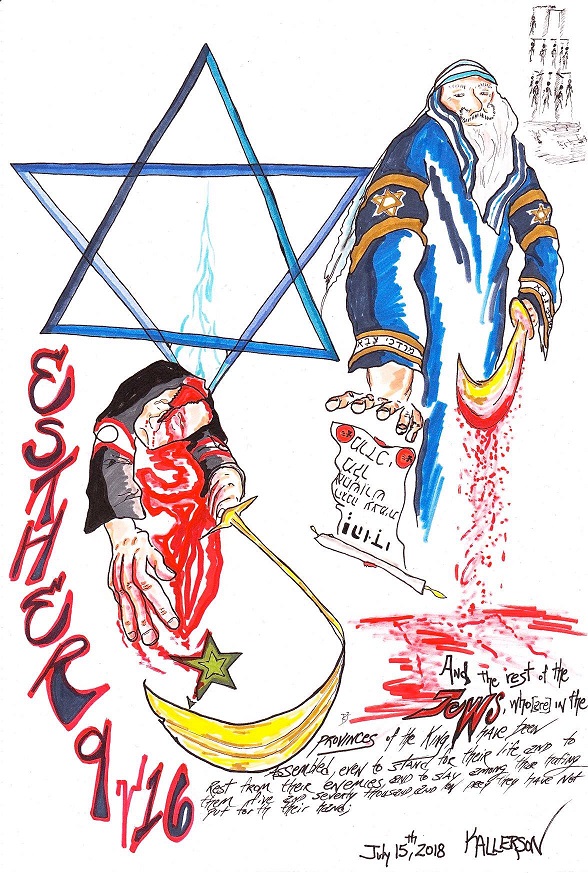
16 The remainder of the Jews in the king’s provinces gathered together and protected their lives, had rest from their enemies, and killed seventy-five thousand of their enemies;
The verse appears highly unusual in its structure, and scholars struggle over why it is written as it is. It first notes that the Jews not in Shushan gathered together and protected their lives. This would have occurred on or before the thirteenth of the month. It then says that they had rest from their enemies, this seemingly would have occurred on and after the fourteenth of the month. It then seems to revert to the events of the thirteenth of the month by saying that they killed 75,000 in their slaughter.
However, the word “rest” is a noun, not a verb. It is used only twice in Scripture, once in 2 Chronicles 6:41 when speaking of the resting place of the Lord, and the other is here in Esther. What it appears to be saying is that is in the gathering and slaughtering of their enemies, they had their rest.
The edict of Mordecai granted them the right to gather, provided them rest, and allowed them to kill their enemies. They had entered their rest even before their enemies were destroyed. It is reflective of the state of Christians today. Hebrews 4:3 says that for those who believe, we have entered our rest (a noun in the Greek), and yet, we are still actively engaged in a spiritual battle in this life.
16 (con’t) but they did not lay a hand on the plunder.
Again, like those Jews in Shushan, this exceptional note of restraint is stated. The Jews did not initiate the conflict, they did not ask for it, but they were willing to see it through and yet not profit off of it, even though they had a right to do so.
17 This was on the thirteenth day of the month of Adar.
These words support the thoughts on the previous verse. They refer to the previous verse, all of which occurred on the thirteenth day, including the rest which the people had entered. This is then confirmed by the final words of today…
*17 (fin) And on the fourteenth of the month they rested and made it a day of feasting and gladness.
There is a place of rest, and there is a state of rest. The Jews of the provinces entered a place of rest, even if they did not enter into a state of rest. They now unite the state with the place. It says that on the fourteenth of Adar, they rested (a verb). It says that in their rest, they then made it a day of feasting and gladness. However, as has been the case throughout Esther, the word “feast” is mishteh. It is a feast of drinking; a banquet. There would be immense joy, wine would flow freely, and the people would have the burdens of this life lifted off their shoulders as they finally were freed of the threat of the enemies which had haunted them for so very long.
With just two sermons left, we continue to see the hidden hand of the Lord working continuously behind the scenes in order to deliver His people. Esther has been chosen as the queen of the realm; Mordecai has been placed in an exalted position; Esther’s petition has been granted to work against the decree of Haman; and the enemies of the Jews have been brought to their end.
All of this could be chalked up to time and chance with the exception that it had already been said that these things would occur. Not the specific details, of course, but the overall promises of protection and life. And so, like always in Scripture, the result of what has come about is ultimately left up to one word for us to consider. That word is “faith.” God has done all of the things He has done in such a way that it takes faith to believe.
The earth looks old, but the Bible says it is young. Where is your faith? The Lord promises destruction by flood, but the skies are sunny. Where is your faith? The Lord says He is our Defender, but we are hemmed in by enemies? Where is your faith? The boat is sinking, but the Lord is right there with you. Where is your faith? The word is written, but the resurrection of a dead Man seems impossible. Where is your faith?
The Bible doesn’t say it is easy to believe, but it does ask us to do so. God looks for faith in His faithless creatures, and so a little bit will do. Will we chalk up the defeat of the enemy to our own goodness and skill? Or will we call out to the Lord in thanks and praise? In the end, the only thing that we can give God is our faith. Loving God requires faith that He exists. Praising God requires faith that He is listening. Praying to God through Jesus Christ implies that we believe in the Person and work of Jesus.
If you have never made the commitment of faith in Him that God is looking for, today is the day. Have faith, and be saved from the wrath which is sure to otherwise come. God would have you saved, and with Him, rather than lost and cast away. Call on Him. It is that simple.
Closing Verse: “Ascribe strength to God;
His excellence is over Israel,
And His strength is in the clouds.
35 O God, You are more awesome than Your holy places.
The God of Israel is He who gives strength and power to His people.
Blessed be God!” Psalm 68:34, 35
Next Week: Esther 9:18-32 The Jews prevailed though their chances looked slim, and so they call them... (The Days of Purim) (12th Esther Sermon)
The Lord has you exactly where He wants you. He has a good plan and purpose for you. At times, you might feel as if he has no great design for you in life, but he has brought you to this moment to reveal His glory in and through you. So follow Him and trust Him and He will do marvelous things for you and through you.
Rest From Their Enemies
Now in the twelfth month, that is, the month of Adar
On the thirteenth day; a date not disputed
The time came for the king’s command
And his decree to be executed
On the day that the enemies of the Jews
Had hoped to overpower them, as is stated
The opposite occurred
In that the Jews themselves overpowered those
———-who them had hated
The Jews gathered together in their cities
Gathering even from field and farm
Throughout all the provinces of King Ahasuerus
To lay hands on those who sought their harm
And no one could withstand them, so the account does tell
Because fear of them upon all people fell
And all the officials of the provinces
The satraps, the governors as well
And all those doing the king’s work helped the Jews
Because the fear of Mordecai upon them fell
For Mordecai was great in the king’s palace
And his fame spread throughout all the provinces
For this man Mordecai became increasingly prominent
So the account to us says
Thus the Jews defeated all their enemies
With the stroke of the sword, as is stated
With slaughter and destruction
And did what they pleased with those who them had hated
And in Shushan the citadel, there and then
The Jews killed and destroyed five hundred men
Also Parshandatha, Dalphon, Aspatha
Poratha, Adalia, Aridatha too
Parmashta, Arisai, Aridai, and Vajezatha
To them was bid tata and adieu
The ten sons of Haman the son of Hammedatha
The enemy of the Jews—they killed
But they did not lay a hand on the plunder
It was enough that their blood was spilled
On that day the number of those who were killed
———-in Shushan the citadel
Was brought to the king; to him the stats they did tell
And the king said to Queen Esther
“The Jews have killed and destroyed five hundred men
In Shushan the citadel
And the ten sons of Haman
What have they done in the rest of the king’s provinces?
Now what is your petition? It shall be granted to you
Or what is your further request? It shall be done
Speak as to what you desire me to do
Then Esther said, “If it pleases the king
Let it be granted to the Jews who are in Shushan
To do again tomorrow according to today’s decree
And let be hanged on the gallows the ten sons of Haman
So the king commanded this to be done
The decree was issued in Shushan
And they hanged Haman’s ten sons, yes each and every one
And the Jews who were in Shushan
Gathered together again on
The fourteenth day of the month of Adar
And killed three hundred men at Shushan
But they did not lay on the plunder a hand
They only killed their enemies; so we are to understand
The remainder of the Jews in the king’s provinces
Gathered together and protected their lives
———-had rest from their enemies, truly a wonder
And killed seventy-five thousand of their enemies
But they did not lay a hand on the plunder
This was on the thirteenth day
Of the month of Adar
And on the fourteenth of the month they rested
And made it a day of feasting and gladness, both near and far
Lord God, thank You for Your presence that is with us
Even when we don’t realize that You are there
Because You sent Your own Son Jesus
We can know that You truly do care
And so Lord, be real to us in a wonderful new way
Open our minds and our hearts to seeing You always
Through every step we take, and throughout every day
Be real to us, O God, and to You will shall give all of our praise
Hallelujah and Amen…