Numbers 3:1-13
The Levites Shall be Mine
In this world, things need to be done. And there is always something to do. Having spent 20+ years in wastewater treatment, I can assure you that there is no time, ever, that we can let our attention to treating that particular stream fall for even a moment. All around the world, people are watching dials, tending to pumps, cleaning screens, taking samples, changing chemical doses, and on and on. Somebody needs to do it.
Houses need to be built, cars need to be fixed, food needs to be prepared, wood needs to be chopped. As I said, there is always something to do. There wouldn’t be hospitals if everyone was healthy, but people get sick, people get hurt, people go nuts. Such is life. If there is a hospital for such folks, then there needs to be doctors and nurses, and also pay collectors for those bills after you’re fixed up.
Think of what it takes to make a single pencil. The amount of human effort to bring one pencil to a store is literally mind-numbing. Wood has to be chopped down. Someone had to make the saw to do it. Someone had to get the metal out of the ground for the saw. Some had to…. You could go on, literally, for hours thinking about what is involved in the process of making and distributing a pencil. And in doing so, I guarantee that you would miss a thousand parts of the program. One can’t run a chainsaw without gas. Gas alone requires a thousand sheet plan just for starters.
Ok, so now you know that something seemingly simple, like buying a pencil, or something out of mind, like the water going down your drain, takes a lot of careful effort to ensure things work out as they should. Why do we think that it is any less complicated when studying theology? There needs to be a plan, there needs to be a framework for executing that plan, and there needs to be people to ensure that plan is worked out properly.
Text Verse: “And He Himself gave some to be apostles, some prophets, some evangelists, and some pastors and teachers, 12 for the equipping of the saints for the work of ministry, for the edifying of the body of Christ, 13 till we all come to the unity of the faith and of the knowledge of the Son of God, to a perfect man, to the measure of the stature of the fullness of Christ;” Ephesians 4:11-13
Paul says that Christ Jesus “gave” some for various purposes within a greater plan. The word “to give” in Hebrew is natan. Paul was a Hebrew-speaking Jew, and – although the NT was written in Greek – he would have had Hebrew on his mind as he thought out his words. It could be that he had been reading the books of Moses that day and was thinking about how God gave the Levites to the priests in order to accomplish their tasks. In this, he then might have thought how the Lord gave out His gifts to various people in order to meet the needs of the church.
In the end, it is an immensely complicated thing, but it has worked amazingly well for 2000+ years. The same is true with how He developed the stewards of the Law of Moses. He took for Himself, and He gave according to His wisdom that which was His. Understanding this, and because you know how precious a pencil actually is after having thought it through, imagine how precious is the word of God which details not earthly, perishable things, but rather heavenly, spiritual things which endure forever.
Even if the Law of Moses and the Levitical system were temporary, the truths which stem from them are eternal. They point to Christ, they reveal Him in unique ways, and they lead us to a much better understanding of why we need Him in our lives. And so as we continue on in another chapter which will have more seemingly irrelevant information that nobody in today’s world would ever care about, remember that this is completely incorrect. One can’t have a pencil without all that it takes to make a pencil, including the erasure and even the little words on the side that nobody ever reads. And one cannot have an appreciation for the Person and work of Christ without going into all of the intricate detail that it took to get us to Him.
Some people couldn’t care at all about the details, but imagine what would happen if the ball were to drop today. When the stores ran out of pencils, that would be the end of them – permanently. When the system breaks down, only those who know how the system works will benefit from it. The Old Testament is the foundation of the system, and the details of Numbers 3 are another marvelous part of that wonderful system, so let’s enjoy what is before us, learning as we go. It’s all to be found in His superior word. And so let’s turn to that precious word once again and… May God speak to us through His word today and may His glorious name ever be praised.
I. Holiness Before the Lord (verses 1-4)
Now these are the records
The words here, v’elleh toledoth, or “and these are the generations,” are a technical formula which occurs numerous times in the book of Genesis. They look down, not up as history unfolds. Some translations say, “genealogies,” some say, “records,” and so on. But when they are given, they introduce a new direction in the narrative, especially concerning genealogies of a man or men. In this case, it is the toledoth, or records…
1 (con’t) of Aaron and Moses
Chapter 3 is immediately introduced with a particular order, Aaron and Moses, rather than Moses and Aaron. Aaron is the older of the two, but this may not be the reason for citing Aaron first. Rather, it is likely because his generations are the priestly class, whereas the other sons of Levi will be named as simply Levites. It appears that Aaron and Moses are considered the heads of the entire tribe of Levi, but Moses’ office is a temporary one compared to Aaron whose generations will continue throughout the duration of the law in a priestly capacity.
Chapter 3 is going to detail and count all of the tribe of Levi, but the statement here speaks only of the toledot, or generations of Aaron and Moses. The reason for this is that it then indicates the relationship of the Levites to the priests. It is the priests which receive the focus of the narrative. But this still doesn’t explain why Moses is considered in the toledot, or generations of the priests. The reason may be that because Moses is the lawgiver, even of the priests, that he is considered as a father in the faith to them. It is as if he begat them because the law, which they administer as priests, came through Moses. This would then be in line with 1 Corinthians 4:14, 15 –
“I do not write these things to shame you, but as my beloved children I warn you. 15 For though you might have ten thousand instructors in Christ, yet you do not have many fathers; for in Christ Jesus I have begotten you through the gospel.”
Paul was as a father who begat his children in Christ, and this same concept may be why Moses is included as a part of the generations of the priests here.
1 (con’t) when the Lord spoke with Moses on Mount Sinai.
The Hebrew reads, “in the day when the Lord spoke with Moses.” This may refer to Numbers 1:1. The same day as the other instructions were given, the instructions for what will now follow have also been given. Or, more likely, it is a general term signifying the time when Aaron and Moses were raised to being the spiritual heads of their tribe. Either way, the statement is especially important because of what is next recorded for us…
2 And these are the names of the sons of Aaron: Nadab, the firstborn, and Abihu, Eleazar, and Ithamar.
The listing of the sons of Aaron includes Nadab and Abihu, and yet, both of them are dead at this point. Thus, this genealogical record is looking down from Aaron’s time as a whole, not from the moment that the account is recorded. Everything from that point is the toledot, or generations of Aaron.
The deaths of Nadab and Abihu are recorded in Leviticus 10. During their time of ordination to the priesthood, they offered profane fire before the Lord. Because of their irreverence, fire from the Lord came out and devoured them. That ended their lines as neither had sons at that time. Along with them, Aaron’s two other sons are Eleazar and Ithamar.
3 These are the names of the sons of Aaron, the anointed priests, whom he consecrated to minister as priests.
These words tend to confirm that the term, “in the day the Lord spoke with Moses,” is referring to a general time-frame of the reception of the law and the institution of the priesthood. The names of all four of the sons of Aaron are spoken of in the same context. They were all considered anointed priests, and all were consecrated to minister as priests. Regardless of the fact that two are now dead, they were alive and serving as priests in the day – meaning any of the entire time – that the Lord spoke to Moses.
The consecration here in the Hebrew is asher mille yadam la’kahen, or “whose hands he filled to serve.” The meaning of that goes back to the filling of the hands with the ram of the consecration in Leviticus 8. And so we see that the term “day” is speaking of a whole, just as “the Day of the Lord” is not a set day, but a period of time. This is more confirmed by…
4 Nadab and Abihu had died before the Lord when they offered profane fire before the Lord in the Wilderness of Sinai;
The time spoken of is past, and yet it is recorded now. Their deaths were “in the Wilderness of Sinai” where Aaron and Moses continue to live at this point. If it seems like an odd way to establish the toledot, or generations, of the priests, it actually isn’t. It is, in fact, a sober reminder to them that there would be consequences for not treating the priesthood as a sacred and holy obligation. The same term liphne Yehovah, or “before the Lord,” is used both for offering profane fire and for dying before the Lord. Thus, there is a stress on the term, signifying holiness.
As the Levites will be recorded as a part of the generations of Aaron, affixing them to the priesthood, it then means that they will be expected to discharge their duties in exactly the same reverent and holy manner.
This statement concerning Nadab and Abihu is their reminder. The Lord is holy, He has called His priests to holiness, and he has called the Levites who minister to the priests to holiness. What may seem unimportant now will, when properly considered, seem immensely important. This is especially true as we arrive at Numbers 16. There, Korah’s rebellion is recorded. Korah is a Levite through Kohath, the son of Levi, but he will challenge the priesthood. When he does, what happened to Nadab and Abihu will seem like a peaceful departure from this existence. They died, but they died quickly and alone, as is next stated…
4 (con’t) and they had no children.
It is a statement which bears several thoughts in one. First, it is an indication that their line ended. That is sad on the surface. They have no descendants to carry on their name. However, it is a statement of mercy in that they had no descendants to mourn them; no children were left as orphans. And it is a greater statement of mercy because when Korah rebels, the account says that the households of those who rebelled were destroyed with the offenders. For Nadab and Abihu, the only loss was their own lives.
4 (con’t) So Eleazar and Ithamar ministered as priests in the presence of Aaron their father.
The result of not ministering in holiness was death to Aaron’s two eldest. As a result, these words indicate that it became the honor, but equally so the responsibility, to carefully minister as priests before Aaron their father.
A priesthood before the Lord our God
The way of mediation has been defined
It is accessible any place we are and anywhere we trod
With our Mediator, none are left out, and none are left behind
All who come through Him have access
And any who so desire may freely come
Does God hear? We don’t even need to guess
He hears all because of Jesus, and not only some
All He requires is that we come by faith in Christ
We come to Him through the precious blood that was shed
It was for our sins that He was sacrificed
And for restored access, is why our Savior bled
II. Bring the Tribe of Levi Near (verses 5-10)
5 And the Lord spoke to Moses, saying:
With the establishment of the new direction of the narrative, that of the toledot, or generations, of Aaron and Moses, a new subsection of that major thought is now introduced with these words. They revert to the standard format which is so common to this particular time while encamped at Mount Sinai – v’daber Yehovah el Moshe l’mor, or “And spoke Yehovah unto Moses, saying…” Aaron’s specific role as the head of the priestly class is identified; the listing of the generations of that class has been named, and so instruction from the Lord on a new, but related, matter is now spoken by the Lord to Moses. That instruction continues with…
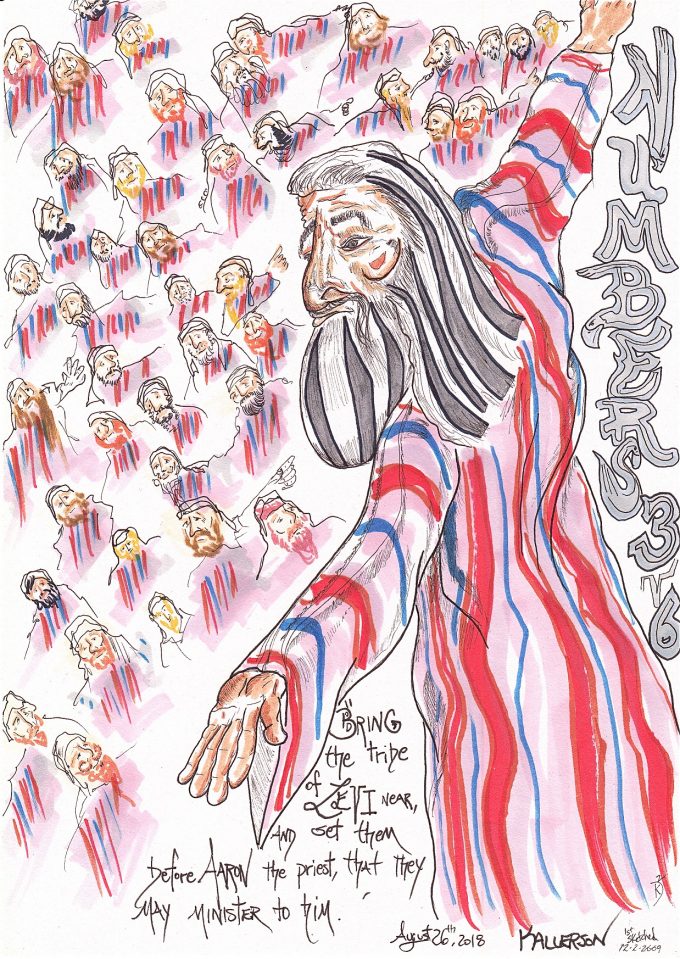
6 “Bring the tribe of Levi near,
In this, the term “bring near” is considered with a view to a sacrificial or devoted sense. Just as animals were brought near as an offering to the Lord, that is what is now being conveyed concerning the tribe of Levi. When this is completed, they will no longer be considered as rightly joining in any common employment or profession.
From this time on, they would be a special class, subordinate to the priests, but separated from Israel, and belonging to the Lord as His own. The tribe of Levi, meaning Levi’s descendants, has already been singled out in Chapter 1 during the time of the census of the other tribes. To remind you, those verses said –
“But the Levites were not numbered among them by their fathers’ tribe; 48 for the Lord had spoken to Moses, saying: 49 “Only the tribe of Levi you shall not number, nor take a census of them among the children of Israel; 50 but you shall appoint the Levites over the tabernacle of the Testimony, over all its furnishings, and over all things that belong to it; they shall carry the tabernacle and all its furnishings; they shall attend to it and camp around the tabernacle. 51 And when the tabernacle is to go forward, the Levites shall take it down; and when the tabernacle is to be set up, the Levites shall set it up. The outsider who comes near shall be put to death. 52 The children of Israel shall pitch their tents, everyone by his own camp, everyone by his own standard, according to their armies; 53 but the Levites shall camp around the tabernacle of the Testimony, that there may be no wrath on the congregation of the children of Israel; and the Levites shall keep charge of the tabernacle of the Testimony.” Numbers 1:47-53
That special calling, which was detailed there, is to be developed further. The Lord instructs Moses haqrev eth matteh levi, or “Bring near the staff (meaning the tribe) of Levi.” They were not counted among the tribes for general purposes, but they are to be counted nonetheless, for a special purpose. This separation stems from two key moments in the life of Levi. The first was in Genesis 34, at the time when his sister Dinah was violated. At that time, both Simeon and Levi killed all the males of Shechem –
“Now it came to pass on the third day, when they were in pain, that two of the sons of Jacob, Simeon and Levi, Dinah’s brothers, each took his sword and came boldly upon the city and killed all the males. 26 And they killed Hamor and Shechem his son with the edge of the sword, and took Dinah from Shechem’s house, and went out.” Genesis 34:25, 26
Many years later, as Jacob was on his deathbed, he blessed his sons according to their futures. When he came to Simeon and Levi, he said the following –
“Simeon and Levi are brothers;
Instruments of cruelty are in their dwelling place.
6 Let not my soul enter their council;
Let not my honor be united to their assembly;
For in their anger they slew a man,
And in their self-will they hamstrung an ox.
7 Cursed be their anger, for it is fierce;
And their wrath, for it is cruel!
I will divide them in Jacob
And scatter them in Israel.”Genesis 49:5-7
The prophecy for these sons is literally fulfilled. Simeon will be divided and dispersed in the inheritance of Judah; Levi will be divided and dispersed throughout Israel. As the Levites, they will minister for the priests and to the people. What is detailed here, like the details of Chapter 1, continue the first half of that equation.
6 (con’t) and present them before Aaron the priest,
v’ha-amadta otow liphne Aharon ha’kohen – “and have stand them before Aaron the priest.” With these words, one gets the sense of a servant standing before his master awaiting instructions. The priesthood has already been selected, presented, ordained, and set into daily practice. The Levites are now being presented as a gift of service to the priests through Aaron, the high priest.
Again, think of what happened with Aaron in Leviticus. He and his sons were designated by the Lord and by name. They were then presented before the Lord. They then went through rites of ordination, and then they were acceptable as priests before the Lord. This is the same process which is being directed towards the Levites. They are first selected, then they will be presented, they will be ordained, and then they will minister. In what capacity they will minister is seen in the next words…
6 (con’t) that they may serve him.
Their duties were named in chapter 1, but they will be expanded on here. What is evident with these words is that it is a service to the priests. They are not appointed to a mediatorial role before the Lord. Rather, they serve the mediator of the covenant, meaning Aaron. As Aaron is representative of his line, then they are to serve the priests who issue from Aaron. This is a permanent arrangement.
7 And they shall attend to his needs and the needs of the whole congregation before the tabernacle of meeting,
As is seen here, the role of Levi is a double-pronged one. They are to first attend to his (meaning the priests’) needs, and they are to also tend to the needs of the whole congregation. However, the verse more accurately reads, “And they shall keep his watch, and watch all the congregation before the tent of meeting.” To keep watch in this sense is a sacred calling and obligation. It is the watch of the Lord which they are actually tending to.
There is a vast, detailed, and complicated set of ceremonial rites which are laid out, especially in the book of Leviticus. There is no way the priests could accomplish all of what was required in this watch before the Lord. The priests are insufficient in number, and the congregation is unschooled in the details of what was required. Because death is the resulting penalty for improper conduct of the Levitical law, there needed to be qualified, capable, and trained men to accomplish what needed to be done. It is the same thought that Paul relays to the people of Corinth when he said –
“For we do not preach ourselves, but Christ Jesus the Lord, and ourselves your bondservants for Jesus’ sake.” 2 Corinthians 4:5
Somebody stands between the Lord and the unskilled to ensure the two meet in harmony and without confusion. Certain men, during each dispensation, have been given specific duties to ensure the people are properly tended to concerning the things of God. In the time before the law, the oldest son of the house was normally the one who would take over the priestly functions of the house. Now, in the time of the law, the Levites are selected in place of the firstborn. That will be seen in just a few verses.
7 (con’t) to do the work of the tabernacle.
It is words like these that show the importance of consistent translation, and with acceptable diversity of words. This clause says, la’avod eth avodat ha’mishkan – “for serving the service of the tabernacle.” The word translated as “tabernacle” here, mishkan, is completely different than the previous clause which said, ohel moed, or “tent of meeting.” By translating both as “tabernacle,” one is given a false reading of what is being said. The two terms are not synonymous. The mishkan is the tabernacle which is inside of the tent of meeting.
Levi is given the job of doing the work of the tabernacle. This would involve erecting it, taking it down, transporting it, keeping things fit, repaired, polished, etc. It would also include assisting the priests in the functions related to the tabernacle, but the Levites themselves would not enter the tabernacle, either in the Holy Place or the Most Holy Place. Though they were helpers to the priests, they were not to perform priestly functions themselves.
8 Also they shall attend to all the furnishings of the tabernacle of meeting,
The specifics of these words are given later in this chapter, and the specifics of the things that only the priests were to do are given in the next chapter. Certain vessels were not to be touched, or even seen, by the Levites. Other things were to be cared for and tended to by them. The majority of the heavy, labor-intensive, tasks would devolve to the Levites. However, this is a service that is of the highest honor nonetheless. They act as servants to the priests, but the service should have been considered one of great honor.
8 (con’t) and to the needs of the children of Israel, to do the work of the tabernacle.
Again, the “children of Israel,” meaning the entire congregation, was to benefit from the service of the Levites. As the house in ancient times was to be served by the father, and then the firstborn son after him, in all things concerning their religious needs, so was Levi now granted this honor.
9 And you shall give the Levites to Aaron and his sons;
The verse here bears a forceful emphasis. First, it says, v’natatah eth ha’levim l’aharon u-l’banav – “And give the Levites to Aaron and to his sons.” They are as a possession being handed over for total ownership. There would be no pay from the priests for this. Rather, pay would come through the tithes of the people, and a tenth of that would be taken, in turn, for the priests. The stress then continues with the next words…
9 (con’t) they are given entirely to him from among the children of Israel.
netumin netunim hemah – “given, given to him.” Repetition in this way in the Hebrew is a statement of emphasis. We say, “wholly given,” or “given entirely,” and so on, but the Hebrew repeats to obtain this same effect. In this, there is both an entirety to the giving, and the certainty of the matter. No Levite is left out, and they are given without the thought of release or exception. Further, the verse says that they are given “from among the children of Israel.”
Those in other tribes were not given in this capacity, and to allow others to be so given would be a violation of what the Lord had determined. He selected Levi from Israel, and so no non-Israelite and no non-Levite would be considered acceptable to perform their duties. This unlawful and thus unholy practice, however, is seen later after the people divide into two kingdoms. That is recorded in 2 Chronicles 13:9, 10.
As a sort of parallel to this verse, but with a different meaning entirely, there is a class of people mentioned later in the Bible who are known as the Nethinim. These would be called “The Given.” They are a class of people who were not Levites, but who also served the people. It is a class of people who served at the temple, but who were of a lower class than that of the Levites. Nethinim comes from natan, to give, and thus they may be people given over to the temple service, whether those of foreign birth as slaves, or those of Israel who are consecrated by vow.
10 So you shall appoint Aaron and his sons, and they shall attend to their priesthood;
The Lord now steps back from the call of the Levites, and again speaks of the priesthood of Aaron and his sons. The words, “they shall attend to their priesthood” mean that because the Levites have been given to them for the non-priestly, and yet many, laborious, and time-consuming tasks, they would be able to tend to their own duties without interruption or over-working. They would be able to burn the daily offerings and incense, pour out the drink offerings, perform the blood sacrifices, bless the people, and so on. The Levites were given the blessing of assistance for non-priestly duties, and so they were to attend to it without fail, but only the priests were to do what priests were appointed to do…
10 (con’t) but the outsider who comes near shall be put to death.”
This is a warning that is tied into the previous clause. Because the priests were freed from the non-priestly duties of the temple service, they alone were to do the priestly duties. Thus, nobody else had a right to come near, and no priest could shirk his duties by asking any other to come near, even a Levite. Any non-priest who approached to conduct priestly duties was to be put to death. An exception to this is found in 2 Chronicles 29:34.
They shall be Mine; I have set them apart
They shall serve Me and be unique unto Me
They bear My sign, and are written on My heart
I have sealed them with an eternal guarantee
And so some as apostles I have given
And some are pastors to lead My people along
Some are preachers, preaching to the livin’
And some are teachers, teaching the hungry throng
Till all come to unity of the faith, as is My design
And to the knowledge of the Son of God, the Lord
Each that has been sealed, each who now is Mine
Each in whom is the heavenly deposit stored
III. They Shall Be Mine (verses 11-13)
11 Then the Lord spoke to Moses, saying:
Again we return to the standard form of introducing a new sub-thought. The priestly line has been identified. The Levitical service has been delineated, and now the reason for, and logic behind, the choosing of the Levites will be stated.
12 “Now behold, I Myself have taken the Levites from among the children of Israel
This explains firstly why Moses could “give” the Levites to Aaron. The Lord has taken them for Himself. In fact, the Hebrew reads it in an emphatic way – v’ani hinneh laqahti eth ha’levim – “And I, behold, I have taken the Levites.” As He has taken them, then He can give them. But when and how did He take them? The answer goes back to the Exodus…
12 (con’t) instead of every firstborn who opens the womb among the children of Israel.
The law of the firstborn was given in Exodus 13, and it is worth repeating to understand what the Lord has now determined concerning the Levites –
“And it shall be, when the Lord brings you into the land of the Canaanites, as He swore to you and your fathers, and gives it to you, 12 that you shall set apart to the Lord all that open the womb, that is, every firstborn that comes from an animal which you have; the males shall be the Lord’s. 13 But every firstborn of a donkey you shall redeem with a lamb; and if you will not redeem it, then you shall break its neck. And all the firstborn of man among your sons you shall redeem. 14 So it shall be, when your son asks you in time to come, saying, ‘What is this?’ that you shall say to him, ‘By strength of hand the Lord brought us out of Egypt, out of the house of bondage. 15 And it came to pass, when Pharaoh was stubborn about letting us go, that the Lord killed all the firstborn in the land of Egypt, both the firstborn of man and the firstborn of beast. Therefore I sacrifice to the Lord all males that open the womb, but all the firstborn of my sons I redeem.’ 16 It shall be as a sign on your hand and as frontlets between your eyes, for by strength of hand the Lord brought us out of Egypt.” Exodus 13:11-16
The nation of Israel was adopted as the Lord’s firstborn son. Because of this, the sign of the firstborn was then mandated. But in accepting the Levites in place of the firstborn among the people, the firstborn was released from this obligation. Therefore, the Levites would be devoted with no division of interest which would have otherwise been the case. Even the firstborn of the animals would now be substituted with the animals of Levi. That will be seen later in this chapter.
12 (con’t) Therefore the Levites shall be Mine,
Countless reasons have been suggested as to why Levi was chosen for this distinction. It has been suggested because they were the smallest tribe, and that number was sufficient for the job. Others ascribe this to the Levite’s zeal for the Lord in the incident of the golden calf. Both of those may add weight to the reason, but what makes the most sense is that because Aaron is already the high priest, there is no need to go beyond Levi to secure an individual set of people.
In the law of the firstborn, there would arise a great deal of confusion in the land and among the people if they were to leave their homes and minister at the temple. Further, if there was no other child, it would upset inheritances to take the firstborn, and so on. The list is long concerning why having a single tribe be called is the best option.
They have no land inheritance, and so there is nothing to cause entanglements there. They are related to the priests, and so there is a sense of fraternal bonding there. The very name of Levi, meaning Attached, gives a sense of why they should be attached to the Lord in this way. The prophecy of the father that they would be scattered in Israel means that the prophecy is fulfilled in this arrangement. On and on, the reasons for selecting Levi are sound and they are numerous.
13 because all the firstborn are Mine.
This was mandated based on the redemption of Israel. The Lord had struck the firstborn of Egypt, and He had spared the firstborn of His firstborn son, meaning Israel. Therefore, they were His. It was His sovereign act to spare them amidst the destruction which brought Israel out, and so He established the law based on that.
13 (con’t) On the day that I struck all the firstborn in the land of Egypt, I sanctified to Myself all the firstborn in Israel, both man and beast.
Again, the firstborn of both man and beast were declared the property of the Lord. The firstborn of both were destroyed in Egypt, but the firstborn of both man and beast of Israel were spared. In this, He sanctified all firstborn as His own. It was the sign of His act, and an acknowledgment by the people of His authority. However, He had, for His sole and wise reasons, now selected Levi in place of the firstborn. Indeed, to have a single tribe to care for the priesthood and its associated duties, and to tend to the people in return, there was the surety of a successful continuance of His service which would be lacking if the original firstborn system had been kept as it was.
*13 (fin) They shall be Mine: I am the Lord.”
“I am sovereign over Israel, I held the right of the firstborn, and now I transfer that right to a single tribe. I am Yehovah, and therefore the decision is made and it will be complied with. To challenge this is to challenge Me; obedience is anticipated and expected.”
Here we are seeing the development of a grand picture of the tribe of Levi. Moses is of Levi, and he was called as the deliverer and lawgiver, as well as the leader. Aaron and his descendants serve in the priestly capacity. They are the keepers of the sanctuary and those who mediate the covenant between the Lord and the people. The other Levites as a tribe are now chosen in place of the firstborn of the people to accomplish any other duties of the sanctuary and in service of the people.
If one steps back and looks at each of these, from Moses to Aaron and his sons, to the greater tribe of Levi, every single aspect of their lives and functions is accomplished in the church by One individual; Christ Jesus. He is our Deliverer, Lawgiver, and Leader. He is the Keeper of the sanctuary, and the Mediator of the covenant as well. And he also is the Firstborn who ministers for the sake of the people before the Father. Levi, as a whole, makes its own unique snapshot of the workings of God, in Christ, for His people.
And this is the very intent of calling Levi from the tribes. In them, there would be a unity of purpose despite being scattered in Levitical cities throughout the land. There would be one group of people, unified in their work life, their family life, and their religious life. Jesus is that bond for us. He performs all of the functions of the men of this called-out tribe, and so our devotion to Him is to be unified as well.
Yes, churches fight over the smallest, most petty issues, but we are united in a unique way at the same time. There is one God, one Mediator, one holy dwelling place, one word of authority in how we approach the Lord, and so on. The difference, however, is that despite Levi being united as a tribe, it was a tribe united as flawed individuals. In Christ, we are united to the One who is perfect in all ways. Where Levi strayed and failed among both priest and people, our perfect Lord has never erred, nor will He ever.
An effective, long-lasting, but temporary and fallible priesthood came through the Law of Moses. A superior, eternal, and infallible priesthood is found in Christ Jesus. Types and pictures of Him are intended to lead to Him. Here in Numbers, as in the rest of Scripture, we are being led along a wonderful path that directs us back to God, and that path goes straight through, and only through, Jesus Christ.
Closing Verse: “Bless the Lord, O house of Israel!
Bless the Lord, O house of Aaron!
20 Bless the Lord, O house of Levi!
You who fear the Lord, bless the Lord!
21 Blessed be the Lord out of Zion,
Who dwells in Jerusalem!
Praise the Lord!” Psalm 135:19-21
Next Week: Numbers 3:14-39 What is it? Can you guess? (A Sign in the Wilderness) (5th Numbers Sermon)
The Lord has you exactly where He wants you. He has a good plan and purpose for you. It may seem at times as if you are lost in a desert, wandering aimlessly. But the Lord is there, carefully leading you to the Land of Promise. So follow Him and trust Him and He will do marvelous things for you and through you.
The Levites Shall Be Mine
Now these are the records of Aaron and Moses, by and by
When the Lord spoke with Moses on Mount Sinai
And these are the names of the sons of Aaron:
Nadab, the firstborn, and Abihu, Eleazar, and Ithamar too
These are the names of the sons of Aaron, the anointed priests
Whom he consecrated to minister as priests, so he did do
Nadab and Abihu had died before the Lord
When they offered profane fire before the Lord
———-these two young men
In the Wilderness of Sinai
And they had no children
So Eleazar and Ithamar ministered as priests instead
In the presence of Aaron their father; by them they were led
And the Lord spoke to Moses, saying:
“Bring the tribe of Levi near
And present them before Aaron the priest
That they may serve him; to his directions they shall adhere
And they shall attend to his needs
And the needs of the whole congregation
———-these duties they shall tackle
Before the tabernacle of meeting
To do the work of the tabernacle
Also they shall attend to all the furnishings
Of the tabernacle of meeting, so I say
And to the needs of the children of Israel
To do the work of the tabernacle, day by day
And you shall give the Levites to Aaron and his sons
———-as to you I tell
They are given entirely to him from among the children of Israel
So you shall appoint Aaron and his sons
And they shall attend to their priesthood
But the outsider who comes near shall be put to death
Make sure this is understood
Then the Lord spoke to Moses, saying:
These words to them he was then relaying
“Now behold, I Myself have taken the Levites
From among the children of Israel
Instead of every firstborn who opens the womb
Among the children of Israel, so to you I tell
Therefore the Levites shall be Mine
Because all the firstborn are Mine, as you already know
On the day that I struck all the firstborn
In the land of Egypt, to their deaths they did go
I sanctified to Myself all the firstborn in Israel, so is My word
Both man and beast. They shall be Mine: I am the Lord
Lord God, we are even now in a wilderness
And we are wanting to be led by You
Without You to direct, our lives would be a mess
And so be our guide, O God; You who are faithful and true
We long for the water in this barren land
May it flow forth from the Rock, our souls to satisfy
Give us this refreshing, spiritual hand
And may we take it, and to our lives daily it apply
And we shall be content and satisfied in You alone
We will follow You as we sing our songs of praise
Hallelujah to You; to us Your path You have shown
Hallelujah we shall sing to you for all of our days
Hallelujah and Amen…