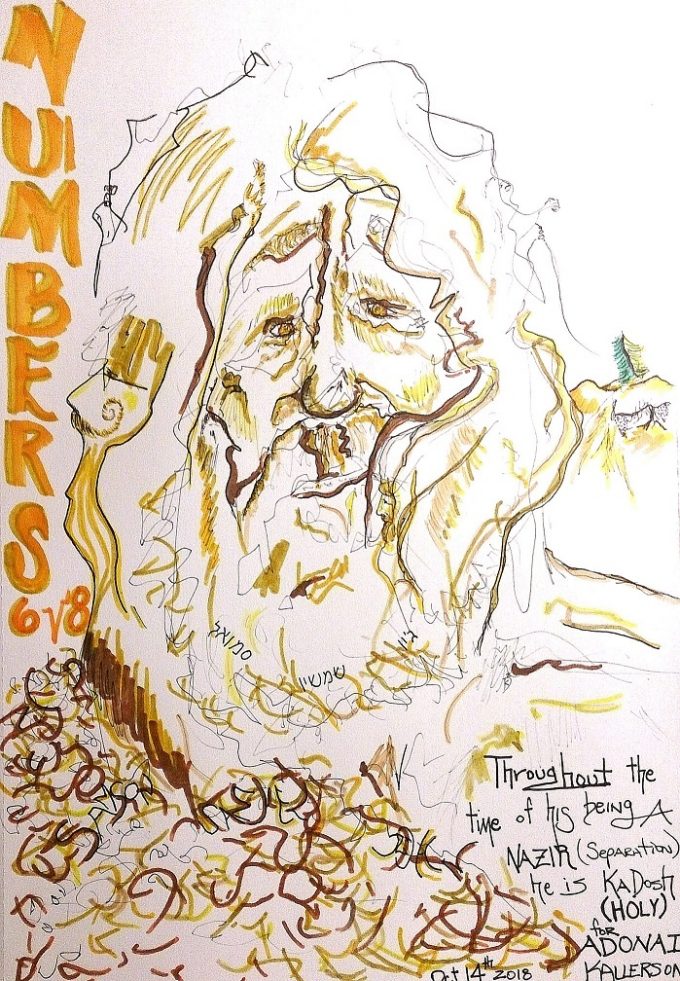
Numbers 6:1-21
The Vow of the Nazirite
Two separate and distinct subjects are detailed in the 27 verses of Chapter 6 – separation and blessing. And yet, they are also united in thought. The first deals with separation to God through the Nazirite vow. The second deals with the separation of the people, Israel, from among the people of the world through a unique and peculiar blessing.
Separation and division is a logical part of the way God works. The Lord separated the nations of the world according to His design. Israel is separated from the world’s people. Levi is separated from among Israel. The priests are separated from their brothers in the tribe of Levi. Nazirites are separated for special service. And so on.
It is too often, and with a total lack of clarity, that we see separation as a bad thing. The people of the world have looked at the Jews as abhorrent because they have kept themselves separate from the nations. That was seen in the words of Haman in Esther, and it has been seen among the people of the world ever since.
The church is divided in ten thousand ways, and yet, it has been a force not for evil, but for good. Though there is one true invisible church, if there were but one true and visible church, the people would follow its path no matter how abhorrent it was. That has actually been seen in major denominations time and time again. It was also seen in the Old Testament system in Israel. It is the division within the church which has maintained the integrity of the church. Like the motto for the United States, the true church is E Pluribus Unum – “Out of many, one.”
Text Verse: “‘“I raised up some of your sons as prophets,
And some of your young men as Nazirites.
Is it not so, O you children of Israel?”
Says the Lord.
12 “But you gave the Nazirites wine to drink,
And commanded the prophets saying,
‘Do not prophesy!”’” Amos 2:11, 12
Like the world, which is trying to break down borders, unite as one, and remove all obstacles to complete control, there are those who are attempting to do the same in the church. The World Council of Churches is one such example. There is a fundamental problem with this, both on a national level and on a spiritual, church-related level.
With such breaking down of barriers, there will inevitably be a top-down control of all others. It is the inescapable outcome of removing set divisions. Those who resist these changes are the ones who will be reckoned as wrongdoers. Israel will never give up her Jewishness. True churches will never yield to an apostate body.
Division is good and it serves a purpose. And although the Lord is not divided in the sense of goals or purpose, there is a distinction between the members of the Godhead. This is the mystery of the Trinity – One God; three persons. Along with the separation of the Nazirites to the Lord, Chapter 27 gives us a taste of the unique nature of God Himself.
Unfortunately, we will only be able to complete the first section of the chapter today, that of the Nazirite vow. It was an important part of the life of Israel; but, unfortunately, the people abused the guidelines, caused their Nazirites to break their vows, and that surely brought on them a curse.
The separation of the people, Israel, and the separation of the Nazirites within the people during their time of vow, were intended to highlight the holiness of God. But God also remained separate from them because of their fallen nature. The law was born of an imperfect priesthood filled with fallible men. God allowed these things in order to bring about the coming of His Son to fulfill this very same law and bring about a new type of separation, and a new type of oneness which comes with a more perfect blessing.
This is the marvel of what God has done. He has brought forth a Branch of Righteousness – and a perfect, pure, and undefiled Vine – out of a system administered through fallible people. Today we will see the first half of this chapter’s equation – that of separation. Next week, we will see the second half – that of blessing. In these you will learn a great deal about the working of God, both for Israel and in Christ. It’s all to be found in His superior word. And so let’s turn to that precious word once again and… May God speak to us through His word today and may His glorious name ever be praised.
I. The Vow of the Nazirite (verses 1-12)
Then the Lord spoke to Moses, saying,
Maintaining purity of the camp, and sanctity among the people, was highlighted in Chapter 5. There was the command to move all defiled people out of the camp. Then there was the idea of confession and restitution concerning guilt. After that came the law of the bitter water, the holy polygraph, for possibly unfaithful wives. Each of these held to the idea of maintaining both physical and spiritual purity.
Moses is now directed in a unique aspect of Israelite life, that of a particular type of vow of consecration to the Lord. This is not a command, but rather an instruction for those who so make the vow. Though not a command to perform the rite, it includes commands for the performance of it. This is seen with the next words…
2 “Speak to the children of Israel, and say to them:
What is submitted to Moses by the Lord is for the people of Israel. It is something which is limited to them alone, and not intended for any who have not joined to the people. Thus, no stranger or foreigner among them can be included in what is now presented.
2 (con’t) ‘When either a man or woman
This is actually a rather remarkable allowance. Almost all matters of law and society are directed specifically to males. Further, it is a stark contrast to the law of the bitter water which was just seen in Chapter 5. That was a law directed for the benefit of the males when a spirit of jealousy came upon them.
However, what is now to be presented is actually highlighted and receives a special dignity because it is available to both man and woman. The only time this would not come into effect for a woman is if her father or husband, under whose authority she was, negated the vow. However, other than that, it is something a woman could participate in. This begins to be seen with the next words…
2 (con’t) consecrates an offering
Here, the verb pala, or “wonder,” is translated as “consecrates.” It was translated as “miracle” in relation to God’s workings in Egypt. The idea is that as a wonder, or miracle, is something out of the normal, so a vow is something out of the normal. It is above and beyond what is considered regular. Even today, when someone does something above and beyond, we will proclaim, “Well, isn’t that wonderful.” This carries the idea being conveyed.
2 (con’t) to take the vow of a Nazirite,
The word is nazir. It is not the same as a Nazarene, meaning someone from Nazareth. What will be presented is not a marker of identification with the Lord Jesus in any way, shape, or form. Though He is separated to God in a unique way, it will be seen that it is not as a Nazirite mentioned here. We know this based on the restrictions to be imposed upon them, none of which applied to Him. Rather, the word comes from the verb nazar, or “to separate.” Thus it signifies separation or consecration.
It was used to describe Joseph who was separated, or distinguished, above his brothers. Joseph was a type of Christ, but he was not a Nazirite. And so the word goes so far, but no further. It was also used concerning the untrimmed vines during the sabbath year observances in Israel. Being untrimmed, they would have a special appearance reflecting their consecrated status. As I said, it is true that Christ was separated among His brothers, like Joseph, but the intent of the Nazirite vow which is explained here has nothing to do with the life and conduct of Christ.
It needs to be noted that though this is a voluntary separation, there are instances where, by divine revelation, some people were devoted to the Lord throughout their lives. This was the case with Samson and John the Baptist. Further, Samuel was devoted by his mother as well.
2 (con’t) to separate himself to the Lord,
l’hazzir l’Yehovah – “to separate to Yehovah.” The meaning of the nazir finds its explanation in these words where the verb nazar is used. The person is consecrated to the Lord. Thus the nazir is one who is consecrated.
3 he shall separate himself from wine and similar drink;
mi’yayin v’shakhar – “from wine and blinko drink.” A Nazirite was to be wholly kept from drinks containing alcohol, be they wine, or be they something of a higher potency. In this, we see a stricter demand on the individual than even the priests. They were only forbidden from drinking during their times of service in the tent of meeting. In this, we also see a standard which was not imposed on Jesus who both made and drank wine. Thus we can see that the term Nazarene in Matthew 2:23 is not referring to Nazirites, in Numbers. However, the separation goes further…
3 (con’t) he shall drink neither vinegar made from wine nor vinegar made from similar drink;
Here is a new word, khomets, or vinegar. It comes from khamets, or the verb meaning “to leaven,” and thus it signifies “to ferment.” The Nazirite is prohibited from vinegar made from either wine or blinko drink. Fermentation is a type of corruption, and thus the symbolism is that of purity and incorruption.
3 (con’t) neither shall he drink any grape juice, nor eat fresh grapes or raisins.
Here is a word found only this once in the Bible, mishrah, or liquor. It is from a word which gives the sense of loosening, and thus it is steeped juice. It is a liquor made from anavim, or grapes. The Nazirite is forbidden from any such drink. Along with this he or she is not to eat any grapes, period – either fresh or dried. And to ensure that there is no confusion, the words continue…
4 All the days of his separation he shall eat nothing that is produced by the grapevine, from seed to skin.
Two more unique words are found here. The first is khartsanim, or seed. It is from kharats, meaning to point sharply, as if in wounding someone. Thus it signifies the sharp bitter taste which comes from the seed. The second is zag, or skin. It is that which encloses the grape, and thus its skin. One must wonder on these prohibitions. The avoidance of all sorts of intoxicating drinks makes sense, but to be kept from grapes or even the products of grapes seems to have no meaning. However, the vine produces grapes, and grapes produce an effect. Deuteronomy 32 speaks of all three – the gephen, or vine; the enav, or grape; and yayin, or wine, in relation to the people of Israel –
“For they are a nation void of counsel,
Nor is there any understanding in them.
29 Oh, that they were wise, that they understood this,
That they would consider their latter end!
30 How could one chase a thousand,
And two put ten thousand to flight,
Unless their Rock had sold them,
And the Lord had surrendered them?
31 For their rock is not like our Rock,
Even our enemies themselves being judges.
32 For their vine is of the vine of Sodom
And of the fields of Gomorrah;
Their grapes are grapes of gall,
Their clusters are bitter.
33 Their wine is the poison of serpents,
And the cruel venom of cobras.” Deuteronomy 32:28-33
The effect of the vine, grape, and wine can be positive or negative. As the Nazirite is dedicated solely to the Lord, the true Vine as He says in John 12:1, during their consecration, they are to be freed from any such external influence. We are not told what the fruit of the knowledge of good and evil in the Garden of Eden was, but the effects of the fruit of the vine would place it as a good candidate.
Christ’s first miraculous sign was to make wine, resulting in good. Mystery Babylon has a cup filled with the wine of her fornication; a cup of evil. Following the symbolism of the vine, the grape, and wine throughout the Bible – from Genesis to Revelation – it becomes clear why this strong prohibition was made. The Nazirite is dedicated to the Lord, and thus the only effect for him is to be that which the Lord Himself determines. As a side note concerning this. Samson’s mother was given this same prohibition during her pregnancy. That is found in Judges 13:7 –
“Now drink no wine or similar drink, nor eat anything unclean, for the child shall be a Nazirite to God from the womb to the day of his death.’”
The consecration was not for her, but for her son. Thus, we have another of the numerous verses in Scripture which indicate that from conception itself, humanity of the child in the womb is indicated. The child is reckoned as a person from that moment.
5 ‘All the days of the vow of his separation no razor shall come upon his head;
Here is a new and frightening word for people like me, the taar, or razor. It is also a sheath for a knife. Thus, it is that which makes bare or is bare. The Nazirite was to never use a razor upon his head. This was to be the case…
5 (con’t) until the days are fulfilled for which he separated himself to the Lord, he shall be holy.
The hair on the head was to be a marker of distinction, indicating the Nazirite’s separation to the Lord. In this, he was considered qadosh, or holy.
5 (con’t) Then he shall let the locks of the hair of his head grow.
A new and rare word is found here – pera, or locks. It is the hair of the head which is expected to grow just as the vine of the Sabbath year was to be left untended, unkempt, and uncut. This lengthy, unwieldy hair was to be that marker of holiness and separation to the Lord. And there is a reason for this which is tied up in the word sear, or hair.
In the Bible, hair signifies an awareness. The hairy goat used as the sin offering is a sair. It was given as an awareness of sin committed. Esau was born hairy while Jacob, the son of promise, was smooth-skinned. The difference in their physical makeup was a picture of their spiritual heritage. But in order to receive the blessing, Jacob needed to emulate his hairy older brother. That was a picture of Jesus. The sinless Son of God took on the form of Adam in order to retrieve the blessing for us that he had lost. Here, the Nazirite’s hair was a reminder of the vow of separation to the Lord – his awareness of that fact.
6 All the days that he separates himself to the Lord he shall not go near a dead body.
This is now a third marker of the separation. The Nazirite was never, under any circumstances, to be near a dead body. To do so would render him or her unclean according to Levitical law. This prohibition would include entering a room where a corpse was, attending a funeral, and so on. Death is the final result of sin. Because of this, the one separated to the Lord was not to be defiled by the sin consequences of human death. The Nazirite was deemed as holy, but the unholiness of being near death would defile.
7 He shall not make himself unclean even for his father or his mother, for his brother or his sister, when they die,
The prohibition here raises the separation of the Nazirite at least to the level of the high priest. He was also instructed to not go near any dead body, including his mother or father. The Nazirite is told this, but even further, the prohibition extends to both brother and sister. The strictness of the prohibition concerning drinking was greater than the priests, the priests were not restricted from the produce of the vine at all times, and only the high priest was restricted from being near a dead body. The separation of the Nazirite is therefore much more specific than even the priests.
7 (con’t) because his separation to God is on his head.
The hair is considered as a crown of separation. It is literally that which marks the separation, just as Samson’s hair is what separated him to the Lord. When the hair was cut, he no longer possessed the power which came with the hair.
8 All the days of his separation he shall be holy to the Lord.
The three markers of his separation – prohibition from alcoholic drinks and anything from the vine; the hair of the head; and being kept from defilement because of a dead person – all look to an unfallen life which was seen in paradise. The source of the knowledge of good and evil was kept away from, there was no awareness of wrongdoing, and there was no death. The Nazirite is wholly dedicated to the Lord.
Thus, in the fullest sense, these physical aspects of the Nazirite spiritually reflect one who is in Christ positionally. We are not under law – the source of the knowledge of sin (Romans 3:20); we are not imputed sin (2 Corinthians 5:19); and we are granted eternal life (a jillion verses).
9 ‘And if anyone dies very suddenly beside him,
Here are two new words, one the source of the other – befeta pithom, or “very suddenly.” The idea here is that there was absolutely no way to avoid being near the death. Despite this…
9 (con’t) and he defiles his consecrated head,
Even by accidental nearness, the head of his consecration has become defiled. As this is so…
9 (con’t) then he shall shave his head on the day of his cleansing; on the seventh day he shall shave it.
Numbers 19 gives the details for purification from defilement by death. A seven-day period involves ritual purification. When that is complete, the offender must shave his head. Even though this was unintentional, he is still an offender against the holiness of God. Therefore purification and atonement is required…
10 Then on the eighth day he shall bring two turtledoves or two young pigeons to the priest, to the door of the tabernacle of meeting;
The number eight is the number of new beginnings. Thus, it is on this day that the once-defiled Nazirite will again start the process of fulfilling the vow. The offering is actually brought to the brazen altar, but the brazen altar and the door of the tent of meeting are intricately connected in Scripture. It is through the sacrifice that access to God is restored.
And so, by bringing the offering to the altar, it is an acknowledgment of this. The reason for this particular offering, and its significance, is detailed in Leviticus 15. To spur you on to a biblically productive and spiritually healthy afternoon, you are implored to go back and watch or read that sermon once again.
11 and the priest shall offer one as a sin offering and the other as a burnt offering, and make atonement for him, because he sinned in regard to the corpse;
These offerings are typical of the sacrifice of Christ, and they are given in anticipation of His coming. Through them atonement is made for him, as it says, “because he sinned in regard to the corpse.” The lesson is that sin transfers and defiles that which is holy, but holiness does not transfer the other way. It is a lesson described in Haggai 2 –
“Thus says the Lord of hosts: ‘Now, ask the priests concerning the law, saying, 12 “If one carries holy meat in the fold of his garment, and with the edge he touches bread or stew, wine or oil, or any food, will it become holy?” ’ ”
Then the priests answered and said, “No.”
13 And Haggai said, “If one who is unclean because of a dead body touches any of these, will it be unclean?”
So the priests answered and said, “It shall be unclean.” Haggai 2:11-13
The lesson is learned here, it is repeated elsewhere, and it should be remembered by us. Though we who are in Christ are not imputed our transgression as violations of law leading to death, we still carry defilement with us when we participate in that which is unclean. We are asked to separate ourselves from such things.
11 (con’t) and he shall sanctify his head that same day.
This means that he will once again begin to grow his hair during a renewed separation to the Lord. His hair shall remain uncut, and his actions shall be as prescribed already for the Nazirite.
12 He shall consecrate to the Lord the days of his separation, and bring a male lamb in its first year as a trespass offering; but the former days shall be lost, because his separation was defiled.
Not only was atonement necessary for the sin committed, but a guilt offering is necessary as a type of payment for the days which have been lost, thus leading to a delay in the completion of the vow. The guilt offering is in acknowledgment of that.
Holy to the Lord, set apart to Him alone
With a marker of separation on his head for all to see
In this marker, his special distinction is shown
For all the days of the vow, this is how it is to be
Who would dare interfere with the vow this one has made?
Who would cause him to violate his holiness?
Should we be the cause of such an unholy trade?
Should we his holiness purposely suppress?
If such is so with a vow made by man towards his God
How much more should we be holy when we are are in Christ the Lord?
Shouldn’t we ever conduct our lives with purity in this life we trod?
And faithfully abide in Christ, being obedient to His word?
II. The Law of the Nazirite (verses 13-21)
13 ‘Now this is the law of the Nazirite: When the days of his separation are fulfilled, he shall be brought to the door of the tabernacle of meeting.
The Nazirite vows were always considered as specific time periods by which a person was dedicated. Those who were dedicated as Nazirites from birth are not of this category. Their entire lives were given to the Lord. For those who simply made a vow of consecration, when that time ended, they were to be brought before the door of the tent of meeting, meaning to the brazen altar.
14 And he shall present his offering to the Lord: one male lamb in its first year without blemish as a burnt offering, one ewe lamb in its first year without blemish as a sin offering,
For the ending of the successfully completed consecration, instead of two turtledoves or two young pigeons, lambs are brought forth for the burnt and sin offerings. The requirement for a sin-offering shows that even a person who was dedicated as a Nazirite was not without shortcomings which required such an offering. As a fallen son of Adam, original sin existed, and surely the conduct of the Nazirite’s life, even under consecration, reflected that.
Due to the small size of the sin-offering, and the fact that it is named after the burnt-offering, it is an indication that any sin of the Nazirite was inconsequential in comparison to the faithfulness of the separation. However, the offering is still needed. It is an obvious picture that even the most faithful souls, who have carried out their lives in Christ in the highest manner of integrity to the Lord, still stand in need of the perfection of Christ to carry us through to the end.
14 (con’t) one ram without blemish as a peace offering,
The ram of this peace offering is contrasted to the lamb of the guilt offering of verse 12. The guilt of loss of days there is now overcome by the victory of fulfilled days here. Instead of guilt, there is peace. The days of separation are accomplished without either his failure to meet them, or the Lord intervening and causing them to fail, such as in a sudden death occurring near him. Thus, the peace offering acknowledges this between the two.
15 a basket of unleavened bread, cakes of fine flour mixed with oil, unleavened wafers anointed with oil, and their grain offering with their drink offerings.
In this, along with the previous verses, we see that five of the ordinary offerings are made by the Nazirite – a burnt offering, a sin offering, a peace offering, a grain offering, and a drink offering. It is almost a festival of offerings acknowledging the accomplishment before the Lord. Unfortunately, it would take an entire sermon, or more, to show how all of these various offerings so marvelously point to the work of Christ, but that is why we went through the book of Leviticus. For any who either missed that, or who have forgotten what was taught there, they are available at the touch of your fingers to the keyboard of your internet-connected device in written, video, and audio formats. Such is the convenience we have provided for you at the Superior Word.
16 ‘Then the priest shall bring them before the Lord and offer his sin offering and his burnt offering;
Despite being named second in verse 14, the sin-offering is actually presented first. With the sin atoned for, the burnt-offering is then presented afterward. Both beautifully picture the Person and work of Christ.
17 and he shall offer the ram as a sacrifice of a peace offering to the Lord, with the basket of unleavened bread; the priest shall also offer its grain offering and its drink offering.
After the sin and burnt offerings come the peace offering which is offered with the unleavened bread. Then the priest offers the grain and drink offerings as prescribed. Again, every word of each offering points to Christ in one way and then another. No detail of these offerings is without its fulfillment in Him. To understand what these offerings reveal is to look directly at what Jesus did in one great act of offering Himself for us and to God.
18 Then the Nazirite shall shave his consecrated head at the door of the tabernacle of meeting, and shall take the hair from his consecrated head and put it on the fire which is under the sacrifice of the peace offering.
The hair reflected his uniting to the Lord in his separation. Now that this separation has come to its fulfillment, he is to shave it off and then put it not with the sacrifice of peace offering, but under it. Thus, it is not a sacrifice as so many scholars state. What seems to be the idea here is that the hair is returned to God through the fire as rightly belonging to Him.
It is an acknowledgment that the hair is as a picture of life in the Lord. If He wanted to, he could have caused the Nazirite to be defiled at any time by a death near him. Even if unintentional, the Nazirite would have to redo the vow until it was complete. Thus the hair of separation itself is as a crown of reward. It being cast back to the Lord then is comparable to the twenty-four elders in Revelation 4:10 casting their crowns before the throne and saying –
“You are worthy, O Lord,
To receive glory and honor and power.” Revelation 4:11
Though the Nazirite completed his time, it was because of the Lord that he could even do so. The reward and glory belong to Him. The offering between the two is Christ, who is our Peace (Romans 5:1).
19 ‘And the priest shall take the boiled shoulder of the ram, one unleavened cake from the basket, and one unleavened wafer, and put them upon the hands of the Nazirite after he has shaved his consecrated hair,
The peace offering is a meal of the one who makes the offering, and in which a portion is taken out of it for the priest who represents the Lord. Two things are different about this peace offering than that described in Leviticus 7. First, in Leviticus 7:13, leavened bread was offered with the sacrifice of the peace offering. That showed that the Lord accepted the offeror, despite his sin. That is not considered in this offering.
The Nazirite has lived a life separated to God, and he has offered a sin offering for any infraction that may have arisen. There is no need to include leavened bread now. Secondly, in Leviticus 7:34, the breast and the thigh of a peace offering were the Lord’s portion. Here, the boiled shoulder of the ram is added to that. Thus, it signifies that the Lord has accepted a fuller offering from the Nazirite because he more fully gave of himself to the Lord. As an understandable idiom, he put his shoulder into the work.
20 and the priest shall wave them as a wave offering before the Lord; they are holy for the priest, together with the breast of the wave offering and the thigh of the heave offering.
Though the priests received the Lord’s sacred portion as their own, they were first waved before the Lord. This was accomplished by the priest placing his hands under those of the Nazirite. The idea of the wave offering is that it is first symbolically offered to the Lord. It is waved back and forth, up and down, and side by side. It is then received back by the priest as the Lord’s designated representative. The heave offering is the same. It is raised to the Lord first, just as Christ was raised on the cross. After that, it is received back by the priest. A full explanation of these things is found in Leviticus.
20 (con’t) After that the Nazirite may drink wine.’
With the vow and separation of the Nazirite being complete, his only dilemma now is whether it will be Merlot or Cabernet.
21 “This is the law of the Nazirite who vows to the Lord the offering for his separation, and besides that, whatever else his hand is able to provide;
What this means is that the Nazirite was obligated to the offerings which have just been stated. They came as a part of the vow itself and they were mandatory. However, the Nazirite could also add to those offerings with whatever his status and wealth could find sufficiency to give.
21 (con’t) according to the vow which he takes, so he must do according to the law of his separation.”
What this final clause means is that he is under full obligation to the requirements of the Nazirite. His vow was not considered acceptable or complete without the completion of the offerings which were required. This, along with any other vows to God, were expected to be performed. That is why Solomon said this –
“When you make a vow to God, do not delay to pay it;
For He has no pleasure in fools.
Pay what you have vowed—
5 Better not to vow than to vow and not pay.” Ecclesiastes 5:4, 5
For a person to vow such as in the case of a Nazirite (or indeed any such noble vow), he would appear holy and exceptional to the people of Israel. However, if he failed to fulfill the responsibility of the offerings that went with this perceived laudable conduct, he would only be a fool in the eyes of the Lord. This is the law of the Nazirite. In the end, it is a custom and a system which in its core pointed to the more glorious separation of God’s people because of Christ Jesus. Every detail of the rite and custom finds its true fulfillment in Him.
As seen in our text verse, Israel purposely caused their Nazirites to stumble by giving them wine to drink. What is sad about this, is that the vow was then annulled, and any time spent was wasted. When the Nazirite went to offer his offerings, they may have been accepted by the priest, but they were not accepted by the Lord.
That in itself stands as a lesson to us. Though in Christ we are not imputed sin, we still have rewards and losses being stored up in our lives and daily actions. There are times where we are drawn away to sin by others. There are times we fail to act in faith. There are also times that we actively act in disobedience. Our lives will be evaluated, and such things as are not acceptable will be burned up.
We will suffer loss because of it. And so, like the Nazirite, we should endeavor to be guided by the Lord alone, we should endeavor to stay away from external influences which misdirect us from the sure and sound path on which we walk, and we should fix our eyes on Jesus – the Author and Finisher of our faith. In doing this our lives will remain acceptable, we will be free from defilement, and we shall receive the welcome words, “Well done” for the lives we live here in these fallen bodies. Better, greater things lie ahead, and so let us strive to pursue better, greater things now in anticipation of that.
Closing Verse: “Therefore
‘Come out from among them
And be separate, says the Lord.
Do not touch what is unclean,
And I will receive you.’
18 ‘I will be a Father to you,
And you shall be My sons and daughters,
Says the Lord Almighty.’” Numbers 23:8, 9
Next Week: Numbers 6:22-27 Does the Lord wish the best for His people? Surely there is no need for guessing… (The High Priestly Blessing) (12th Numbers Sermon)
The Lord has you exactly where He wants you. He has a good plan and purpose for you. It may seem at times as if you are lost in a desert, wandering aimlessly. But the Lord is there, carefully leading you to the Land of Promise. So follow Him and trust Him and He will do marvelous things for you and through you.
The Vow of the Nazirite
Then the Lord spoke to Moses, saying
These are the words He was then relaying
“Speak to the children of Israel, and say to them:
‘When either a man or woman, according to this word
Consecrates an offering to take the vow of a Nazirite
To separate himself to the Lord
He shall separate himself from wine and similar drink
He shall drink neither vinegar made from wine
———-nor vinegar made from similar drink too
Neither shall he drink any grape juice
Nor eat fresh grapes or raisins; such things he shall not do
All the days of his separation therein
He shall eat nothing that is produced by the grapevine
———-from seed to skin
‘All the days of the vow of his separation
No razor shall come upon his head; thus it shall be so
Until the days are fulfilled for which
———-he separated himself to the Lord, he shall be holy
Then he shall let the locks of the hair of his head grow
All the days that he separates himself to the Lord
He shall not go near a dead body according to My word
He shall not make himself unclean
Even for his father or his mother, so I have now said
For his brother or his sister, when they die
Because his separation to God is on his head
All the days of his separation he shall be holy to the Lord
Thus shall it be according to My word
‘And if anyone dies very suddenly beside him
And he defiles his consecrated head, as to you I submit
Then he shall shave his head on the day of his cleansing
On the seventh day he shall shave it
Then on the eighth day he shall bring
Two turtledoves or two young pigeons to the priest
To the door of the tabernacle of meeting
———-so shall he do this thing
And the priest shall offer one as a sin offering
And the other as a burnt offering, as to you I say
And make atonement for him
———-because he sinned in regard to the corpse
And he shall sanctify his head that same day
He shall consecrate to the Lord the days of his separation
And bring a male lamb in its first year as a trespass offering
But the former days shall be lost
Because his separation was defiled by the occurrence of this thing
‘Now this is the law of the Nazirite:
And so to the people these words you shall be repeating
When the days of his separation are fulfilled
He shall be brought to the door of the tabernacle of meeting
And he shall present his offering to the Lord:
One male lamb in its first year without blemish as a burnt offering
———-so he shall do
One ewe lamb in its first year without blemish as a sin offering
One ram without blemish as a peace offering too
A basket of unleavened bread
Cakes of fine flour mixed with oil also
Unleavened wafers anointed with oil
And their grain offering with their drink offerings; it shall be so
‘Then the priest shall bring them before the Lord
And offer his sin offering and his burnt offering as I have said
And he shall offer the ram as a sacrifice
———-of a peace offering to the Lord
With the basket of unleavened bread
The priest shall also offer its grain offering and its drink offering
Such shall be the required proffering
Then the Nazirite shall shave his consecrated head
At the door of the tabernacle of meeting, so he shall do this thing
And shall take the hair from his consecrated head
And put it on the fire which is under
———-the sacrifice of the peace offering
‘And the priest shall take the boiled shoulder of the ram
One unleavened cake from the basket
———-and one unleavened wafer too
And put them upon the hands of the Nazirite
After he has shaved his consecrated hair, so he shall do
And the priest shall wave them as a wave offering before the Lord
They are holy for the priest as I say to you
Together with the breast of the wave offering
And the thigh of the heave offering too
After that the Nazirite may drink wine
He is no longer restricted from the fruit of the vine
“This is the law of the Nazirite among the nation
Who vows to the Lord the offering for his separation
And besides that
Whatever else his hand is able to provide, according to his station
According to the vow which he takes
|So he must do according to the law of his separation
Lord God, we are even now in a wilderness
And we are wanting to be led by You
Without You to direct, our lives would be a mess
And so be our guide, O God; You who are faithful and true
We long for the water in this barren land
May it flow forth from the Rock, our souls to satisfy
Give us this refreshing, spiritual hand
And may we take it, and to our lives daily it apply
And we shall be content and satisfied in You alone
We will follow You as we sing our songs of praise
Hallelujah to You; to us Your path You have shown
Hallelujah we shall sing to you for all of our days
Hallelujah and Amen…