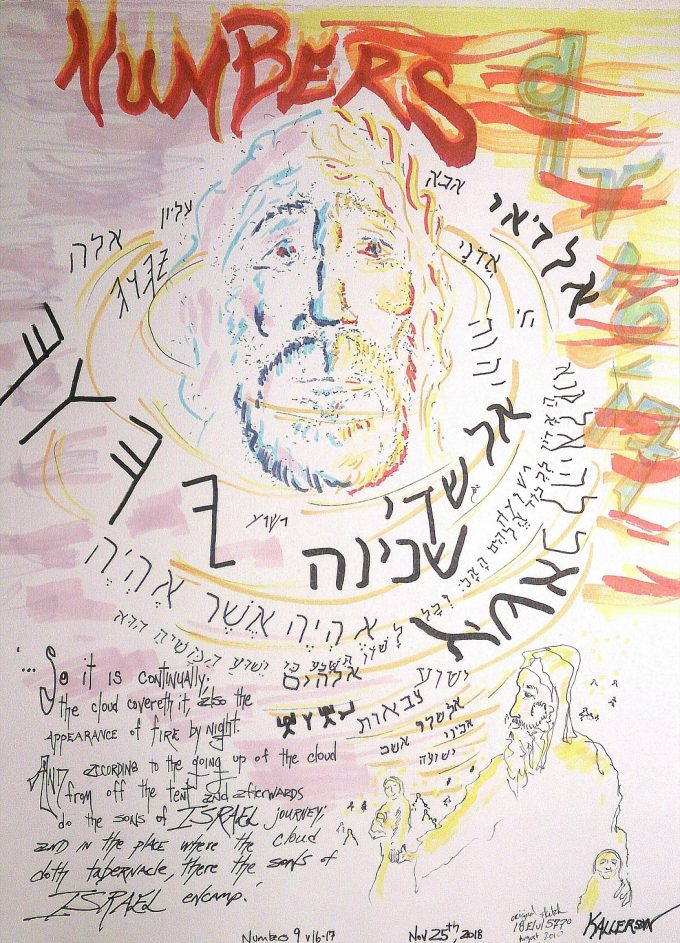
Numbers 9:15-23
Keeping the Charge of the Lord
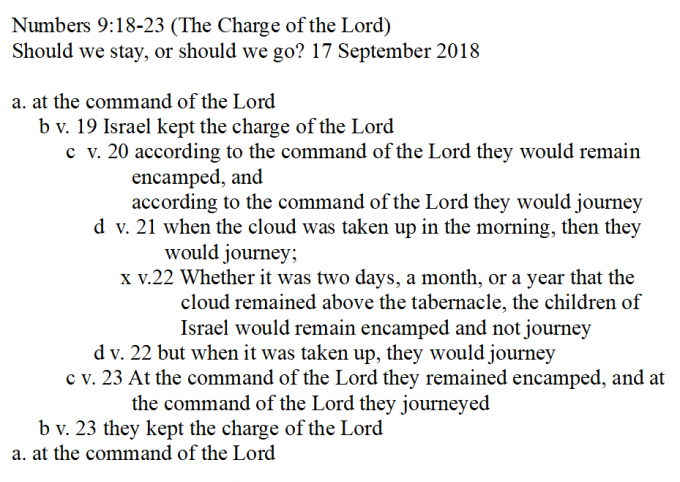
There is seemingly a lot of repetition in today’s verses, but each thought complements the previous thought, building upon it and providing a bit more insight into what the life of Israel in the wilderness was like. When you come to repetitive passages like this, you can almost bet they form a chiastic structure.
About halfway through the sermon, I was convinced this was so, and though I didn’t want to take the time out to look for a chiasm, I also thought it would be the best time to do so. I may never take the time again. And so I laid it out as I normally would, and sure enough, there is a chiasm there. Before we look at it, I will tell you that I then copied it to my regular folder where I keep them and, surprisingly, someone named Vince already found one in these same verses.
Vince has to be a friend of mine, because 1) it is in my folder and 2) I simply said, “found by Vince.” For the life of me, I cannot remember who Vince is or when he sent it to me. However, though the chiasm he found is in the same verses, and though it is laid out in basically the same manner as the one we’ll now look at, he cut his off shorter than it actually should be. So I don’t feel bad about both giving him credit for the chiasm, and for now presenting it as one I found on 17 September as well. All that does, is confirm that it was meant to be found twice.
I only wish I’d checked the folder before spending the time to look for it. It would have made my day a bit easier. But I also may not have noticed the full scope of it. So nothing is lost and something is gained.
Text Verse: “When the Lord has washed away the filth of the daughters of Zion, and purged the blood of Jerusalem from her midst, by the spirit of judgment and by the spirit of burning, 5 then the Lord will create above every dwelling place of Mount Zion, and above her assemblies, a cloud and smoke by day and the shining of a flaming fire by night. For over all the glory there will be a covering. 6 And there will be a tabernacle for shade in the daytime from the heat, for a place of refuge, and for a shelter from storm and rain.” Isaiah 4:4-6
Israel had a tabernacle in their midst. They encamped around it, and they moved at the command of the Lord to their next appointed stop on their journey towards Canaan. Above the tabernacle, there was a cloud visible by day, and within it, fire visible by night. In the future, not just a tabernacle, but all of Jerusalem will be covered with a cloud and smoke by day and the shining of a flaming fire by night. And there too will be a tabernacle.
The difference is that this one will not move. There will be no speculation as to when the Lord will pick up stakes and move on. What Israel in the wilderness hoped for, meaning attaining the promised rest of the Lord, Israel of the future will have realized. Each step of Scripture leads us a little further along the path to final glory. Along the way, the glory of the Lord is revealed, but it is also concealed. Until the coming of Christ, the reason for all of these things was completely unclear. But in Christ, every picture finds its fulfillment, and every shadow finds its substance. This is what is so wonderful about studying the Old Testament in Sunday sermons. When we come to our weekly Bible study where we are in the New Testament, which you all surely come to or listen to later, those things we talk about there make so much more sense. The two halves make a complete whole.
For now, let’s once again get into the first half. Great treasures are to be found in it. Yes, it’s all to be found in His superior word. And so let’s turn to that precious word once again and… May God speak to us through His word today and may His glorious name ever be praised.
I. Moving as the Lord Moves (verses 15-19)
15 Now on the day that the tabernacle was raised up,
These words now take us all the way back to Exodus 40. Right at the end of the book, we read the following words –
“Then the cloud covered the tabernacle of meeting, and the glory of the Lord filled the tabernacle. 35 And Moses was not able to enter the tabernacle of meeting, because the cloud rested above it, and the glory of the Lord filled the tabernacle. 36 Whenever the cloud was taken up from above the tabernacle, the children of Israel would go onward in all their journeys. 37 But if the cloud was not taken up, then they did not journey till the day that it was taken up. 38 For the cloud of the Lord was above the tabernacle by day, and fire was over it by night, in the sight of all the house of Israel, throughout all their journeys.” Exodus 40:34-38
This thought will be restated and expanded upon in our few short verses today. However, it is showing that the presence of the Lord is what remained with Israel, and it is what directed them throughout their journeys.
The account here is not chronological, but it expressive of what occurred from the time when the tabernacle was erected, through the departure from Sinai, which happened after the Second Passover, and which will continue all the way through the time in the wilderness. As Israel has been given the instructions on the Second Passover, and as they will depart shortly after that, this is the logical place to put this section. This presence was first noted in Exodus 13 at the time of Israel’s departure from Egypt –
“So they took their journey from Succoth and camped in Etham at the edge of the wilderness. 21 And the Lord went before them by day in a pillar of cloud to lead the way, and by night in a pillar of fire to give them light, so as to go by day and night. 22 He did not take away the pillar of cloud by day or the pillar of fire by night from before the people.” Exodus 13:20-22
Upon arrival at Sinai, the cloud rested upon the mountain. However, it would move to Moses’ tent at times in order to summon him –
“So it was, whenever Moses went out to the tabernacle, that all the people rose, and each man stood at his tent door and watched Moses until he had gone into the tabernacle. 9 And it came to pass, when Moses entered the tabernacle, that the pillar of cloud descended and stood at the door of the tabernacle, and the Lord talked with Moses. 10 All the people saw the pillar of cloud standing at the tabernacle door, and all the people rose and worshiped, each man in his tent door. 11 So the Lord spoke to Moses face to face, as a man speaks to his friend. And he would return to the camp, but his servant Joshua the son of Nun, a young man, did not depart from the tabernacle.” Exodus 33:8-11
At various other times, this visible manifestation of the Lord has been, or will be mentioned again. This is especially so to call attention to the importance of the events which are occurring. And, the last time that this pillar will be seen is towards the end of Deuteronomy. It will be when the Lord commissions Joshua to assume leadership of Israel –
“Then the Lord said to Moses, ‘Behold, the days approach when you must die; call Joshua, and present yourselves in the tabernacle of meeting, that I may inaugurate him.’
So Moses and Joshua went and presented themselves in the tabernacle of meeting. 15 Now the Lord appeared at the tabernacle in a pillar of cloud, and the pillar of cloud stood above the door of the tabernacle.” Deuteronomy 31:14, 15
That is immediately before the death of Moses, and just prior to entrance into Canaan. And so it can be seen that the presence of the Lord was truly with Israel from the exodus to the entrance; from Egypt to Canaan; from that which pictures leaving our life of bondage to sin, to that which pictures our entrance into the true Land of Promise where God’s rest is assured.
Before going on, and for the sake of clarity, two different things are spoken of in these verses. The first is ohel moed, or “the tent of meeting,” and the second is the mishkan, or “tabernacle.” It is rare to find a good translation which makes a distinction between the two, and because of this, there is inevitably a false sense of what is being relayed.
The tabernacle is an edifice which is inside of the tent of meeting. To correct the translation every time the tent of meeting is noted would be futile. However, when they are spoken of in the same verse, or in the same paragraph, it really is necessary to define which is being referred to. Otherwise, one would think they were the same thing. This becomes evident in the next words…
15 (con’t) the cloud covered the tabernacle, the tent of the Testimony;
kisah he’anan eth ha’mishkan le’ohel ha’edut – “covered the cloud the tabernacle of the tent the testimony.” Most translations make the two appear synonymous, as if the tabernacle is the tent of the Testimony, elsewhere known as the tent of meeting. They are not synonymous though. This is evident from the verse we already cited from Exodus 40:34 –
“And covered the cloud tent of meeting, and the glory of Yehovah filled the tabernacle.” (Charlie’s translation)
And so now in Numbers, we have no reason to assume that the cloud only covered the area of the tent of meeting where the Ten Commandments were kept. This is more evident because in Exodus 40, it then went on to say that Moses couldn’t enter the tent of meeting because the cloud rested upon it. The entire structure is being spoken of here when the term “tent” is used. The cloud covers the entire tent of meeting which covers the tabernacle.
This might seem like a frivolous thing to spend so much time on, but the Lord is the One who has, time and again, purposefully made a distinction between the two. One should ask, “Why the specificity?” The answer must be that one is referring to the deity of Christ, and the other is referring to His humanity. The tabernacle is kept from the sight of the people, whereas the tent is in view of all. The visible manifestation of the cloud and fire shows the people that the Lord is, in fact, residing in the tabernacle, and it is thus He who leads the people when the cloud moves.
The cloud is that which reveals, and it is also that which hides. The Lord’s glory was revealed on the Mount of Transfiguration, but it was also hidden by the cloud. Likewise, the ascension of the Lord on the Mount of Olives was evident in the cloud which also obscured Him from their presence. At the rapture, the saints will be caught up together in the clouds to meet the Lord. There is a revealing, and there is a concealing. Precision of terminology here in the events in the wilderness set the stage for concepts which continue on throughout Scripture.
And there is yet more detail to consider. The tent here is called the “tent of the Testimony” rather than its more common term, “the tent of meeting.” Instead of now referring to it as the place where Moses went in to meet with the Lord, it is referring to it as the tent where the tablets of the Ten Commandments were rested in the ark of the covenant. What the people saw from the outside, and which was covered by the cloud and the fire, was to be a constant reminder to them of the glory which they saw on Sinai when they were given the Ten Commandments. At that time, because of the grandeur of what their eyes beheld, this was the next thing the Bible records –
“Now all the people witnessed the thunderings, the lightning flashes, the sound of the trumpet, and the mountain smoking; and when the people saw it, they trembled and stood afar off. 19 Then they said to Moses, ‘You speak with us, and we will hear; but let not God speak with us, lest we die.’” Exodus 20:18, 19
By saying, “tent of the Testimony” here, it is given in relation not to Moses, but to the people. It is a witness and a reminder to them of what they had seen and been so fearful of. Understanding this, the cloud represents safety, as in a covering – such as from heat; protection – both for and from; God’s omnipotence and man’s ignorance; and so on. The presence of the cloud was the daily sign to the people that the Lord was there with them, but that Moses was the one who spoke to them. For them, it is the “tent of the Testimony.” For Moses, it is the “tent of meeting.” For both, it is where the word of the Lord issues from. For us, it is Christ Jesus, the embodiment of the law and the Word of God.
15 (con’t) from evening until morning it was above the tabernacle like the appearance of fire.
Whereas the Lord’s presence was visible as a cloud during the day, it would be as fire at night. Fire has multiple meanings in the Bible, but the fact that it is associated with the Lord, it would be emblematic of His glory, holiness, protection, judgment, purification, and so on. In both the cloud and the fire, there is the thought of a welcoming presence, and yet the need to stand in awed reverence and fear at the same time. The people were to be comforted that they were cared for by the Lord, and yet they were to remember that they were to honor the Lord as their God, and not tread upon, nor question, His sovereignty.
16 So it was always: the cloud covered it by day, and the appearance of fire by night.
The word tamid, or “always,” is the reason for these words now. The cloud was there on the day the edifice was erected, and throughout that night, it had the appearance of fire, but this wasn’t a temporary display. Rather, it was there from that time on. The words, “by day” are inserted here, which is fine. It says as much in Exodus 40:38. However, the idea is that it is the same cloud at all times. The appearance changes only because of the surrounding circumstances in relation to the people’s eyes. The Lord made Himself manifest in such a way that the people would always know He was there with them.
The amazing thing to ponder at this point, is that despite this cloud and fire being perfectly evident to the people, twenty-four hours a day and every day of the year, they still found reason to grumble, complain, and doubt the Lord. They literally saw an outward manifestation of His presence, and they lacked faith in Him nonetheless. It sounds like Israel at the time of Christ’s first advent, doesn’t it?
17 Whenever the cloud was taken up from above the tabernacle,
The Hebrew says, ohel, “tent,” not “tabernacle.” It is in reference to instruction for the people as a whole. In other words, the cloud rested upon the tent of the Testimony, but when it was time to move, it would rise on high. When this happened, it could be seen by all people, even to the extremities of the camp. When this occurred, it would be a sign to all. Then…
17 (con’t) after that the children of Israel would journey;
The rising of the cloud indicated that it was time to move. In obedience to that, the people would break camp, the priests would prepare the most holy objects, the Levites would perform their duties, and then the signal would blast, and the camps would depart, beginning with Judah. From that moment, they would continue on until the spot which the Lord would direct them to…
17 (con’t) and in the place where the cloud settled,
This should not be taken to mean that the cloud itself directed the people. Rather, when the people, according to the word of the Lord, had arrived at the spot where He had directed them to, the cloud would come down from its lofty height. It is the ark, carried by the Levites of Kohath, that would lead the entire procession. Above them would be the cloud on high for all in the ranks behind to see. This is certain because of Numbers 10:33, 34 –
“So they departed from the mountain of the Lord on a journey of three days; and the ark of the covenant of the Lord went before them for the three days’ journey, to search out a resting place for them. 34 And the cloud of the Lord was above them by day when they went out from the camp.”
The ark set out with the cloud above it. Where the ark rested, so the cloud dwelt, and this is where the tent of the Testimony would again be erected, and also it was…
17 (con’t) there the children of Israel would pitch their tents.
The ark would be set down, the tent would be erected over it, and then the priests would uncover it. At the same time, the children of Israel would be arriving according to their placement around the sanctuary, and they would there pitch their tents.
18 At the command of the Lord the children of Israel would journey,
Here it says, al pi Yehovah – “according to the mouth of Yehovah.” Most scholars treat the rising, movement, and stopping of the cloud as “the command of the Lord.” However, this seems unlikely. What appears to be the case is that the command of the Lord is given to Moses, signifying they were to move out. In confirmation of this, the sign to the people is the rising of the cloud. From there, Israel would journey to where they were told to go. While going, the cloud remained above the ark wherever it was carried by the Levites who had been told where to go. From there…
18 (con’t) and at the command of the Lord they would camp;
Again it says, “according to the mouth of the Lord.” The Lord directed when and where to go, and the sign to them was His presence above the ark as it traveled. From there, they would stay until directed to break camp once again. This was what was expected, and it was for…
18 (con’t) as long as the cloud stayed above the tabernacle they remained encamped.
As Matthew Henry says of their movement, “There is no time lost, while we are waiting God’s time.” The people were to do as instructed, and to remain where the presence of the Lord was. To depart from that would mean disobedience. These things are certain, because in Numbers 14, after a rebellion by the people in refusing to go into Canaan, the Lord told them that they were to remain in the wilderness until they died. Some of them, however, decided to go forward and right the wrong of their refusal by entering the land. However, that meant only more disaster –
“Then Moses told these words to all the children of Israel, and the people mourned greatly. 40 And they rose early in the morning and went up to the top of the mountain, saying, “Here we are, and we will go up to the place which the Lord has promised, for we have sinned!”
41 And Moses said, “Now why do you transgress the command of the Lord? For this will not succeed. 42 Do not go up, lest you be defeated by your enemies, for the Lord is not among you. 43 For the Amalekites and the Canaanites are there before you, and you shall fall by the sword; because you have turned away from the Lord, the Lord will not be with you.”
44 But they presumed to go up to the mountaintop. Nevertheless, neither the ark of the covenant of the Lord nor Moses departed from the camp. 45 Then the Amalekites and the Canaanites who dwelt in that mountain came down and attacked them, and drove them back as far as Hormah.” Numbers 14:39-45
The people lacked the ark, and thus they lacked the presence of the Lord that moved with the ark. The details are coming soon to a disaster sermon near you.
19 Even when the cloud continued long, many days above the tabernacle,
The term yamim rabim, or “days in abundance” can mean “years.” It is an indefinite amount of time, and it was left solely up to the word of the Lord to determine when the camp would again be broken down and moved. While not moving, it says that “Israel kept the charge of the Lord.”
One might wonder why this is expressed. But it becomes obvious when we think of what it might have been like. Was it a horrible spot that lacked any excitement or beauty? Were the tents laid out over rocky, uncomfortable patches of land? Was there nothing but briers and thorns all around? That didn’t matter. The people were to look to the Lord and not the dull, barren, and bitter landscape. He provided them water, manna came six days a week, and He was to be their hope and confidence, not a lust for the world in which they lived.
19 (con’t) the children of Israel kept the charge of the Lord and did not journey.
The word mishmeret, or “charge” signifies that which is to be kept or watched. The people posted sentinels; the people kept the commands of the Lord, living out their lives in accord with His commands and precepts; the people obeyed the law to stay until directed; the priests obeyed the daily rituals and sacrifices of the sanctuary. All of this, and surely more, is included in keeping the charge of the Lord. But mostly, according to the verse itself, it speaks of not journeying as long as the cloud continued above the tabernacle. The people stayed put and kept His charge in doing so.
The spot where we are now is so beautiful and nice
There is a stream of cool water running through it
We can relax and eat dates, and have a meal filled with spice
But to this place, our hopes we surely won’t commit
When the call is made, on we shall go
And maybe the next spot won’t be so grand
But we will be content there; certainly it is so
Even if we spend a year in that barren, wasted land
Our joy isn’t found in a temporary oasis
Nor are we despondent in a rough and ruined land
Such temporary things for our joy are not the basis
Instead, our hope and joy comes from the Lord’s gracious hand
Thank You for Your presence that fills our souls with delight
Thank You, O Lord, our hope, our joy, our ever-shining light
II. At the Command of the Lord (verses 20-23)
20 So it was, when the cloud was above the tabernacle a few days: according to the command of the Lord they would remain encamped, and according to the command of the Lord they would journey.
The opening words, v’yesh asher, or “and sometimes…” are given now to show obedience to what was stated in the previous verses. In other words, one might say, “When Charlie ran the wastewater plant, and whenever he changed the shift schedule, the employees would work their new shifts. He might change them every month, or once every year. But whenever he changed the schedule the employees obeyed the directive. And sometimes he changed the schedule after two weeks, according to his change, the employees would show up to work. And sometimes he changed the schedule once a year, according to that, so they would show up to work.”
For now in Numbers, one might wonder how many different ways the idea of staying put and picking up and moving out can be expressed. Already, the idea has been spoken out three times in three different ways. The last was “many days.” Now it speaks of yamim mispar, or “days of a number,” meaning “a few days.”
Whereas verse 19 spoke of being obedient and staying put, even if the scene was one which was boring, ugly, and deprived of comfort, the spot they next arrived at may have been a beautiful oasis in the middle of the desert where the children could play and the people could smell the fragrant beauty of flowers. Where the tents were set up, the ground might have been soft and cushy. Surely in such a place, the Lord would allow them to hang around for a while and enjoy the comfortable life. But no! This didn’t matter. When it was time to go, they would have to acknowledge the Lord’s call and depart to wherever He next led, not knowing if it would have dates and grass, or rocks and snakes. The Lord’s word was their call to depart.
21 So it was, when the cloud remained only from evening until morning:
Again is says, v’yesh asher, or “And sometimes.” Now the thought is expressed again, but in another new way. The people picked up and moved, arriving in the evening. Their bodies were tired, their minds were racing at the anticipation of sleep and then exploring their surroundings, and the children were intent on finding their friends and playing in a new environment. But no! They set up camp in the evening, sat down to eat, went to bed unable to sleep because of the day’s events and the events of the anticipated day to come. And yet, no sooner had they gone out to collect the day’s manna, then they were alerted to the rise of the cloud and the call to move.
The beautiful date palms were filled with ripe fruit. The junipers smelled of delight, the wild ibis covered the hillside, waiting to be shot with an arrow, roasted over a fire, and mixed in with curry and spice kept from the departure from Egypt. But no! The cloud had arisen, the call to move was made, and the laborious job of breaking down camp, the tedium of waiting for the signal to move, and the tiring trudge in the heat commenced once again. All of this because…
21 (con’t) when the cloud was taken up in the morning, then they would journey;
He is the Lord; we are His people. We are to keep His watch, including the call to move. So we shall do. He is the Lord; we are His people.
21 (con’t) whether by day or by night, whenever the cloud was taken up, they would journey.
Many days or few, or even after a single night. But now, now we are to pick up and move by night! The word went out, and the fiery cloud has risen. There would be no chance to go out and pick a few dates for the trip, and there would be no chance to watch the sun set over the two v-shaped rocks one more time. No. The ark is setting out and so too shall we.
At least walking in the night would be cooler than during the day. That is a plus, unless it was winter time. Even in the desert, the temperatures would get uncomfortably cold at night. And more, traveling at night would mean uncertainty about where to step, if there were snakes or scorpions, and the like. For every positive about traveling by night, there were also two negatives. But the Lord is on the move, and we are His people. We too shall move.
The notion that the Lord first spoke the word of when to go and where to go, and that it wasn’t just following the cloud as he led, is confirmed by the words of Moses to his father-in-law Hobab. In Numbers 10, where we will read –
“So Moses said, ‘Please do not leave, inasmuch as you know how we are to camp in the wilderness, and you can be our eyes. 32 And it shall be, if you go with us—indeed it shall be—that whatever good the Lord will do to us, the same we will do to you.’” Numbers 10:31, 32
If it were merely a matter of following the pillar of cloud and fire, Moses would never have said this to him. Moses did not shun acknowledging a sound guide could both lead the way to where they were next instructed to go, but one who would lead them on a path that was conducive to such a trek. Going left around the next mountain might take an extra two hours, but it would be flat earth and not paths of rocks. The Lord gave the word, the pillar was the sign of it, and the people responded in accord with the word given and the sign provided, even at night.
22 Whether it was two days, a month, or a year that the cloud remained above the tabernacle, the children of Israel would remain encamped and not journey;
And again, the thought is expressed in another entirely new way by stating words which encompass several thoughts already expressed. First, it says yomayim, a way of expressing a two-day period, such as when the manna was given on the sixth day for a day and another day. It would be long enough to wash the clothes and relax, or have a sabbath if they arrived on a Friday. There would be time to see what was around them, but not enough time to get up and really explore. As soon as they were ready to call the place home, they would be told it was time to go.
Next, it says, a month. The Lord might give them time to gather up what was usable in the land around them, make some bows and arrows or spears, enjoy a feast period, or whatever. A month would be long enough to tell them if they didn’t like the place. If so, they would be happy to leave. Or, it would be long enough to tell them they loved the place and wished they could have stayed longer.
And finally, it says, “or a year.” The term is yamim; days. It generally gives the sense of a fullness of time. It may mean a year, and based on the previous two time-frames, that is not unlikely. It is simply an indeterminate amount of time. The thing about it being two days, one month, or one year, is that it didn’t really matter.
Because the Lord could move at any time, there was no time that the people could say, “Well, we can settle down here and relax.” And there was no time that the people could say, “It will be great to leave here soon.” They had no idea. The time period to us is one of looking back on a known. The time period to them was looking forward to an unknown. They were wholly dependent on the Lord’s decision, and there was nothing that could change that, whether they were content in a spot or not they would stop and wait…
22 (con’t) but when it was taken up, they would journey.
Apart from the Lord, there could be no long-term planning, but because of His presence with them, there was no excuse for only short-term planning. The two thoughts are both beautifully summed up elsewhere in the Bible. First from James –
“Come now, you who say, ‘Today or tomorrow we will go to such and such a city, spend a year there, buy and sell, and make a profit’; 14 whereas you do not know what will happen tomorrow. For what is your life? It is even a vapor that appears for a little time and then vanishes away. 15 Instead you ought to say, ‘If the Lord wills, we shall live and do this or that.’ 16 But now you boast in your arrogance. All such boasting is evil.” James 4:13-16
The second thought is expressed in the proverbs –
“A good man leaves an inheritance to his children’s children,
But the wealth of the sinner is stored up for the righteous.” Proverbs 13:22
The people were to occupy, but not assume. They were to be diligent in their daily life, but ready to depart from it on a moment’s notice. In essence, they were to trust in the Lord, be obedient to His call, and willing to accept His decision in whatever occurred in their lives.
23 At the command of the Lord they remained encamped, and at the command of the Lord they journeyed;
Letter for letter, the words are identical to the final clause of verse 9:20. The repetition is given as a sign of obedience to the word. Preceding it in verse 9:20, it went from many days to a few days. Here it goes from two days to a year. The idea is one of voluntary, complete, and absolute submission to the call of the Lord, and to that alone. The words of this section had to have been recorded at the end of the wilderness wanderings, and were probably penned by Moses just prior to his being called up to the heights of Mount Nebo to see the Land of Promise before he died. However, they are logically inserted here, just prior to their departure, to highlight the words now before the times of trouble, leading to punishment, come about. Despite those failings, the people remained under the care of the Lord, moving at His command and direction, in order to eventually find their way to the place where they would enter into their allotted inheritance.
23 (con’t) they kept the charge of the Lord,
This is a general repeat of verse 19 which said, “the children of Israel kept the charge of the Lord. They followed His commands, they spent their lives in obedience to the law, they moved when He directed, the priests tended to their sacred duties, the Levites broke down and re-erected the sanctuary, and they waited… they waited upon the Lord and upon His word to continue on the path He set before them. As it says, they kept this charge…
*23 (fin) at the command of the Lord by the hand of Moses.
The Lord spoke to Moses, and Moses relayed the words to the people for their hearing. Again, as before, we can see that the movement of the cloud was a sign in confirmation of the word of the Lord. If the charge of the Lord includes obedience to the movement of the people, as it surely does, then that movement was spoken out first to Moses and then relayed to the people. When they moved, it was in ranks behind the ark. And where the ark moved, so the cloud moved with it.
In this, the word of the Lord is confirmed by the Lord. It was not Moses’ word to the people, but the Lord’s word through Moses. This is why a challenge to Moses was implicitly a challenge to the Lord Himself. Such will be the case in the chapters ahead, and so terrible will be the downfall of those who so challenge him. In the end, when the Lord speaks, it is the duty of man to pay heed to the Lord’s word, and to accept it in the context of the day in which it is received. The Lord spoke to and through Moses, and His words were found binding upon the people who heard them. The Lord continued to speak through His prophets until the time of John the Baptist, proclaiming the word of the Lord, but also proclaiming a greater Word to come.
Moses himself testified to the coming of Christ. Philip confirms that in John 1 when speaking to Nathanael. He said, “We have found Him of whom Moses in the law, and also the prophets, wrote—Jesus of Nazareth, the son of Joseph” (1:45). Jesus Himself says the same. In John 5:46, speaking to the Jews, He said, “For if you believed Moses, you would believe Me; for he wrote about Me.”
Think it through… if the Lord spoke through Moses, and if Moses wrote about Jesus, then the Lord was speaking through Moses’ hand about Himself, when He would come as a Man. As this is so, then Jesus’ words are the word of the Lord and are binding on those who hear it. We cannot escape judgment if we reject Jesus, and that means Jesus in the context of the day in which He is proclaimed.
Christ came under the law, He lived out the law, and He died in fulfillment of the law. There is no other place to go than to the New Covenant which supersedes the Old. We study Moses in this church because we love Jesus. We are obedient in this church by being obedient to Moses… What! Yes, not to the Law of Moses, but to what the Law of Moses says to us about Jesus. It is He who said, “I will raise up for them a Prophet like you from among their brethren, and will put My words in His mouth, and He shall speak to them all that I command Him. 19 And it shall be that whoever will not hear My words, which He speaks in My name, I will require it of him” (Deuteronomy 18:18, 19).
Yes, Moses foresaw Jesus and said, “If you want to be obedient to the Lord, then you will hear the word of the Lord through this Prophet to come.” The Old is not an end in and of itself, and the trek to Canaan was not the end of the story. It was merely a step on the way to the coming of true glory. What the cloud and fire only anticipated was the coming of Christ.
Let us not be found deficient in our theology by assuming that tents, boxes of wood and gold, and tablets secreted away from sight, to be carried on the shoulders of men, is the end of our faith. No, the Lord whose blood was shed and sprinkled on the true Mercy Seat, and whose Spirit we carry in ourselves when we call on Christ – it is He who is the Author and the Finisher and the end goal of our faith. It is He who is only pictured in these temporary manifestations of the future glory found in Christ Jesus.
Each step of the book of Numbers is another step leading us to that glory. Without this law, we cannot actually appreciate what it took to get us to Him. Every step in the barren wilderness is a step towards the coming of the Lord. In this land where snakes bit at the heels of those who complained, but on whose feet were shoes that didn’t wear out for forty years, miracle upon miracle heaped up as a way of bringing this group of people to a unity that would last beyond all possibility. It is this foundation which united them, and it is in their remaining united that Christ was able to come. And it is in their continued unity for which Christ will come again.
But in the meantime, he is building a church. Someday, before He returns to His people Israel, in the land of Israel, He will first come for that church. It is hoped that you will be ready for that day by calling on Him now. When the call is made, you need to be ready to move.
Closing Verse: “Moreover You led them by day with a cloudy pillar,
And by night with a pillar of fire,
To give them light on the road
Which they should travel.” Nehemiah 9:12
Next Week: Numbers 10:1-10 Tastier than tea and crumpets… (Two Silver Trumpets) (18th Numbers Sermon)
The Lord has you exactly where He wants you. He has a good plan and purpose for you. It may seem at times as if you are lost in a desert, wandering aimlessly. But the Lord is there, carefully leading you to the Land of Promise. So follow Him and trust Him and He will do marvelous things for you and through you.
Keeping the Charge of the Lord
Now on the day that the tabernacle was raised up
The cloud covered the tabernacle, the tent of the Testimony
———-this did transpire
From evening until morning
It was above the tabernacle like the appearance of fire
So it was always:
The cloud covered it by day
And the appearance of fire by night
Such was this marvelous display
Whenever the cloud was taken up
From above the tabernacle, at the time of these events
After that the children of Israel would journey
And in the place where the cloud settled
———-there the children of Israel would pitch their tents
At the command of the Lord the children of Israel would journey
And they would camp at the command of the Lord
As long as the cloud stayed above the tabernacle
They remained encamped, according to His word
Even when the cloud continued long
Many days above the tabernacle; however long it would be
The children of Israel kept the charge of the Lord
And did not journey
So it was, when the cloud was above the tabernacle a few days
According to the command of the Lord, so would it be
They would remain encamped
And according to the command of the Lord they would journey
So it was, when the cloud remained
Only from evening until morning; this amazing sight
When the cloud was taken up in the morning
Then they would journey; whether by day or by night
Whenever the cloud was taken up, then so would it be
Then at this time they would journey
Whether it was two days, a month, or a year
That the cloud remained above the tabernacle, so would it be
The children of Israel would not journey
———-but would remain encamped
But when it was taken up, they would journey
At the command of the Lord they remained encamped
And at the command of the Lord they journeyed
———-so we understand
They kept the charge of the Lord
At the command of the Lord by Moses’ hand
Lord God, we are even now in a wilderness
And we are wanting to be led by You
Without You to direct, our lives would be a mess
And so be our guide, O God; You who are faithful and true
We long for the water in this barren land
May it flow forth from the Rock, our souls to satisfy
|Give us this refreshing, spiritual hand
And may we take it, and to our lives daily it apply
And we shall be content and satisfied in You alone
We will follow You as we sing our songs of praise
Hallelujah to You; to us Your path You have shown
Hallelujah we shall sing to you for all of our days
Hallelujah and Amen…