Numbers 10:1-10
Two Silver Trumpets
What does it mean to be remembered before the Lord? How do we take that? The Lord doesn’t forget, and indeed He cannot forget. He is all knowing, or He ain’t God. The thought of forgetting something in the Bible is that of pushing something actively out of remembrance, even if it isn’t actually forgotten. And then remembering something is an active calling it back to mind, meaning to the attention of one’s focus.
And so when we read a passage like today’s and the Lord says that He will remember the people, it does not mean that He forgot them. Rather, it is that He will take action on their behalf. The verses today are often spiritualized to indicate that the sound of the trumpets is as the sound of preachers and others, proclaiming the gospel of Christ. Although that is flowery and fun, it doesn’t convey the intent of what is being presented here.
And more, that analogy is then taken further by some to say that the words of Paul in 1 Corinthians 14:8, are speaking of the different sounds of the trumpet explained in this passage. There Paul says, “For if the trumpet makes an uncertain sound, who will prepare for battle?” Hence, we need to have clarity of speech when we preach the gospel. That isn’t correct, thank goodness, because as you know, I have the most twisted tongue on the planet.
It is wrong for a couple of reasons. First, it is mixing types of trumpets. The silver trumpets and the ram’s horn had different purposes. Secondly, Paul is referring to the speaking of tongues in a congregation, not specifically preaching the gospel. He was looking for order within the church, not people confusing others with languages unknown to the hearer. As a hint of what these are picturing, we go to Malachi for our text verse today…
Text Verse: “Then those who feared the Lord spoke to one another, And the Lord listened and heard them; So a book of remembrance was written before Him For those who fear the Lord And who meditate on His name.” Malachi 3:16
Another commentary I read also noted that the analogy of these trumpets as being the preaching of the gospel was wrong. In his eyes, they picture prayer before the Lord. He based that on the idea of being remembered before the Lord God, and prayer is what makes that happen. After a page long analysis, he still didn’t defend the case very well. He was correct that it isn’t the preaching of the gospel, but his thoughts on it being prayer don’t add up.
The reasons are too long to go through now, but with a complete and thorough evaluation of the verses, you will see this as well. The two main things to focus on and keep asking yourself while we are going through the passage are, “Why two trumpets?” and “Why silver?” The answer to those questions, combined with the four main purposes which are given for them, will provide the answer.
There is the literal, historical meaning concerning these two trumpets, and then there is, as almost always with passages like this, a pictorial meaning as well. No it is not the preaching of the gospel, nor is it prayer. But both of those are a part of what is pictured. The passage is a marvelous part of His superior word. And so let’s turn to that precious word once again and… May God speak to us through His word today and may His glorious name ever be praised.
I. Make Two Silver Trumpets (verses 1-8)
And the Lord spoke to Moses, saying:
The timing of these words cannot be known. It could be that they were given at the time of the construction of the sanctuary first mandated all the way back in Exodus 25:1. It could have been at some point after the sanctuary was fully set up as is recorded in Exodus 40. It may be that the Lord waited until the camps were arranged in the form of a cross that He speaks out the words to Moses, simply because of what the coming words proclaim.
Each is possible, but no option can be dogmatically claimed. All we have is that the words are stated here, regardless as to when they were spoken. What is important then is not the timing of the instructions given, but the placement of the words in relation to the events which surround them.
The context is that the Little Passover was proclaimed and observed. That was followed by the note about the pillar of cloud and fire which covered the tabernacle, the tent of the Testimony, and that it would continue to be with the people throughout their journey to Canaan. Now, after mentioning that, this passage of ten verses is given. Immediately following this section will be the actual departure from Sinai.
Therefore, what will be presented, even without yet looking at the verses, is intricately connected to the thought of the movement of the people as a united force. Anything beyond that thought will require explanation, but the placement of the passage here is meticulously determined and should be considered as such. With that understanding, we now turn to the purpose of the passage and the reason for the words to Moses, which is that he is to…
2 “Make two silver trumpets for yourself;
aseh lekha shete khatsotsrot keseph – “Make for yourself two trumpets silver.” It is a new word in Scripture, khatsotsrah, or trumpet. These will be seen twenty-nine times, five in Numbers and the majority of the uses will be in 1 and 2 Chronicles. The word is derived from khatsar, meaning “to blow.” That, in turn, comes from a primitive root meaning “to surround with a stockade, and thus to separate from the open country” (Strongs). Knowing the meaning of the root, and without going any further, we can immediately assume that the trumpets will have the intent of gathering together, or separating things one from another. These are not to be confused with the shophar, or ram’s horn trumpet which is seen elsewhere, such as in Leviticus 25:9 which said –
“Then you shall cause the trumpet of the Jubilee to sound on the tenth day of the seventh month; on the Day of Atonement you shall make the trumpet to sound throughout all your land.” Leviticus 25:9
As they are specified to be made of silver, it would be good to remember what silver symbolizes in the Bible. In short, it pictures redemption and in paying of a ransom. In other words, redemptive works in general. This has been seen time and again from Genesis on, but especially in the construction of the sanctuary and in the payment of the ransom money by the people. It is certain then that the same general and consistent meaning would continue to be applied here in these silver trumpets.
2 (con’t) you shall make them of hammered work;
miqshah ta-aseh otam – “of hammered work you shall make them.” The work is to be misqshah, translated here as “hammered.” The word has only been used to describe the cherubim at the ends of the mercy seat, and of the making of the menorah. Whether it is actually “hammered work” or not is disputed. The word comes from miqsheh which means “a fancy hairdo.” So, it could be a turning of metal, like the braids of hair, or it could be a hammering of metal for shaping.
This is the last use of it in the books of Moses, and it will be seen only one more time in Jeremiah 10:5, where it is widely translated, showing that even the best translators can’t come to a sound agreement on what is being relayed there. However they were formed, they were of silver and Moses is then told…
2 (con’t) you shall use them for calling the congregation
v’hayu lekha l’miqra ha’edah. There is one verb and two nouns. It, therefore, actually more precisely says that they are to be used “for the call of the congregation.” What is implied is that the congregation is in one state, and the trumpets are used as a call, thus alerting for a change in that state. At this point we don’t know what the call is, but that will be defined in the verses ahead. It is not a single call, but a call as a particular sounding is made.
The call could be for breakfast, tootle-doo. The call could be made for doing laundry, tootle-dee. The call could be made for dinner (mmmm lamb chops), tootle-dum. These are to be used for “the call” of the congregation, whatever that call is. Precision of translation, in using the noun, reveals this more poignantly to us. Though a bit stiff in wording, Robert Young gives a very good sense of the words by saying, “and they have been to thee for the convocation of the company.”
The trumpets are the instruments used for the convocation of the congregation. The sound of the call is the instruction for what part of the congregation, or the specific direction to the congregation. It’s actually exciting to understand the nuances of the words in advance of the coming instruction. Along with this first purpose, there is a second purpose next given, which is…
2 (con’t) and for directing the movement of the camps.
U-l’massa eth ha’makhanot – “and for the breaking of the camps. The word massa, or “the breaking,” is a noun. The word ha’makhanot has an article, ha, and then makhanot is plural – “the camps.” The idea one gets from these words is that the people are encamped. The trumpets will be used for alerting them that it is time to break down their tents and to move. However, the plural, ha’makhanot, or “the camps,” is specific. Some translations say, “the camp,” as if the entire congregation is to suddenly break down and move. That is not the intent at all. The term, “the camps,” means the several divisions that were described in Numbers 5.
There we learned that it was either the various camps as they are arranged around the sanctuary, such as the divisions to the east, which included Moses and Aaron and the tribes of Judah, Issachar, and Zebulun. Or, it may mean the three divisions of camps – the sanctuary itself, the Levites which surround that, and then the rest of Israel which branches out.
In this case, it is probably the former. After this short passage, the rest of Chapter 10 will deal with the actual departure of the people from Sinai, being led by the standard of the camp of Judah. After that, the tabernacle will be taken down, and so on. It would be the trumpet to direct these individual movements. It is a process which would take hours to complete.
For the last of the camps to break down at the same time as the first of the camps, it might mean that they would be standing in the hot sun half the day. Rather than that, the trumpets would call to the individual camps and alert them that they would need to prepare based on the movement of the camp which went before them. This would be an orderly movement which would be accomplished in a marvelously fashioned way.
Sadly, the vast number of translations do not do a good job of properly conveying the intended meaning of this verse. As an example of really missing the intent, the Douay-Rheims says, “Make thee two trumpets of beaten silver, wherewith thou mayest call together the multitude when the camp is to be removed.”
The number of errors in that one translation makes it impossible to grasp the beauty of what Moses is being so meticulously instructed by the Lord. He is carefully and methodically detailing the purpose of these now so that we, 3500 years later, can mentally follow along as if we were there, watching the people kick up the dust of departure and head out to the sound of these tootling trumpets.
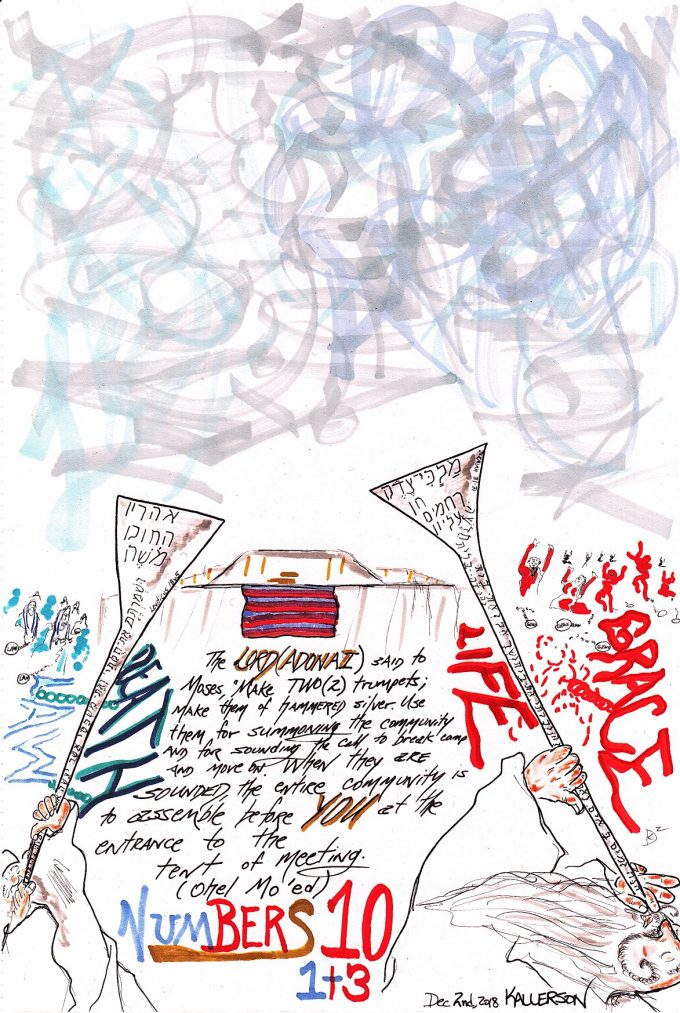
As far as their actual shape, we, fortunately, have a visual depiction of them revealed to us from antiquity. After the siege and destruction of Jerusalem in AD70, the Romans commemorated the event with a carved mural on the Arch of Titus. There, on the mural are several of the implements used in the service of the Lord, including these two trumpets, and so there is no need to guess what they look like. They are straight thin horns that flare out at the end. Flavius Josephus says they were a bit less than a cubit in length. The depiction on the arch seems to show them being much longer, but that is probably because the end piece is placed onto a wooden pole as it was stored. In reality, they were a bit less than the length of a man’s arm from elbow to fingertip.
The reason for being two of them isn’t given, and it is supposed that it is because there are only two priests, Eleazar and Ithamar, to sound them. That may be, or it may not logically follow. First, Aaron is also a priest, but he is not included in this duty. Only his two sons are. Secondly, in Joshua 6, there will be seven priests who blow seven ram’s horns, not seven of these, before the ark. In 1 Chronicles 15:24, seven named priests are said to blow this same type of horn described now before the ark. And in 2 Chronicles 5:12, there will be 120 priests all blowing this same type of trumpet. Only two are specified to be made here.
What seems more likely is based upon the words of Josephus. He indicates that one trumpet was always used to call the nobles, and the other was used to call the people to assemble. Thus, they were probably different in sound so that those who heard could distinguish first by 1) the sound of both being blown together, 2) the sound of each individually, and then 3) by any particular tune. The fact that there were many of the same general types of trumpets made later does not mean that they were used for the same purposes as these two which have been specially mandated by the Lord. Regardless, the Lord now gives particular instruction concerning them…
3 When they blow both of them,
v’taqeu bahen – “when they shall blow with them.” The plural indicates “both” as will be distinguished from the words of the next verse. The word taqa means to thrust, clap, blast, blow, and so on. It can be used to indicate pitching one’s tent, because one must thrust the tent pegs into the ground. It is used in Judges to describe thrusting a dagger into the belly of another, and so on. The horns would be blown in a forceful manner, as is the case with such wind instruments. In this case, it would be with both being blasted out at one time, this was so that…
3 (con’t) all the congregation shall gather before you at the door of the tabernacle of meeting.
This was a general sounding to alert the entire congregation. However, it doesn’t mean that, literally, the entire congregation would show up there. Depending on the amount of open area, it might be impossible for such a large number to gather at that spot. What is probably meant is the representatives of the numbers – tens, hundreds, and/or thousands. Even then, it could be a very large gathering.
4 But if they blow only one,
v’im b’akhat yitqau – “and if with one they blow.” This is a rather difficult set of words to be dogmatic about. It says, akhat, or one, but then it says yitqau, or blow, but it is plural. Therefore, it could be that one of the two is being spoken of, or that both blow “but once.” Meaning “at the same time.” Both are blown, but they are one, uniform, even sounding.
4 (con’t) then the leaders, the heads of the divisions of Israel, shall gather to you.
These would be the heads of thousands, or divisions. It is probably the same twelve leaders who were named in Numbers 1:5-16 during the original census who are being referred to here.
5 When you sound the advance,
u-teqatem teruah – “And when you blow a shout.” The word teruah signifies a loud, continuous alarm. This would be different than the calling of the congregation or the leaders, which was a short blast – whether by one or by both trumpets. The similarity to the Roman sounding of the Clarion, taratantara, leads some to believe that this would be short, broken tones, which are then terminated with long ones. Regardless, this blast would be a recognizable alarm that would probably have brought a sense of true excitement to everyone as…
5 (con’t) the camps that lie on the east side shall then begin their journey.
With the sound of the teruah, Judah would head out, following the ark of the covenant which would lead the way, as is noted in verse 33 of this same chapter. It would be a rather amazing feeling to hear that sound, and to contemplate what lay ahead. Each step taken would be one step closer to the land of promise. With the ark of the Lord leading their way, covered by the pillar of cloud, it would be a wonderful assurance to them that their true home was ahead and waiting for them.
6 When you sound the advance the second time,
u-teqatem teruah sh’nit – “and when you blow a shout the second.” It is the same blast which began the procession, and which is now being blown to continue with the advance, as next stated…
6 (con’t) then the camps that lie on the south side shall begin their journey;
To get a mental picture of this, there is first the ark. Then after that will be the tribes with Judah east of the sanctuary. This would be followed by the carts carrying all of the items of the sanctuary except the most holy objects. Once they were broken down, placed on carts, and had departed, then those on the south side, meaning the right side of the massive cross, would then begin their march.
6 (con’t) they shall sound the call for them to begin their journeys.
teruah yitqeu l’masehem – “a shout they shall blow for their breaking camp.” With these words ends the directions for the setting out. But this leaves an obvious question, “What about the camps to the north and to the west?” Everything so far has been so detailed and so specific, and yet no direction is given for them. There are one of two possibilities for us to consider. The first is that a portion of the text is missing because the Greek translation of the Old Testament adds in the following –
“And ye shall sound a third alarm, and the camps pitched by the sea (i.e., westward), shall move forward; and ye shall sound a fourth alarm, and they that encamp toward the north shall move forward; they shall sound an alarm at their departure.” (Ellicott’s translation).
The second possibility is that the horns were carried along in the same procession with the most holy objects. If so, then the final tribes would have to simply be ready to depart at the appropriate time. This seems the most plausible explanation. The ark went first, but a distance of holiness was most probably to be maintained between it and the people, and so when that distance was sufficient, the horn would blow to alert the standard of Judah to move.
And again, the implements of the sanctuary would follow them at a distance, and so another blast would be needed to alert those on the south when to go. After that, the most holy objects, which were carried by the Levites would then go out when instructed by Eleazar and Ithamar, including these trumpets. Finally, the last two tribes could pick up and move out in order without a need for the trumpets to alert them.
Requiring a certain span for the objects on the carts and for those carried by the Levites would be wise because the amount of dust in the air would cover those sacred things unless a suitable span was made to allow it to settle. After the carried items set out at an agreeable distance, there would be no need for this concern again.
This seems all the more sure, because the addition to the Greek translation is not supported by the Samaritan Pentateuch, the Coptic versions, or anywhere else of note. Instead, the omission seems purposeful, and it is because of the implements of the sanctuary in relation to the tribes that this is so.
And so, to finish this thought, the blast is an indication of marching divisions in relation to the ark and the sanctuary implements. As those are complete after the divisions to the south move, no further blast was necessary. The march of the Lord’s honor guards, meaning the Levites and their implements, was now complete.
7 And when the assembly is to be gathered together, you shall blow, but not sound the advance.
This is taking us back over the previous verses, and it is intended to show a specific difference between the blasts for calling the assembly as directed in 3 & 4, and for the sounding of the advance as directed in verses 5 & 6. There is the calling together of the people with a long, even, and uninterrupted peal, and there is the compelling of them to separate in the advance with short, sharp blasts. The two were to be carefully adhered to. The advance was not to be sounded at the calling of the assembly.
8 The sons of Aaron, the priests, shall blow the trumpets;
Here we see that the blowing of these particular trumpets is reserved for the priestly class alone. At least for these sacred callings, it was not a duty to devolve to either Levite or commoner, but was for the line of Aaron. The same word for trumpet used here is used later in Kings and Chronicles to describe a trumpet not used by priests. If these were the same type of trumpet or not, or if those were not counted in the sacred callings mandated for the priests, isn’t known. However, for the special callings noted here, only the priests were to make the sound.
As the priests mediated between the people and the Lord, the idea is that when the sounds of priestly call were made, it was as if the Lord Himself was making them.
8 (con’t) and these shall be to you as an ordinance forever throughout your generations.
The words here indicate that the trumpets were not just for the call of the assembly on their march to Canaan, but they were for calling the people in that regard now, and for what will next be mentioned in the final two verses of the passage. The call was to be made by the priests on behalf of the Lord, and it was to be as an ordinance under the Mosaic covenant olam, or “to the vanishing point,” and throughout the generations of the Aaronic priesthood. The effectual nature of both of these thoughts is ended in Christ. However, the fulfillment of the symbolism of them continues on in Christ.
Trumpets to gather the people together
Trumpets to set them off on their way
Two silver trumpets to be blown whenever
Blown whenever the Lord’s mouth does say
The people begin their advance at their sound
And the people come before the Lord when they are heard
Come My people, gather around
Listen to the trumpets blast forth My word
I have a plan of redemption laid out before you
And that plan is blasted forth with a shout
Listen to the trumpets; so you are instructed to do
In their sounding forth, you shall have no doubt
Redeemed! This is what the trumpets proclaim
So I have sworn by My holy name
II. As a Memorial Before the Lord (verses 9 & 10)
9 “When you go to war in your land against the enemy who oppresses you,
The verse begins with v’ki, or “And when.” There is already no doubt that war will be coming. It has been implied, and it will be stated explicitly again. They will go into an inhabited land, and they will meet them in battle. However, it is already called “your land” by the Lord. There will be battles to take possession, and it is obvious that there will be battles to retain possession. It is not an “if,” but a “when,” that this will occur. When it does…
9 (con’t) then you shall sound an alarm with the trumpets,
The word is rua, shout. It is a battle alarm to sound as a memorial. We can select two particular times when this is seen. The first is from Numbers 31. This is even before entering Canaan, meaning the land of their possession. However, it is a battle against the adversary, and so the trumpets accompany the army –
“So there were recruited from the divisions of Israel one thousand from each tribe, twelve thousand armed for war. 6 Then Moses sent them to the war, one thousand from each tribe; he sent them to the war with Phinehas the son of Eleazar the priest, with the holy articles and the signal trumpets in his hand. 7 And they warred against the Midianites, just as the Lord commanded Moses, and they killed all the males. 8 They killed the kings of Midian with the rest of those who were killed—Evi, Rekem, Zur, Hur, and Reba, the five kings of Midian. Balaam the son of Beor they also killed with the sword.” Numbers 31:5-8
The second is found in the land at a time when the northern tribes of Israel were arrayed in battle against the southern tribe of Judah. In essence, the adversary is Judah’s own brothers. This is found in 2 Chronicles 13:12-16 –
“’Now look, God Himself is with us as our head, and His priests with sounding trumpets to sound the alarm against you. O children of Israel, do not fight against the Lord God of your fathers, for you shall not prosper!’ 13 But Jeroboam caused an ambush to go around behind them; so they were in front of Judah, and the ambush was behind them. 14 And when Judah looked around, to their surprise the battle line was at both front and rear; and they cried out to the Lord, and the priests sounded the trumpets. 15 Then the men of Judah gave a shout; and as the men of Judah shouted, it happened that God struck Jeroboam and all Israel before Abijah and Judah. 16 And the children of Israel fled before Judah, and God delivered them into their hand.”
The carrying of these trumpets to battle was, however, not necessarily to stimulate the troops to fight. Although that is always a positive aspect of battle to hear the blow of the trumpet, that is only a secondary benefit of this for Israel. The main purpose is next explicitly stated by the Lord…
9 (con’t) and you will be remembered before the Lord your God,
The Lord promised that the people would be remembered by Him at the sounding of the trumpet blasts. Thus, carrying the trumpets to battle, and sounding them in the battle are acts of faith in and of themselves. Whether these were carried into all of their battles or not is not stated. Other trumpets are noted in battle, such as Joab sounding the shophar in 2 Samuel 18:16 to call the people from engaging the enemy any longer. Such calls were made according to the rules of war set up by commanders and the like. But the use of these silver trumpets is specifically for calling for them to be remembered before the Lord. As such, a promise is made…
9 (con’t) and you will be saved from your enemies.
This must be taken in a rather broad sense. The trumpets could not be used as a talisman to prompt God to act in an unholy way. Further, the word “you” is plural, meaning that the people would be saved, but individuals were still sure to die in battle. In the end, even if the battle was lost, as long as Israel remained, it would have to be considered a fulfilled promise of the Lord.
At what point could this be considered as a failed promise by the people would be up to how they perceived what had happened, but the very fact that someone could question the matter meant that he was still alive to do so. The Lord did remember Israel, and He has always saved them from their enemies. The two trumpets were carried off to Rome at the destruction of the temple in AD70. Can that be considered a failure of this promise? No. Here we are 2000 years later, and Israel has still remained saved.
As a side note, two words are translated as “enemy” in this one verse. The fisrt is tsar, adversary. The second is oyev, enemy. The Lord says there will be adversaries, and he proclaims that as such, they are enemies who will be defeated.
10 Also in the day of your gladness,
u-beyom simkhatkhem – “and in the day of your joy.” This signifies any time that the people celebrated a day of joy as a national unit. The Lord will define some of them in the words ahead, but it is not limited to those times. The trumpets were blown at the bringing of the ark to Jerusalem by David. They were blown at the dedication of Solomon’s Temple when the ark was brought to its place of rest. They were blown at the time of the cleansing of the temple by King Hezekiah. They were blown at the laying of the foundation of the second temple in Ezra, and at the dedication of the walls of Jerusalem in Nehemiah.
The day of Israel’s joy even includes the day in which the wicked queen Athalia was dethroned and a legitimate king was reinstalled on the throne of David. He received the throne, and she got whacked outside the house. Such times of national joy were times to sound the trumpets as a means of thanks and praise to the Lord.
What should be noted is that each of these days of gladness in some way points to the Lord: the movement of the ark which pictures Christ – blow the trumpets; the dedication of the temple where Christ reigns – blow the trumpets; the cleansing of that same temple – blow the trumpets; the restoration of the Davidic line leading to Christ – blow the trumpets.
10 (con’t) in your appointed feasts,
u-b’moadekhem – “and in your appointed feasts” is speaking of the feasts of the Lord. This would include the weekly Sabbath, and also the seven annual feasts of the Lord in Leviticus 23. It would also include the later instituted Feast of Purim as noted in Esther 9, and the Feast of Dedication, now known as Hanukkah, noted in John 10. These are all recorded in Scripture, though the last is only noted in the New Testament. However, it was, and to this day still remains, a day of national joy. All of these feasts point to Christ. The Leviticus 23 feasts, and the Feast of Purim have all been analyzed in previous sermons. The Feast of Dedication or Hanukkah, points to Christ as the Light of the world. In all of them – blow the trumpets!
10 (con’t) and at the beginning of your months,
The beginning of the months, or the New Moon celebrations, are mentioned 22 times in the Old Testament, but the reason for them is not detailed in any special way. They are mentioned in connection with the Sabbath quite often, and also in connection with the other feasts. In Amos, we see selling grain was not allowed on the New Moon, just like the Sabbath. Thus it was a time of rest and celebration in anticipation of the month ahead. Psalm 81 is often cited as a fulfillment of what is said in this verse. There it says –
“Sing aloud to God our strength;
Make a joyful shout to the God of Jacob.
2 Raise a song and strike the timbrel,
The pleasant harp with the lute.
3 Blow the trumpet at the time of the New Moon,
At the full moon, on our solemn feast day.” Psalm 81:1-3
However, the word for “trumpet” in the psalm is shophar, a ram’s horn. That would be trumpets blown by the people in joy, not the horns blown by the priests as a memorial. Though both occurred, one thought should not be mixed with the other. The silver trumpets were as a memorial for remembrance by the Lord. The ram’s horn would be for a celebration by the people to the Lord. Again, like the other feasts, Paul shows in Colossians 2:16 that the new moon celebrations pointed to Christ – blow the trumpets!
10 (con’t) you shall blow the trumpets over your burnt offerings and over the sacrifices of your peace offerings;
Only two types of sacrifices and offerings are mentioned here, the burnt offerings and the peace offerings. The first is an offering burnt wholly up to God. The second is an offering which is shared between the Lord and the offeror. Having the horn blown over these is again as a memorial to the Lord. In the first, it is as a memorial of the life of the Lord Jesus offered wholly to God. In the second, it is a participation in that same life between God and His people, comparable to our Lord’s Supper today. Both look to the work of the Lord on our behalf – blow the trumpets!
10 (con’t) and they shall be a memorial for you before your God:
The blowing of the horns over the offering appears to be as important in type and picture as the offering itself. Here we are explicitly told this. The offering is made, but the sounding of the trumpet is what is said to make it as a memorial before their God, and to ensure they understand that not just any god is their God, he firmly states that all of these things only apply because…
*10 (fin) I am the Lord your God.”
Ani Yehovah Elohekhem – I am Yehovah your God. It is the often repeated and emphatic statement that the same God who brought them out of Egypt is the same God who is with them at Sinai, and who is the same God who will be with them at all times that the details of this covenant apply. There is no time that the words here can be twisted to include any other god. The blowing of the trumpets to another god is to waste the very breath of air which makes them sound. The Lord has spoken the words, the words apply only to Him, and Israel’s relationship with Him is dependent on that fact. Not one part of this body of law can be transferred to another god.
Trumpets of silver calling to the Lord
As a memorial of the surety of His Word
III. Why Two Trumpets; Why Silver Trumpets?
The surface meaning of what we have seen is rather obvious, but it doesn’t really explain why two trumpets were mandated, or why they were to be silver. They could have been gold, bronze, or even ram’s horns. And there could have been one or five mandated. As we learned, the fact that there are two sons of Aaron at this time doesn’t sufficiently answer why two were mandated.
Two in the Bible signifies that a difference exists. In one, no difference exits, but in two, there is a division, and thus a difference. If there are two things, even though they differ, they form the whole. And so two signifies a contrast, but a confirmation. There is good and there is evil. They contrast, but they confirm the totality of the state of morality. There is light and there is dark. They contrast, and yet they confirm the state of light or its lack. Jesus is the God/Man. They contrast, and yet they confirm the nature of Christ. The word of God is of two testaments. They contrast, but they confirm the word of God – law/grace; prophets/apostles; pre-incarnation/post-incarnation; etc.
The two trumpets are for the gathering of the people, for the advancement of the people from their camps, for remembrance in battle, and as a memorial before God at various times. Those are the four main reasons. Though each is further defined, these are the four main reasons for them.
Simply stated, the purpose of each of these four is found mirrored in the purpose of the word of God. It is to gather God’s people. It is to advance them forward as they go. It is for the people to be remembered before the Lord in battle. And it is as a memorial before God at the various times of our lives which point to Christ. The two trumpets then reflect the two divisions of the word of God as we have already described them.
The reason that they are silver is because silver, as we know, pictures redemption. Some have tried to equate the silver to the Bible itself by using the words of Psalm 12 which say, “The words of the Lord are pure words, Like silver tried in a furnace of earth, Purified seven times.” That is not a good analogy. The word isn’t being equated to silver, but rather the purity of the silver. The Word of God, however, does portray the redemption of man. From its earliest pages, to its very last, this is one of the several main themes of Scripture, and it is what the silver of these trumpets is picturing.
In Exodus 12:14, the keeping of the Passover was to be to Israel a memorial to the Lord. In Exodus 30, the silver ransom money was then equated directly to the blood of the Passover and was to be a memorial before the Lord as an atonement for them. In Leviticus 23, the first day of the seventh month, the day known as Yom Teruah, was to be a holy convocation and a memorial before the Lord. That looked forward to the day of Christ’s birth, when the One who would come to redeem man entered into humanity.
Here in Numbers, the silver and the trumpet are now combined into one, picturing the word of God which proclaims the Word of God, the coming Lamb of God. It is this then which is the memorial before the Lord. When we hold this word to read it, when we open it to preach from it, when we plug it into our CD and listen to it, we are having the blast of two silver trumpets proclaiming God’s redemption in Christ blasted before us.
The memorials in Scripture, and the memorial which is Scripture, are used to bring God’s people to being redeemed. They are to bring to remembrance the past deliverance of His people, and they continue to remind His people of that same state of being – redeemed. The redemption silver of the ransom money for Israel was used in the tabernacle construction. That shows us that everything about our redemption stands on Christ and is supported by Christ alone. The silver of the trumpets shows us that the redemption of Christ is only revealed in Scripture, but it is to be found in both testaments as they together blow forth the glorious message of God in Christ, reconciling the world to Himself by no longer imputing our trespasses to us.
If you wonder why no memorial was blown over the sin offerings, it is because God no longer remembers our sins. They are gone. The memorial is only blown over that which pictures Christ’s life wholly given up for us, and our life together with Him in fellowship. Here we have two trumpets of silver, blowing as a memorial of the great and wonderful things that God has done in Christ from the very foundation of the world itself, and off into a glorious eternity from this day and forevermore.
As a final note concerning these things, the trumpets were used to call the people together. This is what the Bible is for. When we come together, it is to learn this word. They were also for the advancement of the people. This is what the Bible is for – be it advancement within the ministry, in sending forth missionaries, or for advancing in our own personal, spiritual walk. They were also for remembrance in battle. This is what the Bible is for. We are, as Paul clearly tells us in Ephesians 6, in a spiritual battle. We must rely on this word when engaging in it. When we do, we will be remembered before the Lord.
They were also for times of joy and feasts. This is what the word of God is for. It is to be shared at all times when we gather, to read and cherish within our hearts, and as a devotion to God. And, they were blown over the burnt and peace offerings. This is what the word of God is for as well. It is the intimate connection that we have with God which tells us of Christ’s giving of Himself for us, and of our fellowship with our heavenly Father because of Him.
Let us not forget the lesson of the two silver trumpets. There are two testaments of God’s word which together peal out the sound of man’s redemption which is found in Christ Jesus our Lord. In all things good and holy, blow the trumpets! Let their sound go forth to the glory of God and as a memorial to Him that we are seeking His face in this life. Indeed, blow the trumpets! Let the trumpets resound!
Closing Verse: “Shout joyfully to the Lord, all the earth;
Break forth in song, rejoice, and sing praises.
5 Sing to the Lord with the harp,
With the harp and the sound of a psalm,
6 With trumpets and the sound of a horn;
Shout joyfully before the Lord, the King.” Psalm 98:4-6
Next Week: Numbers 10:11-36 The walking just went on and on… (From Sinai to Paran) (19th Numbers Sermon)
The Lord has you exactly where He wants you. He has a good plan and purpose for you. It may seem at times as if you are lost in a desert, wandering aimlessly. But the Lord is there, carefully leading you to the Land of Promise. So follow Him and trust Him and He will do marvelous things for you and through you.
Two Silver Trumpets
And the Lord spoke to Moses, saying
These are the words He was to him then relaying
“Make two silver trumpets for yourself
You shall make them of hammered work; so you shall do
You shall use them for calling the congregation
And for directing the movement of the camps
———-as I am now instructing you
When they blow both of them
———-all the congregation shall gather before
You at the tabernacle of meeting’s door
But if they blow only one, then the leaders
———-the heads of the divisions of Israel
Shall gather to you, as to you these directions I now tell
When you sound the advance therein
The camps that lie on the east side shall then their journey begin
When you sound the advance the second time
Then the camps that lie on the south side therein
Shall begin their journey
They shall sound the call for them, their journeys to begin
And when the assembly is to be gathered together around
You shall blow, but not the advance sound
The sons of Aaron, the priests
Shall blow the trumpets as one of their vocations
And these shall be to you as an ordinance
Forever throughout your generations
“When you go to war in your land
———-against the enemy who oppresses you
Then you shall an alarm with the trumpets sound
And you will be remembered before the Lord your God
And you will be saved from your enemies, even if they abound
Also in the day of your gladness, in your appointed feasts
And at the beginning of your months
———-when you make your profferings
You shall blow over your burnt offerings the trumpets
And over the sacrifices of your peace offerings
And they shall be a memorial before your God for you
I am the Lord your God, so these things you shall do
Lord God, we are even now in a wilderness
And we are wanting to be led by You
Without You to direct, our lives would be a mess
And so be our guide, O God; You who are faithful and true
We long for the water in this barren land
May it flow forth from the Rock, our souls to satisfy
Give us this refreshing, spiritual hand
And may we take it, and to our lives daily it apply
And we shall be content and satisfied in You alone
We will follow You as we sing our songs of praise
Hallelujah to You; to us Your path You have shown
Hallelujah we shall sing to you for all of our days
Hallelujah and Amen…