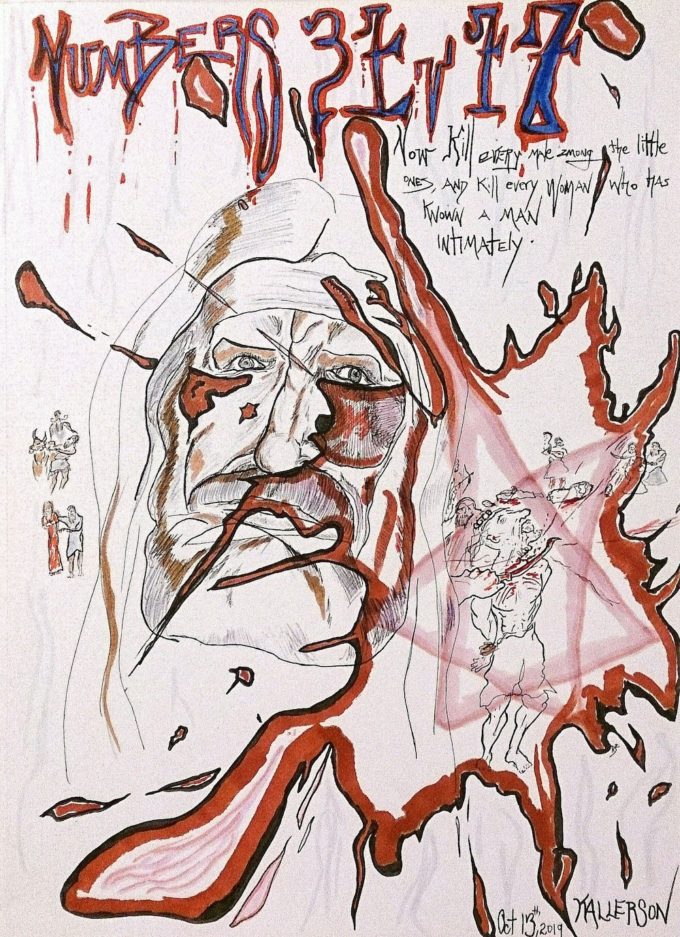
Numbers 31:12-24
The Captives, the Booty, and the Spoil
The first seven verses of this passage are difficult for many to read and to accept. They don’t seem to fit their idea of a loving God. However, they do fit the concept of a just, holy, righteous, and – yes – even a merciful God. Of verses 15-18 in particular, the commentators at Cambridge frightfully state the following –
“All male children and all women who are not virgins are to be killed in cold blood. This cruel command ascribed to Moses dates from an age when the Jews were approaching their narrowest and hardest state of exclusiveness, when piety consisted in rigid separateness from everything foreign. It need cause no difficulty to Christians who have received the command ‘Love your enemies.’” Cambridge
There are several points to be made about this. First, they call what is mandated here by the Lord through Moses cold-blooded killing. If, in fact, the Lord commanded this, and they have then penned this commentary, then they have accused the Lord of being a cold-blooded killer.
Whether He actively did the killing, or whether He used His instrument of judgment, meaning Israel, to carry out His command, it makes no difference. It is a rather uncomfortable position to be in when you stand before the Lord after having accused him of such.
Secondly, they say that this wasn’t the Lord or Moses at all, but rather Jews who were at a point of narrow and hard exclusivism. If this is true, then why would Bible scholars even bother with being Bible scholars. If this isn’t the word of God, then it is the word of man and it is not worth commenting on it in such an analysis.
And that brings us to the third point. They have said that this, “need cause no difficulty to Christians who have received the command ‘Love your enemies.’” Why would Christians care about the command “Love your enemies,” if this isn’t the word of God?
At what point do we say, “This part is the word of God, and this part isn’t?” Who decides that? As it is an arbitrary decision left up to man, then the message of Christ is unreliable. And if the message of Christ is unreliable, then the words of Christ are equally as unreliable. Everything stands or falls on whether the command of Moses in these verses is in accord with the word of God or not. If it’s not, we are wasting our Sunday morning.
Text Verse: “Surely I was sinful at birth, sinful from the time my mother conceived me.” Psalm 51:5 (NIV)
Translations of this verse vary, some of which completely obscure what David is proclaiming under inspiration of the Holy Spirit, but the essential point he is making is that he inherited sin. It is not that he had to do anything to be considered a sinner. It was done for him by being conceived. When he was brought fourth, he was already sinful.
If we can get that simple point of theology correct, then what we see in today’s verses is not at all cruel or unloving. It is what any and all can and should expect from God. He is just, and our inherited sin demands justice.
He is holy, and we are born in an unholy state. Therefore, our just due would be to remain separate from Him for all eternity. He is righteous, and that demands that a payment is due for our simply being conceived; a payment of death.
These things aren’t mere speculation. They are what Scripture teaches. But God is also loving, and He gave of Himself to pay the penalty. He is also merciful, and so He does not always give us what we deserve.
The young virgins deserved exactly what the others who were brought to the camp got, but they were given mercy. Why did God allow that, and what picture was He making for us in that act?
Before we accuse God of wrongdoing, we should have our theology straight. If we are wrong, it will be a sad meeting when we finally stand face to face. In our world today, there are religions which condone what we would call murder – of men, women, and children.
Is there a difference between what they do and what is relayed here in Scripture? The answer is, “Yes.” There is a world of difference. One is sanctioned by the true God, and for very specific reasons, and the others are sanctioned by false gods.
We cannot impute wrongdoing to the Lord and come out unscathed, so let’s look at our verses within their proper context. It’s all to be found in His superior word. And so, let’s turn to that precious word once again and… May God speak to us through His word today and may His glorious name ever be praised.
I. Defiled by Peor (verses 12-18)
12 Then they brought the captives, the booty, and the spoil
Here, three separate designations are made. The first are ha’shviy, or “the captives.” This was explained in verse 9 as the women and their little ones. The second are ha’malqoakh, or “the booty.” This signifies “the takings.”
It is an all-encompassing thought that anything of any value was taken in the campaign including the cattle and flocks that were plundered. And finally, are ha’shalal, or “the spoil.” This is anything else that was plundered from Midian. Such types of things will be described in verses 20 and 22. All of this was brought…
12 (con’t) to Moses, to Eleazar the priest, and to the congregation of the children of Israel,
The words are certainly intended to give the sense of a great military victory where the men of war are heroes who are presenting the rewards of their efforts to the people. Moses, as the leader, is mentioned first. Eleazar is mentioned second, naming his official capacity as “the priest.”
And then “the congregation” signifies the leaders of tribes and heads of families who represent the entire assembly. This will be seen in the next verse. This is a formal presentation of the victory spoils which have been brought…
12 (con’t) to the camp in the plains of Moab by the Jordan, across from Jericho.
The words el ha’makhaneh, or “to the camp,” mean only to the location of the camp, but not into the camp. Due to defilement, the warriors and their booty would first have to pass through a ritual of purification. Because of this, it next says…
13 And Moses, Eleazar the priest, and all the leaders of the congregation, went to meet them outside the camp.
There are two reasons for this. The first is, as already stated, that there is defilement of the people and the plunder which must be purified before it can come into the camp. But this could have been conveyed to them by a messenger. Therefore, this is a mark of both respect and congratulations to the fighting men for their efforts.
The meeting probably contained a threefold aspect. First, there would have been words fitting to the victory by Moses, then a blessing spoken over the people by Eleazar, and then something like our modern “hip hip hooray” shouted out by the leaders of the assembly. It is both a reward for their efforts, and an encouragement and a stimulus to continue on in the same manner in future battles.
14 But Moses was angry with the officers of the army, with the captains over thousands and captains over hundreds,
One can see that just as Moses, Eleazar, and the leaders had come forth from the camp, these three groups had also come forward from the army. They include the pequde or overseers, and the sare, or captains of the larger and smaller divisions.
This would be comparable to the generals and the division and brigade leaders, all coming forward in a modern army. It is they who were responsible for the conduct of the army. It is, therefore, these men to whom Moses shows his displeasure.
14 (con’t) who had come from the battle.
The translation leaves the sense of the verse lacking. There is a noun, tsaba, which is not fully translated. Instead of “who had come from the battle,” it should say something like, “who came in from the host of the battle.”
There are the hosts of Israel, numbering twelve thousand men. Out of these hosts were brought forth those who commanded the force according to their level of authority. It is they who bore the responsibility of ensuring the battle was conducted properly. Moses next verbalizes the reason for his anger…
15 And Moses said to them: “Have you kept all the women alive?
Rather than “women,” it says “females.” “Have you kept all the females alive?” The word is neqevah, and it signifies the sexual form of the female, inclusive of all ages. The instructions from the Lord were neqom niqmat bene yisrael me-et ha’midyanim – “Avenging vengeance sons of Israel on the Midianites.” Moses passed this on to the people with the words latet niqmat Yehovah b’midyan – “give vengeance Yehovah in Midian.”
By keeping the women alive, they failed to do the very thing that was expected of them. It was the women who had been used to seduce Israel. This was a matter of just retribution because of an offense against the Lord which, by default, must include killing the women who brought about the offense, as Moses next explains…
16 Look, these women caused the children of Israel, through the counsel of Balaam, to trespass against the Lord in the incident of Peor,
The words are exactingly spoken by Moses. He begins with the word hen, or “Behold!” He is establishing an excited tone to convey the rest of his words. His next words then set these females in contrast to the children of Israel. They were in the wrong, and they caused the Lord’s people to follow them into the wrong.
He then notes that what they did had been counseled by Balaam. They had taken the advice of a soothsayer in an attempt to pit their god, Peor, against the Lord. The intent is obvious. Balaam looked at Yehovah not as the One all-powerful God, but as a lesser “God of the Jews,” just as the god of Peor was a localized god.
The name Peor comes from the verb paar, meaning “to open wide.” Thus, it means, “The Opening.” As was described before, that verb yields no nouns. Thus, Peor is based on the verb itself, suggesting that this god is one who works out of a hunger or desire. Thus, he can be seen as a god of desire, yearning, and lust.
What Moses is doing by using the term neqevah, or females, is showing that they are the very instruments of lust which then caused Israel to fall into sin. They were the weapon (the opening) of Peor, which brought them to the lust of Peor (the Opening). He is using the female form to describe what the female form brought about in the men.
Through Balaam’s counsel, he thus caused the sons of Israel limsar maal Yehovah – “to set apart treachery against Yehovah.” This is the second and last use of the word masar. It was first seen in verse 5. It comes from a primitive root meaning “to sunder.” Thus, it means “to set apart.”
In verse 5, it was the setting apart of a portion of people from the others and to the Lord for battle. Whereas here, it speaks of those who trespassed against the Lord. In this, they were set apart from the Lord in apostasy. They had taken their affections from the Lord and set them on Peor. As a result…
16 (con’t) and there was a plague among the congregation of the Lord.
This is the outcome of what was instigated by the women. It ended in a plague where 24000 had died. The point being made is that the Lord took vengeance against His own people, to defend His own honor, because of Peor. It was, therefore, fully expected that His own people would take full vengeance, to restore that state of honor, against Midian who brought this about.
17 Now therefore, kill every male among the little ones,
The number of failed commentaries on these words goes on and on. We saw one during the introductory comments, and there are plenty more from the hands of those who don’t understand either the fallen nature of man – meaning the inheritance of original sin – nor the holy and righteous nature of God who allowed Moses to speak forth this command.
The Lord determined that Midian should be destroyed. If the males were allowed to live, the nation would be perpetuated through them. This is not so with the females, whose children would be reckoned through the line of the father.
Further, being identified as Midianites, and because they would remain Midianites, they would carry that name and custom with them. How can we know this? Because the man now giving forth the command to Israel was not an Egyptian, but a Hebrew.
Despite having been taken and brought up as a son of Pharaoh’s daughter, and having been schooled in the wisdom of the Egyptians, Moses first and foremost identified himself with His people, Israel. He was spared and look at what he accomplished.
The evidence of, and justification for, the need to kill every male among the little ones was the Lord’s chosen leader of Israel who stood there before them. And yet, there is more bad news for the captives…
17 (con’t) and kill every woman who has known a man intimately.
Again, we can read this and say, “What a terrible thing to command.” But if there is a war and females are a part of that war, they are reckoned as soldiers to be killed. This was, in fact, a war. Twenty-four thousand of Israel had died because of these women, and they had forfeit their lives because of their active participation. Matthew Henry rightly states –
“The sword of war should spare women and children; but the sword of justice should know no distinction, but that of guilty or not guilty. This war was the execution of a righteous sentence upon a guilty nation, in which the women were the worst criminals.” Matthew Henry
However, Moses makes a fixed guideline by saying, v’kal ishah yodaat ish l’mishkav zakar harogu – “and each woman known of a man by lying of a male you shall kill.” The idea here is that they are the opening.
They have been with a man, and they, therefore, bear a resemblance to Peor – “The Opening.” They cannot be allowed to live because of this. Understanding the concepts behind the words reveals the reason for the decision. Of these words, however, Adam Clarke bizarrely states –
“Of the women killed on this occasion it may be safely said, their lives were forfeited by their personal transgressions; and yet even in this case there can be little doubt that God showed mercy to their souls.” Adam Clarke
In other words, “Because they are women, they get to go to heaven after getting whacked.” Sorry ladies, though it might sound like a sweet deal, it doesn’t work this way. Be sure to check your theology from Scripture, not a from a sentimental old guy.
This is as far from the reality of Scripture as anything you might ever hear. God is no respecter of persons, and he doesn’t give a pass to anyone based on age, sex, culture, color, or for any other reason – apart from being in Christ. Moses’ words are not arbitrary, they are not inappropriate, and they are perfectly in line with the honor of the Lord. But, those who are to be spared are next noted…
18 But keep alive for yourselves all the young girls who have not known a man intimately.
This command is not because they were to be used as sex slaves, it is not because they were of value for resale, nor for any such reason that someone might casually toss out which would indicate some benefit for Israel. Rather, the reason for this is two-fold. First, it is no different than the edict of Pharaoh in Exodus 1 –
“Every son who is born you shall cast into the river, and every daughter you shall save alive.” Exodus 1:22
The females would be assimilated into Israel. They would not become avengers of blood, nor would they bear the family line of the natural father to the next generation. Instead, their children would become citizens of Israel through the father.
And secondly, they were spared for exactly the opposite reason that the other women were killed. They lo yadeu mishkav zakar – “not have known intimately male.” They remained unopened and thus they did not yet bear the image of the false god Peor. The command makes perfect sense when it is compared to the surrounding text.
What is it that we have done to offend the Lord?
What sin have we committed before His face?
Surely payment for our sins we cannot afford
We are left ashamed, abandoned, and disgraced
What we deserve is death for the things we have done
Our lot is rightly to be cast into the pit of hell
But God made the payment; He sent forth His Son
Such a wonderful story for us does the Bible tell
We have pursued other gods; following after them hard
We have not been faithful to the awesome and terrible Lord
But when He died on Calvary; bearing the scent of nard
Peace between us and God has mercifully been restored
II. The Rites of Purification (verses 19-24)
19 And as for you, remain outside the camp seven days;
The words are second person plural. It is referring to all those who had come from the campaign. It is explicit but general. All were to remain outside of the camp for seven days. A state of defilement existed because of the battle, the proximity to the pagans, being around unclean things, and so on.
This would have been the unstated standard for any similar future campaigns. No distinction is made for any person. All are together considered as unclean. However, there are different states of defilement for which further action may be required…
19 (con’t) whoever has killed any person, and whoever has touched any slain,
Unlike the previous clause, which was explicit but general, this is explicit and specific. It is directed to any who had killed another person, or to anyone who had touched a slain person. The act of killing, regardless as to whether the person actually died at that moment or not, is considered to bring about a state of defilement.
Further, it may be that someone didn’t kill anyone, but he was still a part of the burial team. Picking up the dead to toss them into a grave would also bring about defilement. But what about the person who didn’t kill anyone, and who didn’t have to bury anyone? Why did he have to remain outside the camp?
It is because he was a part of the campaign and would have been defiled by simply being around someone who was directly defiled. He would be required to remain outside the camp. For these defiled people, Moses says…
19 (con’t) purify yourselves and your captives
tit-khateu – “unsin yourselves.” The Hebrew actually places the words “and your captives” at the end of the clause. In other words, it reads, “unsin yourselves on day the third and on day the seventh; you and your captives.”
The words, “unsin yourselves,” do not mean that they had committed some type of moral transgression. Rather, what they had done was at the command of the Lord. But by coming in contact with death, they had incurred guilt and required purification.
To understand this, and what their purification fully entailed and pointed to, one would have to watch the two sermons from Numbers 19 concerning the Red Heifer and the Water of Purification.
In short, the entire process looks to the purification offered by Christ. The people of Israel, even when acting in obedience to the Lord’s command, incurred guilt. In this, we can then understand the typology in how it points to our state before God, and how that is cleansed by Christ. In a classic misuse of Scripture, the Cambridge commentators say of these words –
“The Hebrews had not yet received the higher teaching that only ‘the things which proceed out of the man are those that defile the man’ (Mark 7:15).”
Jesus was speaking about foods, not defilement through death, disease, or the like. The Lord, through the Law of Moses, declared these people unclean and were kept separate from the camp because the camp is where the Lord dwelt among the people. The laws were given to fit the typology, which points to Christ.
This is not an issue of eating foods, but of maintaining purity in the presence of the Lord. It is true that the law was given as a tutor to lead us to Christ, but the same principle applies now. Those who are stained with sin cannot enter the presence of the Lord.
It is Christ who purifies from sin; it is Christ who covers us with His righteousness, and it is Christ who therefore keeps us from the imputation of further sin when we are in Him. For those who are not so covered, they are – and will be – excluded from the presence of God. To purify these people in a manner typical of that of the purification of Christ, Moses next says…
19 (con’t) on the third day and on the seventh day.
This is based on the words of Numbers 19. There it says –
“He who touches the dead body of anyone shall be unclean seven days. 12 He shall purify himself with the water on the third day and on the seventh day; then he will be clean. But if he does not purify himself on the third day and on the seventh day, he will not be clean. 13 Whoever touches the body of anyone who has died, and does not purify himself, defiles the tabernacle of the Lord. That person shall be cut off from Israel. He shall be unclean, because the water of purification was not sprinkled on him; his uncleanness is still on him.” Numbers 19:11-13
All who were in the campaign, and all of their captives, would have been so defiled. The blood of the dead would have been on hands, on garments, and on articles taken from the dead. Captives might have touched the dead in mourning. None were free from the effect of the sin of death, and thus all required purification.
20 Purify every garment, everything made of leather, everything woven of goats’ hair, and everything made of wood.”
The actual means of purification is stated in verse 23, meaning the water of purification. But because of the defilement of the battle, which permeated everything, all things were to be purified. The list includes every garment. This means the garments of the soldiers as well as the garments of the captives. It would extend to any garments taken from the dead, or out of the homes of the people.
It next says, v’kal keli owr – “and every vessel skin.” This could be a wineskin, some type of purse, or whatever else. The law for this was given in Numbers 19:15 –
“and every open vessel, which has no cover fastened on it, is unclean.”
The idea is that the vessel is unclean and requires purification. However, the word, keli, or vessel, can extend to anything made of skin – sandals, parchment, tents, saddles, and so on. It next says, v’kal maaseh izzim – “and all worked goats.” Tent coverings, garments, blankets, and so on would all require purification. But this may even be inclusive of other items made from goats, such as horns, bones, hoofs, and the like.
And then it says, v’kal keli ets – “and all vessels wood.” This could be pretty much anything from spoons, bowls, and cups, to beds, boxes, and wagon wheels. Whatever was made of wood was to be sprinkled for purification. Or, as it more literally says again, they are to be “unsinned.”
21 Then Eleazar the priest said to the men of war who had gone to the battle,
Now Eleazar speaks out. What he will say is based on words given in Numbers 19. There it said, “Now the Lord spoke to Moses and Aaron, saying” (19:1). The law was spoken to Moses as the Lawgiver, and to Aaron who was the priest responsible for these priestly functions.
As the law has been given, it is now the priest who speaks forth what has been received. However, it is now Aaron’s son who stands as the high priest of Israel. Therefore, it is he who addresses the men of war who had gone to the battle…
21 (con’t) “This is the ordinance of the law
zot khuqat ha’torah – “this, enactment of the law.” It is a very rare phrase which combines two common words – khuqat, or “statute,” and torah, meaning “law,” or “instruction.” The two words together in this manner are only seen here and in Numbers 19:2 where this particular type of purification was also the subject. For this combined form, John Lange provides a general meaning –
“We would read: an ordinance for securing the Torah. Without this expedient, for instance, the law of purification would have occasioned endless offences on the right hand and on the left.” John Lange
In other words, the word torah, or “law,” here is an all-encompassing statement concerning not any given law, but the Law of Moses itself. In order to secure the law and keep it free from constant defilement in the people, this statute that was given is now being enacted.
21 (con’t) which the Lord commanded Moses:
asher tsivah Yehovah eth Mosheh – “which commanded Yehovah Moses.” Now the khuqat ha’torah, or “enactment of the law,” is said to have been, tsivah, or commanded, by the Lord. There is a definite importance which is ascribed to what Eleazar conveys to the people.
It is binding on all people because it is a part of the mutually agreed-to covenant between the Lord and His people. The Lord spoke to Moses and Aaron concerning the guidance that He commanded. Eleazar now conveys that word to the people. The reason for this is because the typology looks to Christ.
The Pulpit Commentary finds it extraordinary that Eleazar would stand and proclaim this while Moses was standing right there –
“This is the earliest instance of the high priest declaring to the people what the law of God as delivered to Moses was, and then applying and enlarging that law to meet the present circumstances. It is no doubt possible that Eleazar referred the matter to Moses, but it would seem on the face of the narrative that he spoke on his own authority as high priest.” Pulpit
The reason for this is that he will speak next of the cleansing of items by fire and water, something which was never explained before. They are so surprised by this that they also say that verses 21-24 were probably added after the death of Moses.
But that completely undermines the purpose of having a high priest. Moses was the one who received and gave out the law. Once the law was given, it was set. There was no need for Moses to interpret a law which was already passed on and in effect.
And further, if someone later inserted these verses, they would have done it without the instructions from Moses. Their interpretation would be no more valid than that of Eleazar, and it would also then have been added, after the fact, into the word of God which was for Moses to receive.
What they propose makes no sense, and it damages the integrity of Scripture. Rather, Eleazar’s coming words stand as appropriate, and their inclusion in the word confirms that it is so.
22 Only the gold, the silver, the bronze, the iron, the tin, and the lead,
Six metals are named, one of which is new to Scripture, bedil, or tin. The word comes from badal, meaning to separate, and thus it signifies an alloy, and then – by analogy – tin. The word will be used six times, but one of them, in Zechariah 4:10, will speak of a plumb line, because a plumb line separates that which is considered plumb, or upright, and that which is not.
These metals are capable of withstanding fire, a marvelous source of purification, and so it is no surprise that Eleazar would make his proclamation, and so he now continues…
23 everything that can endure fire, you shall put through the fire, and it shall be clean;
This precept has been seen numerous times. When a sin offering is made for the congregation, parts of it were burned on the altar and the rest was burned outside the camp, implying that purification and destruction comes through the fire. In another example, which most poignantly points to purification through fire, it says this in Numbers 16 –
“Then the Lord spoke to Moses, saying: 37 ‘Tell Eleazar, the son of Aaron the priest, to pick up the censers out of the blaze, for they are holy, and scatter the fire some distance away. 38 The censers of these men who sinned against their own souls, let them be made into hammered plates as a covering for the altar. Because they presented them before the Lord, therefore they are holy; and they shall be a sign to the children of Israel.’” Numbers 16:36-38
Eleazar was personally aware of the purifying effects of fire. These unholy men, with their unholy offerings, were burnt in the fire. The censers withstood it and were purified, and so for him to interpret the law in this way is not only right, it is proper for him to do so.
However, this was not fire on the altar which was holy fire. It is fire outside the camp used for cleansing the items. Once they were declared “clean,” they still required a final purification…
23 (con’t) and it shall be purified with the water of purification.
Translations vary here, but the Hebrew indicates that despite being clean after passing through the fire, the metals still had to be purified or “unsinned” with the water of purification.
Unlike the items that were purified with holy fire, these were only considered clean. They still required the purification which points to Christ – meaning the water of purification which contained the ashes of the red heifer.
23 (con’t) But all that cannot endure fire you shall put through water.
This now speaks of all of the other non-metallic items – skins, goats’ hair, wood, or whatever else that could not withstand the fire had to be washed in water. What is implied, though not stated, is that it would then be purified with the water of purification. This is because this water was required on such things in Numbers 19:18.
*24 (fin) And you shall wash your clothes on the seventh day and be clean, and afterward you may come into the camp.”
These words are similar to those of Numbers 19:19, with some changes. The people were required to wash their clothes as noted there. It then says, “and be clean.” This is probably an abbreviated way of saying that the individual was also to bathe, thus becoming clean, as also required there in Numbers 19. After this, they could again enter the camp. This is then what is alluded to in Hebrews –
“…let us draw near with a true heart in full assurance of faith, having our hearts sprinkled from an evil conscience and our bodies washed with pure water.” Hebrews 10:22
The people, despite having been commanded to destroy Midian, may have had hearts that were timid, hateful, covetous, or remorseful over the actions they experienced in battle. And they also bore the defilement of the death they participated in. In the time of purification and cleansing, they were used as a picture of what would come in the true cleansing found in Christ.
And for those who were brought into the camp from outside of Israel, meaning the young virgins, they were cleansed and brought into the community from that point on. The water of purification was sprinkled on them. After the required time and cleansings, they became a part of the community.
They certainly could have refused this, even at such a young age. It was a voluntary action to do so as was seen in Numbers 19. To refuse to receive the sprinkling meant to be cut off from the assembly because, as it said, the person had “defiled the sanctuary of the Lord.”
For one of the girls, they would have then met their fate like the others of Midian. The chances of that would have been unlikely, but if so, it is no different than what happens to people who hear the gospel today and who then reject it. They remain apart from the covenant, and they are destined to be destroyed along with all others who fail to come to Christ for whatever reason.
It is to be remembered from the instructions detailed in Chapter 19, that the people who did the sprinkling of those requiring purification were also made unclean by their duties. They were considered unclean until evening. In fact, every person associated with the process of making and transmitting the water of purification became unclean in the process.
The reason was that everything associated with the red heifer pictured Christ in His death. It is Christ who cleanses from all unrighteousness, but uncleanness had to come from His dead body – a real human body that died – in order for that to come about.
That is why there is no sprinkling with blood in this purification. The blood cleansing is accomplished in Christ’s death. It is the death and the body of death which is dealt with in the water of purification. It is that which defiles. The red heifer is the only sacrifice where the blood was burned with the body.
From there, the ashes were mixed with living water. That furthered the picture of Christ. He didn’t die and stay dead, He rose to provide living waters, but that can only be appropriated through His death, even though His dead body brought defilement under the law of Moses.
The truth we found in Numbers 19, and which is seen again here, is that one cannot get to the Living Water until he is first cleansed by the blood, even though the death associated with that blood defiles.
Romans 6:3 says that we are baptized into Christ’s death. Only through that can we be cleansed. His death, however, was for man’s sin. Without Christ becoming sin we could not become the righteousness of God in Him.
Though we were baptized into His death, we are raised to new life through the power of His resurrection. That is the Living Water with which the ashes were mixed. And it is that which ultimately cleanses us wholly and forever from the defilement of death that we carried in our bodies, even since the first moments of our human existence.
It is an amazing thing that God has done in Jesus Christ. And it is found in this passage which is given to show the effectiveness of the command which was first detailed in Numbers 19.
The lesson is, come to Christ and be freed from the sin of death, and you will be granted life. You will be accepted into the sanctuary of the Lord, and you will be there in the presence of God – the God who loves you enough to do this for you – for all eternity. Come to Christ.
Closing Verse: “If then you were raised with Christ, seek those things which are above, where Christ is, sitting at the right hand of God. 2 Set your mind on things above, not on things on the earth. 3 For you died, and your life is hidden with Christ in God. 4 When Christ who is our life appears, then you also will appear with Him in glory.” Colossians 3:1-4
Next Week: Numbers 31:25-54 We see this now and we will see it again with Gideon… (The Spoils of Midian) (61st Numbers Sermon)
The Lord has you exactly where He wants you. He has a good plan and purpose for you. It may seem at times as if you are lost in a desert, wandering aimlessly. But the Lord is there, carefully leading you to the Land of Promise. So, follow Him and trust Him and He will do marvelous things for you and through you.
The Captives, the Booty, and the Spoil
Then they brought the captives, the booty, and the spoil
To Moses, to Eleazar the priest, and to the congregation
———-of the children of Israel, thus they did so
To the camp in the plains of Moab
By the Jordan, across from Jericho
And Moses, Eleazar the priest, and all the leaders
———-of the congregation
Went to meet them outside the camp, probably filled with elation
But Moses was angry with the officers of the army
With the captains over thousands and captains over hundreds too
Who had come from the battle
And Moses said to them: “Have you kept all the women alive?
———-Now let me speak to you…
Look, these women caused the children of Israel
Through the counsel of Balaam, to trespass against the Lord
In the incident of Peor
And there was a plague among the congregation of the Lord
———-you yourselves saw that terrible sword
Now therefore, kill every male among the little ones
And kill every woman who has known a man intimately
———-yes, do this as stated by me
But keep alive for yourselves all the young girls
Who have not known a man intimately
And as for you, remain outside the camp seven days
Whoever has killed any person, and whoever has touched any slain
Purify yourselves and your captives
On the third day and on the seventh day, once again
Purify every garment
Everything made of leather, be sure this is understood
Everything woven of goats’ hair
And everything made of wood
Then Eleazar the priest said to the men of war
Who had gone to the battle; to them these words he handed
“This is the ordinance of the law
Which the Lord to Moses commanded
Only the gold, the silver, the bronze, the iron, the tin, and the lead
Everything that can endure fire, you shall put through the fire
———-and it shall be clean
And it shall be purified with the water of purification
But all that cannot endure fire you shall put through water
———-this cleansing shall be seen
And you shall wash your clothes and be clean on the seventh day
And afterward you may come into the camp, as to you I say
Lord God, we are even now in a wilderness
And we are wanting to be led by You
Without You to direct, our lives would be a mess
And so be our guide, O God; You who are faithful and true
We long for the water in this barren land
May it flow forth from the Rock, our souls to satisfy
Give us this refreshing, spiritual hand
And may we take it, and to our lives daily it apply
And we shall be content and satisfied in You alone
We will follow You as we sing our songs of praise
Hallelujah to You; to us Your path You have shown
Hallelujah we shall sing to You for all of our days
Hallelujah and Amen…