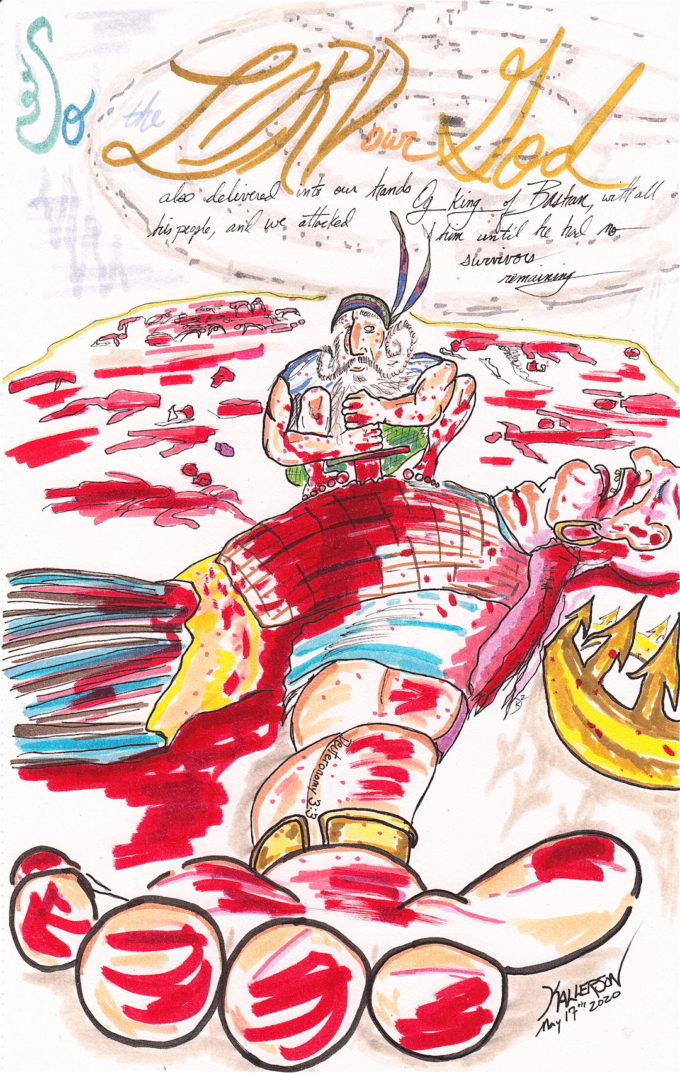
Deuteronomy 3:1-11
The Defeat of Og, King of Bashan
At times, I have to stop and wonder if the passage I’m evaluating for you is being given proper treatment concerning the pictorial or typological patterns that I am making. I have to ask, “Does this really fit, or am I simply making things fit what I want it to say.
This was especially true for me in the Numbers 21 sermon where Sihon and Og were first described in Israel’s victory over them. I really stressed as to whether the typology was correct or not. At other times, the typology has seemed so clear that it is hard to miss. It simply jumps off the page and announces itself.
One good example of that is the typology of the Jordan picturing Christ. The Jordan flows from Mt. Hermon to the Salt, or Dead, Sea. In order for Israel (or indeed anyone) to enter the Land of Promise, it must be through the Jordan, or Christ.
The picture is so obvious, and everything associated with it is so certain, that it doesn’t really require any stress as to whether it is right or not. And yet, each time I have typed up some picture of it – meaning Hermon, the Jordan, the Dead Sea, and so on, I still have to ask myself if what I have been certain about is actually certain.
Presenting something inaccurate means presenting faulty theology. And presenting faulty theology will lead to faulty doctrine. And that leads to unstable Christians who have a part of their walk (maybe more than a part of it) on unstable footing. And each unstable step will lead one a little further off the proper path.
Text Verse: “A mountain of God is the mountain of Bashan; A mountain of many peaks is the mountain of Bashan.” Psalm 68:15
Until typing this sermon, I had never stopped to evaluate the name Hermon. Despite assuming the typology, I hadn’t actually checked it out fully. That actually troubles me thinking about it now. But the patterns seemed so obvious that knowing the actual meaning of Hermon never even came to mind.
However, the mountain is first introduced into the biblical narrative in today’s passage. Because of this, it became necessary to determine its meaning. Thankfully, and with a giant retroactive sigh of relief, it actually fits the typology of everything that you have been taught concerning it, the Jordan, the Dead Sea, and so on.
If it didn’t, the typology of at least half a dozen sermons, or more, would have to be reconsidered, all because I never checked the meaning of the name of a single mountain. But this will be true a thousand more times as we continue through Scripture.
It is impossible to anticipate everything that will arise in Scripture in regard to such things. The fabric is too intricate, and the weaving is too complicated to be able to guess all that the Lord has put in His word for us. So far so good though. The patterns have fit, the typology has matched, and the story continues to unfold so beautifully.
What a treasure God has given us in this marvelous gift we call the Holy Bible. Yes, great things are to be found in His superior word. And so, let’s turn to that precious word once again and… May God speak to us through His word today and may His glorious name ever be praised.
I. Do Not Fear Him (Verses 1-11)
Chapter 2 ended with the defeat of Sihon, king of Heshbon. Israel is being prepared for their crossing of the Jordan and into the promise. That prophetically looked forward to the destruction of the antichrist, something which must come about at the time of Israel’s acknowledgment of Jesus as their true Fountain of hope.
But, as we saw in the Numbers’ sermons, there were two foes to be defeated. The second of them is ahead of them on their trek to the promise. After defeating Sihon, Israel was in a place which made entrance into Canaan possible.
However, with Og and his people holding the northern portion of Gilead and also all of the Bashan, it would be unwise to leave him untouched. In type and picture, the same is true for Israel of today. There are two foes who must be removed before they will pass into the knowledge of Christ and into the heavenly inheritance.
Chapter 3 begins with the details concerning this second foe…
“Then we turned and went up the road to Bashan;
va’nephen va’naal derek ha’bashan – “And we turned, and we ascended the road to the Bashan.” The verse begins with the simple word “And.” it is a continuation of the narrative, despite the chapter divisions later imposed on the text.
Further, the words of the verse are the exact same as Numbers 21:33, except that there it is in the third person plural (they) instead of the first person plural (we). Moses is exactingly recounting the narrative as it was previously given, but from a personal perspective.
As is consistent, there is an article in front of Bashan. It says, “the Bashan.” The name signifies something like the “Place of fertile soil.” Israel was making its ascent to this spot…
1 (con’t) and Og king of Bashan came out against us,
va’yetse og melekh ha’bashan liqratenu – “and came out Og king of the Bashan against us.” The king of this entire fertile place brings himself against Israel.
Here, as in Numbers 21, Og is said to be king of the Bashan. His name comes from uggah, which is a round baked cake. That comes from ug, to bake. The picture we see is one set in opposition to Israel.
Obviously, he then is to be destroyed. The uggah, or baked cake, is seen seven times in the Bible. It is that which nourishes and sustains life. One can see that in denying Israel access to this fertile place, and standing in opposition to them, a picture is made which will be more fully developed.
For now, not only does the king not come out as if he was a friend, but rather, because he will stand against Israel, it will be…
1 (con’t) he and all his people,
hu v’kal ammo – “he and all his people.” Based on the size of the Bashan, one can assume that it was a very large force. They gathered from the entire area of the Bashan in order to destroy them, knowing already that Israel had destroyed Sihon.
As this was so, they would not only have whatever weapons they previously possessed, but they would have accumulated those of Sihon’s army, they would be battle-hardened from the recent fighting, and they would be extremely confident in their capability to fight the next foe that came before them. Thus, Og mustered “all his people.” He could do no less. He then came…
1 (con’t) to battle at Edrei.
la’milkhama Edrei – “to battle at Edrei.” Og led his entire force out to meet Israel at Edrei. Edrei means something like “Mighty.” Despite the name, implying the great force which has arisen against Israel, the Lord was shown to be more powerful. At that time, He had good news for His people…
2 And the Lord said to me, ‘Do not fear him,
The words are almost an exact repeat of Numbers 21:24. Again, the only difference is that it is in the first person here rather than the third person of Numbers 21.
It would be reasonable for an army to fear such a foe. The description of his physical size, which is coming in the verses ahead, along with an army which consists of all of his people throughout the Bashan, and in an area filled with strongly defended cities, one might expect fear and trepidation on the part of Israel. But the Lord told them that it should be otherwise…
2 (con’t) for I have delivered him and all his people and his land into your hand;
The outcome is assured, and the Lord conveys it in that way, ki b’yadekha nathati, “for into your hand I have given.” All Israel has to do is engage the enemy. The Lord has worked out the details, in advance, for them to find complete victory. In defeating the army, they are then to complete the task by also destroying it entirely…
2 (con’t) you shall do to him as you did to Sihon king of the Amorites, who dwelt at Heshbon.’
Israel did not just defeat Sihon, they destroyed him and his entire army to the last man. None were to be spared so that there could be no remnant to later make a claim against the land. And, just as was promised, it also came about – both from the Lord’s assurance, and from Israel’s obedience…
3 “So the Lord our God also delivered into our hands Og king of Bashan, with all his people, and we attacked him until he had no survivors remaining.
The verse here is similar in thought to Numbers 21:35, but it is worded quite differently. It is, again, in the first person instead of the third person. Also, in Numbers it said, “So they defeated him,” meaning Israel defeated Og. However, here the credit is given to the Lord first – “So the Lord our God also delivered.” Only after that are Israel’s actions then mentioned.
Further, in Numbers it mentioned the sons of Og. Here, that is left out. Rather, it simply states that there were no survivors remaining. The victory was complete because the Lord so ordained it, and Israel complied with the Lord’s directives. This was not only true with the army itself, but of all of Og’s kingdom…
4 And we took all his cities at that time;
Og ruled over an entire area, filled with cities. The area, not being very large, and with no access to the sea, would seem to not be fit for many cities, and yet throughout the years, it has been noted by those who visit the area that there are an exceedingly large number of ruins there. Israel, after destroying all of the men in the battle, went about taking those cities they left behind, and Moses says…
4 (con’t) there was not a city which we did not take from them:
Despite the difficult terrain, and the description of the cities yet to come, Israel was able to take and possess every single one of them. In total, they numbered…
4 (con’t) sixty cities,
In his book, The Giant Cities of Bashan, dating to 1867, Josias Porter notes the size of the area and that there were the remains of at least sixty walled cities and a great number of unwalled towns still there. To this day, one can go on Google maps and view them from a satellite view.
Therefore, the account stands as not only possible, but factual. Israel took over these cities after exterminating the inhabitants. These are next noted as being in…
4 (con’t) all the region of Argob,
Here is a new word translated as “region,” khevel. It signifies a cord, rope, or measuring line. It comes from khaval, meaning to wind tightly, as a rope is wound. As it is a measuring line, it speaks of a region, as if it is measured off.
Another new word is the place itself, Argov. That comes from regev meaning a clod of the earth. Thus, the name means, “Stony” “Rough,” or “Rugged.” This is the same place referred to as Trachonitis, meaning “the rugged (or stony) region” in Luke 3:1.
This location, Argov, will be found only here in Deuteronomy 3 and in 1 Kings 4, when speaking of this same location and which mentions these same sixty cities which were captured and remained in continuous use at the time of Solomon. The entire location is then further defined as…
4 (con’t) the kingdom of Og in Bashan.
There is a progression of thought in this one verse which appears to be an inked celebration of what occurred. First, it states what occurred in the positive and in the singular, “And we took all his cities.”
Then, it next states it in the negative, and in the plural, “there was not a city which we did not take from them. It then sings out, “sixty cities!” After that, it mentions the region in which this occurred, “all the region of Argob.” And then it resoundingly shouts out the final glory of the victory, once again speaking of the singular person, “the kingdom of Og in Bashan.”
Next, to show the exemplary nature of the victory, the cities themselves are described…
5 All these cities were fortified with high walls, gates, and bars,
The sixty main cities are described as if by an eyewitness, which Moses surely was. He is recounting the state of the towns for posterity to know the greatness of the victory, and to give assurances to Israel that any such fortifications in Canaan will be equally conquerable.
In this, he uses a word, gaboah, meaning “high” which hasn’t been seen since Genesis 7. There, during the Flood of Noah, it said –
“And the waters prevailed exceedingly on the earth, and all the high hills under the whole heaven were covered.” Genesis 7:19
The word signifies high and exalted. Further, the Hebrew reads, “gates and a bar.” Each city would have two doors which would form a gate, and then a large bar would go through holders on the doors to form an almost impenetrable wall.
Despite this, and despite the other fortifications, Israel – because of the Lord’s hand being with them – was able to conquer them. Nothing was too high for them to attain. They conquered all sixty…
5 (con’t) besides a great many rural towns.
This is a new word, perazi, or hamlets. These would be little towns, maybe surrounded by any rocks cleared from fields, or with low walls to keep in livestock, but not used as protective walls.
The houses would probably be centrally located with the fields outside of any stone borders. Each of these would have had numerous livestock and probably sizeable stores of food when they were taken over. And, as it says, there were many of them. Of all of these cities and towns, Moses says…
6 And we utterly destroyed them, as we did to Sihon king of Heshbon, utterly destroying the men, women, and children of every city.
The translation does not give the sense of the Hebrew. Instead of “the men, women, and children,” it says, “utterly destroying men, the women, and the children.” It thus provides an emphasis that is missed by the translation. The women and the children were not exempt from the destruction.
As this is so, the words require further explanation. In Deuteronomy 2, concerning Sihon’s kingdom, it said –
“We took all his cities at that time, and we utterly destroyed the men, women, and little ones of every city; we left none remaining. 35 We took only the livestock as plunder for ourselves, with the spoil of the cities which we took.” Deuteronomy 2:34
Both there and here, the word kharam, or devoted to destruction, is used. It signifies that the devotion was required by the Lord, and the obedience of the people was followed through with according to the Lord’s word. We also saw this in last week’s sermon.
Though it seems overly brutal to our sensibilities, that is irrelevant to what the Lord determines. He creates, and He can dispense with His creation in whatever way He finds appropriate. As these are Amorites, they had been given the full measure of time to seek the Lord, as He conveyed to Abraham –
“Now as for you, you shall go to your fathers in peace; you shall be buried at a good old age. 16 But in the fourth generation they shall return here, for the iniquity of the Amorites is not yet complete.” Genesis 15:15, 16
The destruction of the Amorites was ordained for when their iniquity had reached full measure. That time had come, and Israel become the instrument in the Lord’s hand to accomplish His judgment upon them. Despite the kharam of the people, the Lord allowed the property and belongings to be spared…
7 But all the livestock and the spoil of the cities we took as booty for ourselves.
Like last week with Sihon, at the allowance of the Lord, all the possessions of the people were not set apart as kharam. This would have been no small amount of livestock and agricultural goods, along with whatever else the people possessed.
At times, such things were set apart for destruction. When that was mandated and not followed through with, the anger of the Lord would then turn against Israel. They were never exempt from the same punishments as the people they encountered, with the exception of being kept as a people because of the Lord’s covenant with them.
In the end, obedience to the word of the Lord is that which is highlighted as the highest importance throughout Scripture.
8 “And at that time we took the land from the hand of the two kings of the Amorites who were on this side of the Jordan, from the River Arnon to Mount Hermon
Here is a summary statement of all of the land which was taken by Israel from these two kings. It is stated as going from the River Arnon all the way to Mount Hermon.
As we have seen in earlier passages, Arnon comes from ranan, which signifies to give a jubilant, ringing cry, and thus Rejoicing.
Hermon, or Khermon, is introduced here, and it will be seen using this name 13 times. The word comes from the same verb used in verse 6, kharam. It speaks of designating something to the afterlife (like the people here were), to the thing that is designated in this way, or keeping that thing for something sacred. It is the same idea as the word harem that bears the same meaning.
Thus, Khermon means Sacred. As it is the name of a mountain, it is “Sacred Mountain.” It is a fitting description of heaven, from which the Jordan, or the Descender, flows from. One can see the marvelous picture here of the land of Bashan, the Place of Fertile Soil.
At one end is Rejoicing, and at the other is the Sacred Mountain, and flowing alongside it is the Descender. Here is a picture of life with Christ in view.
There is rejoicing, there is the fertile soil of the word, there is the coming of Christ from the Sacred Mountain, meaning heaven, and descending to earth. If one simply crosses over Jordan (the Descender), meaning going through Christ, there is access to the Land of Promise.
With that typology understood, the narrative continues…
9 (the Sidonians call Hermon Sirion, and the Amorites call it Senir),
Here the Sidonians are introduced. Their name comes from Tsidon, or Sidon, which means “Fishing” or “Fishery.” The Sidonians called the mountain Sirion, or “Sheeted with Snow,” while the Amorites called it Senir, which is believed to mean “Glittering Breastplate of Ice.” It will be given another name, Sion, in Deuteronomy 4:48. That is probably a shortened form of Sirion.
The reason for including these words appears to be as a historical and geographical note. The mountain forms a natural boundary between several nations, and so the names are given as clarification now for when they will be used elsewhere, both in Israel’s history, and in Scripture itself.
Sirion will be mentioned again in Psalm 29:6, and Senir will be used in 1 Chronicles, the Song of Solomon, and Ezekiel. The KJV will mistakenly use the word Sion in Psalm 65:1 when speaking of Zion, thus adding another error to its translation.
With the borders designated as the Arnon and Mount Hermon, another general description is seen with the words…
10 all the cities of the plain,
Here is a new word, mishor. It signifies an even place, like a plain. It is then figuratively used at times to speak of uprightness and justice.
10 (con’t) all Gilead, and all Bashan,
Both words are actually prefixed by an article, “the Gilead,” and “the Bashan.” Thus, they refer to locations, not cities. Gilead means “The Perpetual Fountain.” Bashan, as we saw, means “Place of Fertile Soil.”
10 (con’t) as far as Salcah and Edrei,
Salcah is first seen here, and it means “Walking.” Edrei means “Mighty.” These are both…
10 (con’t) cities of the kingdom of Og in Bashan.
These cities would be those furthest out in the regional areas, and so they stand as representative of the border regions of what was previously the kingdom of Og in Bashan. He is especially highlighted because of his genealogical relationship to another group who are again brought into the narrative…
11 “For only Og king of Bashan remained of the remnant of the giants.
Again, as was seen in Chapter 2, the word is Rephaim. It is speaking of the exceptional size of the people from which he came. Their large size was probably the product of special inbreeding. This would seem most likely because there is a Rephaite in 2 Samuel 21 with six fingers on each hand and six toes on each foot.
That is a particular genetic defect or hereditary syndrome known as polydactyly. Og was the last of them in this area, not everywhere, as they appear again in Canaan, and of whom the Anakim were associated. What their great size is actually attributable to is not stated in Scripture, but it is not from sleeping with angels. These were normal humans who were genetically larger than others. Of Og, the following is provided…
11 (con’t) Indeed his bedstead was an iron bedstead.
There is a great deal of speculation on what is being said. Some translate it directly as is given here. He has an iron bestead with the given dimensions. Others say that this is speaking of his sarcophagus, a distinct possibility. Other suggestions have been made concerning both the material and what it is fashioned into.
The word itself is eres. It comes from an unused root meaning “to arch.” It is translated as couch or bed throughout the Old Testament. If it is a couch, and as he was a king, it very well could be speaking of a large covered place where he sat as a throne. Charles Ellicott writes of such a throne that was discovered in his time and which was close to the same dimensions.
11 (con’t) (Is it not in Rabbah of the people of Ammon?)
Rabbah, or Rabath, is now introduced into Scripture here. It comes from the verb ravav, meaning to become many or much. Thus, Rabbah means “Great City.” What appears to be the case is that the Ammonites either captured this in a previous battle, they got it from Israel after Sihon’s death and took it to their country, or something similar to that.
However they got it, it became a piece of war spoil so noteworthy that it is recorded here, showing that it was well known to exist and a point of somewhat awe or pride on the part of those who possessed it. The reason for it being so noteworthy becomes obvious from our final words of the day…
*11 (fin) Nine cubits is its length and four cubits its width, according to the standard cubit.
Understanding that this may or may not be a bedstead, it does not mean that Og was thirteen feet tall. It is simply referring to whatever he sat, lay, or reclined on was. He was obviously a big guy, and he had big things around him.
The point is that he was defeated in battle, and therefore size was not the main factor in winning such a war – the Lord is. As an interesting note, the dimensions are specifically given in Scripture, and so we are asked to look at the numbers for clarity.
Of the number 9, EW Bullinger says that “…It is akin to the number six, six being the sum of its factors (3×3=9, and 3+3=6), and is thus significant of the end of man, and the summation of all man’s works. Nine is, therefore, the number of finality or judgment.”
And then, of the number 4, Bullinger says, “It is the number of things that have a beginning, of things that are made, of material things, and matter itself. It is the number of material completeness. Hence it is the world number, and especially the ‘city’ number.”
It is rather incredible that the two numbers fit so well with the finality and judgment of Og and his kingdom, and that the bed ended in Rabbah, or “Great City.”
For now, in Deuteronomy, Israel trusted the Lord, the Lord delivered His enemies into their hands, and they were able to defeat them because of this.
We bear the shield and by faith head in
We gird ourselves with truth as we seek the reward
We have a helmet of salvation for the battle to win
And in our hand, we carry the Spirit’s sword
Yes, the word of God is the instrument by which we fight
And prayer is the line to our side’s Head
Upon our feet is the gospel of peace, as is right
And we have prevailed in the battle; the enemy lies dead
The spoil is piled high from the battle of which we fought
There is great reward for those who entered the fight
On behalf of the Lord, the battle was wrought
And the rewards piled high are a beautiful sight
II. Types and Pictures
As we saw in the Numbers 21 sermon, and which is given more detail in this passage, Og is typical of the False Prophet of Revelation. He is the king of the Bashan, his name coming from uggah, which is a round baked cake. That comes from ug, to bake. He is set in opposition to Israel.
The uggah is that which nourishes and sustains life. In denying Israel access to Bashan, the fertile place, he – as typical of the False Prophet – denies the people of God the truth and nourishment of the word. The battle of Israel against him was at Edrei which signifies “Mighty.” Despite the mighty place chosen for this final battle, it is the Lord, through Israel, who defeats Og. It is even possible that the place was named because of the battle.
The region of the Argob is first mentioned here. It means, “Stony.” It also stands in opposition to the people, and it is something that must be defeated. If you remember, there was great highlight in the verse where the Argob was mentioned, focusing on the sixty cities as if they were the heart of the area.
Those obstacles would reflect the condition of the hearts of the people before coming to Christ – an act signified by passing through the Jordan. Such a condition of the people is actually prophesied about by Ezekiel –
Then I will give them one heart, and I will put a new spirit within them, and take the stony heart out of their flesh, and give them a heart of flesh, 20 that they may walk in My statutes and keep My judgments and do them; and they shall be My people, and I will be their God. Ezekiel 11:19
The Lord even repeats this thought in Ezekiel 36:26.
After noting the victory of the battle, it then noted the scope of both campaigns – against Sihon and against Og. They conquered all the foes on the side of the Jordan. They were the last foes to conquer before they were set to cross over. Likewise, both the Antichrist and the False Prophet will be destroyed before Israel enters the true Land of Promise.
The scope of defeating both these foes included from the Arnon to Mount Hermon. From “Rejoicing” to the “Sacred Mountain.” It pictures a complete victory with heaven as the furthest border. It then noted all the cities of the plain. That introduced the word mishor. A word figuratively used to speak of uprightness and justice.
The condition of the people has gone from wandering in the wilderness of disobedience to possessing the habitation of uprightness. Next, it mentioned “the Gilead,” and “the Bashan.” They now possess “The Perpetual Fountain,” meaning access to the Spirit, and the “Place of Fertile Soil,” meaning the truth of the word.
Also, the account notes the extent of those locations as being as far as Salcah and Edrei. Salcah is first seen here, and it means “Walking.” Edrei means “Mighty.” Both of these anticipate the state of a person at any given time. One can walk in the flesh or walk in the Lord. One can pursue his own might, or he can pursue the might of the Lord.
In possessing the land through the defeat of the two final foes, Israel is thus walking in the land of the Lord and in the strength of the Lord.
Finally, what is really most noteworthy is the connection between the dimensions of the bedstead that were recorded and a connection to that of Mystery Babylon, of which the False Prophet is so obviously connected to.
The number 9 is the number of finality or judgment. The number 4 is the city number. Og found his finality and judgment and his bed was taken to Rabbah, the Great City. Mystery Babylon is likewise called the “great city” again and again in Revelation 17 & 18.
It, and the false prophet, like this foe of Israel, will find both finality and judgment. The patterns are wonderfully placed within Scripture to show us, in advance, clues of what lies yet ahead in redemptive history.
The review of Moses concerning the events of those two battles – with Sihon and Og – is to remind Israel that it is the Lord who brought them to where they now stand, and it is the Lord who offers them the final step in their long and meandering existence as a people.
In this chapter, he will continue to describe this land in the verses ahead, he will speak of the rest offered to them on the other side of the Jordan, and he will then note his desire to cross over the Jordan with Israel, followed by the fact that he cannot do so.
The entire chapter is one which speaks of a promise which cannot be earned through the law, and it is through the law that the Antichrist and the False Prophet will make their deal with Israel, as is recorded in Daniel 9.
The law stands against Israel, except as the law is fulfilled in Christ. This is what the Gentiles learned and accepted two thousand years ago, and this is what Israel as a collective has yet to realize. The law must die outside of the promise.
Unfortunately, it is the law, not the grace of God in Christ, which has risen in the hearts of so many people again and again throughout the ages. It is the constant failing of human existence to simply trust God and to instead attempt to earn His favor through personal merit.
Israel fought these battles, but the victory was found in the Lord, not in their effort. We either have fought or will fight the same battle, but it must be a battle of faith in what He can do, not in what we can do. The spirit of Antichrist, and the teaching of false prophets, exists in the world today.
Together, they deny the Son. When we deny the Son, we deny the Father. When we receive the Son, we are adopted as sons by the Father. Israel is being prepared for her meeting with destiny, and each of us has our own meeting to face. Let us receive the Son and His fulfillment of that which stands against us, meaning the Law, and let us trust in the grace of God found in Christ Jesus our Lord.
Closing Verse: “One generation shall praise Your works to another,
And shall declare Your mighty acts.
5 I will meditate on the glorious splendor of Your majesty,
And on Your wondrous works.
6 Men shall speak of the might of Your awesome acts,
And I will declare Your greatness.
7 They shall utter the memory of Your great goodness,
And shall sing of Your righteousness.” Psalm 145:4-7
Next Week: Deuteronomy 3:12-20 You are being given a great and lengthy test… (Until the Lord Has Given Rest) (10th Deuteronomy Sermon)
The Lord has you exactly where He wants you. He has a good plan and purpose for you. But He also has expectations of you as He prepares you for entrance into His Land of Promise. So, follow Him and trust Him and He will do marvelous things for you and through you.
The Defeat of Og, King of Bashan
“Then we turned and went up the road to Bashan
And Og king of Bashan came out against us
He and all his people, to battle at Edrei
He was making a royal fuss
And the Lord said to me, ‘Do not fear him
For I have delivered him and all his people
———-and his land into your hand
You shall do to him as you did to Sihon king of the Amorites
Who dwelt at Heshbon; you shall do as I have planned
“So the Lord our God also delivered
Into our hands Og king of Bashan
With all his people, and we attacked him
Until he had no survivors remaining; until his people were gone
And we took all his cities at that time
There was not a city which we did not take
From them: sixty cities, all the region of ArgobThe kingdom of Og in Bashan was destroyed in our wake
All these cities were fortified
With high walls, gates, and bars also
Besides a great many rural towns
Our enemies we did swallow
And we utterly destroyed them
As we did to Sihon king of Heshbon; showing no pity
Utterly destroying the men, women
And children of every city
But all the livestock and the spoil – yes, all the looty
Of the cities we took for ourselves as booty
“And at that time, we took the land from the hand
Of the two kings of the Amorites, as they were known
Who were on this side of the Jordan
From the River Arnon to Mount Hermon
The Sidonians call Hermon Sirion
And the Amorites call it Senir – so it was known
All the cities of the plain
All Gilead, and all Bashan too
As far as Salcah and Edrei
Cities of the kingdom of Og in Bashan we cut through
“For only Og king of Bashan remained
Of the remnant of the giants, as they are known
Indeed his bedstead was an iron bedstead
(Is it not in Rabbah of the people of Ammon?)
Nine cubits is its length and its width cubits four
According to the standard cubit; pretty big, for sure
Lord God, turn our hearts to be obedient to Your word
Give us wisdom to be ever faithful to You
May we carefully heed each thing we have heard
Yes, Lord God may our hearts be faithful and true
And we shall be content and satisfied in You alone
We will follow You as we sing our songs of praise
Hallelujah to You; to us Your path You have shown
Hallelujah we shall sing to You for all of our days
Hallelujah and Amen…
“Then we turned and went up the road to Bashan; and Og king of Bashan came out against us, he and all his people, to battle at Edrei. 2 And the Lord said to me, ‘Do not fear him, for I have delivered him and all his people and his land into your hand; you shall do to him as you did to Sihon king of the Amorites, who dwelt at Heshbon.’
3 “So the Lord our God also delivered into our hands Og king of Bashan, with all his people, and we attacked him until he had no survivors remaining. 4 And we took all his cities at that time; there was not a city which we did not take from them: sixty cities, all the region of Argob, the kingdom of Og in Bashan. 5 All these cities were fortified with high walls, gates, and bars, besides a great many rural towns. 6 And we utterly destroyed them, as we did to Sihon king of Heshbon, utterly destroying the men, women, and children of every city. 7 But all the livestock and the spoil of the cities we took as booty for ourselves.
8 “And at that time we took the land from the hand of the two kings of the Amorites who were on this side of the Jordan, from the River Arnon to Mount Hermon 9 (the Sidonians call Hermon Sirion, and the Amorites call it Senir), 10 all the cities of the plain, all Gilead, and all Bashan, as far as Salcah and Edrei, cities of the kingdom of Og in Bashan.
11 “For only Og king of Bashan remained of the remnant of the giants. Indeed his bedstead was an iron bedstead. (Is it not in Rabbah of the people of Ammon?) Nine cubits is its length and four cubits its width, according to the standard cubit.