Deuteronomy 3:12-20
Until the Lord Has Given Rest
The words of this passage speak of possessing land, the division of the land, and the possession of other land by the rest of Israel at a future point. However, there is a difference between the land given to those on one side of the Jordan and those on the other.
It’s not really apparent at first, but the difference is there. We will see that especially as we look over the final three verses of our passage today. In fact, it is so hard to notice this on a cursory, or even on a very close reading, that our minds tend to skip right over the subtlety of what is being conveyed.
It is, however, something that is reflected in the words of Paul to the Ephesians in a roundabout way. He is speaking to the Gentiles, but what he says pertains to what is tucked away back here in Deuteronomy. His words of Ephesians 2 form our text verse today…
Text Verse: “Therefore remember that you, once Gentiles in the flesh—who are called Uncircumcision by what is called the Circumcision made in the flesh by hands— 12 that at that time you were without Christ, being aliens from the commonwealth of Israel and strangers from the covenants of promise, having no hope and without God in the world. 13 But now in Christ Jesus you who once were far off have been brought near by the blood of Christ.” Ephesians 2:11-13
Paul speaks of the covenants of promise. But more exactly, the Greek reads, diathēkōn tēs epangelias, “the covenants of the promise.” The word covenants is plural, while the promise is singular. The law is not of promise, and the inheritance is not of the law. Paul explains that in Galatians 3.
Therefore, the covenants of the promise, though maybe inclusive of the law, are not directed by the law. The law is simply a covenant which leads to the promise, hopefully, for those under it. I say “hopefully” because Paul also explains that the law was simply given as tutor to lead people to Christ. It does not, however, automatically do so.
In fact, the law is one of the greatest hindrances to a relationship with Christ if it is used as a means of earning God’s favor through personal merit, something which excludes grace. The law is supposed to show us that we need grace, not that we can obtain favor through it.
This same thought is seen in our verses today. As I said, it is so well hidden in there that it will take a marvelous little pattern, an unusual literary form, to draw out what is actually being conveyed.
Such interesting things as different types of literary forms are used by God to teach us wonderful lessons right out of His superior word. And so, let’s turn to that precious word once again and… May God speak to us through His word today and may His glorious name ever be praised.
I. The Land East of Canaan (verses 12-17)
12 “And this land, which we possessed at that time,
The words of Moses now return to the thought left off in verse 3:10, where verse 11 was a descriptive insert. From 3:8-10, it spoke of the conquest, and now it speaks of the result of that conquest. The division of the land which was won in battle is now described.
It says they “possessed” the land. The word speaks of an inheritance. Up until this point in Chapter 3, Moses has used two words lakad and laqakh, saying they “took,” and they “captured” the lands. Now it says yarash. It is the result of the seizing of the land. It has become an inheritance.
These two Amorite kings were disinherited from the land, and Israel took possession of it, thus it became the inheritance of Israel, to be passed on from then on.
That was originally recorded in great detail in Numbers 32. Reuben and Gad came forward to petition Moses for the land because of its suitability for livestock, and they had a great deal of livestock. After obtaining assurances from them that they would assist Israel in securing their own possessions, Moses agreed to grant them this land. That grant extends…
12 (con’t) from Aroer, which is by the River Arnon,
As has been seen, Aroer means “Stripped,” “Bare,” or “Naked.” The noun meaning “river,” is nakhal, and it implies a wadi which flows during the times of rain. The word is from the verb nakhal which speaks of obtaining as an inheritance or possession.
Arnon comes from ranan, which signifies to give a jubilant, ringing cry, and thus “Rejoicing.” From that point, and with the Arnon as the boundary…
12 (con’t) and half the mountains of Gilead and its cities,
As elsewhere, the Hebrew is singular, mountain, and Gilead is prefixed by an article, “the Gilead.” Gilead means, “Perpetual Fountain.” Included in this tract of land were the many cities which had been conquered by Israel.
Other than any damage incurred while being besieged, they remained intact. Thus, they were to profit off the labors of those they defeated in battle. All these…
12 (con’t) I gave to the Reubenites and the Gadites.
All of this is the southern area of the land conquered by Israel outside of Canaan proper. This was specifically recorded in Numbers 32:33, along with a separate inheritance –
“So Moses gave to the children of Gad, to the children of Reuben, and to half the tribe of Manasseh the son of Joseph, the kingdom of Sihon king of the Amorites and the kingdom of Og king of Bashan, the land with its cities within the borders, the cities of the surrounding country.” Numbers 32:33
It is the half tribe of Manasseh, spoken of there, that Moses now recounts the details concerning their grant…
13 The rest of Gilead, and all Bashan, the kingdom of Og,
This is the northern portion of the land which was conquered. It included everything remaining of the Gilead and also all of the Bashan, or Place of Fertile Soil. Moses describes that as, “the kingdom of Og.” He was disinherited from the land and Israel received the land for an inheritance, Moses specifically says…
13 (con’t) I gave to half the tribe of Manasseh.
The reason for this land grant was explained in Numbers 32 –
“And the children of Machir the son of Manasseh went to Gilead and took it, and dispossessed the Amorites who were in it. 40 So Moses gave Gilead to Machir the son of Manasseh, and he dwelt in it. 41 Also Jair the son of Manasseh went and took its small towns, and called them Havoth Jair. 42 Then Nobah went and took Kenath and its villages, and he called it Nobah, after his own name.” Numbers 32:39-42
That region is next further described by Moses…
13 (con’t) (All the region of Argob, with all Bashan, was called the land of the giants.
As we saw in the previous sermon, Argob means, “Stony.” The words of this clause are difficult. The word translated as “region” was introduced in verse 3:4. It speaks of a measuring cord which would be used to define a specific parcel of land.
Thus, “region of the Argob,” is not different from “all Bashan,” but it is the same thing. This is certain, because the word Argob is prefixed by an article in this verse. Therefore, a literal translation would say, “All of the region of the Argob, namely all the Bashan – the that was called ‘land of Rephaim.’” It is a descriptive record of what had been, and which now belonged to the tribe of Manasseh.
The Rephaim – the great and tall race of people – were subdued by Israel outside of Canaan. Therefore, the battles inside of Canaan would not be the difficult task their fathers claimed it would be a generation earlier. By faith in the Lord, the possession would be theirs.
14 Jair the son of Manasseh took all the region of Argob,
These words are an expansion of what we just read a moment ago from Numbers 32. Jair, or Yair, means, “He Enlightens.” It is he who is specifically given credit for having defeated the entire region known as Argob. This region is then explained as reaching…
14 (con’t) as far as the border of the Geshurites and the Maachathites,
The name Geshur comes from an unused root meaning to join. Thus, it may mean “Bridge.” They may have been located at a spot which forded, or bridged, the Jordan. Maakah comes from a verb which means to press or squeeze. Thus the name signifies “Oppression.” These people groups would border the land given to Manasseh. Jair took the region…
14 (con’t) and called Bashan after his own name, Havoth Jair, to this day.)
The difficulty of the previous verse seems to be taken away in this verse. And a new difficulty is introduced. First, the region known as Argob is the same as the Bashan. It is this entire region that Jair called after himself, Havoth Jair.
The word Khavoth is the plural of the name Khavah, or “Life.” It is the same name as Khavah, or Eve, Adam’s wife. It is often translated as “the towns of Jair,” probably because a town or city is where the bustle of life occurs. Thus, we could paraphrase this as the “Livings of Jair.”
Secondly, the new difficulty is that the words, “unto this day,” are claimed by numerous scholars to indicate that this is a later insertion into Deuteronomy. There is no reason to assume this.
Though it may seem odd for Moses to say this only a few months after the land was subdued, it is a simple as saying, “He called the cities he defeated by this name, and I have now formally given him the land, and the name shall remain according to his decision.” The same expression ad hayom ha’zeh, has already been used in verse 2:22, and there is no reason to assume that was an insertion.
15 “Also I gave Gilead to Machir.
This was cited from Numbers 32 when we looked at verse 13. Machir is specifically given Gilead. Machir means something like “Salesman.” To him is given the Gilead, or “the Perpetual Fountain.”
Machir is named here, even though he is dead. He was the firstborn son of Manasseh (Joshua 17:1) through his Syrian concubine (1 Chronicles 7:14), and he stood as representative of Manasseh on this side of the Jordan. Thus, the northern half of Gilead was given to him.
In these words, we have a marvelous picture of Israel’s conversion, which is still ahead in redemptive history.
Jair – He Enlightens; Manasseh – He Shall Forget; Argob – Stony; Bashan – Place of Fertile Soil; Havoth Jair – Livings of He Enlightens; and Gilead – Perpetual Fountain.
Christ, or He Enlightens, the Son of He Shall Forget – speaking of forgetting the sins of Israel, shall have victory over the Stony hearts of Israel (Ezekiel 36:26) in the Place of Fertile Soil (signifying their readiness to receive Christ), and will afterward call them the “Livings of He Enlightens.” They will dwell in the illumination of Christ, and they will possess the Perpetual Fountain – the water of Life that will forever issue forth from the throne of God.
There is no reason to assume this is stretching the picture. The names are set, they are given, and they perfectly fit the typology of what has thus far been presented in the Numbers, and now Deuteronomy, account. Next, as was seen in verse 3:12 and which is now expanded on here, Moses says…
16 And to the Reubenites and the Gadites I gave from Gilead
This is the northern border of the land of Reuben and Gad. Where the land of Machir the son of Manasseh ended, is where the land of Reuben and Gad would begin. That would extend south to…
16 (con’t) as far as the River Arnon, the middle of the river as the border,
There is minute and almost tedious specificity here, adding to what has already been stated. It speaks of the middle of the River Arnon, something which seems almost superfluous, but the reason for this is what was said in verse 2:36 –
“From Aroer, which is on the bank of the River Arnon, and from the city that is in the ravine, as far as Gilead, there was not one city too strong for us; the Lord our God delivered all to us.” Deuteronomy 2:36
Because this city of the Moabites was located in the middle of the ravine, Moses is saying that the land, even to the middle of the river, belongs to Israel, but it does not include the whole river and ravine. Israel was given no land of the Moabites, and this is now confirmed by Moses.
This is the southern border of their land, and it is based on a wadi which flows down from the mountains of Moab to the west and ends at about the middle of the Dead Sea just across from En Gedi. So far, the northern and southern borders have been named, and the western border is obviously the Jordan and the Dead Sea. All of this land then extended…
16 (con’t) as far as the River Jabbok, the border of the people of Ammon;
The Jabbok River flows north and south for some distance and eventually flows west. This river, today known as the Zarqa River in Jordan, was to be the border between the Ammonites and Reuben and Gad.
There are water rights on two sides of this land grant – between Israel and both Moab and Ammon. But with a city in the very ravine of one of the borders, the specificity of this verse had to be stated. Instead of being either superfluous or a later addition, it is an absolutely necessary part of the words of Moses.
17 the plain also, with the Jordan as the border
The aravah, or plain is the flat land that ran on the eastern side of the Jordan River. The plain, right up to the Jordan, belonged to them, but the Jordan itself is the border of their land, with Canaan on the other side. Next, it says…
17 (con’t) from Chinnereth
Chinnereth is the Sea of Galilee. The name Kinereth comes from kinor, meaning a type of harp. The reason for the name is the shape of the sea, which looks like a particular type of harp when viewed from above. This would be the northwest corner of their land. That western border would then extend from there southwards…
17 (con’t) as far as the east side of the Sea of the Arabah (the Salt Sea),
This is the western border as it extends southward. It would go all the way down, along the Jordan, and end about halfway down the Sea of the Arabah, meaning the Salt Sea where it would terminate at the middle of the Arnon River…
17 (con’t) below the slopes of Pisgah.
Here is a new word, ashedah, translated here as “slopes.” The word comes from eshed, signifying a foundation or a bed, but that comes from a word signifying an outpouring. Therefore, it means either springs or slopes.
Pisgah, or ha’pisgah, meaning “the Pisgah,” signifies a cleft. It is a high area where there is a cleft in the mountain. Because of this, the word “slopes” seems to make more sense than “springs.” It is this spot, Pisgah, which is on Mount Nebo, from which Moses will survey the land of Canaan before he dies.
Oh, weary soul, there is a fountain of Life waiting for you
If you will just come to Him and receive the Gift
There are nail-scarred hands of the One, Faithful and True
And in taking them, your spirit He will lift
It is He who descended from heaven to give us life
He walked among us and provided the way
No more enmity with God; no more strife
In coming to Him, there dawns a new day
After His walk, He died on Calvary’s tree
And descended to the lowest parts, our debt to pay
By God’s power, He was raised – justification for you and for me
And now, through Him, we are provided the Way
II. Unpacking a Mystery (verses 18-20)
18 “Then I commanded you at that time, saying: ‘The Lord your God has given you this land to possess.
The words of these next three verses are very precise and speak in a rather remarkable way of promises, possession, and performance. But they are almost mysterious when looked at and considered carefully. While typing up this sermon, I realized there is a decidedly chiastic structure to these next three verses –
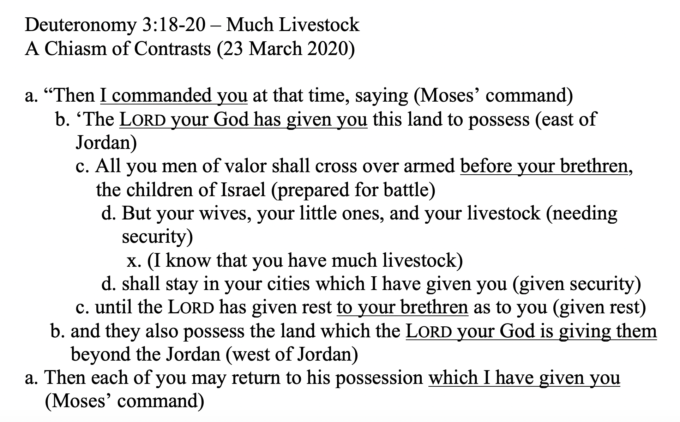
With the division of the land east of the Jordan settled, Moses now recalls the agreement made in Numbers 32 concerning the land which has been divided up as mentioned here. This division, despite being settled according to set boundaries, will actually only take full effect after Canaan is subdued and with these tribes having participated in that 7-year conquest.
A clue to the mystery presented in these verses is actually the first words of them, “Then I commanded you at that time, saying.” It is Moses who commanded. Moses is the lawgiver, and thus he represents the law.
Understanding that, the words, “The Lord your God has given you this land to possess,” are conditional. That is based on what was stated in Numbers 32:29, 30 –
“And Moses said to them: ‘If the children of Gad and the children of Reuben cross over the Jordan with you, every man armed for battle before the Lord, and the land is subdued before you, then you shall give them the land of Gilead as a possession. 30 But if they do not cross over armed with you, they shall have possessions among you in the land of Canaan.’”
In Numbers 32, English translations say, “all your armed men,” or “every man.” But the Hebrew does not say this. Instead, the Hebrew was carefully hyphenated and said, “every-armed.” That precise wording was necessary to show that not all men would go.
Rather, only every man that was to go would be armed. Moses was specific, because otherwise, after he died, a dispute could arise that he intended for every man to go, thus leaving the women and children to build and defend the cities. It would immediately force these tribes to give up this land grant.
Instead, though, some would stay while others will go to battle. After the faithful service of these men, drawn off from the whole, they would then have earned their right to return and possess, with their brothers, the homes and lands which had been tended to during their time of war. Those very specific words are now qualified by Moses…
18 (con’t) All you men of valor shall cross over armed before your brethren, the children of Israel.
The order of the Hebrew is more specific. It says, “drawn off, you shall cross over before your brothers – the sons of Israel – all men of valor.” Actually, only a portion of the men crossed over, about forty thousand out of almost one hundred and eleven thousand. They would be drawn off from the whole.
Further, these who are drawn off were to be bene kayil, or “sons of valor.” The army would be selected based on several requirements. Here, it is specifically noted concerning their willingness and ability to wage war. This will be more specifically defined, however, later in Deuteronomy 20.
When we get there, we will see several reasons for being exempt from warfare including this from Deuteronomy 20:8 –
“What man is there who is fearful and fainthearted? Let him go and return to his house, lest the heart of his brethren faint like his heart.”
No cowardly person was to serve in the army because when he turned and fled, it was bound to be that another, and then another, and then another would follow suit. Just as bravery leads to bravery, so cowardice leads to cowardice. Therefore, only the men of valor were to go. And more…
19 But your wives, your little ones, and your livestock
Rather than saying, “A portion of your men, your wives, and your little ones,” Moses leaves off those men who would not join in the battles. Instead, he only notes the wives, little ones, and livestock.
The word taph, or little ones, normally means small children. They are those who require protection. Here, he is certainly extending it to any who are defenseless. It could be that by using these three examples of helplessness, he is truly looking to cut out any who were cowards. If they were to be included among those three groups, they were certainly not wanted in the battles for Canaan.
As men rotated in and out of the battle, it would be a note for the men to remember and willingly volunteer to join the forces in Canaan rather than be left out during the entire campaign and face the shame of having failed to join in the conquest. This is especially so because of what was originally said to the leaders of these two tribes when they proposed receiving their inheritance outside of Canaan –
“And Moses said to the children of Gad and to the children of Reuben: ‘Shall your brethren go to war while you sit here? 7 Now why will you discourage the heart of the children of Israel from going over into the land which the Lord has given them? 8 Thus your fathers did when I sent them away from Kadesh Barnea to see the land. … And look! You have risen in your fathers’ place, a brood of sinful men, to increase still more the fierce anger of the Lord against Israel. 15 For if you turn away from following Him, He will once again leave them in the wilderness, and you will destroy all these people.” Numbers 32:6-8 & 14, 15
The implication at that time was that they were a bunch of cowards. Once that issue was resolved, and with that still on Moses’ mind, one can see why he is so specific in his words now. And that underlying tone continues with the following words…
19 (con’t) (I know that you have much livestock)
When these tribes came forward to make their initial proposal, there was a heavy stress on the word miqneh, or livestock. It set the tone for the entire passage to be understood. They had a lot of livestock and they used that as their excuse to stay in the land east of the Jordan –
“Now the children of Reuben and the children of Gad had a very great multitude of livestock; and when they saw the land of Jazer and the land of Gilead, that indeed the region was a place for livestock, 2 the children of Gad and the children of Reuben came and spoke to Moses, to Eleazar the priest, and to the leaders of the congregation, saying, 3’“Ataroth, Dibon, Jazer, Nimrah, Heshbon, Elealeh, Shebam, Nebo, and Beon, 4 the country which the Lord defeated before the congregation of Israel, is a land for livestock, and your servants have livestock.’” Numbers 32:1-4
With that memory still fresh on his mind, Moses recalls their words and returns them to their ears. How he conveys his words isn’t known. It could have been in a comical way, as if the whole misunderstanding was cleared up and he was jokingly stating it, “I know you have much livestock!”
Or, it could be that he really thought they were cowards and so he is subtly reminding them of it – “I know you have much livestock…”
If the latter is correct – and it seems likely based on his inclusion of this now – then his note concerning the wives, children, and livestock were to forever remain a pricking reminder in their minds that they needed to man up and conduct themselves as such henceforth.
This is especially so, because the chiasm centers on the idea of their livestock. It appears to be an emphasis that is to be taken to heart and remembered as a point of shame which should spur them on to act with bravery in the battles to come. Either way, of the defenseless ones, Moses says that they…
19 (con’t) shall stay in your cities which I have given you,
Again, the words are conditional. Moses has only given them the cities if they fulfill the commitment they had promised before the Lord. There would be a sufficient number of people to have all of the land cared for, protected, and for rotation of troops in and out of battle. All they needed to do was act in accord with the promise.
In verse 18, it said, “The Lord your God has given you this land to possess.” Now Moses says, “your cities which I have given you.” The word of Moses is the word of law. Unless his words were directed through him by the Lord, it would be a wholly inappropriate statement to make.
But rather than inappropriate, one can see the uniting of the word of the Lord with the spoken word of Moses, the prophet of the Lord. The thought concerning the conditional nature of Moses’ words is next brought to the forefront…
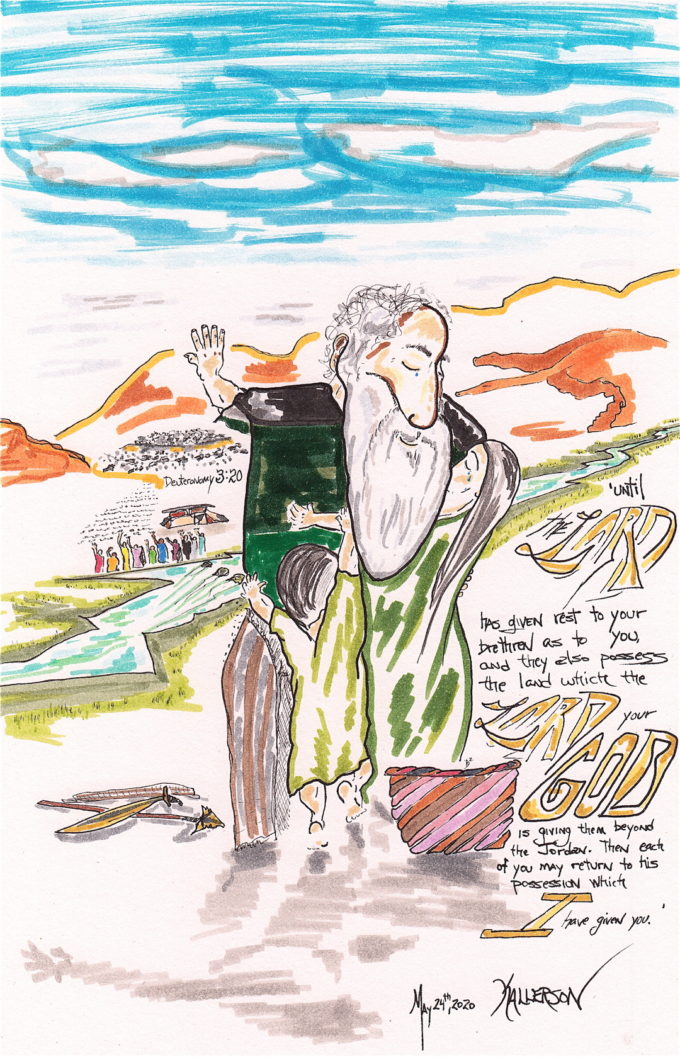
20 until the Lord has given rest
The word “until” is given to remind them that they were under obligation to participate in the campaign to the end. However, it is also a note of surety that it will happen. The words, “until the Lord,” can only mean that the Lord has purposed and thus it will come to pass.
And more, the thought continues with “until the Lord has given rest.” Not only will the endeavor come to pass, but it will end with a set result. The Lord will give nuakh, or rest, as the completion of the campaign that is yet to begin. And that state of rest will be..
20 (con’t) to your brethren as to you,
They had received their inheritance, and with their inheritance, they had received their rest. However, the men of war were to not rest until the other tribes of Israel were also given the same. That is next noted with the words…
20 (con’t) and they also possess the land
Here, the word yaresh, or to inherit, is again used, as it was in verses 12 & 18. Canaan is their inheritance, and when it is subdued, they will have their rest in the land. The thoughts are united as one. Possessing the land is to possess the inheritance, and possessing the inheritance is to obtain the rest.
For all of the other tribes, Moses says that their rest would come from possessing the land…
20 (con’t) which the Lord your God is giving them beyond the Jordan.
There is a unity of thought in the words of these verses. It said both in verse 18 and here, “the Lord your God.” However, in verse 20 it said, “until the Lord has given rest to your brethren.” Their Lord is also the Lord of those on the other side of Jordan.
And again, in verse 3:8, it spoke of defeating the enemies b’ever ha’yarden, or “in side the Jordan,” while speaking of the eastern side. In this verse it again says, b’ever ha’yarden, or “in side the Jordan,” while speaking of the western side. The Lord is the Lord of both sides, and He is the Lord of both groups.
There is one Israel on the side of the Jordan, regardless of which side it is, and the inheritance for each side is given to both by the Lord. For those on the eastern side, once those in Canaan had obtained their possession…
20 (con’t) Then each of you may return to his possession
The conditional nature of the promise is again seen in these words. The inheritance is granted, but only through obedience to the word. For those on the other side, no such note is stated. All it says is that if they cross the Jordan, the Lord will give them the land to possess. The inheritance is assured by simply faithfully trusting in the Lord.
For those who are to receive their inheritance east of Canaan, they must follow the command of Moses. In their obedience to his word, they may then each return to his possession…
*20 (fin) which I have given you.’
Again, it is Moses who says that he has given the possession to them. In verse 18, it said the Lord had given them rest, but it was through Moses that this came about. After the Land of Promise was subdued, they returned to where they had settled. That is recorded in Joshua 22, and it again says that Moses gave them the land –
“Then Joshua called the Reubenites, the Gadites, and half the tribe of Manasseh, 2 and said to them: ‘You have kept all that Moses the servant of the Lord commanded you, and have obeyed my voice in all that I commanded you. 3 You have not left your brethren these many days, up to this day, but have kept the charge of the commandment of the Lord your God. 4 And now the Lord your God has given rest to your brethren, as He promised them; now therefore, return and go to your tents and to the land of your possession, which Moses the servant of the Lord gave you on the other side of the Jordan.’” Joshua 22:1-4
What this is certainly telling us is that man has been given an inheritance from the Lord – all men, including and particularly Israel. But one inheritance is of the law, and one is of the promise. One is earthly, and one is heavenly.
Only those of promise – whether Jew or Gentile – will receive the Lord’s inheritance, meaning the heavenly inheritance. This is why there is the stress on Moses being the one to give the inheritance to those outside of the Land of Promise. They had to earn their inheritance, and it is only an earthly one.
However, those destined for the Land of Promise are granted it through simply believing the Lord and trusting in His work to receive what is offered. The chiasm which spans these last three verses clearly shows us this.
What is it that you are looking for? If it is livestock and worldly wealth, you will have to earn that. But if it is a heavenly inheritance, then you must receive it by faith in the Lord. The two stand in opposition to one another.
Israel is Israel. They are the same group on either side of the Jordan, but only some of Israel will inherit the promise. And for those Gentiles who come to the Lord by faith, they are brought into the commonwealth of Israel to receive the same heavenly inheritance that Israel – the Israel of God – will receive.
The verses are clearly laid out for us to see this, and we must pay heed to what we have seen and heard today. You can be granted an inheritance through law and be separate from the inheritance of the Lord. Or, you can cross the Jordan, come through Christ, and receive the Land of Promise by a simple act of faith.
Choose wisely, and be sure to choose quickly. Life is a passing vapor, and then it is gone. Come to Christ and receive that which is already waiting for those who are willing to do so.
Closing Verse: “Now to Abraham and his Seed were the promises made. He does not say, ‘And to seeds,’ as of many, but as of one, ‘And to your Seed,’ who is Christ. 17 And this I say, that the law, which was four hundred and thirty years later, cannot annul the covenant that was confirmed before by God in Christ, that it should make the promise of no effect. 18 For if the inheritance is of the law, it is no longer of promise; but God gave it to Abraham by promise.” Galatians 3:16-18
Next Week: Deuteronomy 3:21-29 I’m getting tired of this chatter… (Speak No More to Me of This Matter) (11th Deuteronomy Sermon)
The Lord has you exactly where He wants you. He has a good plan and purpose for you. But He also has expectations of you as He prepares you for entrance into His Land of Promise. So, follow Him and trust Him and He will do marvelous things for you and through you.
Until the Lord Has Given Rest
“And this land, which we possessed at that time
From Aroer, which is by the River Arnon, and all its sites
And half the mountains of Gilead and its cities
I gave to the Reubenites and the Gadites
The rest of Gilead, and all Bashan
The kingdom of Og, I gave to half the tribe of Manasseh
All the region of Argob, with all Bashan
Was called the land of the giants; so the people did say
Jair the son of Manasseh took all the region of Argob
As far as the border of the Geshurites and the Maachathites
———-yes, in the direction that way
And called Bashan after his own name
Havoth Jair, to this day
“Also I gave Gilead to Machir
Lots of land for sheep to shear
And to the Reubenites and the Gadites I gave
From Gilead as far as the River Arnon
The middle of the river as the border, as far as the River Jabbok
The border of the people of Ammon
The plain also, with the Jordan as the border
From Chinnereth as far as the east side
Of the Sea of the Arabah (the Salt Sea)
Below the slopes of Pisgah; a land spacious and wide
“Then I commanded you at that time, saying:
‘The Lord your God has given you this land to possess
———-so to you I tell
All you men of valor shall cross over armed
Before your brethren, the children of Israel
But your wives, your little ones, and your livestock
(I know that you have much livestock) – yes, it is true
Shall stay in your cities which I have given you
Until the Lord has given rest to your brethren as to you
And they also possess the land
Which the Lord your God is giving them beyond the Jordan
———-Yes, when they do
Then each of you may return to his possession
Which I have given you
Lord God, turn our hearts to be obedient to Your word
Give us wisdom to be ever faithful to You
May we carefully heed each thing we have heard
Yes, Lord God may our hearts be faithful and true
And we shall be content and satisfied in You alone
We will follow You as we sing our songs of praise
Hallelujah to You; to us Your path You have shown
Hallelujah we shall sing to You for all of our days
Hallelujah and Amen…
12 “And this land, which we possessed at that time, from Aroer, which is by the River Arnon, and half the mountains of Gilead and its cities, I gave to the Reubenites and the Gadites. 13 The rest of Gilead, and all Bashan, the kingdom of Og, I gave to half the tribe of Manasseh. (All the region of Argob, with all Bashan, was called the land of the giants. 14 Jair the son of Manasseh took all the region of Argob, as far as the border of the Geshurites and the Maachathites, and called Bashan after his own name, Havoth Jair, to this day.)
15 “Also I gave Gilead to Machir. 16 And to the Reubenites and the Gadites I gave from Gilead as far as the River Arnon, the middle of the river as the border, as far as the River Jabbok, the border of the people of Ammon; 17 the plain also, with the Jordan as the border, from Chinnereth as far as the east side of the Sea of the Arabah (the Salt Sea), below the slopes of Pisgah.
18 “Then I commanded you at that time, saying: ‘The Lord your God has given you this land to possess. All you men of valor shall cross over armed before your brethren, the children of Israel. 19 But your wives, your little ones, and your livestock (I know that you have much livestock) shall stay in your cities which I have given you, 20 until the Lord has given rest to your brethren as to you, and they also possess the land which the Lord your God is giving them beyond the Jordan. Then each of you may return to his possession which I have given you.’