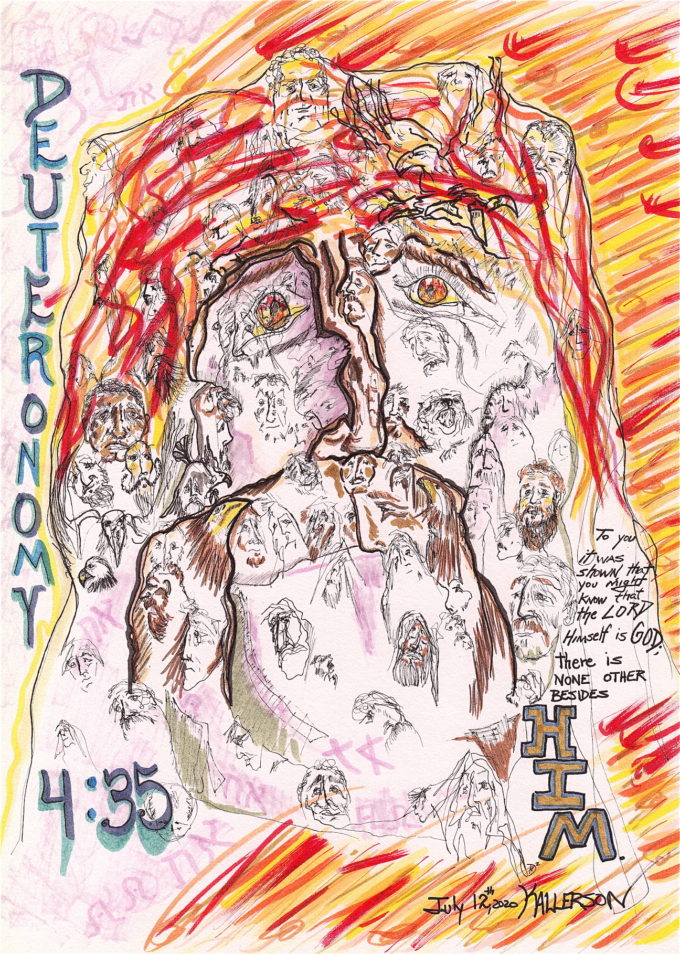
Deuteronomy 4:32-40
There Is No Other
In Romans 9-11, Paul speaks of the situation with Israel in relation to the Lord. He speaks of their rejection of Christ, he speaks of what the state of those who rejected Him is, he speaks of God’s sovereignty over what occurred and what their rejection of Him means for Gentiles and for individual Jews who believe in Him.
He then continues with how their rejection came about, their need for the imputed righteousness of Christ rather than relying on deeds of the law, and how they too can be saved – even despite their continuing hardheartedness.
At the beginning of Chapter 11, Paul opens with, “I say then, has God cast away His people?” His answer, “Certainly not!” He then further explains what their rejection of Christ means for the Gentiles, but he also goes on to say what their acceptance of Christ will mean. He finishes out that portion of his epistle with the following words which form our text verse –
Text Verse: For I do not desire, brethren, that you should be ignorant of this mystery, lest you should be wise in your own opinion, that blindness in part has happened to Israel until the fullness of the Gentiles has come in. 26 And so all Israel will be saved, as it is written:
“The Deliverer will come out of Zion,
And He will turn away ungodliness from Jacob;
27 For this is My covenant with them,
When I take away their sins.”
28 Concerning the gospel they are enemies for your sake, but concerning the election they are beloved for the sake of the fathers. 29 For the gifts and the calling of God are irrevocable. 30 For as you were once disobedient to God, yet have now obtained mercy through their disobedience, 31 even so these also have now been disobedient, that through the mercy shown you they also may obtain mercy. 32 For God has committed them all to disobedience, that He might have mercy on all. Romans 11:25-32
Paul speaks of Israel being beloved for the sake of the fathers. It is exactly what Moses will refer to in our passage today. He then says that the gifts and the calling are irrevocable. For replacement theologians, as well as for those unable to learn what Paul means (but I repeat myself), it is a word meaning, “not able to be changed, reversed, or recovered.”
God has promised, he has called Israel, and that will not change. Israel’s unfaithfulness to the Lord will not in any way affect the Lord’s promises and His faithfulness. This is a great lesson for each of us who has been saved by Christ, but who struggle with all of the things we as humans struggle with. We may be unfaithful, but God will never revoke what He has granted to us through a simple act of faith.
If you have never received Jesus, stick around for the next forty minutes or so for a great sermon (yes, it will be great – because it is based on God’s word), and at the end, I’ll tell you the simple path to salvation. But in case your meeting with God is less than forty minutes away, I’ll give you a short and quick preview – believe that Christ died for your sins and accept that.
This is the central point of all of Scripture – JESUS. The law of Moses is merely a steppingstone leading to Him. It’s all to be found in His superior word. And so, let us turn to that precious word once again and… May God speak to us through His word today and may His glorious name ever be praised.
I. From One End of Heaven to the Other (verses 32-34)
The words of Deuteronomy 4:32-40 are a summary thought for Israel to consider and to live by. It is an amazingly profound portion of Scripture which would be appropriate to copy by every member of the assembly, and to then place in a centrally located part of the house where everyone who came in could see it, reflect on it, and pay heed to it.
Moses is going to reiterate many of the thoughts that he has presented to Israel so far in Chapter 4. He has conveyed to them the need to keep the commandments of the Lord. He will repeat that in verse 40. He has shown that the Lord destroyed many in Israel for idolatry. He will warn that they can expect more of this also in verse 40.
He has spoken of the great wisdom to be found in the statutes and judgments of the Lord. In keeping these, they may call upon Him when needed, because He is near to them. He will refer to this bond in verse 34.
He spoke of the receiving of the law and what it was like when it was received. He will refer to this again in verse 36. He warned against idolatry among the people and the consequences of not paying heed. He will speak of the contrast of that in verse 39 – that the Lord is God, and that there is none other.
He has referred to being brought out of the bondage of Egypt. He will refer to this again in verse 37. And, he has spoken of the faithfulness of the Lord, despite the anticipated unfaithfulness of Israel. He will speak of this unbreakable covenant bond (at least on His side of it) again in verse 34.
In just nine verses, Moses will open up a panorama of thought which extends from the creation of man even through all of the future history of the world. And, it extends out from Israel in all directions over the entire earth.
What is said speaks of the eternal nature of God, and – therefore – of the eternal and irrevocable nature of God’s dealing with this particular people, regardless as to how they respond to Him. In these words, are the magnificent concepts of love, mercy, grace, and also of warning…
32 “For ask now concerning the days that are past,
ki sheal na l’yamim rishonim – For inquire, I pray, to days first. Moses begins the thought imploring his audience – and therefore anyone who ever reads his words – to inquire, into the events of time itself. That word is rishonim, and it signifies the former, first, or beginning.
The idea here is that Moses is imploring his audience to diligently seek, even to the first times that were. But the context of what he is saying is based on the first word, ki, or “for.” The idea is connected to everything in the previous verses. If we start with verse 26 until this verse, we can get the idea of what Moses is conveying –
“I call heaven and earth to witness against you this day, that you will soon utterly perish from the land which you cross over the Jordan to possess; you will not prolong your days in it, but will be utterly destroyed. 27 And the Lord will scatter you among the peoples, and you will be left few in number among the nations where the Lord will drive you. 28 And there you will serve gods, the work of men’s hands, wood and stone, which neither see nor hear nor eat nor smell. 29 But from there you will seek the Lord your God, and you will find Him if you seek Him with all your heart and with all your soul. 30 When you are in distress, and all these things come upon you in the latter days, when you turn to the Lord your God and obey His voice 31 (for the Lord your God is a merciful God), He will not forsake you nor destroy you, nor forget the covenant of your fathers which He swore to them.” Deuteronomy 4:26-31
Moses has let Israel know that they are prone to wander, and in that state, they will be dispersed. They will be in a state of complete denial of the Lord, but in their distress of those times, they will seek Him, and He will be found by them. And that, for two reasons – 1) He is merciful, and 2) He has made a covenant with their fathers.
This is what Moses’ words are now based on, imploring Israel to seek even to the foundings of the world for a comparison to the proposition he will set before them. O Israel, seek to the days…
32 (con’t) which were before you,
asher hayu lephanekha – “which have been before you.” Israel is sitting before Moses, and before entry into Canaan. They are the same people who had been brought out of bondage and offered Canaan many years earlier.
They are the same who rejected that, and who were thus rejected. They are the same whose fathers had perished, and who were now free from the stain of their guilt. However, Moses asks them to not only consider these times, but of all of the times before their calling, even…
32 (con’t) since the day that God created man on the earth,
l’min ha’yom asher bara Elohim adam al ha’arets – “from the day which created Elohim man on the earth.” Moses’ words now take his audience back to both the first page of Scripture and to the sixth the day of creation, where it is recorded –
“Then God said, ‘Let Us make man in Our image, according to Our likeness; let them have dominion over the fish of the sea, over the birds of the air, and over the cattle, over all the earth and over every creeping thing that creeps on the earth.’ 27 So God created man in His own image; in the image of God He created him; male and female He created them.” Genesis 1:26, 27
The intent of the words is that if one could, they were to inquire of every human that ever existed since God created Adam and his wife. This is the diligence of the search that Moses is calling forth for those he is speaking to. And not only in a certain stream of men from Adam is this call made. Rather…
32 (con’t) and ask from one end of heaven to the other,
u-l’miqtseh ha’shamayim v’ad qetseh ha’shamayim – “and to from end of the heavens and to end of the heavens.” The translation “heaven” is incorrect. It is not referring to the place of God’s dwelling, but the places of man’s dwelling. The term means from anywhere on the planet – from north, south, east, or west.
Any location where man has been or is. The search is to be made from all men at any time and at any place in all of that time. Moses is speaking in absolute and all-inclusive terms for an answer to the proposition he now puts forth…
32 (con’t) whether any great thing like this has happened,
hanihyah ka’davar ha’gadol ha’zeh – “has happened like this manner, the great, the this.” What has ever come into being which is comparable to what I am asking you about now? Such a great thing as this! Tell me, please. I want to know…
32 (con’t) or anything like it has been heard.
o ha’nishma kamohu – “or has been heard like it.” Not only is the thing which has come to pass great, but there is nothing even comparable to it. Ear has not heard of such a thing. The sentiment is almost identical to what Paul says in 1 Corinthians when referring to the gospel in 1 Corinthians 2:7-9 –
“But we speak the wisdom of God in a mystery, the hidden wisdom which God ordained before the ages for our glory, 8 which none of the rulers of this age knew; for had they known, they would not have crucified the Lord of glory.
9 But as it is written:
‘Eye has not seen, nor ear heard,
Nor have entered into the heart of man
The things which God has prepared for those who love Him.’”
Paul was not speaking of what lies ahead for the believer. Rather, he – like Moses – was referring to what God had done. God had sent Christ to die for the world in order to call out a people for Himself, even from Israel and even from the Gentiles.
Moses, however, speaks not of the New Covenant in Christ and those who are a part of it, but rather of the Sinaitic Covenant between the Lord and Israel. Of that covenant, and the events which surrounded it, Moses now questions the people.
The questions he will ask are based on the proposition he just set forth – has anything such as this ever happened, at any time since creation, and among any people within creation…
33 Did any people ever hear the voice of God speaking out of the midst of the fire,
ha’shama am qol Elohim m’daber mitok ha’esh – “Heard people voice of God speaking from midst the fire?” The intent of the words is probably, “Did any people hear the voice of ‘a god.’” In other words, what occurred at Sinai between the people and the Lord is completely unknown.
No other people heard the voice of a god because there is no other god than the Lord God. And, the people of Israel did, in fact, hear the voice of the Lord God out of the midst of the fire.
Looking back on the record from Genesis, one would consider the visitation of God to be one of judgment. The earth was flooded at Noah’s time, and all but eight perished. Sodom and Gomorrah were destroyed and only the family of Lot was spared. Nothing is recorded of God speaking. But His visitation was evident.
Later, God appeared to Abram, to make a covenant with him. In the cutting of that covenant, it said a smoking oven and a burning torch passed between the pieces of the animals when the covenant was made with him.
At that time, the Lord spoke to Abram concerning the promise of the land. That event established the baseline of the land covenant with him and his descendants, but more revelation from God would come at Sinai. It is that which Moses is now referring to.
When the Lord appeared to Israel at Mount Sinai, and as was further detailed in verse 12 of this chapter, He spoke out of the midst of the fire. They heard the voice, they were given the words of law, and they saw the terrifying sight of pending judgment which could be anticipated from violating the law. And yet…
33 (con’t) as you have heard, and live?
ka’asher shamata atah va’yehi – “as has heard you, you, and live?” One can feel the emphasis in Moses’ words, “You heard it – even you – and yet you are still alive! Has such a thing ever happened before? I think not, and yet it has happened to you.”
But as important as the emphasis on the addressee is, there is also the fact that his words are in the second person singular. Moses is speaking to each individual personally, even though it is to Israel as a collective. They are being set in complete contrast to any other people group.
Knowing this, a point of immense importance can be elicited from what Moses is conveying. The people heard the words of the Lord God from the fire and they lived. But the same words are conveyed in what Moses recorded.
They are words of law. The law doesn’t change because of the visible manifestation of the Lord or because of its lack. It is the same law that carries the same penalties. This is why the use of the second person singular is so important.
Even if those of Israel die because of the law – and indeed many had died, and many would continue to die because of it – Israel would continue to exist. It is a note of absolute surety for the collective in the face of the expectation of certain disaster for many individuals.
34 Or did God ever try to go and take for Himself a nation from the midst of another nation,
o hanissah Elohim lavo laqakhat lo go miqerev go – “Or did try God to come take for Himself nation from midst nation.” As before, this is more likely saying, “Did a god try.”
The Lord God is again being set against the false gods of all other nations. It is a rhetorical question concerning them. Thus, it demands a negative response. No other god has done such a thing. And next, to show the superlative nature of what Yehovah did, Moses speaks on…
34 (con’t) by trials,
Moses begins a list of seven descriptors concerning their past. The first is massah, meaning testing or trials. It is a new word, being derived from the word nasah which was just used in the previous clause where it asked, “…did God ever try.”
It is probably referring to the trials of the people prior to Moses’ arrival. They were in hard bondage, they were afflicted and tested, and it said in Exodus 2 –
“Then the children of Israel groaned because of the bondage, and they cried out; and their cry came up to God because of the bondage. 24 So God heard their groaning, and God remembered His covenant with Abraham, with Isaac, and with Jacob. 25 And God looked upon the children of Israel, and God acknowledged them.” Exodus 2:23-25
34 (con’t) by signs,
The othoth, or signs, are things given to represent something else. The Lord gave Moses three signs to give to Israel – the rod which turned into a snake, the leprous hand, and the water which turned to blood. He also gave signs to Pharaoh concerning what would come upon them as the Lord accomplished His work. Next…
34 (con’t) by wonders,
u-b’mophtim – “and in wonders.” The mopheth, or wonder, comes from yaphah, or beautiful. Thus, it speaks of that which is conspicuous and amazing. The word “wonders” gives us the right sense. It speaks of the plagues which came upon the land. And yet, it also speaks of the fact that Israel was spared at the same time. While Egypt was destroyed, Israel survived through the plagues – each time, it was a wonder in itself.
34 (con’t) by war, by a mighty hand and an outstretched arm, and by great terrors,
These are what the Lord brought upon Egypt and the Egyptians, especially after the Exodus. Each of them speaks of the power and splendor of the Lord through His great workings. He fought the battles, it was his strength that worked against Egypt, it was his reach which devastated them while Israel remained safe, and it was His actions that brought terror upon the foe. All of this was…
34 (con’t) according to all that the Lord your God did for you in Egypt
It is in the second person plural, the only plurals in this section. The Lord is the God of the people, and He accomplished His work on their behalf accordingly. And He did it…
34 (con’t) before your eyes?
It returns to the second person singular. The collective eyes of the people are spoken of as one person. Israel beheld the marvels wrought by Yehovah his God.
There is no other God; I know not one
Search in the highest heavens and there will be only Me
Search below the earth until your days are done
And no other god shall you see
I alone am the Lord your God
And to Me alone shall you give your thanks and praise
Wherever on this earth you trod
Only Me you shall honor for all your days
Trust in Me, and I will give you rest
I will lead you on soft paths, lush and green
In your soul, you shall be forever blessed
Because you have no other gods; to you only I am seen
II. Consider it in Your Heart (verses 35-40)
35 To you it was shown,
The words are emphatic: atah hareeta – “You, it was shown to you.” Israel, no other, beheld the things which brought them to where they now are. The past is being called to testify that the Lord did these things to Israel, and to no other. This was so…
35 (con’t) that you might know that the Lord Himself is God;
The words are again emphatic: la’daath ki Yehovah hu ha’elohim – “that you might know that Yehovah, He, the God.” As your Bible failed to put an article before the word “God,” please pen it in, and give your translation 1 demerit in the margin.
This is the whole point of the Lord contrasting Himself to the other gods, and it is why the term “a god” should have been used in the previous verses. Any other god is a false god. None has done what Yehovah has done.
Therefore, Yehovah – He – is THE GOD. He did these things so that Israel (it is again in the second person singular) would know that He alone is God. By extension, then, His identification with, protection of, and continued faithfulness to, them is so that all the world will know that He, Yehovah, is THE GOD.
Their faithfulness or unfaithfulness to Him has no bearing on who He is. But His faithfulness to them is for the specific and particular purpose of demonstrating to all that He is God, and…
35 (con’t) there is none other besides Him.
ain od milbado – “None other beside Him.” That there is one God can be logically determined without knowing who that God is. The twelve First Principles logically and undeniably demonstrate this. But just because a person can logically think that through, it does not mean that he knows this God except as can be perceived through what He has created.
But, God can – and Has – specifically revealed Himself in various ways. Here in Deuteronomy 4, He has shown us one of those ways. It is through Israel and what He has done for and through, them. Such things have not been seen in any other nation. Israel was to know this, and they were to then understand that there was, in fact, no god besides Him.
36 Out of heaven He let you hear His voice,
min ha’shamayim – “from the heavens.” The idea is that the people looked up, but the sounds did not come from any discernible place. They heard the voice, saw the fire, but could not discern the location of where the voice came from. This was so…
36 (con’t) that He might instruct you;
Here the word yasar, or instruct, is used. It comes from a primitive root signifying “to chastise.” Thus, it usually gives the sense of punishment for corrective instruction. The terror of hearing the voice of God was intended to do this. The instruction is multi-layered. He instructed them in the law.
He instructed them in seeing that He had no discernable form, and thus He was not to be worshipped through any created thing. He instructed them that He was above them, and yet He was willing to speak to them without destroying them.
He instructed them that He is, because a voice comes from somewhere, and words convey intelligence and meaning. Such things as these, and certainly many more, were provided for their instruction. Further…
36 (con’t) on earth He showed you His great fire, and you heard His words out of the midst of the fire.
v’al ha’arets – “and on the earth.” In Exodus 20:18, it said, “Now Mount Sinai was completely in smoke, because the Lord descended upon it in fire.” Fire consumes and fire destroys. The manifestation was to instruct the people that the Lord is a consuming fire and that they were to heed Him.
And yet, it was also to instruct them that He could contain the fire as well. It extended to where He wished it to go, but it could be contained – signifying restraint and even mercy.
Also, the fire extended from the earth to the heavens. It was a demonstration that Yehovah is not limited to one aspect of His creation.
As it says in Genesis 1:1, “In the beginning God created the heavens and the earth.” He is transcendent over His creation. He can manifest Himself nowhere in it, or He can manifest Himself in one location or another in it, or He can extend Himself between locations – as He did at Sinai.
Despite manifesting Himself, however, the source of the voice could not be determined because it was enveloped within the midst of the fire. All of this was for the instruction of Israel. But it was based upon His faithfulness to those who came before them…
37 And because He loved your fathers,
v’takhat ki ahav eth avotekha – “And instead, because He loved your fathers.” The word takhat means “under,” and thus signifying “instead.” The idea is that when one comes under another, he replaces the one he comes under. Thus, this is referring to Egypt.
Israel was in the midst of Egypt, a people greater and more numerous than Israel. But the Lord chose Israel instead of Egypt to display Himself to the world. It is reflective of Paul’s words to those at Corinth –
‘For you see your calling, brethren, that not many wise according to the flesh, not many mighty, not many noble, are called. 27 But God has chosen the foolish things of the world to put to shame the wise, and God has chosen the weak things of the world to put to shame the things which are mighty; 28 and the base things of the world and the things which are despised God has chosen, and the things which are not, to bring to nothing the things that are, 29 that no flesh should glory in His presence. 30 But of Him you are in Christ Jesus, who became for us wisdom from God—and righteousness and sanctification and redemption— 31 that, as it is written, ‘He who glories, let him glory in the Lord.’” 1 Corinthians 1:26-31
The Lord chose the underdog to display His glory, but more than that, it was because of His love for their fathers – meaning Abraham, Isaac, and Jacob. He had made the covenant promises to them, and He would fulfill them through Israel. As Moses says…
37 (con’t) therefore He chose their descendants after them;
v’yivkhar b’zarow akharav – “and He chose in his seed after him.” The word “seed” is singular. The fathers had other descendants at times, but it is this particular seed, in this particular line, that was chosen by God to reveal Himself in this unique way.
Interestingly, a verse parallel to this is seen in Deuteronomy 10:15, but there, the word “seed,” and the pronouns in the verse, are all plural –
“The Lord delighted only in your fathers, to love them; and He chose their descendants after them, you above all peoples, as it is this day.”
The interchange of the singular and plural throughout these verses is complicated, but purposeful. It shows minute specificity which is, sadly, overlooked by almost all translations. Moses is making theological points about the people who are Israel, and about those people of whom Israel is comprised.
In this clause, we see that Israel was specifically chosen. In this selection, the Lord set them apart from all others. This thought was seen in our text verse today where Paul spoke of Israel’s gifts and calling being irrevocable. The same thought is seen later in Deuteronomy –
“Remember the days of old,
Consider the years of many generations.
Ask your father, and he will show you;
Your elders, and they will tell you:
8 When the Most High divided their inheritance to the nations,
When He separated the sons of Adam,
He set the boundaries of the peoples
According to the number of the children of Israel.
9 For the Lord’s portion is His people;
Jacob is the place of His inheritance.” Deuteronomy 32:7-9
Samuel repeated this during the time of the judges –
“Then Samuel said to the people, ‘Do not fear. You have done all this wickedness; yet do not turn aside from following the Lord, but serve the Lord with all your heart. 21 And do not turn aside; for then you would go after empty things which cannot profit or deliver, for they are nothing. 22 For the Lord will not forsake His people, for His great name’s sake, because it has pleased the Lord to make you His people.’” 1 Samuel 12:20-22
The same thought is found throughout the Old Testament. The Lord was and remains (according to Paul) unwilling to reject Israel, even when they had forsaken Him. It is His honor that is tied up in the preservation of this people.
Though there is overlap in the Lord’s way of dealing with the church, it does not negate His continued faithfulness to Israel. But that is the classic and appalling error made by replacement theologians.
37 (con’t) and He brought you out of Egypt with His Presence, with His mighty power,
Here, it literally says, “in His face.” Thus, it means He personally went with them and led them out of Egypt. It was also a promise given to Moses in Exodus 33:14, where the Lord said, “My Presence will go with you, and I will give you rest.”
Israel did not come out alone, but rather they had the Presence of the Lord with them. They had His great power to guide them, feed them, sustain them, and ensure they would make it to their final destination.
As Exodus 33:14 says that their final destination is being granted their rest, it is a promise that must come to pass. However, Hebrews tells us that Israel did not enter its rest, neither at the time of Joshua, nor at the time of David. As this is so, then the rest which is promised to them – and which is realized in their collectively coming to Jesus – is yet ahead of them, even today.
This is certain because Exodus 33 says I will go with you (plural) and I will give you rest (singular). The Lord will continue to go with the people of Israel, until Israel the people are given rest. At the time of Moses’ words now, he says the Lord has been…
38 driving out from before you nations greater and mightier than you, to bring you in, to give you their land as an inheritance, as it is this day.
It is the Lord who accomplished the act. He was the One who gained the victory for Israel over Sihon and Og, the Amorite kings dwelling east of the Jordan.
Despite their great size and strength, they were dispossessed, or disinherited, from the land so that Israel could then possess it as an inheritance. Because of this, all of these great wonders which the Lord had displayed before Israel, Moses again implores them…
39 Therefore know this day, and consider it in your heart,
The Hebrew is more expressive: v’yadata ha’yom va’hashevota el l’vavekha – “and know this day and return it to your heart.” The people are to consider everything that they had seen and then been reminded of, and then they were to take that knowledge and return it to their heart.
As always, the heart in the Bible is the seat of reasoning and understanding. Therefore, it is like our saying, “Think it through and then tuck it away in your mind.” They were to never forget this. By returning it to their heart, they could contemplate it continuously. So, Israel was to do with the knowledge…
39 (con’t) that the Lord Himself is God
The same emphatic form is brought forth again: ki Yehovah, hu, ha’elohim – “for Yehovah, He, the God.” Again, there is an article before “God.” The emphatic “He,” along with the highlighted nature of Yehovah being “the God,” is intended to reveal His uniqueness. Be sure to put the article before God in your Bible and make a 1 demerit margin note.
The uniqueness of Yehovah continues to be highlighted, again, in the next clause as He is THE God…
39 (con’t) in heaven above and on the earth beneath;
ba’shamayim mi’maal v’al ha’arets mi’takhat – “in the heavens from above and on the earth from under.” It is an important statement to include. In verse 36, it said that the Lord spoke out of the heavens, and that on the earth He showed His great fire. He is not limited to any part of creation.
He fills any and all of creation without distinction. And He can manifest Himself in any way He chooses, such as at Sinai. If someone said the stars from the heavens were gods, that would be false. If someone said the volcanoes from the earth were gods, that would be false.
Such things will be seen as we progress through Scripture, but Israel is being instructed now that those things are false. And yet, they will be the downfall of Israel numerous times because they failed to pay heed to what Moses is now telling them. There is one God and…
39 (con’t) there is no other.
ain od – “no other.” The word od signifies continuance or going around. It is widely translated as again, more, yet, still, else, and so on. There was none, there are none still, and none will be coming around. Yehovah is God and He alone…
40 You shall therefore keep His statutes and His commandments which I command you today,
This verse returns to the opening verse of the chapter, substantially repeating it, but it has now been supported with the reason it is to be so from these previous verses –
“Now, O Israel, listen to the statutes and the judgments which I teach you to observe, that you may live, and go in and possess the land which the Lord God of your fathers is giving you.” Deuteronomy 4:1
Moses has methodically given precise reasons why they are to keep the Lord’s law. These reasons were summed up with the thought that Yehovah is God, and He alone. As this is so, then He is to be obeyed as such.
He has chosen His people, He has revealed Himself to them, He has made them promises in the land they are going to enter, He has given them warnings for disobedience, and Moses has shown that what has occurred is unique in all of the history of the world. God has come to be among a particular people, and they are thus expected to be obedient to His law. In this, Moses says…
40 (con’t) that it may go well with you and with your children after you,
The word translated as “that” is maan. It speaks of a purpose or intent. Moses shows that obedience to His commands isn’t simply an authoritarian edict by a tyrant, but that it will serve a good and noble purpose, which is that it will go yatav, or pleasing, for them.
The Lord intends that the people will prosper if they are attentive to Him and if they do as He instructs. The implication is that if they are not obedient, things will go contrary to them, and they will suffer a self-inflicted wound in the process.
Moses then explains what “go well with you and your children after you” means by saying…
*40 (fin) and that you may prolong your days in the land which the Lord your God is giving you for all time.”
The people are, as we have seen before, tied to the land – meaning Canaan. By observing what the Lord commands, they will continue in the land. The implication is that if they do not, then they will be taken out of the land. It doesn’t need to be said to be understood.
Despite that, however, Moses finishes the section with the words kal ha’yamim, or “all the days.” There is no qualifier to the land grant. It is given to Israel forever. The qualifier is not in whether the land is theirs, but whether they can live in it. It is the Lord who determines if the agreement is sufficiently met by Israel.
When Israel is obedient, they may live in the land. When Israel is disobedient, they may not live in the land. Either way, the land is the Lord’s, and He has given it to Israel as a possession forever.
What has been seen, and what will continue to be seen, is that the law actually points to its own replacement. Israel was never obedient to the law, and they retained the land for an extended period of time before they were finally exiled.
Israel was returned to the land according to the Lord’s calculations of giving the land rest during Israel’s exile – seventy years. They returned and remained disobedient to the Lord throughout that time as well. Eventually, Christ came and fulfilled the law – an act intended to give life to Israel, but they rejected that and were exiled again.
They have been returned again, and they are promised seven more years to find an end to the Mosaic Covenant in Christ. The time of that final seven years is not far off. Eventually, it will come. To be obedient to the laws laid out here by Moses means to be obedient to them all.
We are progressing through Deuteronomy and we will see how this will be possible for them. Suffice it to say that their observance of the law in order to be right with God has nothing to do with their own efforts, but in trusting the Lord who gave the law in the first place.
Until that happens, the prospect of things going well for them and prolonging their days in the land cannot come to pass. But it will. Some wonderful day after much hardship and suffering, it will come to pass. For those of us who have understood what Israel missed, we have a marvelous hope set before us.
The Lord is coming for His people to deliver them from what lies ahead. He has a home prepared for His people, and the rest which we entered when we received Jesus will be realized in its fullness. It is a blessed hope. If it is something you have not yet received, you can do it today, even right now…
Closing Verse: “Thus says the Lord, the King of Israel,
And his Redeemer, the Lord of hosts:
‘I am the First and I am the Last;
Besides Me there is no God.
7 And who can proclaim as I do?
Then let him declare it and set it in order for Me,
Since I appointed the ancient people.
And the things that are coming and shall come,
Let them show these to them.
8 Do not fear, nor be afraid;
Have I not told you from that time, and declared it?
You are My witnesses.
Is there a God besides Me?
Indeed there is no other Rock;
I know not one.” Isaiah 44:6-8
Next Week: Deuteronomy 4:41-49 Places of safety for anyone, including Steve, Tom, or even Gordon… (On the East Side of the Jordan) (18th Deuteronomy Sermon)
The Lord has you exactly where He wants you. He has a good plan and purpose for you. But He also has expectations of you as He prepares you for entrance into His Land of Promise. So, follow Him and trust Him and He will do marvelous things for you and through you.
There Is No Other
For ask now concerning the days that are past
Which were before you, since the day that God created man on the earth by His spoken word
And ask from one end of heaven to the other
Whether any great thing like this has happened
———-or anything like it has been heard
Did any people ever hear
The voice of God (If so, please their name to me give)
Speaking out of the midst of the fire
As you have heard, and live?
Or did God ever try to go and take for Himself a nation
From the midst of another nation, by trials, by signs, by wonders
———-please to me apprise
By war, by a mighty hand and an outstretched arm
———-and by great terrors
According to all that the LORD your God did for you
———-in Egypt before your eyes?
To you it was shown, that you might know – you and not another
That the LORD Himself is God; there is besides Him none other
Out of heaven He let you hear His voice
That He might instruct you; to obedience you should aspire
On earth He showed you His great fire, and you heard His words
Out of the midst of the fire
And because He loved your fathers
Therefore He chose their descendants after them
And He brought you out of Egypt with His Presence
With His mighty power He brought Egypt mayhem
Driving out from before you nations
Greater and mightier than you
To bring you in, to give you their land as an inheritance
As it is this day; His word is faithful and true
Therefore know this day, and consider it in your heart
That the LORD Himself is God
In heaven above and on the earth beneath
There is no other; anything else is a fraud
You shall therefore keep His statutes and His commandments
Which I command you today, that it may go well with you
———-all will be sublime
And with your children after you, and that you
———-may prolong your days
In the land which the LORD your God is giving you for all time
Lord God, turn our hearts to be obedient to Your word
Give us wisdom to be ever faithful to You
May we carefully heed each thing we have heard
Yes, Lord God may our hearts be faithful and true
And we shall be content and satisfied in You alone
We will follow You as we sing our songs of praise
Hallelujah to You; to us Your path You have shown
Hallelujah we shall sing to You for all of our days
Hallelujah and Amen…
32 “For ask now concerning the days that are past, which were before you, since the day that God created man on the earth, and ask from one end of heaven to the other, whether any great thing like this has happened, or anything like it has been heard. 33 Did any people ever hear the voice of God speaking out of the midst of the fire, as you have heard, and live? 34 Or did God ever try to go and take for Himself a nation from the midst of another nation, by trials, by signs, by wonders, by war, by a mighty hand and an outstretched arm, and by great terrors, according to all that the Lord your God did for you in Egypt before your eyes? 35 To you it was shown, that you might know that the Lord Himself is God; there is none other besides Him. 36 Out of heaven He let you hear His voice, that He might instruct you; on earth He showed you His great fire, and you heard His words out of the midst of the fire. 37 And because He loved your fathers, therefore He chose their descendants after them; and He brought you out of Egypt with His Presence, with His mighty power, 38 driving out from before you nations greater and mightier than you, to bring you in, to give you their land as an inheritance, as it is this day. 39 Therefore know this day, and consider it in your heart, that the Lord Himself is God in heaven above and on the earth beneath; there is no other. 40 You shall therefore keep His statutes and His commandments which I command you today, that it may go well with you and with your children after you, and that you may prolong your days in the land which the Lord your God is giving you for all time.”