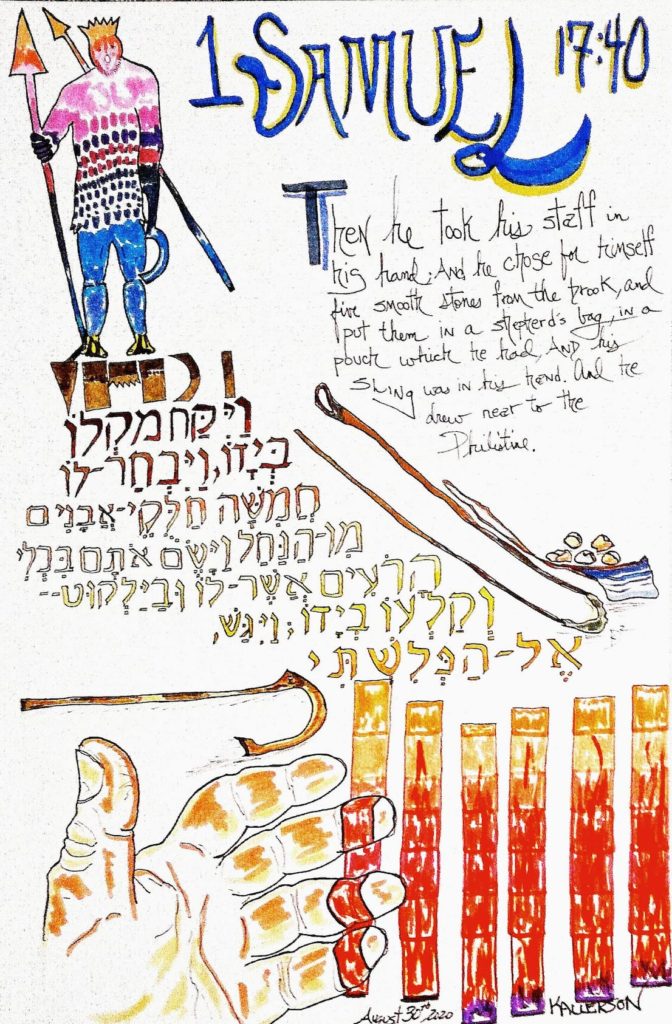
1 Samuel 17:28-40
David and Goliath
The Valley of Elah, Part III
The men of the ranks of Israel, both last week and this week, are seen to have focused on the rewards they would get from Saul for defeating the giant. However, none of them felt it was sufficient to chance meeting him. David challenged them on this, showing in this that if the attitude isn’t right, then the rewards are of no lasting value.
Reading it reminded me of a line out of the movie Field of Dreams. Shoeless Joe remembered what it was like to play. It meant more to him than fame or fortune. Instead, he said, “Oh man, I did love this game. You know, I’d have played for food money. It was the game, the sounds, the smells.”
Some things cannot be bought with money, as we now see in modern baseball. Money is thrown at the players and they disgrace the game and the heritage any chance they get. Therefore, it isn’t about the game at all. It is only about what they can get out of it – be a lot of money or the furtherance of an agenda.
David didn’t care about the offer of Saul. What interested him was the honor of the Lord and the victory of His people over the enemy. Because his heart was right, he was willing to do what nobody else was willing to do. We see that in our verses today, and it gives us a lesson to consider in our own lives.
Text Verse: “Though He slay me, yet will I trust Him.” Job 13:15
In our passage today, David has put his confidence in the Lord. Because this is so, even if he were to die in battle, he could rightfully say that it was the Lord who took his life. Goliath could only be reckoned as the instrument of the Lord’s action.
But, as we will see, David was confident enough in other aspects of what is going on to understand that he would, in fact, prevail. One cannot help but see Christ in this. He knew the outcome of what His earthly life would be, and He plainly told it to the disciples before it came about.
And yet, in the Garden of Gethsemane, He prayed that if there was another avenue, He would be willing to take it, but only if it was the will of His Father. As Job said, so Jesus could say, “Though He slay Me, yet I will trust Him.”
We know that it was the Jews who handed Him over to the Romans, and we know that it was the Romans who nailed Him to the cross, but we also know that it was the divine will of God that it was to happen this way. David sensed that it was the will of the Lord for him to step forward and challenge the enemy, and he did not resist that will.
For us today, we have the will of the Lord for our lives right before us. And yet, we act as if we don’t know what the will of the Lord for our lives is. “I don’t know what to do.” “I don’t know what the Lord is telling me in this.” And so on.
We have life to live, and then we have the will of the Lord to live our lives. He is not here to cross our every t and dot our every i. He is not here to decide for us where to move, what job to take, what person to marry, or what we should have for dinner.
His will for our lives is that we live according to His word. As long as we are doing that, and as long as what we intend to do is not contrary to that, then we are to pray about it and go forward with what we wish to do. If it doesn’t work out, it doesn’t mean it wasn’t the will of the Lord. It means the will of the Lord was realized in whatever didn’t work out.
David is stepping forward doing nothing contrary to the will of God, and he is doing it with the honor of the Lord first and foremost set before him. If we can follow suit in exactly that for each decision we make, then we will be, in fact, following the will of the Lord.
This is just how it is. Do your part and the Lord will do His part. This is a certain truth which is to be found in His superior word. And so, let us turn to that precious word once again and… May God speak to us through His word today and may His glorious name ever be praised.
I. Let No Man’s Heart Fail Because of Him (verses 28-32)
As we saw last week, David was encouraging the men to fight. It is apparent he wasn’t looking to go into the battle himself, as if he was a great warrior. He wasn’t being some type of braggadocio either. Rather, his words to those standing by him were for them to think the matter through. In his words, he said –
“What shall be done for the man who kills this Philistine and takes away the reproach from Israel? For who is this uncircumcised Philistine, that he should defy the armies of the living God?” 1 Samuel 17:26
In saying, “What shall be done for the man…?” David wasn’t trying to find out how he might benefit if he fought. Instead, he was scoffing at an earthly reward and noting that it was the armies of the living God that the Philistine was defying. As this was so, Goliath was defying the God of those armies.
In essence, David was saying, “Get your priorities right! You are not serving for gain. You are serving for your people Israel, and for your God. Trust in Him and He will win the battle for you!” It is with this thought in mind that we now enter into our text today…
28 Now Eliab his oldest brother heard when he spoke to the men;
Eliab is David’s oldest brother, here called akhiv ha’gadol, or “brother, the great.” His name means God is Father, or My God is Father. He hears David’s words to the men, setting up the conflict which next presents itself…
28 (con’t) and Eliab’s anger was aroused against David,
v’yikhar aph eliav b’david – “And burned nose of Eliab in David.” It is an idiom which means that his anger was aroused against him. The idea is that flames shoot out of his nostrils in anger at the words of David. It is apparent that he feels the sting of his own cowardice.
David’s words are taken as a rebuke. He is the younger brother, he has not been commissioned for battle, and here he is counseling everyone that they should just trust in the Lord and the battle will be won. Eliab’s thoughts are essentially, “It’s easy for you to say this. You aren’t the one facing this giant. You are just a shepherd boy…”
28 (con’t) and he said, “Why did you come down here?
Eliab knows exactly why he came down. It would be for delivering the things he needed for the battle – food, supplies, and so on. He is upset that David is sticking his nose into the affairs of the battle, as if he had gone out to face this giant day after day. Rather, “Why don’t you just make your delivery and go back home?” To reinforce that, he then says…
28 (con’t) And with whom have you left those few sheep in the wilderness?
v’al mi natashta meat ha’tson ha’henah ba’midbar – “and upon whom have you abandoned few the sheep the they in the wilderness.” The entire phrase is one of derision. First, he speaks as if David has cast off his appointed duties, leaving them for someone else to pick up because of his negligence – “upon whom have you abandoned.” In essence, Eliab is saying, “You are AWOL from your own duties. And, in that, you are burdening someone else.”
Secondly, “those few sheep,” is a way of further deriding David. “Not only did you abandon your duties, they weren’t very great duties to begin with. Here we are in the heat of a coming battle, and you are out in the fields with a few sheep.”
And thirdly, “in the wilderness,” is a way of saying that David’s tasks are unimportant. He just ambles around with a bunch of sheep that eat thorn bushes in the middle of nowhere. And more, that they are in the middle of nowhere means that in abandoning them, they are now either completely neglected, or are being watched by someone who probably has no vested interest in their care.
Eliab’s own cowardice is causing him to lash out at David in an attempt to exalt his station and humiliate that of his younger brother. As this is so, his next words are intended to further reduce him in esteem and show the contrast between the two of them…
28 (con’t) I know your pride
Ani yadati eth zedonekha – “I know your boiling up.” The word is zadon. It signifies pride, arrogance, self-importance, etc. It comes from zud which signifies boiling up. It is an onomatopoetic expression, reflecting the sound of boiling – zud, zud, zud.
28 (con’t) and the insolence of your heart,
v’et roa l’vavekha – “and the ugliness to your heart.” The word is roa. It comes from ra’ah – bad or evil – and it is variously translated. One must consider the mind of the speaker and the intent behind his words. Roa was first used in Genesis 41:19 to describe the thin cows of Pharaoh’s dream. Hence, I chose “ugliness.” Eliab is saying this to set the stage forr his next words…
28 (con’t) for you have come down to see the battle.”
ki l’maan reowt ha’milkhamah yaradata – “for to purpose seeing the battle you have come down.” The word maan speaks of purpose or intent. Eliab dismisses the fact that David came down for the aid of his brothers, and instead imputes to him the wrongdoing of simply desiring to watch the battle.
It makes his accusation about leaving the “few” sheep in the wilderness all the more striking. In essence, Eliab is saying, “You know nothing of what we’re going through, and you can’t even attend to your own duties. Your only purpose in being here is to watch us suffer through this battle.”
29 And David said, “What have I done now? Is there not a cause?”
David responds without any aggression, but rather with curiosity as to why his brother spoke so insultingly to him. The Hebrew reads, halo davar hu – “Not word it?” In other words, “It was just a mere word.” The force of it then is, “What wrong have I done? Can’t I just ask a simple question?” And so…
30 Then he turned from him toward another and said the same thing; and these people answered him as the first ones did
The word davar, or “word,” which was just used in the previous verse is used again three times in this verse. It says, “And he said according to this word, and the people returned him a word according to the first word.”
In other words, nobody has taken offense at his words except his brother Eliab. The rest of them are perfectly content with his inquiries and they understand he is neither being boastful nor arrogant. And so, they respond just as the first time he asked someone.
31 Now when the words which David spoke were heard,
So far, there is no recorded word of David asking to fight the giant. And in asking, “What shall be done for the man who kills this Philistine?”, there is no note of him wanting to do so. In fact, it is the obvious question every person in the camp would have asked when a reward was first suggested.
Therefore, it is not the words of David wanting to go to battle, but it must be the words of David concerning the uncircumcised Philistine defying the living God. It is certain nobody had spoken this way, and it probably caught the attention of some commander or another within the ranks. Thus, the zeal for the honor of the Lord, something Saul had lacked for some time, is what is highlighted here. Therefore…
31 (con’t) they reported them to Saul; and he sent for him.
It doesn’t say “to Saul,” but “before Saul.” What is probably the case is that the person who heard David speaking came and said, “There’s a kid in the camp who is speaking about Goliath defying the armies of the living God.” Nobody at this point is expecting a young boy to challenge him. Saul is intrigued at the zeal he has heard of, and so he sends to have the source of that zeal brought before him.
32 Then David said to Saul, “Let no man’s heart fail because of him;
The words here take us right back to verse 11 –
“When Saul and all Israel heard these words of the Philistine, they were dismayed and greatly afraid.” 1 Samuel 17:11
All of Israel was dismayed and greatly afraid. That fear had not been diminished over the entire forty days of the Philistine’s challenge. David sensed that and now speaks out words of encouragement, saying, al yippol lev adam alav – “no let fall heart man upon him.”
The words could be taken in one of two ways. 1) It is speaking of Goliath – “No man’s heart should fail because of Goliath,” or 2) it is speaking of each person – “No man’s heart should fail within him.” I would say the context looks to the latter.
Verse 11 shows they were all afraid. The next words in this verse will speak of the Philistine, thus setting a contrast between him and each person in Israel. Thus, the paraphrase of the CEV seems likely, even if tending towards humorous – “…this Philistine shouldn’t turn us into cowards.”
Another interesting point is that the words man and men are used about twenty times in this chapter. Most of the uses are ish, meaning an individual male person. However, in this verse only the word adam is used. It signifies a human being. One can almost sense the purpose for the change in wording.
The Lord promised to redeem adam, or man. Israel needs to essentially be redeemed from the threat of this giant, terrifying foe. It is as if David is stating that the humanity of Israel should take courage in each heart. The foe can be vanquished, and it will be right now, because…
32 (con’t) your servant will go and fight with this Philistine.”
David, without any chance for further questioning, immediately puts forth his offer. In other words, he was never asked, “What do you suggest,” or “How would you handle the matter.” Rather, he accepts the challenge without any conditions, expectations, or demands for assistance.
What he has done is to set himself apart from not only every other man in Israel whose hearts had failed them, but above the Philistine as well. If David has elevated himself above the Philistine, and none other in Israel was willing to challenge him, then – by default – David is not only set apart from all of Israel, but he is above all of Israel as well.
It is the unexpected twist one finds in Scripture. The things that seem lowly and despised are those things which are placed at the head of the procession. To Saul, it is such a shocking proposal that it meets immediate resistance…
Let no man’s heart fail because of him
Don’t worry about that gigantic Philistine
The situation looks dire, yes, it looks grim
And that guy certainly looks really mean
But he is nothing before the living God
The speck you see which is this Philistine
He will be gone with less effort than a nod
When I am through, no more will he be seen
Trust that the Lord will bring us victory
By His great power, we shall see the end of this Philistine
A glorious moment in Israel’s history
A marvelous part of redemptive story’s unfolding scene
II. Go, and the Lord Be with You (verses 33-40)
33 And Saul said to David, “You are not able to go against this Philistine to fight with him;
This clearly shows that David’s previous words in the camp were never expected to be taken as a sign of personal boasting or challenge. He was simply saying that the battle is the Lord’s, and with the Lord in the mix, it could not end in defeat.
When David was brought from the camp, Saul was certainly anticipating him to provide some type of suggested military strategy that could win the battle, not this. Saul, demonstrating a lack of faith in the proposal, has failed to lift his eyes to the Lord and acknowledge the possibility of success. All he sees is the impossibility of the situation. As he says…
33 (con’t) for you are a youth, and he a man of war from his youth.”
Here, Saul calls Goliath ish milkhama, or a “man of war.” It is the same expression used of David in the previous chapter –
“Look, I have seen a son of Jesse the Bethlehemite, who is skillful in playing, a mighty man of valor, a man of war, prudent in speech, and a handsome person; and the Lord is with him.” 1 Samuel 16:18
The difference between the two is age and experience. Here, Saul calls David a naar, or youth. However, Goliath has been a man of war from his naur, or youth, implying that he is aged and seasoned in battle, neither of which could be applied to David, or so he thought…
34 But David said to Saul, “Your servant used to keep his father’s sheep,
The words, “used to” are not appropriate. David was a shepherd, and he remained a shepherd to this day. He says, roeh hayah avdekha l’aviv ba’tson – “Shepherd has been your servant to his father among the sheep.”
He places himself among the helpless, as anyone who has ever been around sheep can testify. Although not evident by these words alone, by taking the rest of the passage with his words here, it is an implicit note that Israel is being equated with sheep.
It is something that David will say again of Israel much later in his life, after he sins against the Lord. So much was his care for his people, that he puts his own family forward in exchange for them –
“Then David spoke to the Lord when he saw the angel who was striking the people, and said, ‘Surely I have sinned, and I have done wickedly; but these sheep, what have they done? Let Your hand, I pray, be against me and against my father’s house.’” 2 Samuel 24:17
In his words to Saul now, he is plainly stating his profession, one which ordinarily would seem dull and carefree to a warrior – tending to helpless sheep – was actually not always dull and carefree…
34 (con’t) and when a lion or a bear came
u-ba ha’ari v’eth ha’dov – “And came the lion and the bear.” The definite articles are expressive. David is seeing the past action in his mind and is relaying it to Saul. And, he is elevating the danger. The sense of the Hebrew is, “Along would come the lion, and even the bear.”
These were, in fact, large and ferocious enemies faced by shepherds. Here David speaks of the ari, or lion. That comes from arah, meaning to gather or pluck. The idea is that the lion will come and forcefully take what it wishes.
He then heightens the danger to him by mentioning the dov, or bear. That comes from davav, which signifies to glide over or move gently. This is how bears are seen to move, gliding along with resolve and intent.
Both animals are purposeful, smell their prey, and come in to take what they desire. What would normally be expected is a reduction in the size of the flock, and a fattening of the belly of the lion or bear. But David claims his pasturing was an exception to that rule…
34 (con’t) and took a lamb out of the flock,
Not only were the lion and the bear threatening the flock, they had actively stolen an animal out of it. Under any such circumstances, one would expect a report to the owner that one of the sheep had been carried away. That would be the end of it. But David shows that his care of the flock included placing himself in harm’s way at times…
35 I went out after it and struck it, and delivered the lamb from its mouth;
The words here are all in the singular, making the statement complicated. He spoke of both the lion and (not or) the bear. Several views have been proposed. As bears and lions don’t search for prey together, it is suggested that 1) David is referring to individual accounts that happened at two different times; 2) He is now only speaking of one of the two accounts – the lion; or 3) this clause is speaking of the lion, and the next clause refers to the bear.
I would suggest that he is speaking in general terms. We don’t know if he met only one lion or 4 in the previous years. The same is true with the bear. He is simply saying that anytime a lamb was plucked out of the flock, he would put his own life on the line and go after whatever did the plucking, strike it, and deliver the lamb.
One can see what a good shepherd he was. Indeed, he set the tone for what lay ahead in the coming of Christ –
“I am the good shepherd. The good shepherd gives His life for the sheep. 12 But a hireling, he who is not the shepherd, one who does not own the sheep, sees the wolf coming and leaves the sheep and flees; and the wolf catches the sheep and scatters them. 13 The hireling flees because he is a hireling and does not care about the sheep. 14 I am the good shepherd; and I know My sheep, and am known by My own. 15 As the Father knows Me, even so I know the Father; and I lay down My life for the sheep.” John 10:11-15
As for David, whether he used a shepherd’s staff, or a sling and stone, he would strike the beast until it let go of the lamb, which he would then retrieve. However, at times there would be more to the battle than just that…
35 (con’t) and when it arose against me, I caught it by its beard, and struck and killed it.
Whatever animal would turn and charge him, he would then show no mercy. He would engage in close quarters battle, grab it by its beard (meaning its neck or snout), and strike it until it was dead.
The words of this verse take us back to Eliab’s resentment of David. David casually mentions his encounters with these beasts, as if it was routine. He may have taken it as normal and expected behavior, but few else would.
His brothers probably looked at him as an anomaly. He fought even for the weak lambs, he pursued even the greatest warriors of the wilderness, when the lamb was safe, he would let the warrior go home wounded and hungry, but when the beast attacked him, he would ensure it never came his way again.
David was only a keeper of the flock, and yet he kept the sheep as he would tend to his own family. Finally, Eliab and all the other brothers saw Samuel pass them by in order to anoint David king over Israel.
If one can’t see the parallels to Christ in this, they are not looking very closely. The otherwise seemingly unremarkable man is found to be the most remarkable of them all.
As a sort of confirmation that he was speaking in general terms concerning any and all battles he faced while shepherding, he again says…
36 Your servant has killed both lion and bear;
There is a stress sadly missing in the translation. gam eth ha’ari gam ha’dov hikah avdekha – “Also the lion; also the bear has struck your servant.” He confirms that when there was a ferocious foe to face, he did not back down or fret, but rather fought with fury until he had finished the fight. All of this is given to now make the parallel to Goliath obvious…
36 (con’t) and this uncircumcised Philistine will be like one of them,
The words bear a stress not normally translated. It says, “the Philistine, the uncircumcised.” David is saying that he is not of the people Israel, nor is he of the covenant of circumcision.
He is double unclean. It then explains why he brought up both the lion and the bear and spoke of the battle with them in the singular. Both are unclean animals and together they represent the single man – the Philistine, the uncircumcised. He will be k’akhad mehem – “as one they.”
David then explains the importance of this. Remembering that he was just referring to being a shepherd helps keep this in its proper perspective. David was willing to risk his life for the sheep of his father. The obvious reason is that they were his father’s sheep.
His was not waging a war to go out and kill beasts in the field. Rather, he was defending the property of his father. David saw the importance of this because he was entrusted with that responsibility. He had the ability to do this, and so to not do it would demonstrate an unfaithful shepherd in the abilities he had been given.
He has now been placed in a new position – by the guiding hand of the Lord – he has been sent to a battle where the lines are drawn up, and where there is a great foe facing the sheep of his heavenly Father. Deuteronomy 32 established this fact for all of Israel to understand. Speaking of the Lord, it says –
“Is He not your Father, who bought you?
Has He not made you and established you?” Deuteronomy 32:6
If the armies of Israel could not face this foe, then they were sheep in need of protection and defense. David understood this and he saw, clearly, that the responsibility which he bore in the wilderness had led him to this greater responsibility. In this state of mind, he then says…
36 (con’t) seeing he has defied the armies of the living God.”
ki khereph maarkoth Elohim khayim – “for he has reproached ranks of God living.” David sees the people of Israel as the people of the living, meaning the One true, God. All other “gods” are dead idols. Just as the sheep were his father’s, so the ranks of Israel are the Lord’s.
The livelihood of his father was bound up in David’s hand in his humble job of caring for the sheep. The honor of the Lord is now bound up in his hand as the defender of the people of the Lord. David could do no less, and – rather – only more, to defend what is of the highest value of all.
And so that asks us, in fact, it begs us, to stop and consider this from our own place and position. What task, job, or profession has been set before you? Is it seemingly menial and inconsequential as David’s was? If so, do you treat it as such, or do you do your best at it, despite the lack of note it brings to the eyes of others?
This isn’t just a sermon pat on the back for the lowly masses. I clean bathrooms, pick up trash, cut lawns, take out garbage, and shake off giant floor mats daily – six days a week. But this is my station, along with preaching, and so I do it to the best of my ability.
Who is it that we are working to please? Ultimately, it is the Lord. David is about to move from a lowly shepherd to a noted warrior, but he is still the same David with the same heart for the Lord that he possessed all along. This is why Samuel anointed him, and this is why the Lord called him a “man after My own heart.”
We will only be recognized as such if we include the Lord in every aspect of our lives, be it pulling electric wires through an old decrepit house in Oklahoma for $12/hr, or trading stocks in New York for $10m/year. Let us include the Lord in what we do, and we will be pleasing to Him as we do it.
But David continues his lesson to us. He not only lived by faith in his ability to perform for the Lord, but in the Lord’s ability to perform through him. That is clearly evidenced by the words…
37 Moreover David said, “The Lord, who delivered me from the paw of the lion and from the paw of the bear,
The word “paw” is literally “hand.” David uses the term, miyad, or “from hand,” saying, “from hand of the lion, and from hand of the bear.” But more, he says that it was the Lord who had delivered him. Though in the previous verse he says he struck and killed them, here he acknowledges that this was only possible because of the Lord.
There is no contradiction in this. The Lord chose the timing of David’s birth, He chose the way he would be woven together, He chose every aspect of David’s life – his abilities, his strengths, all of it. None of it happened apart from the Lord, and therefore everything that was accomplished by David is rightly credited to the Lord.
37 (con’t) He will deliver me from the hand of this Philistine.”
David now repeats the term miyad, or “from hand,” here. He is again equating his encounters with the two animals – the lion and the bear – with the one man, the Philistine. And in this, he again notes that the Lord’s hand of deliverance will be with him at this time.
The fact is that David couldn’t see two seconds into the future. He may have stepped forward and been sliced in two by Goliath in the first moment of the battle. But it is his confidence in the abilities that the Lord gave him – of which he possessed – that he knew the outcome of what would occur.
The thought never crossed his mind that he would be defeated because he knew who he was, he knew his capabilities, and he knew where they came from. And finally, he knew that this Philistine had defied Israel. Goliath would not survive because the Lord would not allow him to survive.
David rightly placed his earthly station alongside the knowledge that the Lord would protect His own honor. In doing that, he knew that he would be the instrument that the Lord would use to make this come about. Saul understood this attitude of David, and he accepted the premise that it was valid…
37 (con’t) And Saul said to David, “Go, and the Lord be with you!”
If the agreement that the contest was as stated before by Goliath, meaning the loser would become the servants of the victor – and there is nothing to suggest it is otherwise – Saul was tying up the fortunes of the entire nation with his consent.
But for a period of forty days the lines had drawn up and nothing had arisen to change the situation. The army could not stay there indefinitely, nor could they simply retreat home without losing land. Saul understood this and agreed, accompanied by a blessing – lek v’Yehovah yihyeh imak – “Go, and Yehovah be with you.”
38 So Saul clothed David with his armor,
The word translated as “armor” here is something other than armor. It is a garment that would go under the coat of mail. It would more appropriately be called “military dress.” The fact that David could fit into this garment of Saul’s shows that he was well grown, even if he was still a youth.
However, Saul is elsewhere described as being a head taller than the rest of the people, so the garment could, to some extent, be adjusted by tightening it. Thus, neither the age nor stature of David can be properly determined from this verse. Despite that, along with this garment, it says…
38 (con’t) and he put a bronze helmet on his head; he also clothed him with a coat of mail.
Saul is a man of battle, and he understands what is needed for an ordinary battle. Without these things, a soldier would be wholly unprepared for going into a skirmish. He doesn’t stop to consider, however, that David never had such things while tending the flocks, and so he prepared him as he knew best. Along with that it says that…
39 David fastened his sword to his armor and tried to walk, for he had not tested them.
The garments, coat of mail, helmet, and sword would have come to a substantial amount of weight. And more, they would take time to get used to, like a person who didn’t normally wear shoes would have to get used to doing so.
In David’s case, he had not been conditioned or trained in their use, and they only made it more difficult for him. He found this out in his attempt to test them. It didn’t work. Therefore…
39 (con’t) And David said to Saul, “I cannot walk with these, for I have not tested them.” So David took them off.
The fact that David was willing to try the protective clothing on shows that he was willing to do so if they were amenable to him, but they were not. However, he was trained to wage battle with beasts with much less, and he was willing to do so again as he had done before.
There appears to be a deeper meaning here, however. David uses the word nasah, to prove or test. It is the same word that was used when Israel “tested” the Lord at the waters of Massah in Exodus 17. The people almost immediately failed to trust that the Lord would provide after they had been brought out of Egypt.
They faced a little hardship, and they asked, “Is the LORD among us or not?” Later, in Deuteronomy 6, Moses warned the people, “You shall not tempt the Lord your God as you tempted Him in Massah.” The account here says, ki lo nisiti, “for no I have tested.”
He is certainly referring to the implements of war, but he has already said that it is the Lord who would deliver him. It appears that this word is being used to show that David will not test the Lord by wearing implements of warfare that he had not brought with him, and because he has said that the Lord would deliver him.
And so, he laid aside the warriors’ garments and decided that he could do better without them. In this, we see a veiled picture of works vs. faith. Man’s efforts, seen in the making and wearing of the implements of battle, are set in opposition to David’s faith.
For this greatest of all battles, he rejects the garments of man’s work, and simply walks out to the battle in faith of the Lord’s provision. In that walk of faith, he then provides for himself the simplest of all weapons. They are the things he would have used in his time alone in the wilderness with his own flock to tend to…
40 Then he took his staff in his hand;
The first implement of battle – a maqel, or staff. It comes from an unused root signifying “to germinate.” Thus, it is just a staff. It isn’t anything especially shaped. In other words, the Lord provided it from the ground, David picked it up, and probably used it as it was. It felt right to him, and so he carried it when he went out to shepherd the flock. Next…
40 (con’t) and he chose for himself five smooth stones from the brook
The next implements of battle – khamishah khaluqe abanim min ha’nakhal – “five smooth stones from the wadi.” Although David probably wasn’t thinking on these lines, the number five in the Bible signifies grace.
The adjective khaluq, or smooth, is only found here in the Bible. It comes from a word signifying, “to divide.” That comes from a root signifying “smooth.” The reason for this is that smooth stones were used as lots. Thus, things were divided into portions through the lot.
The word eben, or stone, comes from the root of banah, or “to build” as stones are used for building things. These are said to have been taken from the nakhal or wadi. A nakhal is a stream that flows at various times, but not at all times. However, it explains the stones being smooth.
David would have selected smooth stones for the greatest possible accuracy. Five being selected was a note of prudence. If one missed, he would have backup, even if he felt it wasn’t necessary.
The word nakhal, or wadi, comes from nakhal which signifies an inheritance. It should be noted that the staff and the stones, including their smoothness, are products of nature provided by the Lord. David uses what the Lord provided. The only part of the weapons that were made by him was the sling itself.
Fanciful explanations of him picking up five stones because Goliath was one of five giants in the area (based on 2 Samuel 21) stretch the narrative unrealistically, but it makes for a good sermon. There is one foe and the agreement is that one side or the other would submit at the loss of their champion. David got these five smooth stones…
40 (con’t) and put them in a shepherd’s bag, in a pouch which he had,
Along with his staff, he had a shepherd’s bag. It was a simple bag, probably used to carry around some food and whatever else he thought he would need while out in the wilderness. It then further says, u-b’yalqut, “and in a pouch.”
What this probably means is that it went into a particular pouch of the shepherd’s bag. This word, yalqut, is only found here in the Bible. It is from laqat, meaning “to gather.” It is a particular place for these gathered items…
40 (con’t) and his sling was in his hand.
The qela, or sling, could be a terrifying weapon. In Judges 20, it says –
“Among all this people were seven hundred select men who were left-handed; every one could sling a stone at a hair’s breadth and not miss.” Judges 20:16
Not only was it highly accurate with practice, but it was essentially lethal when the projectile was properly placed. Due to its accuracy and lethality, other than the time it took to gain enough speed to hurl, it is for all intents and purposes as lethal as a small handgun, and equally as accurate. In the case of my pitiful shooting skills, a practiced slinger would be way more accurate.
Goliath brought a sword and a spear to what is essentially a gunfight. That generally doesn’t work out too well for the one without the gun. David’s military prowess, even at this early point in his life, is evident. He used what he was acquainted with and he didn’t burden himself with anything superfluous.
*40 (fin) And he drew near to the Philistine.
What is evident is that David crossed the ravine and the wadi to the other side while Goliath waited. David went on the offensive in the land held by the enemy. He has gone forward unafraid to a place no other person of Israel dared to go.
It’s a tense spot to end a sermon but end it we must. It is with great hope and anticipation that we will all be here to participate in next week’s sermon together. Until then, remember the thought which opened us today. It is a thought which is based on two simple premises.
The first is that in order to be right with God, we must be living in accord with His will. The second is that in order to be living in accord with His will, we must know what His will is. And that can only happen if we pick up the Bible, read it, and apply it – in its proper context – to our lives.
It is the word of God that reveals the will of God. And of that will, the first aspect of it that we absolutely must get right, is that of Jesus Christ. If we fail to come to God through Him, then nothing else we do in accord with Scripture will make any difference at all.
David had faith in the Messiah because the word said He would come. This is why David was considered such a man of God. It wasn’t because he faithfully observed the law, but because he anticipated what the law promised.
This is what we must do as well. In this, our faith in God will be properly directed faith. In the life of David, we see types and pictures and lessons which direct us to Christ. Let us pay heed to what we see in this, and then let us direct our attention to the One who has come, but who David only anticipated.
If God was pleased with David’s anticipatory faith in the coming Redeemer, just how pleased indeed He will be in our faith concerning the Redeemer who has come.
Closing Verse: “Blessed be the Lord my Rock,
Who trains my hands for war,
And my fingers for battle—
2 My lovingkindness and my fortress,
My high tower and my deliverer,
My shield and the One in whom I take refuge,
Who subdues my people under me.” Psalm 144:1, 2
Next Week: 1 Samuel 17:41-58 Compared to David, as a soldier, Goliath was blah – that’s for shore… (David and Goliath, The Valley of Elah, Part IV)
The Lord has you exactly where He wants you. He has a good plan and purpose for you. And, He has promised to fight the battles you face for you. So, follow Him and trust Him and He will do marvelous things for you and through you.
David and Goliath
he Valley of Elah, Part III
Now Eliab his oldest brother heard
When he spoke to the men without fear
And Eliab’s anger was aroused against David
And he said, “Why did you come down here?
And with whom have you left
Those few sheep in the wilderness?
I know your pride and the insolence of your heart
For you have come down to see the battle; to be a witness
And David said, “What have I done now?
Is there not a cause?” If so tell how!
Then he turned from him toward another and the same thing said
And these people answered him as the first ones did
———-the same message they spread
Now when the words which David spoke were heard
They reported them to Saul; and he sent for him
———-the king’s interest he had incurred
Then David said to Saul, “Let no man’s heart fail because of him
Your servant will go and fight with this Philistine and he will be done in
And Saul said to David, “You are not able to go
Against this Philistine to fight with him; I tell you the truth!
For a youth you are
And he a man of war from his youth
But David said to Saul
“Your servant used to keep his father’s sheep, I admit
And when a lion or a bear came and took a lamb out of the flock
I went out after it and struck it
And delivered the lamb from its mouth
And when it arose against me
I caught it by its beard
And struck and killed it ever so easily
Your servant has killed both lion and bear
And this uncircumcised Philistine; this big oafish clod
Will be like one of them
Seeing he has defied the armies of the living God
Moreover David said
“The LORD, who delivered me from the paw of the lion
———-and from the paw of the bear, it is true
He will deliver me from the hand of this Philistine
And Saul said to David, “Go, and the LORD be with you!”
So Saul clothed David with his armor
And he put a bronze helmet on his head
He also clothed him with a coat of mail
For the battle that lay just ahead
David fastened his sword to his armor and tried to walk
For he had not tested them; he was no toff
And David said to Saul, “I cannot walk with these
For I have not tested them.” So David took them off
Then he took his staff in his hand
And he chose for himself five smooth stones from the brook
And put them in a shepherd’s bag
In a pouch which he had; only five small stones he took
And his sling was in his hand; not a sight very mean
And he drew near to the Philistine
Lord God, turn our hearts to be obedient to Your word
Give us wisdom to be ever faithful to You
May we carefully heed each thing we have heard
Yes, Lord God may our hearts be faithful and true
And we shall be content and satisfied in You alone
We will follow You as we sing our songs of praise
Hallelujah to You; to us Your path You have shown
Hallelujah we shall sing to You for all of our days
Hallelujah and Amen…
28 Now Eliab his oldest brother heard when he spoke to the men; and Eliab’s anger was aroused against David, and he said, “Why did you come down here? And with whom have you left those few sheep in the wilderness? I know your pride and the insolence of your heart, for you have come down to see the battle.”
29 And David said, “What have I done now? Is there not a cause?” 30 Then he turned from him toward another and said the same thing; and these people answered him as the first ones did.
31 Now when the words which David spoke were heard, they reported them to Saul; and he sent for him. 32 Then David said to Saul, “Let no man’s heart fail because of him; your servant will go and fight with this Philistine.”
33 And Saul said to David, “You are not able to go against this Philistine to fight with him; for you are a youth, and he a man of war from his youth.”
34 But David said to Saul, “Your servant used to keep his father’s sheep, and when a lion or a bear came and took a lamb out of the flock, 35 I went out after it and struck it, and delivered the lamb from its mouth; and when it arose against me, I caught it by its beard, and struck and killed it. 36 Your servant has killed both lion and bear; and this uncircumcised Philistine will be like one of them, seeing he has defied the armies of the living God.” 37 Moreover David said, “The Lord, who delivered me from the paw of the lion and from the paw of the bear, He will deliver me from the hand of this Philistine.”
And Saul said to David, “Go, and the Lord be with you!”
38 So Saul clothed David with his armor, and he put a bronze helmet on his head; he also clothed him with a coat of mail. 39 David fastened his sword to his armor and tried to walk, for he had not tested them. And David said to Saul, “I cannot walk with these, for I have not tested them.” So David took them off.
40 Then he took his staff in his hand; and he chose for himself five smooth stones from the brook, and put them in a shepherd’s bag, in a pouch which he had, and his sling was in his hand. And he drew near to the Philistine.