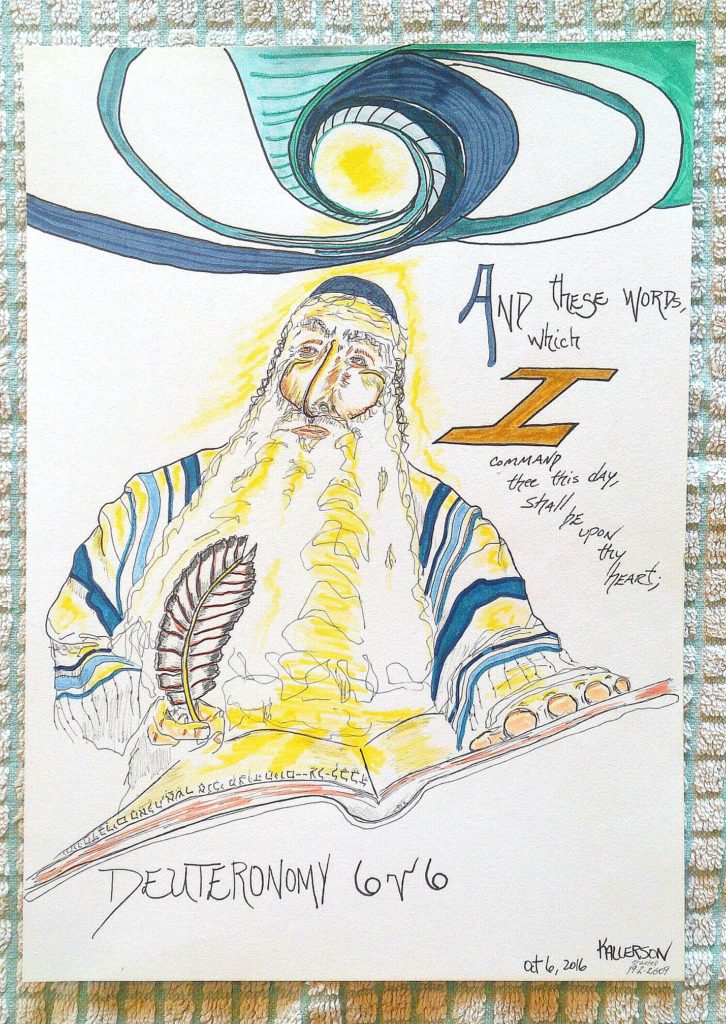
Deuteronomy 6:6-15
Beware, Lest You Forget the Lord
In the passage today, Moses will carefully instruct Israel on the Source of the good things they will receive. In this, there will be no place for boasting in their own greatness. What is coming will be handed to them on a silver platter, and all they have to do is take it, and then remember where the goodness they have came from.
It won’t work, and Israel will do exactly what they are admonished to not do in the years ahead. It will be a costly lesson for them. As far as Israel today, one might say it is different for them. They went into a land that was totally barren, filled with typhus, malaria, and a host of other diseases, and they subdued it.
They basically started from scratch and built it up to what it is today. Is there a difference? Can they boast in their own goodness and righteousness because of this? Well, they certainly do. They take full credit for all of their success, and they do so without acknowledging that the Lord was behind it.
But the answer to the question is, “No. There really is no difference, and no, they have no right to boast in and of themselves for what they have.” Why?
It is because the Lord said, in advance, that He would return them to the land, that He would build them up and watch over them, and that their accomplishments are because He has done so. But lest we point at Israel and mock them for refusing to see this, we need to know that it is a problem in the church as well – one that goes back to its very inception…
Text Verse: “For who makes you differ from another? And what do you have that you did not receive? Now if you did indeed receive it, why do you boast as if you had not received it?” 1 Corinthians 4:7
Those at Corinth were boasting in who they aligned with – be it Peter, or Paul, or Apollos. But who is it that gave each of these leaders his ability? It was the Lord.
If a group goes into a royal palace and the one on the throne has gifts prepared for each of them. Who will they thank – the attendant who brings them the gift, or the one on the throne who offered it? The answer is obvious. Paul asked them to think.
Further, Paul’s words make it clear that what they have as individuals, they received. There could be no arguing against it, and so his question was intended to be like a sharp knife, cutting away their pride. In essence, “Of course you have received all that you have, so why would you boast as if you had earned it?”
In the end, this is true for all things. If you have a big house and lots of money, it is because God gave you the time, intelligence, place, strength, and so on to earn those things. So, do you say how great you are, or do you thank God for His grace upon your life? If you understand properly, it is God who must be given the credit.
No matter what you have, it ultimately came from God. We, like Israel, need to understand this and remember it. In not remembering, we will end up as Israel did, pursuing paths which are unsound and detrimental to our walk with the Lord. Such truths as this are to be found in His superior word. And so, let us turn to that precious word once again and… May God speak to us through His word today and may His glorious name ever be praised.
I. Teach Them Diligently (verses 6-9)
6 “And these words which I command you today shall be in your heart.
Moses will now give instruction concerning the law which has thus far been spoken out, and which he will continue to expound to the people that certainly includes what was just said in verses 4 & 5 –
“Hear, O Israel: The Lord our God, the Lord is one! 5 You shall love the Lord your God with all your heart, with all your soul, and with all your strength.” Deuteronomy 6:4, 5
This is to be considered a command. Thus, it cannot be taken as an emotional love, but a volitional one. The people of Israel were to make a concerted effort to love Yehovah with all of their heart, with all of their soul, and with all of their strength.
But rather than “in your heart,” the Hebrew reads al l’vavekha, or “upon your heart.” As we have learned, in the Bible, the heart is the place of intellect, reason, and understanding. The people were to commit this love of the Lord to their memory.
It was to be as if it was inscribed directly on the heart, or as if a weight was laid upon the heart in order to convict anytime they began to stray. The same term, “upon the heart,” is used in Jeremiah 31:33 when describing the effects of entering the New Covenant in Christ –
“But this is the covenant that I will make with the house of Israel after those days, says the Lord: I will put My law in their minds, and write it on their hearts; and I will be their God, and they shall be My people.”
One can see the difference between the two. In the Mosaic covenant, the people are told to actively work to love the Lord, meaning be obedient to His commands; writing them on their hearts. In the New Covenant, the inscription of the heart is accomplished by the Lord.
One can see the superiority of the New Covenant through the use of this simple term, “upon the heart.” Who is it that does the work? And what are the effects of the work once it is done? One is a law leading to death, the other is a gift, leading to life.
7 You shall teach them diligently to your children,
v’shinantam l’vanekha – “And you shall whet them to your children.” It is a new and rather rare word in Scripture, shanan. It means to whet or to sharpen. Saying “teach them diligently” is more of a paraphrase. Finding a modern word to translate it as intended in this verse is not easy. Whet is closest, but it still needs to be explained.
The word is seen only nine times. Other than here, it is translated as whet, sharpen, or pierce. The idea, then, is to inculcate the commands into the children, but by using this word, we want to include the idea of sharpness, as if the process of instilling the commands is so personal that it is as if the parent is cutting into the child and inscribing them there.
Probably the closest we will get to a comparable translation of the word elsewhere is found in Psalm 73:21 –
When my heart was embittered,
And I was pierced within. Psalm 73:21 (NAS)
This was to be the responsibility of the parents, inscribing the commands of the law in the children. As Matthew Poole says to explain this word, “This metaphor signifies the manner of instructing them, that it is to be done diligently, earnestly, frequently, discreetly, and dexterously.” Paul uses a similar thought in Ephesians –
“And you, fathers, do not provoke your children to wrath, but bring them up in the training and admonition of the Lord.” Ephesians 6:4
Looking at the rest of the Old Testament, one can see how Israel failed in this. Thus, the Lord promised in Jeremiah 31 that He Himself would perform this for the people under the New Covenant. In order for this to be accomplished, Moses speaks on…
7 (con’t) and shall talk of them when you sit in your house,
The commands of the Lord should be tied in with everything that is spoken about in a normal conversation. “It was a great day at work. We reaped innumerable sheaves of wheat. How good the Lord is to us, and how we should love Him for the bounty He provides.”
Whatever is normal conversation within the house, it was to be salted with a word concerning the Lord. In this, He would always be contained within the subject matter. He was to be an active thought from moment to moment and not just a mere afterthought.
7 (con’t) when you walk by the way,
When walking on the way, the conversation may be about how school was, about what the upcoming hunt would be like, or how beautiful the scenery was. In these, or in any other conversations, the love of the Lord was to be an active part of the discussion. “Look at how majestic the mountains the Lord has created are!” “Do you see the intricacy of the spider’s web? The wisdom of the Lord is found even in this!”
7 (con’t) when you lie down,
The last thoughts of the day are the thoughts that set the mind for sleep. It is right to include the Lord in them. “The Lord was very good to us today. We were safe, we ate well, and we had contentment and happiness. Thank You, Lord, for the day which has passed.” These thoughts are what will be remembered also at the dawning of a new day…
7 (con’t) and when you rise up.
The parents were to instruct the children concerning the Lord at the outset of the day, reminding them that the span of life is short, and that the surety of reaching evening was unknown. Therefore, it was right to talk of the Lord in the morning, reminding them that they were accountable for their actions before Him, and to conduct the affairs of the day in a manner worthy of the name they bore – Israel, or “He strives with God.”
They could either strive with God, for God. Or, they could strive with God, against Him. Either way, the day was before them and their actions of the day would be brought to remembrance before the Lord. And so, as reminders of the presence of the Lord, and the need to pay heed to His commands, Moses speaks on…
8 You shall bind them as a sign on your hand, and they shall be as frontlets between your eyes.
The idea here is to be taken metaphorically, not literally. This is certain, as will be seen. However, it is this verse which the Jews of Israel – at Jesus’ time, and even today – use to justify the wearing of phylacteries. In Matthew, Jesus spoke harshly of the scribes and Pharisees who prominently made such ostentatious displays –
“But all their works they do to be seen by men. They make their phylacteries broad and enlarge the borders of their garments.” Matthew 23:5
Today, these are known as tephilim. They wrap their arms with straps, and they have small leather boxes containing scrolls inscribed with verses from the Torah in them strapped to their heads. This practice is taking what is meant to be symbolic and making it literal. The way we know this is metaphor is based on other verses which reveal this.
First, the words here are similar to Exodus 13:16. Concerning the law of setting apart the firstborn of every male to the Lord –
“It shall be as a sign on your hand and as frontlets between your eyes, for by strength of hand the Lord brought us out of Egypt.” Exodus 13:16
This is obviously a metaphor that needs to be explained. But that cannot be understood properly unless Exodus 13:9 is also considered. When speaking of the observance of the Feast of Unleavened Bread, it said this –
“It shall be as a sign to you on your hand and as a memorial between your eyes, that the Lord’s law may be in your mouth; for with a strong hand the Lord has brought you out of Egypt.” Exodus 13:9
The two together explicitly tie the consecration of the firstborn to the consecration of all of the people as is represented by the Feast of Unleavened Bread. The firstborn is given for the whole. Of interest, though, there is also a contrast to this verse in the Bible.
In Christ, the Firstborn of God, the people of God enter into what the Feast of Unleavened Bread anticipates, being a group set apart to God whose sins are no longer imputed. Thus, they are “unleavened,” or “without sin” before God.
Understanding this, the same terminology is used here by Moses to represent a people whose minds are directed to the things of God, and whose actions are in accord with what is right for the people of God. To further understand this, analyzing the words is needed.
First, it says u-qeshartam l’oth al yadekha – “And you shall bind them to sign on your hand.” An oth, or sign, is something that represents something else. The hand is what accomplishes tasks. Therefore, the people are to remember the commands of the Lord in everything they accomplish – be it cleaning a bathroom or writing a sermon. It is to be done with the Lord in mind.
Next it says, v’hayu l’totaphoth ben enekha – “and they shall be as frontlets between your eyes.” The word “frontlets,” or totaphoth, is seen only three times in the Bible. It is also in Exodus 13:16 and Deuteronomy 11:8. It is derived from an unused root signifying to go around or bind.
As noted in Exodus 13, it is not to be taken literally, but as a metaphor. Taking that verse, and placing it side by side with Revelation 13:16, an interesting pattern is seen –
“It shall be as a sign on your hand and as frontlets between your eyes, for by strength of hand the Lord brought us out of Egypt.” Exodus 13:16
&
“He causes all, both small and great, rich and poor, free and slave, to receive a mark on their right hand or on their foreheads.” Revelation 13:16
The place between the eyes is the forehead, and so the two correspond one to another. As we saw in Leviticus, in the Bible, the forehead is the place of conscience and identification.
Therefore, this symbolizes that a person is to set his mind on the law of the Lord. In the New Testament, it is reflective of what Paul says to the Colossians –
“If then you were raised with Christ, seek those things which are above, where Christ is, sitting at the right hand of God. 2 Set your mind on things above, not on things on the earth.” Colossians 3:1, 2
Moses’ words now indicate the state of each person before the Lord. They are to mentally acknowledge the Lord by thinking on His law and of His handiwork in everything they do.
In contrast to this, the mark of the beast on the right hand or on the forehead of those in the tribulation period signifies an acknowledgment of the work and lordship of the antichrist which is followed by their obedience to him.
They have acknowledged him and have taken either a vow, represented by the right hand, or an oath of assertion, represented by the forehead, to the antichrist. The mark may be visible, but it represents the setting apart of the individual to the devil.
Moses, in saying this to the people, admonishes them to think on the Lord, live for the Lord, and conduct their affairs to the Lord at all times. Further…
9 You shall write them on the doorposts of your house and on your gates.
u-ketavtam al mezuzot betekha u-bisharekha – “And you shall write them on doorposts your house and on your gates.” The idea here is certainly metaphorical as well, even if it was literally accomplished by whoever decided to do so.
The two words of focus are mezuzah and shaar – doorpost and gate. The word mezuzah, or doorpost, comes from the same source as the word ziz, or “moving things.” That word is seen only three times – in Psalm 50 and Psalm 80 to describe beasts moving in the field, and once in Isaiah 66:11 to describe the bosom of a woman. Thus, it means that which is conspicuous.
Understanding this, the mezuzah, or doorpost, is that which is conspicuous and prominent in the life of a person. The shaar, or gate, comes from shaar meaning to calculate or reckon. That is used only once, in Proverbs 23:7 –
“For as he thinks in his heart, so is he.
‘Eat and drink!’ he says to you,
But his heart is not with you.” Proverbs 23:7
The gate is for protection of those within. A gatekeeper is one who actively decides who to let in and who to keep out. He makes a reckoning and acts upon that. Understanding these roots, the symbolism of the two words is then made obvious.
The law of the Lord is to be so ingrained in a person that it is in the prominent place of a person’s life. Every major decision is to be made based on an understanding of the law of the Lord. Further, it is to be so inscribed in a person that it is what is then the basis for making life’s decisions. In this, it will be a guard for the wellbeing of the individual.
One is to evaluate the circumstances set before him, consider what is to be done in relation to the law of the Lord which he is intimately familiar with, and then act upon those things accordingly.
As there are numerous laws that have been given, and that will be given, the indefinite nature of Moses’ words, “You shall write them on the doorposts of your house and on your gates,” indicates that this is certainly to be taken in this metaphorical way. Nothing specific is noted, meaning that the entire law is to simply be applied to every aspect of the decisions of life.
Unfortunately, and like all things good, the Jews took this metaphorical concept and applied it literally, but only in a limited manner, and as an intended talisman, rather than as a guide for life.
The word mezuzah has now been applied to a small wood or metal container which is affixed to the right-hand post of the doorway to the house. Inside of it is a piece of rolled-up paper or parchment with Deuteronomy 6:4-9 and/or Deuteronomy 11:13-21.
As a show, it is tradition to touch the mezuzah, kiss their finger, and speak out Psalm 121:8, “The Lord shall preserve your going out and your coming in from this time forth, and even forevermore.”
Like many other such things, there is nothing initially wrong with this, but it results in several problems. First, the idea, if taken literally, is to have the words visible in order to remind them of their content, not hidden away.
Secondly, it – like any other tradition – becomes a substitute for the basis of the words and it becomes an implied talisman – which, yes, the words of the Bible can easily be made into such. Thirdly, if doing this is intended as a fulfillment of the law, it actually then violates the law.
The reason this is so is because the word mezuzah, or “doorposts,” is plural – mezuzot. Therefore, to have the words of law on one post, but not on the other, is to then violate the very law that is being referred to. If you are going to take such precepts literally, they must be adhered to completely.
Unfortunately, this practice is no different than abuses by many Christians – whether true Christians or nominal Christians – in regard to either verses from the Bible, or in regard to the Bible itself.
When either of these is used as a talisman for protection, prosperity, or the like, it is no different than the practice of the Jews with their mezuzah. It becomes a show, a pretense, or a charm, but it does not serve the purpose intended by the Lord for the people of God – which is to know, meditate upon, cherish, and apply the word of God to one’s life.
And so, before we go on, let us convict our hearts. If one sees a mezuzah on the doorpost of a Jewish – or even Christian’s – house, is it shiny from having been rubbed countless times as people entered and exited the house?
If so, does the life of that person reflect the shiny state of the mezuzah? Does he know the word of God? Does he talk about it with others? Does he apply it to his life in such a manner that it is conspicuous to everyone around him? Or is it just there for show?
Likewise, what is the state of the Bible you own? Is it outwardly showy to all around you? Do you keep it in some obvious place where people can see that you own it? Etc. But what about its overall appearance – outside and inside?
Is it well worn? Are there notes, highlights, and underlinings. Or is it just the same as the day it came off the printer? Are the pages worn, stained from use, dog-eared and tattered? Or are they as smooth and clean as the day it was bound?
Although it is not always the case, the condition of one’s Bible is normally the exact opposite of the condition of one’s life. If the Bible is worn out and falling apart, the person’s life is normally tidy and sturdy. But if the Bible is in untouched pristine order, the life of the person will often be a complete ruin.
Lesson for Deuteronomy 6 verse 9 – Keep things in their proper context. Don’t be showy in your exterior religious life, but rather be well-grounded in the word of God. Know your Bible, think on your Bible, cherish the word, and love your God who speaks to you through it.
Remember these things that I command
Keep them always in your heart
If you do this, you shall always stand
From My laws be sure to never depart
Write them on the doorposts of your house
And impress them upon your mind
Talk about them with your children and your spouse
For you, My people, these have been carefully designed
They will guide you as you walk in this life
They will be a lamp to you on the path you take
They will keep you from trouble and from strife
If these, My commands, you never forsake
II. When You Have Eaten and Are Full (verses 10-15)
Moses has been speaking of obeying the commands from a positive viewpoint – “You shall do this, and you shall do that.” Now, he gives a warning concerning being slack in regard to that same law.
The reason for this is the condition of the human heart which quickly forgets the past, and which then presses on into the future without regard to what got that person to where he now is. Moses begins his warning saying…
10 “So it shall be,
v’hayah – “And it shall be.” It is a very common expression, but the intent here is that it is not this way now. Despite this, the time is coming when it will occur. Thus, it is spoken of before it happens, and Israel cannot take credit for it, as is next seen…
10 (con’t) when the Lord your God brings you into the land
The credit for bringing Israel into the land, in advance of the event occurring, belongs to Yehovah. Therefore, it is to be acknowledged as such, and to be remembered in that light. Further, it is not because of the goodness or greatness of the people that this has come about. Rather its occurrence has nothing to do with them directly. Instead, it has to do with the vow of the Lord…
10 (con’t) of which He swore to your fathers,
The Lord swore, and therefore, the Lord will perform. No other god was involved in the process, and any supposed god in Canaan could not stop what Yehovah was about to do.
Israel will enter and possess the land, but their possession of it is only a consequence of the oath which had been made long before they stood on the banks of Canaan. That oath was to the fathers, namely…
10 (con’t) to Abraham, Isaac, and Jacob,
l’avraham l’yitshaq, u-l’yaaqov – “to Abraham, to Isaac, and to Jacob.” The promise was made to each of these fathers. They would possess the land. The promise to Abraham was over 400 years earlier, and the promise to Jacob was over 200 years earlier.
The people who stood there now were to receive what had been promised, but it was the Lord who determined that it would come to pass, and to which generation of people it would come to. Moses is making a particular point in saying what he is saying…
10 (con’t) to give you large and beautiful cities
latet lakh arim gedolot v’tovot – “to give you cities great and beautiful.” Moses does not say, “with cities great and beautiful.” Rather, he says latet lakh – “to give you.” A gift is not earned, and it is not deserved. If it was deserved, it would not be a gift; it would be a wage. Moses carefully chooses his words. Next, he says…
10 (con’t) which you did not build,
If they did not build them, they cannot take credit for them. The Lord made a promise. The Lord brought them in. And, what they received was grace, including…
11 houses full of all good things, which you did not fill,
Within the cities will be houses already built, and in them will be the labors of the people the Lord has dispossessed, waiting for Israel to come and enjoy. There would be food in the pantry, beds already available, linens carefully woven by the women, lamps for lighting, maybe gold or money stored in a special spot, and so on. And within each city would be one or more…
11 (con’t) hewn-out wells which you did not dig,
The people of the land would have dug for water – a laborious task. When water was found, they would have hewn out wells to ensure there was always fresh water on hand – another very laborious task. In this, a new word is seen khatsav, meaning to hew or cut out. The difficult and dangerous work was done.
And more, the inhabitants would have maintained the wells throughout the years as well, so there would be no need to worry about a thing in this regard. Further, there would be…
11 (con’t) vineyards and olive trees which you did not plant—
Instead of being given an empty land requiring many years to begin to produce such things, the people of Canaan had already subdued the land, cleared the fields, and planted fruit-bearing trees.
The most difficult thing Israel would have to do in this regard would be to wait for the fruit to ripen depending on the plant that was already there, and then to pick it and celebrate. The most difficult part of the process would be behind them. But the most important aspect of this new life lay yet ahead…
11 (con’t) when you have eaten and are full—
v’akalta v’savaeta – “and have eaten and are filled up.” The word sava signifies to be sated or completely full. There is no lack at all in the person at the end of the meal. But the idea here isn’t just one meal. Rather, it is speaking of a constant stream of no lack. This is certain based on the context of the next words…
12 then beware, lest you forget the Lord who brought you out of the land of Egypt, from the house of bondage.
When the people are full and satisfied, they will be prone to doing the one thing people do so easily, which is to forget where they came from.
A person raised in a conservative family can go off to college and become a flaming liberal. A wealthy person who was born in poverty can forget the plight of those he once lived with. And Israel, filled up as sons, was bound to forget the Lord who redeemed them from slavery.
The very name Egypt, or mitsraim, means “double distress.” Sitting in Canaan living off the land they did nothing to earn, they are being warned to not forget that they once lived in double distress, even though now they were living the high life.
The parallel idea here, which is what is also typologically pictured, is that of the sinner being redeemed from his life of sin. The Lord asks Israel to not forget Him because people are prone to forget. And Peter admonishes those in Christ to do the exact same thing –
“But also for this very reason, giving all diligence, add to your faith virtue, to virtue knowledge, 6 to knowledge self-control, to self-control perseverance, to perseverance godliness, 7 to godliness brotherly kindness, and to brotherly kindness love. 8 For if these things are yours and abound, you will be neither barren nor unfruitful in the knowledge of our Lord Jesus Christ. 9 For he who lacks these things is shortsighted, even to blindness, and has forgotten that he was cleansed from his old sins.” 2 Peter 1:5-9
Unless we think on the Lord, meditate on His word, and actively love Him for all He has done, we – be it Israel or those in the church – can actually forget the Lord and all He has done for us. Rather than this, Moses implores…
13 You shall fear the Lord your God
The words are emphatic. eth Yehovah elohekha tira – “Yehovah your God you shall fear.” This is contrasted to the words of the previous verse. There it said, “lest you forget the Lord who brought you out of the land of Egypt.”
They were in bondage to the Egyptians who ruled rigorously over them. The Lord, in contrast, gave them freedom and abundance. But because He had the power to do so, it means He also has the power to affect their lives negatively as well. Because of this, they were to fear the Lord their God…
13 (con’t) and serve Him,
v’oto taavod – “and Him serve.” Again, the words are contrasted to the previous verse. There, the noun eved, or slave, was used – “the house of slaves.” Here the verb form of that word, avad, or serve, is used. They were brought out of the house of slaves by the Lord, therefore, they were to serve the Lord.
Here, fear is placed before service. If the people fear the Lord – meaning with a proper, reverential fear, they would faithfully serve Him. The opposite was true in Egypt. The people were slaves in Egypt, and thus they feared the Egyptians.
In essence, Moses is giving them a choice – one of faithful service based on reverential fear, or a return to slavery to others which leads to fear. Egypt as a taskmaster was cruel and unrelenting, but the Lord was caring and gracious. All they needed to do was to remember Him and acknowledge His goodness.
This is one of the verses that Jesus cited to Satan in response to his temptings –
“Then Jesus said to him, ‘Away with you, Satan! For it is written, “You shall worship the Lord your God, and Him only you shall serve.”’” Matthew 4:10
Jesus remained faithful in worship and service of the Lord. Israel will be shown to not measure up. The lessons of the law are set before us to see and understand the majesty of what God did in sending Christ to do what Israel could not do.
13 (con’t) and shall take oaths in His name.
Moses builds upon the previous clause. To fear the Lord means to take oaths in His name. To vow in any other manner is to commit idolatry because it elevates something that is not God to a position that rightfully belongs to Him alone. Jesus, in Matthew 5, said the following –
“Again you have heard that it was said to those of old, ‘You shall not swear falsely, but shall perform your oaths to the Lord.’ 34 But I say to you, do not swear at all: neither by heaven, for it is God’s throne; 35 nor by the earth, for it is His footstool; nor by Jerusalem, for it is the city of the great King. 36 Nor shall you swear by your head, because you cannot make one hair white or black. 37 But let your ‘Yes’ be ‘Yes,’ and your ‘No,’ ‘No.’ For whatever is more than these is from the evil one.” Matthew 5:33-37
He was not telling the people they could not vow in any manner and at any time. The law had already provided that vows and oaths were to be made in certain legal situations.
Rather, He was referring to the making of vows for things where such a vow was unnecessary. His words even indicate this when He speaks of heaven, the earth, your head, and etc. Each of those is a part of creation. To make a vow in relation to one of those things was to then commit idolatry, elevating it to what is reserved for the Lord alone.
Unfortunately, many Christians have taken Jesus’ words and refuse to make any oaths at all, even in legal situations, such as in court. This is not at all the intent of His words, as is evidenced right here in Deuteronomy. If a vow or oath is to be made, it is only to be made in the name of the Lord.
For our daily conversation, however, our words are to be so trustworthy that when we say Yes, it means Yes, and when we say No, it is to mean No. Anything more than that is, as He says, from the evil one.
14 You shall not go after other gods, the gods of the peoples who are all around you
Two things are being dealt with by Moses in these verses. The first is for Israel to not forget God because of a carefree life. The second is to not accept or even tolerate the gods of those who surrounded them. The latter is dealt with here.
To forget God, the first, leads directly to the latter. They are to fear the Lord, serve the Lord, and take oaths in His name. In doing so, they will refrain from going after other gods, serving them and swearing by them.
But the thought of going after other gods also implies the conduct of one’s life. Christians go after Christ, emulating Him and serving Him. One emulates whatever god is served.
The gods of Canaan and the surrounding nations were gods of fertility, death through human sacrifice, immorality, and so on. To go after those gods would mean emulation of them. But the people of Israel were told to be holy, just as Yehovah their God is holy.
And there is a particular reason for exhibiting this conduct which Moses next explains to them once again…
15 (for the Lord your God is a jealous God among you),
ki el qanna Yehovah elohekha b’qirbekha – “For God jealous Yehovah your God in midst of you.” Moses repeats here what has already been said five times. Yehovah is qanna, or jealous. This is the sixth and final time this adjective is found in the Bible. All six uses have been in relation to the name Yehovah.
The jealousy is directed to the violation of depriving Him what He is justly due. Israel is warned that they cannot escape what is coming if they fail in this regard. He is in their midst, implying that He sees and knows all that happens among them. Should they reject Him, the penalty for it is found in the next words…
15 (con’t) lest the anger of the Lord your God be aroused against you
pen yekhere aph Yehovah elohekha bak – “lest burning nose of Yehovah your God against you.” The symbolism is that the countenance of the Lord is so angry that fire shoots out of His nostrils and burns up anything before Him.
This is the result of incurring the jealousy of the Lord. The covenant was made, as a Husband to His betrothed. To violate the covenant will arouse His jealousy. In that, there is only one inevitable outcome. As it says in the proverbs –
“For jealousy is a husband’s fury;
Therefore he will not spare in the day of vengeance.
35 He will accept no recompense,
Nor will he be appeased though you give many gifts.” Proverbs 6:34, 35
No offerings would appease the Lord if the people were also offering to other gods. How could they appeal to Him and also to other gods and somehow expect to escape His fury? Moses says He will pursue…
*15 (fin) and destroy you from the face of the earth.
The words say, “from the face of the ground.” Utter annihilation could be expected for the people who would do such a thing. In this, it is not the utter annihilation of all of Israel, but of those who acted in such a manner. An example of that is found in Ezekiel 9:6.
The Lord has promised to preserve Israel even through the destruction of Israel. Those who offended would be sought out and utterly consumed in His wrath.
Nehemiah 9:24-31 practically mirrors what is said in the verses we have looked at today (open Bible and read that passage). At times, what Nehemiah says is almost word for word what Moses has warned against. His recounting of this shows that what occurred in their exile was solely their fault.
And yet, as he noted, the Lord did not utterly consume them. The word of the Lord, and the covenant of the Lord, will never be violated by the Lord. Israel’s absolute unfaithfulness demonstrates all the more the longsuffering and patience of the Lord. And more, it highlights His grace and mercy as no other thing could.
He is the covenant-keeping God. He kept His promise to the fathers. He kept His promises of punishment within the law, and He kept His promises of the preservation of Israel, also contained in the law. Not a word of the word of the Lord will fail because He – unlike the people of the world – cannot fail.
And so, today, I would ask you to take the necessary step and call out to Him for salvation. We are all going to spend eternity somewhere, and the difference between the two options is either heaven or hell, paradise or the pit. Please choose wisely, call on Christ to save you, and then think on Him and His goodness all the days of your life. This is what will be pleasing to the God who created you for this very purpose.
Closing Verse: “But Jeshurun grew fat and kicked;
You grew fat, you grew thick,
You are obese!
Then he forsook God who made him,
And scornfully esteemed the Rock of his salvation.
16 They provoked Him to jealousy with foreign gods;
With abominations they provoked Him to anger.
17 They sacrificed to demons, not to God,
To gods they did not know,
To new gods, new arrivals
That your fathers did not fear.
18 Of the Rock who begot you, you are unmindful,
And have forgotten the God who fathered you.” Deuteronomy 32:15-18
Next Week: Deuteronomy 6:16-25 In doing these commandments, don’t make such a fuss… (Then It Will Be Righteousness for Us) (25th Deuteronomy sermon)
The Lord has you exactly where He wants you. He has a good plan and purpose for you. But He also has expectations of you as He prepares you for entrance into His Land of Promise. So, follow Him and trust Him and He will do marvelous things for you and through you.
Beware, Lest You Forget the Lord
“And these words which I command you today
Shall be in your heart, as to you I plainly say
You shall teach them diligently to your children
And shall talk of them when in your house you sit
When you walk by the way, when you lie down
And when you rise up – keep on talking and never quit!
You shall bind them as a sign on your hand, like a prize
And they shall be as frontlets between your eyes
You shall write them on the doorposts of your house
———-so to you I tell
And on your gates you shall write them as well
“So it shall be, when the LORD your God
Brings you into the land of which He swore to your fathers
———-a land abundantly filled
To Abraham, Isaac, and Jacob
To give you large and beautiful cities which you did not build
Houses full of all good things, which you did not fill
Hewn-out wells which you did not dig
Vineyards and olive trees which you did not plant—
When you have eaten and are full; not like a skinny twig…
Then beware, lest you forget the LORD, your Creator Spouse
Who brought you out of the land of Egypt, from the bondage house
You shall fear the LORD your God and serve Him
And shall take oaths in His name; so you shall do
You shall not go after other gods
The gods of the peoples who are all around you
(For the LORD your God is a jealous God among you)
Lest the anger of the LORD your God
Be aroused against you and destroy you
From the face of the earth that you trod
Lord God, turn our hearts to be obedient to Your word
Give us wisdom to be ever faithful to You
May we carefully heed each thing we have heard
Yes, Lord God may our hearts be faithful and true
And we shall be content and satisfied in You alone
We will follow You as we sing our songs of praise
Hallelujah to You; to us Your path You have shown
Hallelujah we shall sing to You for all of our days
Hallelujah and Amen…
6 “And these words which I command you today shall be in your heart. 7 You shall teach them diligently to your children, and shall talk of them when you sit in your house, when you walk by the way, when you lie down, and when you rise up. 8 You shall bind them as a sign on your hand, and they shall be as frontlets between your eyes. 9 You shall write them on the doorposts of your house and on your gates.
10 “So it shall be, when the Lord your God brings you into the land of which He swore to your fathers, to Abraham, Isaac, and Jacob, to give you large and beautiful cities which you did not build, 11 houses full of all good things, which you did not fill, hewn-out wells which you did not dig, vineyards and olive trees which you did not plant—when you have eaten and are full— 12 then beware, lest you forget the Lord who brought you out of the land of Egypt, from the house of bondage. 13 You shall fear the Lord your God and serve Him, and shall take oaths in His name. 14 You shall not go after other gods, the gods of the peoples who are all around you 15 (for the Lord your God is a jealous God among you), lest the anger of the Lord your God be aroused against you and destroy you from the face of the earth.