Deuteronomy 7:17-26
The Great and Awesome God
There is a lot of repetition in our ten verses today from verses going all the way back to Exodus. And much of what is said here will also be connected to a lot of what is coming in the time of the law. The Lord carefully weaves His word together in this way so that we will have a better grounding on what we might have misunderstood elsewhere.
In other words, we may have come to some thought or word that was difficult – maybe because it was new or rare. In that, people could debate if what the Lord said is really the way we are interpreting it.
But when the Lord restates things in various ways, and in adding in complementary thoughts to items he is repeating, we can be much surer of being accurate, if we are willing to look through the entire picture.
Unfortunately, that is a lot of laborious, tedious, and mentally taxing work. It is something that few ever do. Because of this, we have all kinds of incorrect interpretations about how things work or what things mean. This is also why it is such a treasure for me personally to preach to the people who attend the Superior Word, or who watch the videos later.
Although it doesn’t need to be said, simply by looking at the numbers one can tell that each of you is a rare breed. Sermons are intended to be an analysis of God’s word, but they often are not. And even if they are, they don’t contain as much detail as you all find rewarding. So, my hat is off to you.
As you know, we have been in the five books of Moses now since 1837, or somewhere around then. And we are steadily plugging through them. Some find no value in the law at all. Others find it too convicting. For whatever reason, people find other things to do than pursue what is stated in the books of Moses.
However, they serve many great purposes, as we have seen over the past years. For the law itself, in Galatians, Paul gives us a couple of the many good reasons why we should know it.
Text Verse: “What purpose then does the law serve? It was added because of transgressions, till the Seed should come to whom the promise was made; and it was appointed through angels by the hand of a mediator. 20 Now a mediator does not mediate for one only, but God is one.
21 Is the law then against the promises of God? Certainly not! For if there had been a law given which could have given life, truly righteousness would have been by the law. 22 But the Scripture has confined all under sin, that the promise by faith in Jesus Christ might be given to those who believe. 23 But before faith came, we were kept under guard by the law, kept for the faith which would afterward be revealed. 24 Therefore the law was our tutor to bring us to Christ, that we might be justified by faith. 25 But after faith has come, we are no longer under a tutor.” Galatians 3:19-25
Paul says the law was added because of transgressions. That actually makes it a kind of downer if that is all there is. But it’s not. He also tells us that the law is our tutor to bring us to Christ. When he said that, he was writing to the Galatians – a Gentile church that was never under the law. And yet, he used the word “our.”
The instruction is for everyone, if we will just pay heed. In knowing the law, and its many, many limitations, we can then more fully understand and appreciate the grace found in Jesus Christ. Yes, Paul makes sure he tells us that we are no longer under a tutor, meaning the law, but how sad it is that many reject that premise.
In truly knowing the law, we can then truly be appreciative of what the grace of God in Jesus Christ means. We’ll see some of that in relation to our conscience. What is impossible under the law because of conscience, is allowable under grace because of the same thing.
We needed this tutor to understand that. It is one of many wonderful truths we will see today, truths that are to be found in His superior word. And so, let us turn to that precious word once again and… May God speak to us through His word today and may His glorious name ever be praised.
I. You Shall Not Be Terrified of Them (verses 17-21)
17 “If you should say in your heart,
The verses today begin with an idiom, ki tomar bilvavekha – “If you should say in your heart.” In the Bible, the heart is not the seat of emotions as it is with us. Rather, it is the seat of reasoning. One considers a matter and reasons it out.
This is a personal, inward reflection. However, the words here, like those of the previous verse which ended us last week, are in the singular. It is the heart of the entire nation which is reflecting on a matter and considering it. And that matter is…
17 (con’t) ‘These nations are greater than I;
The entire nation’s heart is questioned. “We are Israel, and what we are to face in these many peoples is a sum that is far larger and more powerful than we are.” The reasoning is made, and therefore the obvious question is next asked…
17 (con’t) how can I dispossess them?’—
The nations we face are greater, they are larger, they are more powerful, they dwell in fortified cities, they have supplies and weapons, they know the land, and so on. The reasoning out of the matter causes Israel to question. It is the prudent thing to do under normal circumstances. Even Jesus spoke of this –
“Or what king, going to make war against another king, does not sit down first and consider whether he is able with ten thousand to meet him who comes against him with twenty thousand? 32 Or else, while the other is still a great way off, he sends a delegation and asks conditions of peace.” Luke 14:31, 32
This is what is normally expected. Battle means death, possible defeat, and thus subjugation and possibly more death. However, in the case of Israel as they consider their entrance into, and subduing of, Canaan the Lord next says…
18 you shall not be afraid of them,
lo tira mehem – “No you shall be afraid of them.” What Israel sees, and what Israel considers of their own size, state, and abilities in relation to their foes is not even to be considered. Rather, they are to exhibit full confidence in their situation. It is a reminder that has often been repeated already, such as –
“Look, the Lord your God has set the land before you; go up and possess it, as the Lord God of your fathers has spoken to you; do not fear or be discouraged.” Deuteronomy 1:21
This state of confidence, however, is not based upon who they are in relation to the enemy, but in relation to who their God is…
18 (con’t) but you shall remember well
zakor tizkor – remembering, you shall remember. The repetition of the word is given as a way of saying, “You shall continuously call to mind the matter.” Israel was to never forget what had transpired in their past so that they would always be prepared for their future.
18 (con’t) what the Lord your God did to Pharaoh and to all Egypt:
Again, the words are reflective of often-repeated earlier words –
“The Lord your God, who goes before you, He will fight for you, according to all He did for you in Egypt before your eyes.” Deuteronomy 1:30
Israel was a nation of slaves, held in bondage, and unable to free themselves. And yet, in this state, they were brought out from that by the Lord. Pharaoh’s rule over them ended, Egypt was destroyed as a military power, and Israel was freed – all without their own effort.
As this was so while in slavery, then it was a note of surety that the Lord had intentions for them that made it certain they would endure and prevail in whatever else He directed them to do. Whatever was set before them, as long as it was ordained by Him, could not fail.
Likewise, whatever they chose to do that was not authorized by Him was sure to fail. Moses will not touch on this now, but it is a certain truth that should be called to mind. It is reflected in what was said in Numbers, and as was repeated in Deuteronomy 1 –
“Then you answered and said to me, ‘We have sinned against the Lord; we will go up and fight, just as the Lord our God commanded us.’ And when everyone of you had girded on his weapons of war, you were ready to go up into the mountain.
42 “And the Lord said to me, ‘Tell them, “Do not go up nor fight, for I am not among you; lest you be defeated before your enemies.’ 43 So I spoke to you; yet you would not listen, but rebelled against the command of the Lord, and presumptuously went up into the mountain. 44 And the Amorites who dwelt in that mountain came out against you and chased you as bees do, and drove you back from Seir to Hormah. 45 Then you returned and wept before the Lord, but the Lord would not listen to your voice nor give ear to you.” Deuteronomy 1:41-45
Israel’s actions are to be conducted solely by how the Lord directs them. In telling them to go, they are to go, and they will prevail. In telling them to stand fast, if they disobeyed that, they would fail. All of this is taken from the view of what occurred in Egypt.
It is the lesson of being released from the bondage of Egypt that was to be the preeminent reminder of their future conduct at all times. As Moses next says…
19 the great trials which your eyes saw,
ha’masoth ha’gedoloth asher rau enekha – “the trials, the greats, which saw your eyes.” Moses will now focus on events that actually occurred. Israel was in a foreign land, they were unable to free themselves, no other group or people defeated Egypt, and yet they were freed. It was solely by the divine workings of the Lord that it came about.
Here Moses begins a list of five descriptors concerning this magnificent event. The first is ha’masoth ha’gedoloth, or the trials, the greats. Masah is a word derived from the verb nasah which signifies “to try.”
This is probably speaking of the trials the people faced before Moses’ arrival. Israel was in hard bondage, they were afflicted, and they were tested. In this state, Exodus 2 says –
“Then the children of Israel groaned because of the bondage, and they cried out; and their cry came up to God because of the bondage. 24 So God heard their groaning, and God remembered His covenant with Abraham, with Isaac, and with Jacob. 25 And God looked upon the children of Israel, and God acknowledged them.” Exodus 2:23-25
It is obvious that they could not free themselves. They were in anguish and cried out because of it. From there, the Lord heard and responded. Moses next tells them how. Israel also saw…
19 (con’t) the signs
v’ha’othoth – “and the signs.” Othoth, or signs, are things given to represent something else. The Lord gave Moses three signs to give to Israel – the rod which turned into a snake, the leprous hand, and the water which turned to blood. He also gave signs to Pharaoh concerning what would come upon them as the Lord accomplished His work. Next…
19 (con’t) and the wonders,
v’ha’mophetim – “and the wonders.” Mopheth, or wonder, comes from yaphah, or beautiful. Therefore, they speak of that which is conspicuous and amazing. This word then refers to the plagues that came upon the land.
But equally wondrous is the fact that Israel was spared at the same time. While Egypt was destroyed, Israel survived through the plagues. Each such occurrence was a wonder in itself. Next…
19 (con’t) the mighty hand
v’ha’yad ha’khazaqah – “and the hand, the mighty.” The hand is what accomplishes things. Moses is saying that it was by the strength of the Lord’s hand – His power which is mighty – that these things came about and how they were displayed. And more…
19 (con’t) and the outstretched arm,
v’ha’zeroa ha’netuyah – “and the arm outstretched.” The zeroa, or arm, comes from the word zara, meaning “to sow” or “scatter seed.” One can see the arm extending as it does. In this, you can think of the Lord reaching out over all of Egypt.
Nothing was hidden from His reach to destroy, and nothing was left as an obstacle before Israel once His arm had cleared the way. As it next says…
19 (con’t) by which the Lord your God brought you out.
asher hotsiakha Yehovah elohekha – “which brought you out Yehovah your God.” It is speaking of all five of the descriptors mentioned in this verse. Together, the Lord combined them into one awesome display of His ability and capability to accomplish the feat of bringing Israel out from under the huge weight and burden of Egyptian bondage.
It cannot go without reminder at this point that the Lord, bringing Israel out of Egypt, is a direct analogy to Him bringing each person out of their bondage to sin. We have to constantly remind ourselves of this as we progress through Deuteronomy.
Israel was in physical bondage; we were in spiritual bondage. The Lord accomplished the great trials, signs, and wonders, and He did it by a mighty hand and an outstretched arm. It was by His power and His clearing the way for us that this was made possible.
In this passage, Moses is asking His people to not fear the enemies that they will face. Likewise, in Christ, we are to not fear the enemies we face, even and up to our greatest enemy, death. As Paul says –
“So when this corruptible has put on incorruption, and this mortal has put on immortality, then shall be brought to pass the saying that is written: ‘Death is swallowed up in victory.’
55 ‘O Death, where is your sting?
O Hades, where is your victory?’
56 The sting of death is sin, and the strength of sin is the law. 57 But thanks be to God, who gives us the victory through our Lord Jesus Christ.
58 Therefore, my beloved brethren, be steadfast, immovable, always abounding in the work of the Lord, knowing that your labor is not in vain in the Lord.” 1 Corinthians 15:54-58
The Bible, for example in Ephesians 6, says that we are in a battle against the spiritual hosts of wickedness in the heavenly places. What we are seeing in Israel being admonished to not fear the enemy because the Lord has already proven Himself to them, we are likewise to see concerning not fearing our enemies because the Lord has already proven Himself to us. The battle, and the victory, belong to the Lord. As Moses next says…
19 (con’t) So shall the Lord your God do to all the peoples of whom you are afraid.
In verse 18, Moses said, “you shall not be afraid,” using the verb yare – “be afraid.” Here it says, “the peoples of whom you are afraid,” using the adjective yare – “fearful.” This is just how we are as well.
We are fearful of sickness. We are fearful of wicked people. We are fearful of death. But we are told to not be afraid of them. As the Lord has done to sickness, the wicked, and death at the cross, so He will do for us when the time for Him to bring us across into the promise arrives.
It is certain that soldiers of Israel died in battle, but Israel survived. We may “die” in our battle, but we shall also survive. Where the enemy is seen to get the upper hand in humanity, it is only a temporary thing for the redeemed of the Lord.
20 Moreover the Lord your God will send the hornet among them
Here, the tsirah, or hornet, is mentioned for the second of three times in the Bible. The verb comes from tsara which means to be leprous. Also, it is a singular noun with an article in front of it – “the hornet.” Thus, the language is to be taken metaphorically, although some scholars demand a literal interpretation.
However, similar terminology is used concerning bees in Deuteronomy 1:44 and Psalm 118:12. There, they are equated with one’s enemies, not literal insects. Secondly, Joshua says that this was fulfilled in the case of the Amorites in Joshua 24:12 –
“I sent the hornet before you which drove them out from before you, also the two kings of the Amorites, but not with your sword or with your bow.”
There it said it was the hornet that drove out the two kings of the Amorites. And yet, Moses, speaking of the same battle, shows that it was, in fact, Israel who defeated them –
“And at that time we took the land from the hand of the two kings of the Amorites who were on this side of the Jordan, from the River Arnon to Mount Hermon…” Deuteronomy 3:8
This was repeated in Deuteronomy 4:47 and it was referring to the kings Sihon and Og. My take on it is that this is referring to a connection between the hornet and its associated word meaning leprosy.
The Lord promised health and long life to Israel if they held to His laws. As they were going into a land defiled by those things which are opposed to a healthy lifestyle, the enemy had been, or would be, afflicted with disease to the point where they were incapable of standing up to Israel’s armies.
Thus, “the hornet” is a metaphor for God’s judgment of sickness upon them, preparing them for destruction by Israel. The Bible records that Israel actually faced these foes in battle, and so, it is a reasonable explanation for the term “the hornet” which is said to have gone before them.
20 (con’t) until those who are left, who hide themselves from you, are destroyed.
ad avod hanisharim v’ha’nistarim – “Until destroyed the remainers and the hiders from you.” It shows that the words “the hornet” are to be taken figuratively. Indiscriminate killing of people around the land of Israel by hornets is far less likely than the effects of being in hiding from the forces of Israel turning into deprivation, disease, and physical bodily ailments.
The same types of effects are noted upon the people of Israel during their own times of siege from the enemies who came against them. The overall evidence pretty clearly shows that the words “the hornet” are speaking of the effects upon the people as a result of the destruction of them and their cities by Israel, as the Lord led them. This is again noted by Moses’ next words…
21 You shall not be terrified of them;
lo taarots mipenekhem – “No you shall be terrified from their faces.” This isn’t simply speaking of their mean countenances, but of their numbers. Moses is still speaking to Israel in the singular and as a collective body. But he refers to the enemy in the plural. It is a way of saying, “It may be one against many, but do not be terrified.” This is because…
21 (con’t) for the Lord your God, the great and awesome God, is among you.
Ki Yehovah elohekha b’qirbekha el gadol v’nora – “For Yehovah your God, in your midst – God great and to be feared.” It is an adjective and then a verb which are used to describe the Lord. Moses reminds them that He is in the midst of Israel, ever-present with them. It is a note of absolute assurance that He can be relied upon in the battle.
I would personally take these words as a warning to Israel though. In verse 18, they were told not to fear using the verb yare. Here, it says that the Lord is feared, using the same word. One must choose who he will fear.
This is especially so because the final two verses of the chapter indicate that the Lord is watching the actions of Israel at the same time that He is actively working for Israel in the destruction of their enemies.
As long as Israel fears the Lord, they will not fall under the judgment of the Lord. But when they turn to the images and idols of the people they are instructed to destroy, they are no longer showing a fear for the One who is to be feared. Israel cannot have it both ways, nor can we.
As long as we fear the consequences of our actions, we will not conduct ourselves in negative ways. But when one fears a negative outcome, he will remain vigilant to ensure that doesn’t come about. The same God who ruled over Israel, and who continues to do so today, is the same God we are each accountable to for our own actions. As for Israel entering Canaan, Moses continues…
With a mighty hand and an outstretched arm
The Lord brought you out of Egypt the land
Through it all, you suffered no harm
And now at Canaan’s door you stand
Do not fear what the inhabitants can do
The Lord has shown you His greatness already
He will remain constant and faithfully true
So do not fear; rather, remain sure and steady
Do not fear and do not be afraid
The great and awesome God is among you
Do not be so easily swayed
The Lord our God is faithful and true
II. An Accursed Thing (verses 22-26)
22 And the Lord your God will drive out those nations
v’nashal Yehovah elohekha eth ha’goyim ha’el – “And will clear away Yehovah your God the nations the these.” Moses uses the same rare word that he used in verse 7:1, nashal. It means to slip off, draw off, or clear away.
He again promises that the Lord will be the One to draw the people off of the land, just as a person draws of his shoe. Moses says to Israel that they are those who are…
22 (con’t) before you
mipanekha – “from your face.” In the previous verse, he told them not to be terrified mipenekhem, or from their faces. Now he tells Israel they will be removed mipanekha, or from your face. It is beautifully worded showing the complete contrast between the two. Next he says the Lord will do this…
22 (con’t) little by little;
meat meat – “little little.” This tells them that the process will be solely at the direction of the Lord. It is a certainty that the inhabitants are to be driven out. However, there is an incremental process which is to take place.
All advances will be when He determines, not all at once as Israel would certainly be inclined to want to do. How often we look at the Lord’s plans as if He is slacking, but this is not the case. It is only from our short life spans and eagerness to get on with things that we decide things should move more quickly. Understanding this, Moses says…
22 (con’t) you will be unable to destroy them at once, lest the beasts of the field become too numerous for you.
The same basic thought of this verse in Deuteronomy is also given in Exodus 23, but there are differences –
“I will not drive them out from before you in one year, lest the land become desolate and the beasts of the field become too numerous for you. 30 Little by little I will drive them out from before you, until you have increased, and you inherit the land.” Exodus 23:29, 30
One difference is that here it says, “you will be unable to destroy them,” and in Exodus 23 it said, “I will not drive them out from before you.” It is obvious that the actions of Israel are said to be ultimately accomplished by the Lord. What He does not want to come to pass will not come about.
Also, here in Deuteronomy it leaves off the thought of the land becoming desolate. But it is an important point to be reminded of. If all of the inhabitants were taken out at once, the land would become desolate.
The land of Canaan was inhabited. There were fields, crops, fruit trees, wells, houses, and so on. If all the people were taken out at once, there would have been an insufficient number of people to take them over. All of that productivity would have been lost.
But more, with land standing idle and not being properly cultivated, animals would multiply. The word translated as “beasts” signifies living things. If you have fruit trees that aren’t tended to, rats will multiply. If you have rats, you will have disease.
And other animals feed on rats, so they too will quickly multiply – cats, dogs, and so on. Very quickly, you would have many animals, some of them disease-filled, and so on. This exact scenario occurred after the exile of the northern tribes of Israel, as is seen in 2 Kings –
“And it was so, at the beginning of their dwelling there, that they did not fear the Lord; therefore the Lord sent lions among them, which killed some of them.” 2 Kings 17:25
Lions are but one species that would quickly multiply as they fed off the rats and other little animals that were busy feeding off of unattended fruit trees and the like. This is also documented in more recent history after wars where areas were highly depopulated.
The Lord knew these things would occur and so He determined to methodically take care of the occupation of Canaan…
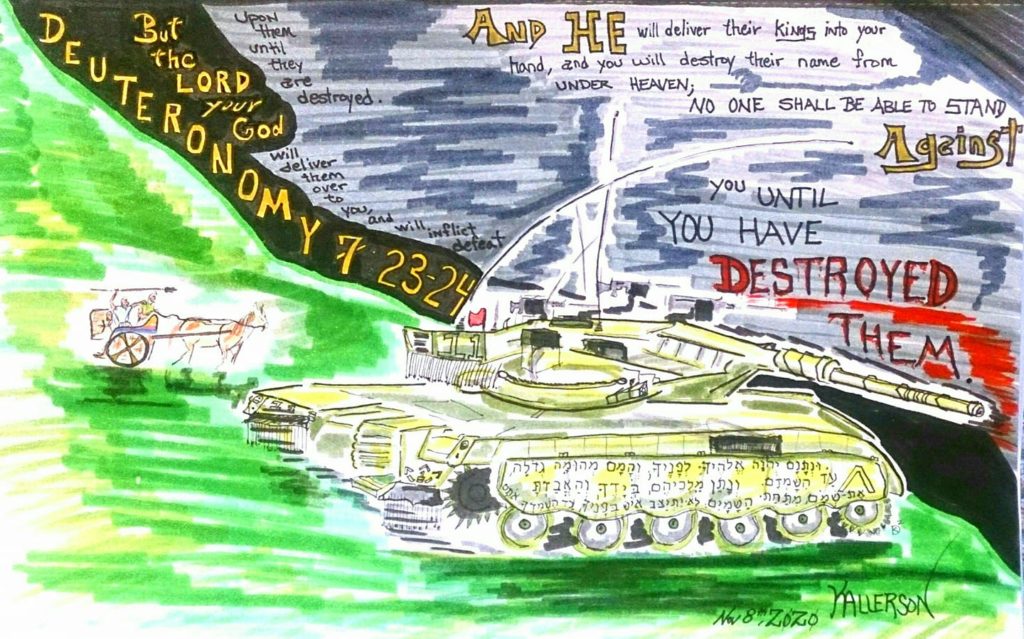
23 But the Lord your God will deliver them over to you,
u-netanam Yehovah elohekha lephanekha – “And will give them Yehovah your God to your face.” It is a note of surety following on after the note of gradual accomplishment. Moses is assuring them that even if it seems that the process is slow, it will be accomplished according to the will of the Lord.
The fact that this later does not fully come to pass does not mean that the Lord failed. Rather, it means that Israel failed. What he will warn about in the coming verses is exactly what Israel will fail to do. When that occurs, the Lord will then amend the process according to their disobedience. That will be seen as we continue.
For now, Moses says that the Lord will deliver these people over to Israel, but then he continues by saying…
23 (con’t) and will inflict defeat upon them until they are destroyed.
v’hamam mehumah gedolah ad hishamedam – “And confusing, disquietude greatly until they are destroyed.” The words are full of action and life as they proceed from a verb followed by a noun and then to an adjective.
Here is a new word in Scripture, mehumah, which I have translated as “disquietude.” It is a noun signifying tumult, confusion, disquietude, discomfiture, and the like. Both it, and the previous word, hamam, come from the same root, hum. That signifies murmur, roar, agitate, make an uproar, and so on.
Thus, both words are onomatopoetic expressions where the sound gives the sense of what is going on. There is turmoil, panic, and so on as the Lord brings great agitation and uproar among them. The divine judgment of the Lord that is anticipated upon the inhabitants is marvelously vocalized by Moses.
And, this divine judgment will not be limited to any single class of people. From the least, even to the greatest, all of the people of Canaan are promised to be delivered into the hand of Israel…
24 And He will deliver their kings into your hand,
v’natan malkehem b’yadekha – “and will give their kings into your hand.” As has been the case throughout this passage, Moses continues to speak in the singular – “their kings into your (singular) hand.” Israel is one, they are many. And yet, Israel will prevail. Once the king is subdued, it is taken as an axiom that the people are likewise subdued.
This conquering of the kings is poignantly noted in Joshua 10 –
“Then Joshua said, ‘Open the mouth of the cave, and bring out those five kings to me from the cave.” 23 And they did so, and brought out those five kings to him from the cave: the king of Jerusalem, the king of Hebron, the king of Jarmuth, the king of Lachish, and the king of Eglon.
24 So it was, when they brought out those kings to Joshua, that Joshua called for all the men of Israel, and said to the captains of the men of war who went with him, “Come near, put your feet on the necks of these kings.’ And they drew near and put their feet on their necks. 25 Then Joshua said to them, “Do not be afraid, nor be dismayed; be strong and of good courage, for thus the Lord will do to all your enemies against whom you fight.” Joshua 10:22-25
The account goes on to say that Joshua then struck the kings, killing them, and then they were hanged on five trees until evening. This was in compliance with the next words…
24 (con’t) and you will destroy their name from under heaven;
v’haabadta eth shemam mi’takhat ha’shamayim – “And cause to perish their names from under the heavens.” The word “heavens” is plural. Here, it is not speaking of heaven in the sense of the Lord’s dwelling place, but of everywhere under the skies.
And more, this is not saying that their names will literally perish as to never be heard again. They are clearly recorded in Scripture for us to know who they were. The idea is that there will be no continuance of them, such as in progeny. Their names were to die with them. This is what is explicitly said to be done to Amalek later in Deuteronomy 25:17-19 –
“Remember what Amalek did to you on the way as you were coming out of Egypt, 18 how he met you on the way and attacked your rear ranks, all the stragglers at your rear, when you were tired and weary; and he did not fear God. 19 Therefore it shall be, when the Lord your God has given you rest from your enemies all around, in the land which the Lord your God is giving you to possess as an inheritance, that you will blot out the remembrance of Amalek from under heaven. You shall not forget.
There was to be nothing left of Amalek, just as there was to be nothing left of the names of any of the other peoples and kings who dwelt in the land of Canaan. They were to be destroyed until they were completely eradicated. And it was fully possible because the Lord promises it would be so…
24 (con’t) no one shall be able to stand against you until you have destroyed them.
lo yityatsev ish b’phanekha ad hishmidkha otam – “no shall stand man in your face until you have destroyed them.” As always, the words “in your face,” or similar phrases, are a literal translation meaning “before” or “in the presence of.”
Moses assures Israel that not only will the kings be destroyed, but not even a man of any state or stature will be able to stand before Israel. However, the promise is conditional. It required faith that the words of Moses were true.
In this, we see the abject failure of the ranks of Israel who stood listening to Goliath’s taunts for forty days. He was one man, but every man in all the ranks of Israel failed to simply trust the Lord and take the words of Moses at face value.
That is, until a young shepherd boy on a mission from his father called this precept to their attention, and then who followed through with his own example of his faith in what Moses now says. To believe Moses is to believe the Lord who inspired Moses to issue forth these words. And he continues with…
25 You shall burn the carved images of their gods with fire;
pesile elohehem tishrephun baesh – “Carved images their gods you shall burn in the fire.” In this clause alone, the words go from the second person singular to the second person plural. And more, the verb “you shall burn” is, like in verse 7:5, accentuated with a suffix, causing it to be emphasized.
There was to be no tolerance for allowing them to continue in the form they were in. Further…
25 (con’t) you shall not covet the silver or gold that is on them,
The act of coveting is forbidden in the tenth commandment. Therefore, to simply covet what was on an idol would be sin. But more, the fact that it was on an idol only exacerbated the problem. If the idol was kept, that would be sin. If only what was on the idol was kept, it would lead to other problems next noted…
25 (con’t) nor take it for yourselves, lest you be snared by it;
Here is a new word, the verb yaqosh. It signifies to lay a bait or a snare. Why would taking the precious part of the carved image while destroying the rest of it be a snare?
It is understood by Moses how precious both silver and gold are. It would normally seem right to melt the metal off of the idols and then reuse it for something else. However, this is absolutely forbidden. At times, the precious metals taken from devoted villages could be claimed by Israel. For example –
“Now the city shall be doomed by the Lord to destruction, it and all who are in it. Only Rahab the harlot shall live, she and all who are with her in the house, because she hid the messengers that we sent. 18 And you, by all means abstain from the accursed things, lest you become accursed when you take of the accursed things, and make the camp of Israel a curse, and trouble it. 19 But all the silver and gold, and vessels of bronze and iron, are consecrated to the Lord; they shall come into the treasury of the Lord.” Joshua 6:17-19
The silver and gold and other metals could be saved and reused, but, all idols and carved images were devoted to the ban and were to be utterly destroyed. This included anything they were plated or adorned with.
If such were reused, it would enter into the public monetary system, and it would be known – for example – that the silver of idols was acceptable to be used in the payment of temple taxes and so forth. Such could never be the case, simply for conscience sake.
The snare that was laid is that of knowing that what was intended for the worship of false gods was acceptable to be used towards offerings to the true God. There was to be no hint of mixing the profane with that which is holy. The heavy stress of this is explained with the next words…
25 (con’t) for it is an abomination to the Lord your God.
ki toavat Yehovah elohekha hu – “For abomination to Yehovah your God it.” The Lord detested what it was. Changing its form doesn’t change what it was previously used for in the minds of the people. Gold is gold and silver is silver. But when the people know the source of it, the conscience of the people is defiled. In this, the Lord cannot be placed alongside that which is profane in the minds of His people.
The precept is clearly explained by Paul concerning meats in 1 Corinthians 8 –
“Therefore concerning the eating of things offered to idols, we know that an idol is nothing in the world, and that there is no other God but one. 5 For even if there are so-called gods, whether in heaven or on earth (as there are many gods and many lords), 6 yet for us there is one God, the Father, of whom are all things, and we for Him; and one Lord Jesus Christ, through whom are all things, and through whom we live.
7 However, there is not in everyone that knowledge; for some, with consciousness of the idol, until now eat it as a thing offered to an idol; and their conscience, being weak, is defiled. 8 But food does not commend us to God; for neither if we eat are we the better, nor if we do not eat are we the worse.” 1 Corinthians 8:4-8
Paul goes on to say in 1 Corinthians 10 –
“Eat whatever is sold in the meat market, asking no questions for conscience’ sake; 26 for ‘the earth is the Lord’s, and all its fullness.’
27 If any of those who do not believe invites you to dinner, and you desire to go, eat whatever is set before you, asking no question for conscience’ sake. 28 But if anyone says to you, ‘This was offered to idols,’ do not eat it for the sake of the one who told you, and for conscience’ sake; for ‘the earth is the Lord’s, and all its fullness.’ 29 ‘Conscience,’ I say, not your own, but that of the other. For why is my liberty judged by another man’s conscience? 30 But if I partake with thanks, why am I evil spoken of for the food over which I give thanks?” 1 Corinthians 10:25-30
As you can see, in this case, what is an abomination to the Lord in the Mosaic Covenant is so because of conscience. The law, as was clearly seen in our text verse, is simply a tutor to instruct the people in the propriety of proper conduct before the Lord, meaning a life of proper conscience.
Earlier, I said that the promise of the Lord’s driving the people out was conditional. The words of this verse, and the destroying of such forbidden things, shows that this is so. In Judges 2, we read –
“Then the Angel of the Lord came up from Gilgal to Bochim, and said: ‘I led you up from Egypt and brought you to the land of which I swore to your fathers; and I said, “I will never break My covenant with you. 2 And you shall make no covenant with the inhabitants of this land; you shall tear down their altars.” But you have not obeyed My voice. Why have you done this? 3 Therefore I also said, “I will not drive them out before you; but they shall be thorns in your side, and their gods shall be a snare to you.” 4 So it was, when the Angel of the Lord spoke these words to all the children of Israel, that the people lifted up their voices and wept.
5 Then they called the name of that place Bochim; and they sacrificed there to the Lord. 6 And when Joshua had dismissed the people, the children of Israel went each to his own inheritance to possess the land.” Judges 2:1-5
The people failed to do what the Lord said. They did what was contrary to His will and therefore He altered the promises given by Moses now.
Unfortunately, they continued to suffer through this type of disobedience until there was no remedy left and they went into exile. Their rejection of the law brought about many woes upon them, and that continues to this day – whether they realize it or not.
26 Nor shall you bring an abomination into your house, lest you be doomed to destruction like it.
We come to the last verse of the chapter with these words. Moses uses the same word, translated as “abomination,” as in the previous verse. The word extends beyond just carved images to anything the Lord proclaims is detestable or abominable.
The people were to separate themselves from such things. If they failed to do so, they would come under the same ban that was to be levied upon the banned thing. This is exactingly seen in the account of Achan in Joshua 7. He failed to heed and thus he and his entire household were utterly destroyed.
Moses warns in advance, but it took a painful life lesson for the truth of the words to be revealed. In hopes of avoiding that, however, Moses proceeds with…
26 (con’t) You shall utterly detest it
shaqets teshaqetsenu – “detesting, it you shall detest it.” The emphasis is given to highlight the importance of the act. Further…
26 (con’t) and utterly abhor it,
v’taev tetaavenu – “and abhorring, you shall abhor it.” It is a new word in Scripture derived from the word translated as “abomination” in the previous verses. They were to actively find abominable that which the Lord declares an abomination. Moses then explains why…
*26 (fin) for it is an accursed thing.
ki kherem hu – “For devoted thing it.” The word kherem signifies devoted to a particular purpose. In this case, it is in the sense of being banned or under a curse, and thus devoted to God through destruction. A New Testament equivalent would be the word anathema.
Something in this state is intolerable to God and must be destroyed. In the Old Testament, as a tool of learning for Israel, things as are described here are noted as such. In the New Testament, Paul equates one who abuses the gospel as such. We will see that in our closing verse today.
The Lord has given man certain instructions at certain times in redemptive history, but the lesson continuously points to the same truths – faith, conscience, reliance on the Lord and not ourselves, and a complete and total trust in, reliance on, and adherence to His word.
Whatever we do that is not in accord with that, we will fall into error. It happened in Eden, it happened with the covenant people, it happened throughout the time of the Mosaic Law, and it continues on today – literally throughout His church.
The word is given, a context is to be maintained, and within that context, we are to live out our lives in His presence. But, throughout all of the times of man’s failings, for those who are within the covenant offered by the Lord, there is also the opportunity to receive His grace.
This is the best part about it all. Man is limited and troubled by time, circumstance, stresses, temptation, and so forth. God understands this, and He is there with us – knowing what we are going through because He Himself was willing to share in our humanity.
Because of this, we have a great High Priest who can sympathize with us. He understands our failings and offers us His grace when we come to Him. Without it, all there is left for humanity is remaining under the ban and being consigned to the trash heap of human history. I would hope for better for you.
Receive God’s offer of pardon in the giving of His Son and be reconciled to Him to live out better days – eternal days – in His glorious presence.
Closing Verse: “I marvel that you are turning away so soon from Him who called you in the grace of Christ, to a different gospel, 7 which is not another; but there are some who trouble you and want to pervert the gospel of Christ. 8 But even if we, or an angel from heaven, preach any other gospel to you than what we have preached to you, let him be accursed. 9 As we have said before, so now I say again, if anyone preaches any other gospel to you than what you have received, let him be accursed.” Galatians 1:6-9
Next Week: Deuteronomy 8:1-9 Understanding this, you will be in the sweet zone… (Man Shall Not Live by Bread Alone) (29th Deuteronomy Sermon)
The Lord has you exactly where He wants you. He has a good plan and purpose for you. But He also has expectations of you as He prepares you for entrance into His Land of Promise. So, follow Him and trust Him and He will do marvelous things for you and through you.
The Great and Awesome God
“If you should say in your heart
‘These nations are greater than I; how can I dispossess them?
———-from me my life will be stripped!
You shall not be afraid of them
But you shall remember well what the LORD your God did
———-to Pharaoh and to all Egypt:
The great trials which your eyes saw
The signs and the wonders when you gave a shout!
The mighty hand and the outstretched arm
By which the LORD your God brought you out
So shall the LORD your God do as in those acts He displayed
To all the peoples of whom you are afraid
Moreover the LORD your God will send the hornet
Among them until those who are left
Who hide themselves from you are destroyed
Of their lives they will be bereft
You shall not be terrified of them; this you shall not do
For the LORD your God, the great and awesome God
———-is among you
And the LORD your God will drive out
Those nations before you little by little; so He will do
You will be unable to destroy them at once
Lest the beasts of the field become too numerous for you
But the LORD your God will deliver them over to you
———-this tactic will be employed
And will inflict defeat upon them until they are destroyed
And He will deliver their kings into your hand
And you will destroy from under heaven their name
No one shall be able to stand against you
Until you have destroyed them; such is the aim
You shall burn the carved images of their gods with fire
You shall not covet on them the silver or gold
Nor take it for yourselves, lest you be snared by it
For it is an abomination to the LORD your God
———-so you have been told
Nor shall you bring an abomination into your house
Lest you be doomed to destruction like it; hear what I say
You shall utterly detest it and utterly abhor it
For it is an accursed thing; yes, hear my words this day
Lord God, turn our hearts to be obedient to Your word
Give us wisdom to be ever faithful to You
May we carefully heed each thing we have heard
Yes, Lord God may our hearts be faithful and true
And we shall be content and satisfied in You alone
We will follow You as we sing our songs of praise
Hallelujah to You; to us Your path You have shown
Hallelujah we shall sing to You for all of our days
Hallelujah and Amen…
17 “If you should say in your heart, ‘These nations are greater than I; how can I dispossess them?’— 18 you shall not be afraid of them, but you shall remember well what the Lord your God did to Pharaoh and to all Egypt: 19 the great trials which your eyes saw, the signs and the wonders, the mighty hand and the outstretched arm, by which the Lord your God brought you out. So shall the Lord your God do to all the peoples of whom you are afraid. 20 Moreover the Lord your God will send the hornet among them until those who are left, who hide themselves from you, are destroyed. 21 You shall not be terrified of them; for the Lord your God, the great and awesome God, is among you. 22 And the Lord your God will drive out those nations before you little by little; you will be unable to destroy them at once, lest the beasts of the field become too numerous for you. 23 But the Lord your God will deliver them over to you, and will inflict defeat upon them until they are destroyed. 24 And He will deliver their kings into your hand, and you will destroy their name from under heaven; no one shall be able to stand against you until you have destroyed them. 25 You shall burn the carved images of their gods with fire; you shall not covet the silver or gold that is on them, nor take it for yourselves, lest you be snared by it; for it is an abomination to the Lord your God. 26 Nor shall you bring an abomination into your house, lest you be doomed to destruction like it. You shall utterly detest it and utterly abhor it, for it is an accursed thing.