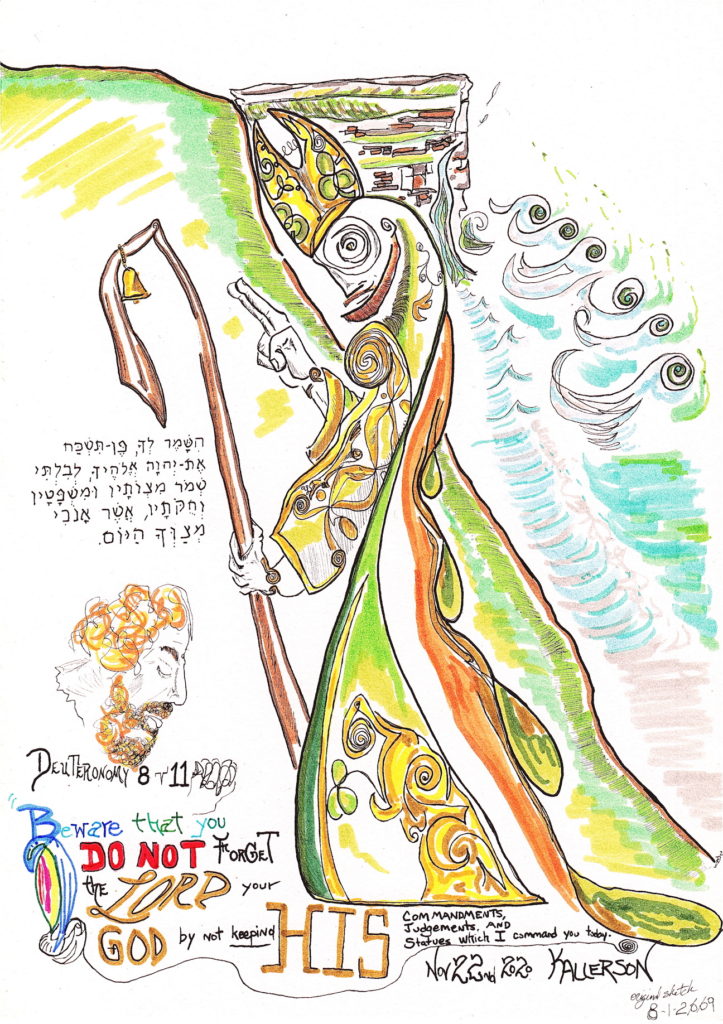
Deuteronomy 8:10-20
And You Shall Remember the Lord Your God
Introductory comments are the last thing I normally type for each sermon. Some days, it’s hard to figure what to say so that we can smoothly blend into the content of what is being given in the sermon text. As I was typing this sermon, Sergio and I were doing what we occasionally do. He was working on a video; I am typing the sermon.
He will say, “I have 4 minutes of a 15-minute video to go.” I will say, “I am on verse 2 of 10 verses.” In that, we have a competition to see where we each will end when the first person is done. While messaging back and forth (and to frustrate him into thinking he was getting way behind), I said, “I just finished verse XX.”
Just a few short minutes later I said, “I just finished verses XX and XX.” This would be an otherwise impossible message. One verse can take up to an hour. I snickered for a moment.
Then I copy and pasted the two verses. Under the first verse, I typed, “blah, blah, blah.” Under the second I typed, “yada, yada, yada.” After that, I said, “I bet nobody will notice.”
After sending it, I couldn’t help thinking that there are some people who actually treat the word like that. As sad as it is, the goal for them doesn’t include remembering that this is the word of God. Nor is it that they care about the Lord who gave the word. They simply put something together to make people feel good on Sunday morning, and it doesn’t matter if it conforms in the least to what the Lord is actually conveying. It breaks my heart.
Text Verse: “Yet I am the Lord your God
Ever since the land of Egypt,
And you shall know no God but Me;
For there is no savior besides Me.
5 I knew you in the wilderness,
In the land of great drought.
6 When they had pasture, they were filled;
They were filled and their heart was exalted;
Therefore they forgot Me.” Hosea 13:4-6
When our hearts get lifted up, we tend to think more highly of ourselves than we should. In that, we forget the Lord our God. There are other ways to forget the Lord as well. We can do it out of sheer negligence, we can do it out of spite, we can do it because we are just too busy with life.
But I want to tell you today, that for those who are the Lord’s, He will never forget us. He will never break the covenant promises to us that He has agreed to. This doesn’t mean that we should not worry about our walk with the Lord. On the contrary, I will take you to a passage in the New Testament at the end of our sermon today to show us just the opposite.
But the great thing about the Lord is that, even if we do forget about Him – for whatever reason – if we are His (meaning saved by the Lord Jesus), He will never turn His back on us. As I have said before, national Israel is a template for each of us concerning our own state before the Lord. Today, you will see the faithfulness of the Lord in a way that your Bible fails to show you. Of this, I am pretty sure.
But when you see it, I hope it stirs you as much as it stirred me on 21 September 2020. Great things are to be found in His superior word. And so, let us turn to that precious word once again and… May God speak to us through His word today and may His glorious name ever be praised.
I. And All That You Have Is Multiplied (verses 10-13)
The words of verse 10 fit marvelously into what was said in the previous verses of the chapter. Verse 1 referred to possession of the land. This one does as well. Verse 2 spoke of remembering what the Lord had done for the people in the wilderness. Here, that is contrasted with blessing the Lord in the land.
Verse 3 spoke of hungering in the wilderness and then being granted manna. Here, it speaks of being full because of the produce of the land given by the Lord. Verses 4 & 5 spoke of the Lord’s care of the people in the wilderness, including His chastening of them. Here, His care of them in the land of their possession is highlighted.
Verses 7-9 spoke of the things by which the land would be considered good. Here it acknowledges that it is, in fact, a good land. This is a marvelous summary verse of that entire set of verses.
In all of this, it is the Lord, not Israel, who is the center of focus. Israel is the recipient of the Lord’s favor, but without the Lord, or with the Lord as an enemy, Israel would not exist. It is not by their hand, their power, or their abilities that the goodness they possess comes about, but by the graciousness of the Lord. As it says…
10 When you have eaten and are full,
v’akalta v’savaeta – “And you shall eat, and you are satisfied.” This is the contrast to verse 3 where it noted that the people hungered in the wilderness. At that time, they complained against Moses and Aaron, which means they complained against the Lord.
Here the words are a statement of fact – “you shall eat,” and “you are satisfied.” Just as they complained in their hunger, they are now actually commanded to do the opposite in the times when they are filled…
10 (con’t) then you shall bless the Lord your God
u-berakhta eth Yehovah elohekha – “and you shall bless Yehovah your God.” It is to be taken as a positive command, not simply a general principle. In receiving, you are to bless. To not do so, then, must be considered a transgression of the law. This is shown to be exactingly fulfilled by Christ, even before His meal and being filled, in the gospels. When feeding the multitudes, it says –
“And He took the seven loaves and the fish and gave thanks, broke them and gave them to His disciples; and the disciples gave to the multitude.” Matthew 15:36
Likewise, it says that He blessed the bread on the night of His crucifixion as well. The law is given, and the Lord was obedient to the precept.
10 (con’t) for the good land which He has given you.
al ha’arets ha’tovah asher natan lakh – “upon the land, the good, which He has given you.” In this, Moses uses the word al – “upon the good land,” not “for the good land.” It isn’t that they possess a piece of land in another area that they go to visit from time to time, and from which abundance is received. Rather, it is a land upon which they live and receive constant benefit from.
The Lord gave them the land, it is a good land, and the Lord has provided for them from that same land. They are to remember, and they are to actively bless the Lord for that which they receive from the land upon which they reside.
The idea is that the Lord was always to be at the center of their attention. It is not the land, and it is not those who dwell upon the land, but rather it is the Lord who gave the land who is to be praised. And there is an important reason for this command…
11 “Beware that you do not forget the Lord your God
In the Hebrew, the words from now until verse 18 are one long, continuous sentence. It is a detailed explanation of what is sure to come, and a warning of what not to forget when it does come.
Blessings lie ahead, but in the abundance of those blessings will come an assumption that what has been received has come about through personal effort and not through the blessing of the Lord. In this, Moses first warns them with the word shamar – to keep, watch, or be attentive to.
In this, they are to be attentive to not forgetting Yehovah their God. He then explains how they will, in fact, forget Him. It is…
11 (con’t) by not keeping His commandments, His judgments, and His statutes
The word commandment is singular. The commandment, judgments, and statutes are from the Lord. It logically follows that in remembering what He has commanded to do, the people will remember the One who has so commanded.
In other words, we know the difference between federal crimes and state and local crimes. If someone carries a gun into a post office, the penalties will be different than if he carries a gun into a 7-11 in a town where that is not allowed. We remember the source of the law when we remember to observe the law.
To shamar, or be attentive to, those various laws means that we are showing regard for the source of them. We may keep the federal laws because we might otherwise be sentenced to many years in federal prison, but we may neglect the local laws because the penalty is a slap on the wrist.
The respect given to the laws of the Lord thus signifies whether a person has a fear of the Lord, a love of the Lord, or some varying degree of contempt for the Lord. And the individual’s attitude toward the Lord will inevitably be tied up in the leader’s attitude toward the Lord.
When the leaders of a nation have no fear of the Lord, the people will follow in that same attitude. The leader is the enforcer of the laws. If he will not enforce the laws set forth, then the people will not either. This is the lesson of the kings of Israel, and it is seen again and again in their record, such as –
“Now it came to pass, when Rehoboam had established the kingdom and had strengthened himself, that he forsook the law of the Lord, and all Israel along with him.” 2 Chronicles 12:1
The opposite attitude was seen in the record of King Asa –
“So they gathered together at Jerusalem in the third month, in the fifteenth year of the reign of Asa. 11 And they offered to the Lord at that time seven hundred bulls and seven thousand sheep from the spoil they had brought. 12 Then they entered into a covenant to seek the Lord God of their fathers with all their heart and with all their soul; 13 and whoever would not seek the Lord God of Israel was to be put to death, whether small or great, whether man or woman.” 2 Chronicles 15:10-13
Of these commands of the Lord, Moses says…
11 (con’t) which I command you today,
Here, the concept of divine inspiration is once again clearly presented. Moses says that what he conveys are the commandment, statutes, and judgments of the Lord, and yet it is he who is commanding them to Israel. Jesus clearly confirms this as well when He asks, “What did Moses command you,” or something similar. It is both the word of Moses and the law of the Lord.
12 lest—when you have eaten and are full,
Here is a contrast to the manna. The people simply received what the Lord provided. They couldn’t take credit for it at all. Rather they received it, knowing exactly where it came from. They could, and in fact they did, complain about the manna, but they could not deny its Source.
Here, the food has come from the ground. Vines were pruned, trees were trimmed, land was tilled, stalks of grain were cut and threshed, and so on. Man’s labor was involved in the process. In the exercise of the labor, it is easy to forget the ultimate Source of the good things that fill the stomach. Further…
12 (con’t) and have built beautiful houses and dwell in them;
Again, there is the contrast to the time in the wilderness. The people dwelt in tents, and they moved at the command of the Lord. There was no tending to farms and gardens. There was a reliance on the Lord. It is reminiscent of the family of Rechab who is mentioned in Jeremiah –
“But they said, ‘We will drink no wine, for Jonadab the son of Rechab, our father, commanded us, saying, ‘You shall drink no wine, you nor your sons, forever. 7 You shall not build a house, sow seed, plant a vineyard, nor have any of these; but all your days you shall dwell in tents, that you may live many days in the land where you are sojourners.’ 8 Thus we have obeyed the voice of Jonadab the son of Rechab, our father, in all that he charged us, to drink no wine all our days, we, our wives, our sons, or our daughters, 9 nor to build ourselves houses to dwell in; nor do we have vineyard, field, or seed. 10 But we have dwelt in tents, and have obeyed and done according to all that Jonadab our father commanded us.’” Jeremiah 35:6-10
These Rechabites were used by the Lord as an object lesson to Israel of failing to adhere to this exact premise now being set forth by Moses in Deuteronomy.
13 and when your herds and your flocks multiply,
Animals take effort. They have to be tended to, fed and watered, and stores need to be set aside for the winter when the land isn’t producing. The more herds and flocks a person has, the more people he will need to tend to them.
The more people beneath a person, then for that person feelings of greatness tend to result. Further, in having an abundance, one tends to trust in that abundance. He forgets the commands of the Lord to have an open hand to the needy. This is what happened with Nabal in 1 Samuel. David came forth looking for assistance in a time of need. Nabal’s response was –
“Shall I then take my bread and my water and my meat that I have killed for my shearers, and give it to men when I do not know where they are from?” 1 Samuel 25:11
Nabal was a man who did not care about the law of the Lord, because he failed to care about the plight of his fellow Israelite. He trusted in his wealth and forgot the Source of that wealth.
13 (con’t) and your silver and your gold are multiplied,
The possession of silver and gold means that the person’s wealth extends beyond the property and that which subsists from the property. A person with silver and gold has increased so much from the property that he now has sufficiency beyond the annual harvest season.
If there is drought, the money is a buffer for such a time. If the equipment breaks down, it can be fixed by paying someone who is handy in that way. And so on. In the possession of silver and gold, that which is otherwise out of reach becomes readily available. In such a state everything else increases as well…
13 (con’t) and all that you have is multiplied;
With the coming of surplus, if one is wise, more can be obtained – more land to produce more crops; more animals to produce more meat, wool, leather, and so on; more wives to increase the stress; more children to help with the chores.
The cycle of increase leads to personal gain as well – extra shoes, more garments, extra rooms which can then be rented out. The multiplication of an industrious man can be great. But for most, that leads naturally to another state…
Where does your ability come from?
A day at the gym and eating right?
Is that the place from whence these come?
And also, from getting a good sleep at night?
Is your wealth amassed high because you are great?
Do you have expensive things because of your skill?
Is filled your cupboard, and is overflowing your plate?
How did it happen? Tell me the drill?
But if you say, “It was because I am great.”
Or if you say, “It was because of my skill.”
I say to you, “Empty is your plate.”
You will be unable to pay the final bill
Call on the Lord Jesus, and include Him in every detail
Bless the Lord for each thing He provides
And when you are weighed on His judgment scale
You will receive all the wonder His heaven provides
II. Parsing Matters (verses 14-20)
14 when your heart is lifted up,
v’ram l’vavekha – “And lifted to your heart.” The heart is the seat of reason, understanding, and intelligence. In the acquisition of many things, a person thinks within himself, “Look at all that I have, and all that I have done.” It is the sin of pride which takes credit for that which one is blessed with. In this…
14 (con’t) and you forget the Lord your God
There is room for only one in the heart of a prideful man. If he is consumed with himself, then he will not remember the Lord his God. It is a certainty. Only a man of humility through and through can avoid the trap of thinking that what he possesses is solely because of his own efforts and greatness.
Moses knows this, and so his warning is also a reminder. It isn’t just that the Lord is on high and blessing people who were already industrious and blessed to start with. Rather, he notes that Israel is the people of Yehovah, the God…
14 (con’t) who brought you out of the land of Egypt, from the house of bondage;
ha’motsiakha me-erets mitsraim mibeth abadim – “who the bringing out of you from land Egypt, from house slavery.” The people of Israel, from the least even to the greatest, were all as one in Egypt. Egypt means “Double distress.” They were in bondage, and they had no way of obtaining their freedom. Their lot was permanent misery.
But in the impossibility of their situation, and with no chance of relief from it, Yehovah brought them out. Thus, whatever they possessed, from a thread to a sandal strap, or from a boundary stone to a king’s palace – all of it was because the Lord had first delivered them to it, and then He had delivered it to them.
The words here are prophetic in nature. It’s not just that such might happen. Moses knows it is certain to happen. And it did. 2 Chronicles 26 details the greatness of King Uzziah and how it came about. It says there, “as long as he sought the Lord, God made him prosper.”
What is then said of him mirrors the thought of verses 11-13. So exactingly that after the many received blessings it then says –
“But when he was strong his heart was lifted up, to his destruction, for he transgressed against the Lord his God by entering the temple of the Lord to burn incense on the altar of incense. 17 So Azariah the priest went in after him, and with him were eighty priests of the Lord—valiant men. 18 And they withstood King Uzziah, and said to him, ‘It is not for you, Uzziah, to burn incense to the Lord, but for the priests, the sons of Aaron, who are consecrated to burn incense. Get out of the sanctuary, for you have trespassed! You shall have no honor from the Lord God.’” 2 Chronicles 26:16-18
Though the king of Israel, and a man of wisdom and great achievement, Uzziah was a son of slaves. Were it not for the Lord, he and his people would still be in bondage. Were it not for the Lord, his line would not have ascended to the throne. Were it not for the Lord, Jerusalem would not be the city of Israelite kings, but the city of the Jebusites.
There is no part of the existence of Uzziah, or any of us for that matter, that is separate from the Lord’s hand in our lives. Our very breath is derived from Him and will someday return to Him. And yet we look to our own greatness and forget the Lord our God.
Most importantly, we were in bondage, we could not save ourselves, and yet He intervened to free us unto Himself. And even in our salvation, we are still not free from the world in which we live. Our walk is one of trial to this day, just as Israel’s was…
15 who led you through that great and terrible wilderness,
ha’molikakha bamidbar ha’gadol v’ha’nora – “who the leading of you in the wilderness, the great, and the terrible.” This is referring to the march from Egypt to Sinai and then to the border of Canaan. It may also include the time after turning from Canaan under punishment, but that is not necessarily so.
The term ha’gadol, or “the great,” speaks of the vastness of the area. The term ha’nora, or “the terrible,” speaks of that which is fearful or awesome. The location is so barren and dry that it cannot be plowed and planted. It is a vast wasteland leading to a land of abundance and promise. This wilderness is a land…
15 (con’t) in which were fiery serpents and scorpions and thirsty land where there was no water;
nakhash saraph v’aqrav v’tsimaon asher ein mayim – “serpent fiery, and scorpion, and thirsty ground which no water.” These words are given to parallel the words “the wilderness, the great, and the terrible.” In them, there are no articles and the nouns, except “water,” are singular. This then emphasizes and highlights the terrible nature of the land.
Here, the word tsimmaon, or thirsty ground, is introduced. It comes from tsame, meaning “thirsty.” It will only be seen three times. It is concerning this horrifying, terrifying, and deadly spot that Moses recalls the Lord’s caring hand for Israel…
15 (con’t) who brought water for you out of the flinty rock;
ha’motsi lekha mayim mi’sur ha’khalamish – “who the bringing forth for you water from rock the flinty.” Bringing Israel out of Egypt was only a part of the process. There was the wilderness to traverse, and that wilderness was both inhospitable and unforgiving. And yet, the Lord was the Leader of them and the Bringer forth of water. In other words, their Guide and Sustainer.
As before, the parallel to Christ should not be missed. Christ certainly led us out of bondage, but He also leads and sustains us on the path to glory. As Paul says in Philippians 1:6, “being confident of this very thing, that He who has begun a good work in you will complete it until the day of Jesus Christ.”
No matter how difficult the trek is, He is there for His people, and He will see them through to the end of what He has purposed for them. If this is not true for Israel, it is true for none of us. And neither Israel’s disobedience, nor ours, will affect the final outcome of what is promised.
In this verse is another new word, khalamish, or “flint.” It will be seen five times. It comes from khalam, meaning to be strong or healthy, or to dream. Not only did the Lord bring water from the flinty rock, but Moses says it was He…
16 who fed you in the wilderness with manna,
ha’maakilkha man bamidbar – “who the feeding of you manna in the wilderness.” In the wilderness, the land is barren. Without water, nothing will grow. Without the growth of vegetation, there is nothing to eat. And yet, Israel survived through the ordeal. The Lord Himself became the Feeder of Israel through the giving of manna.
From verse 14 to verse 16, Moses ascribes four aspects of the care of Israel by the Lord. He is –
the bringing out of you from land Egypt, from house slavery (14)
the leading of you in the wilderness, the great, and the terrible (15)
the bringing forth for you water from rock the flinty (15)
the feeding of you manna in the wilderness (16)
One can see Christ in each description. He redeems us from bondage to sin – meaning from the power of the law (Galatians 3:13); He leads us through the trials of this earthly life (Philippians 1:6); He gives us of the Spirit (1 John 4:13); and He feeds us with Himself (John 6:54). As is consistently seen in such passages, Israel as a collective is given as a type of each one of us.
16 (con’t) which your fathers did not know,
This is a general repeat of verse 3. The manna was to be instructive. The fathers had never known it, nor had those who received it known it. It was something entirely new. In a place where no food could be obtained, food was made available. This was so…
16 (con’t) that He might humble you and that He might test you, to do you good in the end—
l’maan anotekha u-l’maan nasotekha l’hetivkha b’akharitekha – “to end purpose He might humble you, and to end purpose He might test you, to do you good in your latter end.” Everything about the process has an end goal and is thus given with a set purpose.
The “end” spoken of here, then, is to be the result of the time of humbling. Thus, it is entry into the promise. The humbling and the manna, however, began before the giving of the law. Therefore, the manna was to be a step into the time of the law.
But Israel failed even after the giving of the law. They did not enter the promise. And yet, they continued to be sustained for the entire forty years in the wilderness. Thus, the “end” obviously speaks of their actual entry into the promise.
Understanding this, the only two references to the manna in Deuteronomy are in this chapter. The first was in verse 3, and now Moses refers to it again here –
** So He humbled you, allowed you to hunger, and fed you with manna which you did not know nor did your fathers know that He might make you know that man shall not live by bread alone; but man lives by every word that proceeds from the mouth of the LORD.
** who fed you in the wilderness with manna, which your fathers did not know, that He might humble you and that He might test you, to do you good in the end.
In the end, the purpose of the humbling, the hungering, and the manna was a test. How does one do good? By living by every word that proceeds from the mouth of the Lord, and by a continued dependence on the mercies of the Lord.
As we know, Christ is the Word of God. He is the embodiment of all that proceeds from the Godhead, and He is the fulfillment of the law. Therefore, for God to do good to Israel “in the end” means that Israel must come to the One who embodies the words now being given by Moses.
David lived by the word of the Lord, even if he didn’t always obey it. Others obeyed the word of the Lord, but they didn’t live by it. Others did neither. Thus, as much as anything else, the precept spoken here by Moses is one which ultimately involves faith and a right condition of the heart. That is clearly seen in the next words…
17 then you say in your heart,
v’amarta bilvavekha – “And you say in your heart.” The thought now returns to the words of verse 14 (when your heart is lifted up) and the time in Canaan. Moses has explained that which led up to entry into Canaan and the purpose of everything that occurred in the process. But the tendency of man is to look around, see all of his wealth and his many possessions and to say…
17 (con’t) ‘My power and the might of my hand have gained me this wealth.’
Again, and again, the record of Israel reveals this attitude. It happened to Rehoboam, it happened to Uzziah, and it happened to King Hezekiah –
“In those days Hezekiah was sick and near death, and he prayed to the Lord; and He spoke to him and gave him a sign. 25 But Hezekiah did not repay according to the favor shown him, for his heart was lifted up; therefore wrath was looming over him and over Judah and Jerusalem.” 2 Chronicles 32:24, 25
This is the lesson that Moses is conveying to the people. The Lord put them through times of want in order for them to remember Him in the times of abundance. Essentially, he is saying, “Remember where you came from. If not for the Lord, you would still be there. Remember the goodness of the Lord.” As he next says…
18 “And you shall remember the Lord your God,
For Israel, everything is contingent on remembering the Lord, the God of Israel. If they forget Him, then everything else falls to the wayside. The relationship is broken, and they will suffer. If they remember Him, then all will be well with them. Again, Moses confirms this…
18 (con’t) for it is He who gives you power to get wealth,
Moses now uses the same words (power and wealth) that he used in the previous verse. There, he spoke as if one of Israel, “My power and the might of my hand have gained me this wealth.” Here is says it is otherwise. It is the Lord who gives you power to get wealth.
Only in the recognition that the Lord is the Giver of the ability will Israel be right with Him. And Moses says that they are to acknowledge this so…
18 (con’t) that He may establish His covenant which He swore to your fathers, as it is this day.
The covenant Moses is referring to is that which was sworn to Abraham, and then to Isaac, and then to Jacob, as He said in Exodus 33 –
Then the Lord said to Moses, “Depart and go up from here, you and the people whom you have brought out of the land of Egypt, to the land of which I swore to Abraham, Isaac, and Jacob, saying, ‘To your descendants I will give it.’” Exodus 33:1
That is repeated in Leviticus 26, also while the law was being given –
“…then I will remember My covenant with Jacob, and My covenant with Isaac and My covenant with Abraham I will remember; I will remember the land.” Leviticus 26:42
The words, “as it is this day,” mean that Israel is right on the banks of the Jordan. The promise is established, and in a short amount of time, they will cross over into the land. And yet, Moses has been speaking about the time in which Israel is in the land.
Thus, the words, “He may establish His covenant,” are ongoing. The covenant is established, and it will remain so as long as Israel remembers the Lord. That is evidenced by the next words…
19 Then it shall be, if you by any means forget the Lord your God, and follow other gods, and serve them and worship them, I testify against you this day that you shall surely perish.
There is a stress in the Hebrew that is missed in the English. Twice, Moses repeats the same word to intensify the warning – “If forgetting you forget…perishing you will perish.”
However, the first repetition is second person singular – “if you, Israel, forget,” while the second repetition is second person plural – “you (all) of Israel will perish.” It is a hugely important change. The Lord does not say that Israel will perish, only those of Israel will perish.
Israel the nation must be attentive to the words being presented to them. If not, punishment will come upon Israel the people.
The Lord will only establish His covenant with the fathers as long as Israel remembers the Lord. In forgetting Him, and in serving other gods, the promised curses of the Mosaic covenant will be meted out upon them.
This was true in the exile by the Assyrians, it was true in the exile by the Babylonians, and it was true in the exile by the Romans. Israel perished because they forgot the Lord. And again, Moses says to them…
20 As the nations which the Lord destroys before you, so you shall perish,
The word translated here as “nations” is goyim. It is the plural of goy, meaning a gentile. Thus, it can mean nations, gentiles, people, heathen, etc. It is even used to speak of Israel as a people at times, such as in Exodus 19:6 (and etc).
Out of twenty-seven translations checked for this sermon, all twenty-seven say “nations.” And they are all incorrect. Moses is being absolutely specific. If Israel (the nation) forgets, Israel (the people) will perish.
Now in this verse, it says, “As the gentiles (or people) whom the Lord destroys before you (plural), so you (plural) shall perish.” A comparison is not being made to the nation of Israel, but to the people of Israel. Otherwise, it would mean that Israel (the nation) would perish like all the other nations.
The importance of this is immense. Moses has been speaking to Israel in the singular since we started today, and indeed since verse 1 of the chapter when the only other second person plurals were used.
Only in the last clause of verse 19 does he switch to the plural. That continues here. The change is so obvious and striking, and yet it is completely passed over by the hand of the translators, as if the Lord could be unfaithful to His promises. Such will never be the case.
What is happening, is that Moses is now telling the people that they are actually no different as individuals than the people of the nations whom they are to dispossess.
They will be treated exactly the same. Though Israel, the nation, is peculiar and unique, Israel the people are… just people – something I’m sure they would hate to hear. Moses tells them that they, like the peoples whom the Lord destroys before them, will likewise be destroyed…
*20 (fin) because you would not be obedient to the voice of the Lord your God.
Here Moses uses the word eqev, or “because,” for the second and last time in Deuteronomy. It was used in verse 7:12, and now here. It speaks of consequence and so “because” is fine. But I will again explain the word’s etymology to help you get its meaning.
It comes from the verb aqav, meaning the hind part, or following after. That comes from the noun aqev, meaning the heel, or a footprint. What Moses is conveying is that one thing will be the consequence of the other. Just as the peoples of the land were vile and were set to perish, the people of Israel can expect the same for their conduct. Where one foot steps, so will the next.
As I was typing the sermon for you today, I came to verse 19 and the change to the plural and it brought tears to my eyes. Before reading the Hebrew, I couldn’t reconcile in my mind how the nation could be treated the same as the other nations.
When I realized the change to the second person, plural, I was moved enough to message Sergio, and he and I shared a few messages as I conveyed the faithfulness of God to him concerning Israel.
The word of the Lord is about many things, but one of the things it is clearly and unambiguously about is God’s faithfulness. The Lord made a covenant with Israel, and He will never, never, never break faithfulness with them. As a nation, they will stand. Salvation came at their calling and it continues on forever.
As a group of people, they will perish – not entirely, but in relation to their conduct before Him. Looking for a New Testament parallel to the passage we have looked at today, we come to 2 Peter 1. There, Peter speaks of the calling of each person, the call to put their faith into practice, and of the consequences for not doing so.
Like national Israel, the Lord has made a covenant with us that He will never break. This goes so far as our actually forgetting the Lord completely. Like Israel who has done just that, and remains a nation, we can go so far from the Lord that we actually forget we were once saved, but He never will. When the terms of the covenant are met, the salvation is guaranteed. Here is how Peter explains it –
Grace and peace be multiplied to you in the knowledge of God and of Jesus our Lord, 3 as His divine power has given to us all things that pertain to life and godliness, through the knowledge of Him who called us by glory and virtue, 4 by which have been given to us exceedingly great and precious promises, that through these you may be partakers of the divine nature, having escaped the corruption that is in the world through lust.
5 But also for this very reason, giving all diligence, add to your faith virtue, to virtue knowledge, 6 to knowledge self-control, to self-control perseverance, to perseverance godliness, 7 to godliness brotherly kindness, and to brotherly kindness love. 8 For if these things are yours and abound, you will be neither barren nor unfruitful in the knowledge of our Lord Jesus Christ. 9 For he who lacks these things is shortsighted, even to blindness, and has forgotten that he was cleansed from his old sins.
10 Therefore, brethren, be even more diligent to make your call and election sure, for if you do these things you will never stumble; 11 for so an entrance will be supplied to you abundantly into the everlasting kingdom of our Lord and Savior Jesus Christ. 2 Peter 1:2-11
The God we serve is awesome, glorious, and beautiful. He is ever faithful to His unfaithful people, and He will never, never, never forsake those who come to Him by faith. If you want proof of that, look to Israel. If you want reassurance of that, come back to Deuteronomy 8, verses 19 and 20 and remind yourself of this fact.
Thank God for Jesus Christ our Lord who has given us an eternal hope and an absolute guarantee of our salvation. Praise be to God for Jesus Christ our Lord. And all of God’s people say….
Closing Verse: “For who makes you differ from another? And what do you have that you did not receive? Now if you did indeed receive it, why do you boast as if you had not received it?” 1 Corinthians 4:7
Next Week: Deuteronomy 9.1-6 If it were up to you, your state would be a mess… (Not Because of Your Righteousness) (31st Deuteronomy Sermon)
The Lord has you exactly where He wants you. He has a good plan and purpose for you. But He also has expectations of you as He prepares you for entrance into His Land of Promise. So, follow Him and trust Him and He will do marvelous things for you and through you.
And You Shall Remember the Lord Your God
When you have eaten and are full
Then you shall bless the LORD your God
For the good land which He has given you
To Him you shall shout with joy and applaud
“Beware that you do not forget the LORD your God
By not keeping His commandments, His judgments, and His
———-statutes which I command you today
Lest—when you have eaten and are full
And have built beautiful houses and dwell in them
———- as to you I say
And when your herds and your flocks multiply
And your silver and your gold are multiplied too
And all that you have is multiplied
Listen to the warning I give to you
When your heart is lifted up and you forget the LORD your God
Who brought you out of the land of Egypt, from your distress
From the house of bondage
Who led you through that great and terrible wilderness
In which were fiery serpents and scorpions
And thirsty land where there was no water to drink
Who brought water for you out of the flinty rock
You must stop, consider, and think
Who fed you in the wilderness with manna
Which your fathers did not know
That He might humble you and that He might test you
To do you good in the end—even so
Then you say in your heart, cunningly and by stealth
‘My power and the might of my hand
———-have gained me this wealth
“And you shall remember the LORD your God
For it is He who gives you power to get wealth, so to you I say
That He may establish His covenant which He swore
To your fathers, as it is this day
Then it shall be, if you by any means forget the LORD your God
And follow other gods, and serve them and worship them
I testify against you this day that you shall surely perish
Famine, destruction, and mayhem
As the nations which the LORD destroys before you
So you shall perish on the path you trod
Because you would not be obedient
To the voice of the LORD your God
Lord God, turn our hearts to be obedient to Your word
Give us wisdom to be ever faithful to You
May we carefully heed each thing we have heard
Yes, Lord God may our hearts be faithful and true
And we shall be content and satisfied in You alone
We will follow You as we sing our songs of praise
Hallelujah to You; to us Your path You have shown
Hallelujah we shall sing to You for all of our days
Hallelujah and Amen…
10 When you have eaten and are full, then you shall bless the Lord your God for the good land which He has given you.
11 “Beware that you do not forget the Lord your God by not keeping His commandments, His judgments, and His statutes which I command you today, 12 lest—when you have eaten and are full, and have built beautiful houses and dwell in them; 13 and when your herds and your flocks multiply, and your silver and your gold are multiplied, and all that you have is multiplied; 14 when your heart is lifted up, and you forget the Lord your God who brought you out of the land of Egypt, from the house of bondage; 15 who led you through that great and terrible wilderness, in which were fiery serpents and scorpions and thirsty land where there was no water; who brought water for you out of the flinty rock; 16 who fed you in the wilderness with manna, which your fathers did not know, that He might humble you and that He might test you, to do you good in the end— 17 then you say in your heart, ‘My power and the might of my hand have gained me this wealth.’
18 “And you shall remember the Lord your God, for it is He who gives you power to get wealth, that He may establish His covenant which He swore to your fathers, as it is this day. 19 Then it shall be, if you by any means forget the Lord your God, and follow other gods, and serve them and worship them, I testify against you this day that you shall surely perish. 20 As the nations which the Lord destroys before you, so you shall perish, because you would not be obedient to the voice of the Lord your God.