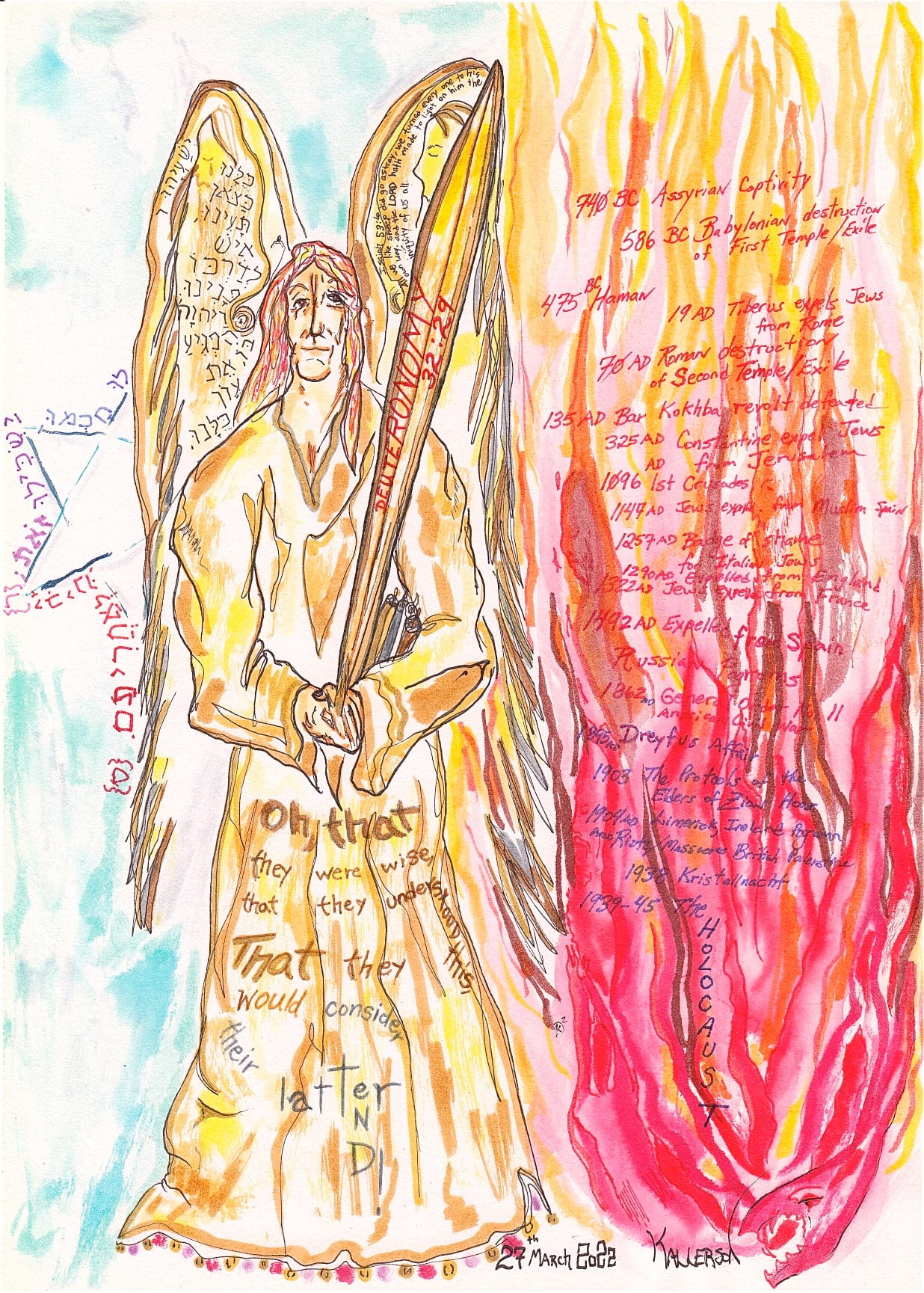
Deuteronomy 32:23-33
The Song of Moses, Part IV
In some of our verses today, Moses, speaking as the Lord, says that He would have utterly eradicated Israel if it were not for the sake of the enemies misunderstanding what had taken place, and why. As such, the Lord would have to put up with the boasting of the enemies as it would be an indication to them that He is not what the Bible portrays Him to be.
Obviously, the Lord has already proclaimed that regardless of their actions, Israel would be kept as a people. But the Song of Moses highlights the keeping of Israel for this particular reason as well.
When considering this, one cannot help but think of the words of Sennacherib, King of Assyria, as called out by the Rabshakeh to the people of Jerusalem…
Text Verse: “Where are the gods of Hamath and Arpad? Where are the gods of Sepharvaim and Hena and Ivah? Indeed, have they delivered Samaria from my hand? 35 Who among all the gods of the lands have delivered their countries from my hand, that the Lord should deliver Jerusalem from my hand?” 2 Kings 18:34, 35
In response to this degrading talk, Hezekiah went before the Lord with the words of Sennacherib and prayed to him. His concluding words were, “Now therefore, O Lord our God, I pray, save us from his hand, that all the kingdoms of the earth may know that You are the Lord God, You alone” (2 Kings 19:19).
Should Sennacherib have prevailed and utterly destroyed Israel, the words of the Lord as conveyed by Moses would have been exactly what would have come to pass. As this is so, is this thought any less true today? Absolutely not. Despite what replacement theologians say, the keeping of Israel is intimately connected with the honor of the Lord.
And that truth is no more poignantly highlighted than in the supposedly sacred, but actually Satanic, book known as the Hadith. From a website about Islam Q&A, we read –
“It is narrated in the hadith that the Prophet [meaning Mohamed] … said: ‘The Hour will not begin until you fight the Jews, until a Jew will hide behind a rock or a tree, and the rock or tree will say: “O Muslim, O slave of Allah, here is a Jew behind me; come and kill him.’”
There are three possibilities with this: 1) Either the Bible is true, and the Hadith is false, or 2) The Bible is false, and the Hadith is true, or 3) both are false. A fourth option is not possible, that of both being true.
As such, Israel will be kept as a people forever, and the Lord has demonstrated that He is God, or Israel will someday be eradicated and Moses is wrong, logically following that then would be that the Lord is not God.
There is a whole lot tied up in the preservation of Israel if one understands the words of the books of Moses. It truly is unfortunate that replacement theology has arisen in the world. Those who hold to it actually place the integrity of the Bible on the same par as Israel’s enemies, even if they don’t intentionally do so. The result is the same.
Let us be sound in our thinking and not get caught up in strange teachings that do not accurately reflect what God is doing in redemptive history
Great things are to be found in His superior word. And so, let us turn to that precious word once again and… May God speak to us through His word today and may His glorious name ever be praised.
I. Amassed Evils (verses 23-25)
Since verse 19, the poem has highlighted the results of Israel’s abandonment of the Lord. In response to that, Moses has highlighted the Lord’s rejection of them. Since verse 20, Moses has been writing in the first person as if his words are those of Yehovah.
That continues now, referring to His rejection of them, His turning from them, and His judgment upon them. However, verse 21 alluded to His plan to lure Israel back to Himself through His active turning to another group of people.
While that has been occurring, the devastations upon Israel continue today. They are words of terrifying disaster that accurately, but most mournfully, reflect the state of the people of Israel since their rejection of Him at the time of their visitation by Christ Jesus. With that understood, the words of Yehovah continue…
23 ‘I will heap disasters on them;
aspe alemo raoth – “I will amass upon them evils.” One can imagine sheets of paper, each with a different evil written upon it, being torn off the stack and tossed onto the land. With the coming of each sheet, another disaster arrives. Soon, the land and the people are completely destroyed, and nothing is left but the sheets of doom lying in heaps, testifying against the people.
They have done evil before the Lord in defiance of His word, and so He sends forth His word to testify against them. As it comes, so come the evils He had promised. They are piercing and they are deadly…
23 (con’t) I will spend My arrows on them.
hitsay akaleh bam – “My arrows I will expend in them.” Whereas the Lord amasses evils upon the people, as if they are coming down from above, it now says He expends all of His arrows in them – as if He is standing amongst them and shooting at one after another directly until all His arrows are gone.
The arrow, in this case, signifies a plague of some sort. The word is being used metaphorically, as can be seen from Ezekiel 5 –
“When I send against them the terrible arrows of famine which shall be for destruction, which I will send to destroy you, I will increase the famine upon you and cut off your supply of bread.” Ezekiel 5:16
Even Job, a man outside of the covenant people, understood this symbolism –
“For the arrows of the Almighty are within me;
My spirit drinks in their poison;
The terrors of God are arrayed against me.” Job 6:4
An interesting internal a/b/c-c/a/b structure is provided with this verse –
(a) I will amass (b) upon them (c) evils
(c) My arrows (a) I will expend (b) in them
These evils and arrows are defined by the words of the coming verses…
24 They shall be wasted with hunger,
The entire verse is direct, and it calls for the mental insertion of prepositions and verbs that Moses simply leaves out. That begins with this first clause: maze ra’av– “Emaciated, hunger.” The adjective mazeh is found only here. It comes from an unused root signifying “to suck out.”
Thus, one can think of people that are simply skin and bones, as if a straw was inserted into them and their body fat and muscle were sucked out. The only thing left of them is a state of agonizing hunger. It is a perfectly suited description of the condition of the people when the Nazi death camps were liberated.
So starved were the people that when soldiers showed them a kindness by offering them a candy bar or some other food from their kits, some of the people’s bodies went into shock, and they died. An act of tender kindness turned into an unintended sentence of death. Next, the horror of the arrows progresses…
24 (con’t) Devoured by pestilence and bitter destruction;
u-lehume resheph v’qetev meriri – “And consumed fever and depletion bitter.” Two new nouns are spoken forth. The first is resheph. It comes from saraph, meaning “to burn.” Thus, it is that which burns, like a hot coal. In this case, I would think it is referring to an intense fever resulting from the emaciation.
The second is qetev. This comes from an unused root meaning to cut off. Thus, it is a state of ruin. To maintain it as a noun, I have said “depletion.”
Again, one can think of the horrors of the concentration camps and other such times of immense deprivation that have come upon the people as history has recorded. The people claimed to be Jews, they claimed to be united to the Lord, and yet, they have all but ignored Him.
The wounds, though stated as active events coming from the Lord, are actually self-inflicted wounds. They are the inevitable consequences of their failure to respond favorably to Him. But again, the Lord next states that these are a direct punishment from His hand…
24 (con’t) I will also send against them the teeth of beasts,
Making the words more pronounced, the word is singular, “tooth.” It is a way of uniting all teeth of every formidable beast into one giant weapon: v’shen behemoth ashalakh bam – “And fang beasts I will send in them.”
The tooth (fang) becomes a symbol for the chaos it wreaks. One can think of tearing flesh, blood, bits of bone and hair, all being openly displayed among the people. It is a horrifying thought of appalling devastation. And that terrifying weapon has a companion in its destructive purposes…
24 (con’t) With the poison of serpents of the dust.
im khamath zokhale aphar – “With a burning, reptiles dust.” The word translated as “a burning” is given to signify the state that occurs when bitten. Thus, venom or infection is to be understood. The next word, zakhal, is new. It comes from a verb meaning to shrink back or crawl away as if being shy or afraid.
As other words are translated as snake and serpent, I chose reptile because other reptiles also have bites that cause a burning of the body through venom or infection. The translation of the NKJV is less literal, but it is more understandable.
I am guessing on the structure of this verse, but the use of the connecting conjunctions is notable –
(a) Emaciated, hunger.
(a) And consumed fever and depletion bitter.
(b) And fang beasts I will send in them.
(b) With a burning, reptiles dust.
The terrors come from all directions. They come from above and from within. They come in many forms, and they come with a variety of horrors. But more is yet ahead, and they will be indiscriminate in who they come against…
25 The sword shall destroy outside;
mikhuts tesakel kherev – “From out shall bereave sword.” In other words, the terror from outside is the sword that will leave a person childless – be it in war, enemy attack, looters, or whatever. There will be danger on the outside that will leave the parent childless. And more…
25 (con’t) There shall be terror within
It is a plural noun followed by another noun: u-mekhadarim emah – “And from inner chambers, dread.” This is set in contrast to the previous clause. Outside is one place where there is bereavement. However, any place inside, as indicated by the plural, is a place of dread. This is comparable to the curses of Deuteronomy 28 –
“And among those nations you shall find no rest, nor shall the sole of your foot have a resting place; but there the Lord will give you a trembling heart, failing eyes, and anguish of soul. 66 Your life shall hang in doubt before you; you shall fear day and night, and have no assurance of life. 67 In the morning you shall say, ‘Oh, that it were evening!’ And at evening you shall say, ‘Oh, that it were morning!’ because of the fear which terrifies your heart, and because of the sight which your eyes see.” Deuteronomy 28:65-67
And these terrors will be…
25 (con’t) For the young man and virgin,
gam bakhur gam betulah – “Also young man; also virgin.” It speaks of those who are young with their entire lives ahead of them. They may be innocent to the things of the world, but the world is there to devour them.
While they think that a long and full life lies ahead, the termination of their days is at hand. It is like considering the tragedy of a man ready to be married, but who is then called up for the draft. Before the happiness can be realized, only sadness and loss are experienced. Further…
25 (con’t) The nursing child with the man of gray hairs.
Because this is a verb and two nouns, it was hard to give the same structure in the English: yoneq im ish sevah – “Suckling with man advancement.” The word sevah signifies being gray and thus old. The word “advancement” is the only noun I thought accurately matches what is said here while still conveying the intent.
This is then set against the young man and the virgin. Those who are much less developed, and those who are much more developed – even from the very beginning of life to the very ending of it – are not exempt from what is promised to come upon the people.
(a) From out shall bereave sword. (location/result)
(a) And from inner chambers, dread. (location/result)
(b) Also young man; also virgin. (comparison)
(b) Suckling with man advancement. (comparison)
It is rather amazing to see the variety of poetic structures Moses uses in his words. They go from one to another, often completely unique from those around it. And yet, they flow together harmoniously. Because of the tragedy, the words convey, the majesty of how they are penned is easy to overlook.
With these terrors duly noted, especially with them noted along with the calling of the Gentiles while they are ongoing, the tenor of the words next takes on a new direction…
Bitter destruction and days of pain are our lot
As multiplying terrors are found on every side
Surely it is as if a terrible plot
Is waged against us until all have died
From without there is evil to slay any and all
From within there is terror at what lies ahead
Around all the people has descended a dark pall
The enemy attacks wanting everyone dead
From where will come comfort and an end to this plight?
When will the Lord relent and end this disaster
Only horror and terror come to our sight
Save us O Lord, our God, and our Sovereign Master!
II. Our Hand is Exalted (Verses 26 & 27)
26 I would have said, “I will dash them in pieces,
The word “would” is not correct. The first verb is perfect and the second is known as cohortative. In other words, the first verb is as if the action is accomplished while the second expresses an intention to perform: amarti aphehem – “I have said: ‘I will blow them away.’”
Here we find another word found only this once in Scripture, paah. It comes from a primitive root meaning “to puff.” As such it is then an onomatopoeia meaning “to blow away.”
One gets the sense of the Lord breathing in deeply and then rapidly exhaling – “Paaaaaah!” It was the intention of Him to do just that, and in His anger at this disobedient nation, He exclaims that this is exactly what He will do. In this frame of mind, the dialogue marches on…
26 (con’t) I will make the memory of them to cease from among men,”
Again, the first verb is cohortative. The Lord intends to do this thing: ashbitah me-enovosh zikram – “I will cause to cease from mankind memory them.” This complements what was just said. The Lord says purposefully that He will blow the people away.
It will be such a great and pronounced exhaling that they will simply be eradicated. There will be of them not even a memory of a memory left among humanity. The structure of this verse is a simple a/a parallel –
I have said:
(a) ‘I will blow them away.’
(a) I will cause to cease from mankind memory them.
Despite the adamant proclamation that the Lord would eliminate Israel, there is a caveat that will spare them…
27 Had I not feared the wrath of the enemy,
lule kaas oyev agur – “If not provocation enemy I would abide.” The words here are difficult and are widely rendered by scholars, even if most translations are similar. The word kaas is the same as in verse 32:19 last week. It signifies to provoke.
Also, the word gur is used. It signifies to sojourn, reside, live as an alien, and so on. But at times it is rendered as “fear.” Hence, most translations take this route. It is mentally easy to justify for the sake of the reader.
But that does not seem to be the intent, even if it is the result. If the Lord were to blow away the people, He would have to live in the provocation of Israel’s enemies for as long as man remained on earth. Thus, there would be, in the mind of the enemy, the thought that the Lord was incapable of controlling His own people.
Therefore, the idea would be that in His frustration at them, He decided to just entirely eliminate them. If this was the case, then what kind of a God would He be? This translation is then fully supported by the next words…
27 (con’t) Lest their adversaries should misunderstand,
The word “misunderstand” is just the opposite of what is stated, even if it may be implied: pen y’nakeru tsaremo – “Lest should discern their adversaries.” The meaning is clear. The adversaries see that Israel is destroyed. It is a fact that they have recognized.
But this brings in all of the complications that could possibly come forth from such an event. The Lord established them. He gave His word through and to them. He brought the Messiah through them, but He also promised to keep them as a people and never break His covenant with them. On and on the thoughts would go.
The entire fabric of the redemptive process, up to and including the coming of Jesus and His promised return to Israel, would be suddenly and inextricably unwoven.
Just think of nations like Hitler’s Germany or Iran. They have been or they are completely set on the destruction of Israel. It is their greatest desire and their deepest hope. With the destruction of Israel would come a defiling of the name of the Lord, and an exaltation of the name of their supposed god.
The Lord would have to live in their provocations. At this point in the Song of Moses, everything is centered on the fact that Israel must continue, even though they have been as faithless as Hosea’s wife.
As these words are recorded concerning a time that occurs at the same time as the calling of the Gentiles, it is an absolute testimony to the fact that Israel was, is, and shall remain. Otherwise, the enemies of God would have an unearned right…
27 (con’t) Lest they should say, “Our hand is high;
pen yomeru yadenu ramah – “Lest they will say: ‘Our hand is exalted!’” The terrors described above included the sword, implying enemies who wield the sword.
The Lord may use pestilence, famine, or other means, but to completely eliminate a group of people that is scattered around the world – in part or in whole – would require the sword to fully accomplish the task. If Hitler had prevailed, one can see him rejoicing and taking credit for what he was able to do.
Likewise, if this came about today, it is absolutely certain that adherents to Islam would take credit for the victory, and for the rest of time they would proclaim that their false god was actually the victorious and true god. The Lord could not, and indeed He cannot, allow that to occur.
In the world, there would be a complete misperception concerning what actually transpired…
27 (con’t) And it is not the Lord who has done all this.”’
v’lo Yehovah paal kal zot – “And no Yehovah who accomplished all this.” The obvious meaning is, “It is we who have destroyed Israel and Yehovah neither had anything to do with it, nor was He able to stop it. We have prevailed, we are exalted, and Yehovah is not God.”
The Lord would have to abide in this. Any other options would be completely contradictory to His nature. In other words, and by default, the very act of Him blowing Israel away so that they were eliminated from mankind is also completely contrary to His nature. Israel, despite what they deserve, must stand.
The words of this verse are set in an a/b pattern –
(a) If not provocation enemy I would abide. (provoking)
(b) Lest should discern their adversaries. (discernment, but in the sense of not discerning)
(a) Lest they will say: ‘Our hand is exalted! (provoking)
(b) And no Yehovah who accomplished all this. (not discerning)
Who is great like our God? Who is he?
Who does such great wonders and mighty things?
Is there another so great? Can there be?
No! To our God alone all of creation sings
He has redeemed His people for His own
And He has kept them despite their constant falling away
Through this people His fame has grown
Great is His name, and greater day by day
Who could restrain Himself as has the Lord?
From destroying those who so callously turn away
But because of His faithfulness to His word
He has kept this people as His own, to this very day
III. Their Rock Had Sold Them (Verses 28-33)
With the last section complete, a new idea is put forth by Moses. It is in verses 28-33 that the evident nature of Israel’s unworthiness to be spared is detailed. As such, it highlights that they are, in fact, spared.
28 “For they are a nation void of counsel,
I disagree. The nation is a nation filled with counsel, of the highest sort and from the most impeccable Source. It is not that they are void of counsel. Rather: ki go obad esot hemah – “For nation devoid prudence they.”
The word go, or nation, is usually used when referring to Gentiles. However, they are here likened to any other nation. In fact, they are actually much duller than any other nation. That is seen in the word Moses introduces here.
It is the word etsah, coming from a verb signifying advice. As such it speaks of counsel, prudence, purpose, and so on. It is not at all that Israel lacked counsel. They had the law, they had the prophets, they had the Redeemer Himself. And then came the apostles after Him.
They had miracles, signs, and wonders performed among them. And yet, they had as much sense as that of a tree root, and maybe less. If God Himself appeared among them… wait a minute, He did. And even then, they could not perceive it. They failed to recognize the time of their visitation. And to this day, they remain blinded…
28 (con’t) Nor is there any understanding in them.
v’en bahem tevunah – “And no in them understanding.” This is a parallel thought to the previous clause. Just as there is no prudence in their thinking, they are also devoid of understanding. Both words of this verse now are used in a single verse in Proverbs –
There is no wisdom or understanding [tevunah]
Or counsel [etsah] against the Lord. Proverbs 21:30
In this, “counsel” is fine because that speaks in relation to the Lord about a thought or action against Him. However, here in Deuteronomy it is speaking of the state of Israel having counsel but not applying it because they lack the prudence or discernment to do so. One can see this in the parallelism –
(a) For nation devoid prudence they.
(a) And no in them understanding.
But this is not the Lord’s fault. He has done everything to make it otherwise, even giving them the prophetic word to warn them…
29 Oh, that they were wise, that they understood this,
The first verb is perfect, the second is imperfect: lu hakemu yaskilu zot – “If they were wise, they would understand this!” In other words, they have their history, they have the prophecies, they have the promises, and they have the WORD OF GOD to guide them.
It is all recorded there, both the past and the future. What has happened isn’t because they didn’t have sufficient information, but because they have been unwilling to simply check out the facts.
A perfect example of their inability to discern is seen in regard to the coronavirus issue. All of the information one needs to know concerning what is going on is out there. But Israel was the first to jump into the proverbial pot, implementing mandates of all sorts, and they have continued to seethe in the boiling water as the spices have been added.
They do not have the reason to grasp what is so painfully obvious. How much more ridiculous are they in regard to the weightier matters set before them…
29 (con’t) That they would consider their latter end!
An important preposition, to, is overlooked: yavinu l’akharitam – “They would consider to their latter end!” The words are parallel to the previous clause and can be understood when combined with the opening thought – “[If they were wise], they would consider to their latter end.”
This is speaking of the nation. It is true that blessings are promised to them in the Messianic age, but that is clearly indicated as being preceded by a time of great wrath and destruction upon them. This is evident from the words of Moses, the prophets, and Jesus Himself.
If they considered the time “to their latter end,” they would know that things will only get worse before they finally get better. But like sappy churches that fill the world, the focus is always, always, always on the blessing, the good, the prosperity, and the favor.
And yet, this is only a portion of what God says belongs to Israel, and what belongs to the church. The sadness of not considering what the word says to the people to whom it is directed – and indeed to the whole world – will fully, finally, and tragically be realized someday.
If they were wise:
(a) They would understand this!
(a) They would consider to their latter end!
As for Israel, the question is asked…
30 How could one chase a thousand,
ekah yirdoph ekhad eleph – “How could chase one a thousand?” It is the opposite, and multiplied, of what was promised to Israel as a blessing in Leviticus 26 –
“Five of you shall chase a hundred, and a hundred of you shall put ten thousand to flight;
your enemies shall fall by the sword before you.” Leviticus 26:8
Here, Moses indicates that the opposite is in store for Israel in the future. Asking it as a question implies that there is a fixed answer that is as obvious as the nose on one’s face. But before he explains how it could be, he provides a parallel example…
30 (con’t)And two put ten thousand to flight,
u-sh’nayim yanisu revavah – “And two cause to flee a multitude?” It is another and greater multiplication. Where one will chase a thousand, a foe of only two will cause an entire multitude to flee. The word revavah simply means a vast multitude whether definite or indefinite. But how could this happen…
30 (con’t)Unless their Rock had sold them,
It is not conditional. It is a perfect verb preceded by a positive conjunction: ki tsuram mekaram – “For their Rock had sold them.” The Lord gave them sure and great promises that He would be with them in battle and that they would defeat their enemies.
But in a state of being sold, the impossible would come to pass. It speaks of an amazing defeat of the people because they turned from their Rock, and then, He sold them…
30 (con’t)And the Lord had surrendered them?
v’Yehovah hisgiram – “And Yehovah delivered them.” Yehovah is clearly stated in parallel to the Rock of the previous clause. The word here literally means to shut up or to close. But it figuratively means “to deliver.” When one is shut up, he can be delivered over. This is seen, for example, in Amos where the same word is used –
“The Lord God has sworn by Himself,
The Lord God of hosts says:
‘I abhor the pride of Jacob,
And hate his palaces;
Therefore I will deliver up the city
And all that is in it.’” Amos 6:8
The amazing words show how far the people have gone from the Lord that the Lord would sell off and surrender the people.
(a) How could chase one a thousand?
(a) And two cause to flee a multitude?
(b) For their Rock had sold them.
(b) And Yehovah delivered them.
31 For their rock is not like our Rock,
ki lo ketsurenu tsuram – “For no like our Rock their rock.” Moses, speaking of the Lord, makes a comparison between the gods of the enemies and Yehovah. They are not at all like Him. This is stated throughout Scripture, such as –
“Truly, Lord, the kings of Assyria have laid waste all the nations and their lands, 19 and have cast their gods into the fire; for they were not gods, but the work of men’s hands—wood and stone.” Isaiah 37:18, 19
The contrast is absolute. Yehovah is God and all other “gods” are simply the work of men’s hands or the imagination of their minds. With that stated, Moses next says…
31 (con’t) Even our enemies themselves being judges.
v’oyevenu pelilim – “And our enemies, judges.” Many translations insert words here hoping for clarity. Others paraphrase what is said in an attempt to explain what is being said. But none that I found really explain what the meaning of the words must be.
It is apparent that the clauses are parallel. In looking at it as such, the meaning may come forth. I have set forth two variations either of which can be grammatically correct –
For no:
(a) like our Rock (b) their rock
(b) And our enemies, (a) judges
(a) For no like our Rock (b) their rock
(b) And our enemies, (a) judges
What appears to be the case here, and it is tough to be dogmatic, is that it is one of two options based on how the word “judges” is set in parallel to the Lord – either in a positive or a contrasting parallel.
If contrasting, it is saying that the Lord is the Rock and their gods are no rock. Likewise, their enemies are not judges. It is the Lord who made the decision, and both sold and surrendered them. The enemies actually had nothing to do with what occurred. I would prefer this.
However, it could be a positive parallel. If so, then He is the true Judge, and they are judges only because the Lord has allowed it. Said differently, Israel was sold by Yehovah to the enemy who then judged them. This makes less sense to me. Either way, the verses are set in parallel, and one of these two meanings seems to be the case.
32 For their vine is of the vine of Sodom
ki mi’gephen sedom gaphnam – “For from vine Sodom their vine.” It is debated who this is referring to, Israel or the Gentiles just mentioned. The answer must be Israel. Israel is compared to a vine again and again throughout Scripture, such as –
“Yet I had planted you a noble vine, a seed of highest quality.
How then have you turned before Me
Into the degenerate plant of an alien vine?” Jeremiah 2:21
Also, it is only they who are morally compared with Sodom and Gomorrah in the rest Old Testament –
“Hear the word of the Lord,
You rulers of Sodom;
Give ear to the law of our God,
You people of Gomorrah:” Isaiah 1:10
This then is given to explain the reason why the Lord sold them and surrendered them. That then leads to…
32 (con’t)And of the fields of Gomorrah;
u-mishadmoth amorah – “And from fields Gomorrah.” It is another new word, shedemah, coming from sadeh, or “field.” It is a field that is cultivated and should produce. However, what is produced by the vine and the field is next noted…
32 (con’t)Their grapes are grapes of gall,
anavemo ineve rosh – “Their grapes, grapes of poison.” Their produce of the vineyard is of no value at all, and in reality, it is harmful. The grapes here speak of the people’s actions, the fruit of their conduct. Putting up with them is like drinking wormwood.
32 (con’t) Their clusters are bitter.
ashkelot merorot lamo – “Clusters bitter to them.” This is the conduct of the people. It is a society filled with repulsive wickedness and perversion, as if they are carrying around entire clusters of inedible grapes. It is all they produce because their vine and their fields can produce nothing else.
(a1) For from vine Sodom their vine.
(a2) And from fields Gomorrah.
(b1) Their grapes, grapes of poison.
(b2) Clusters bitter to them.
Moses is explaining to the people their very nature in the future and the reason why all the evils will come upon them. As such, they deserve the same punishment that Sodom and Gomorrah received. But more of their character is brought forth next…
33 Their wine is the poison of serpents,
khamath tannim yenam – “Burning of serpents their wine.” This means that their wine is that made of serpent’s poison, which causes burning. The type of serpent, tannin, can only be guessed at. The word is used when speaking of things in the sea in Genesis 1:21, and it is what Moses’ rod turned into in Exodus 7:9. It was obviously poisonous because Moses ran from it.
Regardless of that, as wine is representative of a cultural expression in Scripture, it means that their entire culture is one that is just like the poison of serpents. It permeates everything about them as a people, flowing through them. Moses then further describes what the culture of Israel is like…
*33 (fin)And the cruel venom of cobras.
v’rosh pethanim akzar – “And poison vipers cruel.” Here is a new word, pethen. It is a venomous snake either in the cobra or viper family.
Due to the variety of vipers found in Israel, using “vipers” is a good possible translation, but there are also black desert cobras there as well. Regardless of the type of snake, the meaning is obvious. The “wine,” or cultural expression, of Israel is that of a highly venomous snake. Taken together, the clauses are set in a simple a/a parallel.
(a) Burning of serpents their wine.
(a) And poison vipers cruel.
The words of Moses are the words of Moses, and the Lord inspired them. Hence, one cannot say that what is said here is not reflective of the people without denying that these are the true words of God.
As a general statement concerning Israel, they must be considered a true, accurate, and current description of them as viewed from the Lord’s perspective. They have rejected their Messiah, they do not adhere to the word of the Lord, and they are filled with wickedness and self-righteousness.
And yet, despite their state before Him, He has kept them, and He will continue to keep them. The day is coming when they will again be His holy people. In the meantime, they have been handed over to Satan for what they rightly deserve.
But as I remind you each week, they are simply a snapshot of us. We are His people, and yet we fail Him constantly and in many ways. Despite that, just as His covenant with Israel stands, so His covenant with any who come to Him stands.
God, because of Jesus Christ, could no more reject one of His saved believers than He could reject His own Son. The covenant has been cut, the blood has been shed, and the commitment has been made.
Israel’s failings will not, nor can they ever, negate the faithfulness of the Lord to His side of the covenant. Likewise, our failings will not, nor could they, negate His faithfulness to the seal with which He has sealed us.
Because of this, how much more should we be willing to live for Him instead of following after the same failings that upset the Lord. If you are secretly caught up in adultery, you must consider your ways. If you are thieving from others, it is time to change what you are doing. If you treat your spouse with less than the greatest of respect, it is time for you to redirect your actions.
These are things that the Lord looks disfavorably on. And why should we be recorded in the annals of history as being just like those of Israel who have so greatly displeased the Lord? Let us do our utmost to live for God because of His great love with which He first loved us. May it be so, starting even today.
Closing Verse: “’I overthrew some of you,
As God overthrew Sodom and Gomorrah,
And you were like a firebrand plucked from the burning;
Yet you have not returned to Me,’
Says the Lord.
12 ‘Therefore thus will I do to you, O Israel;
Because I will do this to you,
Prepare to meet your God, O Israel!’” Amos 4:11, 12
Next Week: Deuteronomy 32:34-43 Amazing words, and that ain’t no jive… (The Song of Moses, Part V) (97th Deuteronomy Sermon)
The Lord has you exactly where He wants you. He has a good plan and purpose for you. But He also has expectations of you as He prepares you for entrance into His Land of Promise. So, follow Him and trust Him and He will do marvelous things for you and through you.
The Song of Moses, Part IV
‘I will heap disasters on them without haw or hem
I will spend My arrows on them
They shall be wasted with hunger
Devoured by pestilence and bitter destruction
I will also send against them the teeth of beasts
With the poison of serpents of the dust; a horrid concoction
The sword shall destroy outside
There shall be terror within, terrifying cares
For the young man and virgin
The nursing child with the man of gray hairs
I would have said, “I will dash them in pieces, right there and then
I will make the memory of them to cease from among men
Had I not feared the wrath of the enemy
Lest their adversaries should misunderstand
———-their thinking being amiss
Lest they should say, “Our hand is high
And it is not the LORD who has done all this
“For they are a nation void of counsel as if from jackals
———- they stem
Nor is there any understanding in them
Oh, that they were wise, that they understood this, and wisdom
———-they would spend
That they would consider their latter end!
How could one chase a thousand
And two put ten thousand to flight
Unless their Rock had sold them
And the LORD had surrendered them in their plight?
For their rock is not like our Rock who needs no nudges
Even our enemies themselves being judges
For their vine is of the vine of Sodom
And of the fields of Gomorrah through and through
Their grapes are sour gall
Their clusters are bitter too
The poison of serpents is their wine
And on the cruel venom of cobras they dine
Lord God, turn our hearts to be obedient to Your word
Give us wisdom to be ever faithful to You
May we carefully heed each thing we have heard
Yes, Lord God may our hearts be faithful and true
And we shall be content and satisfied in You alone
We will follow You as we sing our songs of praise
Hallelujah to You; to us Your path You have shown
Hallelujah we shall sing to You for all of our days
Hallelujah and Amen…
23 ‘I will heap disasters on them;
I will spend My arrows on them.
24 They shall be wasted with hunger,
Devoured by pestilence and bitter destruction;
I will also send against them the teeth of beasts,
With the poison of serpents of the dust.
25 The sword shall destroy outside;
There shall be terror within
For the young man and virgin,
The nursing child with the man of gray hairs.
26 I would have said, “I will dash them in pieces,
I will make the memory of them to cease from among men,”
27 Had I not feared the wrath of the enemy,
Lest their adversaries should misunderstand,
Lest they should say, “Our hand is high;
And it is not the Lord who has done all this.” ’
28 “For they are a nation void of counsel,
Nor is there any understanding in them.
29 Oh, that they were wise, that they understood this,
That they would consider their latter end!
30 How could one chase a thousand,
And two put ten thousand to flight,
Unless their Rock had sold them,
And the Lord had surrendered them?
31 For their rock is not like our Rock,
Even our enemies themselves being judges.
32 For their vine is of the vine of Sodom
And of the fields of Gomorrah;
Their grapes are grapes of gall,
Their clusters are bitter.
33 Their wine is the poison of serpents,
And the cruel venom of cobras.