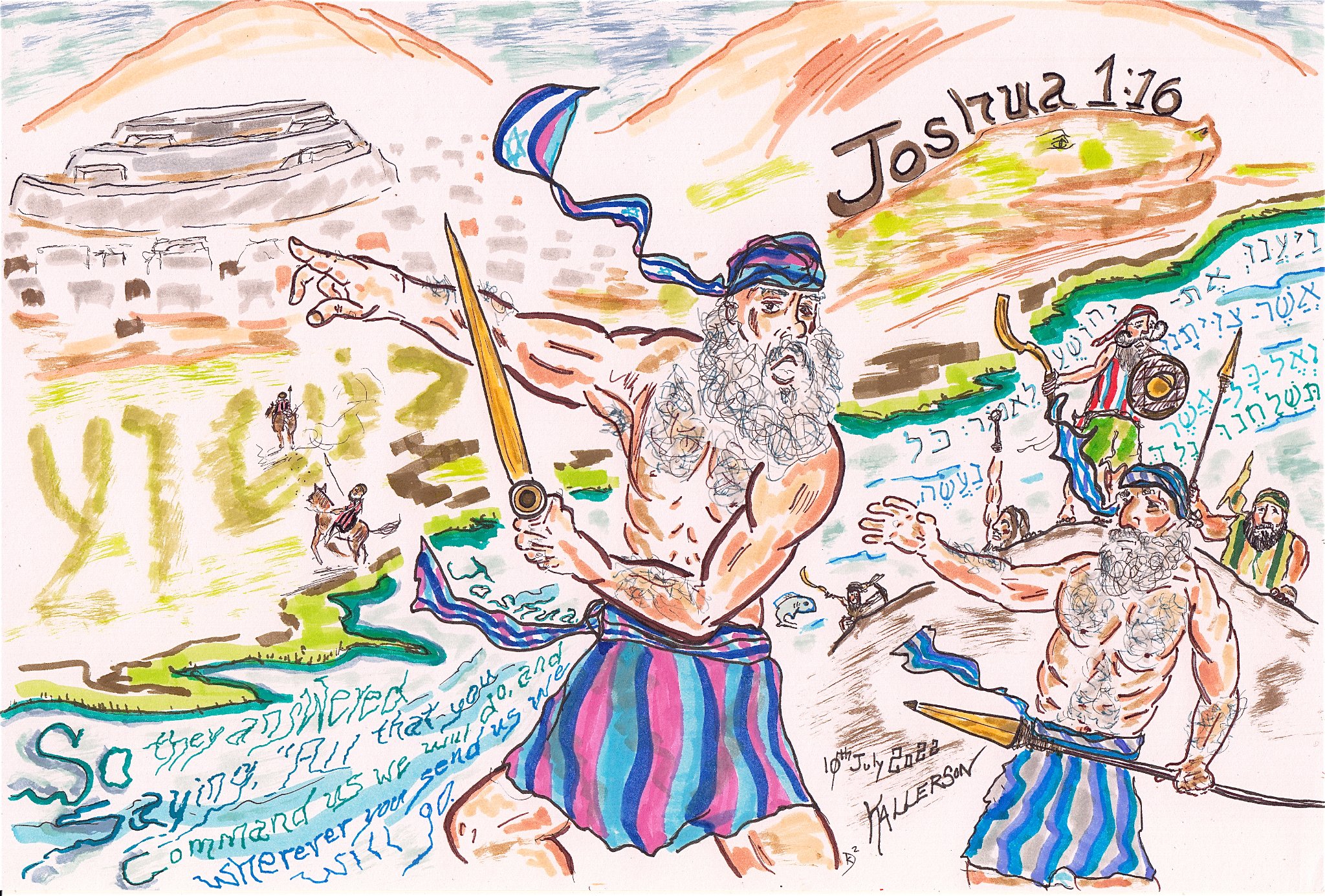
Joshua 1:10-18
All That You Command Us We Will Do
In the US, there are a lot of people that owe a lot of money on student loans. The person who is currently in the White House has been talking about erasing that debt. The day before typing this sermon, I saw an article that it may now be for only some people that he will decide upon.
By the time the sermon is given, who knows what will have happened. But it is morally wrong to simply wipe away someone’s debt in the manner he is planning. This means that, like all government waste, someone else must pay their bills.
Regardless of how it happened, or what the terms were, these people signed the line and accepted the loan. They benefitted from it, and they are responsible for paying it back. But that doesn’t matter to people like this guy. Power, control, and votes are all that speak to such people’s otherwise unreasoning minds.
In today’s passage, a group of people is addressed by Joshua. They made a promise to Moses that they would take certain actions in order to receive certain benefits. They spoke with their mouths, and they are obligated to perform.
As good citizens, they will agree to uphold what they had spoken. If we could only get people to do the same in today’s world, things would go a lot better for all…
Text Verse: “So the children of Reuben, the children of Gad, and half the tribe of Manasseh returned, and departed from the children of Israel at Shiloh, which is in the land of Canaan, to go to the country of Gilead, to the land of their possession, which they had obtained according to the word of the Lord by the hand of Moses.” Joshua 22:9
By the end of Joshua, the people who made that promise to Moses, and who will now reaffirm it to Joshua, will have fulfilled their part of the obligation.
It is inexcusable to borrow money – be it from an individual or an institution – and then not pay back what you owe. However, there are times when it is impossible to do so, and there are laws that govern such things. Along with those laws are certain negative aspects of the forgiveness that are heaped upon the person for a period of time.
What is more inexcusable is for the government, with the exception of executive pardon as allowed by the constitution, to arbitrarily and without consequence forgive someone else’s debt. It is the height of presumption, and it is damaging to all who are connected to the matter.
The government will only grow more callous toward its citizens, the one forgiven will never learn personal responsibility, and those who were owed that money – meaning the taxpaying citizens – are essentially robbed by those who are supposed to represent and protect them.
It is totally unlike what God has done in Christ. We are the debtors, and He is the One to whom the debt is owed. God didn’t rob others to pay that debt for us. Rather, He paid it Himself through the incarnation. In the giving of His Son, harmony is restored, and a state of rest exists. God did the work, and we receive the benefits of it. Thank God for Jesus Christ.
We will talk about that for both the church and Israel before we finish today. Again, thank God for Jesus Christ. Great things such as entering God’s rest are to be found in His superior word. And so, let us turn to that precious word once again and… May God speak to us through His word today and may His glorious name ever be praised.
I. Until the Lord Has Given Your Brethren Rest (verses 10-18)
10 Then Joshua commanded the officers of the people, saying,
To open the passage today, Joshua is said to have commanded the “officers of the people.” The word is shoter, coming from an unused root meaning “to write.” It has been seen since Exodus 5 and was commonly used in Deuteronomy.
Though the identity of this position is not fully known, they are probably superintending magistrates who are likely responsible for the genealogical records. As such, they would identify who was eligible to fight. They would probably keep an account of who went to battle, who was due a furlough, who had died, and so on.
Whether they were fighters or not, and probably not, it is they who would be responsible for those who would keep all such accountings. It is this group that was given the charge to identify the warriors as is recorded in Deuteronomy 20 –
“Then the officers shall speak to the people, saying: ‘What man is there who has built a new house and has not dedicated it? Let him go and return to his house, lest he die in the battle and another man dedicate it. 6 Also what man is there who has planted a vineyard and has not eaten of it? Let him go and return to his house, lest he die in the battle and another man eat of it. 7 And what man is there who is betrothed to a woman and has not married her? Let him go and return to his house, lest he die in the battle and another man marry her.’
8 “The officers shall speak further to the people, and say, ‘What man is there who is fearful and fainthearted? Let him go and return to his house, lest the heart of his brethren faint like his heart.’ 9 And so it shall be, when the officers have finished speaking to the people, that they shall make captains of the armies to lead the people.” Deuteronomy 20:5-9
At this time, the duties of these shoterim are probably greater than just gathering the troops together for battle. This is because not only the soldiers will be entering Canaan, but the families of the people will as well. Hence, the officers were there to ensure that the breakdown and movement of the entire nation went smoothly.
With that understood, Joshua continues, saying…
11 “Pass through the camp and command the people, saying,
The Hebrew more precisely reads, “Pass through in the midst of the camp.” It is the responsibility of the shoterim to ensure that all people were carefully instructed to be ready for what lay ahead, going tribe by tribe and from tent to tent. All people were to be carefully instructed on what they needed to do. Which was…
11 (con’t) ‘Prepare provisions for yourselves,
The word signifies a supply of food. It is the word used at the Exodus to describe the situation –
“And they baked unleavened cakes of the dough which they had brought out of Egypt; for it was not leavened, because they were driven out of Egypt and could not wait, nor had they prepared provisions for themselves.” Exodus 12:39
One might ask why they would need this if they were still receiving manna. That is found in Joshua 5 –
“Now the children of Israel camped in Gilgal, and kept the Passover on the fourteenth day of the month at twilight on the plains of Jericho. 11 And they ate of the produce of the land on the day after the Passover, unleavened bread and parched grain, on the very same day. 12 Then the manna ceased on the day after they had eaten the produce of the land; and the children of Israel no longer had manna, but they ate the food of the land of Canaan that year.” Joshua 5:10-12
But this passage in Joshua 5 explains why they would need provisions. They would no longer receive the manna. And even before that happened, the manna would only fall around the camp (Exodus 16:13). For those on expeditions, they would naturally need to have their own provisions. Joshua next notes that there was a set time to prepare…
11 (con’t) for within three days you will cross over this Jordan,
ki b’od sh’loshet yamim atem oberim eth ha’yarden ha’zeh – “For in until three days you will cross over the Jordan, the this.” The words are problematic for the reader based on the events that follow.
In Chapter 2, it refers to the spies being sent out, coming to the house of Rahab, leaving her house at night, and hiding three days before returning to Joshua. Hence, this cannot be three days as one would expect from a cursory read.
There are several possibilities. The first is that the term “within three days” is from the time of an appointed date. In other words, not necessarily “today” but “within three days of the order to go.” It is an innovative idea, but the Hebrew really appears to be speaking of a three-day period.
Another option is that the events now recorded are not necessarily chronological. In other words. This statement would then belong after Joshua 3:1 –
Then Joshua rose early in the morning; and they set out from Acacia Grove and came to the Jordan, he and all the children of Israel, and lodged there before they crossed over. Joshua 3:1
Then Joshua commanded the officers of the people, saying, 11 “Pass through the camp and command the people, saying, ‘Prepare provisions for yourselves, for within three days you will cross over this Jordan, to go in to possess the land which the Lord your God is giving you to possess.’” Joshua 2:10, 11
So it was, after three days, that the officers went through the camp; 3 and they commanded the people, saying, “When you see the ark of the covenant of the Lord your God, and the priests, the Levites, bearing it, then you shall set out from your place and go after it. Joshua 3:2, 3
If this is correct, then the events of Joshua actually begin in Chapter 1:1-9 and then follow with those of Chapter 2. But to make the narrative understandable, verses 1:10, 11 are placed out of where they chronologically occur.
If so, verses 1:12, 13 are spoken at some point, without specificity as to when, for instruction to those who will inherit land west of the Jordan.
A third option is that the delay in the return of the spies caused a delay in the events originally scheduled for three days hence. The second option appears most likely. One would need to use the Hebrew in a seemingly unintended way for the first option. Joshua would seem unprepared for contingencies if it were the third option.
As such, I would assume that the events are not chronological but are rather chosen to illustrate their importance as they transpired. Therefore, this order to cross by Joshua would have come on the seventh day of the first month, and the spies would have been sent out several days earlier depending on when the Sabbath was.
The main point of this is that there is no need to say the text is in error. Such an obvious blunder would not be admitted, even if this wasn’t the word of God.
Rather, there is a precise timing, and the events were both understandable to the author and they have a valid explanation, even if it must be thought through first. With this understood, Joshua’s command continues, saying they will cross over…
11 (con’t) to go in to possess the land which the Lord your God is giving you to possess.’”
The word yarash, which is used twice in this clause, signifies to possess as in an inheritance. In other words, it may be the possession of the inhabitants that live there now, but they will be disinherited, and Israel will receive the inheritance promised to Abraham, Isaac, and Jacob.
Paul, the author of Hebrews, Peter, and Jesus (in Acts and Revelation) each speak of obtaining the inheritance. Canaan is typical of the state of sanctification that comes through faith in Christ, but that state includes the promise of heaven and eternal life.
Therefore, Canaan – as a type – cannot be limited to being emblematic of being sanctified in Christ, but it must include everything that such a state of sanctification promises. In Ephesians 1 and 2, Paul clearly shows that our present state is inclusive of heaven itself.
Another note concerning this verse, which has been seen several times in Deuteronomy, is that the word translated as “will cross over” is overim. It is identical in spelling to the word ivrim, or Hebrew.
Thus, this gives a sense of the state of what it means to be a true Hebrew. It speaks of a person who has crossed over (through) Christ unto salvation, as pictured by crossing through the Jordan. For now, the passage continues with…
12 And to the Reubenites, the Gadites, and half the tribe of Manasseh Joshua spoke, saying,
Although perfectly understandable, the Hebrew is more specific, “And to the Reubenite, and to the Gadite, and to the half-tribe the Manasseh said Joshua to say.”
The words to be spoken here are based on the agreement reached in Numbers 32. These two- and one-half tribes desired to have their inheritance east of Jordan. As such, Joshua is now reminding them of their responsibility before they can finalize that claim…
13 “Remember the word which Moses the servant of the Lord commanded you, saying,
The specific words of Moses are found in Numbers 32:29, 30 –
“And Moses said to them: ‘If the children of Gad and the children of Reuben cross over the Jordan with you, every man armed for battle before the Lord, and the land is subdued before you, then you shall give them the land of Gilead as a possession. 30 But if they do not cross over armed with you, they shall have possessions among you in the land of Canaan.’”
The words “as a possession” imply what Joshua next says…
13 (con’t) ‘The Lord your God is giving you rest and is giving you this land.’
The land is given, and in possession of it, rest is realized. As for the word nuakh, or “rest,” what is realized in Canaan is only typical of the true rest found in Christ. The theology behind that continues on throughout the Old Testament and is more clearly explained in the book of Hebrews.
As for the “rest,” meaning settling down in their possession east of Jordan, that is only potential at this point. The terms of the agreement to finalize this inheritance must first be met. That is stated as Joshua continues…
14 Your wives, your little ones, and your livestock shall remain in the land which Moses gave you
This is what was proposed by them in Numbers 32 –
“Then they came near to him and said: ‘We will build sheepfolds here for our livestock, and cities for our little ones, 17 but we ourselves will be armed, ready to go before the children of Israel until we have brought them to their place; and our little ones will dwell in the fortified cities because of the inhabitants of the land.’” Numbers 32:16, 17
It is then what Moses accepted and restated to them –
“Then Moses said to them: ‘If you do this thing, if you arm yourselves before the Lord for the war, 21 and all your armed men cross over the Jordan before the Lord until He has driven out His enemies from before Him, 22 and the land is subdued before the Lord, then afterward you may return and be blameless before the Lord and before Israel; and this land shall be your possession before the Lord. 23 But if you do not do so, then take note, you have sinned against the Lord; and be sure your sin will find you out. 24 Build cities for your little ones and folds for your sheep, and do what has proceeded out of your mouth.’” Numbers 32:20-24
Joshua next notes that those who remain will do so…
14 (con’t) on this side of the Jordan.
b’ever ha’yarden – “in side the Jordan.” It speaks of either side based upon the reference point given. In this case, it means “on this side (east) of the Jordan.” The Jordan is the divider between these tribes, and the distinction is being carefully and meticulously delineated now by Joshua, just as it had been by Moses.
As for the agreement, those words of Moses continue to be repeated by Joshua…
14 (con’t) But you shall pass before your brethren armed,
These men would certainly be armed, but the word used now, khamushim, is one that signifies harnessed, or in a battle array. It has the same root spelling as khamesh, or “five” and the identical spelling to “fifty.”
Therefore, it may mean “by fives,” and so a marching array of five per line, or maybe arrayed under five leaders into van, rear, right, left, and center divisions. Or it could mean “by fifties,” as if by a platoon. Whatever its exact meaning, it is surely a structured unit.
It was used when speaking of Israel as they left Egypt. They weren’t merely a mob of people fleeing, but they were orderly and in ranks as they departed.
So would these men be when they crossed into Canaan. They would be in battle array and prepared to subdue the land for their brothers just as their brothers had participated in subduing those in the land of their inheritance. This is next said to be…
14 (con’t) all your mighty men of valor, and help them,
Rather than “all” in the absolute sense, only a portion of the men will actually cross over, about forty thousand (Joshua 4:13) out of almost one hundred and eleven thousand (Numbers 26). Therefore, almost twice as many men would stay behind compared to those who would go.
Joshua’s words have to be taken in the context of Numbers 32 where the words “every armed” were stated. Here, Joshua calls them mighty men of valor.
There would be those going to battle, those protecting the families and homesteads east of the Jordan, and certainly rotations of both. Some would go to battle and then be relieved by others. This state was to continue…
15 until the Lord has given your brethren rest,
ad asher yaniakh Yehovah la’akhekhem – “Until which has given rest, Yehovah, to your brothers. This is only speaking of rest from their enemies. It is not speaking of the final promised rest that Canaan anticipates. This is clearly seen in the next words…
15 (con’t) as He gave you,
ka’kem – “as you.” If this was the final fulfillment of the promise, then it would not include the idea of the “rest” being the same as those who dwelt outside of Canaan. Therefore, Canaan is only given as a type of the true rest that is yet ahead.
As I said before, Hebrews explains this, building upon what David says in the psalms, to validate this thought. For now, Joshua says…
15 (con’t) and they also have taken possession of the land which the Lord your God is giving them.
This was the agreement. These tribes would participate in subduing Canaan until all the tribes had received their inheritance. The Lord had promised that the land would be given to them, and the men of Israel, including those of the tribes east of the Jordan, were to be the instrument of destruction for those who dwelt there.
15 (con’t) Then you shall return to the land of your possession and enjoy it,
The words are a paraphrase. It reads, “And you shall return to the land of your possession and possess it.” In other words, their possession is only potential at this point. The families may dwell there, and there may be houses and fields there, but they do not truly possess it until their task is complete. Only then will they possess the land…
15 (con’t) which Moses the Lord’s servant gave you
Verse 13 said, “The Lord your God is giving you rest and is giving you this land.” Now, it says that Moses gave it to them. This is perfectly in line with Numbers 32:31 which says, “As the Lord has said to your servants, so we will do.”
The Lord was never said to have been consulted in the text, but it signifies that either Moses first consulted Him, or Moses’ decision was as if rendered by the Lord. Either way, the words of the lawgiver are considered as the words of the Lord. The grant is…
15 (con’t) on this side of the Jordan toward the sunrise.”
b’ever ha’yarden mizrakh ha’shemesh – “in side the Jordan rising the sun.” The specificity of wording is common, and it is given to avoid any confusion at all, both immediately and at all times hence. There could not be a later claim that “in side the Jordan” meant one side or another to meets one’s personal whims.
16 So they answered Joshua, saying, “All that you command us we will do, and wherever you send us we will go.
From the words of this verse, it is now apparent, as it should be, that the command of Joshua now stands in place of the command of Moses. Moses has spoken; Joshua now speaks. The transfer of authority, as far as the narrative is laid out, is complete in these words.
The Lord had indicated as much in verses 1-9 from last week, but now that is shown to be fully accepted by the people. Although this may still be only representative of the tribes east of the Jordan, it is more probably inclusive of all the tribes, as was first expressed in verse 10 when referring to the entire camp.
Of this verse, the Pulpit Commentary gives an analysis that is far from what I would consider acceptable –
“Obedience is easy when all goes well with us, and when it makes no demand upon our faith. The Israelites murmured when the promise was as yet unfulfilled. They rebelled against God when obedience entailed serf sacrifice. But now all was hope and eagerness. So it is often with the young Christian at the outset of life’s battle, before he has begun to realise the exertion and self denial that can alone ensure him victory.”
This fails to recognize that Israel was offered Canaan forty years earlier, the land was before them, and all they had to do was trust the Lord. The same groups of people who were in the land then are still there.
But more importantly, the intent of the words, “the exertion and self-denial that can alone ensure him the victory,” are not to be found in Scripture.”
John says, “For whatever is born of God overcomes the world. And this is the victory that has overcome the world—our faith” (1 John 5:4). And that faith is in what Christ has done, not us. As Paul says, “But thanks be to God, who gives us the victory through our Lord Jesus Christ” (1 Corinthians 15:57).
Let us not remove ourselves too far from what is most important. Our faith in what God has done, not exertion and self-denial, will give us the victory. As for Joshua, this newly confirmed state of authority continues with…
17 Just as we heeded Moses in all things, so we will heed you.
The words here could either be laughable, tragic, acceptable, or anticipatory depending on how far back the “Moses” reference goes. Israel almost never heeded Moses until the very recent past. The incident concerning Israel’s harlotry with the Midianite women and joining to Baal of Peor was a very short time earlier.
Thus, if they are referring to the entire congregation, it would be laughable. However, the miscreants were either slain by others or died in the plague. Thus, there was obedience in the killing of the offenders, but the circumstances were tragic.
If the people are referring to the time since then, which is only a short span, their words could be considered acceptable, but without a lot of history to support the state of their future conduct.
Or, the words could be considered anticipatory in that the people, despite failing Moses, almost constantly remained united under Moses. They would now, together, anticipate a better state of obedience under Joshua.
In type, at least, the obedience of faith, is realized in the words now. They are about to enter Canaan, passing through the Jordan. As this is so, they at least typologically anticipate the state of Israel when they finally yield themselves to Christ Jesus, who alone fulfilled the law.
17 (con’t) Only the Lord your God be with you, as He was with Moses.
This is not to be taken as a condition of obedience. Instead, it is a basis for it and as if a prayer that it will always be so. It was understood that the Lord was with Moses, and it is now understood that he is with Joshua. To proclaim this obedience more directly, the next words are uttered…
18 Whoever rebels against your command and does not heed your words, in all that you command him, shall be put to death.
The same general words were used a few times in Deuteronomy when rebelling against the command of the Lord. Now, they point to the Lord’s representative, thus acknowledging that what he says is to be held on par with the decision of the Lord. That is the reason for the comparable law given by Moses –
“Now the man who acts presumptuously and will not heed the priest who stands to minister there before the Lord your God, or the judge, that man shall die. So you shall put away the evil from Israel. 13 And all the people shall hear and fear, and no longer act presumptuously.” Deuteronomy 17:12, 13
Joshua, though never called a judge, served in the capacity of one. He led Israel and, as such, was the representative of the Lord for the people in all civil matters.
The typology of Christ is sobering. As He assumed to leadership of Israel after the Law of Moses was fulfilled and ended, it means that all who have failed to come to Him – and who continue to fail to do so to this day – are condemned. As for Joshua under the law, the continued words of the people close out the chapter…
*18 (fin) Only be strong and of good courage.”
raq khazaq v’emats – “Only: be strong and be strengthened.” It is the same words, repeated several times in Deuteronomy, especially three times in Deuteronomy 31 – “be strong and be strengthened.” Moses said this to the people and then twice to Joshua. The Lord also said it to Joshua in verse 1:7. The people now pronounce these same words upon Joshua.
Whatever challenges lay ahead, the Lord was with him, and the people were behind him. The enemies would be defeated, and the land would be subdued.
A place of rest for the people of God
A state that says, “All is well with my soul”
To God alone be the glory, and to Him alone we applaud
For one seeking rest, He has it all under control
Those who do believe have entered that rest
But it remains that some others must enter it too
A people that has not yet passed the test
But they will someday, this word is true
What is it that will bring them to this state?
How will they come to it? What will they do?
How will they enter through the gate?
Only by faith will they enter. Nothing else will do
II. Having Rest and Entering the Rest
Because of the focus on being given rest in this passage, it is good to review exactly what that means. It has been said that Canaan is only typical of the rest that the Bible speaks of for believers in Christ. And that is true.
In the Greek translation of this passage, the verb katapauó, is used both times rest is mentioned. It is a word signifying to settle down or, literally, colonize. Figuratively, it means to desist, cease, and so on. It is used three times in Hebrews 4 when speaking of being given rest.
Along with that is the corresponding noun katapausis. That is used eight times in Hebrews 3 and 4. That gives the sense of a place of rest, such as an abode.
Moses, in Deuteronomy 12, spoke of the menukhah, meaning either “rest” or a place of rest. In speaking to them, he said that they had not yet obtained such a place, or state, of rest.
But Moses’ point was that the people had the law, and yet they had not been observing the law (think of Israel today). Despite this, they had been brought to the very doorstep of the inheritance promised by the Lord. As this is so, even now with Joshua leading, then it cannot be by the law that they will obtain their rest.
Now in Joshua, as it was when Moses spoke, the idea of rest is tied in with the elimination of the enemy. It means dwelling in safety. The idea of having obtained it is found later in Joshua –
“Now it came to pass, a long time after the Lord had given rest to Israel from all their enemies round about, that Joshua was old, advanced in age.” Joshua 23:1
It is again seen concerning David and his kingdom in 2 Samuel 7 –
“Now it came to pass when the king was dwelling in his house, and the Lord had given him rest from all his enemies all around, 2 that the king said to Nathan the prophet, ‘See now, I dwell in a house of cedar, but the ark of God dwells inside tent curtains.’” 2 Samuel 7:1, 2
Because of David’s efforts in defeating the enemies, it is used again by Solomon in 1 Kings 5 as the reason to build the house of the Lord. At that time Solomon acknowledges that the promised rest was obtained as he prayed the invocation prayer after the temple was complete –
“Blessed be the Lord, who has given rest to His people Israel, according to all that He promised. There has not failed one word of all His good promise, which He promised through His servant Moses.” 1 Kings 8:56
And yet, David, despite having subdued the enemies and provided this rest, indicates that the rest that both Joshua, and he, had obtained was not the promised rest Moses spoke of. He does this by using the word “Today” in the 95th Psalm –
“Today, if you will hear His voice:
8 “Do not harden your hearts, as in the rebellion,
As in the day of trial in the wilderness,
9 When your fathers tested Me;
They tried Me, though they saw My work.
10 For forty years I was grieved with that generation,
And said, ‘It is a people who go astray in their hearts,
And they do not know My ways.’
11 So I swore in My wrath,
‘They shall not enter My rest.’” Psalm 95:7-11
Using this, the author of Hebrews unmistakably shows that obtaining the inheritance is not of the law. He does it first by citing the 95th Psalm, and then by saying this in Hebrews 3:16-19 –
“For who, having heard, rebelled? Indeed, was it not all who came out of Egypt, led by Moses? 17 Now with whom was He angry forty years? Was it not with those who sinned, whose corpses fell in the wilderness? 18 And to whom did He swear that they would not enter His rest, but to those who did not obey? 19 So we see that they could not enter in because of unbelief.”
With that said, he then notes that because David said Today hundreds of years after Joshua had received his rest, it means that the rest spoken of is not merely referring to rest from the physical enemies of Israel. As he says in Hebrews 4:8, “For if Joshua had given them rest, then He [the Spirit through David] would not afterward have spoken of another day.”
Each of these times, he uses either the verb or noun form of the words we noted – katapauó and katapausis – the same form of the verb used in the Greek of Joshua 1. However, in Hebrews 4, another word is used, which is found only that one time in the New Testament, sabbatismos.
It is an emphatic verbal noun, and it is a derivation of the word shabbaton, or Sabbath day. Thus, it signifies (as some translations more appropriately say) a keeping of “Sabbath-rest.” James Strong defines it as “the repose of Christianity (as a type of heaven)” –
“There remains therefore a rest for the people of God.” Hebrews 4:9
In this verse, the word translated as “remains” was also used in Hebrews 4:6 –
“Since therefore it remains that some must enter it, and those to whom it was first preached did not enter because of disobedience, 7 again He designates a certain day, saying in David, ‘Today,’ after such a long time, as it has been said:
‘Today, if you will hear His voice,
Do not harden your hearts.’” Hebrews 4:6, 7
After this, the author spoke of Joshua and then of the sabbatismos for the people of God –
“For if Joshua had given them rest, then He would not afterward have spoken of another day. 9 There remains therefore a rest for the people of God. 10 For he who has entered His rest has himself also ceased from his works as God did from His.” Hebrews 4:8, 9
The author of Hebrews clearly and concisely states what he had so methodically been building up to by saying, “There remains therefore.”
The author, under inspiration of the Holy Spirit, says unambiguously that the day, called Today, still allows for obtaining what was once denied, which is “a rest for the people of God.” Charles Ellicott says, “It is tacitly assumed that no subsequent fulfillment has altered the relation of the promise.”
What this means is that which was available in past times remains available. Because it is promised, and because the promise was not laid hold of, the promise remains unappropriated. And though unappropriated, it is also not retracted.
What blazes forth in what is being said is the use of the word sabbatismos. By using this, instead of the other word for “rest” that he had been using, it takes the thought all the way back to Genesis 2:2 where God is said to have “rested” on the seventh day.
There, the word is shabath, the verb from which the idea expressed in the noun “Sabbath” is derived. God rested, implying He had a rest. It is this rest that has remained unappropriated but not retracted.
But the question is, “To whom is this directed?” As noted, it is a Sabbatism “for the people of God.” The question then is, “Who is this referring to?” Many Christian scholars say that it is a type of heaven for the church, or the “true Israel.” That is somewhat in line with what James Strong said.
However, in Hebrews 4:3, it was already stated that those who believe have entered their rest. It is a place of rest that is granted by faith in Christ. No distinction can be made between Jew and Gentile. It simply says that those who believe have entered.
And yet, there is the unappropriated offer of entering into God’s rest for the people of God. The idea of “the people of God” is notably used in the New Testament, with certain exceptions when speaking of the Gentile-led church, to speak of Israel.
As this is so, it is not a “spiritual Israel” that has replaced the people of Israel, but it is actually referring to the people known as Israel. Speaking of the literal people of Israel, Paul uses the term “His people” in Romans 11:1 & 2. The author of Hebrews, speaking of the “house of Israel and the house of Judah,” uses the term in Hebrews 8:10. He also calls Israel “the people of God” in Hebrews 11:25. Peter informs his Jewish audience that they “once were not a people but are now the people of God.”
The implication is that they were rejected by God, but then after that rejection, they are, once again, to be called as His people. Even Paul, in Galatians 6:16, speaks of the “Israel of God.” That does not refer to Gentiles who have replaced Israel, but rather those Israelites who have come to Christ in contradistinction to those Jews who have not.
And finally, the audience of the book of Hebrews is the Hebrew people. The overwhelming evidence points to the subject of Hebrews 4:9 and the sabbatismos as being for the Jewish nation, Israel. It is they who are being referred to.
The rest which remains for them, that of the true rest found in Christ Jesus, remains open to them. With this understanding, this does not negate that Gentiles are included in this. Anyone who believes in Christ Jesus’ finished work is granted entrance into God’s rest.
But the context is that the “people of God” being referred to are the people of Israel. It is they who were with Joshua, and it is they to whom the psalmist wrote the words of the 95th Psalm.
So why is this important? It is because the past many chapters, since Numbers 14, have pointed to Israel’s rejection of Christ and of their time of punishment and dispersion. Their entry into Canaan is a type of finally entering into the true state of Sabbath Rest that God has been working to bring the world back to.
Israel will come to believe in Christ. When they do, the seventh day, the millennium, will finally be realized. The Old Testament promises of this earthly restoration were made to Israel. Someday, they will enter into that and lead the nations – with Christ as their Head – for a thousand years.
But what is important for us to understand now, is that Hebrews clearly and unambiguously says that “we who have believed do enter that rest.” God’s rest for the weary soul is received through faith in Christ. This is open to both Jew and Gentile, and it is what we will finally realize in its fullness when we are glorified.
Let us keep the boxes straight. Faith in Christ for the individual brings us to our rest. Faith in Christ for national Israel will bring them to their seventh-day millennial rest. As complicated as it all is to grasp, the simplicity of the result is that all will be restored and that God will be glorified.
For now, may you accept the simple premise that God has made the offer and that entering into what He offers is available through faith alone. Just believe the gospel and receive the promised inheritance and the rest that comes with it.
Closing Verse: “In Him you also trusted, after you heard the word of truth, the gospel of your salvation; in whom also, having believed, you were sealed with the Holy Spirit of promise, 14 who is the guarantee of our inheritance until the redemption of the purchased possession, to the praise of His glory.” Ephesians 1:13, 14
Next Week: Joshua 2:1-11 Her name rhymes with Taxicab and COVID Jab… (A Harlot Named Rahab) (3rd Joshua Sermon)
The Lord has you exactly where He wants you. He has a good plan and purpose for you. It is He who has defeated the enemy and who now offers His people rest. So, follow Him and trust Him and He will do marvelous things for you and through you.
All That You Command Us We Will Do
Then Joshua commanded the officers of the people, saying
These words to them he was relaying
“Pass through the camp and command the people, saying
‘Prepare provisions for yourselves, for within three days
———-so to you I address
You will cross over this Jordan, to go in to possess the land
Which the Lord your God is giving you to possess
And to the Reubenites, the Gadites he was relaying
And half the tribe of Manasseh Joshua spoke, saying
“Remember the word which Moses the servant of the Lord
Commanded you, saying (please understand)
‘The Lord your God is giving you rest
And is giving you this land
Your wives, your little ones, and your livestock
Shall remain in the land which Moses gave you
On this side of the Jordan
But you shall pass before your brethren armed, so you shall do
All your mighty men of valor, and help them
Until the Lord has given your brethren rest
As He gave you, and they also have taken possession
Of the land which the Lord your God is giving them in this quest
Then you shall return to the land of your possession and enjoy it
Which Moses the Lord’s servant gave you
On this side of the Jordan toward the sunrise
These things you shall do
So they answered Joshua, saying
“All that you command us we will do
And wherever you send us we will go
Just as we heeded Moses in all things, so we will heed you
Only the Lord your God be with you, as He was with Moses
Whoever rebels against your command and does not heed
Your words, in all that you command him, shall be put to death
Only be strong and of good courage as you lead
Lord God, turn our hearts to be obedient to Your word
Give us wisdom to be ever faithful to You
May we carefully heed each thing we have heard
Yes, Lord God may our hearts be faithful and true
And we shall be content and satisfied in You alone
We will follow You as we sing our songs of praise
Hallelujah to You; to us Your path You have shown
Hallelujah we shall sing to You for all of our days
Hallelujah and Amen…
10 Then Joshua commanded the officers of the people, saying, 11 “Pass through the camp and command the people, saying, ‘Prepare provisions for yourselves, for within three days you will cross over this Jordan, to go in to possess the land which the Lord your God is giving you to possess.’”
12 And to the Reubenites, the Gadites, and half the tribe of Manasseh Joshua spoke, saying, 13 “Remember the word which Moses the servant of the Lord commanded you, saying, ‘The Lord your God is giving you rest and is giving you this land.’ 14 Your wives, your little ones, and your livestock shall remain in the land which Moses gave you on this side of the Jordan. But you shall pass before your brethren armed, all your mighty men of valor, and help them, 15 until the Lord has given your brethren rest, as He gave you, and they also have taken possession of the land which the Lord your God is giving them. Then you shall return to the land of your possession and enjoy it, which Moses the Lord’s servant gave you on this side of the Jordan toward the sunrise.”
16 So they answered Joshua, saying, “All that you command us we will do, and wherever you send us we will go. 17 Just as we heeded Moses in all things, so we will heed you. Only the Lord your God be with you, as He was with Moses. 18 Whoever rebels against your command and does not heed your words, in all that you command him, shall be put to death. Only be strong and of good courage.”