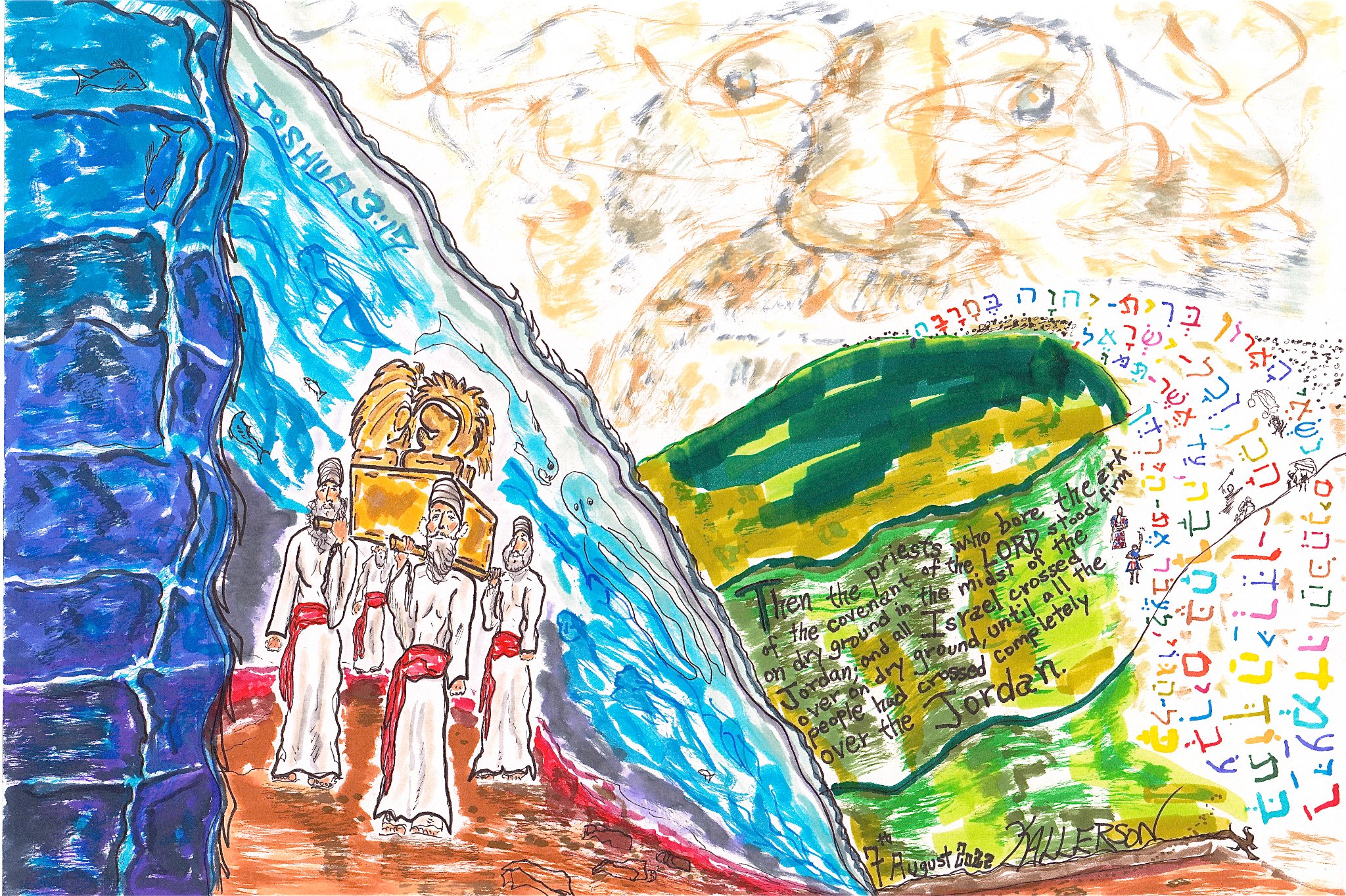
Artwork by Doug Kallerson.
Joshua 3:14-17
And the People Crossed Over, Part II
In Numbers 14, the people failed to believe the Lord. They complained against Him, and they rejected Him. The typology clearly pictured Israel’s rejection of Jesus. Because of their faithlessness, they were sentenced to turn into the wilderness where none of that generation, save Joshua and Caleb, would enter into the inheritance.
The next day, they decided, “Here we are, and we will go up to the place which the Lord has promised, for we have sinned!” But the Lord had already spoken, and the sentence had been pronounced. Instead of trusting the Lord and having Him lead them, they decided it was by their effort and works that they would take the inheritance.
This is what Israel has now done for the past two thousand years. They rejected Christ, and they decided to make up their own plan of salvation through works. After the people were turned to the desert to wander, God gave them a provision for salvation when they had been bitten by snakes in the wilderness, looking to a bronze snake on a cross (picturing Jesus).
That was given to show any Jew since the coming of Christ that he could be saved if he looked to Jesus. But it is only an individual salvation. The nation, all of them who have not come to Christ, have perished and will someday be cast into the Lake of Fire.
But there is a time when the nation as a whole will enter the inheritance. That day has been anticipated in all of our sermons since Numbers 14. With Moses (the law) dead, they will enter. They will now have what was lacking in their attempt to enter after their sentence –
Text Verse: “But they presumed to go up to the mountaintop. Nevertheless, neither the ark of the covenant of the Lord nor Moses departed from the camp.” Numbers 14:44
The ark was not with them, nor was Moses. In Christ, Israel has both. He is the ark, and He is the embodiment of the Law of Moses. With Him at their head, pictured by Joshua, they will enter. It is Jesus Christ, and He alone, by which man can enter into the inheritance. And it is by Him alone that all Israel will someday be saved.
The typing of this sermon actually got started some years ago, probably around the Numbers 14 sermon. I was looking at this passage from Joshua and noticed a pattern that will be revealed in today’s sermon. I sent it to Sergio and Rhoda, and Sergio – responding for both of them – said this about what I sent –
Cut off !! Wooow! And then Josh 3:16 says it was cut off by Adam by the Dead Sea!!! And the words used there are “cut off” and “finished” (Tam) – Just like Christ had said – it is finished!!
And the word for “dipped” in Josh 3:15 says the priests “nitbeli” – same word for Baptism!
…
THIS IS INCREDIBLE!’!!!!
Never underestimate Sergio and Rhoda’s zeal for the word of God. I have held onto those comments since then and have anxiously awaited putting all of this together. I certainly hope you will enjoy what God has placed in His word.
Before going on, it is true that modern Hebrew is not the same as biblical Hebrew, but there is overlap, and there must be a common understanding of biblical concepts in translations. Hence, what is presented here does not violate the typology at all, it is clearly supportive of it.
These are words of surety for Israel, and thus, they are words of surety for us. If you are struggling with the idea of eternal salvation, you shouldn’t. What God is doing is not about your faithfulness – you unfaithful soul. It is about His.
Cast off the arrogance concerning your (or another’s) inability to remain saved. It is not about you. God has made the promise. God has done the work. God has given the pledge. If it were about you, and it isn’t, you would lose your salvation. Don’t poke at the Lord’s covenant looking for holes in it. There are none.
Great things such as eternal salvation are to be found in His superior word. And so, let us turn to that precious word once again and… May God speak to us through His word today and may His glorious name ever be praised.
I. On Dry Ground (verses 14-17)
14 So it was, when the people set out from their camp
The symbolism being conveyed is lost. It says tents, not camp: v’hi bin’soa ha’am meaholehem – “And it was, in setting out the people from their tents.” The word translated as “set out” means to pull up and relocate, especially the pulling up of tent pegs.
It is what occurred when the people left Mount Sinai in Numbers 10 and began their journey to Canaan. It is the final pulling up and heading out on that long, arduous trek (a self-inflicted wound) that began forty years earlier. Although getting ahead in the narrative, we are told the exact day that this occurs in Joshua 4:19 –
“Now the people came up from the Jordan on the tenth day of the first month, and they camped in Gilgal on the east border of Jericho.”
This is an important day. First, it is exactly forty years, to the day, from the event recorded in Exodus 12 –
“Speak to all the congregation of Israel, saying: ‘On the tenth of this month every man shall take for himself a lamb, according to the house of his father, a lamb for a household. 4 And if the household is too small for the lamb, let him and his neighbor next to his house take it according to the number of the persons; according to each man’s need you shall make your count for the lamb. 5 Your lamb shall be without blemish, a male of the first year. You may take it from the sheep or from the goats. 6 Now you shall keep it until the fourteenth day of the same month. Then the whole assembly of the congregation of Israel shall kill it at twilight.’” Exodus 12:3-6
The first year was spent at Sinai, and then the people departed, disobeyed, and were sentenced to exile. It is forty years to the day from when the lamb was selected as the Passover until the people are to pass through the Jordan.
Further, this is exactly a period of fourteen thousand days, to the day, after the people set out from Mount Sinai as is recorded in Numbers 10. That will be reviewed when we get to Joshua 4. For now, the purpose of this pulling up and setting out is…
14 (con’t) to cross over the Jordan,
la’avor eth ha’Yarden – “to pass through the Jordan.” The word avar signifies to pass over or through, but it is certainly to be rendered “through” in this case. There is no bridge. Rather, the waters will cease, and the people will pass through to the other side of the Descender. The people will go through…
14 (con’t) with the priests bearing the ark of the covenant before the people,
As we have seen, the priests symbolize Christ in the performance of His duties. The ark symbolizes Christ in His Person and what that specifically speaks of is concerning the law and His death in fulfillment of it. To more fully appreciate this and grasp what is being conveyed, reviewing the Exodus sermons concerning its construction are necessary. As for these things…
15 and as those who bore the ark came to the Jordan,
u-k’bo nos’e ha’aron ad ha’Yarden – “And according to coming those bearing the ark unto the Jordan.” This means that as they bore the ark, according to the moment they arrived at the Jordan – at just this moment – but which is next further explained…
15 (con’t) and the feet of the priests who bore the ark
v’ragle ha’kohanim nos’e ha’aron – “and feet the priests those bearing the ark.” As soon as the bearers of the ark arrived at that spot and…
15 (con’t) dipped in the edge of the water
nitbelu biqtseh ha’mayim – “had immersed in extremity the waters.” The word is taval, normally translated as “dipped.” It means “immersed.” When one dips, the thing dipped is immersed. Hence, it is the same word used in the Hebrew New Testament when translating the word “baptize.” Likewise, the word “baptize” comes from the Greek word baptizó which signifies immersion, not sprinkling or pouring.
15 (con’t) (for the Jordan overflows all its banks during the whole time of harvest),
v’ha’Yarden male al kal g’dotav kol y’me qatsiyr – “and the Jordan full upon all his banks all days harvest.” Here is a new word, gadah. It comes from an unused root signifying to cut off. Hence, it speaks of the bank or border of the river as it is cut into the stream.
The water is full “upon” all its banks, meaning it is overflowing. This is because of the rainy season now mixing with the melting of the snow on Mt. Hermon. All of this water is flowing into the Jordan which descends through this single gorge all the way to the Salt (Dead) Sea. The harvest being referred to now is the barley, not the wheat, as seen in Exodus 9 –
“Now the flax and the barley were struck, for the barley was in the head and the flax was in bud. 32 But the wheat and the spelt were not struck, for they are late crops.” Exodus 9:31
That the flax was in harvest at this time has already been seen in Joshua 2:6 where it was noted that Rahab had stalks of flax arranged on her roof. This would have been for drying them after harvesting them. In other words, the account is precise and there is no doubt that it was as is now described.
This doesn’t mean, however, that the waters were not overflowing through the wheat harvest as well, and it can be inferred that they do. Today, this is not the case. So much water is drawn off from the Jordan for agriculture that it is no longer that way, but there is no reason to assume that the overflowing didn’t last much longer in the past.
Because of this immense flow of water, rushing to its termination in the Salt Sea, the miracle which will now be described is all the more pronounced. At the very moment the feet of the priests were immersed, it came about…
16 that the waters which came down from upstream stood still,
A verb is being used as a noun here: vayaamdu ha’mayim ha’yor’dim milmalah – “And stood the waters, the descenders from above.” What this means is that the waters ceased flowing where the priests are. However, this does not initially occur at the spot where they stand, making the event even more miraculous. The waters stood…
16 (con’t) and rose in a heap very far away at Adam,
qamu ned ekhad harkheq meod ba’Adam – “risen heap one far very in the Adam.” What this means is that the waters actually stopped earlier in time than when the priests stepped into the water.
In other words, the water is backed up at a location very far upriver. If the waters backed up a long distance away, then the water that was cut off continued to recede from that point as a full flowing river for a certain amount of time so that when the priests stepped into the flow and the waters stopped for them, it was when the receding water from above finally reached them and passed by.
As such, the miracle is all that much more pronounced. The Lord knew exactly when the feet of the priests were going to step into the water. Planning for that event, in advance, He stopped the waters upriver to accommodate its occurrence.
It is irrelevant how He did this, but it is still not inappropriate to speculate. Maybe He caused a logjam. Maybe a tremor caused a slope of rock and gravel to produce a dam, and so on. Even if a natural explanation like at the parting of the Red Sea exists, where an east wind is said to have caused it, the miracle is that it occurred at exactly the moment specified by His word.
The name Adam is the exact same in Hebrew as Adam, the first man. That, in turn, is the same as the word adam signifying “man” and “mankind.” Next, the words “in the Adam” are explained as…
16 (con’t) the city that is beside Zaretan.
ha’ir aher mitsad tsar’than – “the city which from side Zaretan.” The name Tsar’than comes from a root signifying adversary or oppression. The “n” at the end is believed to indicate “place of.” Hence, the name means “Place of Oppression,” or “Place of the Adversary.”
16 (con’t) So the waters that went down into the Sea of the Arabah, the Salt Sea,
v’ha’yor’dim al yam ha’aravah yam ha’melakh – “and the descenders upon sea the Arabah, Sea the Salt.” The word aravah, comes from the word arav, meaning to become evening or grow dark. This is identical to arav, meaning to take or give on pledge. Hence, this can be typologically paraphrased as, “and the descenders upon the Sea of the Pledge.”
The narrative goes on and explains what the “Sea of the Arabah” means by saying, “Sea the Salt.” The words are being precise to definitively show us that it is the Salt Sea that is being referred to. The fact that two names are used is also a very clear indication that typology is being provided for us to consider. The waters…
16 (con’t) failed, and were cut off;
tamu nikratu – “finished, cut off.” This is speaking of the waters (the descenders) that are coming from above and flowing to where the Dead Sea is located. The words are extremely precise concerning what is happening, even before Israel’s eyes. With this complete, it next says…
16 (con’t) and the people crossed over opposite Jericho.
v’ha’am av’ru neged yerikho – “and the people crossed through in front of Jericho.” They are directly facing Jericho as they pass through the Jordan. The word neged comes from nagad, signifying to be conspicuous. As such, it means “the part opposite,” and thus a counterpart or mate. Because of this, it is used to describe a helper for Adam –
“And the Lord God said, ‘It is not good that man should be alone; I will make him a helper comparable to him.’ 19 Out of the ground the Lord God formed every beast of the field and every bird of the air, and brought them to Adam to see what he would call them. And whatever Adam called each living creature, that was its name. 20 So Adam gave names to all cattle, to the birds of the air, and to every beast of the field. But for Adam there was not found a helper comparable to him.” Genesis 2:18-20
As such, that translation can mean exactly what is here in Joshua. There is the historical event – “and the people crossed through in front of Jericho.” But there is also what is typological – “and the people crossed through comparable (meaning suitable) Jericho.”
17 Then the priests who bore the ark of the covenant of the Lord stood firm on dry ground
v’yaamdu ha’kohanim nos’e ha’aron b’rith Yehovah b’kharavah – “And stood the priests bearers the ark covenant Yehovah in dry.” It is the same word used in Exodus 14 concerning the parting of the Red Sea –
“Then Moses stretched out his hand over the sea; and the Lord caused the sea to go back by a strong east wind all that night, and made the sea into dry land, and the waters were divided.” Exodus 14:21
This standing in dry ground is explained with the next words…
17 (con’t) in the midst of the Jordan;
b’tok ha’Yarden haken – “in midst the Jordan – established.” What is debated is whether the priests remained standing in the spot on the banks of the river where they had first stepped, or did they enter into the riverbed after the waters stopped once the descending water was gone? This is actually important to at least consider. Many translations say, “in the middle of the Jordan.” A couple paraphrase it saying, “in the middle of the riverbed.” This may give a false impression.
If the priests stood where they first touched the water on the overflowing banks of the river, the “in the midst of the Jordan” may not mean “in the physical middle of where the river flows,” but “in the middle of where the river had flowed.”
In other words, “midst” may be referring to “between the cut-off waters.” Half was cut off upriver, and half continued downriver. Hence, the physical separation of the waters is what is being described, not the middle of what is a normal flowing river.
No matter what, this was a sign of safety and security to the people that the waters would not suddenly break loose above and drown them. The Lord, represented by the ark of the covenant of Yehovah, stood in the crossing to ensure that the people were, in fact, safe to cross. For the sake of clarity, the word kun (haken), or established was placed in the previous clause by the NKJV, translating it as “firm.”
However, it is standing alone in the Hebrew, thus providing emphasis. It is a common word that signifies, “to be firm” or “establish.” Despite it being common, it is an important one to consider when we are done with the verses.
17 (con’t) and all Israel crossed over on dry ground,
v’kal Yisrael ov’rim b’kharavah – “And all Israel crossers through in dry.” The meaning is obvious, as literally millions of people cross over below the ark, they were all able to do so in a spot that was dry. It is the same word just translated as “dry” in the first clause of the verse.
Further, as has been seen before, the word translated as “crossers through” is a verb that is identical in spelling to the word ivrim, or Hebrew. Thus, this can – and should – be taken as a pun indicating just that. All the people that cross are Hebrews. The crossing through continued…
*17 (fin) until all the people had crossed completely over the Jordan.
The word “people” is not appropriate. That word, ha’am, the people, was used in verses 3, 5, 6, 14, and 16. This is a different word. Translating it as “people” completely destroys the typology: ad asher tamu kal ha’goy la’avor eth ha’yarden – “until which finished the nation to cross over the Jordan.”
The entire nation of people who are there safely cross over while the priests stood and bore the ark in the midst of the Jordan. The miracle is complete, and the record of it stands as a witness to the world of the miraculous workings of the Lord on behalf of the nation of Israel.
This is the day! We are headed into the promised land
Christ has done it all for us
Look at the waters, taken away! See how they stand
Look at the marvelous work of our Lord Jesus
We shall enter in and receive the promise today
After so long, our eyes are opened to our Christ
He came and did it all! And we now behold the way
It is Jesus alone who for our sins was priced
Glory be to God who has done such things for us!
Glory to our Lord who has opened to us the way
Praise be to our God! Yes, our Lord Jesus!
We shall enter in. Yes! Today is the day!
II. Pictures of Christ
How does one present the future in a way that will explain exactly what will happen but also in a way that can easily remain hidden from those who are not yet ready to see it? The answer, as we have seen, time and again in the first five books of the Bible, is “through typology.”
Israel was given the law, Israel failed to enter into the inheritance, and Israel was punished and sent into exile, remaining under the law. Moses could not enter the inheritance because he typifies the law. And it is clear in understanding New Testament theology that no one under the law can obtain the inheritance without what is offered in Christ.
As such, Moses had to die outside of the inheritance. But Israel under their Messiah, typified by Joshua who is the leader of his people, will enter the inheritance now that the law is dead. That is the marvelous story that is seen in Chapter 3. The years of punishment and exile are over.
This chapter is pointing to Israel of today, set to enter in. They are not yet ready, but these words of Joshua show us that it will come to pass. There was a period of three days from the time of the command until the time of entrance. As we saw, in verse 1, it literally reads “in until three days.” This is what Hosea prophesied concerning Israel’s time of punishment –
“Come, and let us return to the Lord;
For He has torn, but He will heal us;
He has stricken, but He will bind us up.
2 After two days He will revive us;
On the third day He will raise us up,
That we may live in His sight.
3 Let us know,
Let us pursue the knowledge of the Lord.
His going forth is established as the morning;
He will come to us like the rain,
Like the latter and former rain to the earth.” Hosea 6:1-3
There is a time when Israel will be healed. It will be “after two days,” meaning after two thousand years (see Psalm 90:4 and 2 Peter 3:8), and “on the third day,” meaning in the third period of a thousand years – the millennium.
What needs to be understood is that Moses’ death signifies the ending of the law. That happened at Jesus’ time. Hence, the three-day period now given explains that. As such the typology of Numbers 14, where they rejected entrance into Canaan and went into exile, even until the time of Moses’ death, is typologically included in this three-day period.
But more, during that time, individual Jews could be saved by faith by looking to the bronze serpent. Thus, it is the same gospel as that proclaimed to the Gentiles. So much for hyperdispensationalism.
All of that time between Numbers 14 and this event now is like an insert story that is seen again and again elsewhere in the Bible. It is at the end of this two-thousand-year period that the promises to Israel will finally be realized. So much for the church replacing Israel. I’m sorry for replacement theologians, but this is exactly what is being pictured.
The people are moving from Acacia Grove (ha’shittim) to the Jordan. As we have seen in previous sermons, including Joshua 2, the word Shittim is derived from shotet, a scourge. That word is used only once in the Bible. In Joshua 23:13, it says –
“…know for certain that the Lord your God will no longer drive out these nations from before you. But they shall be snares and traps to you, and scourges on your sides and thorns in your eyes, until you perish from this good land which the Lord your God has given you.” Joshua 23:13
It is also true that the law itself can be equated to scourges, simply because “by the law is the knowledge of sin” (Romans 3:20). In Joshua 23, the people of Canaan are equated to scourges who would afflict Israel. Thus, the scourges are that which draw the people away from faith in the Lord and to that which is false.
The law is what caused Christ to be scourged for His people, and it is what Israel has been under. With Moses dead, they are now leaving the law – something that is going to happen when they call on Christ. From the law, they are going to ha’yarden – the Jordan, meaning “the Descender.” It is a picture of Christ.
The Descender starts at Mount Hermon, meaning “Sacred.” It is capped in snow all year, signifying purity. It is emblematic of heaven, the Sacred place. The water then descends to and passes through the area of Dan, or Judge. Christ descended from heaven to the world to be the Judge of sin and to have sin judged in Him.
The waters flow south into the Galilee where they linger. Christ’s life and ministry were centered on this area where He lingered, spending most of His recorded time there. The Jordan then travels in a very long zigzagging path along the border of Canaan. Christ, the Descender, went through all Israel, traveling and preaching.
The Jordan terminates in the Salt Sea, the Sea of the Arabah. It is the Dead Sea. Christ, the Descender, went to His death. But there was no corruption found in Him, typified by the salt of the Salt Sea – a picture of incorruption. In His death, the pledge, typified by the “Sea of the Pledge,” is given. It refers to the Spirit, the pledge (arrabon – from the Hebrew eravon) of Ephesians 1:13, 14 –
“In Him you also trusted, after you heard the word of truth, the gospel of your salvation; in whom also, having believed, you were sealed with the Holy Spirit of promise, 14 who is the guarantee [arrabon] of our inheritance until the redemption of the purchased possession, to the praise of His glory.” Ephesians 1:13, 14
From this sea, the waters do not continue on. Rather, they evaporate – a picture of the resurrection and ascension. As for the fulfillment of the typology, Jesus Himself expressly tells us that He is the fulfillment of what the Jordan pictures –
“For I have come down from heaven, not to do My own will, but the will of Him who sent Me.” John 6:38
Though modern New Testament Hebrew is different than biblical Hebrew, there are overlapping words. In the Sar Shalom Hebrew translation of Jesus’ words, v’yaradti, “and I have come down,” is used. The name Jordan is from the same word, yarad. Jesus is the Descender.
Next, the ark was introduced in verse 3:3. As was explained, that pictures Christ, the embodiment of the law. The priests who bear it picture Christ in His work, bearing the sacrificial and priestly requirements of the law. The people are told that when they see it, they are to get ready to move after it.
There is to be a space of two thousand cubits between the ark and the people. Some say the distance signifies the two-thousand-year interval already mentioned, but that has already been dealt with. Though ultimately the same, there is more in what it is pointing to.
Rather, this is a Sabbath day’s walk, and it anticipates following Christ into His rest as is indicated in Hebrews 4:3 where it says, “For we who have believed do enter that rest.” That is explained by the idiom that was used, ki lo avartem ba’derek mit’mol shilshom – “for no you have passed through in the way from yesterday, day before yesterday.”
This more perfectly explains the time from Christ until Israel enters. It is a way of saying, “This is not something you have done before.” But typologically it is the two days (the two thousand years) they, as a nation, failed to follow Christ.
The people sanctifying themselves in verse 5 signify their preparing themselves mentally, turning their hearts to the Lord and away from the law. The external rites that came at the giving of the law were ineffective in changing the people. Instead, they must have hearts properly directed to Christ’s fulfillment of it.
In verse 7, it was said that Joshua would be exalted in the eyes of the people. This is pointing to that time when Jesus, of whom Joshua is the type, will be exalted in the eyes of Israel. That verse contained a strong emphasis, “that they may (certainly) know.” There will be no doubt when Israel at last comes to their Messiah. He will finally take the place of Moses in their eyes.
In verse 10, it referred to the waters being stopped up as a means of telling that el khai – a Living God – is among them. This is exactly the purpose of Christ’s incarnation and work: to prove that He is the living God and that He is among His people.
He is not like the dead gods of the nations, but He is the Lord of all the earth. It is He, Jesus, the embodiment of the law who was going before the people as the Descender, God in Christ. The deity of Jesus Christ, when the typology is understood, is inescapable.
In verse 13, this was again clearly seen in the words, “ark the covenant [even] Lord all the earth.” The ark of the covenant, meaning Jesus, the embodiment of the law, is Yehovah – God incarnate – the Lord of all the earth. It clearly anticipated the incarnation, where the physical is merged with the spiritual.
In verse 14, it referred to the people setting out from their tents. This is a picture of Israel leaving the tent of the law, the ohel moed, the tent (tabernacle) of meeting, to come to Christ who is the true Tent (Tabernacle) that the law only prefigured –
“And the Word became flesh, and did tabernacle among us, and we beheld his glory, glory as of an only begotten of a father, full of grace and truth.” John 1:14 (YLT)
Though it is actually found in Chapter 4, we saw earlier, that this is said to be taking place on the same day that the Passover lambs were selected. They were lambs that were accepted only after they were deemed to be without blemish. It is reflective of “Christ, as of a lamb without blemish and without spot” (1 Peter 1:19).
Israel will come to realize that Christ is the One who these pictures anticipate, and they will come to Him. This is what is being pictured. It is exactly forty years, to the day, from that original selection of the lambs.
Forty “points to the action of grace (5), leading to and ending in revival and renewal (8)” (Bullinger). Israel was given grace by not being destroyed. They are now arriving at a time of revival and renewal.
In verse 15, the priests (Jesus in His work) with the ark (Jesus the embodiment of the law) came to the Jordan (Christ, the Descender) and their feet dipped (were baptized) into the edge of the water.
In Scripture, the placement of the foot signifies possession. Where the foot stands, that place is the person’s possession (see Deuteronomy 11:24, 28:35 & 65, and Joshua 1:3). The priests symbolize Jesus in His duties. When His duties are complete and his sole rests, the waters (life) are cut off.
The significance of the feet being “baptized” is that they then represent the possession of the waters into which they stepped. Hence, even though the people will pass through on dry ground, it is as if they are being baptized in their passage through. This concept is seen, explicitly, concerning the passing through of the Red Sea in 1 Corinthians 10 –
“Moreover, brethren, I do not want you to be unaware that all our fathers were under the cloud, all passed through the sea, 2 all were baptized into Moses in the cloud and in the sea.” 1 Corinthians 10:1, 2
Likewise, in the death of Christ, being pictured now, believers are baptized into Him –
“Or do you not know that as many of us as were baptized into Christ Jesus were baptized into His death?” Romans 6:3
Hence, these people typologically anticipate Israel of the future being baptized into Christ as they pass through the Descender (Jesus) and into the promised inheritance.
Further, this was when the river was overflowing during the whole time of the harvest. As it says in verse 3:15, it overflows all “His” banks during this time. The harvest is the time of the gospel of Jesus Christ, as Jesus said –
“Jesus said to them, ‘My food is to do the will of Him who sent Me, and to finish His work. 35 Do you not say, “There are still four months and then comes the harvest”? Behold, I say to you, lift up your eyes and look at the fields, for they are already white for harvest!’” John 4:34, 35
It is at this time, and when the priests’ feet are baptized into the Descender (Jesus’ work under the law filled with the Spirit of God), that the waters (the descenders) stood and rose in one heap very far away, “in the Adam.”
Water symbolizes life. The life of the Descender, God in Christ, is standing all the way back in a heap to Adam, the man, and thus all who are in Adam. It is the fulfillment of the promise to man even from the time of the fall. It is why Adam named his wife Khavah, Life. He anticipated the life that was lost, but which would come again to quicken the dead of humanity.
When Christ was baptized into His death, that life was gathered all the way back to our first father, and all the faithful since then –
“But I have a baptism to be baptized with, and how distressed I am till it is accomplished!” Luke 12:50
Christ performed His work under the law (the priests/priestly role), He embodied that law (the ark), and in His death, the waters of the Descender (God in Christ) stopped and reverted all the way back to Adam for fallen man in order to allow any who have believed or who will believe in Him to pass through.
As for the location, Adam, that is said to be beside Zaretan (Tsar’than ) the Place of Oppression or the Place of the Adversary. Whichever is closest, the meaning is obvious. Spiritually dead man has been vexed and oppressed since the fall when Adam was expelled from Eden, where Satan, the Adversary, did his work. The waters backed up to revive those in Adam who come through the work of Jesus Christ.
With that, the waters downstream of the priests standing with the ark went all the way down to the Sea of the Pledge, the Salt Sea. It is a picture of Christ, after His being cut off in death. He remained incorruptible in His death (see Acts 2:27), and it is through His death that the pledge – the Holy Spirit – is received.
It is in the death of Jesus, the cutting off of the waters (symbolizing life) that these things came about. As it said, the waters tamu nikratu – “finished, cut off.” One cannot help but see Jesus’ fulfillment of the law in this.
There are several words that signify “finished” in Hebrew, such as shalam, kalah, and tamam. Each is close in meaning. The word used here, tamam, is in accord with the idea used in John 19 where Jesus says, “It is finished.” This word is used to indicate the end of the words of the Song of Moses and the end of the words of Job in his discourse.
It was also used when speaking of finishing the work of the pillars in the temple, and so on. It signifies finished, come to an end, complete, etc. The next word karath, or cut off, is used when speaking of death, in this case, it is death in the cutting of a covenant. Here are the verses needed to understand this –
The promise of the New Covenant –
“Behold, the days are coming, says the Lord, when I will make a new covenant with the house of Israel and with the house of Judah.” Jeremiah 31:31 (karath/cut – see fulfillment in Hebrews 8:8).
The cutting off of Christ –
“And after the sixty-two weeks
Messiah shall be cut off, but not for Himself; (karath/cut off)
And the people of the prince who is to come
Shall destroy the city and the sanctuary.
The end of it shall be with a flood,
And till the end of the war desolations are determined.” Daniel 9:26
The fulfillment of the law by Christ –
“After this, Jesus, knowing that all things were now accomplished, that the Scripture might be fulfilled, said, ‘I thirst!’” John 19:28 (tamam/fulfilled)
“It is finished!” John 19:30 (tamam/finished)
The cutting of a New Covenant in the blood of Christ –
“Likewise He also took the cup after supper, saying, ‘This cup is the new covenant in My blood, which is shed for you. 21 But behold, the hand of My betrayer is with Me on the table. 22 And truly the Son of Man goes as it has been determined, but woe to that man by whom He is betrayed!’” Luke 22:20-22 (karath/cut – see Jeremiah 31:31 above)
In Israel’s realization that Christ died in fulfillment (tamam) of the law and then cut (karath) a New Covenant in His blood, they will then – finally then – cross through His death and into the promise.
That was seen in verse 16 with the words “and the people crossed through suitable Jericho.” They are now suitable as a people, because of passing through the Descender – which is because of the cutting off of Christ in fulfillment of the law – that they will be a people suitable for the place of fragrance – restored perfection.
The priests (Christ’s work) with the ark of the covenant of Yehovah (Christ the embodiment of the covenant of Yehovah and the fulfillment of the law) standing “in dry” (a picture of the death of Christ) is what allows the people to pass through.
Of them, it said, b’tok ha’Yarden haken – “in midst the Jordan – established.” As I said, the word haken (kun), meaning “to be firm, or establish,” is an important one.
Christ’s work, being established, is what then allows Israel to be established. This is seen in Isaiah 54, and it refers to the future, when Israel will come to Christ. There the word kun is used –
[All your children shall be taught by the Lord,
And great shall be the peace of your children.
14 In righteousness you shall be established; [kun]
You shall be far from oppression, for you shall not fear;
And from terror, for it shall not come near you.” Isaiah 54:13, 14
This is based on what is said in Isaiah 54:1 –
“’Sing, O barren,
You who have not borne!
Break forth into singing, and cry aloud,
You who have not labored with child!
For more are the children of the desolate
Than the children of the married woman,’ says the Lord.” Isaiah 54:1
Paul cites this in Galatians 4 explaining that this is a metaphor for Sarah and Hagar representing the two covenants. Those of the Old Covenant are in bondage (not established). Those who are of the New Covenant, are free (established). They are a part of “the Jerusalem above” (Galatians 4:26).
This is just what is being seen. Israel is being established in Christ by passing through His death. This is seen elsewhere as well, such as in Jeremiah 30:20 where the same word is again used.
With this understood, verse 17 said that all Israel crossed through on dry ground. It contained the pun on the word ov’rim (crossers over) which is the same as ivrim (Hebrews). Those who had rejected Christ are not true Hebrews, but someday, they will be those who cross through Christ, and it will be “all Israel.”
The anticipation of Israel’s redemption is that the nation as a whole will come to Christ. Paul speaks of that day which is yet ahead in Romans 11 –
“And so all Israel will be saved, as it is written:
‘The Deliverer will come out of Zion,
And He will turn away ungodliness from Jacob;
27 For this is My covenant with them,
When I take away their sins.’” Romans 11:26, 27
Paul is not saying that “all Israel of all time” will be saved. Rather, he is saying that Israel the nation, all of them, will be saved when they – as a nation – call out to God through Christ Jesus. This is what is being seen in verse 17 with the final words of the chapter, ad asher tamu kal ha’goy la’avor eth ha’yarden – “until which finished the nation to cross over the Jordan.”
Every person and the entire nation will be saved. This is the culmination of what has been anticipated for the people since they turned away from believing the Lord in Numbers 14, and it will be the culmination of what has been needed since they turned away from the Lord’s Messiah, Jesus Christ, when He came.
During the first sermon, I explained the four causes of what was being seen. In typology, however, this is what is seen: The priests bearing the ark (Jesus’ work under the law) is the material cause. Their entry into the Jordan (the people’s entry into Christ) is what makes the thing (like wood in a table) to be. The formal cause, the design, is the parting of the Jordan (the death of Christ in fulfillment of the law). The efficient cause, what brings it about, is the Lord’s presence working in and through Jesus. And the final cause, the purpose, is the exaltation of the Lord Jesus in the eyes of the people.
This is the marvel of what God is doing in Christ. It is not two gospels, one for the Jews and one for the Gentiles, as some heretically claim. It is one thing for all people: faith in Messiah going all the way back to Adam. But along with individual salvation, there is also the promised national salvation of Israel.
Anyone, Jew or Gentile, can be saved today through the finished work of Christ – very clearly depicted in today’s passage. However, national Israel will also be saved – meaning every one of them – when the nation calls out to Him.
This is a promise to no other nation, and it is given to demonstrate the covenant-keeping faithfulness of the Lord to those He swore to keep as a people forever. But this also shows us the nature of His covenant-keeping for all.
Just as He has kept, and He will continue to keep Israel, despite their unfaithfulness to the covenant, so He will keep us in Christ. The surety of our salvation is tied up in the surety of Israel’s national salvation. If He will violate the agreement made with them, then our salvation is just as dubious.
But the story in Joshua 3 tells us that Israel will be saved and come into the New Covenant. Paul tells us this as well. And the apostles go on to show us that this is the same faithfulness that we can expect in Christ.
If you are a Christian who believes you can lose what God has promised you, your theology is lacking, and your faith is not properly directed to God in Christ. Rather, your faith is tied up in your own supposed righteousness. As such, you should probably question your salvation. Don’t lose out on the reward, but trust in Christ, rest in Christ, and be confident in Christ.
Closing Verse: “Therefore My Father loves Me, because I lay down My life that I may take it again. 18 No one takes it from Me, but I lay it down of Myself. I have power to lay it down, and I have power to take it again. This command I have received from My Father.” John 10:17, 18
Next Week: Joshua 4:1-14 It is Christ’s blood that atones, and it is done… (Twelve Stones, Part I) (7th Joshua Sermon)
The Lord has you exactly where He wants you. He has a good plan and purpose for you. It is He who has defeated the enemy and who now offers His people rest. So, follow Him and trust Him and He will do marvelous things for you and through you.
And the People Crossed Over, Part II
So it was, when the people set out
From their camp to cross over the Jordan
———-every Tom, Dan, and Gordan
With the priests bearing the ark of the covenant before the people
And as those who bore the ark came to the Jordan
And the feet of the priests who bore the ark
Dipped in the edge of the water that did the Jordan fill
(for the Jordan overflows all its banks
———-during the whole time of harvest)
That the waters which came down from upstream stood still
And rose in a heap very far away at Adam
The city that is beside Zaretan as you surely know
So the waters that went down into the Sea of the Arabah
———-the Salt Sea, failed
And were cut off; and the people crossed over opposite Jericho
Then the priests who bore the ark of the covenant of the LORD
Stood firm on dry ground in the midst of the Jordan
———-By the waters they were not tossed
And all Israel crossed over on dry ground
Until all the people had over the Jordan completely crossed
Lord God, turn our hearts to be obedient to Your word
Give us wisdom to be ever faithful to You
May we carefully heed each thing we have heard
Yes, Lord God may our hearts be faithful and true
And we shall be content and satisfied in You alone
We will follow You as we sing our songs of praise
Hallelujah to You; to us Your path You have shown
Hallelujah we shall sing to You for all of our days
Hallelujah and Amen…
14 So it was, when the people set out from their camp to cross over the Jordan, with the priests bearing the ark of the covenant before the people, 15 and as those who bore the ark came to the Jordan, and the feet of the priests who bore the ark dipped in the edge of the water (for the Jordan overflows all its banks during the whole time of harvest), 16 that the waters which came down from upstream stood still, and rose in a heap very far away at Adam, the city that is beside Zaretan. So the waters that went down into the Sea of the Arabah, the Salt Sea, failed, and were cut off; and the people crossed over opposite Jericho. 17 Then the priests who bore the ark of the covenant of the Lord stood firm on dry ground in the midst of the Jordan; and all Israel crossed over on dry ground, until all the people had crossed completely over the Jordan.