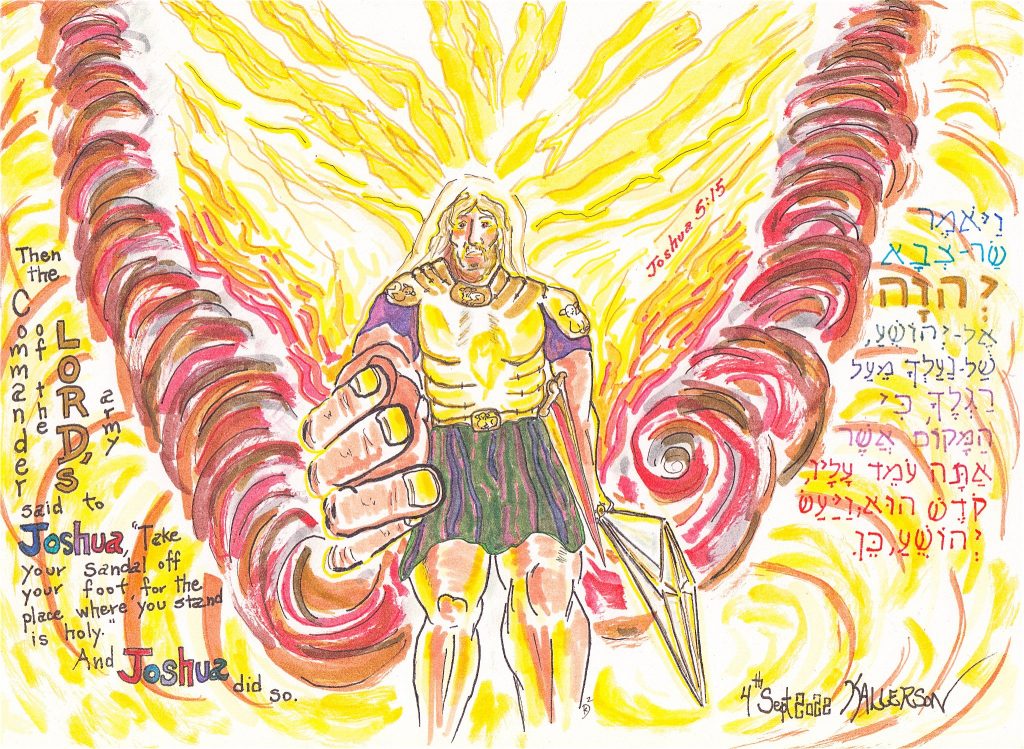
Joshua 5:10-15
The Reproach of Egypt, Part II
This sermon is a tad longer than we have had of late. If I make this introduction very long (as it is the last thing I type each week), it will be even longer. So I will keep it short. But the importance of what is said and seen in these early Joshua sermons is beyond most people’s imagination.
There are many important doctrines that are either expressly seen here in the typology or that are clearly implied. For example, the heresy of reinserting the Law of Moses, or living by the Law of Moses as a means of being found acceptable to God, is explicit.
The doctrine of hyperdispensationalism, meaning the teaching that there are two gospels, one for the Jews and one for the Gentiles, is clearly refuted. There is one gospel even if the term “kingdom” points to different things at different times. God’s promises to Israel the nation do not mean that there are two gospels. It means that He will keep His word to them as a nation.
Whether it will be a mid- or post-trib rapture is revealed in Old Testament typology as well. And, when Jesus speaks in Matthew 23 and 24, the passage today, especially, shows that it is something being spoken to the people of Israel. That couldn’t be any clearer.
Text Verse: “Then Jesus said to those Jews who believed Him, ‘If you abide in My word, you are My disciples indeed. 32 And you shall know the truth, and the truth shall make you free.’”
33 They answered Him, ‘We are Abraham’s descendants, and have never been in bondage to anyone. How can You say, “You will be made free”?’
34 Jesus answered them, ‘Most assuredly, I say to you, whoever commits sin is a slave of sin. 35 And a slave does not abide in the house forever, but a son abides forever. 36 Therefore if the Son makes you free, you shall be free indeed.’” John 8:31-36
The problem with the heresies, or faulty points of doctrine that I mentioned above, stems from a lack of study and understanding of … anyone? No, not necessarily the New Testament, but the Old. Unless one knows the Old as well as the New, many of the points of doctrine in the New either cannot be fully appreciated, or they can easily be manipulated to say something that is not intended.
Replacement theology (the church has replaced Israel), would not exist if people could understand the typology being given in the Old Testament, especially from Numbers 14 until now. Ecclesiastes says –
“That which is has already been,
And what is to be has already been;
And God requires an account of what is past.” Ecclesiastes 3:15
It doesn’t say this simply because the sun rises every day. Rather, it says this because He has orchestrated His word to show us what is coming by what He has already done. Pay attention to the past. In it, you will find the future. Great things are to be found in His superior word. And so, let us turn to that precious word once again and… May God speak to us through His word today, and may His glorious name ever be praised.
I. On the Fourteenth Day of the Month (verses 10-12)
10 Now the children of Israel camped in Gilgal,
va’yakhanu bene Yisrael ba’gilgal – “And camped sons Israel in the Gilgal.” This has already been noted in Chapter 4 –
“Now the people came up from the Jordan on the tenth day of the first month, and they camped in Gilgal on the east border of Jericho. 20 And those twelve stones which they took out of the Jordan, Joshua set up in Gilgal.” Joshua 4:19, 20
As noted then, Gilgal comes from the word gilgal, meaning a wheel. It thus means A Circle, A Wheel, or, figuratively Liberty (as in a rolling away). With the rite of circumcision found in verse 5:9 (last week’s sermon) complete, the reproach of Egypt was rolled away from the people. With that noted, it next says…
10 (con’t) and kept the Passover
va’yaasu eth ha’pesakh – “And made the Passover.” This is something those who were not circumcised could not have participated in during the wilderness wanderings. This is explicitly stated in Exodus 12:47-49 –
“All the congregation of Israel shall keep it. 48 And when a stranger dwells with you and wants to keep the Passover to the Lord, let all his males be circumcised, and then let him come near and keep it; and he shall be as a native of the land. For no uncircumcised person shall eat it. 49 One law shall be for the native-born and for the stranger who dwells among you.’”
It can be speculated on all day long whether the older generation observed it or not, such as Moses, Joshua, and Caleb. But this is not the point of what is being conveyed. We are being shown clear and specific typology to be considered.
The people were uncircumcised, and they could not have observed the Passover. As such, this is only the third recorded Passover that Israel has observed. The first was at the time of the Exodus. The second was at Sinai, just prior to leaving on the journey to Canaan. This is now upon entrance into Canaan.
Because of this, the first is reflective of the Exodus and delivery from bondage in becoming the Lord’s people. The second is reflective of life under the law and in anticipation of entering the promise. This third is reflective of the Eisodus, or entry, into the promise. It is a snapshot of Israel’s history that has, not yet been fulfilled. For now, they have been circumcised, and the note of observance is given directly after that was accomplished. It was…
10 (con’t) on the fourteenth day of the month
b’arbaah asar yom la’khodesh – “in four ten day to the month.” This was explicitly stated in Exodus 12:18 –
“In the first month, on the fourteenth day of the month at evening, you shall eat unleavened bread, until the twenty-first day of the month at evening.”
However, the question to now ask is, “The fourteenth day of which month?” The reason this is relevant is two-fold. First, if they were circumcised on a day after the tenth day of the first month, which is when they crossed the Jordan, and as would initially be thought correct based on a general reading of the passage, it would mean the men were still in the pain of having been circumcised.
It said in verse 8 last week that the men “stayed in their places in the camp until they were healed.” If this is in the first month, the account is exactly forty years, to the day, after having observed the first Passover as recorded in Exodus 12. However, since we saw in Joshua 5:8 that they remained in the camp, it doesn’t make sense that this would be in the first month.
But there is a second reason that will be seen soon for why it is not the first month. Either way, the Passover is when the moon is full. It is when the Lord (the Antitype) was crucified as is recorded in the New Testament in fulfillment of the type. It was…
10 (con’t) at twilight
ba’erev – “in the evening.” Just as commanded in the original observance and as was to be observed henceforth, so they observed it in the Gilgal…
10 (con’t) on the plains of Jericho.
b’arvoth yerikho – “in plains Jericho.” As has been noted, the word aravah, or plains comes from arav, meaning evening. This is identical to arav, meaning to take on pledge, give in pledge, exchange, become surety, and so on. As such, for the given typology, one should think of “the pledges of Jericho,” where Jericho means, “Place of Fragrance.”
Of this, Albert Barnes, not in any manner connecting the events to the typology being presented, still wisely says the following –
“The revival of the two great ordinances – circumcision and the Passover – after so long an intermission could not but awaken the zeal and invigorate the faith and fortitude of the people. Both as seals and as means of grace and God’s good purpose toward them then, the general circumcision of the people, followed up by the solemn celebration of the Passover – the one formally restoring the covenant and reconciling them nationally to God, the other ratifying and confirming all that circumcision intended – were at this juncture most opportune.” Albert Barnes
What has everything since Numbers 14 been anticipating? Without even knowing the connection and the fulfillment of the typology, Barnes’ words accurately reflect what is happening. With the observance of the Passover, it next notes…
11 And they ate of the produce of the land on the day after the Passover,
va’yokelu m’avur ha’arets mimakorath ha’pesakh – “And they ate from produce the land from morrow the Passover.” Here is a word found only now and in the next verse, avur. It is translated as “produce.” It is from avar – to pass over or through, the word constantly seen concerning the act of crossing through the Jordan.
Some translations indicate that the produce mentioned here is old provisions that were carried over with them. Hence, to them this conveys the idea of passing over. But this is incorrect as is seen in the next verse where it specifically ties this produce to the produce of Canaan. Therefore, it is not that the food passed with them across the Jordan. Rather, it is food waiting for them as they passed through. They are not eating old things, but new. It is…
11 (con’t) unleavened bread and parched grain,
matzoth v’qalui – “unleavened bread and roasted.” The matzoth, or unleavened bread, is bread without yeast. The word qalah, or grain that is roasted, comes from qalah, meaning to be lightly esteemed, despised, and so on. This is because the grain is shriveled and appears as such. This was eaten…
11 (con’t) on the very same day.
b’etsem ha’yom ha’zeh – “in bone the day, the this.” The meaning is on the exact same day, the 15th of the month and none other. To say, “in bone,” is to say “identical,” as in Adam’s proclamation that Eve was “bone of my bones.”
This is the fifteenth – not the sixteenth – day of the month as many commentators claim. Nor can this day of eating be considered a violation of the Feast of Firstfruits which occurred on the day after the Sabbath because these are not crops planted by Israel and intended for the harvest (see Exodus 23:16).
Rather, the people are eating what has grown of itself or what was planted by others. It is an acknowledgment that they have been circumcised, observed the Passover, and have entered into new life. With this occurring…
12 Then the manna ceased on the day after they had eaten the produce of the land;
va’yishboth ha’man mi’makhorath b’akhelam m’avur ha’arets – “And rested the manna from morrow in their eating from produce the land.” It is the sixteenth of the month. The people now eating of the produce of Canaan is the fulfillment of the word given by the Lord to sustain Israel in Exodus 16 –
“And the children of Israel ate manna forty years, until they came to an inhabited land; they ate manna until they came to the border of the land of Canaan.” Exodus 16:35
As noted earlier, this is surely the second month, not the first. Not one commentator that I know of made the proper connection to what is being conveyed. The first reason is that the people had to heal from being circumcised, but more specifically, Exodus 16, where the manna was originally given, also says –
“And they journeyed from Elim, and all the congregation of the children of Israel came to the Wilderness of Sin, which is between Elim and Sinai, on the fifteenth day of the second month after they departed from the land of Egypt.” (v.1)
…
“Then Moses and Aaron said to all the children of Israel, ‘At evening you shall know that the Lord has brought you out of the land of Egypt. 7 And in the morning you shall see the glory of the Lord; for He hears your complaints against the Lord.’” (vss.6, 7)
…
“So it was that quail came up at evening and covered the camp, and in the morning the dew lay all around the camp. 14 And when the layer of dew lifted, there, on the surface of the wilderness, was a small round substance, as fine as frost on the ground.” (vss.13, 14)
The manna came on the 16th day of the second month. For Exodus 16:35 to be accurate concerning forty years (and it certainly is), the account in Joshua, that is now occurring on the 16th day of the month would have to be the second month. It is something for which a provision had already been made –
“Then the Lord spoke to Moses, saying, 10 ‘Speak to the children of Israel, saying: ‘If anyone of you or your posterity is unclean because of a corpse, or is far away on a journey, he may still keep the Lord’s Passover. 11 On the fourteenth day of the second month, at twilight, they may keep it. They shall eat it with unleavened bread and bitter herbs. 12 They shall leave none of it until morning, nor break one of its bones. According to all the ordinances of the Passover they shall keep it. 13 But the man who is clean and is not on a journey, and ceases to keep the Passover, that same person shall be cut off from among his people, because he did not bring the offering of the Lord at its appointed time; that man shall bear his sin.’” Numbers 9:9-13
As for the word translated as “ceased,” it is shabath – to cease, desist, or rest. It was first used in Genesis 2 saying –
“And on the seventh day God ended His work which He had done, and He rested (va’yishboth) on the seventh day from all His work which He had done. 3 Then God blessed the seventh day and sanctified it, because in it He rested (shabath) from all His work which God had created and made.” Genesis 2:2, 3
As for the account now, the giving of the manna was rested exactly forty years, to the day, after it had first been given…
12 (con’t) and the children of Israel no longer had manna
v’lo hayah od livne Yisrael man – “and no had again to sons Israel manna.” Forty years after the initial giving of the manna, to the day, the manna rested and did not come again…
12 (con’t) but they ate the food of the land of Canaan that year.
va’yokhelu mit’vuath erets k’naan ba’shanah ha’hi – “And ate from the yield land Canaan in the year, the it.” Instead of manna, the people ate from the tevuah, or yield of the ground of Canaan.
Canaan is derived from kana, “to humble,” or “to subdue.” That comes from a root signifying “to bend the knee.” Thus, it signifies something like humiliated, or humbled, or even subdued.
Let us keep the Passover, we are no longer defiled
We have come to the One who purifies us
We were objects of His wrath, but upon us He has now smiled
He is our Lord, He is our God, He is Jesus!
We missed Him on the first time around
And at that time of Passover, we were defiled
Upon us, His wrath grew hot; it did abound
But, finally, upon us He has smiled
We are circumcised not just in the flesh, but in the heart
We have come through His death into life
Today, we have made a glorious new start
For to us has come reconciliation after the many years of strife
II. The Commander of the Lord’s Army (verses 13-15)
13 And it came to pass, when Joshua was by Jericho,
v’hi bihyoth Yehoshua birikho – “And it came to pass in being Joshua in Jericho.” The wording is specific. It says, “in Jericho.” The same phrase is used four more times and it refers to being in Jericho, as in a border going through there or people residing there. Because of this, there is no reason to assume this is chronological.
Rather, it seems that this actually belongs chronologically in the contents of the next chapter, but it is being presented now for typological fulfillment. There in Jericho it is…
13 (con’t) that he lifted his eyes and looked,
va’yisa enav va’yar – “and lifted his eyes and saw.” It is the exact same expression seen in Genesis 18:2 when Abraham lifted his eyes and saw the Lord (Yehovah/Jesus) with two others. There in Jericho, the Place of Fragrance, Joshua’s attention is now raptly fixed on what he sees…
13 (con’t) and behold, a Man stood opposite him
v’hineh ish omed l’negdo– “And behold! Man standing to opposite him.” This is a human male that is standing right in front of him, just like in Genesis 18 where the Lord physically appeared to Abraham. The text can mean nothing else.
13 (con’t) with His sword drawn in His hand.
v’kharbo sh’lupha b’yado – “And sword drawn in His hand.” It is the exact same expression seen in Numbers 22:23 & 31 where the Lord (Yehovah/Jesus) stood with His sword drawn in His hand when opposing Balaam on his donkey. The connection to Genesis and Numbers is leaving us no doubt about the identity of this Man.
As an important side note, the word kherev is identical to Horeb, or the mountain where the law was given. Certainly, a picture is being made for us to see.
13 (con’t) And Joshua went to Him and said to Him, “Are You for us or for our adversaries?”
va’yelek Yehoshua elav va’yomer lo halanu atah im l’tsarenu – “And went Joshua unto Him and said to Him, “Are to us You, if to our adversaries?” Joshua has no idea who this Man is, and so he is asking whether he is one of his men or one of the adversaries. Everything about the words appears to mean that this is occurring in Jericho at some point during the time of the battle…
14 So He said, “No, but as Commander of the army of the Lord I have now come.”
va’yomer lo ki ani sar tseva Yehovah atah bati – “And said, ‘No! For I Prince(-iple) host Yehovah now have come.’” The word sar signifies the head, chief, prince(-iple) figure, and so on. It signifies the one in charge.
The host of the Lord does not simply mean Israel, but all of the powers that are arrayed under Him. This would include humans, angels, even the sun, moon, planets, stars, elements, and so on. Everything at the disposal of the Lord is considered as His host. This Man is in the position of all power and authority over all of creation. As such…
14 (con’t) And Joshua fell on his face to the earth and worshiped,
va’yipol Yehoshua el panav artsah va’yishtakhu – “And fell Joshua unto his face earth and worshiped.” The word translated as “worshiped” can mean to simply bow down, but he has already fallen on his face. Hence, it means nothing other than the act of worshiping.
This is more so because of who the Man has claimed to be. If Joshua did not believe Him, an entirely different reaction would have taken place. The context itself clearly indicates that this is a Man, and this man is God, because only God has all power and authority.
14 (con’t) and said to Him, “What does my Lord say to His servant?”
va’yomer lo mah adoni m’daber el avdo – “and said to Him, ‘What my Lord from word unto His servant.” Again, Joshua is the leader of Israel. Israel is the Lord’s people. There is none greater than Joshua in Israel because of this. And yet, he subordinates himself to this Man by calling Him “Lord” and by saying he is His servant.
The Lord has already spoken to Joshua seven times since chapter 1. Joshua is fully aware of who the Lord is, and he is fully aware of what the Ten Commandments say. The Lord alone is to be worshiped, and yet he is worshiping this Man who is obviously, therefore, the Lord.
15 Then the Commander of the Lord’s army said to Joshua,
v’yomer sar tseva Yehovah el Yehoshua – “And said Prince(-iple) host Yehovah unto Joshua.” While Joshua is in the act of worshiping the Lord with his face to the ground, the command is given. From the perspective of the Bible, it is another indication that this Man is God. He is accepting worship while giving out a command to the leader of His people. And the command is…
15 (con’t) “Take your sandal off your foot, for the place where you stand is holy.”
The words are emphatic: sal naalkha m’al raglekha ki ha’maqom asher atah omed alav qodesh hu – “Remove your sandal from upon your foot for the place where you stand upon, holy IT.” With only a few changes, it is the exact same words spoken to Moses at the burning bush –
Remove your sandals from upon your feet for the place where you stand upon, ground holy it. Exodus 3:5
Remove your sandal from upon your foot for the place where you stand upon, holy it. Joshua 5:15
Other than these differences, the only other major difference is that there is an additional letter, a vav, in the word “stand” in Exodus 3 that is missing in Joshua 5.
In this command, and it is a command, the Man is instructing Joshua from One who is greater to one who is lesser. In essence, “Resign yourself to me.” He is the possessor of, and in authority over, the place. Joshua’s sandals, whether made by him or by someone else, were the work of man’s hands. His footprints were created by God, implying God’s mastery over him.
There is then a uniting of the created foot with the dust from which it was created. Nothing of human origin would be considered acceptable in the presence of such a place of holiness. This was seen in Exodus 20 which says –
“And if you make Me an altar of stone, you shall not build it of hewn stone; for if you use your tool on it, you have profaned it.” Exodus 20:25
God made the stones, not man. If man’s efforts are placed along with God’s holiness, only defilement will occur. God calls, God sanctifies, and God glorifies. The process of holiness is “of and by God and God alone.” And yet, this is a Man who is, obviously, God. Because of this, and because of the command, it says…
*15 (fin) And Joshua did so.
In compliance to the directive, and just as his predecessor Moses surely had done, Joshua removed his sandals. It is with this note that the chapter ends.
The sword of the Lord is drawn in victory
Great things for us He has done
His hand is held high for all to see
And in it is the sword by which the battle was won
He is the One who came for the battle to win
A challenge to undo the failings of our first father
He was called to live a life without sin
And in His victory, no more will the devil man bother
Great is the Lord, and greatly to be praised
Great and mighty things He has done
With shouts of joy, our voices are raised
Hallelujah to Christ our Lord! God’s own Son
III. Pictures of Christ
Joshua 5 started with a note about the inhabitants on the west side of the Jordan being in fear and their hearts melting. It is perfectly obvious that since Numbers 14, the record has been of Israel being under punishment for rejecting the Lord and failing to enter the promise.
Everything since then has been in anticipation of them eventually being brought into Canaan. At the same time, that has been a parallel to Israel having rejected their Messiah. They went into exile and punishment according to the law of Moses.
Joshua 3 and 4 typologically anticipated the time when they will finally accept Jesus and enter into the promise. With Moses, the Law, dead, they could finally enter into God’s grace by following Jesus’ fulfillment of it. Christ went first, and Israel will join Him in His victory someday. Hence, the plural “we” was used in verse 5:1.
In verse 2, Joshua was told to make “swords rocks” and to circumcise the sons of Israel who had not been circumcised. This is a clear reference to the state of Israel during their time of exile after having rejected Christ. Paul explains this in Romans 2. Despite being circumcised in the flesh, Israel has been in a state of uncircumcision since their rejection of Jesus –
“For circumcision is indeed profitable if you keep the law; but if you are a breaker of the law, your circumcision has become uncircumcision.” Romans 2:25
The Jewish people today are uncircumcised. Joshua, picturing Jesus is told to make the instruments of circumcision and to circumcise the people. It was all in the singular. He was to do it. In Israel’s having crossed the Jordan, it anticipates Christ’s circumcision of the nation – by Himself. This is exactingly reflected in the words of Paul concerning those at Colossae –
“In Him you were also circumcised with the circumcision made without hands, by putting off the body of the sins of the flesh, by the circumcision of Christ, 12 buried with Him in baptism, in which you also were raised with Him through faith in the working of God, who raised Him from the dead.” Colossians 2:11, 12
Only Christ can truly circumcise according to God’s standard, of which the physical rite of circumcision only anticipated, meaning the cutting of the sin nature in man. But notice how Paul tied this circumcision in with baptism. It is the baptism that was typologically seen in Israel crossing the Jordan in Chapter 3.
In other words, and to understand what is going on, we have been seeing the process of salvation in individual passages, but they all happen at once. *Moses, the law dies. Israel accepts Christ’s fulfillment of the law. *Israel enters the Jordan (Christ); Israel is baptized into Christ’s death (Chapter 3). *Israel, signified by the stones carried to Gilgal and which are then rested there, enters its rest (Chapter 4). *Two sets of stones are set up, signifying the heavenly government of Jews and Gentiles (Chapter 4). *Israel is circumcised; Israel has put off the body of sins of the flesh / The reproach of the past is taken away when believers are circumcised by the Lord (Chapter 5). *Believers partake of Christ as their Passover (Chapter 5). *The Lord is the Leader of the people, and they are brought into “holy ground.” (Chapter 5).
These (and all other events) happen at the same moment, but we have seen the individual applications spread out over five chapters so far. All of this will happen to Israel someday, just as it happens to every believer now who comes to Christ.
The circumcision is performed with “swords, rocks.” The symbolism is the law (sword – kherev (חרב) / law – Horeb (חרב)) and the Lord who is the Rock (the same word, tsur, is used to describe Him in Exodus 17:6 when the water came from the rock). Paul says in 1 Corinthians 10:4, citing that example, that Christ is the Rock.
In other words, the “circumcision” is Christ’s fulfillment of the law being imputed to the people and becoming their “circumcision.” The interesting addition in the Greek translation of Joshua 24:30 which we cited when looking at Joshua 5:2, and which noted that these knives were buried in the tomb of Joshua, if original, gives its own marvelous picture of Christ’s tomb being the very place where all of this is made possible.
Verse 2 finished with the note of the “second” being circumcised. It is referring to the second generation who did not die in the wilderness. In other words, it anticipates the generation that follows the disobedient generation noted by Jesus in Matthew –
Assuredly, I say to you, this generation will by no means pass away till all these things take place. 35 Heaven and earth will pass away, but My words will by no means pass away. Matthew 24:34, 35 (refers to the generation of wilderness wanderings)
The “generation” Jesus is referring to is the same generation of Israel today. This is why he can speak of them even two thousand years later, meaning those who will enter the tribulation period – of which Matthew 24 is describing – as “this generation.” They are the first, disobedient, generation. The “second” generation has yet to call on Christ, but they will do so, as He said to them in the previous chapter –
“O Jerusalem, Jerusalem, the one who kills the prophets and stones those who are sent to her! How often I wanted to gather your children together, as a hen gathers her chicks under her wings, but you were not willing! 38 See! Your house is left to you desolate; 39 for I say to you, you shall see Me no more till you say, ‘Blessed is He who comes in the name of the Lord!’” Matthew 23:37-39
In verse 3, it expressly stated that Joshua (he – sg.) circumcised the sons of Israel. That is why only Joshua is mentioned even though it would be impossible for him to do it alone. It is Jesus alone who does this. It is deliberately stated this way anticipating Christ’s work in granting them the seal of righteousness Paul writes of –
“And he received the sign of circumcision, a seal of the righteousness of the faith which he had while still uncircumcised, that he might be the father of all those who believe, though they are uncircumcised, that righteousness might be imputed to them also, 12 and the father of circumcision to those who not only are of the circumcision, but who also walk in the steps of the faith which our father Abraham had while still uncircumcised.” Romans 4:11, 12
Israel today still cannot see what is exactingly being shown right in their own writings. They are uncircumcised and in their sinful state they have completely missed what Scripture is telling them.
Verse 3 next continued with “the hill of the foreskins,” meaning “the hill of the uncircumcised.” It is, again, telling us that Israel is in a state of uncircumcision at this time. But someday they will join the saints of Christ and the “hill of the uncircumcised” will become a reality.
They will put off the body of sins of the flesh in coming to their Messiah, Jesus, in whom the line of sin in man is “cut.” That is what is pictured in the rite of physical circumcision and is fulfilled in Christ.
Verse 4 specifically showed that Israel was circumcised under Moses in anticipation of Christ, but those who rejected Christ – either before His coming or after His arrival – were destined to die apart from God’s mercy. The circumcision of the next generation is given to correct that based on their faith in coming to Christ (as seen in Matthew 23:37-39 above).
This is why the words zakar (male – coming from zakar, “to remember) and then enosh (male – coming from anash and signifying a mortal) are used. It was to show the state of those who die apart from Christ, and those who are remembered by Christ.
It is also why the term “coming out from Egypt” is used. Until Israel enters Canaan, which anticipates Israel finally coming to Christ, they are always “coming out of Egypt,” meaning that which pictures sin. They are in bondage to the law by which is the knowledge of sin (Romans 3:20). The Mosaic Covenant has total hold over them until they enter into the New Covenant.
Verse 5 reconfirmed this. It was anticipated in what was said in Numbers 32:13, and it will be fulfilled when Israel finally calls out to Jesus –
“So the Lord’s anger was aroused against Israel, and He made them wander in the wilderness forty years, until all the generation that had done evil in the sight of the Lord was gone.” Numbers 32:13.
Verse 6 continued to show this, speaking of the generation walking forty years in the wilderness. Forty, as we have seen, is the number indicating “a period of probation, trial, and chastisement … It is the product of 5 and 8, and points to the action of grace (5), leading to and ending in revival and renewal” (Bullinger). This is exactly what is anticipated in Israel’s final restoration.
Until all the “comers out of Egypt” (vs. 5) are no longer coming out, meaning they have come to Christ, the picture will not be realized. They are a nation just like any other Gentile people, reflected in the term ha’goy or “the nation,” as it says, “because they did not obey [hear] the voice of the Lord.”
The words could not more perfectly reflect Israel. They failed to believe, they did not heed His voice, and they were punished. As such, they were denied entry into the promise, exactly as the author of Hebrews states and as we saw in last week’s sermon. They did not enter into the land of milk and honey that Jesus offered them.
Verse 7 repeated the note concerning the uncircumcised generation and that Joshua (alone) had personally circumcised the second generation. At that time, I noted three things that the circumcision meant:
- This is a witness to the Lord’s acceptance of the people as being in a right covenant relationship. The sign of circumcision testifies to it. As such, the guilt of the fathers would no longer be laid upon them.
- They would now be acceptable to observe the Passover.
- With the sign of the covenant upon them, they would now be granted that which was promised to the fathers.
This all lies ahead for Israel, but it is being pictured in Joshua for them to finally see someday. Maybe they will read or watch the Superior Word sermons and realize this.
Verse 8 noted that “all the people” were circumcised. It speaks of the time of national salvation. The pun of the words of verses 7 and 8 was noted at that time. “And their sons He raised up in their place (takhtam).” It now says of those sons, “and they sat in their place (takhtam) in the camp.”
Verse 9 referred to “the reproach of Egypt” having been rolled away. The people had rejected the Lord and wanted to go back to Egypt in Numbers 14. The people rejected the grace of God in Christ and determined to stay under the law and living in sin. Only in coming to Christ is the “reproach of Egypt” rolled away.
With the crossing of the Jordan (being baptized into Christ), and with the fulfillment of the sign of circumcision (a result of that baptism), they will someday be restored to the divine favor of the Lord, Yehovah.
With that noted last week, the final words of verse 9 gave the name Gilgal, or Liberty. The people will enter into Liberty after the years of bondage to the law. (John 8:31-36; Acts 15:10, 11; Romans 8:15; Galatians 4:9, 24&25, 5:1; Hebrews 2:15, etc.).
Starting with verse 10 today, it again noted the Israelites were in Gilgal, or Liberty, where they “kept the Passover.” It is an obvious reference to Christ’s death and their acceptance of that –
“Therefore purge out the old leaven, that you may be a new lump, since you truly are unleavened. For indeed Christ, our Passover, was sacrificed for us.” 1 Corinthians 5:7
The purging out of the old leaven is not speaking of the Passover, but of what follows it, the Feast of Unleavened Bread. Christ died to make us sinless. Thus, believers are to purge the sin from their lives. In observing the Passover it signifies commemorating Christ’s death, the fulfillment of what the Passover from Egypt only anticipated.
It was “in the evening (erev), and in the plains (aravah) of Jericho.” Both words are connected to arav, which speaks of a pledge. It is thus hinting to us of the erevon found in Genesis 38, which anticipates the arrabón noted 3 times by Paul, all referring to the pledge of the Spirit, such as –
“Now He who establishes us with you in Christ and has anointed us is God, 22 who also has sealed us and given us the Spirit in our hearts as a guarantee.” 2 Corinthians 1:21
As verse 10 refers to the “plains of Jordan,” the Place of Fragrance, it means the guarantee of a return to Eden and restored fellowship with God. As Albert Barnes correctly noted concerning the circumcision and Passover observance, without ever making the connection to Christ –
“…the one formally restoring the covenant and reconciling them nationally to God, the other ratifying and confirming all that circumcision intended – were at this juncture most opportune.” Albert Barnes
This is exactly what is being pictured. As I said earlier, all these things occur simultaneously in coming to Christ, but we are seeing them in individual bites to help us understand the magnitude of what God has done for us, and of what He is still doing for Israel.
As for the unusual word avur, or “produce,” found only in verses 11 and 12, that is from avar, or to pass over or through. Both are connected to the word “Hebrew.” In other words, the people are now true Hebrews who have crossed over in both person and substance, signified by the next words of verse 11, matzoth v’qalui, or “unleavened bread and parched grain.” This is explained by Paul’s continued words of 1 Corinthians 5 –
“Therefore let us keep the feast, not with old leaven, nor with the leaven of malice and wickedness, but with the unleavened bread of sincerity and truth.” 1 Corinthians 5:8
The matsah is the unleavened bread Paul refers to – life without sin. The qalah is the state of man in Christ, reflected in the description of Moses in Hebrews 11 –
“By faith Moses, when he became of age, refused to be called the son of Pharaoh’s daughter, 25 choosing rather to suffer affliction with the people of God than to enjoy the passing pleasures of sin, 26 esteeming the reproach of Christ greater riches than the treasures in Egypt; for he looked to the reward.” Hebrews 11:24-26
The food they are noted as eating reflects the state of new life that believers now, and national Israel someday will, participate in.
Verse 12, along with Exodus 16:35, clearly showed that the Passover they observed was the second, not the first, Passover. The law is fulfilled in Christ, but Israel missed it the first time. The second Passover was given for those who were unclean – meaning Israel – at the first Passover.
In other words, though the law is fulfilled in Christ, its fulfillment for Israel lies yet ahead. This is exactly why the Lord gave a second Passover in the law. It was to provide for Israel who remains in their uncleanness to this day. The death of Christ clings to them and it must be purged away through faith in what He has done. It is exactly why the author of Hebrews says –
“In that He says, ‘A new covenant,’ He has made the first obsolete. Now what is becoming obsolete and growing old is ready to vanish away.” Hebrews 8:13
The law, which is obsolete, will only vanish away for Israel when they observe the second allowed Passover. Until that time, the manna – meaning God’s supernatural preservation of Israel – will continue until they partake of the true Bread from Heaven, Christ. This is the reason for His statement to the apostles on the night before He was crucified –
“When the hour had come, He sat down, and the twelve apostles with Him. 15 Then He said to them, ‘With fervent desire I have desired to eat this Passover with you before I suffer; 16 for I say to you, I will no longer eat of it until it is fulfilled in the kingdom of God.’” Luke 22:14-16
He was the first Passover. He will be Israel’s second Passover. Israel will enter into God’s rest, His shabath, that has been anticipated since creation week of Genesis 1. The preservation of Israel, until the millennium, is absolutely guaranteed in the symbolism of the manna.
When they eat of Christ, the need to supernaturally preserve them will no longer be needed. The goal will have been attained. After that, they will dine on “the food of the land of Canaan.” The meaning is that they will eat in the land of the humbled – those who have bent the knee to Christ.
With this picture now complete, the narrative turned to Joshua encountering the Commander of the Lord’s Army. It is a picture of Israel’s leadership and their long-awaited meeting with Christ –
“Now I saw heaven opened, and behold, a white horse. And He who sat on him was called Faithful and True, and in righteousness He judges and makes war. 12 His eyes were like a flame of fire, and on His head were many crowns. He had a name written that no one knew except Himself. 13 He was clothed with a robe dipped in blood, and His name is called The Word of God. 14 And the armies in heaven, clothed in fine linen, white and clean, followed Him on white horses.” Revelation 19:11-14
The armies of heaven, those who are taken at the rapture, are a portion of the Commander of the army of the Lord. Joshua meets Him “in Jericho,” meaning in the Place of Fragrance. It is Israel’s understanding that Christ is the Lord God.
The same terms used in Joshua, and which point to Christ, were seen in Genesis with Abraham and in Numbers with Balaam. It is clearly and unambiguously telling us that Yehovah is incarnate, and that Jesus is Yehovah.
The drawn sword (kherev (חרב) is the law (Horeb (חרב) of which Jesus is the embodiment [the Word of God].) That is exactly explained in the citation from Revelation. It is saying that Christ is the victorious One over the law! He is the embodiment and fulfillment of it! He is Jesus!
When asked if He was for or against Israel, His response was, “No!” Charles Ellicott beautifully states why –
“The war is a Divine enterprise, in which human instruments are employed, but so as to be entirely subordinate to the Divine will. Jehovah is not for Israel, nor for Israel’s foes. He fights for His own right hand, and Israel is but a fragment of His army.” Charles Ellicott
Israel, to this day, thinks it is all about them. Rather, it is all about Jesus. Israel is a small, but hugely important, portion of what God is doing. Someday, the leadership of Israel (who speak for all of Israel) will realize who He is, and they will fall and worship before Him, just as Joshua did.
With that, verse 15 noted the Lord’s command for Joshua to remove his sandals. I noted then the difference between His command to Moses and the one to Joshua –
Remove your sandals from upon your feet for the place where you stand upon, ground holy it. Exodus 3:5
Remove your sandal from upon your foot for the place where you stand upon, holy it. Joshua 5:15
Other than these differences, the only other major difference is that there is an additional letter, a vav, in the word “stand” in Exodus 3 that is missing in Joshua 5.
Moses (the law) was given for all people of Israel individually (your feet) to accomplish. Joshua (Jesus, the law’s fulfillment) was given for all of Israel collectively (your foot) to participate in.
The additional vav is the sixth letter of the aleph-beth and was given to indicate man, especially fallen man, under the law. The omission of the vav in relation to Joshua indicates the fulfillment of the law (to stand) by Christ, the sinless God/Man.
This, and the account with Moses at the bush, are the only two times this was commanded. When two similar things, or two similar occurrences, are noted in the Bible, there is a reason for it. There will be a contrast between the two and yet they will confirm something.
In the case of these two accounts, one is before Israel is delivered from bondage; one is after they have been safely led into the land of promise. He is the Covenant-Keeping Lord.
One is outside of Canaan; one is in Canaan. The Lord is God over the whole earth – over both Jew and Gentile. In one there is the Lord unseen and the voice of God from “over there.” In the other, there is the Lord visible, tangible, and in human form. The Lord is the incarnate Word of God; He is Jesus.
In one, He is the Lord who will give the law – the Angel or Messenger of it; in the other, He is the Lord who defends the law which is given – the Commander of the Lord’s army. He is the Lord of the law, its herald and upholder.
And more, the bush that burned with fire but was not consumed signifies the life of Israel under the law that was to be given. They would suffer affliction under it, but they would not be consumed. Likewise, Jesus suffered under it, but He was not consumed.
On the other hand, the Man with the sword drawn is the Champion of the law, the Victor over it. Israel has now entered into the promise, following Him in this state.
In the end, we are seeing the amazing story of what God is doing in Christ, and He is confirming it through a particular group of people. To absolutely prove to the world that it is so, He has, and He continues to work through Israel, confirming His covenant with them despite their unfaithfulness to Him. We serve a great God because we serve Jesus.
Closing Verse: “Stand fast therefore in the liberty by which Christ has made us free, and do not be entangled again with a yoke of bondage. 2 Indeed I, Paul, say to you that if you become circumcised, Christ will profit you nothing. 3 And I testify again to every man who becomes circumcised that he is a debtor to keep the whole law.” Galatians 5:1-3
Next Week: Joshua 6:1-16 It’s time for this city to go, even until it is done… (The Battle of Jericho, Part I) (11th Joshua Sermon)
The Lord has you exactly where He wants you. He has a good plan and purpose for you. It is He who has defeated the enemy and who now offers His people rest. So, follow Him and trust Him and He will do marvelous things for you and through you.
The Reproach of Egypt, Part II
Now the children of Israel camped in Gilgal
And kept the Passover on the fourteenth day, we know
Of the month at twilight
On the plains of Jericho
And they ate of the produce of the land
On the day after the Passover, so it was this way
Unleavened bread and parched grain
On the very same day
Then the manna ceased on the day
After they had eaten the produce of the land after many a year
And the children of Israel no longer had manna
But they ate the food of Canaan that year
And it came to pass, when Joshua was by Jericho
That he lifted his eyes, and behold
———-it appeared to be one of his contemporaries
A Man stood opposite him with His sword drawn in His hand
And Joshua went to Him and said to Him
———-“Are You for us or for our adversaries?”
So He said, “No, I have now come
But as Commander of the army of the Lord”
And Joshua fell on his face to the earth and worshiped
And said to Him, “What does my Lord say to His servant?
———-What is Your word?
Then the Commander of the Lord’s army said to Joshua
“Take your sandal off your foot as now you know
For the place where you stand is holy”
And Joshua did so
Lord God, turn our hearts to be obedient to Your word
Give us wisdom to be ever faithful to You
May we carefully heed each thing we have heard
Yes, Lord God may our hearts be faithful and true
And we shall be content and satisfied in You alone
We will follow You as we sing our songs of praise
Hallelujah to You; to us Your path You have shown
Hallelujah we shall sing to You for all of our days
Hallelujah and Amen…
10 Now the children of Israel camped in Gilgal, and kept the Passover on the fourteenth day of the month at twilight on the plains of Jericho. 11 And they ate of the produce of the land on the day after the Passover, unleavened bread and parched grain, on the very same day. 12 Then the manna ceased on the day after they had eaten the produce of the land; and the children of Israel no longer had manna, but they ate the food of the land of Canaan that year.
13 And it came to pass, when Joshua was by Jericho, that he lifted his eyes and looked, and behold, a Man stood opposite him with His sword drawn in His hand. And Joshua went to Him and said to Him, “Are You for us or for our adversaries?”
14 So He said, “No, but as Commander of the army of the Lord I have now come.”
And Joshua fell on his face to the earth and worshiped, and said to Him, “What does my Lord say to His servant?”
15 Then the Commander of the Lord’s army said to Joshua, “Take your sandal off your foot, for the place where you stand is holy.” And Joshua did so.