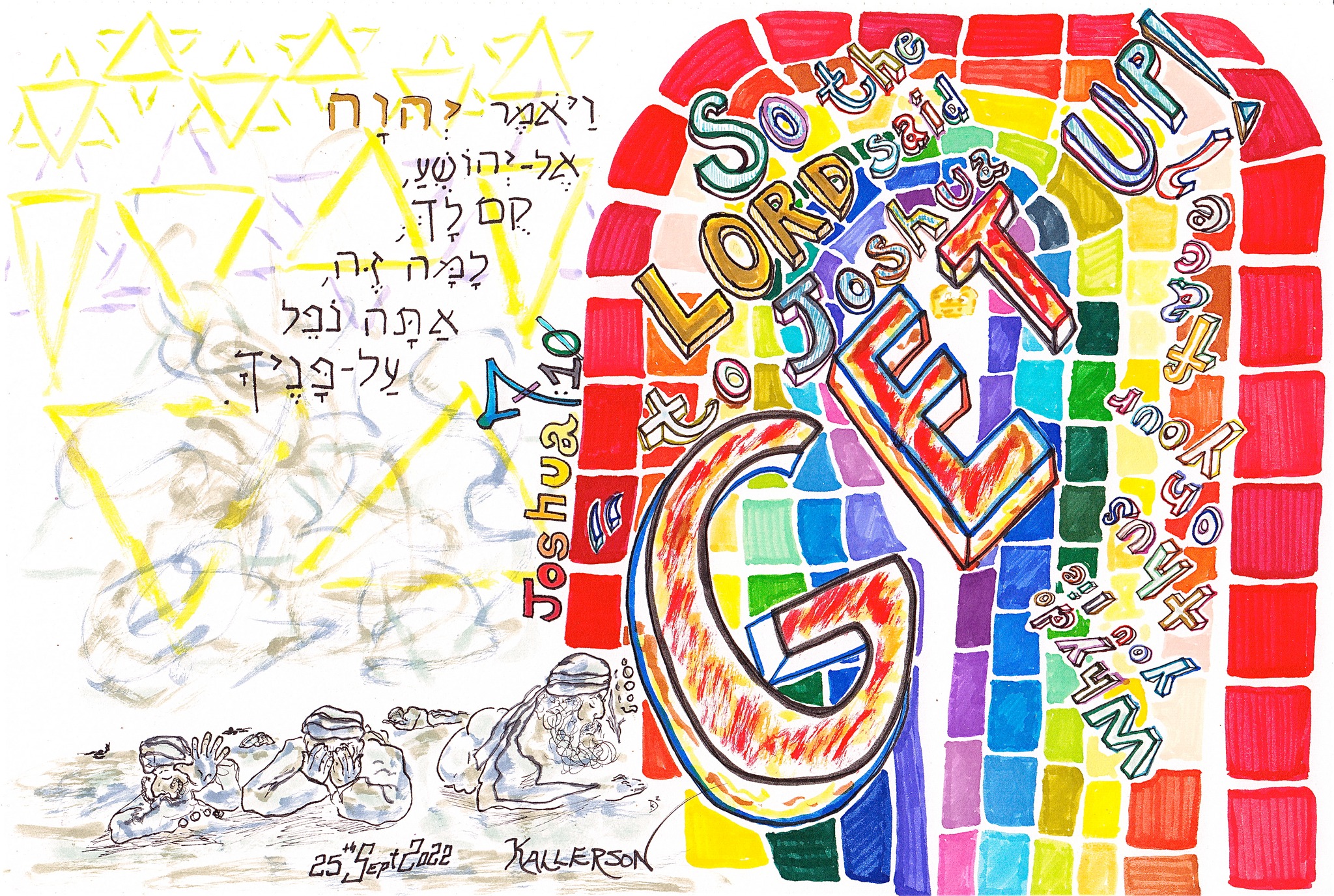
Artwork by Doug Kallerson.
Joshua 7:1-15
The Valley of Achor, Part I
In the verses today, it notes that the people of Israel had sinned. This is despite only one person having sinned. Regardless, the Lord turned away from them and allowed them to be struck down before their enemies.
In this, Adam Clarke wrote, “It is impossible that God should turn against his people, if they had not turned away from him.” This is an important point to consider, not only from a reading of the biblical history of the nation, but also from reading the extra-biblical state of them.
And the reason for this is that the extra-biblical history of Israel is actually not extra-biblical at all. The things that have come about in their history since their dispersion are spoken of in the Bible in great detail, carefully fulfilling what it said would happen.
Because of this, we can have every confidence that what is recorded about their future will come about as well. And there is a reason for this. That is because the Lord has covenanted with them and because His name rests upon them. The psalmist confirms that the two, the Lord and Israel, are united in this regard –
Text Verse: Do not keep silent, O God!
Do not hold Your peace,
And do not be still, O God!
2 For behold, Your enemies make a tumult;
And those who hate You have lifted up their head.” Psalm 83:1, 2
The psalmist identifies the enemies of Israel as the Lord’s enemies. This was true, and it remains true to this day. Even though the Lord has had Israel under the curses and punishments of the law, He has also carefully kept them as a people for exactly this reason.
What happens to them is a corporate thing because they are one people under His covenant. Nothing will ever separate them from Him because of this truth. As this is incontrovertible, it should give us every assurance that it is so with us, too. God has covenanted with each believer in Christ. That means that just as sure as Israel’s continued existence is, so is our salvation.
To avoid error, we need to not look at these things from our perspective. But this is just what we do. We look at failed marriages and say, “The covenant is broken,” and then we transfer that to Israel’s relationship with the Lord. And when we see Israel in that light, the natural thing is to look at our own covenant relationship in that light. “God has rejected Israel and so He will reject us. It is up to us, not Him, to see things through to the end.”
Instead of this, and instead of looking at everything from our own perspective, we need to remove ourselves from the equation and view things from God’s perspective. He does not fail, He does not make mistakes, and He will never go beyond His word.
His word is a reflection of who He is. If we can hold fast to that thought, we will not fall into such grievous errors in our thinking. The eternal nature of God’s decrees is one marvelous part of the treasure we can find in His superior word. And so, let us turn to that precious word once again and… May God speak to us through His word today, and may His glorious name ever be praised.
I. But the People Fled (verses 1-5)
But the children of Israel committed a trespass regarding the accursed things,
va’yimalu bene Yisrael maal ba’kherem – “And acted unfaithfully sons Israel – unfaithful in the anathema.” Both the verb and noun forms of the word maal are used here. It comes from a root meaning “to cover.” Thus, it signifies to act unfaithfully or treacherously, as if covering over or hiding a deed. It is to commit a trespass.
But notice that it says, “the children of Israel.” Even before any further charge is made, the entire congregation is noted as having acted unfaithfully. The corporate nature of the people is that which is immediately highlighted.
It is of note that the same word used here in the Greek translation, nosphizó, meaning to pilfer, is also used in Acts 5:2 in the account of Ananias and Sapphira. There, no corporate guilt is assigned because it was an offense of lying to the Holy Spirit, but the parallel between the two accounts is noteworthy.
For now, the corporate nature of the act is highlighted even though the treachery was found in only one man…
1 (con’t) for Achan the son of Carmi, the son of Zabdi, the son of Zerah, of the tribe of Judah,
The meaning of the name Achan is not readily determined. The closest known word comes from the Chaldean akhana, meaning a serpent. In 1 Chronicles 2:7, he is called Achar. That is based on a word used in Joshua 6:18 and which will be used again in verse 7:25. It means “to trouble.” Hence, he is the serpent who troubles; The serpent, the troubler; or The serpent of trouble.
He is noted as the son of Carmi. That is from the word kerem, or vineyard. Thus, he is “My Vineyard,” or “Vinedresser.” He, in turn, is the son of Zabdi. That is from the word zavad, to give. The “i” is either possessive, or it refers to the Lord, and so he is either Gift of Yehovah or My Gift.
Zabdi is the son of Zerah, that is from the word zarakh, to rise or come forth, as in the sun. Thus he is Dawning, Rising of Light, etc. And he was born to Judah meaning Praise, Praised, or Let Him (God) be Praised.
If this is an unbroken genealogy, and because it has been 256 years since Judah and Zerah went down to Egypt, it means that the fathers bore the children at an average of 50 or more years of age. Of this person, Achan, it says he…
1 (con’t) took of the accursed things;
It is singular: min ha’kherem – “from the anathema.” The entire city is as a whole. No part of it was to be taken for common use but was to be dedicated to the Lord either through destruction or removal to the treasury of the house of the Lord.
1 (con’t) so the anger of the Lord burned against the children of Israel.
va’yikhar aph Yehovah bivne Yisrael – “and burned nostril Yehovah in sons Israel.” The mental image is of the anger of the Lord being so great that He stands in the middle of the people while smoke and fire proceed from His nostrils, burning among them. This sets the tone for what next occurs…
2 Now Joshua sent men from Jericho to Ai,
va’yishlakh Yehoshua anashim mirikho ha’ay – “And sent Joshua men from Jericho the Ai.” The name of the city is always prefixed by an article: ha’ay, or “the Ai.” Ai means “Ruins” or “Heap of Ruins.” It was first mentioned in Genesis 12 –
“And he moved from there to the mountain east of Bethel, and he pitched his tent with Bethel on the west and Ai on the east; there he built an altar to the Lord and called on the name of the Lord.” Genesis 12:8
Thus it is The Ruins…
2 (con’t) which is beside Beth Aven, on the east side of Bethel,
asher im beith aven mi’qedem l’beith el – “which with house wickedness from east to house God.” Beth means “house.” Aven comes from aven meaning wickedness, trouble, vanity (meaning idols, which are vain), iniquity, and so on. And so it means something like “House of Wickedness.”
Bethel, or Beith el, means “House of God.” It was also first noted in Genesis 12:8 and was named that again by Jacob in Genesis 28:19 after he had his dream of a ladder ascending to heaven. In Hosea 4, 5, and 10, the prophet combines the two, calling Bethel where the calf of the northern tribes was set up Beth Aven.
2 (con’t) and spoke to them, saying, “Go up and spy out the country.”
va’yomer alehem lemor alu v’rag’lu eth ha’arets – “and said to them, to say, ‘Go up and reconnoiter the land.” The word regel means foot, and so they are to go out and “foot” the land, meaning reconnoiter.
2 (con’t) So the men went up and spied out Ai.
va’yaalu ha’anashim vay’rag’lu eth ha’ay – “And went up the men and reconnoitered – the Ai.” It is essentially the same command Joshua gave to the two men in Chapter 2 concerning checking out the land along with Jericho. However, this time it only says he sent men without giving any specific number.
3 And they returned to Joshua and said to him, “Do not let all the people go up,
The evaluation of Ai, based upon their search, is that this will be an easy defeat. First, they know the Lord is with them. Because of that, and because of the diminutive size of the city, it would be overkill to send a large force. Therefore, they say…
3 (con’t) but let about two or three thousand men go up and attack Ai.
k’alpayim ish o kishloshet alapim ish yaalu v’yaku eth ha’ay – “according to two thousand man or according to three thousand man let go up and strike the Ai.” The number is insignificant compared to the number of available fighting men.
The reason for this is that the total number in the city (Joshua 8:5) is said to be twelve thousand. Therefore, a fighting force of about three thousand would be all the city could hope to muster.
Other than their confidence in the Lord’s presence, it would be the height of presumption for Israel to go into battle with such a small force because the city would be fortified. Therefore, they would be fighting a comparable force while also trying to enter the city. The next words elevate that thought.
3 (con’t) Do not weary all the people there, for the people of Ai are few.”
al t’yaga shamah eth kal ha’am ki meat hemah – “Not do weary there all the people for few they.” Here is a new word, yaga. It is from a primitive root signifying to grasp. As such, it means to be exhausted, tire, toil, be weary, and so on. When one is tired, he will grasp onto something to hold himself up. This is the idea. It can be used in a physical or a mental sense. In Isaiah, it says –
“You have bought Me no sweet cane with money,
Nor have you satisfied Me with the fat of your sacrifices;
But you have burdened Me with your sins,
You have wearied [yaga] Me with your iniquities.” Isaiah 43:24
One can see the Lord saying, “Uggh. I’m just worn out by these people and their wickedness.” The men who checked out Ai feel that any more than a small force would be a waste, and the people would be wearied, meaning simply getting up and heading out to battle, for no reason at all. Therefore…
4 So about three thousand men went up there from the people, but they fled before the men of Ai.
It doesn’t yet speak of any men falling in battle. It simply says that Israel fled before the men of Ai. This heightens the sense of the loss of the battle. Israel was simply unable to muster an attack and it was apparent to them that the Lord was not with them, but had abandoned them to their own effort. Only after noting the disgrace of defeat are any of the particulars then noted…
5 And the men of Ai struck down about thirty-six men,
Using the word “about” makes no sense when a definite number is given: va’yaku mehem anshe ha’ay kiloshim v’shisha ish – “And struck from them men the Ai according to thirty and six men.” Thirty-six were killed. The number is derived from a multiple of nine and four. In the Bible, nine is the number of finality or judgment. Four is the number of material completeness, the world number, the city number.
5 (con’t) for they chased them from before the gate as far as Shebarim, and struck them down on the descent;
This is the only time that ha’shevarim, or “the Shevarim,” is mentioned in the Bible. It comes from shever which signifies a fracture as in a broken foot; also a breach, a crushing, destruction, or figuratively as ruin. It is surely not a location that bore the name previously.
Rather, the place is named because of what occurred. There was a breach in the ranks of Israel; they panicked and fled, and the ranks were then utterly broken at a particular spot – the Shebarim. From there, the men of Ai simply chased the retreating horde of Israel, striking them down as they descended.
What is hard to actually determine is whether there were only thirty-six killed, or – as the Greek translation seems to indicate – thirty-six were killed at first, and then all the rest were destroyed after that. Either way, the point is that it was evident the Lord was not with them in the battle…
5 (con’t) therefore the hearts of the people melted and became like water.
This is the penalty for the corporate sin of Israel. In Joshua 2 and Joshua 5, the same word, masas, or melt, was used concerning the people of the land. Now, that has been turned back on them –
“And as soon as we heard these things, our hearts melted; neither did there remain any more courage in anyone because of you, for the Lord your God, He is God in heaven above and on earth beneath.” Joshua 2:11
“So it was, when all the kings of the Amorites who were on the west side of the Jordan, and all the kings of the Canaanites who were by the sea, heard that the Lord had dried up the waters of the Jordan from before the children of Israel until we had crossed over, that their heart melted; and there was no spirit in them any longer because of the children of Israel.” Joshua 5:1
It is plainly evident that the Lord was not with Israel, and it is certain that confusion permeated the entire congregation as they pondered what this would mean for them.
Why, O Lord, has this come about?
What is it that has caused all this suffering?
What has happened has caused me to doubt
What is the source of this terrible thing?
Lord, we look to you and wait for a word
We long to know what has caused this trouble
When the answer is given, and we have heard
We will take action to correct it on the double
Lord, don’t let anything tarnish Your great name
Be with Israel and rescue us from this terrible state
Spread around the world Your glorious fame
Let the nations know that Your name alone is great
II. Distress, Humility, and Mourning (verses 6-15)
In response to the events that took place, Joshua goes through a series of outward displays reflecting his inner state, surely wondering how things could have gone from glorious to disastrous in such a short amount of time. First, it says…
6 Then Joshua tore his clothes,
Tearing one’s garments is less a sign of mourning than it is a sign of great distress. It is an outward display of the high emotions occurring within. One might say, “My heart was torn by what happened.” This is the sense of what is being conveyed. It is, therefore, why the Lord said this to the people in Joel –
“So rend your heart, and not your garments;
Return to the Lord your God,
For He is gracious and merciful,
Slow to anger, and of great kindness;
And He relents from doing harm.” Joel 2:13
The people were told that catastrophe was coming with the Day of the Lord. In this, there would be much tearing of their garments as the distress came upon them. But the Lord corrected them, noting that outward signs without the inward distress were ineffective. Therefore, they were to rend their hearts and turn to Him. Next…
6 (con’t) and fell to the earth on his face
To fall on one’s face is a demonstration of humility. It is what Abram did when the Lord appeared to him and changed his name to Abraham while promising to make His covenant with Him.
It is also what the people did when the Lord sent fire out to consume the burnt offering on the altar at the establishment of the priestly ministry in Leviticus 9. These, and many other such incidents relay to us the idea of humility from the person. Joshua did this…
6 (con’t) before the ark of the Lord until evening,
Whether the ark was in the Most Holy Place or not, the intent of the words is that Joshua lay prostrate before the presence of the Lord, indicated by the presence of the ark, until the evening, meaning when the day had expired. And more, it says…
6 (con’t) he and the elders of Israel;
It is obvious that he called the leaders together for this outward display of distress, humility, and also of mourning…
6 (con’t) and they put dust on their heads.
This is a sign of distress, humility, and mourning all tied up in one. The idea goes back to the earliest pages of Genesis. Man was formed from the dust of the earth (Genesis 2:7). As such, it is an acknowledgment of the Lord’s creation of, and sovereignty over, humanity. Therefore, to put dust on one’s head is a sign of humility before the Creator.
It is a sign of mourning because of what the curse upon the man from Genesis 3 means –
“In the sweat of your face you shall eat bread
Till you return to the ground,
For out of it you were taken;
For dust you are,
And to dust you shall return.” Genesis 3:19
Man’s lot is to return to the dust. Joshua and the elders were certainly mourning for those who were lost, but the mourning extends to all humanity who must come to the same end. Joshua, not knowing why they have been defeated, felt the onrush of that for himself and all of Israel, anticipating that one defeat meant total defeat unless the Lord would again be with them.
Dust on the head is also a sign of distress because of what the curse upon the serpent from Genesis 3 signifies –
“Because you have done this,
You are cursed more than all cattle,
And more than every beast of the field;
On your belly you shall go,
And you shall eat dust
All the days of your life.” Genesis 3:14
The serpent would dine upon the unredeemed of the world as their bodies decayed and turned back to dust. Joshua and the elders are showing their distress that the Lord may have abandoned them permanently. If so, instead of victory in Messiah, Israel would find defeat in the devil. That comes forth clearly in the next words…
7 And Joshua said, “Alas, Lord God,
va’yomer Yehoshua ahah Adonay Yehovah – “And said Joshua, “Ah, Adonai Yehovah.” The interjection ahah, meaning Oh!, Ah!, or Alas! is introduced here. It is a word that extends beyond surprise to a state of woeful shock, such as when Jephthah saw his daughter coming out of the house and he realized that he would then have to sacrifice her as a burnt offering based on a hasty vow he had made to the Lord.
Along with this word, Joshua combines the word Adonai – a reference to the Lord Yehovah as his sovereign master – and also the proper name of Yehovah. The entire phrase then shouts out great distress, saying…
7 (con’t) why have You brought this people over the Jordan at all
The words bear a particular emphasis: lama heavarta haavir eth ha’am ha’zeh eth ha’yarden – “Why bringing over you brought over (at all!) the people, the this, the Jordan?”
This appears less like a lack of faith in the Lord than complete bewilderment of what the purposes of the Lord are. Israel was told they would conquer the land and possess it. But suddenly there is a defeat that should not have taken place with no discernible reason for it. He simply cannot fathom what would cause this to transpire. But it did, and it, therefore, appears that the intent is…
7 (con’t) —to deliver us into the hand of the Amorites, to destroy us?
Joshua mentions the Amorite (it is singular), meaning Renown, specifically because they had defeated the Amorites Sihon and Og on the other side of the Jordan. If this small city of Ai could prevail against Israel, then the Amorites who were certainly bent on revenge would tear through them without restraint, totally destroying them.
Joshua appears to think that what has occurred is actually by design and that it must be based on a previously undisclosed failing prior to their entry into Canaan. Therefore, he says…
7 (con’t) Oh, that we had been content, and dwelt on the other side of the Jordan!
v’lu hoalnu va’neshev b’ever ha’yarden – “And O! We had been content and we stayed in side the Jordan.” The land on the other side had been subdued. For whatever reason, the Lord was displeased with Israel and Joshua thinks it must have something to do with their crossing over.
It doesn’t appear, at all, that he has considered that something has happened since then, especially when Jericho was such a great victory. With that said, Joshua questions the Lord concerning their conduct…
8 O Lord, what shall I say when Israel turns its back before its enemies?
Rather, the words refer to Israel collectively – biy Adonai mah omar akhare asher haphak Yisrael oreph lipne oyevav – “Oh, Adonai, what I say after which turns Israel his neck before his enemies.”
Israel, collectively, had transgressed. Joshua doesn’t know this yet, but Israel had turned his neck before his enemies. Joshua both knows and understands this. As Israel is the people of Yehovah, he is utterly confused as to what will come of this…
9 For the Canaanites and all the inhabitants of the land will hear it, and surround us, and cut off our name from the earth.
Again, it is singular – the Canaanite. Joshua notes that they and all of the other people groups will hear of what has transpired. When that happens, they will immediately take the initiative and come after the entire nation of Israel and utterly destroy them, cutting off their name. If that is to happen, and because Israel is the bearer of the name of Yehovah…
9 (con’t) Then what will You do for Your great name?”
Joshua has inextricably tied the name of Israel to the name of the Lord. This is because the Lord has already inextricably tied His name to that of Israel. This was clearly seen in our text verse when the psalmist equated attacking Israel as an attack against God.
If what Joshua says is not turned around, these nations will align and come to destroy Israel and thus end the name of the Lord. It is what Psalm 83 conveys about the people’s surrounding them later in their history –
“They have taken crafty counsel against Your people,
And consulted together against Your sheltered ones.
4 They have said, “Come, and let us cut them off from being a nation,
That the name of Israel may be remembered no more.”
5 For they have consulted together with one consent;
They form a confederacy against You:
6 The tents of Edom and the Ishmaelites;
Moab and the Hagrites;
7 Gebal, Ammon, and Amalek;
Philistia with the inhabitants of Tyre;
8 Assyria also has joined with them;
They have helped the children of Lot. Selah” Psalm 83:3-8
With this seen and noted, the Lord now responds to Joshua…
10 So the Lord said to Joshua: “Get up! Why do you lie thus on your face?
It must be remembered that Joshua and the elders had lain prostrate before the Lord until evening. It is not known how long that time was, be it 45 minutes or four and one-half hours. It is now the start of the new day. And so imperative words follow, demanding action.
Further, the word “you” is emphatic: qum lakh lamah zeh atah nophel al panekha – “Arise to you! Why this YOU falling upon your face?” Joshua is the leader of the people, and the people now require their leader to act because…
11 Israel has sinned,
khata Yisrael – “Has sinned Israel.” The collective nature of what occurred is highlighted here. It is as if every person in the nation was guilty of actively doing what only one person had done. That is clear with the next five clauses where the plural is used – they, they, they, they, they. They all have done it and they all are now under the ban.
11 (con’t) and they have also transgressed My covenant which I commanded them. For they have even taken some of the accursed things, and have both stolen and deceived; and they have also put it among their own stuff.
The entire verse is one clause of accusation after another, producing a strong and poignant emphasis. After the first clause, the word v’gam, or “and also,” begins each clause which is followed by a plural verb: v’gam averu; v’gam laqehu; v’gam ganevu; v’gam kikhashu; v’gam samu – “and also they have transgressed; and also they have taken; and also they have stolen; and also they have deceived; and also they have put.
The collective nature of each clause is highlighted by the plural. Joshua surely understands the collective meaning and accepts it as such, even if he doesn’t know yet what has transpired. This is because Jericho was to be anathema as he conveyed quite clearly to the people –
“And you, by all means abstain from the accursed things, lest you become accursed when you take of the accursed things, and make the camp of Israel a curse, and trouble it.” Joshua 6:18
Because of the actions of one or more people, pilfering that which belonged to the Lord, the entire nation had now become anathema, as the Lord next says…
12 Therefore the children of Israel could not stand before their enemies,
The invasion was a small number of soldiers, but it could just as easily have been the entire army. The Lord had, only a short time before, expressed this to them in the Song of Moses –
“How could one chase a thousand,
And two put ten thousand to flight,
Unless their Rock had sold them,
And the Lord had surrendered them?” Deuteronomy 32:30
The Lord had sold them, and He had surrendered them. They could not stand before even a small city…
12 (con’t) but turned their backs before their enemies,
The words are short and concise and show the collective nature of what happened: oreph yiphnu liphne oyevehem – “neck (sg.) they turn before their enemies. And this is…
12 (con’t) because they have become doomed to destruction.
ki hayu l’kherem – “because they have become to anathema.” In taking that which is anathema, or devoted, they have become devoted. What happened to the soldiers, be it thirty-six or all three thousand, was the just penalty for them and indeed for the entire nation, as the Lord says…
12 (con’t) Neither will I be with you anymore, unless you destroy the accursed from among you.
The word shamad, destroy, is used here. Joshua knows that this is referring to not only the thing that was anathema but the person who is now anathema as well. But depending on who it is, that may extend further. At this time, he is unaware of the extent of it.
This word, shamad, is translated as exairó, or eject, in the Greek translation. It is used only once in the New Testament, and it is probable that Paul was thinking of exactly this passage from Joshua when he wrote his instructions to those in Corinth concerning the man who was having his father’s wife –
“But those who are outside God judges. Therefore ‘put away from yourselves the evil person.’” 1 Corinthians 5:13
Evil is an infection that must be dealt with at all times and in all situations. As for Joshua, he is now told what he must do…
13 Get up, sanctify the people, and say, ‘Sanctify yourselves for tomorrow, because thus says the Lord God of Israel: “There is an accursed thing in your midst, O Israel;
The Lord repeats the same thought as in verse 10, “Get up!” He is to not only arise from lying prostrate but to also arise to the task at hand. This task is to have the people sanctify themselves (pl.) because there is “an accursed thing in your (sg.) midst, O Israel.”
They are many who must sanctify themselves individually, but they are one because they are collectively anathema. As such, they are to prepare themselves l’makhar, or “to tomorrow.” If the sun has set, this means the same day, but after the rising of the sun.
13 (con’t) you cannot stand before your enemies until you take away the accursed thing from among you.”
The meaning is clear. They will be pushed back and destroyed until the anathema is removed from their midst. The proof of that has already been handed to them in the day’s defeat. That would continue, unabated, unless the necessary action is taken. And so…
14 In the morning therefore you shall be brought according to your tribes. And it shall be that the tribe which the Lord takes shall come according to families; and the family which the Lord takes shall come by households; and the household which the Lord takes shall come man by man.
The speculation on how this was conducted is extensive. Some argue it was determined by lots. Others demand that this could not be the case and it was rather determined by the Urim and Thummim.
If the manner in which it took place was important, we would have been told what was done. But that is not where the focus is. Rather, it is on the fact that the Lord already knows who the offender is, and there is a process by which the man will be singled out.
Which, incidentally, now tells Joshua that there is a single offender who has brought all of this trouble upon the nation. When he is identified, bad news lies ahead for him…
15 Then it shall be that he who is taken with the accursed thing shall be burned with fire,
A verb is used as a noun. More rightly it says, “And it shall be the taken, in the anathema, shall be burned in the fire.” The one whom the Lord identifies was to be burned, but that is not the entirety of the matter…
15 (con’t) he and all that he has,
Because he is anathema, he must be totally destroyed. If he has possessions, they are to be destroyed too. And if he has a family, his entire family was to be destroyed. Just as it was with Jericho, there was to be no leniency on anything or anyone belonging to him.
The law recorded in Deuteronomy 24:16 does not apply here. There it said, “Fathers shall not be put to death for their children, nor shall children be put to death for their fathers; a person shall be put to death for his own sin.”
That is referring to a person receiving the penalty of death under the covenant. The law of kherem, or anathema, means that the man and all that he comprises (including his family under his authority) are subject to the ban, without exception.
This would have made for a really sleepless night for the offender if he knew what the Lord said to Joshua, especially if he was a family man. All was anathema…
15 (con’t) because he has transgressed the covenant of the Lord,
ki avar eth b’rith Yehovah – “because he has crossed over covenant Yehovah.” This is more than a violation of the covenant but causing oneself to be taken out of the covenant graces altogether. To cross over the covenant is to remove oneself from it. This is what this man has done and his life and all that he has is now anathema…
*15 (fin) and because he has done a disgraceful thing in Israel.’”
The word nevalah is used. It is not just something disgraceful, but it is senseless in the extreme. It is a disregard for that which is moral, and it exemplifies foolishness.
A word in the New Testament that might be close is moros or foolish. It is equivalent to our modern word moron. However, Paul turns the moronic around and uses the word in a surprising way saying that as Christians, we must become foolish when we think we are wise (1 Corinthians 3:18), and that the apostles are fools for Christ’s sake (1 Corinthians 4:10). The word nevalah is never used that way in the Old Testament.
Such a person in the Old Testament has committed a moral violation that is deserving of whatever comes his way in regard to punishment. The one identified in the morning would get exactly what his moral state deserved.
This is a good point on which to end our thoughts today. The suspense is high and that will keep us until the next time we meet. But it is also a good point to make a comparison to what Paul did by turning around the moronic in his epistles.
This is what the gospel does, it turns things around. The law brings death; the gospel brings life. The law was exclusive, belonging only to Israel. The gospel is inclusive of all peoples. The law demanded rigidity of worship. The gospel gives freedom of worship. The law brought about fear to those who understood its constraints. The gospel brings about confidence to those who understand its liberties.
Where the man who is to be identified was to be removed from the people and burned to death, finding only earthly condemnation, the man who was identified for wrongdoing in 1 Corinthians 5 was to be removed for the destruction of his flesh, but also for the saving of his soul.
Everything about what God offers in Christ is not only better than what is faced under the law, it is infinitely better. Where the law has an end, the gospel starts immediately now for those who come to Christ, and it goes on for eternity.
Don’t miss out on what Christ has done. Come to Him and find peace with God and rest from your labors. Come to Christ and find pardon from your sin. Be sure to not wait. Come to Christ Jesus today.
Closing Verse: “In the name of our Lord Jesus Christ, when you are gathered together, along with my spirit, with the power of our Lord Jesus Christ, 5 deliver such a one to Satan for the destruction of the flesh, that his spirit may be saved in the day of the Lord Jesus.” 1 Corinthians 4:4, 5
Next Week: Joshua 7:16-26 After getting stoned, the penalty adds even more, sad but true… (The Valley of Achor, Part II) (14th Joshua Sermon)
The Lord has you exactly where He wants you. He has a good plan and purpose for you. It is He who has defeated the enemy and who now offers His people rest. So, follow Him and trust Him and He will do marvelous things for you and through you.
The Valley of Achor, Part I
But the children of Israel committed a trespass regarding
———-the accursed things
For Achan the son of Carmi, the son of Zabdi, the son of Zerah
———-as the account does tell
Of the tribe of Judah, took of the accursed things
So the anger of the Lord burned against the children of Israel
Now Joshua sent men from Jericho to Ai
Which is beside Beth Aven, on Bethel’s east side
And spoke to them, saying, “Go up and spy out the country
So the men went up and Ai they spied
And they returned to Joshua and said to him
“Do not let all the people go up, there is no need to
But let about two or three thousand men go up and attack Ai
Do not weary all the people there, for the people of Ai are few
So about three thousand men from the people went up
But they fled before the men of Ai like wine from a trembly cup
And the men of Ai struck down about thirty-six men
For they chased them from before the gate as far as Shebarim
And struck them down on the descent
Therefore the hearts of the people melted, becoming like water
———-it would seem
Then Joshua tore his clothes
And fell to the earth on his face until evening before
———-the ark of the Lord
He and the elders of Israel
And they put dust on their heads all with one accord
And Joshua said, “Alas, Lord God
Why have You brought this people over the Jordan at all
———-to deliver us,” he cried
“Into the hand of the Amorites, to destroy us?
“Oh, that we had been content, and dwelt on Jordan’s other side
“O Lord, what shall I say about this attack
When Israel before its enemies turns its back?
“For the Canaanites and all the inhabitants of the land
Will hear it and surround us. What a shame!
And cut off our name from the earth
Then what will You do for Your great name?
So the Lord said to Joshua: “Get up from that place!
Why do you lie thus on your face?
“Israel has sinned, and they have also transgressed My covenant
———-which I commanded them
For they have even taken some of the accursed things
———-as if their blessings were not enough
And they have both stolen and deceived
And they have also put it among their own stuff
“Therefore the children of Israel could not stand
———-before their enemies
But turned their backs before their enemies, sad but true
Because they have become doomed to destruction
Neither will I be with you anymore, unless you destroy
———-the accursed from among you
“Get up, sanctify the people, and say, ‘Sanctify yourselves
For tomorrow, because thus says the Lord God of Israel:
“There is an accursed thing in your midst, O Israel
You cannot stand before your enemies, for you it will not go well
Until you take away – Hear Me, My word is true!
The accursed thing from among you
“In the morning therefore you shall be brought
———-according to your tribes
And it shall be that the tribe which the Lord takes shall come
———-according to families, this is the plan
And the family which the Lord takes shall come by households
And the household which the Lord takes shall come man by man
“Then it shall be that he who is taken with the accursed thing
Shall be burned with fire, he and all that he has, a burning hell
Because he has transgressed the covenant of the Lord
And because he has done a disgraceful thing in Israel
Lord God, turn our hearts to be obedient to Your word
Give us wisdom to be ever faithful to You
May we carefully heed each thing we have heard
Yes, Lord God may our hearts be faithful and true
And we shall be content and satisfied in You alone
We will follow You as we sing our songs of praise
Hallelujah to You; to us Your path You have shown
Hallelujah we shall sing to You for all of our days
Hallelujah and Amen…
But the children of Israel committed a trespass regarding the accursed things, for Achan the son of Carmi, the son of Zabdi, the son of Zerah, of the tribe of Judah, took of the accursed things; so the anger of the Lord burned against the children of Israel.
2 Now Joshua sent men from Jericho to Ai, which is beside Beth Aven, on the east side of Bethel, and spoke to them, saying, “Go up and spy out the country.” So the men went up and spied out Ai. 3 And they returned to Joshua and said to him, “Do not let all the people go up, but let about two or three thousand men go up and attack Ai. Do not weary all the people there, for the people of Ai are few.” 4 So about three thousand men went up there from the people, but they fled before the men of Ai. 5 And the men of Ai struck down about thirty-six men, for they chased them from before the gate as far as Shebarim, and struck them down on the descent; therefore the hearts of the people melted and became like water.
6 Then Joshua tore his clothes, and fell to the earth on his face before the ark of the Lord until evening, he and the elders of Israel; and they put dust on their heads. 7 And Joshua said, “Alas, Lord God, why have You brought this people over the Jordan at all—to deliver us into the hand of the Amorites, to destroy us? Oh, that we had been content, and dwelt on the other side of the Jordan! 8 O Lord, what shall I say when Israel turns its back before its enemies? 9 For the Canaanites and all the inhabitants of the land will hear it, and surround us, and cut off our name from the earth. Then what will You do for Your great name?”
10 So the Lord said to Joshua: “Get up! Why do you lie thus on your face? 11 Israel has sinned, and they have also transgressed My covenant which I commanded them. For they have even taken some of the accursed things, and have both stolen and deceived; and they have also put it among their own stuff. 12 Therefore the children of Israel could not stand before their enemies, but turned their backs before their enemies, because they have become doomed to destruction. Neither will I be with you anymore, unless you destroy the accursed from among you. 13 Get up, sanctify the people, and say, ‘Sanctify yourselves for tomorrow, because thus says the Lord God of Israel: “There is an accursed thing in your midst, O Israel; you cannot stand before your enemies until you take away the accursed thing from among you.” 14 In the morning therefore you shall be brought according to your tribes. And it shall be that the tribe which the Lord takes shall come according to families; and the family which the Lord takes shall come by households; and the household which the Lord takes shall come man by man. 15 Then it shall be that he who is taken with the accursed thing shall be burned with fire, he and all that he has, because he has transgressed the covenant of the Lord, and because he has done a disgraceful thing in Israel.’”