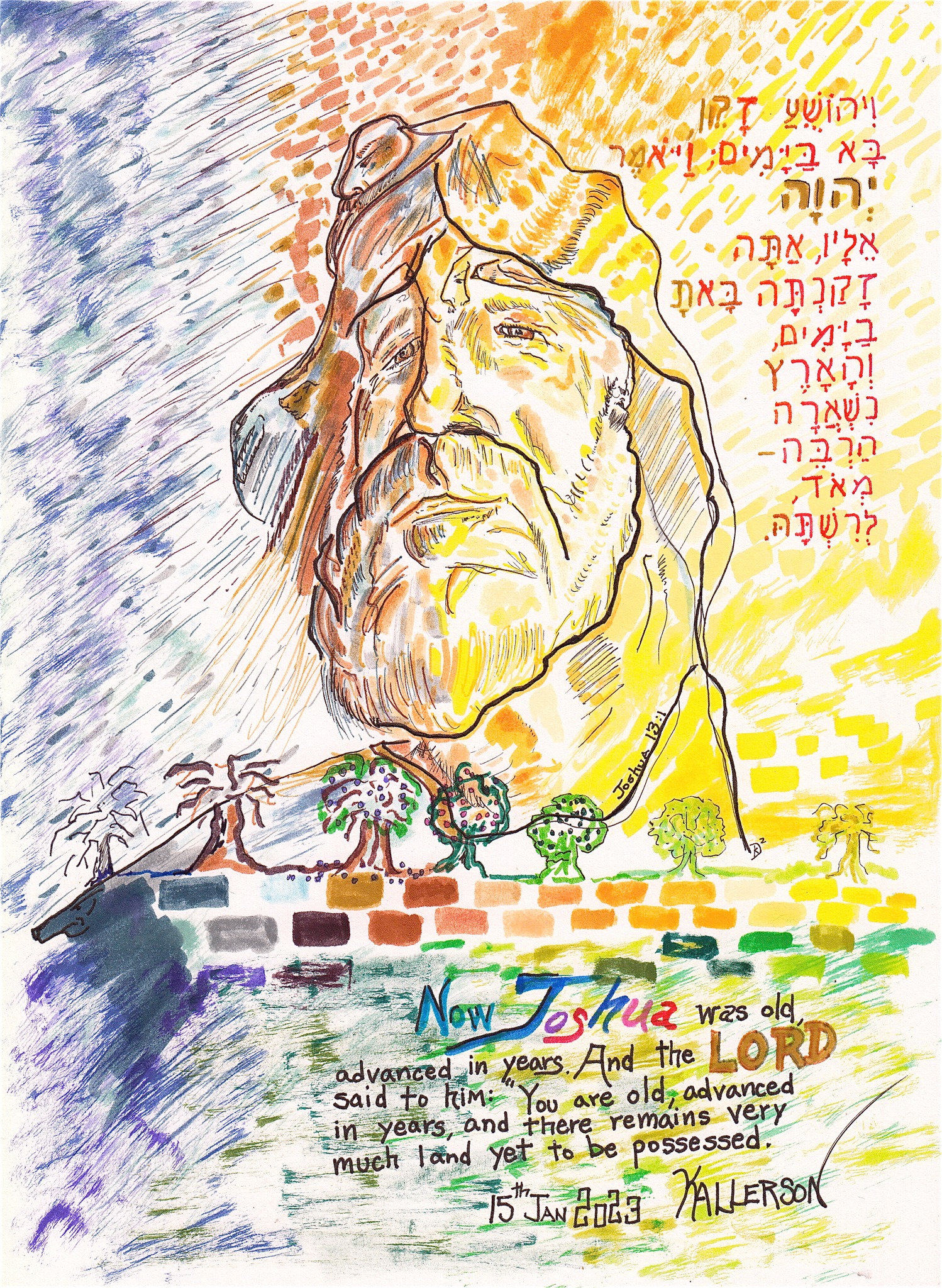
Artwork by Douglas Kallerson.
Joshua 13:1-14
Now Therefore, Divide This Land
Of the words of Joshua, Arthur Stanley, from his book Sinai and Palestine in Connection With Their History, dated 1883, says –
“There is one document in the Hebrew Scriptures to which probably no parallel exists in the topographical records of any other ancient nation. In the Book of Joshua we have what may without offence be termed the [Doomsday] Book of the conquest of Canaan. Ten chapters of that Book are devoted to a description of the country, in which not only are its general features and boundaries carefully laid down, but the names and situations of its towns and villages enumerated with a precision of geographical terms which encourages and almost compels a minute investigation.”
In other words, because of the precision of what is stated in the chapters detailing the land of Israel, it begs the naysayer of Scripture to prove it wrong. There isn’t just a smattering of detailed information, but an overwhelming amount of it.
And it is so comprehensive and precise that either the author knew exactly what he was writing so that anyone at any time could pinpoint the locations with a bit of effort, or it is a completely flawed description of the markings and borders he has laid out.
As time has marched on and things have been buried or removed, some locations may be harder to pinpoint, but there is enough of what is written that can be substantiated, even 3000+ years later, that the correctness of the other locations when they were written down is assured.
As we go through the verses today, we’ll see that many of these names were not only written down once, but several times. And they were not just written down by being copied one account from another. Rather, they were written down in a way that would ensure that any disputes about the details could be resolved by a review of the details of a secondary account.
Text Verse: “Then He said to them, ‘O foolish ones, and slow of heart to believe in all that the prophets have spoken! 26 Ought not the Christ to have suffered these things and to enter into His glory?’ 27 And beginning at Moses and all the Prophets, He expounded to them in all the Scriptures the things concerning Himself.” Luke 24:25-27
The reliability of Old Testament Scripture is put to the test even in the New Testament. Again and again, the word “Scripture” is cited by Jesus or the apostles when referring to the Old Testament. At other times, Jesus or an apostle will simply make a point from Scripture, such as –
“For as in the days before the flood, they were eating and drinking, marrying and giving in marriage, until the day that Noah entered the ark, 39 and did not know until the flood came and took them all away, so also will the coming of the Son of Man be.” Matthew 24: 38, 39
Jesus presents the flood as a literal occurrence. He speaks of Abel as a literal human. If there was an Abel, then there was an Adam who begot Abel. Jesus tells us that Moses (meaning the Torah, the five books of Moses) and the prophets speak of Him. The entire Bible, the word of God, calls forth with the words, “Test me! See if I am what I have presented.” If we do test it, we will be assured of its veracity.
As for the contents of our passage, Charles Ellicott makes a marvelous point about those who claim the books of Moses and Joshua were actually penned at a much later date. If that were so, there would be some real inconsistencies of thought. Using the law as his example, he says –
“We are also able to understand more clearly why so much stress was laid upon the necessity of adherence to the Book of the Law in Joshua’s commission (Joshua 1:6-8). The fact that these rules are not what human nature would be at all disposed to obey continuously and as a matter of set practice (have they ever been observed yet in any conquest recorded in history?) is worth noting, as a proof of the undesigned veracity of the story. It is a mark of thorough consistency between the law and the history of Israel. And if the authorship of Deuteronomy belonged to the late date which some claim for it, how could we account for the insertion of a law which was never kept, and could not be kept at the time when some suppose it was written? From the days of Solomon and thenceforward, the relation of the remnant of the conquered Canaanites to Israel was fixed. The Phœnicians and Philistines maintained a separate national existence to the last.”
His point is well stated. If these things were written much later, even as late as 300BC as so many claim, it would make no sense to include items which proved a total failure on Israel’s part. This might be the case in a fictional story, but it would never be the case in writings that claimed to be historical, accurate, and indeed holy.
Trust the word, even if you don’t always understand it. When the Bible says there was a city, a well, or an altar in a certain spot, you can bet that someone will go there, pull out his spade, and hear the tink of the metal hitting rock which is what he was looking for. It has happened innumerable times in history, and it continues to occur regularly today.
Archaeology is only one of a host of sciences that validates the pages of Scripture. Evolution schmevoltion. I don’t have enough faith to believe we evolved, and neither should you. There is not one bone on the planet that has yet proved that inane “theory,” which is – by the way – why it is still called a “theory.” Trust the word of God. It is, after all, God’s word.
And great things are always to be found in His superior word. And so, let us turn to that precious word once again, and… May God speak to us through His word today, and may His glorious name ever be praised.
I. This Is the Land That Yet Remains (verses 1-7)
1 Now Joshua was old, advanced in years.
This is more a paraphrase. The Hebrew says: vihoshua zaqen ba ba’yamim – “And Joshua old, entering in the days.” Despite being a type of the Lord, Joshua was also a man, a historical figure, who led Israel, but who also aged and eventually died. However, the events of his life are used to convey truths about the work of the Lord and the ongoing story of redemptive history.
1 (con’t) And the Lord said to him:
There are times in the narrative that the Lord obviously spoke to Joshua personally, such as during the battle of Ai when He instructed Joshua to act in the heat of battle. Whether this is the case now, or whether the Lord speaks to him through a prophet, priest, or some other way is not recorded. But the Lord does speak to him…
1 (con’t) “You are old, advanced in years,
atah zaqantah bata ba’yamim – “You old, entering in the days.” There are things to consider about these words. Joshua isn’t nearly as old as Moses was at the time of his death. It is likely that Joshua was around a hundred years old.
Moses was one hundred and twenty when he died and “his eyes were not dim nor his natural vigor diminished.” Despite being aged, he was not “old.” On the other hand, Joshua will die at the same age Joseph did, one hundred and ten (Joshua 24:29). Some years before that, he is already considered as “old.”
Therefore, being old is not so much dependent on the actual number of years a person lives, but the state of the person at any given time. In 1 Kings 1:15, it says that David was “very old,” and yet he was only about seventy when he died.
The state of Joshua demands that certain things must be done. The conquests he made have established a foothold in the land that is great enough so that it can be divided among the tribes. And yet, there are many people groups that have not yet been subdued in the land; some never will be.
Despite this, the instructions found in the law intended for the land to be solely the possession of Israel. Therefore, the division of the land, even before it is wholly subdued, now falls to Joshua…
1 (con’t) and there remains very much land yet to be possessed.
v’ha’arets nisharah harbeh meod l’rishtah – “and the land left much, very, to possess.” Despite his great successes in the many conquests he led, a significant amount of land remained outside of the control of Israel. This is unlike the land east of the Jordan which was wholly subdued under Moses.
It is a marvelous parallel to the state of things for those who come to Christ. In Him, the inheritance is secured because of Christ’s fulfillment and ending of the law. And yet, there are battles to be won and enemies to be subdued after coming to Him.
There is no contradiction in this at all. It is exactly how the New Testament portrays the state of things. There is total victory and assured salvation in Christ, and yet there is a constant war being waged against those who are in Christ.
Anyone who doesn’t get this either feels he must earn his salvation (Christ’s victory was not total), which is impossible to do, or he feels he can lose his salvation (the struggles of life in Christ can overcome what He has done), which is likewise impossible.
As for the literal history of Israel’s unconquered land…
2 This is the land that yet remains:
zot ha’arets ha’nishareth – “This the land, the remaining.” This clause introduces what will be said through verse 7. As such, this is a parenthetical thought which terminates with the words of verse 7 –
2: This is the land
2-6: Naming the land.
7: Now therefore, divide this land.
2 (con’t) all the territory of the Philistines and all that of the Geshurites,
kal g’liloth ha’p’lishtim v’kal ha’geshuri – “all circles the Philistines and all the Geshuri.” A new word is introduced here, gelilah. It comes from galal, meaning to roll. Thus, it is a region, like a circle, as if encircled by borders.
As for the people groups, the name Philistine comes from, palash, signifying to roll in the dust as an act of mourning. They are the Grievers. The name Geshur comes from an unused root meaning to join. Thus, it may mean Bridge.
Some think that these from Geshur are the same as those mentioned in Joshua 12:5, being in the northeast area of Canaan. Others think they may be the same people group, but a portion of them settled in the south. That seems more likely for two reasons.
The first is that the Geshuri is mentioned in 1 Samuel 27:8 and it is clearly in the southern area of Canaan. Also, it is because the region of these groups is next described. That region is…
3 from Sihor, which is east of Egypt,
min ha’sikhor asher al pene mitsraim – “from the Sikhor which upon face Egypt.” The Sikhor probably derives its name from shakhar, to be black. If so, it is a dark, turbid river. It is The Turbid. This is the same river known as the Wadi of Egypt in Joshua 15:4. Today, it is known as the Wadi el Arish that flows into the Mediterranean Sea from the Sinai Peninsula. The border goes…
3 (con’t) as far as the border of Ekron northward
v’ad gebul eqron tsaphonah – “and unto border Ekron northward.” Ekron comes from aqar, to pluck up or uproot. But that is from the same as eqer, an offshoot or descendant. Hence, the name could mean either Offshoot or Uprooted. Zephaniah will make a play on the name later in Scripture, saying, “Ekron shall be Uprooted” (Zephaniah 2:4).
Ekron is the most northern of the five cities of the Philistines.
3 (con’t) (which is counted as Canaanite);
la’kenaani tekhashev – “to the Canaanite reckoned.” The words could be referring to the previous clause when speaking of Ekron. However, it is more likely tied to the next clauses. This would mean that the named people groups are regarded as Canaanites, even if they are not specifically descendants of Canaan. In other words, they are subject to conquest. They are…
3 (con’t) the five lords of the Philistines—
khameshet sarne p’lishtim – “five lords Philistines.” The word seren is introduced here. It signifies a lord, but also an axle. Hence, the word may indicate the lord is the central point upon which the city turns. These five lords, plus one people group, are…
3 (con’t) the Gazites, the Ashdodites, the Ashkelonites, the Gittites, and the Ekronites; also the Avites;
The names are all in the singular, not the plural. And the word “also” is not in the text. As for their names, Gaza (Azah) means Strong. Ashdod means Ravager. Ashkelon comes from shaqal, to weigh, as in weighing money. Hence it is the Market. Gath means Winepress. Ekron was named in the previous verse. These are the five groups of Philistines.
Along with them are named the Avites. Their name comes from avah, to bend or twist, but also a distortion or ruin, or even perversity or moral evil. They may be the Ruiners, but I would think the name could extend to Mischief-makers. They are included here because of what is said in Deuteronomy 2:23 –
“And the Avim, who dwelt in villages as far as Gaza—the Caphtorim, who came from Caphtor, destroyed them and dwelt in their place.”
Apparently, they continued to exist in limited number even if mostly destroyed and driven out. The details continue with…
4 from the south, all the land of the Canaanites,
The actual division of the verses is debated. Some place the words. “from the south” with the previous clause. Some place them with the words following. The Greek, instead of saying mi’teman, or “from the South,” says “from Teman,” which is the proper name of a location belonging to Edom.
No matter which, it immediately follows with the land of the Canaanites. That extends northward…
4 (con’t) and Mearah that belongs to the Sidonians as far as Aphek, to the border of the Amorites;
u-m’arah asher la’tsidonim ad apheqah ad gebul ha’emori – “and Mearah which to the Sidonians unto Aphek unto border the Amorite.” Mearah means Cave. It is a region with a cave near Lebanon. Several possible sites have been suggested.
Sidon comes from tsud, to hunt. Thus, it is Hunting Place. As it is on the coast, it means to hunt fish and thus Fishery. Aphek comes from aphaq, meaning to hold or to be strong, and so it means Fortress. And Amorite signifies Renown.
The idea here is all of the area of the Canaanites from Ekron north to Sidon and then eastward to Aphek which may be the northern area of Bashan, and which extends to the area of Mount Hermon. However, there are at least three different locations known as Aphek, and so this is a bit of guesswork.
5 the land of the Gebalites, and all Lebanon, toward the sunrise, from Baal Gad below Mount Hermon as far as the entrance to Hamath;
Depending on the root word, Gebal means either Boundary or Hill of God. Lebanon means White One or even Mountain of Snow. Baal Gad means Lord of Fortune with a secondary meaning of Lord of the Invasion. Hermon means Sacred. Hamath means Defense or Citadel.
Gebal is also known as Byblos and is a city on the Mediterranean north of Sidon (even north of Beirut), It is seen in 1 Kings 5:18 and Ezekiel 29:9. The borders mentioned go eastward and extend to Mount Hermon and even northward to Hamath, which was the northern location spied out by the twelve spies in Numbers 13. It was recorded as the northern border in Numbers 34.
6 all the inhabitants of the mountains from Lebanon as far as the Brook Misrephoth, and all the Sidonians—
The Brook Misrephoth, or Misrephoth Mayim, means Burning of Waters. It was seen in Joshua 11:8. This explains the people who live in those areas. It is inclusive of the Sidonians and Phoenicians. What is said about all these people and the named locations is, obviously, conditional.
These areas were never fully cleansed of the inhabitants, even if they were controlled by Israel such as during the time of David and Solomon. Therefore, what the Lord next says is only assured if Israel itself acted…
6 (con’t) them I will drive out from before the children of Israel;
It is emphatic and it refers to all of the peoples and places mentioned since verse 2, “I will drive them out.” The Lord promises to do so, but Ellicott is right in how he presents it, saying, “…the promise of driving them out from before the children of Israel, supposes that the Israelites must use their own endeavours, must go up against them. If Israel, through sloth or cowardice, let them alone, they are not likely to be driven out. We must go forth in our Christian warfare, and then God will go before us.”
He is right about this in both that which is promised to Israel and our own situation as believers. It is as common as wind gusts in a hurricane for Christians to claim success in something, but then never put forward any effort in order to obtain what they have claimed.
But more directly, we are told about the spiritual warfare we are in; and yet, without the proper tools to wage that war, one cannot triumph. In Ephesians 6, Paul writes of truth, righteousness, the gospel, faith, surety of salvation, and the employment of the word of God.
Each one of these things finds its basis in knowing the word and applying it to our lives. Israel may have known how to fight but failed to engage the battle. Or Israel may have faced a battle and not known how to fight. Are we any different in our spiritual walk? Not in the least.
What we are seeing in Joshua is a reflection of what we are called to in our own lives. This is something that was already perfectly stated in Number 33 –
“Speak to the children of Israel, and say to them: ‘When you have crossed the Jordan into the land of Canaan, 52 then you shall drive out all the inhabitants of the land from before you, destroy all their engraved stones, destroy all their molded images, and demolish all their high places; 53 you shall dispossess the inhabitants of the land and dwell in it, for I have given you the land to possess. 54 And you shall divide the land by lot as an inheritance among your families; to the larger you shall give a larger inheritance, and to the smaller you shall give a smaller inheritance; there everyone’s inheritance shall be whatever falls to him by lot. You shall inherit according to the tribes of your fathers. 55 But if you do not drive out the inhabitants of the land from before you, then it shall be that those whom you let remain shall be irritants in your eyes and thorns in your sides, and they shall harass you in the land where you dwell. 56 Moreover it shall be that I will do to you as I thought to do to them.’” Numbers 33:51-56
The Lord will clear out the inhabitants if Israel will act in driving out the inhabitants. The Lord will go before us in our spiritual battles if we are simply willing to follow and be set for the battles we are to face. As for Joshua, the Lord continues, saying…
6 (con’t) only divide it by lot to Israel as an inheritance, as I have commanded you.
This is more an explanation than a translation. It reads: raq hapileha l’yisrael b’nakhalah ka’asher tsivitikha – “only, cause it to fall to Israel in inheritance according to which I commanded you.” The inheritance will fall by lot, but only because Joshua will cause the lots to fall. With that, the parenthetical thought in verses 2-6 is complete and the closing thought of the section is provided…
7 Now therefore, divide this land as an inheritance to the nine tribes and half the tribe of Manasseh.”
The meaning is “all of the land just named,” not just that which is subdued. In other words, the land is to be divided and those areas not yet subdued were to be handled by the tribe who received the particular allotment. That is exactingly seen in Joshua 17.
The main kings and fortifications had been subdued. The structure of the societies within Canaan had been sufficiently destroyed so that those remaining would find it difficult to organize against Israel. And so, the land was now to be parceled up and granted to those who had not received an inheritance east of the Jordan.
For example, Judah and Simeon will receive their allotment in Joshua 15 and 19, but then it will say this in Judges 1:3 –
“So Judah said to Simeon his brother, “Come up with me to my allotted territory, that we may fight against the Canaanites; and I will likewise go with you to your allotted territory.” And Simeon went with him.”
These tribes were willing to put forth the effort, “and the Lord delivered the Canaanites and the Perizzites into their hand” (Judges 1:4). Other tribes failed to obey, and they never did drive out the inhabitants. That will be seen in just a few verses.
It is time to get about dividing the land
It is ready to be inhabited, so get it done
Enough battles have been fought to understand
That the rest of the battles you face will be won
I will drive out the rest if you will just get started
And you cannot fail if you will get up and get going
Do not be afraid, dismayed, or downhearted
Be confident in My word; great things I will be showing
If you sit idly about, you cannot expect a victory
But if you head out confident in the truth of My word
Then you shall prevail; test Me in this and you will see
Just have trust and faith in what you have heard
II. Nevertheless (verses 8-14)
There is a ton of repetition from previous sermons in these verses set before us. It even closely mirrors much of what was said in Joshua 12:1-6. It may seem tedious and redundant. “Haven’t we just heard this?”
This will continue throughout the allotment to each individual tribe. But the specificity is necessary. There is not only typology for us to consider, but it is also a set of actual inheritances that had to be precisely detailed for a group of people that actually existed.
Just as we have extremely precise descriptions in the legal recordings of our land deeds, Israel also needed to maintain such records. Thus, we need to be patient as we go through these allotments, understanding that there was a need for precision in order to ensure harmony within and among the tribes of Israel.
8 With the other half-tribe the Reubenites and the Gadites received their inheritance,
As an explanatory paraphrase, the NKJV adds in words that are not in the text. It says: imo ha’reuveni v’ha’gadi laqehu nakhalatam – “With him the Reubenite and the Gadite took their inheritance.” The words here need to be taken with the last words of verse 7.
There it referred to Manasseh. As such, the “With him” is referring to Manasseh. One half of him was divided east of the Jordan while the other half was west of the Jordan.
8 (con’t) which Moses had given them, beyond the Jordan eastward, as Moses the servant of the Lord had given them:
The Hebrew reads more precisely: “which had given to them Moses, in side the Jordan eastward, according to which had given to them Moses, servant Yehovah.” In other words, the land had been given to them by Moses, meaning the two- and one-half tribes, and then it had been divided by Moses among them.
It wasn’t just that they all had been given the expanse of land and could settle wherever they wanted, but that they had been given the expanse of land which was then carefully – even meticulously – described and apportioned out. In other words, these tribes together had received their inheritance and then each tribe individually had received its inheritance. The entire expanse was…
9 from Aroer which is on the bank of the River Arnon, and the town that is in the midst of the ravine, and all the plain of Medeba as far as Dibon;
The land described in verses 9 and 10 is the southern area of the land grant east of the Jordan. It comprises the kingdom of Sihon, king of the Amorites.
As a reminder, Aroer means Stripped, Bare, or Naked. Arnon means Roaring Stream. The type of ravine is a nakhal, signifying a wadi. The word comes from the verb nakhal signifying “to take possession.”
The noting of the city which is in the midst of the ravine is most probably speaking of Aroer, the same city just mentioned. It is both on the bank of the ravine and within the ravine. Hence, it is a double city. If this is correct, then Isaiah refers to this double city –
“The cities of Aroer are forsaken; They will be for flocks Which lie down, and no one will make them afraid.” Isaiah 17:2
Next, ha’mishor, or “the plain,” is a word that signifies a level place. Thus, it figuratively speaks of uprightness. It is “the place of uprightness.” Medeba means something like Waters of Rest. And Dibon means Pining. Also included are…
10 all the cities of Sihon king of the Amorites, who reigned in Heshbon, as far as the border of the children of Ammon;
Sihon means something like Tempestuous or Warrior. Heshbon means Intelligence. Ammon means A People. Everything that belonged to the kingdom of Sihon was subdued and the inhabitants were completely destroyed, even right up to the border of the land. Also included in this large tract was…
11 Gilead, and the border of the Geshurites and Maachathites, all Mount Hermon, and all Bashan as far as Salcah;
The land described in verses 11 and 12 is the northern area of the land grant east of the Jordan. It comprises the kingdom of Og in the Bashan. With this in mind, Gilead means Perpetual Fountain.
The Gushurite possessed a small area in the northeast corner of Bashan. It was adjoined to the area of Argob (Deuteronomy 3:14), and to the kingdom of Aram (Syria) as seen in 2 Samuel 15:8. As we saw earlier, Geshur means Bridge.
The Maachthite dwelt on the southwest area of Mount Hermon where the Jordan finds its source. Maacah means Oppression. Also, Bashan is prefixed by an article, the Bashan. It means The Place of Fertile Soil. Salcah means Walking. With these borders defined, it next says this is…
12 all the kingdom of Og in Bashan, who reigned in Ashtaroth and Edrei,
As we saw in the last chapter, Og comes from uggah, which is a round baked cake. That comes from ug, to bake. His reign was from both of these cities, probably having a palace in each. Ashtaroth is believed to signify Union of Instructions, and thus One Law. Edrei means something like Mighty.
12 (con’t) who remained of the remnant of the giants; for Moses had defeated and cast out these.
The wording is rather precise: hu nishar mi’yeter ha’rephaim va’yakem mosheh va’yorishem – “He remained from remnant the Rephaim. And struck them Moses and dispossessed them.” It is two separate thoughts. Og alone remained of the Rephaim. Moses both destroyed Og and those he reigned over.
If you compare the corresponding verses in Chapters 12 and 13, you can see the similarities and the differences –
“The other king was Og king of Bashan and his territory, who was of the remnant of the giants, who dwelt at Ashtaroth and at Edrei, 5 and reigned over Mount Hermon, over Salcah, over all Bashan, as far as the border of the Geshurites and the Maachathites, and over half of Gilead to the border of Sihon king of Heshbon.” Joshua 12:4, 5
“Gilead, and the border of the Geshurites and Maachathites, all Mount Hermon, and all Bashan as far as Salcah; 12 all the kingdom of Og in Bashan, who reigned in Ashtaroth and Edrei, who remained of the remnant of the giants; for Moses had defeated and cast out these.” Joshua 13:11, 12
Though it is essentially the same thing being said, it is purposefully restructured as if to ensure that what is said in one place is fully understood by saying it again a bit differently in another place. Therefore, if one was to be twisted or incorrectly analyzed, the other would provide support to correct the error.
The same is true with the previous verses concerning Sihon and his territory. There are some larger differences in the description of his kingdom, but together they form a full picture for the tribes to ensure that the scope of the entire land, as well as that of the individual parcels, is perfectly understood.
With that, a curious negative note is entered into the account…
13 Nevertheless the children of Israel did not drive out the Geshurites or the Maachathites, but the Geshurites and the Maachathites dwell among the Israelites until this day.
The word translated as “Nevertheless” is simply “And.” Also, the names are in the singular in the first clause and they are stated by their principal name in the second clause – “And the sons of Israel did not dispossess the Geshurite and the Maacahthite. And Geshur and Maakath dwell in the midst of Israel until this day.”
The curiosity of saying this comes from the fact that these two people groups were not a part of the kingdom of Og. Rather, they dwelt on his border as noted in verse 12:5. However, the matter is resolved by the fact that they were located within the borders specified by the Lord as belonging to Israel. Other such notes of failure will be seen as the Bible continues.
14 Only to the tribe of Levi he had given no inheritance;
This is explicitly stated now while referring to the land east of the Jordan to explain why Levi is not included in any land inheritance there. This is repeated in the allotment to Manasseh on the east side in verse 13:33 and concerning all other allotments west of the Jordan in verse 14:4.
It will then be addressed as the main subject of Chapter 21. The narrative is being extremely precise in dealing with the Levites, as in the book of Numbers does in particular, but elsewhere in Scripture as well.
*14 (fin) the sacrifices of the Lord God of Israel made by fire are their inheritance, as He said to them.
The translation is rather poor. It was copied from the KJV which got much of it wrong. It is emphatic and reads: ishe Yehovah elohe Yisrael hu nakhalato ka’asher diber lo – “Fire offerings of Yehovah, God of Israel, IT his inheritance as He said to him.”
First, not all offerings are sacrifices. Second, there is an emphasis on the fact that the offerings are Levi’s inheritance. As they belong to the Lord, and so the Lord is then Levi’s inheritance –
“Therefore Levi has no portion nor inheritance with his brethren; the Lord is his inheritance, just as the Lord your God promised him.” Deuteronomy 10:9
Also, the words appear as if the Lord was speaking directly to Levi, “as He said to him.” The Levites are uniquely set apart as the Lord’s, and it was by the word of the Lord that this came about.
As for the typology of what is presented in these verses, it has been explained, and in some cases, re-explained several times. Since we just went through much of it at the beginning of chapter 12, there is no point in going through it all again.
It is true that there are minor differences that could be evaluated for typology, but the overall message of the presentation shouts out details that we know refer to Jesus. He is the focal point of all that is given.
And yet, we cannot ignore the fact that these details were also minutely provided to ensure Israel would have exact guidelines and particulars to avoid any land conflict later in their own history. Hence, the reiteration of the details will allow for those who might argue to reference another account to overcome any disputes that might arise.
As for our own surety of what is presented, remember what was said by Arthur Stanley and Charles Ellicott as we opened today. What the Bible presents calls out to be tested and verified. And for thousands of years, this is exactly what people have done.
They have tried to prove it is in error and they have failed. They have found supposed contradictions and then these were proven wrong. They have tested it for accuracy, and it has passed at the turn of every page.
It is certain that not everything in the Bible has been proven true, but it is also certain that nothing in the Bible has been proven false. There is a great difference between the two. The latter removes any reason to ever read it again. The former challenges us to continue seeking out what it says, knowing that it has been proven right. This allows us to be confident that it will continue to be right in everything else that is still unknown.
Trust the word of God. It is a faithful friend that will never let you down. And above all, trust Jesus who is the focal point of the entire word. I can tell you with one hundred percent confidence that He will never (No, never ever!) let you down.
Closing Verse: “But you must continue in the things which you have learned and been assured of, knowing from whom you have learned them, 15 and that from childhood you have known the Holy Scriptures, which are able to make you wise for salvation through faith which is in Christ Jesus.” 2 Timothy 3:14, 15
Next Week: Joshua 13:15-33 It is where we are set to go, so we are headed toward… (An Inheritance by Jericho, Eastward) (28th Joshua Sermon)
The Lord has you exactly where He wants you. He has a good plan and purpose for you. It is He who has defeated the enemy and who now offers His people rest. So, follow Him and trust Him and He will do marvelous things for you and through you.
Now Therefore, Divide This Land
Now Joshua was old, advanced in years
And the LORD said to him, yes, Joshua He addressed
“You are old, advanced in years
And there remains very much land yet to be possessed
This is the land that yet remains:
All the territory of the Philistines and all that of the Geshurite
From Sihor, which is east of Egypt
As far as the border of Ekron northward (which is counted
———-as Canaanite)
The five lords of the Philistines—
The Gazites, the Ashdodites
The Ashkelonites, the Gittites
And the Ekronites; also the Avites – so many “-ites”
From the south
All the land of the Canaanites
And Mearah that belongs to the Sidonians as far as Aphek
To the border of the Amorites
The land of the Gebalites
And all Lebanon, toward the sunrise
From Baal Gad below Mount Hermon
As far as the entrance to Hamath, where Hamath lies
All the inhabitants of the mountains from Lebanon
As far as the Brook Misrephoth, so the record does tell
And all the Sidonians
Them I will drive out from before the children of Israel
Only divide it by lot to Israel as an inheritance, so you shall do
As I have commanded you
Now therefore, divide this land as an inheritance, divide it this way
To the nine tribes and half the tribe of Manasseh
With the other half-tribe the Reubenites and the Gadites
Received their inheritance, measured out by cord
Which Moses had given them, beyond the Jordan eastward
As had given them, Moses, the servant of the Lord
From Aroer which is on the bank of the River Arnon
And the town that is in the midst of the ravine
And all the plain of Medeba as far as Dibon
All the land that is there seen
All the cities of Sihon king of the Amorites
Who reigned in Heshbon, as far as the border
———-of the children of Ammon
Gilead, and the border of the Geshurites and Maachathites
All Mount Hermon
And all Bashan as far as Salcah
All the kingdom of Og in Bashan, who reigned in Ashtaroth
———-and Edrei too
Who remained of the remnant of the giants
For Moses had defeated and cast out these, their land he did accrue
Nevertheless the children of Israel
Did not drive out the Geshurites or the Maachathites
———-so they did not obey
But the Geshurites and the Maachathites
Dwell among the Israelites until this day
Only to the tribe of Levi he had given no inheritance
The sacrifices of the Lord God of Israel
Made by fire are their inheritance
As He said to them – as He did tell
Lord God, turn our hearts to be obedient to Your word
Give us wisdom to be ever faithful to You
May we carefully heed each thing we have heard
Yes, Lord God may our hearts be faithful and true
And we shall be content and satisfied in You alone
We will follow You as we sing our songs of praise
Hallelujah to You; to us Your path You have shown
Hallelujah we shall sing to You for all of our days
Hallelujah and Amen…
Now Joshua was old, advanced in years. And the Lord said to him: “You are old, advanced in years, and there remains very much land yet to be possessed. 2 This is the land that yet remains: all the territory of the Philistines and all that of the Geshurites, 3 from Sihor, which is east of Egypt, as far as the border of Ekron northward (which is counted as Canaanite); the five lords of the Philistines—the Gazites, the Ashdodites, the Ashkelonites, the Gittites, and the Ekronites; also the Avites; 4 from the south, all the land of the Canaanites, and Mearah that belongs to the Sidonians as far as Aphek, to the border of the Amorites; 5 the land of the Gebalites, and all Lebanon, toward the sunrise, from Baal Gad below Mount Hermon as far as the entrance to Hamath; 6 all the inhabitants of the mountains from Lebanon as far as the Brook Misrephoth, and all the Sidonians—them I will drive out from before the children of Israel; only divide it by lot to Israel as an inheritance, as I have commanded you. 7 Now therefore, divide this land as an inheritance to the nine tribes and half the tribe of Manasseh.”
8 With the other half-tribe the Reubenites and the Gadites received their inheritance, which Moses had given them, beyond the Jordan eastward, as Moses the servant of the Lord had given them: 9 from Aroer which is on the bank of the River Arnon, and the town that is in the midst of the ravine, and all the plain of Medeba as far as Dibon; 10 all the cities of Sihon king of the Amorites, who reigned in Heshbon, as far as the border of the children of Ammon; 11 Gilead, and the border of the Geshurites and Maachathites, all Mount Hermon, and all Bashan as far as Salcah; 12 all the kingdom of Og in Bashan, who reigned in Ashtaroth and Edrei, who remained of the remnant of the giants; for Moses had defeated and cast out these.
13 Nevertheless the children of Israel did not drive out the Geshurites or the Maachathites, but the Geshurites and the Maachathites dwell among the Israelites until this day.
14 Only to the tribe of Levi he had given no inheritance; the sacrifices of the Lord God of Israel made by fire are their inheritance, as He said to them.