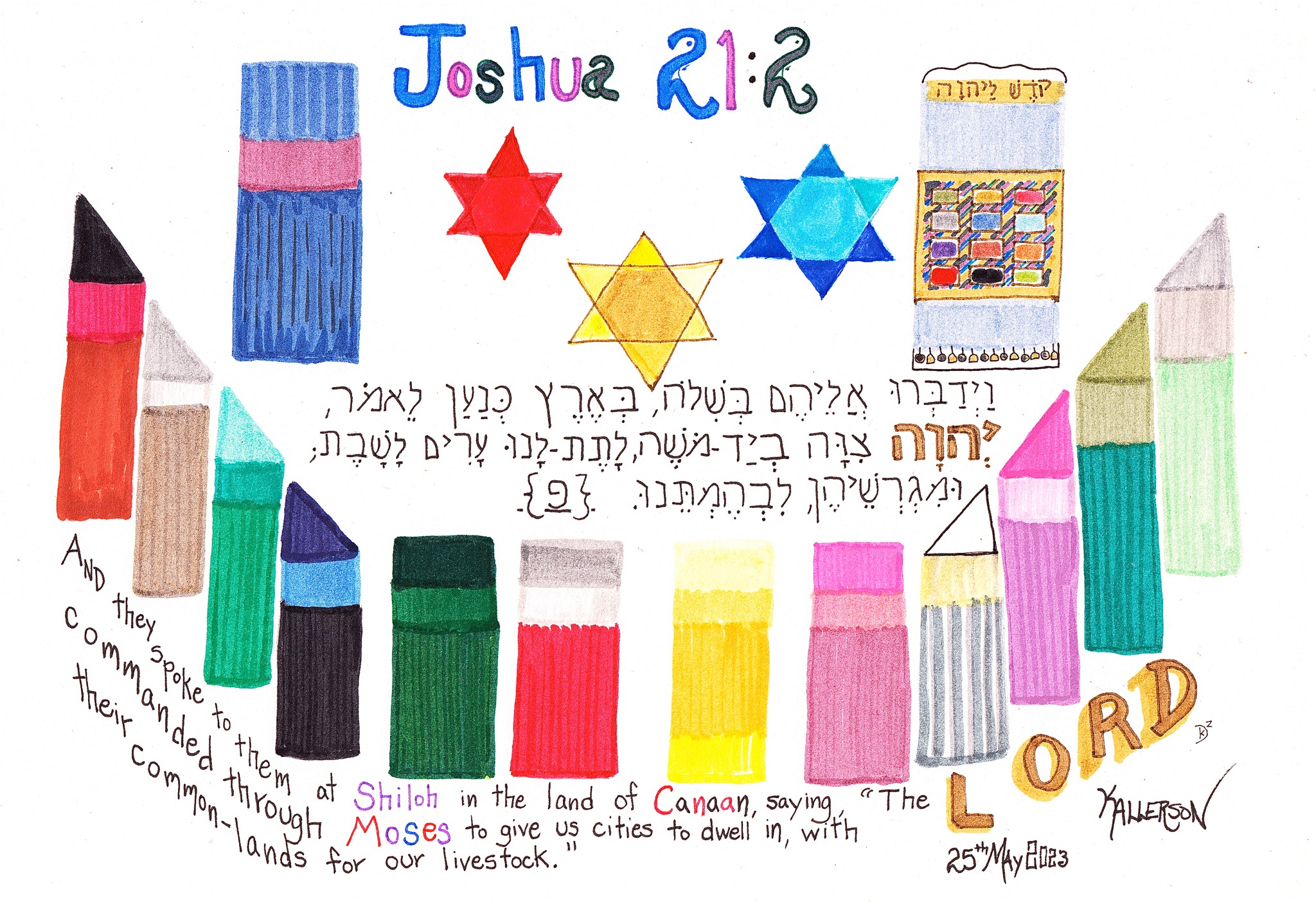
Artwork by Doug Kallerson
Joshua 21:1-8
Cities to Dwell In
Quite often, our sermons cite the work of E.W. Bullinger. More than anyone else, he revealed the meaning of numbers used in Scripture. Anyone doing a study on Bible numbers would save a lot of time if they had his book, Number in Scripture, handy.
Today, anyone with an internet connection can have it handy because it is on several websites and some even make it easy to download it as a PDF. The thing about citing Bullinger isn’t just that what he says “seems to make sense.” Rather, he normally cites detailed examples of his conclusions concerning the meaning of numbers right from Scripture. Sometimes, he cites dozens of examples.
Because of this, you can be relatively certain that when someone cites Bullinger, the citation is reliable, even if the analysis given by the person citing him isn’t. In other words, there are times when someone will cite Bullinger, but will then botch the analysis and conclusion.
Therefore, just because someone cites him, or any other reliable scholar, it is always good to not accept the conclusion at face value. So, be sure to check up on what you hear.
Concerning Bullinger’s work, you will hear it referenced many times today. The passage before us is filled with numerical and typological patterns. It really is a marvelous treasure of God’s wisdom.
Text Verse: “Simeon and Levi are brothers;
Instruments of cruelty are in their dwelling place.
6 Let not my soul enter their council;
Let not my honor be united to their assembly;
For in their anger they slew a man,
And in their self-will they hamstrung an ox.
7 Cursed be their anger, for it is fierce;
And their wrath, for it is cruel!
I will divide them in Jacob
And scatter them in Israel.” Genesis 49:5-7
In Genesis 49, Jacob prophesied over his son Levi that he would be divided in Jacob and scattered in Israel. Though brought into the narrative in several ways since then, the actual allotment of cities to Levi starting in today’s passage is the fulfillment of that prophecy.
The Bible has meticulously, even minutely, detailed how this would come about. Step by step, everything in Scripture moves us toward clarity of what God is doing. And yet, some people miss out on this obvious truth. The Pulpit Commentary on Joshua 21:2 says –
“First, the six cities of refuge were to be appointed, and then forty-two more were to be added to them. Calvin, not noticing this, has complained that this narrative is not in its proper place, and that it should have been inserted before the details in ch. 20.” Pulpit Commentary
Despite being almost idolized by many, Calvin’s comment is so far out of line with reality that it’s hard to imagine what he was thinking. What the Pulpit Commentary references was explicitly stated in Numbers 35, as will be seen below. But even if it wasn’t, his statement calls the order of Joshua into question. That alone opens up a can of worms concerning the reliability of the biblical text.
This is why it is so important to check what you are told, consider what is in a printed commentary, and – above all – to be familiar with what is said in Scripture. John Calvin was just a guy. The commentator of the Pulpit Commentary was just a guy. We are all fallible and prone to error. The word of God is not.
The word is reliable, so be confident in it alone. Everything else needs to be measured against this marvelous standard we call the Holy Bible. Wonderful things are to be found in His superior word. And so, let us turn to that precious word once again, and… May God speak to us through His word today, and may His glorious name ever be praised.
I. By the Hand of Moses (verses 1-8)
Then the heads of the fathers’ houses of the Levites came near to Eleazar the priest,
The heads of the fathers’ of the Levites are those who lead the three divisions of the Levites, descending from Levi’s three sons: Gershon, Kohath, and Merari. Of them, it says they came near to Eleazar the priest. Eleazar means Whom God Helps or God Has Helped.
The matter to be resolved is the granting of Levitical cities for the people of the tribe to dwell in. As it is a matter to be determined by lot, Eleazar, being the high priest, is named first just as in Joshua 14:1 with the division of the land for the tribes. This same order was stated again in Joshua 17:4 and 19:51.
1 (con’t) to Joshua the son of Nun,
The same order as the verses just mentioned continues where Eleazar is named before Joshua. Eleazar is the one to determine the will of the Lord. He then conveys that will to Joshua. One must know the will of the Lord prior to abiding by that will. In the case of the division of the land, it will come from the Lord through the hand of Eleazar.
Joshua is the civil and military leader of the nation and was naturally to be included in any such matter. Joshua means The Lord is Salvation.
1 (con’t) and to the heads of the fathers’ houses of the tribes of the children of Israel.
These would be the men named in Numbers 34:16-28 who were also mentioned at the beginning of the land division in Joshua 14:1. At that time, they came before Eleazar and Joshua to receive their land inheritances.
They are now gathered together because of a law matter that must be settled which deals with cities within their land. These cities are to be made the possession of the Levites and this is now the appropriate time to settle the issue.
Of this, John Calvin’s comments completely miss the point of what is happening. He assumes that the people simply forgot about the Levites, saying, “For thus it usually happens, while everyone is paying attention to his own care, that he forgets his brothers.”
It is a ridiculous statement when considered. As the cities were within the borders of individual tribes, and those tribes are only now defined, it would have been impossible to assign the Levitical cities according to tribal inheritances until this point.
The assignment of the tribes and the granting of Joshua’s inheritance was complete at the end of Chapter 19. The designation of the cities of refuge comprised Chapter 20.
As seen, those cities were logically determined before the assignment of the Levitical cities, even though they are a part of the Levitical cities. Only now, and not through incompetence on behalf of the people, is it appropriate to define Levitical cities within the tribes. Therefore, only now do they come forward…
2 And they spoke to them at Shiloh in the land of Canaan,
Shiloh is the place of the Tent of Meeting as first noted in Joshua 18:1. The congregation had moved from Gilgal to this more central location. Shiloh means Tranquility. Canaan signifies Humbled, Humiliated, or even Subdued.
2 (con’t) saying, “The Lord commanded through Moses to give us cities to dwell in, with their common-lands for our livestock.”
More correctly, it reads: Yehovah tsivah b’yad Mosheh – “Yehovah commanded in hand Moses.” The term “in hand” signifies “by the authority of,” but that authority was transferred to the scroll. The Lord commanded it to Moses and Moses committed it to writing as a permanent written command. The matter now to be considered was specifically mentioned in Numbers 35 –
“And the Lord spoke to Moses in the plains of Moab by the Jordan across from Jericho, saying: 2 “Command the children of Israel that they give the Levites cities to dwell in from the inheritance of their possession, and you shall also give the Levites common-land around the cities. 3 They shall have the cities to dwell in; and their common-land shall be for their cattle, for their herds, and for all their animals.” Numbers 35:1-3
This is what is being considered, in compliance with the mandate of law. Saying “from the inheritance of their possession” means that the matter was not ignorantly forgotten, but this is the time when it can be properly settled. The inheritance of the children of Israel is complete in the division of the land. Thus, the Levitical cities may be assigned accordingly.
3 So the children of Israel gave to the Levites from their inheritance,
The word “gave” is correct, but it may not mean, “Here are the cities we have decided to give to you,” as if the individual tribes determined the matter. Rather, it likely means that the process is directed by the Lord. The Lord gave the tribal inheritances to the children of Israel. From there, these cities are given out of those inheritances by the Lord.
Or it could be that the tribes allocated Levitical cities that were then assigned to the families of Levi according to the lot. If so, the Levities might have looked over the cities and given their preferences during the surveying of the land. Either way, the process of allotting them begins to be realized in the next words. They were…
3 (con’t) at the commandment of the Lord, these cities and their common-lands:
el pi Yehovah – “unto mouth Yehovah.” This must be referring to what lies ahead because the cities were not named in Numbers 35, only the number of them was given. Therefore, the lot itself is being equated to the mouth (command) of Yehovah. This is what Numbers 35 says –
“Now among the cities which you will give to the Levites you shall appoint six cities of refuge, to which a manslayer may flee. And to these you shall add forty-two cities. 7 So all the cities you will give to the Levites shall be forty-eight; these you shall give with their common-land. 8 And the cities which you will give shall be from the possession of the children of Israel; from the larger tribe you shall give many, from the smaller you shall give few. Each shall give some of its cities to the Levites, in proportion to the inheritance that each receives.” Numbers 35:6-8
With that remembered, it next says…
4 Now the lot came out for the families of the Kohathites.
Kohath was the second son of Levi, but from him descends the priestly line of Aaron. Thus, he is allotted the first portion. Depending on the root used for the name Kohath, it means either Obedience or Gathering/Assembly. From him, the first allotted portion will go to the priests…
4 (con’t) And the children of Aaron the priest, who were of the Levites, had thirteen cities by lot
The translation is understandable, but it is completely out of order from the Hebrew, which reads, “and it was to the sons of Aaron the priest (from the Levites) …”
The way the Hebrew is worded, it clearly sets the priests off as a distinct class within the Levites. The meaning of the name Aaron is debated. Jones’ Dictionary renders it Very High.
Kohath received the first lot and then from there the sons of Aaron, descended from Kohath, then received the first lot of Kohath. It was…
4 (con’t) from the tribe of Judah, from the tribe of Simeon, and from the tribe of Benjamin.
The words are correctly translated, and then in the Hebrew, the text ends with the words “in the lot, cities three ten.” The total is given at the end of the verse, not in the middle. It is to be noticed that even without naming them yet, the cities are located directly around Jerusalem.
Judah (Praise) is to its south, Simeon (He Who Hears) is within Judah, and Benjamin (Son of the Right Hand) is to its north. Thus, the priestly cities, by the providence of the lot from the Lord, place the priests in a somewhat circular fashion around the city.
As for the number thirteen, Bullinger says that “every occurrence of the number thirteen, and likewise of every multiple of it, stamps that with which it stands in connection with rebellion, apostasy, defection, corruption, disintegration, revolution, or some kindred idea.”
5 The rest of the children of Kohath had ten cities by lot from the families of the tribe of Ephraim, from the tribe of Dan, and from the half-tribe of Manasseh.
The Hebrew reads in a completely different order, “And to sons Kohath, the remainings, from families tribe Ephraim, and from tribe Dan, and from half-tribe Manasseh, in the lot, cities ten.”
Ephraim (Twice Fruitful/Ashes), Dan (Judge), and the half-tribe of Manasseh (He Shall Forget/From a Debt) are located just west and north of Benjamin. Ten signifies the perfection of divine order. As Bullinger notes, “It implies that nothing is wanting; that the number and order are perfect; that the whole cycle is complete.”
Albert Barnes states, “The non-priestly Kohathites had been diminished by the destruction of Korah and his company (Numbers 16). On comparing Numbers 26:57 following with Numbers 3:27 ff, two of the families of the Kohathites seem to have disappeared altogether. Hence, it is not surprising that the rest of the Kohathites were sufficiently accommodated in ten cities.”
The total number of cities for Kohath is twenty-three.
6 And the children of Gershon had thirteen cities by lot from the families of the tribe of Issachar, from the tribe of Asher, from the tribe of Naphtali, and from the half-tribe of Manasseh in Bashan.
Gershon was the first son born to Levi. His name means Expelled One or Exiled One. His allotment is also thirteen cities coming from Issachar (He is Wages), Asher (Happy), Naphtali (My Twistings/My Wrestlings), and from the other half-tribe of Manasseh across the Jordan in the Bashan (The Place of Fertile Soil).
The tribes within Canaan are located north of the half-tribe of Manasseh, but the area of Zebulun is omitted. The other half-tribe of Manasseh, east of the Jordan, is to the very north of the tribal inheritances.
7 The children of Merari according to their families had twelve cities from the tribe of Reuben, from the tribe of Gad, and from the tribe of Zebulun.
The name Merari comes from marar, to be bitter or to be strong. The i at the end may be possessive, and so it means either Bitterness or Strong or My Bitterness or My Strength.
He is the youngest son of Levi and his cities are somewhat dispersed. Reuben’s tribal land is the southernmost portion east of the Jordan. Gad is the middle tribe east of Jordan, just north of Reuben but south of Manasseh. However, the third area for his cities, which is in the land of Zebulun, is west of the Jordan in land locked between Issachar, Manasseh, Asher, and Naphtali.
Together, they will possess twelve cities, the number of perfection of government or of governmental perfection. Thus, all combined, there are – as directed by the Lord in Numbers 35 – forty-eight Levitical cities, six of which are cities of refuge.
8 And the children of Israel gave these cities with their common-lands by lot to the Levites,
As noted in verse 3, these were either chosen by the children of Israel and then allocated by lot or they were chosen by the Lord and then allocated by lot. Either way, they were given from within the tribal inheritances of the children of Israel. The common-lands are those lands explicitly described in Numbers 35 –
“The common-land of the cities which you will give the Levites shall extend from the wall of the city outward a thousand cubits all around. 5 And you shall measure outside the city on the east side two thousand cubits, on the south side two thousand cubits, on the west side two thousand cubits, and on the north side two thousand cubits. The city shall be in the middle. This shall belong to them as common-land for the cities.” Numbers 35:4, 5
However the decision was made, the entire process was…
8 (con’t) as the Lord had commanded by the hand of Moses.
ka’asher tsivah Yehovah b’yad Mosheh ba’goral – “According to which commanded in hand Moses, in the lot.” The Lord commanded Moses, Moses wrote out the words of law, and from the law, the lot was cast to determine these cities.
Concerning these cities, and of the Bible in general, there are always people who deny that these words could have been written at this time in Israel’s history. There simply were not enough priests and Levites to properly fill the cities. That is an error in understanding the layout and purpose of Levitical cities.
Just because these are designated as Levitical cities, it does not mean that only Levities lived in them. Nor does it mean that Levities only lived in Levitical cities. Though lengthy, Adam Clarke does a noble job of explaining the situation of these cities in relation to Israel –
“It has been asked in what sense did the Levites possess those cities, seeing they had no inheritance? To which it may be answered that it is not likely the Levites had the exclusive property of the cities in which they dwelt, for it is evident that the other Israelites dwelt among them. We know, says Calmet, by history, that the cities of the Levites were almost entirely filled with Israelites of other tribes. For instance, Gibeah of Benjamin, which is here given to the Levites, Joshua 21:17, was always peopled by the Benjamites, as appears from the history of the Levite, whose wife was so horribly abused by them; Judges 19:22-27. Saul and all his family dwelt in the same city; and David and his court spent the first years of his reign at Hebron, which was also a city of the Levites, Joshua 21:10. It appears, therefore, that they had no other property in those cities than merely the right to certain houses, which they might sell, but always with the right of perpetual redemption, for they could finally alienate nothing; and if the possessor of such a house, having sold it, did not redeem it at the year of jubilee, it reverted to the Levites. And as to their lands for their cattle, which extended two thousand cubits without the city, these they were not permitted to sell: they were considered as the Lord’s property. See Leviticus 25:32-34 (note), and the notes there. It is therefore very likely that, in the first instance, the Levites had simply the right to choose, in all the cities assigned them, the houses in which they were to dwell, and that those of the tribe to which the city belonged occupied all the other dwellings. There is also reason to believe that in process of time, when the families of the Levites increased, they had more dwellings assigned to them, which were probably built at the public expense. We may also observe that the Levites were not absolutely bound to live in these and no other cities: for when the tabernacle was at Nob, priests and Levites dwelt there, see 1 Samuel 21:1, etc.; and when the worship of God was established at Jerusalem, multitudes both of priests and Levites dwelt there, though it was no Levitical city: as did the courses of priests afterwards at Jericho. This was a circumstance which Moses had foreseen, and for which he had provided. See Deuteronomy 18:6, etc.”
He is correct in this. As this is so, there must be more than what is seen on the surface. The Lord chose the number of the cities before Israel ever entered the land. The lot determined who went where within these cities, and yet, they were not bound to these cities, as if they had to permanently dwell in them. More is going on for us to consider.
Separated in Jacob and divided in Israel
The tribe of Levi is to be dispersed
And yet, from it there is a marvelous story to tell
Redemption from the land that was cursed
God’s Christ will come and bring healing
Into the world that He created
This blessed way that God is dealing
With those who upon the Messiah have waited
A world at enmity with God
Is what Messiah will come to restore
Among His creatures He will trod
In the new world will be treasures galore
II. Pictures of Christ – Numbers and Names
The inheritances of the tribes are being used to reveal Christ in a marvelous way. Levi has no land inheritance of its own, and yet they do possess an inheritance. That was seen in Joshua 14:1-5 where it was noted –
“Because Levi, who anticipates Christ, has the Lord as their inheritance, there is no need for a land grant. … In other words, just as the Lord is Levi’s inheritance, so the Lord is Jesus’ inheritance. What belonged to the Lord from Israel passed to and through Levi. What belongs to the Lord from redeemed humanity passes to and through Jesus.”
What we are dealing with now follows in thought with the contents of that sermon. There are thirteen individual land grants. In order, they were Judah, Simeon, Benjamin, Ephraim, Dan, half-Manasseh, Issachar, Asher, Naphtali, half-Manasseh, Reuben, Gad, Zebulun.
As was noted earlier concerning the number thirteen, Bullinger says that “every occurrence of the number thirteen, and likewise of every multiple of it, stamps that with which it stands in connection with rebellion, apostasy, defection, corruption, disintegration, revolution, or some kindred idea.”
This is the state of the world without Christ. Israel is being used to reveal this. However, Bullinger explains further concerning the number later in his book. He says –
“THE CONNECTION OF THE NUMBER THIRTEEN WITH SUBSTITUTION AND ATONEMENT The Saviour, though without sin, was ‘made sin,’ or a sin-offering, for His people. He was ‘wounded for our transgressions,’ and bruised for their iniquities. He was, in fact, ‘NUMBERED WITH THE TRANSGRESSORS’ (Isa 53:12). Therefore this number is not only the all-pervading factor of SIN, but also of sin’s atonement. It is not only the number which brands the sinner as a rebel against God, but it is the number borne by the sinner’s Substitute. His very names in the Old Testament, before the work of Atonement was entered on or accomplished, are all multiples of 13, just as His names, afterwards in the New Testament and when the work of Atonement was carried out, are all multiples of 8.
- Christ 1480 (8×185)
- Lord 800 (8×100)
- Our Lord 1768 (8×221)
- Saviour 1408 (8x8x22)
- Emmanuel 25600 (8x8x8x50)
- Messiah 656 (8×82) ● Son 880 (8×110) The Old Testament names are:–
- Jehovah = 26 (13×2)
- Adonai = 65 (13×5)
- Ha-Elohim = 91 (13×7)
- Messiah, as given in Psalm 2, a form in which it occurs 10 times, ‘His Anointed’ = 364 (13×28)–the very number of Satan himself.”
The world without Christ is fallen, and Christ came to redeem the world, taking on the appearance of sinful man and bearing his guilt. By adding Levi to the inheritance, the grants total fourteen. Bullinger defines the number, saying –
“FOURTEEN being a multiple of seven, partakes of its significance; and, being double that number, implies a double measure of spiritual perfection. The number two with which it is combined (2×7) may, however, bring its own significance into its meaning, as in Matthew 1, where the genealogy of Jesus Christ is divided up and given in sets of 14 (2×7) generations, two being the number associated with incarnation.” Bullinger
Using Israel as a picture of the world, despite their rebellion and apostasy in the earthly realm, because of Levi, the Lord has placed His stamp upon them in the spiritual realm.
Likewise, with Jesus’ incarnation, the fallen world can be brought to a state of perfection once again. Christ is like the glue that binds all else together. This connection between Christ and fallen man is further explained in the passage today.
There are three sons of Levi. Three is the number of Divine Perfection. Bullinger says it “points us to what is real, essential, perfect, substantial, complete, and Divine.”
Despite there being three sons, there are four allotments because Kohath is divided into two – the sons of Aaron and the rest. Bullinger notes that four refers to all that is created. It points to material completeness. It is the world number and especially the city number.
The first family, that of Kohath, is divided into two portions. Two is the number of difference. In two, there is a contrast and yet there is a confirmation of things. For example, the Bible has two testaments. They contrast and yet they confirm the whole word of God.
Kohath, Obedience, is so divided. The first lot was for the sons of Aaron (Very High), each tribe of his allotted cities is a picture of Jesus, the Son of the Most High. He is the Praise of God (Judah). He is He Who Hears (meaning obeys) God (Simeon), He is the Son of the Right Hand (Benjamin).
And yet, they are given thirteen cities, the number of disorder, disintegration, etc. It is the state of the world into which Christ entered. But, as Bullinger explained, thirteen is connected to substitution and atonement. He is the fulfillment of everything associated with the priestly duties of substitution and atonement, as was made perfectly evident in the Leviticus sermons.
The second lot, the contrast and yet the confirmation, is seen in the remaining ten cities given to the rest of Kohath. Christ’s work is the perfection of divine order. He was Twice Fruitful in His Work through the Ashes of His afflictions (Ephraim), bringing in Jew and Gentile. He is the Judge of sin (Dan), it having been judged in Him. With that He Shall Forget their Sin, having paid sin’s penalty, From a Debt (Manasseh).
The second son is Gershon, Exiled One. This speaks of Christ in His work as well. He is Wages (Issachar) for the sin of man. He is Happy/Blessed (Asher) in the completion of His effort which was revealed in (Naphtali) My Wrestlings. He, the true Israel, wrestled with God and prevailed.
This was an allotment of thirteen cities, signifying the substitutionary and atoning work of Christ, despite the state of disorder and disintegration in the world which He entered.
The third son, Merari, anticipates Christ. The name means either My Bitterness or My Strength. They are two sides of the same coin because bitterness includes the idea of that which is strong. Either name will suffice. The completion of Christ’s work is the proof of God’s declaration of the Sonship of Christ – See a Son (Reuben). In the resurrection is realized His Fortune (Gad) and the granting of the Glorious Dwelling Place (Zebulun) as His rightful due.
This was an allotment of twelve cities, governmental perfection/perfection of government.
Everything about these allotted cities reveals the workings of God in Christ. And yet, there is another aspect of them seen in the Numbers 35 sermon which began to be revealed again in the Joshua 20 sermon. The six cities of refuge, although being a part of Levi’s allotment, are separate and unique.
There are 48 cities, but six are set apart from the others. In Numbers 35:6, it said –
“Now among the cities which you will give to the Levites you shall appoint six cities of refuge, to which a manslayer may flee. And to these you shall add forty-two cities.”
The forty-two cities are secondary to the highly important designation of six cities of refuge. The Levitical cities are six plus forty-two first and foremost. One could say that the United States was first 13 with 37 states added later. Although all are equal, there is a special note of honor held among those designated first.
Without the need to count on your fingers, I can tell you that 6 + 42 = 48. Bullinger notes that six “has to do with man; it is the number of imperfection; the human number; the number of MAN as destitute of God, without God, without Christ.” Simply put, it reveals fallen man. However, it also reveals Christ who came in the appearance of fallen man.
Forty-two is a most interesting number. Bullinger says it is a number connected with Antichrist, giving examples to support this. He then notes –
“Being a multiple of seven, it might be supposed that it would be connected with spiritual perfection. But it is the product of six times seven. Six, therefore, being the number of Man, and man’s opposition to God, forty-two becomes significant of the working out of man’s opposition to God.
There may be something more in the common phrase about things being all ‘sixes and sevens.’ They are so, indeed, when man is mixed up with the things of God, and when religious ‘flesh’ engages in spiritual things.”
Of the number 48, the obvious division of it by 12 and 4 is not to be missed. Twelve signifies the perfection of government. Four represents the number of material completeness. It is the world number, and especially the “city” number.
Thus, in these cities, one can see a representation of the kingdom of God in the world, with a special focus on 1) fallen man which is represented by the six cities of refuge, as well as 2) the kingdom of antichrist (the world opposed to God where religious flesh engages in spiritual things).
Despite the seeming contradiction in the individual numbers 6 and 42, with that of 48, it reveals that when taken together, the first two combine to form the perfection of God’s government in creation, or – more specifically – what God has used to form the kingdom of God in the world through the work of Christ.
It is a rather marvelous picture of Him, working through Christ, and forming this universal government, highlighted by those who come to take refuge in Him.
As seen earlier in Joshua 14:1-5, in these allotments, Levi anticipates Christ and His work in numerous ways. Levi is allotted his inheritance (the Lord is his inheritance) within Israel, dispersed among the other thirteen allotments.
Despite the disorder, disintegration, corruption, and so forth of Israel, God brought Jesus into the world through them. In His incarnation, He resided among them and brought them – meaning the commonwealth of Israel – into a double measure of spiritual perfection, inclusive of both Jew and Gentile.
The dispersion of Levi throughout the land meant that Levi always walked among the people. This is what is reflected about God in Christ according to Paul in 2 Corinthians 6 –
“I will dwell in them
And walk among them.
I will be their God,
And they shall be My people.” 2 Corinthians 6:16
The actual residing of Levi among Israel was to keep the people’s focus, understanding, and thoughts concentrated on the Lord. The Levites were to minister to the people in the things of the Lord, keeping them properly educated in the law. Someday the fulfillment of that will be seen when we dwell in heaven and Christ dwells in us and walks among us.
Everything mentioned about Levi throughout the books of Moses and here in Joshua is given to help us understand the work of Christ on our behalf and then to point us to our relationship with God because of Him.
When we consider Levi, as a tribe, their duties, their inheritance – all of it – anticipates the Person and work of Jesus. But this should not be unexpected. God used this imperfect tribe that is a portion of the imperfect people known as Israel to reveal to us the perfection of Christ Jesus. It is all in the numbers and names and it is marvelous.
Closing Verse: “Mercy and truth have met together;
Righteousness and peace have kissed.
11 Truth shall spring out of the earth,
And righteousness shall look down from heaven.” Psalm 85:10, 11
Next Week: Joshua 21:9-19 They are designated for all of them, from the greatest to the least… (The Cities of the Children of Aaron, the Priest) (46th Joshua Sermon)
The Lord has you exactly where He wants you. He has a good plan and purpose for you. It is He who has defeated the enemy and who now offers His people rest. So, follow Him and trust Him and He will do marvelous things for you and through you.
Cities to Dwell In
Then the heads of the fathers’ houses
Of the Levites came near to Eleazar the priest
To Joshua the son of Nun, and to the heads of the fathers’ houses
Of the tribes of the children of Israel – the greatest to the least
And they spoke to them at Shiloh in the land of Canaan
Saying, “The LORD commanded, through Moses He did talk
To give us cities to dwell in
With their common-lands for our livestock
So the children of Israel
Gave to the Levites from their inheritance, as the law demands
At the commandment of the LORD
These cities and their common-lands:
Now the lot came out for the families of the Kohathites
And the children of Aaron the priest, who were
———-of the Levites we know
Had thirteen cities by lot from the tribe of Judah
From the tribe of Simeon, and from the tribe of Benjamin also
The rest of the children of Kohath
Had ten cities by lot on that day
From the families of the tribe of Ephraim, from the tribe of Dan
And from the half-tribe of Manasseh
And the children of Gershon had thirteen cities by lot
From the families of the tribe of Issachar, they came on
From the tribe of Asher, from the tribe of Naphtali
And from the half-tribe of Manasseh in Bashan
The children of Merari
According to their families had twelve cities, these they did accrue
From the tribe of Reuben, from the tribe of Gad
And from the tribe of Zebulun too
And the children of Israel gave these cities
With their common-lands by lot to the Levites
As the LORD had commanded
By the hand of Moses, they were given these sites
Lord God, turn our hearts to be obedient to Your word
Give us wisdom to be ever faithful to You
May we carefully heed each thing we have heard
Yes, Lord God may our hearts be faithful and true
And we shall be content and satisfied in You alone
We will follow You as we sing our songs of praise
Hallelujah to You; to us Your path You have shown
Hallelujah we shall sing to You for all of our days
Hallelujah and Amen…
Then the heads of the fathers’ houses of the Levites came near to Eleazar the priest, to Joshua the son of Nun, and to the heads of the fathers’ houses of the tribes of the children of Israel. 2 And they spoke to them at Shiloh in the land of Canaan, saying, “The Lord commanded through Moses to give us cities to dwell in, with their common-lands for our livestock.” 3 So the children of Israel gave to the Levites from their inheritance, at the commandment of the Lord, these cities and their common-lands:
4 Now the lot came out for the families of the Kohathites. And the children of Aaron the priest, who were of the Levites, had thirteen cities by lot from the tribe of Judah, from the tribe of Simeon, and from the tribe of Benjamin. 5 The rest of the children of Kohath had ten cities by lot from the families of the tribe of Ephraim, from the tribe of Dan, and from the half-tribe of Manasseh.
6 And the children of Gershon had thirteen cities by lot from the families of the tribe of Issachar, from the tribe of Asher, from the tribe of Naphtali, and from the half-tribe of Manasseh in Bashan.
7 The children of Merari according to their families had twelve cities from the tribe of Reuben, from the tribe of Gad, and from the tribe of Zebulun.
8 And the children of Israel gave these cities with their common-lands by lot to the Levites, as the Lord had commanded by the hand of Moses.