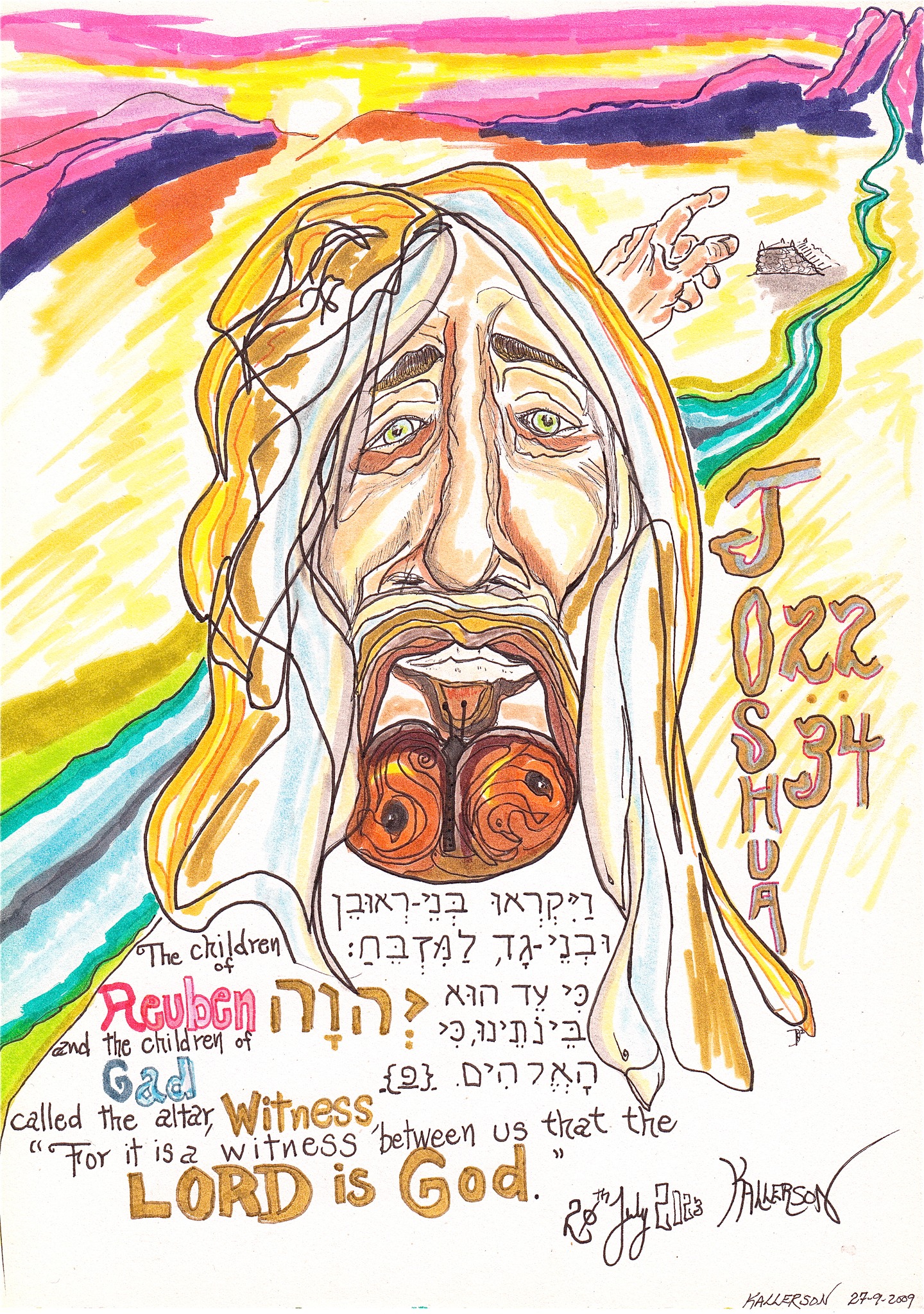
Artwork by Douglas Kallerson.
Joshua 22:30-34
The Lord God of gods, Part III
One of the most common (and nauseating) accusations that Christians will sling out at other Christians is, “You can’t be a Christian because…” Then, they toss out their own pet peeve as proof that the other person cannot be saved.
“You don’t read the King Jimmy Bible, you can’t be saved.” Show me that in John 3:16. Yet, such accusations are as common as rice in a Thai restaurant.
Did you know that according to the Church of Christ if you aren’t baptized, you’re not saved? Yeah. Really. Some even go further and say if your baptism wasn’t in the Church of Christ, you can’t be saved. Hmmm.
So we have just read the final section of Joshua 22. We’ll evaluate the verses and then look to see why they have been placed here. But based on what I just said, you may have an idea that they give us typology regarding salvation.
The tribes east of the Jordan really built an impressive altar. They had a reason for doing so as well. God chose what they did to reveal other things to us. As has been the case with the rest of Joshua, the detail all points to something else. It is a fascinating journey we have been on and that continues here.
Text Verse: “Blessed is he whose transgression is forgiven,
Whose sin is covered.
2 Blessed is the man to whom the Lord does not impute iniquity,
And in whose spirit there is no deceit.” Psalm 32:1, 2
David wrote these words about a thousand years before the coming of Christ. He was a man under law, and yet he spoke of things that occurred apart from the law. He was able to rightly see things about God, His nature, and His attributes that many people in the church today still can’t understand.
And this is even after Paul took these words of David and gave a detailed explanation about what God is doing with them. What does it mean when David says, “Blessed is the man to whom the Lord does not impute iniquity?”
That will be revealed in our passage today. It is an exceptionally interesting look into what occurred with people like David. It is also a necessary inclusion in the pages of the Bible. Without it, there would be a void in how we might perceive a certain group of people who have lived in a particular dispensation of time.
Get ready, great things are to be found in His superior word. And so, let us turn to that precious word once again, and… May God speak to us through His word today, and may His glorious name ever be praised.
I. Yehovah Is the God (verses 30-34)
In Part I of this three-part series, Phinehas and ten rulers from each tribe of Israel that settled in Canaan came to the eastern tribes and questioned them concerning the altar they had built. They reminded those tribes east of the Jordan about the matter of Peor and the trespass of Achan and the tragedy those events brought upon Israel.
In Part II, a response was given from the eastern tribes, proclaiming their innocence in any sort of transgression. Rather than an altar for offering and sacrifice, they had built the altar to stand as a witness between them and the western tribes that they, too, had a right to the Lord God of Israel.
Rather than the Jordan being a dividing border between the two groups, the altar standing above it acknowledged their right to participation in all covenant blessings of Israel. With that remembered, the final verses of the chapter begin with…
30 Now when Phinehas the priest and the rulers of the congregation, the heads of the divisions of Israel who were with him, heard the words that the children of Reuben, the children of Gad, and the children of Manasseh spoke, it pleased them.
There is no “when” in the Hebrew. Rather, the flow of thought is, “And … heard the words … and it was good in their eyes.” In the naming of Manasseh, no definite article is used. It says, “and sons Manasseh.”
If you recall, when the article has been used, a note of separation has been highlighted. When not used, the thought is inclusiveness. Here, they accept their actions and thus also the people who took the action.
In this verse, one can feel the sense of relief that must have permeated the delegation since they first heard of the matter. With each step closer to the meeting with the eastern tribes, there was probably a sense of increasing tension.
Then, as the western tribes presented their case, there was probably heightened anxiety and maybe even anger. However, as the eastern tribes began to speak, any such emotions would have dissipated.
The defense began with an exaltation of the name of the Lord, continued with a rhetorical note acknowledging the Lord’s right to judge them if they were in the wrong, then explained the reason for what they had done, and ended with an adamant protestation that they would never rebel against the Lord. Their words were accepted, and they were found pleasing in the eyes of the delegation…
31 Then Phinehas the son of Eleazar the priest said to the children of Reuben, the children of Gad, and the children of Manasseh,
Phinehas speaks on behalf of the delegation, addressing those from each of the tribes. Again, there is no article before Manasseh. We get the sense inclusivity and fellowship because of this. As for his address to them, he says…
31 (con’t) “This day we perceive that the Lord is among us,
ha’yom yadanu ki b’tokenu Yehovah – “The day we know for in our midst Yehovah.” In verse 20, the delegation mentioned the trespass of Achan. Because of what he did, the Lord told Joshua –
“Israel has sinned, and they have also transgressed My covenant which I commanded them. For they have even taken some of the accursed things, and have both stolen and deceived; and they have also put it among their own stuff. 12 Therefore the children of Israel could not stand before their enemies, but turned their backs before their enemies, because they have become doomed to destruction. Neither will I be with you anymore, unless you destroy the accursed from among you.” Joshua 7:11, 12
The Lord said he would not be with Israel anymore unless they remedied the situation. This is what the western tribes feared would be the case with the assumed transgression of the eastern tribes. Now, in knowing the purpose of the altar, they knew that the Lord had not abandoned them. Rather, He remained in their midst…
31 (con’t) because you have not committed this treachery against the Lord.
asher lo m’altem b’Yehovah ha’maal ha’zeh – “that not transgressed in Yehovah the transgression, the this.” It again points back to the transgression of Achan. When Chapter 7 opened, it used the same words as those here –
“But the children of Israel committed [v: maal] a trespass [n: maal] regarding the accursed things, for Achan the son of Carmi, the son of Zabdi, the son of Zerah, of the tribe of Judah, took of the accursed things; so the anger of the Lord burned against the children of Israel.” Joshua 7:1
Side by side, this is clearly evident –
7:1 – And transgressed [v: maal] sons of Israel a transgression [n: maal].
22:31 – Not transgressed [v: maal] in Yehovah the transgression [n: maal].
These internal clues show us how seriously the western tribes considered the matter. The Lord said He would no longer be with Israel until they resolved the matter of Achan’s transgression. But more, that single transgression of Achan was considered by the Lord as an act committed by Israel as a whole.
If it was done with perverse intent, how much more would this be a reason for the Lord’s removal of Himself from them! What was perceived as a matter equal to or greater than that of Achan is now considered resolved because of the words of defense spoken by the eastern tribes. Therefore, Phinehas continues…
31 (con’t) Now you have delivered the children of Israel out of the hand of the Lord.”
There is no single equivalent word to fully express the word that opens the statement: az hitsaltem eth bene Yisrael miyad Yehovah – “Consequently have delivered sons Israel from hand Yehovah.” The word az is a demonstrative adverb signifying “then,” “now,” or “at that time.”’
In this case, though, it is not strictly temporal, but the result of a logical sequence: This, this, therefore this. The fear was that Israel was again subject to kherem or being devoted to destruction unless they acted against the perceived transgression.
However, the consequence of their actions and the words of their defense have delivered Israel from such a state. With the matter thus happily resolved, it next says…
32 And Phinehas the son of Eleazar the priest, and the rulers, returned from the children of Reuben and the children of Gad, from the land of Gilead to the land of Canaan, to the children of Israel, and brought back word to them.
The name of the half-tribe of Manasseh is notably missing from the words. Of this, John Lange says, “In Joshua 22:32 the children of Reuben and Gad alone are named, and so in Joshua 22:34, merely for brevity’s sake.”
I would disagree with such an idea. There is no such thing as “for brevity’s sake” in Scripture. When something is said, it is for a reason. When something is left unsaid, the same is true. This is more certain because the matter before us was conducted in the Gilead, half of which belonged to the half-tribe of Manasseh.
So unusual is this omission that the Greek text includes Manasseh in their translation –
“So Phinees the priest and the princes departed from the children of Ruben, and from the children of Gad, and from the half tribe of Manasse out of Galaad into the land of Chanaan to the children of Israel; and reported the words to them.”
It is certainly implied that Manasseh is included in the words, but the exclusion of the name should tell us that we are being explained things in typology as well as from a literal, historical perspective.
Manasseh has been named ten times in this chapter. Five times a definite article has preceded the name and five times it has been omitted. The name is now noticeably missing from the final two mentions of the eastern tribes which occur after the matter has been resolved. This begs us to consider what is being said.
33 So the thing pleased the children of Israel,
vayitav ha’davar b’ene bene Yisrael – “And pleasing the word in eyes, sons Israel.” It is the same thought just presented in verse 30. What was pleasing in the eyes of the delegation is now pleasing in the eyes of the people.
The word “word” signifies a matter or issue. In this case, the matter that was reported to them consists of what was spoken in verses 21-29. Because it was an acceptable, even noble, response, it elicited a response from them…
33 (con’t) and the children of Israel blessed God;
vaybarakhu Elohim bene Yisrael – “And blessed Elohim sons Israel.” In using the word Elohim, it is referring to the power of God. The word is ultimately derived from ul, strength or might.
Being plural, it gives the sense of Powers or Forces which probably refers to the many aspects of God’s workings within creation. Such an idea is what was conveyed by Jesus to the Sanhedrin during His trial –
“And the high priest arose and said to Him, ‘Do You answer nothing? What is it these men testify against You?’ 63 But Jesus kept silent. And the high priest answered and said to Him, ‘I put You under oath by the living God: Tell us if You are the Christ, the Son of God!’
64 Jesus said to him, ‘It is as you said. Nevertheless, I say to you, hereafter you will see the Son of Man sitting at the right hand of the Power, and coming on the clouds of heaven.’” Matthew 26:62-64
In the use of Elohim in this verse, it is surely referring back to the statement made by the eastern tribes when they first responded to the charges brought against them –
El Elohim Yehovah El Elohim Yehovah
He is the Powers of Israel, displaying Himself on their behalf. Because of this, the people blessed Him…
33 (con’t) they spoke no more of going against them in battle,
The words are unusual. Rather than “spoke,” it says: v’lo ameru la’aloth alehem la’tsavah – “and no said to arise upon them to the war.” As a general rule of thumb, when the word davar, or spoke, is used, it gives the sense of something that is considered without any sense of participation. When amar, said, is used it usually involves participating in an action.
What this is probably referring to is what was said in their initial words to the eastern tribes –
“Then they came to the children of Reuben, to the children of Gad, and to half the tribe of Manasseh, to the land of Gilead, and they spoke [davar] with them, saying, 16 ‘Thus says the whole congregation of the Lord: “What treachery is this that you have committed against the God of Israel, to turn away this day from following the Lord, in that you have built for yourselves an altar, that you might rebel this day against the Lord?”’” Joshua 22:15, 16
The western tribes said they were “the whole congregation of the Lord.” That implied that the eastern tribes were not a part of the congregation of the Lord. The western tribes were on His side; the eastern tribes were not. Thus, their actions were in participation with the Lord.
Now, they are saying that together, they and the Lord, were not going to arise upon those of the eastern tribes…
33 (con’t) to destroy the land where the children of Reuben and Gad dwelt.
The attention is on the land rather than the people: la’shakhet eth ha’arets asher bene Reuven u’bene Gad yoshvim bah – “to destroy the land where sons Reuben and sons Gad dwelt in her.” This would go back to what they said to the eastern tribes as well –
“Nevertheless, if the land of your possession is unclean, then cross over to the land of the possession of the Lord, where the Lord’s tabernacle stands, and take possession among us; but do not rebel against the Lord, nor rebel against us, by building yourselves an altar besides the altar of the Lord our God.” Joshua 22:19
If the land was unclean, then the land was to be destroyed. The little nuances are carefully presented again and again within the passage to explain what was on the minds of the people, why things occurred, and why they turned out as they did.
34 The children of Reuben and the children of Gad called the altar, Witness,
The words are almost universally mistranslated. Here are several general options:
And the children of Reuben and the children of Gad called the altar Ed. KJV
And the sons of Reuben and the sons of Gad called the altar Witness. NASB
And the sons of Reuben and the sons of Gad proclaim concerning the altar. YLT
And the children of Reuben and the children of Gad gave a name to the altar. Darby
And the sons of Reuben and the sons of Gad will call to the altar. SLT
The Hebrew reads: va’yiqreu bene Reuven u’bene Gad la’mizbeakh – “And called sons Reuben and sons Gad to the altar.” That doesn’t seem to make sense. Therefore, various changes are made to try to make sense of what is being conveyed.
The KJV inserts the word Ed, the Hebrew word for Witness (nothing to do with Ed Sullivan, BTW). They did this to anticipate the thought of the next clause. In order to do this, they consider the first word of the next clause as an untranslatable sign of a quotation for direct discourse.
The NASB did the same thing, but gave the English translation of ed.
Young’s takes the “to the” and assumes it means it is referring to a proclamation that will be explained in the next clause.
Darby takes the words “And called” (meaning “And proclaimed”) as meaning “And gave.” That would be like us saying, “And they called his name Esau,” which is what Genesis 25:25, using the same word, says in the English translation – “And the first came out red. He was like a hairy garment all over; so they called his name Esau.”
That literally says, “And called name Esau.” The problem is that it ignores the “to the” before “altar.” If it said, “And called to the Esau,” such a comparison could be made, but it doesn’t.
Smith’s Literal Translation is the closest, saying “will call to the altar.” The verb is imperfect and so he decided to make it a future action, indicating an ongoing thing. There is no need for that. Again and again vayiqreu is translated as “and called.” This gets the sense across as intended. With that understood, it next says…
*34 (fin) “For it is a witness between us that the Lord is God.”
The words are emphatic. And again, not a single translation gives a literal rendering of these words: ki ed hu benotenu ki Yehovah ha’ Elohim – “For Witness IT, between us. For Yehovah the God.” Rather than Yehovah is God, it says He is THE God.
Taken with the first clause, the whole thought reads: “And called sons Reuben and sons Gad to the altar. For Witness, IT, between us. For Yehovah the God.” What is that telling us?
The “between us” part is referring to the eastern tribes and the western tribes. The altar itself stands as a witness between the tribes.
As for the article before God, “the God,” it is an emphatic statement that Yehovah is the one true God. As was explained in Deuteronomy 14, the definite article is expressive. It is used when referring to the one true God in relation to man.
But more especially, it is in relation to those who are in a right relationship with Him, or it is used to contrast those who are not in a right relationship with Him. In this case, the use of the article tells us that both the eastern and western tribes are in a right relationship with Him.
Still, the passage itself must be evaluated in how it points to Jesus to be fully understood.
To him who does not work
But who believes on Him who does the justifying
There is a heavenly perk
So the word of God is testifying
His faith is accounted for righteousness
This is the blessedness of man
And this is the secret of his success
That is set forth in God’s redemptive plan
Blessed are those whose lawless deeds are forgiven
And those whose sins are covered
They have gone from death to livin’
No more will fault in them be discovered
II. An Explanation of the Typology
The first thing to remember is what the two sets of tribes picture. All the tribes have received an inheritance. One set of tribes received theirs on the eastern side of the Jordan while the other received theirs on the west side.
The Jordan, the Descender picturing Jesus in His incarnation, is the dividing line between the two. In the first portion of Chapter 22 was an explanatory note confirming the salvation of those who anticipated the coming of Messiah while living under the law of Moses prior to the incarnation of Jesus Christ.
Moses was mentioned five times in relation to them, and it explicitly stated that it was he who gave the inheritance to the tribes (verses 22:4, 7, and 9). However, verse 4 said of the tribes west of the Jordan, “And now, the Lord your God has given rest to your brethren.”
Those east received their inheritance through Moses. But with the coming of Christ, the law is obsolete, annulled, and set aside. No person can receive their inheritance apart from Christ since His advent. Even though there are seven more years of law yet ahead for Israel, those years will not bring anyone to salvation through law observance.
Rather, they are intended to, finally, drive Israel to the understanding of their need for Christ. That is what will occur with national Israel someday, and it is what Chapters 3 and 4 of Joshua dealt with.
Pertaining to the salvation of national Israel, what is a deduction someone might incorrectly make about those who were under the law prior to the coming of Jesus? “Well, if national Israel had to come to Jesus even while under the law (meaning the seven years of tribulation), then those who came before Jesus’ incarnation must not be saved at all.”
“How could they be saved and have received an inheritance without Jesus having come?” Obviously, this is just a proposed speculation that should not realistically be considered. However, this is exactly what several other sets of typologies we have seen in Joshua were conveying.
Remember when the king of Ai was hanged on a tree? That was a picture of the law dying in Christ when He was hung on a tree. And yet, the same picture was seen again when the five kings in Joshua 10 were hung on five trees.
Those five kings pictured the five books of Moses. Wasn’t it obvious that the entire law died in Christ? Yes, but the second picture was given to avoid any future arguments, such as, “Well, Jesus fulfilled Genesis through Numbers, but Deuteronomy is still in effect.”
As nutty as that sounds, God is covering every base so that we can know exactly what the redemptive narrative entails. Other such obvious (my sermon editor told me not to use the word obvious) speculations were resolved elsewhere in Joshua as well. Chapter 22 is no different. “Of course those who believed before the coming of Jesus are saved!” “Well, yes… maybe, but…”
This is the purpose of the account given in Joshua 22:10-34. God is meticulously covering every base so that we don’t have doubts about such things. The effects of the work of the Messiah, Jesus, goes both forward and backward for Israel.
But the effects also go forward for the church, meaning Jew and Gentile, during this dispensation. The rapture, for example, is something limited to those of the church, but it applies to all within the church regardless of ethnicity, gender, age, etc. These things have been seen in numerous passages in Joshua.
To ensure that we know what is going on with the Old Testament saints concerning their relationship to Christ Jesus, we have been given these verses today.
The eastern tribes came to the “circles of the Jordan,” which was still within the land of Canaan, meaning the inheritance of the Humbled granted to national Israel by the Lord. There they built this great and impressive altar, a replica of the altar of the Lord. The circles, g’liloth, signify Liberties.
Despite living under the law, their altar is a testimony to the liberties they possess. And more, it was built not “by” the Jordan, but “upon (over, above)” the Jordan. The picture of Christ is plain. Their altar is a testimony to their salvation in Christ, despite having lived under Moses.
Moses gave them their inheritance, but ultimately, the Lord gave the law to and through Moses. The salvation of these people under the law, resulting in the inheritance granted to them, came by faith, not by works of the law. Hebrews 11 is a perfect testimony to this.
The chapter speaks of the faith of the saints from Abel all the way throughout the time of the law. It finishes with these words –
“And all these, having obtained a good testimony through faith, did not receive the promise, 40 God having provided something better for us, that they should not be made perfect apart from us.” Hebrews 11:39, 40
Hebrews is written specifically to the Hebrew people, but it is given as a contrast between Moses, meaning the law, and what Christ offers. It is a warning that to choose the law when the knowledge of Christ has been understood is a self-condemning act.
Thus, it is especially an epistle directed to the end times Jews of the tribulation period, even if what it details pertains to all people in various ways.
The reaction of the western tribes and the words of the delegation confirm this. The idea of the eastern tribes going to war against them from Shiloh (Tranquility) gives the sense. “We have the inheritance because we accepted Jesus and were granted our rest. You, however, were under the law.”
If they were under the law, then how could they participate in the inheritance? Going to war against them indicates that they are not on the same side. However, before war was declared, a delegation was sent to discern the meaning of their actions.
Phinehas (Mouth of Judgment) son of Eleazar (Whom God Helps) was sent. A judgment will be made concerning their actions as God helps them come to an understanding.
The two- and one-half tribes are mentioned by name, but there is no article before Manasseh because the other half-tribe of Manasseh is a part of the delegation. Despite the disagreement, a sense of inclusiveness is anticipated through the dialogue.
Further, the meeting is in the land of the Gilead, the Perpetual Fountain. The eastern tribes supposedly have the Spirit, but the erection of the altar seems to indicate otherwise. The matter must be resolved.
Along with Phinehas, there are leaders from each of the ten tribes. Ten “signifies the perfection of Divine order. … It implies that nothing is wanting; that the number and order are perfect; that the whole cycle is complete.” Bullinger
The ten leaders have all they need in Christ, the fulfillment of the law, summed up by the Ten Commandments. These ten leaders are representing those Ten Commandments for the sake of the narrative. Phinehas represents the sacrificial part of the law of atonement and propitiation before those Ten Commandments.
The statement of verse 16, “Thus says the whole congregation of the Lord,” indicates that they feel they are the only true congregation and the others have excluded themselves by their actions. Those under the law have trusted in self, the law, or some other god, but they have not trusted in the Lord.
Their actions were deemed as transgression, seen in the use of the verb and noun maal. Like Achan who had broken the law of coveting, these people had likewise transgressed and not followed the Lord.
Their action was deemed an act of rebellion, marad, just as those who refused to believe the Lord in Numbers 14 had rebelled, marad, against the Lord.
Even more, the sin of Peor – that of the adultery of bowing down to false gods – was brought to remembrance. By building the altar, the eastern tribes were accused of similar sin, highlighted by the use of an emphatic YOU. With that, the offer was, “Nevertheless, if the land of your possession is unclean, then cross over to the land of the possession of the LORD.”
Think of Jesus in the typology. “You are of the law. You need to come to our side of Jesus’ incarnation and you can then share in the inheritance. That is where the Lord’s tabernacle (picturing Jesus) is and take possession there.”
Everything they say smacks of the words of the book of Hebrews. For example, Jesus is what the tabernacle only prefigured as revealed in Hebrews.
“We have Jesus. You just have types and shadows. You are not of the congregation of the Lord. Building an altar is rebellion.” Despite the accusations, the response of the western tribes refutes their words. They emphatically appeal to El Elohim Yehovah as their witness.
They then said, “HE knows, and Israel – HE shall know.” Israel will realize what the Lord already knows. Their altar is not of rebellion or treachery. It is not for offerings or sacrifices – all of which are fulfilled in Jesus. If it was for these things, then “Yehovah – HE will seek.”
The Lord knew their intentions and their state before Him. However, those of Israel who see the division between the two, the Jordan (the Descender, meaning Christ in His incarnation), might say, “You aren’t of us, the Lord has set Jesus as a division between us!”
In verse 25 at the time this was said, Reuben and Gad were mentioned without Manasseh for the first time. Because half of Manasseh was west of the Jordan, it could not be said that Manasseh had no inheritance within Canaan.
As an example, people say there are ten lost tribes of Israel. Totally incorrect. After the exile of the ten tribes by Assyria, people from many of those tribes are noted both in the Old and New Testaments. If there is a single person from a tribe, the tribe continues.
That is evidenced by the words of Jesus, Paul, and others in the New Testament when they refer to the twelve tribes of Israel, even in the present tense. Hence, Manasseh is not mentioned because Manasseh has a portion west of the Jordan. However, Reuben and Gad are singled out as having, “Naught to you portion in Yehovah.”
But they did have a portion, even if it came through Moses. That is the point of the passage. The eastern tribes do have a stake in the Lord, and that is why they determined to build “the altar.” The article is expressive and indicates that there is a set intention for a particular altar.
It wasn’t for offering or sacrifice, but it served as a witness – “for witness IT.” The altar upon (above, over) the Jordan is an emphatic witness for them “to serve service Yehovah to His face,” meaning on the true altar. That is where they would offer their burnt offerings, sacrifices, and peace offerings.
As the altar of the Lord is a typological anticipation of Jesus, then their offerings are also to Jesus. The altar is witness to that fact. As such, there could be no claiming against them, “You have no part in the Lord.” The construction of the replica of the altar is evidence of this.
The altar then is one of faith. “We are of the Lord and this is witness to it. If it was of works, it would be used as an altar is typically used. But this altar was not. It was a witness and nothing more.”
Verse 30 that opened us today showed that Phinehas and the rulers (ten of them) heard this response and were pleased. They now get it. Those who were under the law, but who anticipated Jesus are truly of Israel.
The priest, representative of the sacrificial system and the ten rulers, representative of the Ten Commandments and thus the entire law, are satisfied through their act of faith, not in their adherence to the law.
Hence, they acknowledge that “in our midst Yehovah.” Faith in anticipation of the coming Messiah saves just as does faith in the Messiah who has come. They also acknowledged that these men had “not transgressed in Yehovah the transgression.” In other words, they are blameless before the law because of their deed of faith.
With this acknowledgment, the people were delivered from the hand of the Lord and Phinehas (Mouth of Judgment) son of Eleazar (Whom God Helps) and the ten rulers returned from the sons of Reuben (See a Son) and the sons of Gad (Fortune) from the Gilead (the Perpetual Fountain) to Canaan (the land of the Humbled).
The judgment has been rendered, the Lord has intervened, the status of these men is no longer in question, they have the Spirit and all is well. Again as before, there was no need to mention the half-tribe of Manasseh because Manasseh was already represented among the tribes.
This would explain why the word for tribe, mateh, was used in the first verse of the chapter and shevet was used in all other instances. The genealogical aspect of the tribe was secure. The political aspect of the eastern half-tribe is what was in question. That is no longer the case. The words are telling a story if we just pay heed.
Verse 33 then noted that the word was pleasing in the eyes of the sons of Israel. There can be no future questioning. Because of the faith of these people, the sacrificial system that anticipated Christ was acceptable for them and the ten commandments testify to this for them.
Therefore, they blessed Elohim because of it. Christ, who sits at the right hand of the Power is praised by Israel because He has saved all of Israel who have come to Him through faith.
Any supposed enmity between the two – meaning before His coming or after His coming – is ended and the war is averted which would have destroyed “the land where sons Reuben and sons Gad dwelt in her.”
That land is the land of the Torah, the inheritance that came through the law of Moses. As long as it was by faith in Messiah, Israel could receive the inheritance. How can we know this? Because of the final verse of the chapter –
“And called sons Reuben and sons Gad to the altar. For Witness, IT, between us. For Yehovah the God.”
What is that telling us?
The altar was not for works of any kind, but it was an altar of faith built above (over, on) the Jordan. Those who were before the coming of Christ called to the altar in faith. It didn’t matter if they were under law, the law comes from the Lord, it anticipated the coming of the Lord, and the people of faith under the law called out to the Lord.
As for the word replica used in this passage, it is the Hebrew word tavnit. It is the same word used in modern Hebrew Bibles to describe the pattern noted in Hebrews 8 –
“For if He were on earth, He would not be a priest, since there are priests who offer the gifts according to the law; 5 who serve the copy and shadow of the heavenly things, as Moses was divinely instructed when he was about to make the tabernacle. For He said, “See that you make all things according to the pattern [Heb: b’tavnitho (literally, in His form)] shown you on the mountain.” Hebrews 8: 4, 5
The things of the tabernacle, including the altar, were only typological representations of Jesus. He is the Altar. The replica of the altar built by these tribes was an anticipation of Christ to come.
As this is so, and as that altar in Israel was the altar of Yehovah, it is a logical and necessary deduction from this passage that Jesus is Yehovah incarnate. He is ha’elohim, “the God” who stands in relation to man.
This is what the passage before us is about. David was a man under law. However, our text verse today showed us that despite being under law, he was not imputed sin according to the law. But by the very nature of law, sin is imputed.
Therefore, he – by default – was a man of faith in something greater than the law. When he sinned by taking Bathsheba, God’s prophet spoke to him in 2 Samuel 12:13, saying, “The Lord also has put away your sin; you shall not die.” The Lord’s mercy was bestowed upon David apart from the law.
David thus deduced that if this occurred, then God’s other divine attributes were also to be realized in our relationship with Him only apart from the law. The law then must have had another purpose than to bring man into a right relationship with God.
Although David didn’t have a full comprehension of the work of the Messiah, he did understand the blessedness of man who received God’s righteousness apart from the law. It is this faith in God’s people who were under the law that is revealed in Joshua 22.
To close, I would ask you to consider your own trek towards the inheritance. How do you think it will come about? If you suppose it is through something you have done or need to do, then you have failed the test.
However, if you will simply have faith that God has done the work and all you need to do is accept that, you will be saved. God cannot deal with you unless you first remove yourself from the equation concerning effort. Christ has done that. Now, just believe. This is what pleases God.
Closing Verse: “But to him who does not work but believes on Him who justifies the ungodly, his faith is accounted for righteousness, 6 just as David also describes the blessedness of the man to whom God imputes righteousness apart from works:
7 ‘Blessed are those whose lawless deeds are forgiven,
And whose sins are covered;
8 Blessed is the man to whom the Lord shall not impute sin.’” Romans 4:5-8
Next Week: Joshua 23:1-16 The Faithfulness of the Lord has been unveiled… (Not One Word Has Failed) (54th Joshua Sermon)
The Lord has you exactly where He wants you. He has a good plan and purpose for you. It is He who has defeated the enemy and who now offers His people rest. So, follow Him and trust Him and He will do marvelous things for you and through you.
The Lord God of Gods, Part III
Now when Phinehas the priest and the rulers of the congregation
The heads of the divisions of Israel who were with him as well
Heard the words that the children of Reuben, the children of Gad
And the children of Manasseh spoke, it pleased them: pretty swell
Then Phinehas the son of Eleazar the priest said
To the children of Reuben, the children of Gad, and the children
———-of Manasseh this word
“This day we perceive that the LORD is among us
Because you have not committed this treachery against the LORD
“Now you have delivered the children of Israel
Out of the hand of the LORD; things are looking swell”
And Phinehas the son of Eleazar the priest, and the rulers, returned
From the children of Reuben and the children of Gad
From the land of Gilead to the land of Canaan
To the children of Israel, and brought back word to them
———-that things weren’t so bad
So the thing pleased the children of Israel
And the children of Israel blessed God in a manner heartfelt
They spoke no more of going against them in battle
To destroy the land where the children of Reuben and Gad dwelt
The children of Reuben and the children of Gad
Called the altar, Witness
“For it is a witness between us that the LORD is God
So it is; so we confess
Lord God, turn our hearts to be obedient to Your word
Give us wisdom to be ever faithful to You
May we carefully heed each thing we have heard
Yes, Lord God may our hearts be faithful and true
And we shall be content and satisfied in You alone
We will follow You as we sing our songs of praise
Hallelujah to You; to us Your path You have shown
Hallelujah we shall sing to You for all of our days
Hallelujah and Amen…
30 Now when Phinehas the priest and the rulers of the congregation, the heads of the divisions of Israel who were with him, heard the words that the children of Reuben, the children of Gad, and the children of Manasseh spoke, it pleased them. 31 Then Phinehas the son of Eleazar the priest said to the children of Reuben, the children of Gad, and the children of Manasseh, “This day we perceive that the Lord is among us, because you have not committed this treachery against the Lord. Now you have delivered the children of Israel out of the hand of the Lord.”
32 And Phinehas the son of Eleazar the priest, and the rulers, returned from the children of Reuben and the children of Gad, from the land of Gilead to the land of Canaan, to the children of Israel, and brought back word to them. 33 So the thing pleased the children of Israel, and the children of Israel blessed God; they spoke no more of going against them in battle, to destroy the land where the children of Reuben and Gad dwelt.
34 The children of Reuben and the children of Gad called the altar, Witness, “For it is a witness between us that the Lord is God.”