
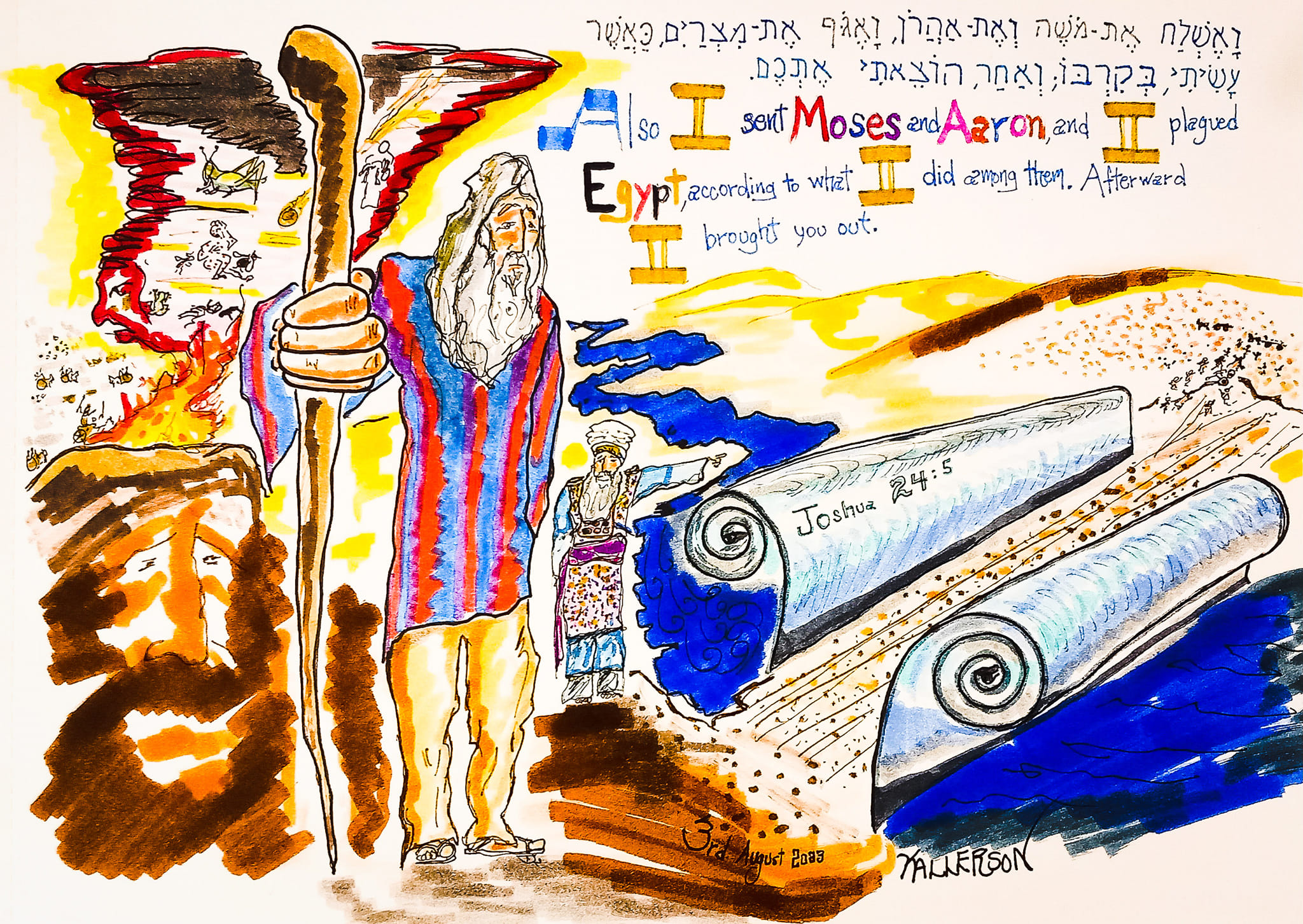
Artwork by Doug Kallerson
Joshua 24:1-5
For He Is a Holy God, Part I
One of the folks in the online church, Trent, who used to play in a rather famous Christian band that won a Grammy Award and other nominations, sent me a note tying music theory into some of the regions of Asia that are mentioned in the Bible.
He noted that the Catholic Church played a big part in naming the seven scales. They are based on the names of various Roman regions where the sounds originated. They are the Ionian, Dorian, Phrygian, Lydian, Mixolydian, Aeolian, and Locrian.
The Lydian, for example, is from the district of Lydia in a Roman province in Asia. It is in this district that Thyatira is located. This is where Lydia, who is noted in Acts 16, was from. Thyatira is also one of the seven churches mentioned in Revelation. Looking at the names of the seven scales, you can also see that the Phrygian comes from Phrygia which is also mentioned in Acts.
Trent wanted to explain these things to me a little more clearly and so he did a short video on YouTube playing variations in the styles and saying things like, “You can hear the difference in this – da da da, and this – da da da.” Actually, I couldn’t hear the difference at all. I’m as tone deaf as a dead fish.
I found that out when a music teacher had to let me go from the Sarasota Boys Choir after testing me. “Is this higher or lower?” “Is this sharper or flatter?” I had no idea. Hence, off the choir I went.
The funny thing is, I can hear that there are differences, but I have no comprehension of what they are.
To get this, imagine someone who is color blind. He knows there is a difference in the colors he is being shown, but he has no idea what it is. He sees the shades, but it means nothing to him. That is me with music.
Text Verse: “But God spoke in this way: that his descendants would dwell in a foreign land, and that they would bring them into bondage and oppress them four hundred years.” Acts 7:6
They make special glasses now that can help a colorblind person see colors. Go to YouTube and type in a search for “Colorblind person sees color for the first time.” The reaction you see will be like mine when I can distinguish sound differences for the first time.
These people literally break down weeping. Now imagine what it will be like for all of us when we see, for the VERY FIRST TIME, life without the taint of sin. Imagine that. I cannot wait.
Trent’s video made me think about this and it comes to my mind often. The music he plays is so natural to him that he gets all excited as he says things like, “Ok, now listen to this…” And yet, I cannot perceive it at all. Imagine eating Thai peppers and then ice cream and not being able to tell the difference. Trent gets it; I don’t.
The point of this is that as we have been going through Joshua, there are things that make seemingly no sense at all. You read the words and keep going while maybe thinking, “I have no idea what this is saying to me. And yet, there is a symphony playing in the background.”
There is so much going on, and yet we miss the nuances. This is the great thing about going through the Bible verse by verse and even word by word. We are forcing ourselves to hear the differences in the sounds being played.
We are tasting that the Lord is so very good in so many new ways. And we are seeing innumerable colors emanating from what seems to be an otherwise colorless passage recorded with black letters on white pages.
Stephen mentioned the four hundred years of bondage and oppression that Israel faced. He cited this from Genesis 15. In Galatians, Paul says that the law came four hundred and thirty years after the promise to Abraham. How can that be if Israel was in Egypt for four hundred years? Spoiler alert: they weren’t.
To understand what is being conveyed by the Lord to Israel, we will need to review many such things as we go through Joshua 24. We’ll get through the first five verses today, the Lord willing. As for the seven scales of music, Trent almost seemed let down that there is no Lycanian mode.
The province of Lycaonia is known as Wolf-land. It is where our term Lycan, or werewolf, is derived from. We have no werewolf scale for music. Well, except for howls and screams from people who have to listen to me when I sing.
Really wonderful treasures are to be found in His superior word. And so, let us turn to that precious word once again, and… May God speak to us through His word today, and may His glorious name ever be praised.
I. Before the God (verses 1 & 2)
Then Joshua gathered all the tribes of Israel to Shechem
va’yeesoph Yehoshua eth kal shivte Yisrael shekemah – “And gathered Joshua all tribes Israel Shechem-ward.” Rather than Shiloh where the tabernacle was located, Joshua has gathered them together at Shechem for a particular purpose.
Shechem is identical to shekem, shoulder. Thus, it literally means Shoulder. However, that comes from shakam signifying to incline, as inclining the shoulder to a burden. Hence, it is normally translated as to rise or start early. Abarim defines Shechem as “[Having a Sense of] Responsibility.”
Shechem is where the Lord first spoke to Abram after coming into the land of promise and uttered His promise to him –
“Then the Lord appeared to Abram and said, ‘To your descendants I will give this land.’ And there he built an altar to the Lord, who had appeared to him. 8 And he moved from there to the mountain east of Bethel, and he pitched his tent with Bethel on the west and Ai on the east; there he built an altar to the Lord and called on the name of the Lord.” Genesis 12:7, 8
It is where Jacob was said to have finally and safely returned from his journey to Padan Aram –
“Then Jacob came safely to the city of Shechem, which is in the land of Canaan, when he came from Padan Aram; and he pitched his tent before the city. 19 And he bought the parcel of land, where he had pitched his tent, from the children of Hamor, Shechem’s father, for one hundred pieces of money. 20 Then he erected an altar there and called it El Elohe Israel.” Genesis 33:18-20
It is the location where Jacob stayed at the time his daughter Dinah was defiled. Because of that, Simeon and Levi killed all the males of the city. In this same location, it said this in Genesis 35 –
“And Jacob said to his household and to all who were with him, ‘Put away the foreign gods that are among you, purify yourselves, and change your garments. 3 Then let us arise and go up to Bethel; and I will make an altar there to God, who answered me in the day of my distress and has been with me in the way which I have gone.’ 4 So they gave Jacob all the foreign gods which were in their hands, and the earrings which were in their ears; and Jacob hid them under the terebinth tree which was by Shechem.” Genesis 35:2-4
It is the location where Joseph’s bones were taken and buried. That was first commanded to Israel in Genesis 50 –
“And Joseph said to his brethren, ‘I am dying; but God will surely visit you, and bring you out of this land to the land of which He swore to Abraham, to Isaac, and to Jacob.’ 25 Then Joseph took an oath from the children of Israel, saying, ‘God will surely visit you, and you shall carry up my bones from here.’” Genesis 50:24, 25
The fulfillment of that will be seen towards the end of Joshua 24. Also, Shechem is the area where Mount Ebal and Mount Gerizim are located. Thus, it is the location where Moses commanded these words to be carried out –
“Keep all the commandments which I command you today. 2 And it shall be, on the day when you cross over the Jordan to the land which the Lord your God is giving you, that you shall set up for yourselves large stones, and whitewash them with lime. 3 You shall write on them all the words of this law, when you have crossed over, that you may enter the land which the Lord your God is giving you, ‘a land flowing with milk and honey,’ just as the Lord God of your fathers promised you. 4 Therefore it shall be, when you have crossed over the Jordan, that on Mount Ebal you shall set up these stones, which I command you today, and you shall whitewash them with lime. 5 And there you shall build an altar to the Lord your God, an altar of stones; you shall not use an iron tool on them. 6 You shall build with whole stones the altar of the Lord your God, and offer burnt offerings on it to the Lord your God. 7 You shall offer peace offerings, and shall eat there, and rejoice before the Lord your God. 8 And you shall write very plainly on the stones all the words of this law.” Deuteronomy 27:1-8
The altar was built, and the ceremony was conducted as recorded in Joshua 8. In fact, as nutty as this may sound, the events in Joshua 24 may coincide with the building of the altar in Joshua 8. In Joshua 8, it said, “Now Joshua built an altar to the Lord God of Israel in Mount Ebal.”
The word translated as “Now” in that verse is az, a demonstrative adverb that generally signifies “at that time” or “thereupon.” It can refer to a point in the future when a prophecy or a statement of fact is given, such as “At that time, the Lord will do such and such.”
Further, the word translated as “built” is yivneh. It is an imperfect verb that carries the sense of ongoing or even the future. The same form is used in 2 Samuel 7, saying –
“He shall build a house for My name, and I will establish the throne of his kingdom forever.” 2 Samuel 7:13
Though it appears while reading Joshua that the events are chronological, including in Joshua 8, as I explained at that time that was highly unlikely. As has been seen again and again, the individual passages of Joshua are categorical and expressive, not necessarily chronological.
If this is the same event as in Joshua 8, then the gathering includes the entire congregation of Israel, including all the women and children. It would also mean that the last verses of Joshua 24 concerning the death of Joshua are again categorical, not chronological.
If this is a correct analysis, then I would take the events of Joshua 8:30-35 as occurring between Joshua 24:24 and 24:25. This is speculation and is a logical way to resolve the chronology of the events in Joshua. Regardless, each of these notable events of Israel’s history has a bearing on what is stated in Joshua 24.
As for this gathering, as noted, it could be a regular gathering on one of the appointed feast days, or it could be that it is a special gathering. Either way, it is an all-inclusive gathering of the tribes.
And yet, if it is not in conjunction with the events of Joshua 8, it may be that the next words define what “all the tribes of Israel” mean. Like in Joshua 23:2, rather than all the people of the nation, it may mean all the representatives of the tribes…
1 (con’t) and called for the elders of Israel, for their heads, for their judges, and for their officers;
Rather than “their,” the words are in the singular, referring to Israel as a single man: vayiqra l’ziqne Yisrael u-l’rashav u-l’shoptav u-l’shot’rav – “and called to elders Israel, and to his heads, and to his judges, and to his officers.”
The four categories include the elders who are the seventy leaders eventually known as the Sanhedrin. The heads are the chief men of the families. The judges are those who interpreted the law and made decisions based on their analyses. The word used to describe the officers, shoter, comes from a word indicating to write. Thus, they would be scribes or official superintendents or magistrates. With their calling, it next says…
1 (con’t) and they presented themselves before God.
Of the 38 translations I checked for this verse, not a single one accurately includes the article before “God.” Rather, it says: vayityatsevu liphne ha’elohim – “and stationed themselves before the God.”
As always, the definite article is expressive. It is used when referring to the one true God in relation to man. But more especially, it is in relation to those who are in a right relationship with Him, or it is used to contrast those who are not in a right relationship with Him.
Israel is the nation of the Lord. They have presented themselves before the true God to be instructed by Joshua. This is the same thought that is used in Job 1 & 2, using the same word –
“And it was the day, and came the sons of the God to station themselves upon Yehovah.” Job 1:6 (CG)
The meaning is that those who worshiped the Lord came to offer upon His altar as was noted in the previous verse of Job. The view that the “sons of God” refers to angels is incorrect. It is referring to those humans who worshiped the Lord, having retained the knowledge of Him in the form handed down from Noah.
To ensure the Lord would continue to be revealed properly among the people of the world, Israel was selected as a nation, a covenant was made with them, and His tabernacle and later His temple was placed among them. As such, the leaders of this nation have been called together for this purpose.
Understanding this, the narrative continues, explaining who “the God” is. However, the words are those of the Lord having been conveyed to Joshua. As this is so, the text is claiming divine inspiration in what is next said…
2 And Joshua said to all the people, “Thus says the Lord God of Israel:
koh amar Yehovah elohe Yisrael – “Thus says Yehovah, God of Israel.” The words explain the meaning of ha’elohim, the God, just mentioned. Yehovah is the God of Israel. As noted above, He is God, the God, to those who stand in a proper relationship with Him.
However, the appropriate worship of Him was naturally dying out once again. People are prone to quickly apostatize from a proper understanding of who God is, and so to maintain proper revelation of who He is, He called Israel as His people. That is clearly elucidated in the coming words, beginning with…
2 (con’t) ‘Your fathers, including Terah, the father of Abraham and the father of Nahor, dwelt on the other side of the River in old times;
The word “including” is not in the text: b’ever ha’nakhar yashvu avotekhem me’olam terakh avi Avraham va’avi nakhor – “in side the river dwelt your fathers from antiquity: Terah father Abraham and father Nahor.”
The meaning of Terah is a best guess, but it appears to come from two words, tur, which gives the sense of a broad sweeping motion, and ravakh which is to be wide, spacious, unconfined, and so on. Thus, it could signify Wanderer.
Abraham is defined by most as Father of a Multitude or Father of Many Nations.
Nahor comes from nakhar, a snorting. Thus, it means Snorting or Breathing Hard.
The meaning of this clause is that before Israel was called, even before Abraham was called, Terah and Abraham and Nahor dwelt on the other side of the Euphrates River.
Because the word “including” is not in the text, the plural is surely inclusive of Abraham. Terah, along with Abraham and Nahor lived in that area and there is no reason to assume that the next words do not apply to them…
2 (con’t) and they served other gods.
va’yaavdu elohim akherim – “And served gods other.” Although it is unpalatable to tie Abraham in with serving other gods, hence the probable reason for the inclusion of the word “including” in the previous clause, this is what the text says.
In Jewish tradition it is asserted that while living in Ur, Abraham was persecuted for his disgust of idolatry. Because of this, he was called from there by God. As usual, such traditions are not to be considered as reliable. Rather, this is what explains the most curious words of Abraham that are universally mistranslated –
“And it came to pass, when God caused me to wander from my father’s house…” Genesis 20:13
The verb is plural. Therefore, the translation “God” is incorrect. It reads: v’hi ka’asher hithu oti elohim mibeith avi – “And it was according to which caused to wander me gods from house my father.”
In other words, he is saying that it wasn’t the Lord God who caused him to wander from his father’s house. Rather, the false gods that were served in Ur is what caused him to wander from his father’s house. That is seen in Genesis 11 –
“And Terah took his son Abram and his grandson Lot, the son of Haran, and his daughter-in-law Sarai, his son Abram’s wife, and they went out with them from Ur of the Chaldeans to go to the land of Canaan; and they came to Haran and dwelt there. 32 So the days of Terah were two hundred and five years, and Terah died in Haran.” Genesis 11:31, 32
Whether it was Terah or Abraham that realized the idolatry of Ur was inappropriate, or whether the Lord specifically revealed Himself to one of them, the decision was made to leave there.
Based on the next words, it seems likely that it was Abraham and that it was because of the purposeful intervention of the Lord. Matthew Poole agrees with this and says –
“…both Abraham and Nahor were no less idolaters than the rest of mankind. This is said to prevent their [Israel’s] vain boasting in their worthy ancestors, and to assure them that whatsoever good was in or had been done by their progenitors, was wholly born God’s free grace, and not for their own merit or righteousness, as the Jews were very apt to conceit.”
This is likely. Whatever way the original calling came about, and whoever it was to, God was the One who acted first, superintending over the events. With this contemplated, the word of the Lord through Joshua continues…
Christ has redeemed us from the curse of the law
Having become a curse for us
Just imagine what Israel saw
As they crucified Jesus
There was this sinless Lamb of God
And yet, “Cursed is everyone who hangs on a tree”
Should we weep and mourn, or stand and applaud?
Over the things God has done for you and me
Because of what He has done for us
The blessing of Abraham might come
Upon the Gentiles in Christ Jesus
Wonderful news is to be learned therefrom
That we might the promise receive
The gift of the Spirit through faith in those who believe
II. In His Midst (verses 3-5)
3 Then I took your father Abraham from the other side of the River,
va’eqakh eth avikhem eth Avraham me’ever ha’nakhar – “And took your father, Abraham, from side the river.” The obvious meaning is “from the other side of the Euphrates” in the land of Ur. The gods caused Abraham to wander, but the Lord took him and purposefully led him.
The Lord God, the true God, called Abraham away from the false gods in order to establish him. Abraham is the material cause; Abraham’s faith is the formal cause; getting Abraham away from the false gods was the efficient cause; and a relationship with the true God for him and his generations was to be the final cause.
The words of this clause begin a list of events from Israel’s history. Each is a mark of grace in itself, but there are five which confirms the meaning of the number, grace. Cambridge mistakenly lists them as –
(i) The Call of Abraham;
(ii) The Deliverance from Egypt;
(iii) The Defeat of the Amorites on the east of the Jordan, and the frustration of the machinations of Balaam;
(iv) The Passage of the Jordan and Capture of Jericho;
(v) The Victories over all the nations of Canaan.
These need to be amended to fit what the narrative reflects –
(i) The Move and Call of Abraham and the Establishment of the Line of Promise;
(ii) The Move to and Deliverance from Egypt;
(iii) The Move into the Land of the Amorites on the East of the Jordan and their Defeat;
(iv) The Move through the Jordan and the Subduing of the Land of Canaan;
(v) The Planting of Israel in the Land of Promise.
The great point of what is to be noted in verses 3-13 is the one that is left unstated. There is nothing about the giving of the law in the Lord’s words.
The point is that Abraham was an idolater in the land of idolatry. These false gods were leading the people astray. Eventually, there would be no understanding left of the true God, Yehovah. Therefore, the Lord acted to bring about proper worship of Himself and to restore the world to Himself through that proper worship.
As this is so, it becomes obvious that the law is not the final step in the process. Rather, it is an instructive tool leading to the final step.
The Jews think they are the point of all of the steps taken along the redemptive path. From there, the covenant made with them at Sinai sealed that. As such, they see themselves as the ultimate focus of favor from the Lord and the law as the final mark of that favor.
But if Abraham’s call was one of grace, and if the events in his life led to a declaration of righteousness apart from the law, then the law cannot annul what happened before its inception. Paul explains that in Galatians 3 –
Therefore He who supplies the Spirit to you and works miracles among you, does He do it by the works of the law, or by the hearing of faith?— 6 just as Abraham “believed God, and it was accounted to him for righteousness.” 7 Therefore know that only those who are of faith are sons of Abraham. 8 And the Scripture, foreseeing that God would justify the Gentiles by faith, preached the gospel to Abraham beforehand, saying, “In you all the nations shall be blessed.” 9 So then those who are of faith are blessed with believing Abraham.
10 For as many as are of the works of the law are under the curse; for it is written, “Cursed is everyone who does not continue in all things which are written in the book of the law, to do them.” 11 But that no one is justified by the law in the sight of God is evident, for “the just shall live by faith.” 12 Yet the law is not of faith, but “the man who does them shall live by them.”
13 Christ has redeemed us from the curse of the law, having become a curse for us (for it is written, “Cursed is everyone who hangs on a tree”), 14 that the blessing of Abraham might come upon the Gentiles in Christ Jesus, that we might receive the promise of the Spirit through faith.
15 Brethren, I speak in the manner of men: Though it is only a man’s covenant, yet if it is confirmed, no one annuls or adds to it. 16 Now to Abraham and his Seed were the promises made. He does not say, “And to seeds,” as of many, but as of one, “And to your Seed,” who is Christ. 17 And this I say, that the law, which was four hundred and thirty years later, cannot annul the covenant that was confirmed before by God in Christ, that it should make the promise of no effect. 18 For if the inheritance is of the law, it is no longer of promise; but God gave it to Abraham by promise. Galatians 3:5-18
The call of Abraham cannot be separated from the life of Abraham. Though the declaration of righteousness and the promise are not mentioned by the Lord through Joshua at this time, they explain the reason for the call.
The Lord is working through a plan where the entire world will, once again, worship Him in the proper manner. Understanding this, the words of the Lord through Joshua next say…
3 (con’t) led him throughout all the land of Canaan,
va’olekh oto b’kal erets k’naan – “And walked him in all land Canaan.” That is seen in the words of Genesis 13 –
“And the Lord said to Abram, after Lot had separated from him: ‘Lift your eyes now and look from the place where you are—northward, southward, eastward, and westward; 15 for all the land which you see I give to you and your descendants forever. 16 And I will make your descendants as the dust of the earth; so that if a man could number the dust of the earth, then your descendants also could be numbered. 17 Arise, walk in the land through its length and its width, for I give it to you.’” Genesis 13:14-17
The Lord directed Abraham to walk throughout the land, and so he did as instructed. This great survey of the land was to give him confidence in the word of the Lord. Even if he was a sojourner, the land would be established as the possession of his seed.
This would be for the continued revelation of the Lord concerning Himself. To bring this about, it next says…
3 (con’t) and multiplied his descendants and gave him Isaac.
The written Hebrew texts says: va’erev eth zaro va’eten lo eth yitskhaq – “and multiplied his seed and gave to him Isaac.” These words are included under the major category of the call of Abraham and the establishment of the line of promise.
Though the multiplication of Abraham’s seed is mentioned, which would have included sons through Hagar and Keturah, those children are excluded from the text because they are irrelevant to what is being presented. Isaac means Laughter. He is the son of promise and the continuation of the line of promise. Next…
4 To Isaac I gave Jacob and Esau.
va’eten l’yitskhaq eth yaaqov v’eth esav – “And gave to Isaac Jacob and Esau.” Isaac was a son of promise. But the words here clearly indicate that both Jacob and Esau were given to Isaac. Thus, even if a son is not of promise, he is still a granting from the Lord. That is reflected in the words of Psalm 127 –
“Behold, children are a heritage from the Lord,
The fruit of the womb is a reward.” Psalm 127:3
It is a rather sobering thought when we consider how children in the womb are treated today.
Jacob literally means Heel Catcher, but that has several independent meanings such as Supplanter, One Who Trips Up, One Closely Following, etc. Each is tied into the thought of grabbing the heel of another.
Esau comes from asah, to do or make. He was born hairy and thus looked like a fully formed man. His name is Made. As for these two…
4 (con’t) To Esau I gave the mountains of Seir to possess,
It’s maddening how the NKJV diverts incorrectly from the KJV. The KJV, despite not being a great translation, got these words exactly and then the NKJV completely messes them up. At times, it is more like the UKJV (Unimproved): va’eten l’esav eth har seir la’reshet oto – “And gave to Esau Mount Seir, to possess it.”
It seems like a superfluous statement to make when Esau, like Ishmael, is not a son of promise. However, the promise of the land of Canaan was given to Jacob. Therefore, it would provide a reason for how the land would remain the possession of Jacob and his offspring.
That was explained in Genesis 36, just as was the removal of Ishmael in Genesis 21 and the other sons of Abraham in Genesis 25. But nothing of those things is mentioned here. Thus, we can assume that we should look for typology. Har Seir, or Mount Seir means Hairy Mount.
As has been seen many times, a mountain (har) is a lot of something gathered. It is synonymous with a large but centralized group of people. Hair signifies an awareness of something, most especially an awareness of sin. Next, it says…
4 (con’t) but Jacob and his children went down to Egypt.
These words begin the second section of the Lord’s discourse, “The Move to and Deliverance from Egypt.” v’yaaqov u-banav yaredu mitsrayim – “And Jacob and his sons went down Egypt.” Egypt means Double Distress. The movement of Jacob and his family to Egypt was something spoken to Abraham many years earlier, including the reason it would come about –
“Now when the sun was going down, a deep sleep fell upon Abram; and behold, horror and great darkness fell upon him. 13 Then He said to Abram: ‘Know certainly that your descendants will be strangers in a land that is not theirs, and will serve them, and they will afflict them four hundred years. 14 And also the nation whom they serve I will judge; afterward they shall come out with great possessions. 15 Now as for you, you shall go to your fathers in peace; you shall be buried at a good old age. 16 But in the fourth generation they shall return here, for the iniquity of the Amorites is not yet complete.’” Genesis 15:12-16
The movement of Jacob and his family to Egypt occurred in the year 2299 Anno Mundi. It was 215 years after the initial promise of the land that was made to Abraham in Genesis 12. That occurred in the year 2084AM.
From that point, it would be another 215 years before Israel would be brought out of Egypt in the year 2514AM. One might then say that the Lord’s words to Abraham in Genesis 15 are not true. If they would be afflicted 400 years and yet they were only in Egypt for 215 years, then there is an error.
But this is incorrect. It says, “Know certainly that your descendants will be strangers in a land that is not theirs, and will serve them, and they will afflict them four hundred years.” Isaac was born in the year 2109AM.
He would have been weaned between two and four years old. That would be 2011-2013AM. As they departed from Egypt in 2514AM, and as Ishmael began afflicting Abraham’s descendants at the weaning of Isaac in a land that was not yet theirs, it is 400 years from Ishmael’s afflicting Isaac to the exodus from Egypt.
Also, one might argue that the words “the fourth generation” are wrong because the people were in Egypt for more than four generations. Again, this would be incorrect. Only the line of Levi, out of all of those who went to Egypt, has the specific years of their lives recorded.
This is based on the naming of Jochebed, the daughter of Levi, in Exodus and Numbers. Those two mentions are –
“Now Amram took for himself Jochebed, his father’s sister, as wife; and she bore him Aaron and Moses. And the years of the life of Amram were one hundred and thirty-seven.” Exodus 6:20
&
“The name of Amram’s wife was Jochebed the daughter of Levi, who was born to Levi in Egypt; and to Amram she bore Aaron and Moses and their sister Miriam.” Numbers 26:59
Jochebed is noted as Amram’s wife and also “his father’s sister,” but she is also called “the daughter of Levi who was born to Levi in Egypt.”
In Exodus 6:16, it said that Levi lived to the age of 137. The only other son of Jacob whose age at death was recorded was Joseph, because it was necessary to know. After Levi, of his three sons, only the age of Kohath is given at his death, 133.
And then, for all the sons of Kohath, only the age of Amram is given at his death, 137. As the Israelites dwelt in Egypt for 215 years, these ages were recorded to show the reliability of God’s promise to Abraham, and thus the reliability of the word of God itself. This is evidenced by the words, “and to Amram she [Jochebed] bore Aaron and Moses and their sister Miriam.”
Jochebed is Levi’s natural daughter, and Kohath is Levi’s natural son. Amram was Levi’s grandson who married his aunt, Levi’s daughter. It was to that union that Aaron, Moses, and Miriam, Levi’s great-grandchildren, were born.
The specific record of this line was given to establish a direct line from Abraham to Moses and Aaron through Isaac and Jacob. That is clearly evident when compared with the other sets of genealogies already given in the Bible.
But more, the special record of the years of these people’s lives, along with the special note of Jochebed as being both the daughter of Levi and sister of Kohath, is given to show that the Lord’s words are both true and fulfilled.
Jacob went to Egypt with his family which included his son Levi and Levi’s three sons, Gershon, Kohath, and Merari. In Egypt, Kohath had a son named Amram, and Amram had a son named Moses.
Thus, Moses is the fourth generation from Jacob who went to Egypt (Jacob: Levi, Kohath, Amram, Moses). And the sons of Aaron and Moses are the fourth generation from Kohath, Levi’s son, who also went to Egypt. As it is this generation that entered Canaan, the prophecy concerning the fourth generation was exactingly fulfilled.
As for the events leading up to the Exodus, they are referred to next in this second event in the Lord’s acts of grace towards the covenant people…
5 Also I sent Moses and Aaron,
This has to be considered a calling of grace. Moses had fled to Midian and would have spent the rest of his life there. Once he received his calling, he attempted to get the Lord to send someone else. This was especially based on these words –
“O my Lord, I am not eloquent, neither before nor since You have spoken to Your servant; but I am slow of speech and slow of tongue.” Exodus 4:10
The Lord responded with –
“So the Lord said to him, ‘Who has made man’s mouth? Or who makes the mute, the deaf, the seeing, or the blind? Have not I, the Lord? 12 Now therefore, go, and I will be with your mouth and teach you what you shall say.’” Exodus 4:11, 12
However, Moses again asked the Lord to send someone else, kindling the Lord’s anger against him. Because of this, the Lord appointed Aaron to be Moses’ mouthpiece. From there, with these two as the Lord’s instruments to work out His plans, it next says…
5 (con’t) and I plagued Egypt,
va’egoph eth mitsrayim – “And I struck Egypt.” Without needing to go into any detail, the Lord sums up the ten plagues upon Egypt, combining them into one thought, that of striking them. This was…
5 (con’t) according to what I did among them.
It is complicated to figure out what the subject is: ka’asher asiti b’qirbo – “According to which I did in his midst.” The name Egypt is a feminine noun, so it can’t be referring to that.
Without anything else to go on except wrong commentaries, I would conclude that it is referring to Pharaoh who is taken synonymously with Egypt. The same word is used in Exodus 3, where this is the case –
“But I am sure that the king of Egypt will not let you go, no, not even by a mighty hand. 20 So I will stretch out My hand and strike Egypt with all My wonders which I will do in its midst [b’qirbo – “in his midst”]; and after that he will let you go.” Exodus 3:19, 20
This makes sense. It has a precedent, even if the nearest antecedent is not masculine, and it resolves the noticeable gender discord. In fact, because the Lord is speaking through Joshua about the Exodus account, and because that has been recorded and maintained among Israel, I would say it is the resolution to the matter. With that, the Lord next says…
*5 (fin) Afterward I brought you out.
v’akhar hotseti etkhem – “And after brought out you (pl.).” The words are to all those gathered before the Lord, some of whom had actually dwelt in Egypt but were young enough to escape the sentence upon those who were destined to die in the wilderness.
As for the words themselves, they will be repeated and more fully explained in the next section. Despite that, they are complete enough to end the first section of the discourse to the people.
With just five short verses, we have been able to review a few portions of hundreds of years of Israel’s history. The Lord is making a point by telling Israel these things. In each thought, there is the note that grace has been given.
Israel has no right to boast because it is the Lord who has accomplished these things. But more, the law that they have been given, though great and noble, is not a means to an end. It is merely a steppingstone to bring them where they need to be.
They should be able to see this from the things He has conveyed to them, but to this day, they cannot see it, nor can many in the church. A promise was given to Abraham and his seed. The introduction of the law cannot void that promise.
Paul couldn’t see this until the Lord personally intervened, and then it changed his life. Since then, what occurred in his life, and how that is relevant to our relationship with God has been recorded in the New Testament. We don’t need a personal appearance from the Lord to get it. We just need to read and think about what we have read.
Hold fast to the grace of God in Christ. He has done all the work. We just need to accept that truth and believe. In our believing, He is pleased enough with us to seal us with His Spirit, adopt us as His children, and call us His sons and daughters. Don’t over complicate the simplicity of that.
We may or may not be able to perceive all the wonderful sounds, tastes, and sights that are right there in the Bible, but we can at least get the basics right. God has made the gospel simple enough that anyone can get it. So hear the word, believe in your heart, and confess with your mouth. In this, you will do well.
Closing Verse: “So Jacob went down to Egypt; and he died, he and our fathers.” Acts 7:15
Next Week: Joshua 24:6-15 To the Lord, we shall applaud, this we shall do... (For He is a Holy God, Part II) (56th Joshua Sermon)
The Lord has you exactly where He wants you. He has a good plan and purpose for you. It is He who has defeated the enemy and who now offers His people rest. So, follow Him and trust Him, and He will do marvelous things for you and through you.
For He Is a Holy God, Part I
Then Joshua gathered all the tribes of Israel
To Shechem and called for the elders of Israel
For their heads, for their judges, and for their officers
And they presented themselves before God
———-to see what he would tell
And Joshua said to all the people, “Thus says the
———-LORD God of Israel:
‘Your fathers, including Terah, the father of Abraham and the
———-father of Nahor
Dwelt on the other side of the [Euphrates] River in old times
And they served other gods, such was the score
Then I took your father Abraham
From the other side of the River, on a new track
Led him throughout all the land of Canaan
And multiplied his descendants and gave him Isaac
To Isaac I gave Jacob and Esau
To Esau I gave the mountains of Seir to possess
But Jacob and his children went down to Egypt
The place of their distress
Also I sent Moses and Aaron
And I plagued Egypt, without a doubt
According to what I did among them
Afterward I brought you out
Lord God, turn our hearts to be obedient to Your word
Give us wisdom to be ever faithful to You
May we carefully heed each thing we have heard
Yes, Lord God may our hearts be faithful and true
And we shall be content and satisfied in You alone
We will follow You as we sing our songs of praise
Hallelujah to You; to us Your path You have shown
Hallelujah we shall sing to You for all of our days
Hallelujah and Amen…
Then Joshua gathered all the tribes of Israel to Shechem and called for the elders of Israel, for their heads, for their judges, and for their officers; and they presented themselves before God. 2 And Joshua said to all the people, “Thus says the Lord God of Israel: ‘Your fathers, including Terah, the father of Abraham and the father of Nahor, dwelt on the other side of the River in old times; and they served other gods. 3 Then I took your father Abraham from the other side of the River, led him throughout all the land of Canaan, and multiplied his descendants and gave him Isaac. 4 To Isaac I gave Jacob and Esau. To Esau I gave the mountains of Seir to possess, but Jacob and his children went down to Egypt. 5 Also I sent Moses and Aaron, and I plagued Egypt, according to what I did among them. Afterward I brought you out.


