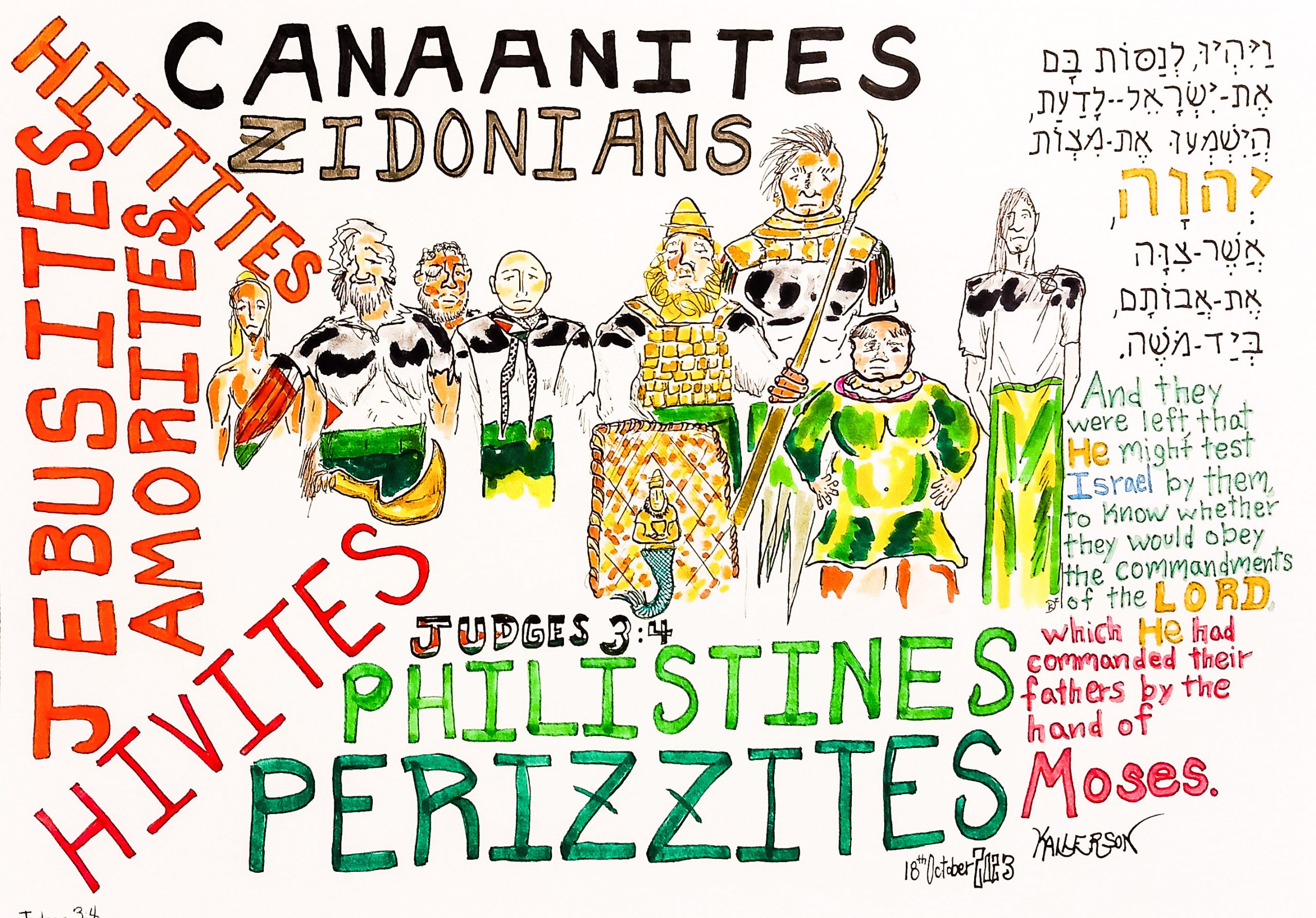
Artwork by Douglas Kallerson
Judges 3:1-11
Othniel, Israel’s First Judge
In 2 Corinthians 3, Paul writes about his trust in God, knowing that our sufficiency comes from Him. In his words, he noted the believers’ trust is “through Christ,” but he possibly feared that this expression wouldn’t be fully understood, so he expanded on it.
He points out that we are not sufficient “of ourselves.” If we have trust in the things of God, then they must be from God. One cannot trust in what one does not believe in! This sufficiency from God excludes thinking that it is somehow derived “from ourselves.”
In all things related to faith, God must be the Source. Our faith, our hope, our trust, our reason for our works, etc., all stem from God. Nothing that we possess in our faith can logically stem from ourselves.
This does not mean that we don’t have free will. Rather, the free will we exercise stems from God as well. He is the Source of all things.
One difference between a mature believer and those who are either weak in their faith or who have almost no faith at all is that they have come to the understanding that all things are from, for, and to God. He is absolutely sovereign, and we are living within the confines of His sovereign works over and through creation.
Text Verse: “And we have such trust through Christ toward God. 5 Not that we are sufficient of ourselves to think of anything as being from ourselves, but our sufficiency is from God, 6 who also made us sufficient as ministers of the new covenant, not of the letter but of the Spirit; for the letter kills, but the Spirit gives life.” 2 Corinthians 3:4-6
With the understanding of God’s sovereignty, Paul continues his thought by acknowledging that “our sufficiency is from God.” The gospel is from God. The conversion was from God. Growth in Christ was from God. Communication of the gospel to others and their reception of it is from God.
If we as believers can truly accept this, then we stand in a good spot in relation to Him. In the end, there should be no fear of failure, no fear of man, and no worry about the day ahead. God is directing all things according to His wisdom.
We are to engage our feet with this thought in mind. Let us head out each day knowing that the Lord is already aware of all that will transpire, and He is directing our steps according to that plan.
The life you have is a gift from the Lord and is to be used for the Lord. Use it to His glory, and don’t fret about the path you are on. He is there with you, and He will be there at the end, waiting for you.
Such great truths as this are to be found in His superior word. And so, let us turn to that precious word once again, and… May God speak to us through His word today, and may His glorious name ever be praised.
I. Taught to Know War (verses 1-6)
Now these are the nations which the Lord left,
The opening words of the chapter give greater detail than what was stated as Chapter 2 closed out. This is a common way that the Bible deals with a subject, first introducing it and then more fully explaining it: v’eleh ha’goyim asher hiniakh Yehovah – “And these the nations which rested Yehovah.” This is how Chapter 2 closed out –
“Then the anger of the Lord was hot against Israel; and He said, ‘Because this nation has transgressed My covenant which I commanded their fathers, and has not heeded My voice, 21 I also will no longer drive out before them any of the nations which Joshua left when he died, 22 so that through them I may test Israel, whether they will keep the ways of the Lord, to walk in them as their fathers kept them, or not.’ 23 Therefore the Lord left those nations, without driving them out immediately; nor did He deliver them into the hand of Joshua.” Judges 2:20-23
The same word used in Chapter 2 is used here, yanakh, to leave alone, lay down, etc. It comes from the same root at nuakh, to rest. He removed His hand from them at the time, not coming after them as before. Instead, they would be laid up, or rested, within the land, but not necessarily permanently…
1 (con’t) that He might test Israel by them,
l’nasoth bam eth Yisrael – “to test in them Israel.” The reason for this setting aside the destruction of these nations is explicitly said to be for a testing of Israel. Again, it is the same word used as Chapter 2 ended, nasah, to test, try, tempt, etc.
This testing is to be for Israel. In Chapter 2, it was said to find out whether they would keep the ways of Yehovah, to walk in them as their fathers kept them or not. Now, that is further explained with the words…
1 (con’t) that is, all who had not known any of the wars in Canaan
eth kal asher lo yadu eth kal mikhamoth k’naan – “all who no knew all wars Canaan.” The testing is tied into the thought of war. The purpose of the wars in Canaan was to eradicate the inhabitants. Therefore, the testing of obedience in keeping the ways of Yehovah includes this warfare.
This can be seen from what occurred in Joshua. First, Joshua was told that the Lord would be with him in battle –
“No man shall be able to stand before you all the days of your life; as I was with Moses, so I will be with you. I will not leave you nor forsake you. 6 Be strong and of good courage, for to this people you shall divide as an inheritance the land which I swore to their fathers to give them. 7 Only be strong and very courageous, that you may observe to do according to all the law which Moses My servant commanded you; do not turn from it to the right hand or to the left, that you may prosper wherever you go.” Joshua 1:5-7
However, when disobedience was found in the nation, this was the result –
“So the Lord said to Joshua: ‘Get up! Why do you lie thus on your face? 11 Israel has sinned, and they have also transgressed My covenant which I commanded them. For they have even taken some of the accursed things, and have both stolen and deceived; and they have also put it among their own stuff. 12 Therefore the children of Israel could not stand before their enemies, but turned their backs before their enemies, because they have become doomed to destruction. Neither will I be with you anymore, unless you destroy the accursed from among you.’” Joshua 7:10-12
Of this, Keil rightly says, “In the wars of Canaan under Joshua, therefore, Israel had experienced and learned, that the power to conquer its foes did not consist in the multitude and bravery of its own fighting men, but solely in the might of its God, which it could only possess so long as it continued faithful to the Lord.”
This is what the subsequent generations would need to learn. To follow in the ways of the Lord is inclusive of performing in war, being obedient to the Lord’s precepts, and not diverting from them.
2 (this was only so that the generations of the children of Israel might be taught to know war,
Verse 2 is parenthetical and explanatory. The Hebrew construction is quite complicated, but it bears an emphasis that falls on the first word of each main clause: raq l’maan daath doroth bene Yisrael l’lamdam mikhamah – “Only, to end purpose know generations sons Israel, to teach them war.” The word raq signifies a limitation. The only reason for leaving these nations was for the purpose of teaching the subsequent generations of Israel war.
Think of those in the church. It is not uncommon for people to ask why the Lord doesn’t just take home and glorify believers when they come to Christ. Why leave us here to go through all the troubles of life? Because someone must teach the next generation about the Lord.
Judges are in the land, being raised up to lead the people in battle. Likewise, we are being raised up to lead people to the Lord and to disciple them in right doctrine. Israel fought earthly battles, Paul speaks of the spiritual warfare of the church, but the parallels are set to see the similarities between the two.
Remember Paul’s words of the text verse. He said, “Not that we are sufficient of ourselves to think of anything as being from ourselves, but our sufficiency is from God.” Joshua discovered that when Achan sinned.
The nation discovered that again when the treaty with the Gibeonites was made without first consulting the Lord. The nation needed to learn that they were wholly dependent on Him. Their sufficiency was not of themselves, but from God. And this was not a one-time event. It is something that had to be repeatedly taught…
2 (con’t) at least those who had not formerly known it),
Rather than “it,” the word is plural, “them.” Again, the word raq, only, provides the emphasis: raq asher l’phanim lo yadum – “Only, who to faces [meaning before] no had known them.” The plural, them, refers to the wars of Canaan. John Lange rightly states –
“It is not for technical instruction in military science that He leaves the heathen nations in the land, but that Israel may know what it is to wage war, that without God it can do nothing against Canaan, and that, having in the deeds of contemporary heroes a present counterpart of the experience of their fathers, who beheld the mighty works which God wrought for Israel through Moses and Joshua, it may learn humility and submission to the law.”
Said plainly, to learn war does not mean to become proficient at killing the enemy but to acknowledge dependence on God, who alone can provide the victory. As Israel will learn, the consequences for not depending on the Lord (not learning this lesson of war) will be serving other nations. This lesson will be borne out time and again in Judges.
For Israel to learn this, a list of nations is next provided. One can see the flow if the parenthetical words of verse 2 are removed –
“Now these are the nations which the Lord left, that He might test Israel by them, that is, all who had not known any of the wars in Canaan …”
3 namely, five lords of the Philistines,
The word translated as lords, seren, signifies a lord, but also an axle. Hence, the word may indicate the lord is the central point upon which the city turns. It is always used in relation to the lords of the Philistines, with the exception of it being used once to describe the bronze axels of the carts in Solomon’s Temple.
As for the name Philistine, it comes from palash, signifying to roll in the dust as an act of mourning. They are the Grievers. Also…
3 (con’t) all the Canaanites, the Sidonians, and the Hivites who dwelt in Mount Lebanon, from Mount Baal Hermon to the entrance of Hamath.
The names are in the singular. The whole clause reads: “and all the Canaanite, and the Sidonian, and the Hivite dwelling Mount the Lebanon from Mount Baal Hermon unto to entering Hamath.”
Canaanite means Humbled, Humiliated, or Subdued. Sidon comes from tsud, to hunt. Thus, it is Hunting Place. As it is on the coast, it means to hunt fish and thus Fishery. Hivite means Villagers, or maybe more specifically, Tent Villagers.
A mountain (har) is a lot of something gathered. It is synonymous with a large but centralized group of people.
Lebanon means White One or even Mountain of Snow. However, it is derived from lavan, meaning white. This is identical to lavan, or brick, because bricks turn white when fired. That word carries the connotation of works because bricks imply the work of man as opposed to stone which is created by God.
Abarim provides Lord of Designation or Lord of Destruction for Baal Hermon. However, being consistent with the translation of Hermon from elsewhere, it would be Lord of Sacred, meaning that which is set apart, as in Designation.
Hamath means “Defense” or “Citadel.”
4 And they were left, that He might test Israel by them,
More exactly, the words read, “And were to test, in them, Israel.” It is through the leaving of these people groups that Israel was to be tested. Would they rely on the Lord? Would they be obedient to Him? This is next explicitly stated…
4 (con’t) to know whether they would obey the commandments of the Lord, which He had commanded their fathers by the hand of Moses.
A verb is used as a noun: “to know the obeying, commandments Yehovah which commanded their fathers in hand Moses.” The testing is through war with these nations. Again, it is not for Israel’s education in military prowess, but for their understanding concerning the effects of war, in victory or in defeat.
If Israel obeys, they will prosper against their enemies. When they don’t, they will suffer the consequences of their disobedience through the wars waged against them. As such…
5 Thus the children of Israel dwelt among the Canaanites, the Hittites, the Amorites, the Perizzites, the Hivites, and the Jebusites.
Rather, the word Canaanite appears to be used as all-encompassing. That is then subdivided into the individual people groups, all of which are in the singular: “And sons Israel dwelt in midst the Canaanite: the Hittite, and the Amorite, and the Perizzite, and the Hivite, and the Jebusite.”
Of those not already described, Hittite means Terror, Terrible, or Fearsome; Amorite – Talkers (active) or Renown (passive); Perizzite – Villager or Dweller in an Open Country; Jebusite – Treading Down (active) or Trodden Underfoot (passive).
This is not the same as the listing of people groups in verse 3. Those were bordering peoples whom Israel would engage in war. These listed here are those dwelling in Canaan. Israel dwelt in the midst of them.
The John Lange Commentary notes that this verse introduces the second major part of the book of Judges, noting, “THE History of Israel under the Judges: a history of sin, ever repeating itself, and of Divine Grace, constantly devising new means of deliverance. Meanwhile, however, the imperfections of the judicial institute display themselves, and prepare the way for the Appointment of a King.”
While dwelling in the midst of these people groups, it next says…
6 And they took their daughters to be their wives, and gave their daughters to their sons; and they served their gods.
The failings of Israel in relation to the law are highlighted in these words when contrasted to those of Moses. For example –
“When the Lord your God brings you into the land which you go to possess, and has cast out many nations before you, the Hittites and the Girgashites and the Amorites and the Canaanites and the Perizzites and the Hivites and the Jebusites, seven nations greater and mightier than you, 2 and when the Lord your God delivers them over to you, you shall conquer them and utterly destroy them. You shall make no covenant with them nor show mercy to them. 3 Nor shall you make marriages with them. You shall not give your daughter to their son, nor take their daughter for your son. 4 For they will turn your sons away from following Me, to serve other gods; so the anger of the Lord will be aroused against you and destroy you suddenly. 5 But thus you shall deal with them: you shall destroy their altars, and break down their sacred pillars, and cut down their wooden images, and burn their carved images with fire.” Deuteronomy 7:1-5
This generation has grown up apart from the leadership of Joshua. They failed to heed the warnings set forth by the Lord and Joshua, and they have departed from following the Lord. Therefore, they will learn through war what it means to not be obedient. The consequences for their failure will be the result.
With verses 5 & 6 concluded as an introduction to this major section, the Pulpit Commentary says –
“CHAPTER 3:7-11 This section introduces us into the actual narrative of the Book of Judges, the prefatory matter being now concluded. The whole book proceeds on the same model as this section does. The apostasy of Israel; their servitude under the oppressor sent to chastise them; their cry of distress and penitence; their deliverance by the judge raised up to save them; the rest which follows their deliverance. There is infinite variety in the details of the successive narratives, but they are all formed on the same plan.”
Be obedient to what I say
Even if not doing so will turn out for good
It is not right for you to ever disobey
Be sure that this is perfectly understood
If My word is violated, and good comes from that
It is because I ordained that it would be this way
But your disobedience only makes you a brat
Even if good comes from it, you have no right to disobey
Turn from disobedience, and always do right
Do not use the excuse that, “Things will turn out ok!”
That is wickedness in My sight
There is never a time when it is right to disobey
II. Othniel the Son of Kenaz (verses 7-11)
In Judges 2:11-16, the repetitive cycle of falling away and then being drawn back to the Lord is introduced. Reading them now and then comparing them to what is said in the next five verses will show this pattern –
“Then the children of Israel did evil in the sight of the Lord, and served the Baals; 12 and they forsook the Lord God of their fathers, who had brought them out of the land of Egypt; and they followed other gods from among the gods of the people who were all around them, and they bowed down to them; and they provoked the Lord to anger. 13 They forsook the Lord and served Baal and the Ashtoreths. 14 And the anger of the Lord was hot against Israel. So He delivered them into the hands of plunderers who despoiled them; and He sold them into the hands of their enemies all around, so that they could no longer stand before their enemies. 15 Wherever they went out, the hand of the Lord was against them for calamity, as the Lord had said, and as the Lord had sworn to them. And they were greatly distressed.
16 Nevertheless, the Lord raised up judges who delivered them out of the hand of those who plundered them.” Judges 2:11-16
“So the children of Israel did evil in the sight of the Lord. They forgot the Lord their God, and served the Baals and Asherahs. 8 Therefore the anger of the Lord was hot against Israel, and He sold them into the hand of Cushan-Rishathaim king of Mesopotamia; and the children of Israel served Cushan-Rishathaim eight years. 9 When the children of Israel cried out to the Lord, the Lord raised up a deliverer for the children of Israel, who delivered them: Othniel the son of Kenaz, Caleb’s younger brother. 10 The Spirit of the Lord came upon him, and he judged Israel. He went out to war, and the Lord delivered Cushan-Rishathaim king of Mesopotamia into his hand; and his hand prevailed over Cushan-Rishathaim. 11 So the land had rest for forty years. Then Othniel the son of Kenaz died.” Judges 3:7-11
7 So the children of Israel did evil in the sight of the Lord.
Rather: vayaasu bene Yisrael eth ha’ra b’ene Yehovah – “And did sons Israel the evil in eyes Yehovah.” This is the second of eight times the masculine term “the evil” is seen in Judges. Each time, it is accompanied by the words “in eyes of Yehovah.” Thus, the offense is personal in the relationship between the people and the Lord…
7 (con’t) They forgot the Lord their God, and served the Baals and Asherahs.
More precisely: “And forgot Yehovah their God and served the Baals and the Asherahs.” The Baals were described in Judges 2. There is the Baal as the main deity, and then there are the Baals of the individual tribes and clans.
Asherahs are based on a nature goddess companion of Baal found in Phoenicia, Assyria, Canaan, etc. They are represented by large wooden pillars or images set up in honor of Ashteroth. Examples can be seen also in Judges 2.
8 Therefore the anger of the Lord was hot against Israel,
It is the common phrase indicating the extreme displeasure of the Lord: vayikhar aph Yehovah b’Yisrael – “And burned nostril Yehovah in Israel.” It is as if the Lord is standing in the midst of the people with His nostril fuming, smoke pouring out of His nose.
8 (con’t) and He sold them into the hand of Cushan-Rishathaim king of Mesopotamia;
vayimkerem b’yad kushanrishathyim melekh aram naharayim – “And sold them in hand Cushan-Rishathaim, king Aram Naharayim.” The name and location are a mouthful. This is the only account where this person is mentioned in Scripture.
As for the meanings, Cushan comes from Cush, the area of Ethiopia. Abarim says that the meaning of Cush is “irretrievably obscure.” The only real clue to its meaning is found in Jeremiah 13:23 –
“Can the Ethiopian change his skin or the leopard its spots?
Then may you also do good who are accustomed to do evil.” Jeremiah 13:23
The skin of the Ethiopian is black, and so most translate Cush as Black. One could argue that is illogical unless the leopard means spots.” But this is just what the word, namer, or leopard, means. It comes from an unused root meaning to filtrate and thus to spot or stain as if by dripping.
The second half of the name, Rishathaim, comes from rishah, wickedness. Being a plural, it would mean Double Wickedness or Extra Wicked. Taken together, the name would most likely mean Black-Double Wickedness.
Aram means Elevated, High, or Citadel. Naharaim comes from nahar, to flow or stream, and speaks of both water and light that flows. But this is used metaphorically for peoples and nations, such as in Isaiah 2, where it says the nations will stream to Jerusalem.
Thus it means Two Steams. The whole name would then mean Elevation (Citadel) of Two Streams, be they of water, light, or something else.
8 (con’t) and the children of Israel served Cushan-Rishathaim eight years.
Bullinger states that as a numeral, eight is the superabundant number. As it is seven plus one, “it is the number specially associated with Resurrection and Regeneration, and the beginning of a new era or order.” As for Israel’s time of service to this guy…
9 When the children of Israel cried out to the Lord,
vayizaqu bene Yisrael el Yehovah – “And cried sons Israel unto Yehovah.” This is what happened when they were in Egypt –
“Now it happened in the process of time that the king of Egypt died. Then the children of Israel groaned because of the bondage, and they cried out; and their cry came up to God because of the bondage.” Exodus 2:23
They were in bondage, they cried to the God, He heard and responded. Under Cushan-Rishathaim’s oppression, they again cry out to the Lord. And He again responds…
9 (con’t) the Lord raised up a deliverer for the children of Israel, who delivered them:
More precisely: “And raised up Yehovah savior to sons Israel and saves them.” In turning back to the Lord and crying out to Him, He returned to them and brought about their deliverance. It is what verse 2:16 said would take place. As for their savior, it is…
9 (con’t) Othniel the son of Kenaz, Caleb’s younger brother.
eth athniel ben qenaz akhi kalev ha’qatan mimenu – “Othniel son Kenaz brother Caleb the younger from him.” Othniel, or Force of God, was seen in Joshua 15 and Judges 1. He is noted as the son of Kenaz, or Hunter. That was explained in Joshua 14 as a name based on a profession, similar to many of our own names. Hence it is someone who seeks a form of wisdom like any such profession would.
He is noted as the younger brother of Caleb, or Dog. Thus, he is a Gentile by genealogy. Of him, it next says…
10 The Spirit of the Lord came upon him, and he judged Israel.
vathi alav ruakh Yehovah vayishpoth et Yisrael – “And became upon him Spirit Yehovah, and judged Israel.” It is a phrase that will be used in Judges, Samuel, and Kings. This is a special marking upon the individual as a divinely appointed Judge to relieve the people in their time of need. Of him, it says…
10 (con’t) He went out to war, and the Lord delivered Cushan-Rishathaim king of Mesopotamia into his hand; and his hand prevailed over Cushan-Rishathaim.
Rather, it is more precise: “And went out to the war, and gave Yehovah in his hand Cushan-Rishathaim, king of Aram. And prevailed his hand over Cushan-Rishathaim.”
Rather than being delivered, it says the Lord gave him into Othniel’s hand. The king of Aram was a present being handed over to Othniel. With that, the record of this foe is ended. Because of this event, the next words are stated…
11 So the land had rest for forty years.
This refers to the time after Othniel’s victory, regardless as to the length of his life. During these years, the land sat quietly and without any further harm from their enemies.
Forty is defined by Bullinger as “a period of probation, trial, and chastisement—(not judgment, like the number 9, which stands in connection with the punishment of enemies, but the chastisement of sons, and of a covenant people).”
And more, because “it relates to enlarged dominion, or to renewed or extended rule, then it does so in virtue of its factors 4 and 10.”
Four, “is the number of things that have a beginning, of things that are made, of material things, and matter itself. It is the number of material completeness. Hence it is the world number, and especially the ‘city’ number.”
Ten signifies “Completeness of order, marking the entire round of anything, is, therefore, the ever-present signification of the number ten. It implies that nothing is wanting; that the number and order are perfect; that the whole cycle is complete.”
Whether at the end of this time of peace or at some point prior to it, the words next say…
*11 (fin) Then Othniel the son of Kenaz died.
Rather than “then,” the text says: “And died Othniel son Kenaz.” Placing this statement at the end of the account would suggest that he died after the forty years. However, the words may simply refer to the ending of his life without any connection to the forty years of peace. Of this and the rest of Judges, Ellicott says –
“Many questions have been raised, such as—Do the forty years include or exclude the period of servitude? Is forty meant to be an exact or a general number? Are the various periods of rest and servitude continuous and successive, or do they refer to different parts of the Holy Land, and do they synchronise? Perhaps no final answer to these questions is as yet possible, and no less than fifty schemes of the chronology of the period of the judges have been attempted, which fact alone proves how insufficient are the data on which to decide.” Charles Ellicott
I would disagree with the last thought. The data are not insufficient. Rather, it is our inability to rightly interpret the data that is problematic. Ellicott died in 1905. Since then, many more opinions have arisen, and there is no agreement on most of these points. As for what we are being shown in the first judge, that will be explained next…
A plan is being worked out by God
In the stream of time it unfolds
With each breath we take or step we trod
The watchful eye beholds
There is trouble along the way
But the Lord remains faithful and true
And with each passing day
The mercies of the Lord renew
Oh Israel, hope in the Lord your God
And know that He has not forgotten you
Someday the Gentiles shall applaud
When to you the message of Jesus finally comes through
III. Explaining Othniel
Othniel is the first judge of Israel. He is the brother of Caleb and son of Kenaz who has pictured the Gentiles in Joshua and Judges 1. The symbolism remains the same here.
Israel is in a time of apostasy, having done evil in the eyes of Yehovah (verse 7). It says they 1) forgot Him, and 2) served the Baals and Asherahs (verse 8). That is two evils –
“‘Has a nation changed its gods,
Which are not gods?
But My people have changed their Glory
For what does not profit.
12 Be astonished, O heavens, at this,
And be horribly afraid;
Be very desolate,’ says the Lord.
13 ‘For My people have committed two evils:
They have forsaken Me, the fountain of living waters,
And hewn themselves cisterns—broken cisterns that can hold no water.’” Jeremiah 2:11-13
In response, the nostril of the Lord burned in Israel (verse 8). It is the continued rejection of the Lord at His coming. In rejecting Jesus, they have rejected the Lord. Thus, (verse 8) He sold (makar) them into the hand of Cushan-Rishathaim, king of Mesopotamia.
As was seen in Judges 2:14, Israel sold, makar, themselves to their enemies (Isaiah 52:3). The Lord allowed it to happen because of their actions. Thus, it can be said that the Lord sold them. The names then tell what is happening. They are sold into the hand of Black-Double Wickedness king of Elevated Two Streams. During this period, they serve him.
In Amos 9, the Lord equates Israel to the people of Cush, or Ethiopia –
“Are you not like the people of Ethiopia [kushi] to Me,
O children of Israel?” says the Lord.
“Did I not bring up Israel from the land of Egypt,
The Philistines from Caphtor,
And the Syrians from Kir?” Amos 9:7
This provides the needed meaning. Israel, equated to the Ethiopians, is in a state of double wickedness. The elevated two streams refer to the House of Israel and the House of Judah (Jeremiah 31:31). Even if they are out of God’s favor at this time, they remain elevated in His redemptive plans. For now, this is the state that they have sold themselves into.
However, the period is only for eight years. It is not a permanent thing. Eight is the superabundant number and is associated with Resurrection and Regeneration. In other words, they will come to accept the resurrected Jesus and be regenerated someday when they cry out to Him (verse 9).
The verse continues with, “And raised up Yehovah savior to sons Israel and saves them.” It speaks of the coming and work of Jesus, including the resurrection, that they will accept at that time. But that is not something that will come out of the blue. There has to be a means by which they will learn this.
Thus, Othniel (Force of God), son of Kenaz (Hunter), Caleb’s (Dog’s) younger brother, is introduced. The Gentile has carried the word of God since Israel rejected Jesus. As explained in both Joshua and Judges 1, Othniel is as a hunter of men in the sense that he is seeking wisdom not only for himself but for others as well.
Therefore, he typifies those who expend themselves in the pursuit of the knowledge of God and in conveying that to others. It is through the Gentiles that the revelation of God in Christ is transmitted back to the Jews. Hence, it says of him in verse 10 that “The Spirit of the LORD came upon him, and he judged Israel.”
The same terminology was said about Jesus in Isaiah 61:1 and then cited by Him in Luke 4:18. The Spirit of God came upon Jesus. That then transfers to those who believe in Him. During this dispensation, it is a Gentile-led church.
Verse 10 continues, saying that Othniel went out to war (2 Corinthians 10:4, etc.) and delivered Black-Double Wickedness, king of Elevated, into his hand, and his hand prevailed over Black-Double Wickedness. The message of believing Gentiles is that the Messiah, Jesus, will prevail over Israel and the House of Judah.
Romans 10:19 and 11:11 both note that Israel will be provoked to jealousy by the Gentiles. It is true that the Gentiles carry a message first penned by a Jew, but that message was inspired by God. Therefore, it is not an issue to say that it is the message from the Gentiles whose message is what will prevail over the Jews someday. Othniel is being used in typology to reveal this.
From there, the number forty was given to indicate the rest that Israel received. As it is related to enlarged dominion or renewed or extended rule, the factors 4 and 10 indicate that the world (4) at that time will be in a state where “nothing is wanting; that the number and order are perfect; that the whole cycle is complete” (Bullinger). That is seen in the words of Isaiah concerning the millennium –
“They shall not hurt nor destroy in all My holy mountain,
For the earth shall be full of the knowledge of the Lord
As the waters cover the sea.” Isaiah 11:9
These few verses are literally crammed with theology if thought through point by point to their logical end: the law cannot save, Jesus is God, the church has not replaced Israel, Israel will come to accept Jesus. On and on, point after point, the message of the word is validated in typology so that we can know when our thoughts are right or wrong.
Paul spoke of our sufficiency being from God in the opening thoughts today. Israel had to learn through war that their trust and sufficiency was to be from God. It is a lesson they have not yet learned. But they will learn it during the greatest war of all time, a war that tragically lies ahead for them and, indeed, for the entire world.
This short story from the book of Judges is given to show us this in advance. Other lessons are yet ahead as we travel through its pages. Let us remember as we read the word that it is all about Jesus. Everything is focused on Him or what He is doing in the world for and through His people. Jesus: praise God for Jesus Christ our Lord.
Closing Verse: “I say then, have they stumbled that they should fall? Certainly not! But through their fall, to provoke them to jealousy, salvation has come to the Gentiles. 12 Now if their fall is riches for the world, and their failure riches for the Gentiles, how much more their fullness!” Romans 11:11, 12
Next Week: Judges 3:12-23 The story is good, yes a good one to tell, because it is so fun… (Ehud, Judge of Israel, Part I) (9th Judges Sermon)
The Lord has you exactly where He wants you. He has a good plan and purpose for you. It is He who judges His people according to their deeds. So, follow Him, live for Him, and trust Him, and He will do marvelous things for you and through you.
Othniel, Israel’s First Judge
Now these are the nations which the LORD left
That He might test Israel by them
That is, all who had not known
Any of the wars in Canaan
(This was only so that the generations
Of the children of Israel – a point to not omit
Might be taught to know war
At least those who had not formerly known it)
Namely, five lords of the Philistines
All the Canaanites, the Sidonians (and there were a lot)
And the Hivites who dwelt in Mount Lebanon
From Mount Baal Hermon to the entrance of Hamath
And they were left, that He might test Israel by them
To know whether they would obey (and be smelling like roses)
The commandments of the LORD
Which He had commanded their fathers by the hand of Moses
Thus the children of Israel dwelt among the Canaanites
———-yes, those “ites”
The Hittites, the Amorites, the Perizzites, the Hivites
———-and the Jebusites
And they took their daughters to be their wives
———-giving approval nods.
And gave their daughters to their sons; and they served their gods
So the children of Israel did evil in the sight of the LORD
They forgot the LORD their God
And served the Baals and Asherahs
Giving false gods an approval nod
Therefore the anger of the LORD was hot against Israel
And He sold them into the hand of Cushan-Rishathaim
———-(there were many tears)
King of Mesopotamia
And the children of Israel served Cushan-Rishathaim eight years
When the children of Israel cried out to the LORD
The LORD raised up a deliverer for the children of Israel
Who delivered them: Othniel the son of Kenaz
Caleb’s younger brother. They had relief for a spell
The Spirit of the LORD came upon him, and he judged Israel
He went out to war, and the LORD delivered Cushan-Rishathaim
———-that bad dude
King of Mesopotamia into his hand
And his hand prevailed over Cushan-Rishathaim
———-Yes, he was subdued
So the land had rest for forty years, a good long ride
Then Othniel the son of Kenaz died
Lord God, turn our hearts to be obedient to Your word
Give us wisdom to be ever faithful to You
May we carefully heed each thing we have heard
Yes, Lord God may our hearts be faithful and true
And we shall be content and satisfied in You alone
We will follow You as we sing our songs of praise
Hallelujah to You; to us Your path You have shown
Hallelujah we shall sing to You for all of our days
Hallelujah and Amen…
Now these are the nations which the Lord left, that He might test Israel by them, that is, all who had not known any of the wars in Canaan 2 (this was only so that the generations of the children of Israel might be taught to know war, at least those who had not formerly known it), 3 namely, five lords of the Philistines, all the Canaanites, the Sidonians, and the Hivites who dwelt in Mount Lebanon, from Mount Baal Hermon to the entrance of Hamath. 4 And they were left, that He might test Israel by them, to know whether they would obey the commandments of the Lord, which He had commanded their fathers by the hand of Moses.
5 Thus the children of Israel dwelt among the Canaanites, the Hittites, the Amorites, the Perizzites, the Hivites, and the Jebusites. 6 And they took their daughters to be their wives, and gave their daughters to their sons; and they served their gods.
7 So the children of Israel did evil in the sight of the Lord. They forgot the Lord their God, and served the Baals and Asherahs. 8 Therefore the anger of the Lord was hot against Israel, and He sold them into the hand of Cushan-Rishathaim king of Mesopotamia; and the children of Israel served Cushan-Rishathaim eight years. 9 When the children of Israel cried out to the Lord, the Lord raised up a deliverer for the children of Israel, who delivered them: Othniel the son of Kenaz, Caleb’s younger brother. 10 The Spirit of the Lord came upon him, and he judged Israel. He went out to war, and the Lord delivered Cushan-Rishathaim king of Mesopotamia into his hand; and his hand prevailed over Cushan-Rishathaim. 11 So the land had rest for forty years. Then Othniel the son of Kenaz died.