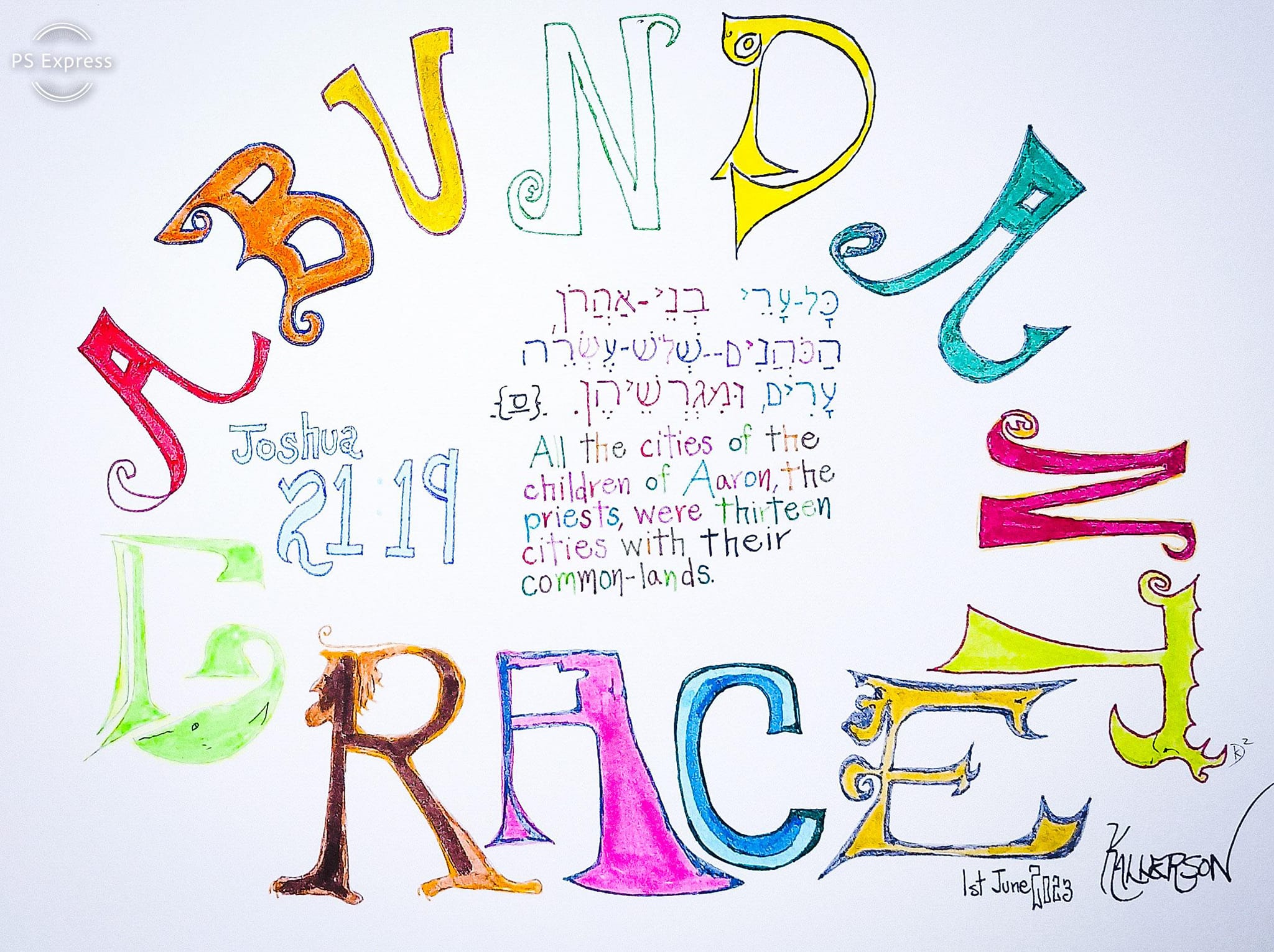
Artwork by Doug Kallerson.
Joshua 21:9-19
The Cities of the Children of Aaron, the Priest
A few years ago, I got an email from Sergio about 2 Corinthians 1:20. He said he had heard a pastor using that verse to describe the great things we can do because we are in Christ. In other words, the pastor was saying the verse is about us.
Sergio said that the analysis just didn’t make sense to him because the Bible is about Jesus, but he couldn’t figure out what was wrong with it. So I copied that verse and its explanation from my 2 Corinthians commentary and sent it to him. This is that short commentary –
——————–
For all the promises of God in Him are Yes, and in Him Amen, to the glory of God through us. 2 Corinthians 1:20
Speaking of Christ Jesus, Paul says that “all the promises of God in Him are Yes.” However, the translation here with the inserted “are” makes “Yes” the predicate of the promises. That is not the intent. Rather, what Paul is saying is that Christ is the incarnate answer to the promises of God. Thus, it should be stated as a separate clause. “For how many soever be the promises of God, in him is the yea.” (ERV)
It is Christ who is the fulfillment of the promises. When we call on Him, those promises which were fulfilled in Him now belong to us. Going on it says “and in Him Amen.” Vincent’s Word Studies notes that “In giving this answer in His person and life, Christ puts the emphatic confirmation upon God’s promises.” God made promises and those promises are emphatically fulfilled in Jesus.
This is explained by Him when He spoke to the leaders of Israel in John 5 –
“And the Father Himself, who sent Me, has testified of Me. You have neither heard His voice at any time, nor seen His form. 38 But you do not have His word abiding in you, because whom He sent, Him you do not believe. 39 You search the Scriptures, for in them you think you have eternal life; and these are they which testify of Me. 40 But you are not willing to come to Me that you may have life.” John 5:37-39
He is the fulfillment of Scripture and therefore the promises of God which were made to the people of God (to Abraham for example, explaining that in his seed all nations of the earth would be blessed) are realized in Him. Paul gives this thought in Romans 15 –
“Now I say that Jesus Christ has become a servant to the circumcision for the truth of God, to confirm the promises made to the fathers, 9 and that the Gentiles might glorify God for His mercy…” Romans 15:8, 9
And in the book of Hebrews, we read this –
“And for this reason He is the Mediator of the new covenant, by means of death, for the redemption of the transgressions under the first covenant, that those who are called may receive the promise of the eternal inheritance.” Hebrews 9:15
Every Messianic promise is realized in Jesus and in Him is the Amen. It means he is faithful and true. In Him is the confirmation and establishment of those promises. In Revelation 3:14 He is called the “Amen” to demonstrate this.
——————–
Text Verse: “Him we preach, warning every man and teaching every man in all wisdom, that we may present every man perfect in Christ Jesus.” Colossians 1:28
Unfortunately, I don’t have the conversation from Sergio to quote exactly because he failed to keep it or even remember us having it. That’s two strikes on him. At least I remember us having it. Also, it was a bit disappointing that he didn’t just go to the commentary without asking me. Strike three.
Despite this, you get the point from the analysis. The promises of God have been made. Jesus Christ is the fulfillment of them all. He is the Answer to questions about what God is doing. How is that relevant to today’s passage? Once again, it is all in the details.
He is the Response from God as to what is needed to be right with Him. Without Jesus Christ, there would only be one path leading to condemnation. But since the fall of man, another path has been hinted at. Jesus Christ is the One who has made that other avenue available.
Thank God for Jesus Christ who has made it so. The details are to be found in our passage today. Such great things are revealed in His superior word. And so, let us turn to that precious word once again, and… May God speak to us through His word today, and may His glorious name ever be praised.
I. Cities from Judah and Simeon (verses 9-12)
The first eight verses of the chapter detailed the lot for each of the sons of Levi concerning their tribal land grants. The first lot was to the priests, the Kohathites, who are the children of Aaron, son of Kohath. The second lot went to the rest of the sons of Kohath.
The third lot went to the sons of Gershon, son of Levi. That was followed by the fourth lot being designated to the sons of Merari, son of Levi. Those first eight verses ended with the words, “And the children of Israel gave these cities with their common-lands by lot to the Levites, as the Lord had commanded by the hand of Moses.”
With that, the tribal land grants, according to those lots, will now be designated, beginning with the words…
9 So they gave from the tribe of the children of Judah and from the tribe of the children of Simeon these cities which are designated by name,
The tribes of Judah and Simeon are the first to have their Levitical cities delineated. All of their Levitical cities are to be given to the priestly class, the sons of Aaron, son of Kohath. Judah means Praise. Simeon means He Who Hears.
For the sake of remembrance, the tribe of Simeon received its inheritance within the borders of Judah. Thus, with the exception of four cities to be designated in Benjamin, all of the priestly cities will be located around Jerusalem within the overall borders of Judah.
Those four cities in Benjamin are in the area bordering Jerusalem today. Thus, by God’s overarching hand of providence, they are all located around where the temple will eventually be erected hundreds of years later. These are cities…
10 which were for the children of Aaron,
It is singular: vay’hi livne Aharon – “And it was to sons Aaron.” Though seemingly awkward, the subject is the lot that is mentioned in the final clause of the verse. Thus, it is saying that “the lot was,” not “the cities were.” What seems awkward is actually a note defining the importance of how the lot is given.
By noting Aaron’s sons now, it is highlighting their importance within the tribe of Levi, being set apart as the priestly caste. Aaron means Very High. Once this division has been noted, only then does it name the family of the tribe…
10 (con’t) one of the families of the Kohathites, who were of the children of Levi;
Again, it is more specific, noting the chief of the families, the son, in the singular: mi’mish’poth haq’hathi mi’bene Levi – “from families the Kohathite from sons Levi.” There is one family of Kohath that is then divided into sons, Aaron is the first son noted just as Kohath is the first son of Aaron. Depending on the root used for the name Kohath, it means either Obedience or Gathering/Assembly. Levi means Attached.
10 (con’t) for the lot was theirs first.
ki lahem hayah ha’goral rishonah – “for to them was the lot, first.” As noted, the goral, or lot, is the subject of the verse, but it is only introduced now. Thus, the priestly class of Aaron is set apart, almost emphatically, by the structure of the sentence. With that, their cities are now to be named…
11 And they gave them Kirjath Arba (Arba was the father of Anak), which is Hebron,
To be precise, it reads, “And gave to them Kirjath Arba, father the Anok, it Hebron.” The spelling of the name is different here than at any other time. Instead of Anaq, it reads Anoq. The addition of the sixth letter, vav, is what changes the spelling and pronunciation
ענוק
ענק
This is the first designated Levitical city. It is the area claimed by Caleb as his possession as promised by the Lord after his faithfulness noted in Numbers 13 & 14. The area was actually designated to him in Joshua 14.
Kirjath Arba means City of Four. Hebron means Alliance. Anak means Long Neck or Necklace. But that requires more explanation. Anaq signifies being fitted out with supplies, and thus furnished liberally, just as a necklace is made up of many pieces. This city is next said to be…
11 (con’t) in the mountains of Judah, with the common-land surrounding it.
Being a city, it is referred to in the feminine: b’har Yehuda v’eth migrasheha s’vivotheha – “in mount Judah and her common-lands and her surroundings.” As noted, this was the area given to Caleb. That point is now explicitly stated to remind Israel of this fact…
12 But the fields of the city and its villages they gave to Caleb the son of Jephunneh as his possession.
Though only the Peshitta, the standard Bible of the Syriac tradition, translates the preposition this way, it literally says, “in his possession.” The whole verse more literally reads, “And field, the city, and her villages, gave to Caleb son Yephuneh, in his possession.”
The entire area, stated in the singular as “field,” along with all of the villages of that area, belonged to Caleb. The common land noted in the previous verse was the area surrounding the city and which extended out for two thousand cubits. This was reserved for the flocks and herds of the Levites within the city as noted in Numbers 35:5 concerning Levitical cities –
“And you shall measure outside the city on the east side two thousand cubits, on the south side two thousand cubits, on the west side two thousand cubits, and on the north side two thousand cubits. The city shall be in the middle. This shall belong to them as common-land for the cities.”
Remember that cities designated as Levitical cities had other people living in them. The city itself was specially set apart for the Levites, but this did not mean it was only for them. This is evidenced as Scripture continues to unfold. As for the names, Caleb means Dog. Yephuneh means He Will Be Beheld.
13 Thus to the children of Aaron the priest they gave Hebron with its common-land (a city of refuge for the slayer),
The order is not as laid out in the Hebrew. The stress is on the fact that this is a city of refuge: “And to sons Aaron the priest gave city refuge the slayer – Hebron and her common-lands.” It is one of the six cities of refuge and the first of the three to be designated within the land of Canaan, west of the Jordan. Next…
13 (con’t) Libnah with its common-land,
More precisely: v’eth livnah v’eth migrasheha – “and Libnah and her common-lands.” Libnah means “Whiteness.” However, that comes from lavan, a verb meaning to make white or make bricks because bricks whiten when they are made.
14 Jattir with its common-land, Eshtemoa with its common-land,
Depending on the root, Jattir means Remainings or Remnant, Surplus, Preeminence, Abundance, Excellence, or something similar. Despite the variations, there is general agreement that the name is best defined as Preeminence.
Eshtemoa comes from shama, to hear. Thus, it means Hearing but in the sense of Obedience.
15 Holon with its common-land, Debir with its common-land,
Depending on the root, Holon means Strong Place or Sandy Place. Debir means Place of the Word.
16 Ain with its common-land, Juttah with its common-land, and Beth Shemesh with its common-land:
Ain means Eye or Fountain. Juttah means Extended, Leveraged, or It Will Be Stretched Out. Abarim explains the root, saying –
“The verb נטה (nata) means to leverage: to manipulate one’s environment beyond one’s natural powers, but at the price of range, accuracy, diversity, duration, and so on — a price that when unpaid drags the entire enterprise into a net-negative collapse. All technology, including information technology, is leverage, which is always to be wielded with great care, whilst always respecting its inevitable price.”
The word mateh, or tribe, is derived from this word. It indicates a staff that represents the tribe.
Beth Shemesh means House of the Sun. In total from Judah and Simeon, there are…
16 (con’t) nine cities from those two tribes;
These nine cities come from within the land of Judah, but Simeon is within the borders of Judah. As some of the cities came from within Simeon, it means that the nine cities are from both tribes. Of the number nine, Bullinger says –
“It is the last of the digits, and thus marks the end; and is significant of the conclusion of a matter. It is akin to the number six, six being the sum of its factors (3×3=9, and 3+3=6), and is thus significant of the end of man, and the summation of all man’s works. Nine is, therefore, THE NUMBER OF FINALITY OR JUDGMENT.”
The number two is the number of division or difference. However, when there are two things, they will contrast but will also confirm a whole. For example, the two testaments of the Bible contrast, but they confirm the whole of the word of God. Next, more cities are noted…
The whole world is at stake because of sin
Nothing will stop the judgment to come
Without Christ Jesus, we are all done in
Without Him, the future is bleak and glum
But because of the work that He has wrought
We can be free from condemnation
With His own blood He has bought
Precious souls from every nation
The cities have a story to tell us
They reveal the glory of what God has done
In the giving of our Lord, our Savior, Jesus
Sin is judged and the victory is won
II. Cities from Benjamin (verses 17-19)
17 and from the tribe of Benjamin, Gibeon with its common-land, Geba with its common-land,
These are from the third designated tribal inheritance that extends from the northern border of Judah, that of Benjamin. Benjamin means Son of the Right Hand. Gibeon, or Giv’on, comes from gavia, meaning a cup or a bowl. When upside down, it looks like a hill. As such, it means Hill Town or Hilly.
Geba has the same essential meaning, Hill. Of these similar names, Abarim adds in a notable comment –
“There are no two ways about it: the names Geba, Gibeah and Gibeath mean Hill, but it’s clear that in the Hebrew experience of reality, hills didn’t only occur in the landscape (collections of earth) but also in the human populations that peopled it.
“The ‘hill of Benjamin’ may have been an actual hill but it also represented the culture that formed within Benjamin. The ‘hill of Saul’ may also have been an actual hill but also referred to the national mood and atmosphere that he generated.
“To the Hebrews, a hill country resembled a humanity that consisted of separate and rivaling tribes, clans and families, while a plain resembled a humanity at peace.”
Of the next verse, a famous biblical figure resided there…
18 Anathoth with its common-land, and Almon with its common-land: four cities.
Anathoth was where the prophet Jeremiah, also of the priestly class, came from –
“The words of Jeremiah the son of Hilkiah, of the priests who were in Anathoth in the land of Benjamin, 2 to whom the word of the Lord came in the days of Josiah the son of Amon, king of Judah, in the thirteenth year of his reign.” Jeremiah 1:1, 2
The root of Anathoth, anah, has one of four separate usages. Thus, it can mean Answer/Response, Occupation, Humbled or Afflicted, or Sing. Jones’ Dictionary says it means Answers to Prayers.
Almon comes from alam, to hide or conceal. Thus it means Hidden or Concealed. But it is not necessarily the type of hidden that means, “Hidden away as a secret.” Rather, it looks to something that is not noticed, purposefully or unintentionally, but which may be revealed later. An example of this is found in Leviticus 4:13 –
“Now if the whole congregation of Israel sins unintentionally, and the thing is hidden [alam] from the eyes of the assembly, and they have done something against any of the commandments of the Lord in anything which should not be done, and are guilty…” Leviticus 4:13
A purposeful example is found in the words of Psalm 10:1 –
“Why, LORD, do you stand far off? Why do you pay no attention [alam] during times of trouble?” Psalm 10:1 (NET Bible)
As such, it could very well signify Unnoticed. As for the number four, Bullinger says –
“It is emphatically the number of Creation; of man in his relation to the world as created; while six is the number of man in his opposition to and independence of God. It is the number of things that have a beginning, of things that are made, of material things, and matter itself. It is the number of material completeness. Hence it is the world number, and especially the ‘city’ number.” Bullinger
19 All the cities of the children of Aaron, the priests, were thirteen cities with their common-lands.
The cities come from three separate tribes, but all are in close proximity to Jerusalem. Thus, the Lord designated the priests to be close to the city where His name would reside long before the move to that location was made. Everything was prepared in advance for the time when the kingship and the priesthood would both be established in Jerusalem from that time forward.
As for the number thirteen, Bullinger says that “every occurrence of the number thirteen, and likewise of every multiple of it, stamps that with which it stands in connection with rebellion, apostasy, defection, corruption, disintegration, revolution, or some kindred idea.”
This is the state of the world without Christ. Israel is being used to reveal this. However, as we saw last week, Bullinger goes further concerning the number. He says –
“THE CONNECTION OF THE NUMBER THIRTEEN WITH SUBSTITUTION AND ATONEMENT The Saviour, though without sin, was ‘made sin,’ or a sin-offering, for His people. He was ‘wounded for our transgressions,’ and bruised for their iniquities. He was, in fact, ‘NUMBERED WITH THE TRANSGRESSORS’ (Isa 53:12). Therefore this number is not only the all-pervading factor of SIN, but also of sin’s atonement. It is not only the number which brands the sinner as a rebel against God, but it is the number borne by the sinner’s Substitute. His very names in the Old Testament, before the work of Atonement was entered on or accomplished, are all multiples of 13, just as His names, afterwards in the New Testament and when the work of Atonement was carried out, are all multiples of 8.”
These are the cities of the priestly class of the Levites, the sons of Aaron, and they have a story to tell…
What works will suffice to please our God?
Who has the preeminence that it will take?
Who has accomplished enough that He would applaud?
And extend His hand out for a shake
Is there any who has heard and obeyed?
So that God will listen and favorably reply
Who has done enough for His wrath to be stayed?
Has anyone done enough to even squeak by?
The cities have a story to tell
About the marvelous thing that God has done
If we pay heed, things will go well
When we learn of the deeds of God’s own Son
III. Our Great High Priest
The previous passage in last week’s sermon showed the overall picture of what Levi’s inheritances point to. There were thirteen inheritances in Israel, showing the rebellion and apostasy of the world, but when Christ is included, it is brought to a state of perfection once again.
The verses today define the priestly role of Christ in that matter. The priests are included in three separate tribes: Judah, Simeon, and Benjamin. The number three defines what is “real, substantial, complete, and entire” (Bullinger).
This reveals the full scope of Christ’s priestly duties for all people at all times. However, there are divisions to be seen within these three inheritances as well. The first is that of Judah (Praise) and Simeon (He Who Hears). As noted, these were for the sons of Aaron (Very High), who is referred to as being from the family of Kohath (Obedience) of the sons of Levi (Attached).
Christ is the Praise of God and He Who Hears, meaning being obedient to, God. He is the exalted (Very High) High Priest (Hebrews 4:14) who was Obedient, even to death while being Attached to God through the incarnation –
“And being found in appearance as a man, He humbled Himself and became obedient to the point of death, even the death of the cross.” Philippians 2:8
With that defined, thus establishing the setting of the inheritance, it went on to naming the cities, identifying the first one in several ways over three verses –
“And they gave them Kirjath Arba (Arba was the father of Anak), which is Hebron, in the mountains of Judah, with the common-land surrounding it. 12 But the fields of the city and its villages they gave to Caleb the son of Jephunneh as his possession.
13 Thus to the children of Aaron the priest they gave Hebron with its common-land (a city of refuge for the slayer).” Joshua 21:11-13
Kirjath Arba, City of Four, is first named. As has been seen, four “is emphatically the number of Creation; of man in his relation to the world as created … It is the number of things that have a beginning, of things that are made, of material things, and matter itself. It is the number of material completeness. Hence it is the world number, and especially the ‘city’ number” according to Bullinger.
It refers to Christ’s work in the material creation to reclaim it from the power of Satan. With that, it then noted Arba as “father the Anok.”
Previous sermons explained that the word anaq signifies being fitted out with supplies, and thus furnished liberally, just as a necklace is made up of many pieces. For example, it is used figurately as a sign of pride as in Psalm 73:6 when referring to the wicked where it says, “Therefore pride serves as their necklace.”
With that understood, it was seen that this is the only time that the word is spelled with an additional letter, a vav, the sixth letter of the Aleph-Bet. Six is the number of man, especially fallen man. This then refers to Christ, the One who was furnished with everything necessary to redeem man through His priestly duties, and which is explained in the words of Hebrews 2 –
“Therefore, in all things He had to be made like His brethren, that He might be a merciful and faithful High Priest in things pertaining to God, to make propitiation for the sins of the people. 18 For in that He Himself has suffered, being tempted, He is able to aid those who are tempted.” Hebrews 2:17, 18
Christ came in the appearance of sinful man, hence, the additional vav. Next, calling it Hebron, Alliance, looks to the relationship established between Christ and His people because of His work. Being in the mountains of Judah, Praise, signifies a gathering of a large, centralized group of people who have been brought to God through Christ’s priestly work because He is the Praise of God.
The note concerning Caleb is given as a historical reference to remind Israel concerning his inheritance, but it is also a typological reminder that he, despite being identified as a Gentile, is included in the inheritance of Judah, and thus the commonwealth of Israel –
“Therefore remember that you, once Gentiles in the flesh—who are called Uncircumcision by what is called the Circumcision made in the flesh by hands— 12 that at that time you were without Christ, being aliens from the commonwealth of Israel and strangers from the covenants of promise, having no hope and without God in the world. 13 But now in Christ Jesus you who once were far off have been brought near by the blood of Christ.” Ephesians 2:11-13
With that explained, the identification of Hebron continued in verse 13 noting that it was given to Aaron (Very High) the priest as a city of refuge. When one is in alliance with Christ, He is the refuge for all who come to God through Him –
“Thus God, determining to show more abundantly to the heirs of promise the immutability of His counsel, confirmed it by an oath, 18 that by two immutable things, in which it is impossible for God to lie, we might have strong consolation, who have fled for refuge to lay hold of the hope set before us.” Hebrews 6:17, 18
Libnah was next named. As stated, that comes from lavan, a verb meaning to make white or make bricks because bricks whiten when they are made. Following the use of this word, ever since the early Genesis account where the people made lavan, or bricks, to build the tower of Babel, it has consistently pictured works-based salvation.
In this case, because it is referring to a city of the Levites, and thus to Christ, it is a picture defining His works. We rightly say that our salvation is the gift of God, not of works. But that does not mean that salvation is not of works. It is; just not our works. It is Christ’s work that saves, His works are then imputed to us who do not work. Thus it is a gift.
The next named city was Jattir, Preeminence. It defines the Person of Jesus Christ because of His work –
“He is the image of the invisible God, the firstborn over all creation. 16 For by Him all things were created that are in heaven and that are on earth, visible and invisible, whether thrones or dominions or principalities or powers. All things were created through Him and for Him. 17 And He is before all things, and in Him all things consist. 18 And He is the head of the body, the church, who is the beginning, the firstborn from the dead, that in all things He may have the preeminence.” Colossians 1:15-18
Next Eshtemoa was named. Like the name Simeon, it comes from the word shama and is defined as Hearing, as in Obedience. It looks to the obedience of Christ as was noted earlier when Philippians 2:8 was cited.
After that was named Holon. It signifies Strong Place. Several verses could be used to explain this, but Romans 5:6 is sufficient –
“For when we were still without strength, in due time Christ died for the ungodly.” Romans 5:6
Likewise, 2 Corinthians 12:9 is just as beautiful to express this. Romans 5:6 defines the salvation obtained through the strength of Christ while 2 Corinthians 12:9 defines our capabilities in our state of salvation because of Christ –
“And He said to me, ‘My grace is sufficient for you, for My strength is made perfect in weakness.’” 2 Corinthians 12:9
These and other verses clearly explain the city named Holon.
Next was named Ain or Fountain. Jesus explained the meaning as He spoke to the woman at the well –
“Jesus answered and said to her, ‘Whoever drinks of this water will thirst again, 14 but whoever drinks of the water that I shall give him will never thirst. But the water that I shall give him will become in him a fountain of water springing up into everlasting life.’” John 4:13, 14
Jesus is the Fountain by which our own fountains of everlasting life are derived.
After that, Juttah was named. That comes from natah, to leverage, and thus it means Leveraged. As noted, it is where the symbol of authority, the mateh, or staff is derived from. When Moses stretched out the staff (mateh) which was a picture of Christ Jesus, he was leveraging the power of God. This should explain the symbolism. Christ is the manner in which God’s power is leveraged for salvation.
Lastly, Beth Shemesh, House of the Sun, was noted from Judah and Simeon. That has been seen in several Joshua sermons as being typical of Christ, the Sun of Righteousness who shines forth as the Light of God described in Revelation 21:23 and which John speaks elsewhere of as the Light of the World.
With those complete, it then noted that there were nine cities from Judah and Simeon. Nine, being the number of finality or judgment, as applied to Christ in these cities is a clear reference to Him as the completion (9) of all things either for salvation or for condemnation (2). There is a contrast between the two, but they confirm the final state of all men.
From there, verse 17, Benjamin, or Son of the Right Hand, was named. Christ is the Son of the Right hand –
“So then, after the Lord had spoken to them, He was received up into heaven, and sat down at the right hand of God.” Mark 16:19
The first two cities, Gibeon and Geba, are etymologically the same. The connection to Gabbatha has been made several times already in Joshua. Having two cities named one after another with this same etymological root is a Hebrew way of providing emphasis by repeating a word or thought.
It is a way of emphatically identifying Christ’s Passion as the defining event that is pertinent to all humanity. Being typologically one out of two, it is as if there are separate rivaling tribes. There is the Hill for the saved, and there is the Hill for the condemned.
From there, verse 18 first mentioned Anathoth, Answer. Jesus Christ is the Answer. As noted in the opening comments today, He is the Yes and the Amen. The priestly city of Anathoth is given as an advanced hint of this. He is the fulfillment of all Messianic expectations.
Finally, the last city was Almon, which I translated for clarity as Unnoticed. It looks to Christ as our High Priest where no sin goes unnoticed in atonement, but for those who have rejected Him, no sin goes without being noticed for condemnation.
The verse ended by noting they are “four cities.” It is again the number of creation, the world number, and the city number. The scope of Christ’s work is all-inclusive as is indicated in the names of these four cities from Benjamin, the Son of the Right Hand.
Finally, verse 19 finished with the note that together, these comprise thirteen cities. It is the number of “rebellion, apostasy, defection, corruption, disintegration, revolution, or some kindred idea.” That is the world in which we live. And yet, it is also the number of “SUBSTITUTION AND ATONEMENT. The Saviour, though without sin, was ‘made sin,’ or a sin-offering, for His people” Bullinger.
This is our High Priest. This is Jesus who has been meticulously described in the priestly Levitical cities of Judah, Simeon, and Benjamin.
An interesting thought is that despite being divided between three tribes, and despite the two tribes, Judah and Simeon, being mentioned separately in verses 9 and 16, they are still counted together for their nine cities.
Thus, the division is 9 and 4 to equal 13. Therefore, there are two overall divisions. As such, the 9 (finality and judgment) contrast the 4 (the number of creation). Just as the cities (9) and the tribes (2) contrast. And yet, they also confirm the entire scope of Christ’s authority over all creation to finalize all things and bring all things to judgment.
The reason He can do this is because He is the One who has already received the judgment of the world upon Himself as He stood on the Pavement, Gabbatha, before the authority set over Him. The King of Israel, the perfect Lamb of God, and our Passover sacrifice was judged despite His perfection.
God has allowed His sacrifice to be vicariously applied to us as the only suitable atonement for our sins. As this is so, and because God must judge sin, He has appointed Jesus Christ to be the One to accomplish this. This is His role as our High Priest.
Those for whom He mediates no longer face a judgment for sin. For those who do not come to Him, there is only the expectation of judgment upon them for their sins. Let us be wise and discerning. The cities have been named and they had a story to tell. Pay heed and come to Jesus who alone can restore you to God through what He has done.
Closing Verse: “Therefore, holy brethren, partakers of the heavenly calling, consider the Apostle and High Priest of our confession, Christ Jesus.” Hebrews 3:1
Next Week: Joshua 21:20-26 How many? Do the math, all rights?… (The Cities of Kohath, the Levites) (47th Joshua Sermon)
The Lord has you exactly where He wants you. He has a good plan and purpose for you. It is He who has defeated the enemy and who now offers His people rest. So, follow Him and trust Him and He will do marvelous things for you and through you.
The Cities of the Children of Aaron, the Priest
So they gave from the tribe of the children of Judah
And from the tribe of the children of Simeon also
These cities which are designated by name
Which were for the children of Aaron. To them, they did go
One of the families of the Kohathites, an initial burst
Who were of the children of Levi; for the lot was theirs first
And they gave them Kirjath Arba
(Arba was the father of Anak), a point we can’t omit
Which is Hebron, in the mountains of Judah
With the common-land surrounding it
But the fields of the city and its villages (this is not a digression)
They gave to Caleb the son of Jephunneh as his possession
Thus to the children of Aaron the priest they gave
Hebron with its common-land (a city of refuge for the slayer)
Libnah with its common-land
Jattir with its common-land, maybe they needed a brick layer
Eshtemoa with its common-land
Holon with its common-land a place pretty swell
Debir with its common-land
Ain with its common-land. With a fountain
———– there was no need to dig a well
Juttah with its common-land
And Beth Shemesh with its common-land also
Nine cities from those two tribes
To the sons of Aaron they did go
And from the tribe of Benjamin, Gibeon with its common-land
Geba with its common-land, and more
Anathoth with its common-land
And Almon with its common-land: cities four
All the cities of the children of Aaron, the priests
Were thirteen cities with their common-lands
———-sweet places to hold feasts
Lord God, turn our hearts to be obedient to Your word
Give us wisdom to be ever faithful to You
May we carefully heed each thing we have heard
Yes, Lord God may our hearts be faithful and true
And we shall be content and satisfied in You alone
We will follow You as we sing our songs of praise
Hallelujah to You; to us Your path You have shown
Hallelujah we shall sing to You for all of our days
Hallelujah and Amen…
9 So they gave from the tribe of the children of Judah and from the tribe of the children of Simeon these cities which are designated by name, 10 which were for the children of Aaron, one of the families of the Kohathites, who were of the children of Levi; for the lot was theirs first. 11 And they gave them Kirjath Arba (Arba was the father of Anak), which is Hebron, in the mountains of Judah, with the common-land surrounding it. 12 But the fields of the city and its villages they gave to Caleb the son of Jephunneh as his possession.
13 Thus to the children of Aaron the priest they gave Hebron with its common-land (a city of refuge for the slayer), Libnah with its common-land, 14 Jattir with its common-land, Eshtemoa with its common-land, 15 Holon with its common-land, Debir with its common-land, 16 Ain with its common-land, Juttah with its common-land, and Beth Shemesh with its common-land: nine cities from those two tribes; 17 and from the tribe of Benjamin, Gibeon with its common-land, Geba with its common-land, 18 Anathoth with its common-land, and Almon with its common-land: four cities. 19 All the cities of the children of Aaron, the priests, were thirteen cities with their common-lands.