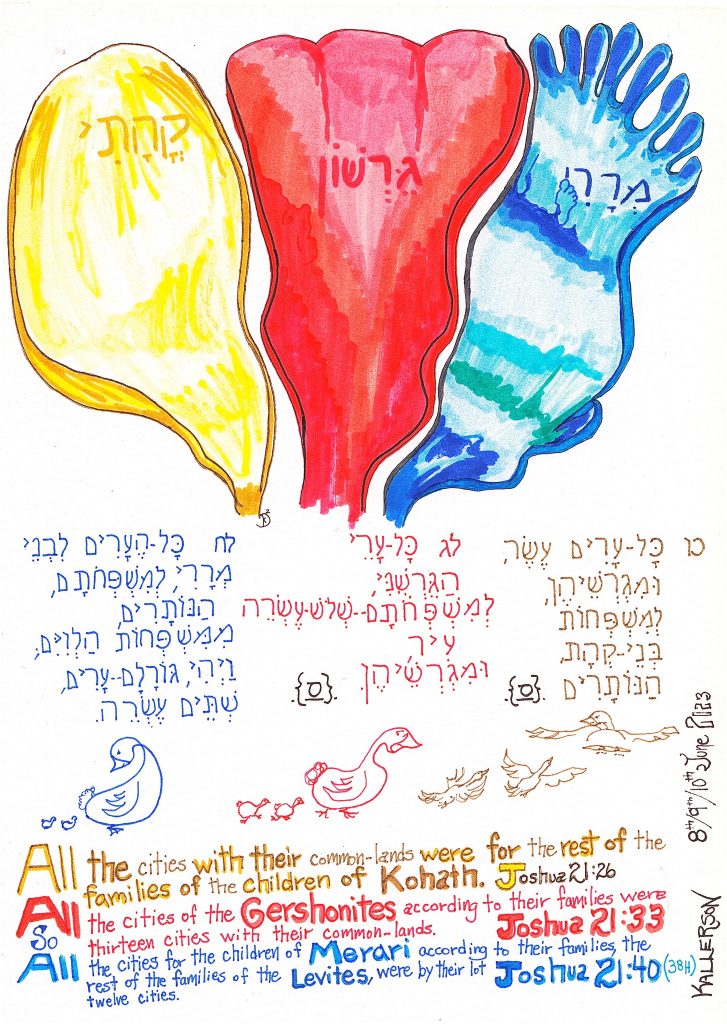
Joshua 21:34-45
The Cities of Merari
One of my frequent recommendations to people, usually in our Thursday Bible studies, is to get a Bible with decent footnotes. I don’t mean a study Bible with brief little comments at the bottom. Those are generally worthless.
Instead, footnotes will often give you the meat of what is going on in a translation. Of our verses today, the NKJV provides a footnote for Joshua 21:36 –
Joshua 21:36 So with LXX, Vg. (cf. 1 Chr. 6:78, 79); MT, Bg., Tg. omit vv. 36, 37
The meaning is that the LXX (the Greek Septuagint) and the Vg (Latin Vulgate) are as they have translated. However, the MT (Masoretic Text), the Bg (be’ur Gra), and the Tg (Targums) omit verses 36, 37.
Without even doing a deep study, we can be certain that the Masoretic Text is rong. The oldest manuscript of theirs is from the 11th century. The be’ur Gra commentary was done by Elijah ben Solomon Zalman in the 18th century, so this also is much later. And the targums are not the greatest source of reliable information because they are based on faulty oral tradition, although they do provide additional support at times.
The Greek Septuagint is a translation from the Hebrew dated around 250BC. The Latin Vulgate is translated from the Hebrew around AD382. Therefore, it’s pretty certain on the surface that verses 36-37 belong there. Without them, the obvious statement found in verse 41 concerning there being forty-eight Levitical cities would be incorrect.
Text Verse: “Be diligent to present yourself approved to God, a worker who does not need to be ashamed, rightly dividing the word of truth.” 2 Timothy 2:15
It is certain that if a copy of a manuscript of Shakespeare’s work was found containing spelling errors, transpositions, margin notes, missing words or sentences, etc., anyone who evaluated it would say, “This is a copy of Shakespeare’s work.” In fact, it would be ridiculous to say otherwise.
And yet, naysayers of the Bible demand perfection of transmission to be a part of the process of conveying His word. If such perfection does not exist (which it could not because of the nature of man), then to them it somehow cannot be God’s word. The thinking is biased and flawed.
It is a trap that too many have fallen into, thus believing that God has somehow preserved His word in an exacting manner that is 100% infallible in one particular version or another. Some people say the LXX is the only infallible translation. Some say the Masoretic Text is inspired and infallible, and some say only the 1611 King Jimmy Version is, etc.
It is an irresponsible way of looking at things. God has preserved His word by giving us an innumerable number of documents by which we can tell what is accurate and what is not. This is true with the two contended verses in Joshua 21 as it is with all other such discrepancies. Cambridge says this concerning verses 36-37–
“This verse and the succeeding have the Masoretic note appended that they are not found in the Masora or true tradition. Kimchi therefore rejects them. But they are found in the LXX. and the rest of the ancient versions, and they are necessary to make up the number of forty-eight cities. Dr. Kennicott, as well as Michaelis, Rosenmuller, and Maurer defended their genuineness. So does Knobel, who complains that Rabbi Jacob Ben Chajim, in his Rabbinical Bible of 1525, has very improperly omitted these towns on the authority of the Masora, and that many editors have foolishly imitated him. They have no doubt been omitted by the mistake of a copyist, who passed on from the אַרְבָע (four) of ver. 35 to that of ver. 37, omitting all that lay between.”
In other words, what has occurred is a very common scribal error known as a homeoteleuton. There is a repetition of endings in words that confuses the scribe as he looks to a source text and then back to the copy he is making. He looked at the end of verse 35 –
Dimnah with its common-land, and Nahalal with its common-land: four cities.
He then looked back to continue and his eyes looked to the ending of verse 37 –
Kedemoth with its common-land, and Mephaath with its common-land: four cities.
He then proceeded on to verse 38 not realizing what he had done. This is why God has preserved His word in multiple manuscripts and in multiple languages. It is because man is fallible.
If you don’t understand this, go back and watch the Exodus 25:10-22 sermon entitled The Ark of the Covenant and the Seat of Mercy. God shows us in typology exactly what we need to know.
Do we have a sure word? We sure do. What we will look at today is the word of God and great things are to be found in His superior word. And so, let us turn to that precious word once again, and… May God speak to us through His word today, and may His glorious name ever be praised.
I. Twelve Cities (verses 34-40)
The Levitical cities have been presented from the tribes in this chapter. The tribal designations and the number of cities were named first. From there, a detailed listing of each has been provided. The first son of Levi to be detailed was that of Kohath.
Those designations were divided between the priestly class and the other Kohathites who were Levites. Next came the sons of Gershon. Now, the final group of Levites, those of Merari, are to be given their detailed listing of cities. That begins with…
34 And to the families of the children of Merari, the rest of the Levites,
Rather than an adjective, a verb is used: u-l’mishp’hoth bene marari hal’viyim ha’notarim – “And to families sons Merari, the Levites, the remainings.” The meaning is that everything that is remaining is to be designated to the Levites of the youngest son, Merari.
The name Merari comes from marar, to be bitter or to be strong. The i at the end may be possessive, and so it means either Bitterness or Strong or My Bitterness or My Strength. The cities of his allotment are named, beginning with…
34 (con’t) from the tribe of Zebulun, Jokneam with its common-land, Kartah with its common-land,
Zebulun means Glorious Dwelling Place. Jokneam means either People Will Be Lamented or Let the People Acquire. Kartah was not listed in the cities of Zebulun as recorded in Joshua 19. This is the only time it is mentioned in Scripture. It comes from qereth, a city. That then comes from qarah, to meet or befall. Thus it means City or Place of Meeting.
35 Dimnah with its common-land, and Nahalal with its common-land:
“Yay! We get Dimnah. We’re number one! We’re number one!” Well, maybe not. Dimnah is also found only here in Scripture. Scholars agree it is from the word domen, dung. Hence, it means Dung Heap.
Nahalal is identical to nahalol, found only in Isaiah 7:19. There, it is translated as pastures or watering holes. Young’s says, “commendable things.” That then comes from nahal to lead or guide to a watering place or a place of rest. The most known use of that is found in Psalm 23 –
“He leads [nahal] me beside the still waters.” Psalm 23:2
Strong’s defines it as Pasture. I define it as Led to Rest.
35 (con’t) four cities;
As we have seen, Bullinger says –
“It is emphatically the number of Creation; of man in his relation to the world as created; while six is the number of man in his opposition to and independence of God. It is the number of things that have a beginning, of things that are made, of material things, and matter itself. It is the number of material completeness. Hence it is the world number, and especially the ‘city’ number.” Bullinger
36 and from the tribe of Reuben, Bezer with its common-land, Jahaz with its common-land,
Reuben’s tribal land is east of the Jordan. And more, Zebulun doesn’t even have a border on the Jordan. Thus, the sons of Merari are somewhat divided from one another.
Reuben means See, A Son. Bezer, or Betser, comes from batsar, meaning to enclose or make inaccessible, and so it means Fortress or Defense. However, it is identical to the word betser, which means precious ore. That is seen only in Job 22 –
“Then you will lay your gold in the dust,
And the gold of Ophir among the stones of the brooks.
25 Yes, the Almighty will be your gold
And your precious silver.” Job 22:24, 25
The idea is that the ore is what people use as a defense or a protection, but the person would put away this protection and trust in the Lord as his gold – his protection – instead.
Jahaz, or Yahats, was seen in Joshua 13. It means Trodden Down. It is where the battle between Israel and Sihon took place as is recorded in Numbers 21:23.
37 Kedemoth with its common-land, and Mephaath with its common-land:
Both cities were also named in Joshua 13. Kedemoth means Ancient Times, Antiquity, or Beginnings. Mephaath means something like Place of Radiance. Abarim notes that it more precisely would be Place of Radiant Theophany.
37 (con’t) four cities;
This now makes eight total cities. Added to that are…
38 and from the tribe of Gad, Ramoth in Gilead with its common-land (a city of refuge for the slayer),
As always, the order of the Hebrew places the emphasis on the fact that it is a city of refuge by stating that first. Only then is the city named: u-mimateh gad eth ir miqlat ha’rotseakh et Ramoth ba’gilad v’eth migrasheha – “And from tribe Gad city refuge the slayer, Ramoth in the Gilead and her common-land.”
Gad is also east of the Jordan. Reuben is furthest south while Gad is on Reuben’s northern border, extending as far north as the half-tribe of Manasseh.
Gad means Troop or Fortune. Ramoth comes from rum, meaning “high” or “exalted.” Thus, it signifies Heights or Lofty Place. The Gilead means The Perpetual Fountain. Also…
38 (con’t) Mahanaim with its common-land,
Mahanaim means Two Camps. It is where the angels met Jacob in Genesis 32:1, giving rise to the name. Eventually, a city was built there. David will flee there after his son Absalom temporarily overthrows him. It is mentioned at various times elsewhere in the Old Testament.
39 Heshbon with its common-land, and Jazer with its common-land:
Heshbon means Intelligence. Jazer, or yatser, means Helpful or He Shall Help.
39 (con’t) four cities in all.
With these final four cities, the designating of the Levitical cities by name is complete…
40 So all the cities for the children of Merari according to their families, the rest of the families of the Levites, were by their lot twelve cities.
The verse more precisely reads: “All the cities to sons Merari, to their families, the remainings from families the Levites. And were their lot cities two ten.”
It is a closing statement on the entire granting of cities within the tribal inheritances for Merari and thus for all the sons of Levi. As for Merari, there are twelve cities granted. It is the number of perfection of government or of governmental perfection.
Four cities and four more, well that makes eight
Add another four and twelve is what you get
Out of these twelve, the typology is great
They tell us that in Christ, our future is set
Let us cherish this wonderful word each day
And enjoy everything that our eyes alight upon
Whatever the words before us say
May we consider them before our eyes move on
There is treasure to be found in this word
It tells us about our glorious Savior Jesus
And so, let us be attentive to what we have heard
Such wonderful things He has done for us
II. The Good Word (verses 41-45)
41 All the cities of the Levites within the possession of the children of Israel were forty-eight cities with their common-lands.
This is exactingly in accord with what was stated by the Lord in Numbers 35 –
And the Lord spoke to Moses in the plains of Moab by the Jordan across from Jericho, saying: 2 “Command the children of Israel that they give the Levites cities to dwell in from the inheritance of their possession, and you shall also give the Levites common-land around the cities. 3 They shall have the cities to dwell in; and their common-land shall be for their cattle, for their herds, and for all their animals. 4 The common-land of the cities which you will give the Levites shall extend from the wall of the city outward a thousand cubits all around. 5 And you shall measure outside the city on the east side two thousand cubits, on the south side two thousand cubits, on the west side two thousand cubits, and on the north side two thousand cubits. The city shall be in the middle. This shall belong to them as common-land for the cities.
6 “Now among the cities which you will give to the Levites you shall appoint six cities of refuge, to which a manslayer may flee. And to these you shall add forty-two cities. 7 So all the cities you will give to the Levites shall be forty-eight; these you shall give with their common-land. 8 And the cities which you will give shall be from the possession of the children of Israel; from the larger tribe you shall give many, from the smaller you shall give few. Each shall give some of its cities to the Levites, in proportion to the inheritance that each receives.” Numbers 35:1-8
The listing of the cities here in Joshua fulfills this mandate of the Lord through Moses. As the cities of refuge were designated as a part of this allocation, and as they have been specifically named during this allocation, the total number of cities must reflect this when they are considered.
In other words, despite being forty-eight cities, it is six plus forty-two that is highlighted above all else. It is to be remembered that the cities are not necessarily inhabited only by Levites. Nor are the Levites restricted only to these cities.
Rather, these cities are designated as Levitical cities for the sake of ensuring the people of Israel were tended to by the Levites in a manner appropriate to the tribal land in which they dwelt. Dispersing the Levites as has been done will ensure that this is the case.
42 Every one of these cities had its common-land surrounding it;
The Hebrew is very precise in its presentation: tihyenah he’arim ha’eleh ir ir u-migrasheha sivivothekha – “Were the cities, the these, city city, and her common-land around her.” It is a way of referring to each city independently and not as a class of cities collectively. The collective is then next referred to…
42 (con’t) thus were all these cities.
ken l’kal he’arim ha’elleh – “thus to all the cities, the these.” Each city was given its own common-land to surround it, and thus it was for all of the cities of the Levites. There was nothing spoken by the Lord that failed to be done.
Because this allocation to the Levites is the last part of the distribution of the land according to inheritances and according to law, there will obviously be a concluding statement to that fact as well. That is next seen…
43 So the Lord gave to Israel all the land of which He had sworn to give to their fathers,
This is the culmination of promises that went back approximately 480 years. The book of Joshua began in the first month of the year 2555 Anno Mundi as can be dated from Joshua 4:19. It is now seven or so years later. So it is somewhere around 2562AM. For context, the call to Abram was in the year 2084AM –
“Now the Lord had said to Abram:
‘Get out of your country,
From your family
And from your father’s house,
To a land that I will show you.
2 I will make you a great nation;
I will bless you
And make your name great;
And you shall be a blessing.
3 I will bless those who bless you,
And I will curse him who curses you;
And in you all the families of the earth shall be blessed.’
4 So Abram departed as the Lord had spoken to him, and Lot went with him. And Abram was seventy-five years old when he departed from Haran. 5 Then Abram took Sarai his wife and Lot his brother’s son, and all their possessions that they had gathered, and the people whom they had acquired in Haran, and they departed to go to the land of Canaan. So they came to the land of Canaan. 6 Abram passed through the land to the place of Shechem, as far as the terebinth tree of Moreh. And the Canaanites were then in the land.
7 Then the Lord appeared to Abram and said, ‘To your descendants I will give this land.” And there he built an altar to the Lord, who had appeared to him.’” Genesis 12:1-4
This promise has been repeated to Isaac, Jacob, and the people of Israel numerous times since then. Thus, the words are given as a confirmation of each instance of those words since they had originally been spoken to Abram. The promises were made and they have been fulfilled…
43 (con’t) and they took possession of it and dwelt in it.
As is the case with the cites, the land is also referred to in the feminine in Hebrew: vayirashuha vayesh’vu bah – “and they possessed her and dwelt in her.” The same feminine language is used of the land elsewhere. A notable example is in Ezekiel 33 –
“For I will make the land most desolate, her arrogant strength shall cease, and the mountains of Israel shall be so desolate that no one will pass through.” Ezekiel 33:28
The intent is that there is to be a mutual blessing between the people and the land, and the land with her people, while the Lord superintends over both. That state of blessing began at this point. With the land and city allocations complete, Israel should live contentedly before the Lord because…
44 The Lord gave them rest all around,
vayankh Yehovah lahem misaviv – “And rested, Yehovah, to them from around.” It is as if the Lord set them down in the land with no need for care or worry about external pressures. Some see this as contradictory because the land is not fully subdued and there were enemies remaining.
But that is not the point of the statement. The land was divided, the people were allocated their parcels, cities were designated for the Levites, and everything was within Israel’s ability to handle.
If any of our parents gave us a piece of property with a house properly secured with gates, doors with locks, weapons of defense, etc., the parents could just as easily say, “We have given you rest in your own home.” It would be illogical to say, “Yes, but there are neighbors who don’t like me, the grass will keep growing, there will be bills for water and electricity, and so on.”
Life goes on. Suitable provision has been made, but there is a point where the person has to say, “I will keep the house secure, I will mow the lawn, I will pay the bills, etc.” This is the state in which Israel is now. They have been rested in the land and now it is their responsibility to provide for themselves by accepting and maintaining their inheritance. The Lord had provided exactly what He promised…
44 (con’t) according to all that He had sworn to their fathers.
Again, the words are given to show the faithfulness of the Lord to His spoken word. He has promised, and His word is an oath in and of itself. The written record here was not questioned by the people at the time. Thus, it cannot be rightly questioned by anyone later. This is confirmed in the next words…
44 (con’t) And not a man of all their enemies stood against them;
v’lo amad ish biphnehem mi’kal oy’vehem – “And no stood man in their faces from all their enemies.” Again, this does not mean there were not enemies around them. It means that there was no active resistance or engagement against them.
The land and the people were suitably subdued. Therefore, any failure to continue to subdue it would be the fault of Israel. The Lord has done what He promised. As it says…
44 (con’t) the Lord delivered all their enemies into their hand.
The singular mixed with the plural is notable: eth kal oy’vehem natan Yehovah b’yadam – “all their enemies gave Yehovah into their hand.” It is a group of people with one hand. The enemies had been sufficiently delivered into it, and all they needed to do was act on what they now possessed. With that, the final verse of the chapter is a celebratory note of victory…
*45 (fin) Not a word failed of any good thing which the Lord had spoken to the house of Israel. All came to pass.
A literal translation is: “Not fell word from all the word, the good, which had spoken Yehovah unto house Israel. The all came.” One can mentally think of the Lord speaking His promises in the past. Since they were spoken, they have floated upon the stream of time in exactly the same way they were first spoken.
Not a single word of prophecy falls out of the line as they continue forward until this point in time, at which they have come rushing into the present and settle as if it was into a house with an open door. The words entered and were considered fulfilled.
This is the faithfulness of the Lord to His spoken word.
Not a word of the Lord shall ever fail us
We can hold fast that it is faithful and true
It is the word that tells about Jesus
Of all that He has done and will do
Not a word will fail of every good thing
Which the Lord has spoken to us
Complete trust in this word to us will bring
A fulfilled hope in the message of Jesus
It is the word of God a light for the way
As we travel through this darkened world
Until comes that most marvelous day
When Christ shall descend as the heavens are unfurled
The book is written and it will come about
Let us be firm and fixed, never having a doubt
III. Explaining the Typology
For the third and last time, we have been provided with a listing of the Levitical cities, other than the priestly cities, for the sons of Levi. As with the Levites of Kohath and Gershon, these allotments detail aspects regarding Christ as the Firstborn in His work under the law.
However, the main content of the passage is mostly centered on the naming of the cities. So, this will not only reflect the work of Christ, but also how it applies to His people, meaning their state in Him.
As we saw, the name Merari means either My Bitterness or My Strength. They are two sides of the same coin because bitterness includes the idea of that which is strong. It looks to the work of Christ. It was a work of bitterness but it is accomplished in the strength of the Lord.
The three tribal allotments of Merari are Zebulun, Reuben, and Gad. They speak of the granting of the Glorious Dwelling Place (Zebulun) as Jesus’ rightful due based upon the proof of God’s declaration of His Sonship – See a Son (Reuben). That, in turn, reflects the fact that in the resurrection is realized His Fortune (Gad).
Within these allotments, the cities were named. The Levitical cities reflect the state of those within the inheritances, meaning believers in Christ. These started with four in Zebulun, Glorious Dwelling Place. Jokneam means Let the People Acquire. It is the allowance of the inheritance because of the work of Christ.
Kartah means City. It speaks of the city Zion, or the New Jerusalem, where believers are already citizens as noted in the New Testament, such as in Galatians, Hebrews, and Revelation. One example is –
“…for this Hagar is Mount Sinai in Arabia, and corresponds to Jerusalem which now is, and is in bondage with her children— 26 but the Jerusalem above is free, which is the mother of us all.” Galatians 4:25, 26
Dimnah, Dung Heap, has its own special meaning for believers. It is the response to the present Zion, meaning the Jerusalem “which now is.” Paul explains that in Philippians –
“But what things were gain to me, these I have counted loss for Christ. 8 Yet indeed I also count all things loss for the excellence of the knowledge of Christ Jesus my Lord, for whom I have suffered the loss of all things, and count them as rubbish [skubalon, dung], that I may gain Christ.” Philippians 3:7, 8
Finally in Zebulun is Nahalal, Led to Rest. We have been led to rest in Christ, our Glorious Dwelling Place. As it says in Hebrews 4, “For we who have believed do enter that rest.”
Next were the four cities of Reuben, See a Son. The first is Bezer, Defense. In Christ we rest in Him as our Defense, having laid aside our own protection. Jahaz, Trodden Down, looks to the total victory found in Christ concerning anything that would keep us from our own state of sonship –
“And the God of peace will crush Satan under your feet shortly.” Romans 16:20
Kedemoth, Ancient Times, refers to the promise fulfilled in Christ and in which we participate –
“…according to the faith of God’s elect and the acknowledgment of the truth which accords with godliness, 2 in hope of eternal life which God, who cannot lie, promised before time began, 3 but has in due time manifested His word through preaching, which was committed to me according to the commandment of God our Savior.” Titus 1:1-3
Mephaath, Place of Radiance, or as Abarim notes Place of Radiant Theophany, surely looks to our faith in Jesus, the manifestation of God in humanity –
“God was manifested in the flesh,
Justified in the Spirit,
Seen by angels,
Preached among the Gentiles,
Believed on in the world,
Received up in glory.” 1 Timothy 3:16
Lastly, Gad, Fortune, also had four cities. The first was Ramoth in the Gilead, or Heights in the Perpetual Fountain. This refers to the state of believers, even now in the heavenly places, sealed with the Holy Spirit. That is a sanctuary city which speaks of being completely secure and hidden in Christ.
That was followed by Mahanaim, Two Camps. This city speaks of the salvation of both Jews and Gentiles. Taken together with Ramoth in the Gilead, both thoughts are found in Ephesians 2 –
“…and raised us up together, and made us sit together in the heavenly places (Ramoth) in Christ Jesus, … For He Himself is our peace, who has made both one, and has broken down the middle wall of separation, 15 having abolished in His flesh the enmity, that is, the law of commandments contained in ordinances, so as to create in Himself one new man from the two (Mahanaim), thus making peace, 16 and that He might reconcile them both to God in one body through the cross, thereby putting to death the enmity. 17 And He came and preached peace to you who were afar off and to those who were near. 18 For through Him we both have access by one Spirit (the Gilead) to the Father.” Ephesians 2:6 & 14-18
One might argue that because they are now one, that would defeat the purpose of the name Two Camps. However, Paul never says that Jews are no longer Jews. The term is reserved for them exclusively. Thus, even though there is one church body, there are two major divisions within it, Jews and Gentiles, despite what replacement theology teaches.
That is followed by Heshbon or Intelligence. It refers to the state of those who are in Christ. Paul contrasts the faith of believers with the intelligence of the world, demonstrating that the wisdom of God is far above what they possess –
“I will destroy the wisdom of the wise;
the intelligence of the intelligent I will frustrate.”
…
“For the foolishness of God is wiser than human wisdom, and the weakness of God is stronger than human strength.” 1 Corinthians 1:19 & 25 (NIV)
Lastly is Jazer, or Helpful/He Shall Help. It is an obvious position in Christ –
“The Lord is my helper;
I will not fear.
What can man do to me?” Hebrews 13:6
The three divisions of four cities, totaling twelve speaks of the effects of Christ’s work covering the entire earth (four) and forming the perfection of government (twelve) out of His people.
Thus the allocation of the Levitical cities is complete, forming a consistent and marvelous set of pictures of the work of Jesus Christ and the effects of His work as realized in His people.
In total, the sets of Levitical cities were said to equal 48 –
The priests (verse 19), 13 cities;
The non-priestly Kohathites (verse 26), 10 cities;
The Gershonites (verse 33) 13 cities;
The Merarites (verse 40) 12 cities.
Total (verse 41), 48 cities.
As the cities of refuge were specifically and emphatically noted, prior to the naming of the city, it should be restated what the entire picture of these cities tells us.
The obvious immediate division of 48 by 12 is that it signifies the perfection of government while 4 represents the number of material completeness. It is the world number, and especially the “city” number.
Thus, in these cities, one can see a representation of the kingdom of God in the world. However, there is a special focus on man which is represented by the six cities of refuge. It is a marvelous picture of God, working through Christ, and forming a universal government, highlighted by those who come to take refuge in Him.
With that, the final verses had a strong emphasis on the fact that this was the completed work of the Lord – “the Lord gave to Israel,” “The Lord gave them rest,” “the Lord delivered all their enemies.” The typology is evident. Jesus Christ has done everything necessary to bring us to God’s rest.
There is nothing lacking in His work and there is nothing that we can do to add to it. This does not mean that we are to just sit idly by and whittle away our time. The inheritance is secured, but our state within it is up to us, just as it was for Israel.
God has not removed them from the equation, even though they have been faithfully unfaithful to Him. And more, He will bring them to the state of exaltation that He promised them. The same is true with us. But how do we want our eternity to be set?
Rewards and losses are coming at the Bema seat of Christ. So let us endeavor to do the work of spreading His name now while we can.
As for the evaluation of the final words of the chapter, rather than merely think of Israel and the Lord’s fulfillment of His word to them, listen again and think of God’s people, His redeemed, and Jesus’ fulfillment of the word for us –
“Not a word failed of any good thing which the Lord had spoken to the house of Israel. All came to pass.”
One can picture the Lord speaking His promises in the past. Since they were spoken, they have floated upon the stream of time in exactly the same way they were first spoken.
Not a single word of prophecy falls out of the line as they continue forward until this point in time, at which they have come rushing into the present and settle as if it was into a house with an open door. The words entered and were considered fulfilled.
This is true for every person who has ever come to Christ. From the first promises of a Redeemer in Genesis 3, all the way through Scripture, every single promise of God is realized in the salvation of each individual who calls out to Him.
And more, there are other promises, future to us now, that God has made. We can be as sure of their coming to pass as we are of those that have been realized already. Be sure to trust Christ today. What He has done, and what God will continue to do through Him, is as certain as the rotation of the earth as each day unfolds; even more so. Let us trust in Him to the glory of God who has spoken forth His word.
Closing Verse: “For all the promises of God in Him are Yes, and in Him Amen, to the glory of God through us. 21 Now He who establishes us with you in Christ and has anointed us is God, 22 who also has sealed us and given us the Spirit in our hearts as a guarantee.” 2 Corinthians 1:20-22
Next Week: Joshua 22:1-9 It’s the best, without any haw or hem… (So Joshua Blessed Them) (50th Joshua Sermon)
The Lord has you exactly where He wants you. He has a good plan and purpose for you. It is He who has defeated the enemy and who now offers His people rest. So, follow Him and trust Him and He will do marvelous things for you and through you.
The Cities of Gershon, the Levites
And to the families of the children of Merari
The rest of the Levites as was planned
From the tribe of Zebulun
Jokneam with its common-land
Kartah with its common-land
Hold on, there are more
Dimnah with its common-land
And Nahalal with its common-land: cities four
And from the tribe of Reuben, Bezer with its common-land
Jahaz with its common-land, totaling up the score
Kedemoth with its common-land
And Mephaath with its common-land: once again cities four
And from the tribe of Gad, Ramoth in Gilead with its common-land
———-(a city of refuge for the slayer)
Mahanaim with its common-land, a portion not so small
Heshbon with its common-land
And Jazer with its common-land: four cities in all
So all the cities for the children of Merari
According to their families, all the men
The rest of the families of the Levites
Were by their lot twelve cities, yes two and ten
All the cities of the Levites
Within the possession of the children of Israel
Were forty-eight cities with their common-lands
Together, they have a marvelous story to tell
Every one of these cities had its common-land surrounding it
Thus were all these cities, really quite a bit
So the LORD gave to Israel all the land
Not a part or just a bit
All of which He had sworn to give to their fathers
And they took possession of it and dwelt in it
The LORD gave them rest all around
According to all that He had sworn to their fathers; just as planned
And not a man of all their enemies stood against them
The LORD delivered all their enemies into their hand
Not a word failed of any good thing
Which the LORD had spoken to the house of Israel
All came to pass
Such a marvelous story to tell
Lord God, turn our hearts to be obedient to Your word
Give us wisdom to be ever faithful to You
May we carefully heed each thing we have heard
Yes, Lord God may our hearts be faithful and true
And we shall be content and satisfied in You alone
We will follow You as we sing our songs of praise
Hallelujah to You; to us Your path You have shown
Hallelujah we shall sing to You for all of our days
Hallelujah and Amen…
34 And to the families of the children of Merari, the rest of the Levites, from the tribe of Zebulun, Jokneam with its common-land, Kartah with its common-land, 35 Dimnah with its common-land, and Nahalal with its common-land: four cities; 36 and from the tribe of Reuben, Bezer with its common-land, Jahaz with its common-land, 37 Kedemoth with its common-land, and Mephaath with its common-land: four cities; 38 and from the tribe of Gad, Ramoth in Gilead with its common-land (a city of refuge for the slayer), Mahanaim with its common-land, 39 Heshbon with its common-land, and Jazer with its common-land: four cities in all. 40 So all the cities for the children of Merari according to their families, the rest of the families of the Levites, were by their lot twelve cities.
41 All the cities of the Levites within the possession of the children of Israel were forty-eight cities with their common-lands. 42 Every one of these cities had its common-land surrounding it; thus were all these cities.
43 So the Lord gave to Israel all the land of which He had sworn to give to their fathers, and they took possession of it and dwelt in it. 44 The Lord gave them rest all around, according to all that He had sworn to their fathers. And not a man of all their enemies stood against them; the Lord delivered all their enemies into their hand. 45 Not a word failed of any good thing which the Lord had spoken to the house of Israel. All came to pass.



