Acts 21:36

US Capitol at night.

Tuesday, 14 November 2023

For the multitude of the people followed after, crying out, “Away with him!” Acts 21:36

Note: You can listen to today’s commentary courtesy of our friends at “Bible in Ten” podcast. (Click Here to listen)

You can also read this commentary, with music, courtesy of our friends at “Discern the Bible” on YouTube. (Click Here to listen), or at Rumble (Click Here to listen).

In the previous verse, the violence of the mob necessitated that Paul be carried by the Roman cohort that had arrested him. To explain the matter further, Luke next says, “For the multitude of the people followed after.”

The angry mob, as so often happens, was unwilling to allow the soldiers to do their duties unhindered. Once Paul was arrested, one would think the people would be satisfied and leave him to the Romans to be dealt with. However, they were so worked up that they were determined to follow, attempting to get their hands on him. As they went, they were “crying out, ‘Away with him!’”

The word translated as “away” is airo. It means to lift up, take off, or remove. Our modern word aero, such as in an aerodrome, finds its root here. It is the same word, in the same angry voice, that was used in Luke 23:18 and John 19:15. For example, it says in Luke 23:18 –

“And they all cried out at once, saying, ‘Away with this Man, and release to us Barabbas.’”

The same word will be used in Acts 22:22, where its full intent and sense will be clearly given –

“And they listened to him until this word, and then they raised their voices and said, ‘Away with such a fellow from the earth, for he is not fit to live!’”

The intent for Jesus as He stood before Israel at Passover, and for Paul now in Acts, is that these crowds wanted them killed.

Life application: The same sentiment has been brought against faithful believers innumerable times over the past two thousand years. Today, it is a common event to see people demanding that Christians be executed for supposed crimes against Islam. Even when the person has done nothing wrong, false charges of blasphemy are conjured up by the rabid accusers.

This is becoming much more common in the West as well. Marxist groups are becoming more and more unfriendly to Christianity. Churches are targeted, politicians on the left cry out untrue accusations, and schools are filled with people who literally hate the idea of Christianity being proclaimed.

These things will never get better. The world is on a course against God, and it is the Bible that properly reveals who He is and how He has displayed Himself in human history. Because of this, the nations hate Israel as well. It isn’t that Israel is right with God, but that God has covenanted with them as a nation. If Israel could be destroyed, then it would prove that the Bible was not truly the word of God.

It is understood from the Bible that Israel will not be right with God until they come to Jesus. Therefore, even Jews hate the complete message of Scripture as revealed in the New Testament. It is why so many Jewish people actively work against Christianity.

Any attack against you simply because you are a faithful Christian, or against your faith because it is biblically based, is an attack against the God who has saved you and who has revealed Himself in Scripture as having done so. Expect this, and do not be surprised as these things occur.

Lord God Almighty, we know that it is in Your power to simply eradicate all the evil in the world today. We also know that You have not done so yet because You have a plan that is greater than our short existence. So, Lord, help us to be patient in our waiting upon You. Should trials come, give us the strength and wisdom to handle them appropriately. To Your glory, we pray. Amen.


Acts 21:35

Capitol in the distance.

Monday, 13 November 2023

When he reached the stairs, he had to be carried by the soldiers because of the violence of the mob. Acts 21:35

Note: You can listen to today’s commentary courtesy of our friends at “Bible in Ten” podcast. (Click Here to listen)

You can also read this commentary, with music, courtesy of our friends at “Discern the Bible” on YouTube. (Click Here to listen), or at Rumble (Click Here to listen).

A literal rendering would be, “And when he came upon the stairs, it happened he was carried by the soldiers because of the violence of the crowd” (CG).

In the previous verse, it noted that the commander of the soldiers couldn’t determine what Paul had done, if anything, because of the yelling of the crowd. Therefore, he commanded that Paul be taken into the barracks where things could be sorted out. Now, the action continues, saying, “And when he came upon the stairs.”

This takes the reader back to verse 32. The Roman soldiers were said to have run down to the tumult, indicating from a higher area. Now, Paul was being conducted back to that place. As they arrived at the stairs to ascend to the barracks, it next says, “it happened he was carried by the soldiers.”

It doesn’t yet say why this is the case. There would only be one of two reasonable explanations for it. The first would be that Paul was purposefully hindering their ascent, refusing to comply with being taken voluntarily. The second would be because of external pressures bearing down on them. The latter is the case. As it says, “because of the violence of the crowd.”

Luke’s description takes us mentally right into the account. The soldiers literally picked him up by his legs and started carrying him up the stairs because the people were pressed in against them.

The more they were pressed, the more the crowd would reach in, trying to get Paul. With the soldiers busy caring for him, they were unable to fend off the people. Luke uses a word to indicate suddenness, sumbainó – literally, “it happened.”

According to Vincent’s Word Studies, “The verb means, literally, to come together; hence, of a coincidence of events. It is designedly introduced here to express more vividly the fact of the peculiar emergency and the peril of Paul’s situation.”

What this means is that while they were on the flat portion of the temple mount, the guards could easily encircle Paul and have their hands ready at their weapons. However, as they arrived at the ascent, the cohort was unable to fully protect him and the raving crowds pressed in, taking advantage of the confined situation to tear at him.

Life application: Like so many things that occur in life, there are times that our guard is let down. For the Romans surrounding Paul, it was an unavoidable event that they could not fully encircle him due to the layout of the surroundings. At times, we may be exhausted, not paying attention, distracted, etc.

At such times, we may let our guard down unintentionally. It is at such times that others may take advantage of the situation and try to trip us up. Likewise, the devil wants nothing more than to have the people of the Lord ineffective in their lives. When we are busily engaged in matters of life, he will come to rob and steal our testimony.

Therefore, even when we are off guard, we need to be on guard. In other words, the old adage, “When you least expect it, expect it,” applies to believers. We need to always have a subroutine running in the back of our minds to be cautious, wise, and discerning about the world around us.

To hone such skills means to purposefully think about one’s surroundings at all times, until it becomes second nature. A bodyguard is taught to be alert at all times. He scans close by and off into the distance. His job is to protect. Ours is too. But our protection is to be directed to our maintaining a good testimony, no matter what challenges we face. Let us endeavor to do so, considering that we represent the Lord at all times.

Glorious Lord God, You have given us salvation and a new direction in life. Please be with us and help us to always reflect a proper attitude that is honoring You. May our guard be up, and may our lives be alert and ready at all times to stop the attacks that suddenly arise against us. To Your glory, we pray. Amen.


Judges 4:1-16 (Deborah, Judge of Israel, Part I)

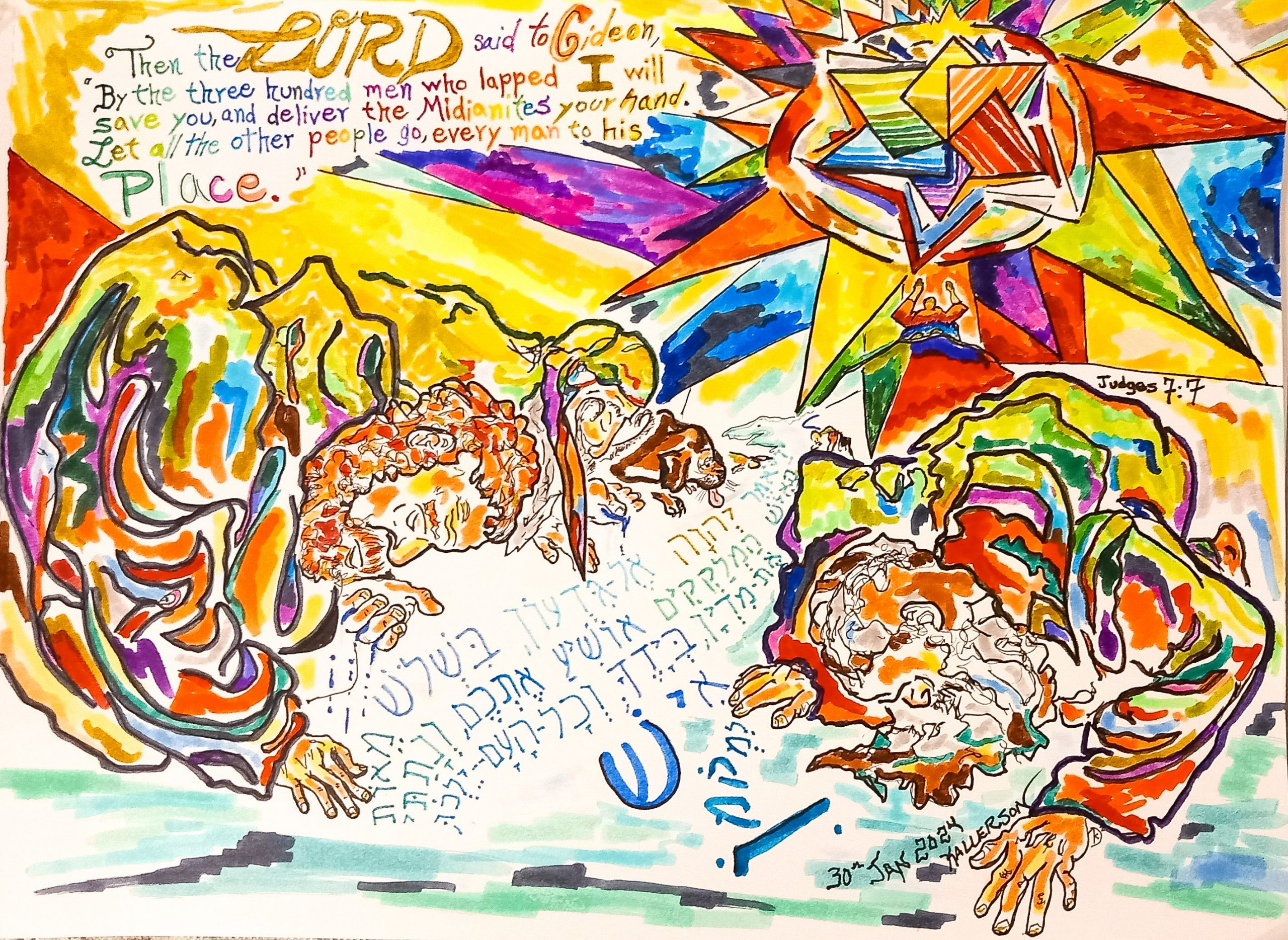
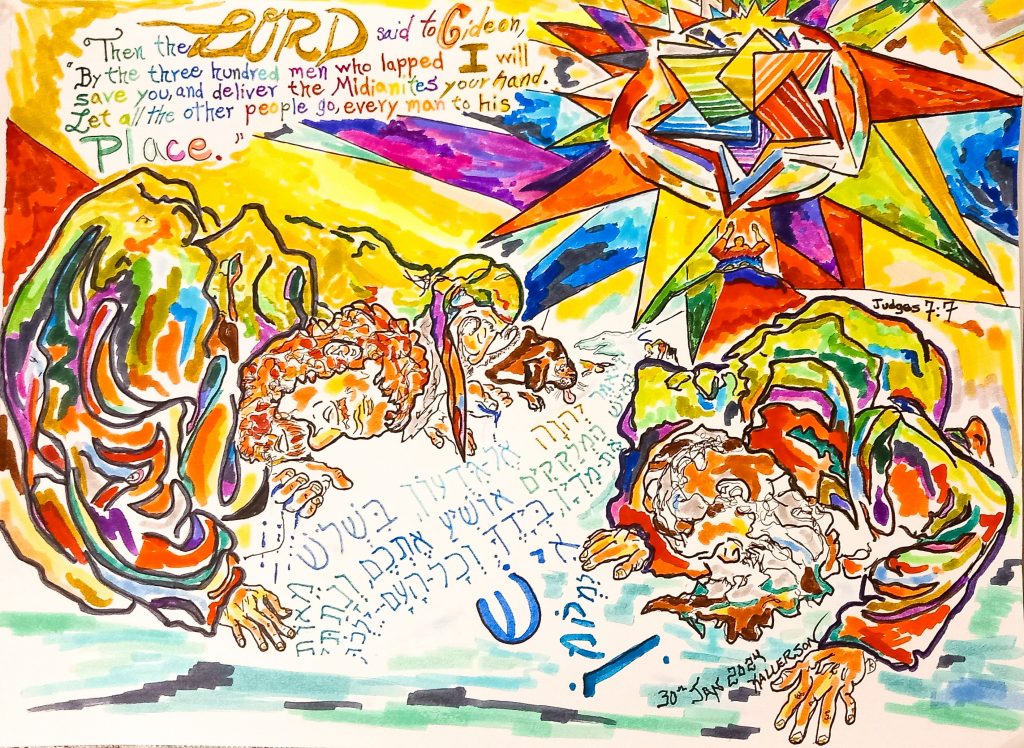
Artwork by Douglas Kallerson.

Judges 4:1-16
Deborah, Judge of Israel, Part I

The Bible is comprised of many types of literature. Each has its own special place and purpose. Some types have overlapping purposes, as we have seen many times. One type of literature is that of prophecy. Quite often, prophetic literature is based upon spoken utterances that were then written down.

It is rare, but not unheard of, for women to prophesy in Scripture. But just like their male counterparts, their words have been recorded, and they are a valuable part of this sacred word. Peter makes a general statement concerning prophecy and the prophetic word, rendering it in the masculine. But women such as Deborah are implicitly included in his words…

Text Verse: “And so we have the prophetic word confirmed, which you do well to heed as a light that shines in a dark place, until the day dawns and the morning star rises in your hearts; 20 knowing this first, that no prophecy of Scripture is of any private interpretation, 21 for prophecy never came by the will of man, but holy men of God spoke as they were moved by the Holy Spirit.” 2 Peter 1:19-21

In our verses today, we will see that Deborah means Bee. But there is more to the meaning of the name than what is literal, as will be seen when we get there. The bee, for example, has a host of information behind it that can be drawn out of the natural world and from Scripture. Because it is so interesting, I will include the comments of Abarim concerning the name of Deborah. Please enjoy their thoughts –

“Tradition and most Bible commentators and translators (including Jones’ Dictionary of Old Testament Proper Names) assume that the bee was known after a derivation of the verb דבר, meaning to speak, because of the sound a bee makes when it flies. This is highly unlikely for two reasons.

First, the bee is not the only creature that makes a sound, or even buzzes. Calling a bee but no other insect a talker would show an imprecision that is ultimately foreign to the Hebrew language.

Secondly, even in Bible times, the bee was culturally defined as a producer of honey. Honey was the only available sweetener in those days, and honey was recognized as a great source of strength (1 Samuel 14:27). Where milk is compared to the initial nutrition of a new believer (1 PETER 2:2), honey serves the die-hards. Hence Canaan was known as the land flowing with milk and honey (Exodus 3:8), and the judgments of the Lord, as well as his words, were deemed sweeter than honey (Psalm 19:10, 119:103). King David reckoned unity in the House of the Lord sweet (Psalm 55:14); Ezekiel tastes a scroll that was given to him by The Word Of God, and it tastes sweet as honey (3:3), and the same happens to John the Revelator (REVELATION 10:10).

Another prominent insect in the Bible is the fly, which also buzzes. The Hebrew word for fly is זבב (zebub), which serves a segment of the name Beelzebub, meaning Lord Of The Flies. The difference between the kingdom of God and the whatever-dom of satan shows clearly in the difference between the bee and the fly: bees have a house, and operate within a complex colony. Bees like flowers and help them reproduce, make honey, speak a language, care for offspring, and are armed. Flies are homeless, aren’t social, don’t cooperate, like dung and decaying flesh, make nothing, speak no language, don’t care for their offspring, and are not armed.

Also note that bees can only function as a society. There is no such thing as a solitary bee, which makes honey on its own out of the sheer perfection of its private brilliance. Instead, the bee is a creature that consists of countless many individuals, who venture about their world and do their little ordinary thing without having much sense of any difference between them and the whole hive. Said otherwise: bees neither have Nobel Prizes nor Superbee comic strips, nor do they imagine to stand on the shoulders of giants.”

When you encounter some part of the created order in the Bible, think about why it is mentioned. The intricacy of it in the natural world will be used in Scripture to teach us greater spiritual truths. Such wonderful things as the bee are to be found in His superior word. And so, let us turn to that precious word once again, and… May God speak to us through His word today, and may His glorious name ever be praised.

I. To Go or Not to Go (verses 1-8)

When Ehud was dead, the children of Israel again did evil in the sight of the Lord.

The NKJV turns the clauses around, thus making it hard to evaluate what is written. Rather, the words read in the following order: vayosiphu bene Yisrael laasoth ha’ra – “And added, sons Israel, to do the evil.”

It is as if there is a divine scale or counter being added to with every evil act of Israel. As has already been seen, it isn’t just evil they are doing, but the evil. It is a personal offense against God, collectively committed by the people as a whole as indicated by the words “sons Israel.”

As there is no king responsible for the people, it is attributed to the people in an all-encompassing way. Further, this is committed b’ene Yehovah – “in eyes Yehovah.” The evil is an offense done openly, almost mocking or challenging the authority of the Lord. It is as if the people are willingly testing Him to see what He would do about it.

It is not at all unlike the attitude of those on the left in the world today. They mock God through their open defiance of Him as if they are purposefully trying to elicit a response. When none comes, they simply do more evil to test Him further. With this condition raging among the people, the verse ends with…

v’ehud meth – “And Ehud died.” Of these words, Adam Clarke says, “Why not when Shamgar was dead? Does this not intimate that Shamgar was not reckoned in the number of the judges?” Shamgar was noted in the last verse of Chapter 3 –

“After him was Shamgar the son of Anath, who killed six hundred men of the Philistines with an ox goad; and he also delivered Israel.” Judges 3:30

As was explained, the words imply that Shamgar was a contemporary of Ehud. He may have arisen after Ehud, but still during the time of Ehud. As noted in the first Judges sermon, the chronology of the Judges, according to Paul’s words of Acts 13:20, demands that there are times when the various judges overlap. This is probably one of those instances.

Ehud was the main judge at the time, but Shamgar was probably appointed as a judge to deal with the Philistines during that same period. Further, unlike so many translations, which are only further marred by the NKJV by reversing the clauses of this verse, it does not say “when,” “now,” “after,” etc., in relation to Ehud’s death.

Again, read the entire verse: “And added, sons Israel, to do the evil in eyes Yehovah. And Ehud died.” There is no reason to assume that the evil began after the death of Ehud: They were doing the evil in the eyes of the Lord (3:12), the Lord strengthened Eglon king of Moab against them (3:12), they cried out to the Lord for deliverance (3:15), the Lord raised up Ehud to deliver them (3:15), they saw the deliverance of the Lord through Ehud, and Ehud declared that it was the Lord who delivered them (3:28).

And yet, Israel added to the evil in His eyes, most likely during the time of Ehud. It said in Chapter 3 that Moab was subdued under the hand of Israel, and it had rest for eighty years. That does not mean that the people were obedient during those years, but that there was no war during them.

Only after saying that Israel added to the evil does it then say, “And Ehud died.” It is as if Israel said, “How do we really know the Lord did this? Let’s test it and see.” And so, they added to the evil…

So the Lord sold them into the hand of Jabin king of Canaan,

vayimkerem Yehovah b’yad yavin melekh k’naan – “And sold them Yehovah in hand Jabin, king Canaan.” As noted in Chapter 2, the idea of selling someone is not for profit. Rather, it is that the Lord handed them over to their enemies as if they were property to be disposed of. “Here, I don’t want this anymore. Do what you will with it.”

The actual sequence is that Israel sold itself to do evil and, therefore, the Lord sold them off for what they were worth, meaning nothing. The name Jabin was noted in Joshua 11 –

“And it came to pass, when Jabin king of Hazor heard these things, that he sent to Jobab king of Madon, to the king of Shimron, to the king of Achshaph, and to the kings who were from the north, in the mountains, in the plain south of Chinneroth, in the lowland, and in the heights of Dor on the west, to the Canaanites in the east and in the west, the Amorite, the Hittite, the Perizzite, the Jebusite in the mountains, and the Hivite below Hermon in the land of Mizpah.” Joshua 11:1-3

This may be a royal or hereditary name that accompanies the position. Thus, it is probably not the same Jabin as before. As for the name, Jabin or yavin, it has to do with discernment, coming from the word bin, meaning to discern. The name means He Perceives, He Discerns, He Understands, The Wise, The Intelligent.

Canaan means Humiliated, Humbled, or even Subdued. Of the location of his reign, like in Joshua 11, it says…

2 (con’t) who reigned in Hazor.

The name Hazor, or khatsor, actually has various meanings based on its root, which signifies “to begin to cluster or gather.” It may mean Village, Trumpet, Leek, Enclosure, and so on. The city falls within the borders of Naphtali (Joshua 19:36).

2 (con’t) The commander of his army was Sisera,

v’sar tsvao sisra – “And commander his host Sisera.” Of the name Sisera, Abarim says, “Fuerst’s Hebrew & Chaldee lexicon to the Old Testament draws toward a foreign word meaning meditator (someone who meditates) and NOBSE Study Bible Name List reads Meditation as well.”

They then say, “To a Hebrew audience, however, the first part of the name Sisera may have reminded of the word סוס (sus), meaning swallow or horse (note that some later versions of Jeremiah 8:7 indeed use the form סיס, sis for סוס, sus) … The -ra part of the name may have sounded as if it came from the verb ראה (ra’a), meaning to see or look.”

Therefore, they say, “to a Hebrew audience the name Sisera may have sounded as something like Keen And Swift or See The Horse.” Of him, it next says…

2 (con’t) who dwelt in Harosheth Hagoyim.

There is an emphasis in the words to ensure it is understood that this is referring to Sisera and not Jabin: v’hu yoshev b’kharosheth ha’goyim – “and HE dwelt in Harosheth Ha’Goyim.” There is nothing complicated about the words, but there are various ways to translate them. The word Hagoyim is the definite article adjoined to the word goyim, which means both Gentiles and nations. Thus:

And he dwelt in Harosheth the Nations.
And he dwelt in Harosheth the Gentiles.
And he dwelt in Harosheth the Goyim.
And he dwelt in Harosheth HaGoyim.
Etc.

The first half of the location comes from kharosheth, a carving or a skillful work. The meaning of the location is then Carving of the Nations or Manufactory of the Gentiles. However, Abarim also provides Silence of the Gentiles based on a different but associated verb.

Concerning these possibilities, they then say, “Since the Bible is not at all interested in political goings on and solely in the evolution of wisdom (that is science and technology of all sorts), this place called Harosheth-hagoyim obviously embodied the strength and validity of systems of learning that were not part of Israel.”

As for what happened to Israel once they came under the yoke of their afflicters, it says…

And the children of Israel cried out to the Lord;

vayitsaqu bene Yisrael el Yehovah – “And cried sons Israel unto Yehovah.” It is ironic that Israel had destroyed Jabin King of Hazor and burned the city with fire, but now Jabin, King of Canaan, who reigned in Hazor, is afflicting Israel.

Whether this was the same location that was rebuilt or another location given the same name, while Israel was frittering away its inheritance, the defeated line of Jabin was rebuilding and preparing for revenge upon the afflicters of his people. When he was in control, Israel finally woke up and cried out to the Lord…

3 (con’t) for Jabin had nine hundred chariots of iron,

ki t’sha meoth rekev barzel lo – “for nine hundred chariot iron to him.” The name Jabin is inserted here, probably incorrectly, based on the emphasis provided in the coming clause. This seems to be referring to the army under Sisera.

It is a vast-sized chariot force. It is likely that these carried scythes on their sides that were fastened to the axles. When they ran through the ranks of men they faced, the horses would trample some, the wheels would crush others, and the scythes would hack up others. They were a fearsome thing to fight against on smooth, open plains.

As for the number, it is a multiple of nine and ten. Nine “is akin to the number six, six being the sum of its factors (3×3=9, and 3+3=6), and is thus significant of the end of man, and the summation of all man’s works. Nine is, therefore, THE NUMBER OF FINALITY OR JUDGMENT” (Bullinger).

Ten signifies “Completeness of order, marking the entire round of anything, is, therefore, the ever-present signification of the number ten. It implies that nothing is wanting; that the number and order are perfect; that the whole cycle is complete” (Bullinger).

3 (con’t) and for twenty years he had harshly oppressed the children of Israel.

There is an emphasis on the individual, and the word translated as “harshly” is a noun, not an adverb: v’hu lakhats eth bene Yisrael b’khazeqah esrim shanah – “And HE oppressed sons Israel in vehemence twenty years.” Here is a new word, khozqah. It is a noun signifying vehemence.

In Exodus 3:9, using the same word translated as oppressed, it noted that the Egyptians oppressed Israel. However, Sisera is said to oppress Israel in vehemence. They failed to learn the lesson of Egypt, and so the Lord sold them to someone even more determined to oppress them in their own land. This went on for twenty years. Of the number twenty, Bullinger notes –

It “…is the double of ten, and may in some cases signify its concentrated meaning. But its significance seems rather to be connected with the fact that it is one short of twenty-one, 21 – 1 = 20; that is to say, if 21 is the three-fold 7, and signifies Divine (3) completion as regards spiritual perfection (7), then twenty, being one short of 21, it would signify what Dr. Milo Mahan calls expectancy.”

Now Deborah, a prophetess, the wife of Lapidoth,

It should be noted that apart from the wicked Athaliah, who stole the throne of Judah for a season, until Prime Minister Golda Meir, Deborah was the only woman to ever lead Israel. But a judge exercised more authority than even the modern Prime Minister. Further, she is the only judge until the last judge, Samuel, noted as being a prophet.

As for the verse, the words are abrupt and are poorly rendered by most translations: u-d’vorah ishah n’viah esheth Lapidoth – “And Deborah, woman, prophetess, wife (or woman) Lapidoth.” The words are placed together without any connectors to call attention to the unusual occurrence of there being a female in this position.

The fact that she is a woman is highlighted, even though it is obvious from the context without saying it. It must be observed that Israel was just delivered by a left-handed man, a seemingly inferior trait. And now, Israel has a female judge – considered even more inferior. Of this, John Lange says –

“That she, a woman, became the centre of the people, proves the relaxation of spiritual and manly energy.” John Lange

This is true, but there is more to it than that. Notably, after her, the next judge will be Gideon –

“So he said to Him, ‘O my Lord, how can I save Israel? Indeed my clan is the weakest in Manasseh, and I am the least in my father’s house.’” Judges 6:15

But this pattern already started with the first judge, Othniel. He was specifically noted as Caleb’s brother, ha’qaton, or “the younger.” The word is derived from qut – to feel a loathing. The implication is that the elder is greater, and anything less is to be despised. And yet the younger, the lesser, was the first judge.

Then there was Ehud, the left-handed, and then Shamgar, son of Anath, or There a Stranger, Son of Affliction. The name itself implies that he was an unlikely candidate to do anything great. The clear point is that the Lord is using what is considered lesser to magnify His glory through the victories that are obtained.

As for the name Deborah, it is identical to the word d’vorah, a bee. That comes from davar, to speak. Thus, the name means Bee. However, beyond that, it implies Speaker or Formalizer, as in pronouncing a word.

She is next identified as a prophetess. So far in Scripture, only Miriam in Exodus 15:20 has been noted as such. The word prophetess comes from the verb nava, to prophesy. That is ultimately derived from a primitive root signifying to speak or sing by inspiration. She formalizes the word of the Lord for the people as she speaks forth what He has inspired.

She is next identified as the wife (or a woman) of Lapidoth. The word Lapidoth comes from lapid, a torch, lamp, lightning, etc. That was first used in Genesis 15:17 to describe the burning lamp of the Lord that passed through the divided animals. It also described the lightnings that flashed at the giving of the Ten Commandments at Mount Sinai.

That word then comes from an unused root, probably meaning to shine. What the words are saying is not readily discernible. Is Lapidoth a person, a location, or a descriptor?

Wife of Lapidoth, whose name means Torches (Lamp).
Woman of a location named Torches.
Woman of Torches, meaning a fiery spirit.
Woman of Flashes, as in a woman of splendors.
Etc.

If Lapidoth were her husband, it would be normal to identify what tribe he belonged to. None is given. Figuratively, the word eshet is applied to women at times, such as woman of foolishness (Proverbs 9:13), woman of contention (Proverbs 21:19), and woman of valor (Proverbs 31:10). Therefore, it is no stretch to use a figurative meaning here as well. Of her, it next says she…

4 (con’t) was judging Israel at that time.

hi shophta eth Yisrael ba’eth ha’hi – “she was judging Israel in the time, the it.” She was the one who rendered decisions on behalf of the Lord, settled controversies, etc. However, she will also be the one to bring the afflicter of Israel to destruction, probably because Sisera would not expect a woman to go beyond ministerial duties to those of warfare. Of her duties, it next says…

And she would sit under the palm tree of Deborah

The verb is a participle: v’hi yosheveth takhat tomer d’vorah – “And she would sit under palm Deborah.” To sit means in judgment, as in Exodus 18:13, where it said Moses sat to judge the people. The palm is a symbol of uprightness and righteousness. With these words, one can get the sense of her sitting in the place of righteousness, conveying to the people the formalized word (davar) of the Lord. This was located…

5 (con’t) between Ramah and Bethel in the mountains of Ephraim.

ben ha’ramah u-ben beith el b’har ephrayim – “between the Ramah and between Bethel, in Mount Ephraim.” The Ramah means The Height or Lofty Place. Bethel means House of God. A mount (har) is a lot of something gathered. It is synonymous with a large but centralized group of people. Ephraim means Twice Fruitful and also Ashes.

5 (con’t) And the children of Israel came up to her for judgment.

vayaalu eleha bene Yisrael la’mishpat – “And ascended unto her sons Israel to the judgment.” To ascend does not necessarily mean in elevation, but in position, such as a subordinate going up to a person of higher rank or respect. This is the meaning here. She is the judge of Israel, and thus, the people ascend to her in that capacity.

Then she sent and called for Barak the son of Abinoam from Kedesh in Naphtali,

va’tishlakh va’tiqra l’baraq ben avinoam miqedesh Naphtali – “And sends and calls to Barak son Abinoam from Kedesh Naphtali.” Without saying it, the implication is that she received a divine word to pass on as instruction. But more, what transpires implies that she has full authority to rule.

She will appoint the commander of the army and direct him accordingly. But more still, he is considerably north of where she is, and yet, he acknowledges her call and comes to her.

Barak means Lightning.

Abinoam comes from av, meaning father. The i is either possessive or locative, and noam means delightfulness or pleasantness. Thus, the name means something like My Father is Pleasantness (Delightfulness) or Father of Pleasantness (Delightfulness).

Kedesh means Holy or Sacred.

Naphtali means My Wrestlings or My Twistings, but it has a secondary meaning of Crafty.

6 (con’t) and said to him, “Has not the Lord God of Israel commanded,

Her words are a Hebrew form of an emphatic proclamation: vatomer elav halo tsivah Yehovah elohe Israel – “And said unto him, ‘Has not commanded Yehovah God Israel.’” In other words, Yehovah, the God of Israel, has definitely commanded according to her words, which are…

6 (con’t) ‘Go and deploy troops at Mount Tabor;

It is a difficult clause: lek u-mashakhta b’har tavor – “Go and draw in Mount Tabor.” The word mashakh signifies to draw, such as drawing Joseph out of the pit, drawing lambs out for the Passover, making a long draw on a horn, drawing a bow, etc.

The next verse will use the same word concerning the army of Sisera. Hence, it seems deploy, as in arraying the troops, is probable. Thus, the next clause is instructive concerning this one – “You will array your troops, and in your deploying, you will take ten thousand men.”

Mount Tabor is just a bit east of Nazareth. The name Tabor may come from barar, to purify or clarify and would mean Purified, Purifying, or Clarifying. However, Strong’s connects it to tvar, to break, and calls it Broken Region. As early as the third century AD, Mount Tabor was considered the Mount of Transfiguration.

6 (con’t) take with you ten thousand men of the sons of Naphtali and of the sons of Zebulun;

Matthew Poole gives several reasons for naming these tribes –

“… partly, because they were nearest and best known to Barak, and therefore soonest brought together; partly, because they were nearest to the enemy, and therefore must speedily be assembled, … and partly, because these had most smarted under their oppressor…”

Being a multiple of ten it “implies that nothing is wanting; that the number and order are perfect; that the whole cycle is complete” (Bullinger).

As for Zebulun, it means Glorious Dwelling Place.

and against you I will deploy Sisera, the commander of Jabin’s army, with his chariots and his multitude at the River Kishon;

The NKJV rearranges the words. They begin with u-mashakhti elekha el nakhal qishon eth sisra sar tseva yavin – “and I will draw unto you (sg.) unto River Kishon Sisera, commander host Jabin.” The word mashakh, or draw, is again used. Hence, the idea of deploying forces in battle array seems to be what is intended.

The River Kishon is a bit south and west of Nazareth and a bit north and east of Megiddo, very close to modern-day Afula. The word translated as river, nakhal, comes from the verb nakhal signifying to take possession. Kishon comes from the verb qush, to lay bait or lure. Thus, it means Snarer or Place of Snaring (or Ensnarement). It is an appropriate name for the moment.

It next says in the singular (which here stands for the plural): v’eth rikvo v’eth hamono – “and his chariot and his multitude.” If all nine hundred chariots were deployed, the entire army with them would be rather sizeable. Despite this, a promise from the Lord is given…

7 (con’t) and I will deliver him into your hand’?”

The verb is in the perfect aspect: unthatihu b’yadekha – “And have given him in your hand.” It is a done deal. All Barak needs to do is engage the enemy. The Lord has assured the outcome. Despite this, Barak’s failing to trust in this actually being a divine word shines forth in the next words…

And Barak said to her, “If you will go with me, then I will go; but if you will not go with me, I will not go!”

Rather, the first responding verb is perfect aspect: vayomer eleha baraq im telkhi imi v’halakhti v’im lo telkhi imi lo elekh – “And said unto her Barak, ‘If you will go with me, and I have gone. And if no will go with me, no I will go.’”

Of this, Keil – in line with numerous others – ridiculously says, “certainly not for the reason suggested by Bertheau, viz., that he distrusted the divine promise given to him by Deborah, but because his mistrust of his own strength was such that he felt too weak to carry out the command of God.”

The guarantee is victory, regardless of his own strength. Keil is saying exactly the same thing as Bertheau, but denying he is saying it. The reason isn’t that he doesn’t trust the divine promise of the Lord. The reason is that he doesn’t trust her words are a divine promise of the Lord. If she goes with him, then it will confirm that she believes the words she has said.

In other words, a person may claim the rapture is going to be on 25 September , but if he keeps asking for people to give to his ministry so that he can pay the bills and send his kids to college, his claims are obviously suspect – I mean, obviously! Likewise, this isn’t a distrust of the Lord, or he wouldn’t go even with Deborah. The aspect of the verbs shows this –

  • “If you will go with me, and I have gone.” There is trust in the word if the communicator of the word is reliable.
  • “And if no will go with me, no I will go.” There is no trust in the word because the communicator of the word is not reliable.

Despite this, there is a penalty for not trusting the commission that rested upon her…

Has not the Lord spoken His word?
And is it not reliable enough to pay heed?
It is a tested and mighty sword
Open it up and give it a read

Has not the Lord confirmed His word?
Again and again, He has done so
Therefore let us strive to live in accord
With this precious gift we have come to know

The Lord has spoken it out as a guide
We can confidently place our full trust in it
And so, let us determine and decide
To glean from it every precious tidbit

II. And the Lord Routed Sisera (verses 9-16)

So she said, “I will surely go with you;

vatomer halokh elekh imakh – “And said, ‘Going I will go with you.’” Her words show absolute confidence in the matter. She had received a divine word, and she had passed it on accordingly…

9 (con’t) nevertheless there will be no glory for you in the journey you are taking,

ephes ki lo tihyeh tiphartekha al ha’derek asher atah holekh – “A cessation, for no will be your glory upon the way which you are going.” The noun ephes means exactly that, a cessation. In this case, it is a way of saying that this is a final word on a particular matter. Thus, it is usually paraphrased as something like “nevertheless.”

She will certainly go with him, but because of his peevishness, Barak has guaranteed that he will not be the one who is most remembered for the victory the Lord will provide. Rather, and embarrassingly…

9 (con’t) for the Lord will sell Sisera into the hand of a woman.”

Barak has been commissioned to lead the host into battle. The battle will be engaged and won. But instead of him being given the ultimate honor for having won it, a woman will receive the greater glory. The thought is expressed in 2 Samuel 12 concerning such a victory –

“Now Joab fought against Rabbah of the people of Ammon, and took the royal city. 27 And Joab sent messengers to David, and said, ‘I have fought against Rabbah, and I have taken the city’s water supply. 28 Now therefore, gather the rest of the people together and encamp against the city and take it, lest I take the city and it be called after my name.’” 2 Samuel 12:26-28

Instead of honor, a later account in Judges will help explain the humiliating nature of Deborah’s words –

“But a certain woman dropped an upper millstone on Abimelech’s head and crushed his skull. 54 Then he called quickly to the young man, his armorbearer, and said to him, ‘Draw your sword and kill me, lest men say of me, “A woman killed him.”’ So his young man thrust him through, and he died.” Judges 9:53, 54

9 (con’t) Then Deborah arose and went with Barak to Kedesh.

vataqam d’vorah vatelekh im baraq qedshah – “And arose, Deborah, and went with Barak Kedesh-ward.” Deborah is perfectly confident that the word she has received is reliable. Barak is now convinced as well. He has come to trust not just the word of the Lord but the messenger of the Lord who gave it.

10 And Barak called Zebulun and Naphtali to Kedesh;

vayazeq baraq eth zevulun v’eth Naphtali qedshah – “And cried out, Barak, Zebulun and Naphtali Kedesh-ward.” The word here is not the same as in verse 6, translated as “called.” Rather, it is zaaq. It means to cry out. In this case, it implies for the people to hear and respond for battle, heading for Kedesh. Once gathered…

10 (con’t) he went up with ten thousand men under his command, and Deborah went up with him.

Here is an idiom signifying authority: vayaal b’raglav asereth alphe ish vataal imo d’vorah – “And ascended in his feet ten thousand man, and ascended with him Deborah.” It is as if he is leading, and the men are following along in his steps, being in submission to him. The idiom will be explained in verse 14, where it says, “after him.”

There are no horses or chariots among them. Each followed in his steps while Sisera’s vast and well-equipped army awaited them. But they had Deborah with them, and that means they had the certain word of the Lord assuring their victory.

With that, a new figure is introduced. When such a seemingly arbitrary introduction is made, it usually signifies an important figure is actually being introduced. For example, in Genesis 22, a seemingly unimportant addendum is added at the end of the chapter –

“Now it came to pass after these things that it was told Abraham, saying, “Indeed Milcah also has borne children to your brother Nahor: 21 Huz his firstborn, Buz his brother, Kemuel the father of Aram, 22 Chesed, Hazo, Pildash, Jidlaph, and Bethuel.” 23 And Bethuel begot Rebekah. These eight Milcah bore to Nahor, Abraham’s brother. 24 His concubine, whose name was Reumah, also bore Tebah, Gaham, Thahash, and Maachah.” Genesis 22:20-24

And yet, this seemingly irrelevant passage becomes fully understandable in Genesis 24, which deals with the continuation of the line of promise through the marriage of Isaac to Rebekah. Likewise, what is next said will lead to the fulfillment of Deborah’s prophecy from the Lord.

11 Now Heber the Kenite, of the children of Hobab the father-in-law of Moses, had separated himself from the Kenites

Rather: v’khever ha’qeni niprad miqayin, mibene khovav khothen mosheh – “And Heber the Kenite has separated from Kain, from sons Hobab, in-law Moses.” The Kenites were a nomadic people who came out of the wilderness with Israel at the time of Moses. They were related to Moses by marriage. The term khathan, or in-law, is used. This can be a father-in-law, brother-in-law, etc. The word carries the idea of affinity through marriage in various ways.

This person, Heber, separated himself from the other Kenites as nomadic people will do. The reason for stating this is because the Kenites were mentioned as being in the Wilderness of Judah in Judges 1:16.

Heber means Associate, Companion, Fellowship, etc., coming from the verb khavar, to unite or join.

Kenite is a patronym derived from Qayin, or Kain. That name is derived from qanah, to acquire. However, it is also etymologically connected to qayin, spear. To further complicate things, Jones’ Dictionary takes the meaning from Numbers 24:21, tying it to the word qen, or nest. Thus, various names can be considered: Acquire, People of the Spear, Nestling, etc.

Kain (Cain) bears the same possible meanings as Kenite.

Hobab comes from khavav, to love. Thus, it means Cherished, Loved, Beloved, etc.

Moses means He Who Draws Out.

Of Heber, it says…

11 (con’t) and pitched his tent near the terebinth tree at Zaanaim, which is beside Kedesh.

vayet aholo ad elon batsanim asher eth qedesh – “And stretched his tent until terebinth in Zaanaim (or until Elon-Zaanaim) which with Kadesh.” The meaning is that the area of his nomadic lifestyle took him as far as the terebinth tree, which is in the area of Zaanaim in the same area as Kedesh.

Elon is an oak or a terebinth. But that is also derived from ayil, a ram. That is then derived from ul, a word that gives the sense of strength.

Zaanaim comes from tsaan, to wander or travel about. Hence it means Migrations, Wanderings, or Removals.

12 And they reported to Sisera that Barak the son of Abinoam had gone up to Mount Tabor.

vayagidu l’sisra ki alah baraq ben avinoam har tavor – “And told (pl.) to Sisera, for has ascended Barak son Abinoam Mount Tabor.” The plural means that it was probably not Heber that told them. Sisera was referred to in the singular in the previous verse. It is rather a general statement that his men or someone aligned with him told of Barak’s position. With this information at hand, it next says…

13 So Sisera gathered together all his chariots, nine hundred chariots of iron,

vayazeq sisra eth kal rikvo tesha meoth rekhev barzel – “And cried out, Sisera all his chariot, nine hundred chariot iron.” In discovering that Barak is on the mountain, Sisera would be able to surround it and compel him to surrender. There could not be a long siege without a city filled with supplies to sustain them. And along with the chariots…

13 (con’t) and all the people who were with him, from Harosheth Hagoyim to the River Kishon.

The words refer to the vast plain on the bank of the Kishon that could sustain Sisera’s chariots in battle. This is where he had planned on conducting the battle, and it would have been a highly effective place to do so. But he is drawn away from this choice area to go to Mount Tabor. This was exactly the plan set forth to trap him. And it worked…

14 Then Deborah said to Barak, “Up! For this is the day in which the Lord has delivered Sisera into your hand.

vatomer d’vorah el baraq qum ki zeh ha’yom asher natan Yehovah eth sisra b’yadekha – “And said, Deborah, ‘Arise! For this the day which has given Yehovah Sisera in your hand.” Sisera is as a gift from the Lord to be defeated.

All they need to do is engage the battle because the gift has already been bestowed. To assure him that this is so, she gives another emphatic proclamation…

14 (con’t) Has not the Lord gone out before you?”

halo Yehovah yatsa l’phanekha – “Has not Yehovah gone out to your face?” In verse 6, she asked, “Has not commanded Yehovah God of Israel?” At that time, Barak doubted her words as being inspired. Now, he has no reason to do so. She had accompanied him, and the battle was strategically ready. With the assurance of the Lord going before him, it could not but succeed…

14 (con’t) So Barak went down from Mount Tabor with ten thousand men following him.

More precisely, “And descended from Mount Tabor, and ten thousand man following him.” The sudden rushing of Barak’s men would render many chariots all but useless. They needed to be properly aligned and carefully prepared for an impending battle.

Despite this, there would still be many chariots that might be able to carry out an attack. And yet, Barak and his men left the higher ground and engaged on the plain. Chaos was sure to ensue, and it did…

15 And the Lord routed Sisera and all his chariots and all his army with the edge of the sword before Barak;

The wording is very peculiar and seems to not fit: vayaham Yehovah eth sisra v’eth kal ha’rekhev v’eth kal ha’makhaneh l’pi kherev liphne barak – “And confused Sisera and all the chariot and all the camp to mouth sword to face Barak.”

The phrase “to mouth sword” is usually associated with the act of directly killing the enemy, not as an overall phrase of battle as it is used here. John Lange paraphrases it by saying, “in the conflict.” However, the use of kherev is intentional and is certainly telling us something typologically.

As for the word translated as “confused,” it is the same word, hamam, that the Lord used when He promised this in Exodus 23 –

“I will send My fear before you, I will cause confusion [hamam] among all the people to whom you come, and will make all your enemies turn their backs to you. 28 And I will send hornets before you, which shall drive out the Hivite, the Canaanite, and the Hittite from before you.” Exodus 23:27, 28

The word signifies to make a noise or move noisily, and thus to cause confusion. This is ascribed to the Lord, and so whatever threw them into confusion, it is exactly what the Lord promised in Exodus 23. There was absolute chaos among the foes. Also…

15 (con’t) and Sisera alighted from his chariot and fled away on foot.

vayered sisra meal ha’merkvah vayanas b’raglav – “and descended Sisera from upon the chariot and fled in his feet.” This was probably an attempt to fit in with the rest of the people and not be identified as the commander. John Lange gives his impression of the battle –

“It must have been his intention, in case Barak did not attack, to surround him on the mountain, and thus compel him to descend into the valley. But before the terrible chariot-force has well arranged itself, the Israelitish army, fired with divine enthusiasm by Deborah, and led by Barak, charges down on the flanks of the enemy, and breaks up their battle ranks. Everything is thrown into confusion—panic terrors ensue,—everything turns to flight. The great captain has lost his head; of all his strategic plans nothing remains; only presence of mind enough is left him to seek salvation from destruction by not fleeing in his chariot, nor with the others.” John Lange

While Sisera was fleeing, it next says…

16 But Barak pursued the chariots and the army as far as Harosheth Hagoyim,

v’baraq radaph akhare ha’rekhev v’akhare ha’makhaneh ad harosheth ha’goyim – “And Barak pursued after the chariot and after the camp until Harosheth Hagoyim.” The enemy was pursued as far as the home of Sisera from where they came, and they were destroyed in the same area where they were supposedly to destroy Barak and his men…

*16 (fin) and all the army of Sisera fell by the edge of the sword; not a man was left.

The words speak of absolute victory for Barak: vayipol kal makhaneh sisra l’pi kherev lo nishar ad ekhad – “and fell all camp Sisera to mouth sword. No remained even to one.” So much for going out with your troops. The only survivor at this time is Sisera. The enemy had been destroyed to the last man.

Meanwhile, Sisera is heading in a northerly direction to find a safe haven in Hazor. If he makes it there, he will be the only one to convey to Jabin the details of what occurred.

For now, we must close in anticipation of completing the chapter next week. The one lesson that I give you here is to tell you that I do not disagree with Barak’s decision to question the integrity of Deborah, unless he had previously dealt with her or was aware of her status as a prophetess.

There are innumerable people who claim divine revelation and a word from the Lord to this day. And yet, there is no reason to believe any of them. The Bible is complete. It finishes with a note about the grace of our Lord Jesus and the word Amen. We don’t need any further revelation from the Lord.

What we need has been provided. Not a single prophecy or supposed divine utterance since the completion of the Bible has any bearing on what the church or those in it need to know. Hold fast to this word and be confident in it. Our lives will unfold exactly as they should without trying to pry into things that God has not already given us in His word. Hold fast to Scripture alone, and you will do well.

Closing Verse: “Deal with them as with Midian,
As with Sisera,
As with Jabin at the Brook Kishon.” Psalm 83:9

Next Week: Judges 4:17-24 Ooh ah! What will it tell… when we are through? (Deborah, Judge of Israel, Part II) (12th Judges Sermon)

The Lord has you exactly where He wants you. He has a good plan and purpose for you. It is He who judges His people according to their deeds. So, follow Him, live for Him, and trust Him, and He will do marvelous things for you and through you.

Deborah, Judge of Israel, Part I

When Ehud was dead, stiff as a board
The children of Israel again did evil in the sight of the LORD

So the LORD sold them into the hand
Of Jabin king of Canaan, who reigned in Hazor
The commander of his army was Sisera
Who dwelt in Harosheth Hagoyim, he was a man of war

And the children of Israel cried out to the LORD
For Jabin had nine hundred chariots of iron, pretty swell
And for twenty years
He had harshly oppressed the children of Israel

Now Deborah, a prophetess, the wife of Lapidoth
Was judging Israel at that time, keeping things afloat

And she would sit under the palm tree of Deborah
Between Ramah and Bethel, there her time was spent
In the mountains of Ephraim
And the children of Israel came up to her for judgment

Then she sent and called for Barak the son of Abinoam
From Kedesh in Naphtali, and said to him this and maybe more
“Has not the LORD God of Israel commanded
‘Go and deploy troops at Mount Tabor

Take with you ten thousand men of the sons of Naphtali
———-and of the sons of Zebulun, please understand
And against you I will deploy Sisera, the commander of
———-Jabin’s army
With his chariots and his multitude at the River Kishon
And I will deliver him into your hand’?”

And Barak said to her, “If you will go with me, then I will go
But if you will not go with me, I will not go! Oh no, no!

So she said, “I will surely go with you
Nevertheless there will be no glory for you in the journey
———-you are taking
For the LORD will sell Sisera into the hand of a woman
Then Deborah arose and went with Barak to Kedesh, her palm
———-she was temporarily forsaking

And Barak called Zebulun and Naphtali to Kedesh
He went up with ten thousand men under his command
And Deborah went up with him
Just as they had planned

Now Heber the Kenite, of the children of Hobab the father-in-law
———of Moses
Had separated himself from the Kenites
And pitched his tent near the terebinth tree at Zaanaim
Which is beside Kedesh so he could see the sights

And they reported to Sisera that Barak the son of Abinoam
Had gone up to Mount Tabor, to Tabor he did roam

So Sisera gathered together all his chariots
Nine hundred chariots of iron, the line went on and on
And all the people who were with him
From Harosheth Hagoyim to the River Kishon

Then Deborah said to Barak, “Up!
For this is the day in which the LORD has delivered
———-Sisera into your hand
Has not the LORD gone out before you?”
So Barak went down from Mount Tabor with ten thousand men
———-following him, just as they had planned

And the LORD routed Sisera
And all his chariots and all his army, such was the output
With the edge of the sword before Barak
And Sisera alighted from his chariot and fled away on foot

But Barak pursued the chariots and the army
As far as Harosheth Hagoyim
And all the army of Sisera fell by the edge of the sword
Not a man was left from that team

Lord God, turn our hearts to be obedient to Your word
Give us wisdom to be ever faithful to You
May we carefully heed each thing we have heard
Yes, Lord God may our hearts be faithful and true

And we shall be content and satisfied in You alone
We will follow You as we sing our songs of praise
Hallelujah to You; to us Your path You have shown
Hallelujah we shall sing to You for all of our days

Hallelujah and Amen…


When Ehud was dead, the children of Israel again did evil in the sight of the Lord. So the Lord sold them into the hand of Jabin king of Canaan, who reigned in Hazor. The commander of his army was Sisera, who dwelt in Harosheth Hagoyim. And the children of Israel cried out to the Lord; for Jabin had nine hundred chariots of iron, and for twenty years he had harshly oppressed the children of Israel.

Now Deborah, a prophetess, the wife of Lapidoth, was judging Israel at that time. And she would sit under the palm tree of Deborah between Ramah and Bethel in the mountains of Ephraim. And the children of Israel came up to her for judgment. Then she sent and called for Barak the son of Abinoam from Kedesh in Naphtali, and said to him, “Has not the Lord God of Israel commanded, ‘Go and deploy troops at Mount Tabor; take with you ten thousand men of the sons of Naphtali and of the sons of Zebulun; and against you I will deploy Sisera, the commander of Jabin’s army, with his chariots and his multitude at the River Kishon; and I will deliver him into your hand’?”

And Barak said to her, “If you will go with me, then I will go; but if you will not go with me, I will not go!”

So she said, “I will surely go with you; nevertheless there will be no glory for you in the journey you are taking, for the Lord will sell Sisera into the hand of a woman.” Then Deborah arose and went with Barak to Kedesh. 10 And Barak called Zebulun and Naphtali to Kedesh; he went up with ten thousand men under his command, and Deborah went up with him.

11 Now Heber the Kenite, of the children of Hobab the father-in-law of Moses, had separated himself from the Kenites and pitched his tent near the terebinth tree at Zaanaim, which is beside Kedesh.

12 And they reported to Sisera that Barak the son of Abinoam had gone up to Mount Tabor. 13 So Sisera gathered together all his chariots, nine hundred chariots of iron, and all the people who were with him, from Harosheth Hagoyim to the River Kishon.

14 Then Deborah said to Barak, “Up! For this is the day in which the Lord has delivered Sisera into your hand. Has not the Lord gone out before you?” So Barak went down from Mount Tabor with ten thousand men following him. 15 And the Lord routed Sisera and all his chariots and all his army with the edge of the sword before Barak; and Sisera alighted from his chariot and fled away on foot. 16 But Barak pursued the chariots and the army as far as Harosheth Hagoyim, and all the army of Sisera fell by the edge of the sword; not a man was left.


Acts 21:34

US Capitol.

Sunday, 12 November 2023

And some among the multitude cried one thing and some another.
So when he could not ascertain the truth because of the tumult, he commanded him to be taken into the barracks.
Acts 21:34

Note: You can listen to today’s commentary courtesy of our friends at “Bible in Ten” podcast. (Click Here to listen)

You can also read this commentary, with music, courtesy of our friends at “Discern the Bible” on YouTube. (Click Here to listen), or at Rumble (Click Here to listen).

In the previous verse, the commander came forward and seized Paul, asking what he had done. With that, it now says, “And some among the multitude cried one thing and some another.”

Notice the similarity to what occurred in Ephesus –

“Some therefore cried one thing and some another, for the assembly was confused, and most of them did not know why they had come together.” Acts 19:32

The same disarray that was found among Gentiles was to be found among Jews as well. There was a disturbance, and few of the people knew why they were there. They simply were there to join in the melee and participate in a big event.

And more, those who did know were probably on the outskirts of the fray, egging on the useful idiots who really had no idea why they were there at all. This type of thing continues to this day. People in a mob are easily stirred into a frenzy. And more, they are easily swayed by a quietly spoken suggestion in the ear of one who is antsy to take out his life’s frustrations in such a setting.

The word translated as “cried” is used only by Luke in the New Testament. He uses it at the crucifixion in Luke 23:21 and three times in Acts. It is derived from two words signifying “upon” and “to give forth a sound.” Thayer’s Greek Lexicon notes that it signifies to call out, followed by direct discourse.

One can see the people hollering something out, looking for attention. That is then followed up with words that the speaker hopes will have an effect on the commander. But with probably dozens of people yelling at the same time, it would make determining the matter impossible. Because of this, Luke next records, “So when he could not ascertain the truth.”

If there were calls from various factions, all trying to defend their actions and to place the blame on Paul – but without actually knowing what he had done – the facts would be nearly impossible to determine. Because of this and “because of the tumult,” the commander would get nowhere. The obvious best course of action would be to get the truth of what occurred from the person who was being pummeled.

This could be obtained in various ways, but it was certain that Rome would ultimately get its answers. Therefore, “he commanded him to be taken into the barracks.”

Thayer’s Greek Lexicon notes that the word translated as barracks is actually one that signifies interpolation or insertion, such as “into a discourse of matters foreign to the subject in hand.”

In other words, the area is Jerusalem, a Jewish city in the land of Israel, and yet, there are foreign barracks tossed into the mix. This doesn’t match the Jewishness of the general layout of the city. One can think of a US Air Base located in the greater Tokyo area. It is something foreign to the Japanese and city-like nature of the surroundings. Of this word, Vincent’s Word Studies provides necessary detail –

“The main tower had a smaller tower at each corner, the one at the southeastern corner being the largest and overlooking the temple. In this tower were the quarters of the soldiers. The word is derived from the verb παρεμβάλλω [paremballo], to put in beside, used in military language of distributing auxiliaries among regular troops and, generally, of drawing up in battle-order. Hence the noun means, a body drawn up in battle-array, and passes thence into the meaning of an encampment, soldiers’ quarters, barracks. In Hebrews 11:34, it occurs in the earlier sense of an army; and in Hebrews 13:11, Hebrews 13:13; Revelation 20:9, in the sense of an encampment. In grammatical phraseology it signifies a parenthesis, according to its original sense of insertion or interpolation.”

Life application: What happens in this account is no different than riots all around the world on any given day. People show up at events and quickly become followers of whoever seems to be in the know. They act out, trying to be a part of something big going on around them, maybe to gain status or notoriety from their conduct.

Unfortunately, that is not what will normally occur. Instead, the evil machinations of those who start the ruckus are usually obscured enough to keep them out of the picture while still controlling the events.

Today, with surveillance cameras everywhere, such cunning people can be identified. For example, during riots in Washington DC, a city with cameras everywhere, a review of the recordings will reveal people actually giving orders to others to act. At the same time, they remain out of the main focus of the rioting. Their care is not for immediate attention, but to have their greater purposes brought about.

When those who are directed to act are arrested or shot, it means nothing to those who instigated the matter. The damage is done, and the cause has been brought forth, permanently changing the course and structure of the society.

For this reason, it is important to not be caught in the middle of religious, cultural, or political gatherings without being fully aware of one’s surroundings. Real harm is intended for people who start out with good intentions but who get caught up in events beyond themselves. Evil agendas are well planned, carefully monitored, and will rarely reveal themselves, except in how they ultimately gain control from such situations.

Lord God, we have lives to live, and we enjoy participating in the things that occur around us, joining in societal events. But we ask You to help us always to be cautious and circumspect in how we enter into gatherings, knowing that as Christians we can easily be targeted simply because we love Jesus. Help us to bring glory to You and to not be caught up in things that could diminish His great name in others’ eyes. Amen.


Acts 21:33

Washington Monument.

Saturday, 11 November 2023

Then the commander came near and took him, and commanded him to be bound with two chains; and he asked who he was and what he had done. Acts 21:33

Note: You can listen to today’s commentary courtesy of our friends at “Bible in Ten” podcast. (Click Here to listen)

You can also read this commentary, with music, courtesy of our friends at “Discern the Bible” on YouTube. (Click Here to listen), or at Rumble (Click Here to listen).

More precisely, the Greek reads, “Then, having drawn near, the commander seized him and commanded to be bound with two chains, and inquired who he might be and what he had done” (CG).

In the previous verse, the commander took soldiers and centurions and ran down to the unruly mob beating Paul. When they saw these Romans coming, the mob stopped beating him. Now, the action continues, saying, “Then, having drawn near.”

With the power and authority of Rome, they came through the unruly mob and approached Paul. Once there, it says, “the commander seized him.”

It is a bold move showing the caliber of the man. This chiliarch, taking full command of the situation, simply came forward and personally seized Paul from their grasp. Being the commander of a thousand men, he could have delegated this to anyone below him. But one can see the air of authority in him through this action. He personally seized him “and commanded to be bound with two chains.”

These words are the fulfillment of the prophecy by Agabus in Acts 21:11 –

“When he had come to us, he took Paul’s belt, bound his own hands and feet, and said, ‘Thus says the Holy Spirit, “So shall the Jews at Jerusalem bind the man who owns this belt, and deliver him into the hands of the Gentiles.”’”

As he prophesied, so it came to pass. However, the Jews only passively bound him through their actions. The Romans formally bound him. The two chains, if to be taken literally from the words of Agabus, were placed with one chain on his hands and the other on his feet.

Luke’s specificity in these details concerning “two chains” is probably to indicate this. Being bound in this way would imply that they thought he was a hardened criminal, and this appears to be the sense as indicated in the coming words of verse 38. For now, it next says, “and inquired who he might be and what he had done.”

It is an obvious thing to do, even if the responses he received may not be the truth of the matter, the commander had to begin somewhere. As will be seen, the confusion of the situation will not be determined until later.’

Life application: The boldness of the commander walking into the midst of the fray and seizing Paul reveals a person confident in his position and authority. One can even imagine the Jews around Paul dividing and stepping back as he approached. He is the one who wielded the power, and he was unconcerned about what anyone around him may do.

This is a confident act, but it could have ended badly for him. One in the crowd, or even Paul himself, may have had a knife and struck out at him. But he was confident enough that such an occurrence was unlikely. This man was not a believer in Christ, and yet he didn’t fear the situation around him. He was a man with hope only in this life, but he was confident in his actions.

Unlike him, we have a hope that goes beyond this earthly life. Despite this, how willing are we to simply step forward and act? People are going to be separated from God for all eternity, and yet we act peevishly in our sharing of the gospel. We worry we might offend. We worry that we will look silly. We fret over not being able to properly convey what needs to be said.

One thing is for sure, if we don’t try, we won’t convey anything at all. Let us be bold and confident that our words and actions can have an effect on those we meet. Go forward and speak! People need Jesus. Let us be bold in our desire to share the wonderful message of Jesus Christ.

Heavenly Father, be with us and direct us according to Your wisdom. Help us as we go out into the world each day and boldly find others that we can talk to about what You have done through the giving of Your Son for us. May we not fail to speak! Help us in this, O God. Amen.