Judges 1:1-8
Judah Shall Go Up
There are several mysteries concerning the book of Judges. In one way, it is one of the simplest books of all to read. It involves interesting stories and curious oddities that excite the mind.
RC Sproul once talked about being at a Jewish camp for children one year. He wanted to read the Bible to them, and since he knew he couldn’t read from the New Testament, he chose the book of Judges.
For a young mind, it has all the excitement of a first-rate Hollywood movie. Sampson and Delilah. O my! Samson bringing down the walls of the temple of Dagon! Woooooow! Three hundred men defeating the vast army of the Midianites! Hooray!
The stories in Judges are filled with exciting details. But they also carefully reveal the underlying problem with man and the grace of God towards His people. Such great things are ahead of us as we enter into this new and exciting part of God’s word.
Text Verse: “And what more shall I say? For the time would fail me to tell of Gideon and Barak and Samson and Jephthah…” Hebrews 11:32
All four of these men are characters in Judges. Three of them held the position of Judge, but all of them were involved in fighting the Lord’s battles. However, there are difficulties that we will face in this book along with all the excitement. Adam Clarke notes –
“The chronology of the Book of Judges is extremely embarrassed and difficult; and there is no agreement among learned men concerning it. When the deliverances, and consequent periods of rest, so frequently mentioned in this book, took place, cannot be satisfactorily ascertained.” Adam Clarke
Rather than the chronology being embarrassed, it is more embarrassing because of our limitations. It is not God’s word which is convoluted, but our understanding of it. We are the ones who struggle to figure out what is going on, how it all fits together, and how this book ties in with the rest of the Bible.
It is embarrassing for us to evaluate it and later find out we were wrong on this point or that. But it is better to dive in and search it out than to shy away from it and not attempt to figure out what is going on.
The Lord willing, over the next 21 chapters of the book of Judges, I will do my utmost to not embarrass myself as I provide you with the details contained in them. While typing this sermon, I found out that I had an error in something I presented in the Joshua sermons. I will clarify it as we go.
It’s a rather small error, but I apologized to the Lord many, many times as I typed. We should strive for perfection as we evaluate this gloriously marvelous word. This is because it is God’s superior word. And so, let us turn to that precious word once again, and… May God speak to us through His word today, and may His glorious name ever be praised.
I. The Book of Judges, An Introduction.
The book of Judges is the seventh book of the Holy Bible. Depending on how the Old Testament is divided, it is sometimes classified as 1) the second book of the section, sometimes called The Writings; 2) one of the Historical Books; or 3) a portion of the Former Prophets. Jesus uses this last division in Luke 24 –
“These are the words which I spoke to you while I was still with you, that all things must be fulfilled which were written in the Law of Moses and the Prophets and the Psalms concerning Me.” 45 And He opened their understanding, that they might comprehend the Scriptures.” Luke 24:44, 45
Judges follows Joshua. Its Hebrew name is Sefer Shoftim, literally, “Book of Judges.” It is named based on the period of Israel’s history that was ruled by judges rather than kings.
It is often claimed that this was a period of Israel living in a pure theocracy, but such a notion implies that the people are living for God and under His rule in an obedient and heartfelt manner. This is hardly the state of Israel at this time. Rather, a state of apostasy is noted at the turn of every page.
As far as dating when the book was written, there is dispute. However, the conservative and traditional dating is based upon internal clues found within the book. First, a repeated phrase concerning Israel having no king looks ahead to a time when Israel will have a king. Saul was Israel’s first king as recorded in 1 Samuel. Therefore, its writing would be at that point or after.
In Judges 1, it notes that Jebusites were living in Jerusalem. However, David conquered Jerusalem in 1004 B.C. Therefore, it would predate that timeframe. Likewise, a reference to Canaanites living in Gezer hints at a time before that city was given to Solomon as a gift in 1 Kings 9:6.
Also, there is a reference to “Bethlehem, Judah” in Judges 17 & 19 and also in Ruth 1 and 1 Samuel 17. As this occurs nowhere else in that manner, it seems to indicate that the phrase was limited to a specific period around the time of Samuel, the final judge of Israel.
One verse that tends towards a much later dating for the book is Judges 18:30 –
“Then the children of Dan set up for themselves the carved image; and Jonathan the son of Gershom, the son of Manasseh, and his sons were priests to the tribe of Dan until the day of the captivity of the land.”
If this is referring to the exile of the inhabitants under Tiglath-Pileser III in 733-32 B.C. or their final deportation under Sargon in 722-21 B.C., then it means the book, or at least this note in the book, was written hundreds of years later.
However, this could be a prophetic announcement of a future captivity because of Israel’s apostasy, or it could refer to some other event that occurred. What is most likely the case is revealed from an evaluation of the word translated as captivity, galah. It signifies to uncover or remove, but it is widely translated as reveal, appear, discover, disclose, make known, etc.
This word, galah, is used in 1 Samuel 4 at the time of the captivity of the ark –
“Then she named the child Ichabod, saying, ‘The glory has departed [galah] from Israel!’ because the ark of God had been captured and because of her father-in-law and her husband. 22 And she said, ‘The glory has departed [galah] from Israel, for the ark of God has been captured.’” 1 Samuel 4:21, 22
Thus, this verse that seemingly points to a later date may be the author’s reference to this event. If so, it would make Samuel a likely candidate for having authored Judges.
No author is named within the book, but Samuel the prophet is traditionally considered to be the inspired author. The Talmud ascribes authorship of both Judges and Samuel (which in Christian Bibles is divided into 1 & 2 Samuel) to the prophet Samuel.
As for the dating of the actual contents of the book, it falls between the events of the book of Joshua and the reign of Saul, Israel’s first king. This is a period of about three hundred years. However, a seeming inconsistency is found in Paul’s words of Acts 13 –
“Now for a time of about forty years He put up with their ways in the wilderness. 19 And when He had destroyed seven nations in the land of Canaan, He distributed their land to them by allotment.
20 “After that He gave them judges for about four hundred and fifty years, until Samuel the prophet. 21 And afterward they asked for a king; so God gave them Saul the son of Kish, a man of the tribe of Benjamin, for forty years.” Acts 13:18-21
The problem with this is that it says in 1 Kings 6:1 that it was four hundred and eighty years from the exodus until starting to build the temple in Jerusalem. This would make the Bible’s chronology seemingly impossible to reconcile because of the kingships of Saul and David, along with the forty years in the wilderness and the events of Joshua.
However, the words of Paul are not speaking of a set chronology of one judge leading to the next. Rather, the rule of some judges overlapped the rule of another judge. Taking the time of each judge’s rule as recorded in Judges and 1 Samuel, and then adding them together reveals what Paul was speaking of: 8 + 40 + 18 + 80 + 20 + 40 + 7 + 40 + 3 + 23 + 22 + 18 + 6 + 7 + 10 + 8 + 40 + 20 + 40. This totals 450 years.
Thus, Paul’s reference is to the cumulative years of rule by the judges, even when they overlap, not a chronological dating.
As far as historical context, the book is given to reveal the time when Israel was ruled by judges rather than a king. The tribes were loosely held together but were tightly knit enough to unite when necessary to weed out evil among them. This is particularly seen towards the end of the book when the tribe of Benjamin commits a great offense in the land.
From a theological perspective, the events of the book reveal that though there are human judges within the land, the Lord (Yehovah) is the true and ultimate Judge over the events that occur. For example, during the time of Jephthah, conflict arose between Israel and the people of Ammon. In his words to them, he says –
“Therefore I have not sinned against you, but you wronged me by fighting against me. May the Lord, the Judge, render judgment this day between the children of Israel and the people of Ammon.” Judges 11:27
Other internal clues concerning the Lord’s rule are seen within the book as well. For example, Deborah is said to have judged while sitting under a palm tree, a symbol of uprightness and righteousness, in Judges 4. The passage will then refer to the righteous acts of the Lord (Judges 5:11) as the true Judge of Israel.
In Judges 6, the next major account in the book, it says –
“Now the Angel of the Lord came and sat under the terebinth tree which was in Ophrah, which belonged to Joash the Abiezrite, while his son Gideon threshed wheat in the winepress, in order to hide it from the Midianites.” Judges 6:11
The Lord sat under an elah, or terebinth, tree (indicating strength). The passage then builds upon the idea of the might of the judge whom the Lord had appointed to deliver the people.
Paying attention to these types of internal clues will provide the reader with the means of understanding the theology that lies behind the narrative.
The people are prone to wander, and the judges are selected to return them to the Lord. The people are subdued by their enemies, and the judges are appointed to free them from their plight. The people are faithless to the covenant, and the Lord remains faithful to it, even when the judge himself is weak or otherwise ineffective.
An important note that must be included is that the book of Ruth is noted as occurring during the time of the judges (Ruth 1:1). As such, this timeframe is not only concerned with the preservation of Israel as a people, but – like all of their history – it is carefully watched over to lead to the Davidic rule of Israel and thus to the coming Messiah.
Even if veiled throughout all of what occurs, the anticipation is that of the coming of the true Judge in His incarnation.
And that leads to the redemptive context of the book. Judges, like Joshua, demonstrates the faithfulness of the Lord in keeping His promises to His people. They are settled in the land, they act contrary to the will of the Lord, and He takes action to instruct them through correction. And yet, He remains faithful to the covenant promises He has agreed to. The key thought of Judges is the twice repeated statement –
“In those days there was no king in Israel; everyone did what was right in his own eyes.” Judges 21:25 (also Judges 17:6)
Even while Israel did not do what was right in the eyes of the Lord, the Lord always upheld His side of the covenant. This was to ensure that the people would continue until the coming of the Messiah, and thus to the redemption of the world from the power of sin. A key passage that encompasses this thought is found in these words –
“So the Lord said to the children of Israel, ‘Did I not deliver you from the Egyptians and from the Amorites and from the people of Ammon and from the Philistines? 12 Also the Sidonians and Amalekites and Maonites oppressed you; and you cried out to Me, and I delivered you from their hand. 13 Yet you have forsaken Me and served other gods. Therefore I will deliver you no more. 14 Go and cry out to the gods which you have chosen; let them deliver you in your time of distress.’
15 And the children of Israel said to the Lord, ‘We have sinned! Do to us whatever seems best to You; only deliver us this day, we pray.’ 16 So they put away the foreign gods from among them and served the Lord. And His soul could no longer endure the misery of Israel.” Judges 10:11-16
Being the seventh book of the Bible, it is of value to consider the number as it is revealed in Scripture. Seven is the number of spiritual perfection. Obvious pictures of Christ, the epitome of spiritual perfection, will be seen in Judges, and yet God will use imperfect people to accomplish this.
As such, those highlighted in Judges are only typical of Christ, and the book is merely a typological representation of the greater Judge, Jesus Christ.
There is much more that could be said about the book, and commentaries abound for you to consider. As for us, it is time to enter into this treasure of God’s word and begin seeking out its secrets. May the Lord bless our time in the book of Judges.
The enemies are out there, but they are defeated
The victory is assured as we head out
Through the power of the cross, they are unseated
And so to the Lord we give a victory shout
Every tribe and tongue and nation
Is included in the deal
Human hearts filled with elation
Because of the precious Seal
How grateful we are for what You have done
Thank You, O God for our Lord Jesus
We have restoration through the giving of Your Son
Such marvelous things You have done for us
I. Thumbs and Big Toes (verses 1-8)
Now after the death of Joshua it came to pass
The book actually begins as several of the books of the Old Testament begin, with a conjunction connected to a verb: vayhi akhare moth Yehoshua – “And it was, after death Joshua.”
Beginning with the word “and,” it signifies that what is presented is merely a continuation of the same story we have been reading. God is revealing to us wonders, unfolding them in a logical sequence which – at times – may or may not be chronological, but they fit in a fashion as orderly as if they were chronological.
In this case, it is a chronological event, following directly after the recorded death and burial of Joshua as Joshua ended. This same “and” begins the books of Exodus, Leviticus, Numbers, Joshua, Ruth, 1 and 2 Samuel, 1 and 2 Kings, 2 Chronicles, Ezra, Esther, Ezekiel, and Jonah.
Beginning this way is intended to show us the continuation of a thought process that began earlier. The note of the deaths of Joshua and Eleazar were recorded at the end of Joshua –
“Now it came to pass after these things that Joshua the son of Nun, the servant of the Lord, died, being one hundred and ten years old. 30 And they buried him within the border of his inheritance at Timnath Serah, which is in the mountains of Ephraim, on the north side of Mount Gaash.
31 Israel served the Lord all the days of Joshua, and all the days of the elders who outlived Joshua, who had known all the works of the Lord which He had done for Israel.
32 The bones of Joseph, which the children of Israel had brought up out of Egypt, they buried at Shechem, in the plot of ground which Jacob had bought from the sons of Hamor the father of Shechem for one hundred pieces of silver, and which had become an inheritance of the children of Joseph.
33 And Eleazar the son of Aaron died. They buried him in a hill belonging to Phinehas his son, which was given to him in the mountains of Ephraim.” Joshua 24:29-33
It is with this context that the words, “And it was,” find their meaning. It is at this point in the history of the redemptive narrative…
1 (con’t) that the children of Israel asked the Lord,
vayishalu bene Yisrael b’Yehovah – “and asked sons Israel in Yehovah.” The first thing to notice is the repetition of “and” here –
“And it was, after death Joshua.”
“and asked sons Israel in Yehovah.”
John Lange takes this as cause and consequence. Hence, he sees it as being “right after the death of Joshua, they asked.” As for the term “in Yehovah,” it is an unusual phrase, and it is debated what the meaning of asking “in Yehovah” is. Some think it means via the high priest who consulted the Urim and Thummim. That seems likely. In Numbers 27, it said –
“And the Lord said to Moses: ‘Take Joshua the son of Nun with you, a man in whom is the Spirit, and lay your hand on him; 19 set him before Eleazar the priest and before all the congregation, and inaugurate him in their sight. 20 And you shall give some of your authority to him, that all the congregation of the children of Israel may be obedient. 21 He shall stand before Eleazar the priest, who shall inquire before the Lord for him by the judgment of the Urim. At his word they shall go out, and at his word they shall come in, he and all the children of Israel with him—all the congregation.’” Numbers 27:18-21
The words “by the judgment of the Urim” are b’mishpat ha’urim – “in judgment the Urim.” Hence, to inquire in Yehovah would be “in the judgment of the Urim” because it is the Lord who responds according to the Urim, the Lights. The sons of Israel were…
1 (con’t) saying, “Who shall be first to go up for us against the Canaanites to fight against them?”
The reference to the enemy is singular: l’mor mi yaaleh lanu el ha’k’naani bat’khilah l’hilakhem bo – “to say, who shall ascend to us unto the Canaanite in the beginning to fight in him?” The word lakham signifies to fight, war, eat, devour, etc. It comes from a root signifying to feed on. Thus, one gets the imagery of the savageness of war.
The timing of these words is debated. The verse started with the thought of this being after the death of Joshua. However, most scholars are adamant that the contents of Judges 1 through Judges 2:8 are referring to events that have already occurred. For example, Joshua 2:6 specifically mentions Joshua dismissing the people, which is in accord with Joshua 24:28.
Likewise, the portions of the account of Caleb in Judges 1:12-20 have already been recorded in Joshua 15. However, it was argued at that time that the true timing of the event is probably now in Judges 1 but that it was recorded in Joshua 15 for the sake of the deed of inheritance.
Whether that was a correct analysis or not, these overlapping events do not need to be taken chronologically but categorically. In other words, things are being brought forward from Joshua, or they were brought back from Judges to meet the needs of what is necessary to fit a greater picture being developed.
Having said this, there is no reason to assume that the events described are not after the death of Joshua. In the wars under Joshua, the nation fought as a whole. The question now submitted to the Lord is, “Who shall go up first?”
The implication is that each tribe is going to individually continue removing the Canaanites from the land in their own inheritances. This is something that would occur after the death of Joshua.
2 And the Lord said, “Judah shall go up.
vayomer Yehovah Yehuda yaaleh – “And said Yehovah, Judah shall ascend.” The word ascend is used differently at times. Here, it is to engage in battle against a defended position. As defended positions are normally elevated to obtain the advantage, those attacking are considered as “going up.”
In this case, the tribes have asked for the Lord’s determination as to who should engage first, and His response is Judah. As Judah means Praise, it forms a pun. Because the question is asked of the Lord, the implied words are, “Who shall ascend first ‘before you Lord?’” The answer is, “Praise shall go first before Me.” And the reason is…
2 (con’t) Indeed I have delivered the land into his hand.”
The battle is assured, and the praise shall go forth, anticipated by the tribe whose name is Praise. The same symbolism was seen when the tribes marched in the wilderness. Judah was the first to break camp and it led the procession throughout all their wanderings. Praise of the Lord led the way.
This thought is an anticipation of the coming of Messiah as well. In Genesis 49, it said –
“Judah, you are he whom your brothers shall praise;
Your hand shall be on the neck of your enemies.” Genesis 49:8
Those words look to the coming of the Messiah who will be the ultimate expression of destroying the enemies of God’s people. Judah being first is a reminder of that. With that determination made, Judah will do what is logical by inviting their brother tribe to join them…
3 So Judah said to Simeon his brother, “Come up with me to my allotted territory, that we may fight against the Canaanites;
vayomer Yehuda l’shim’on akhiv aleh iti b’gorali v’nilakhamah ba’k’naani – “And said Judah to Simeon his brother, ‘Ascend with me in my lot and we will fight in the Canaanite.’” Here, the use of “ascend” is not specifically speaking of the fighting to take place as it was in the previous verse.
Rather, much of Judah is in the mountainous areas, but Simeon’s lot is in the lower areas of the Negev and the Shephelah. Hence, though they are speaking about fighting, the terminology will be different for Simeon in the next clause because of this.
Judah and Simeon were both sons of Leah, so there is already a special bond between them. However, what is more germane at this time is that Simeon’s tribal inheritance is contained entirely within the borders of Judah. Thus, it makes complete sense that they would work together to subdue the remaining inhabitants.
3 (con’t) and I will likewise go with you to your allotted territory.” And Simeon went with him.
v’halakti gam ani it’kha b’goralekha vayelek ito shim’on – “‘And I will go, also I, with you in your lot.’ And went with him Simeon.” The agreement was made, and it would have been best for both of them, but especially Simeon. His numbers were small, and he had to travel through Judah’s territory to reach his own. Simeon means He Who Hears.
4 Then Judah went up, and the Lord delivered the Canaanites and the Perizzites into their hand;
vayaal Yehuda vayiten Yehovah eth ha’k’naani v’ha’perizi b’yadam – “And ascended Judah, and gave Yehovah the Canaanite and the Perizzite into their hand.” The verb is singular. Thus, it means that either Judah went up alone or that Simeon is included as a part of the force of Judah.
As for the names of the enemies, these are the same two groups mentioned at the time of Abraham in Genesis 13 and again at the time of Jacob in Genesis 34.
Canaanite means Humiliated, Humbled, or even Subdued. In some of the previous sermons, I identified Perizzite as A Breach or Irruption, coming from parats. This is not correct. Rather, it comes from perazi, a hamlet dweller. Thus, it means something like Villagers or Dwellers in an Open Country.
4 (con’t) and they killed ten thousand men at Bezek.
vayakum b’vezeq asereth alapim ish – “and struck in Bezeq ten thousand man.” The name Bezeq comes from the noun, bazaq, signifying a flash of lightning. However, this is not in reference to heat, noise, or illumination, but of the scattering effect.
Abarim notes that the unused Hebrew verb, bazaq, probably meant to scatter and that its Aramaic counterpart does mean this. The noun is found only once in Scripture –
“As for the likeness of the living creatures, their appearance was like burning coals of fire, like the appearance of torches going back and forth among the living creatures. The fire was bright, and out of the fire went lightning [baraq]. 14 And the living creatures ran back and forth, in appearance like a flash of lightning [bazaq].” Ezekiel 1:13, 14
Hence, it means Scattering or Flash of Lightning.
The number ten thousand should be taken as a large but indeterminate number. However, being a multiple of ten, it “implies that nothing is wanting; that the number and order are perfect; that the whole cycle is complete” (Bullinger).
It appears that these words anticipate the next verse. In other words, the battle is described in its overall victory, and then the details are filled in. If this is not the case, then it would mean that Bezek, which is only elsewhere mentioned in 1 Samuel 11, is a district rather than a city. If so, then two separate events are described between these two verses. Either way…
5 And they found Adoni-Bezek in Bezek, and fought against him;
vayimtsu eth adoni vezeq b’vezeq vayilakhamu bo – “And they found Adoni-Bezek in Bezek and fought in him.” The word Adoni is not a name but a title. Adon means Master, Sir, or Lord, and the i makes it possessive. Thus, it is My Lord or Lord Of. Therefore, the entire name is [My] Lord of Scattering, or [My] Lord of Lightning Bolt.
Saying they found him may mean that they came upon him suddenly and completely surprised him. Also, saying “fought against him” is a way of saying they fought against his army. The singular speaks of all under him. As such, it appears that the entire army was completely unprepared for what came upon them.
5 (con’t) and they defeated the Canaanites and the Perizzites.
Again, it is singular, “and they struck the Canaanite and the Perizzite.” The meaning is that the Canaanites and Perizzites were completely defeated, not that every one of the people groups was killed. Both names will be seen again later in Scripture.
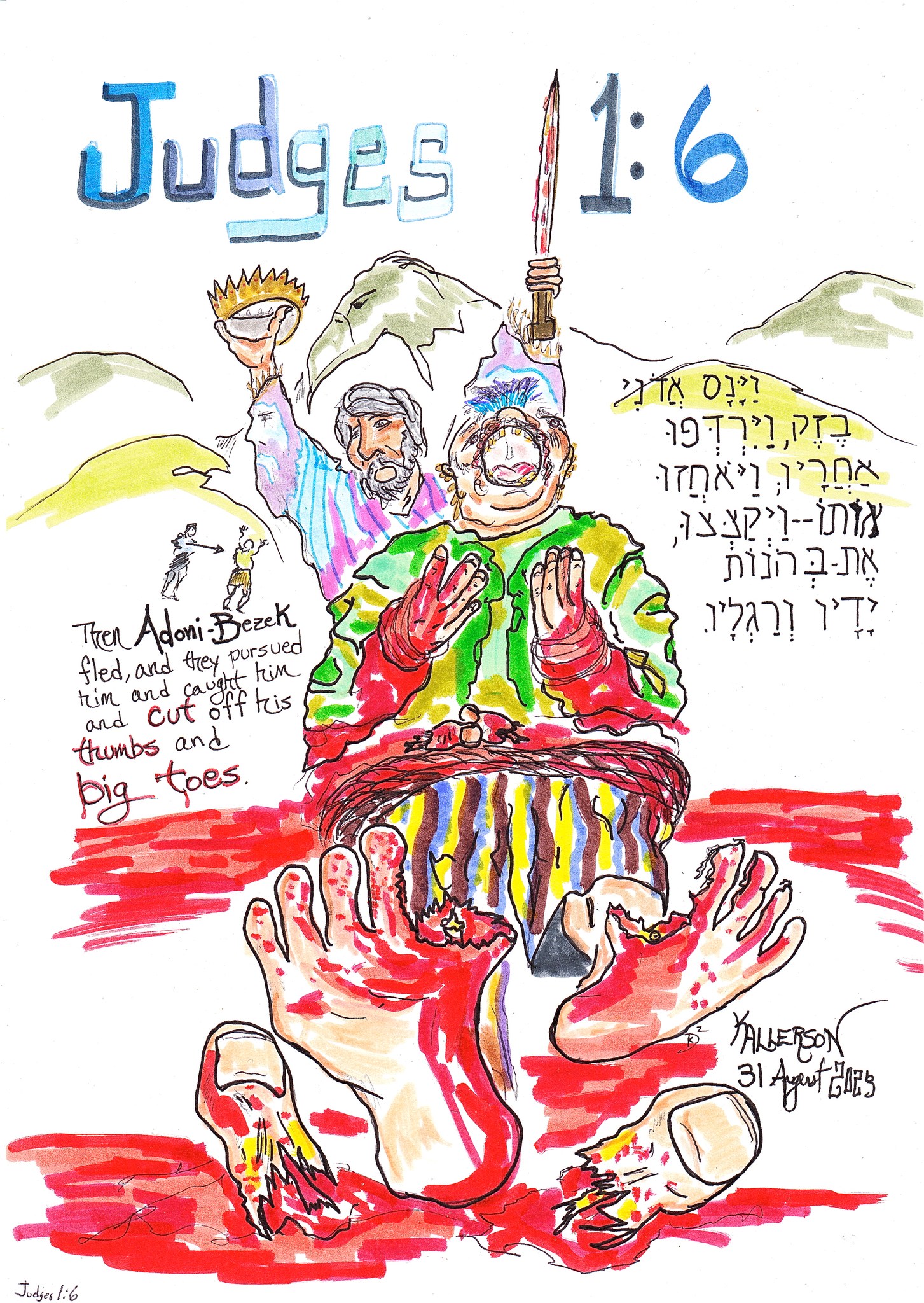
6 Then Adoni-Bezek fled, and they pursued him and caught him and cut off his thumbs and big toes.
There is no way to satisfactorily translate this in English. There is one word, bohen, to describe both thumb and big toe. A literal translation, using one word, would be “his thumbs – hands and his feet.”
Of this, Adam Clarke and others say, “That he might never be able to draw his bow or handle his sword, and great toes, that he might never be able to pursue or escape from an adversary.”
This cannot be the reason. If it were so, it would mean that they would do this to every foe they encountered. That would be similar to what is recorded by Cambridge –
“A barbarity frequently practised in ancient warfare to mark the humiliation of the captives and prevent them from further mischief. Thus the Athenians are said to have decreed that the right thumb of every Aeginetan taken prisoner should be cut off ‘that they may be incapable of carrying a spear, but not incapable of working an oar,’ Aelian, Var. Hist. ii. 9.”
This is the only time this punishment is meted out in Scripture, and thus it cannot be that they were worried about this guy fighting back, running away, or any other such thing.
7 And Adoni-Bezek said, “Seventy kings with their thumbs and big toes cut off used to gather scraps under my table;
More precisely, it reads, “Seventy kings, thumbs – their hands and their feet – cut off, have been gathering under my table.” Of this, Charles Ellicott says –
“The peculiar appropriateness of the punishment in this instance arose from the Lex talionis, or ‘law of equivalent punishment,’ which Moses had tolerated as the best means to limit the intensity of those blood-feuds.”
That only applied to those under the law. This may be a case of “he got what he dished out,” but it is not a case of judgment under the lex talionis, except as it would apply to an offense against God Himself.
As for the number seventy, being a multiple of 7 and 10, Bullinger says it, “signifies perfect spiritual order carried out with all spiritual power and significance. Both spirit and order are greatly emphasised.”
As for his offense against God, this is what he acknowledges…
7 (con’t) as I have done, so God has repaid me.”
ka’asher asiti ken shilam li elohim – “According to which I have done, thus repaid to me God.” How does one explain this when it was a common practice among the Athenians and other people groups? It isn’t like God repaid all of the others who did this in the same manner. And yet, Adoni-Bezek ascribes it to the doings of God.
Two possible answers seem to make sense. He could be saying, “thus repaid to me gods.” The word elohim can be referring to one god or many, the true God or a false god. He could be saying that the gods of his enemies have repaid him as he had done to those men who served them.
Or he could be acknowledging Israel’s God as the true God. As Israel is the Lord’s people, what they have done is to be considered as if it was done by God. Israel must have heard of Adoni-Bezek’s common practice and decided that they would do to him what he had done to others. This is not unlike what is seen in 1 Samuel 15 and elsewhere –
“But Samuel said, ‘As your sword has made women childless, so shall your mother be childless among women.’ And Samuel hacked Agag in pieces before the Lord in Gilgal.” 1 Samuel 15:33
It is also how the Lord dealt with Babylon as noted in Jeremiah –
“Because the plunderer comes against her, against Babylon,
And her mighty men are taken.
Every one of their bows is broken;
For the Lord is the God of recompense,
He will surely repay.” Jeremiah 51:56
This same thought carries into the New Testament as well. Paul says that it is “a righteous thing with God to repay with tribulation those who trouble you” (2 Thessalonians 1:6, etc.). Such things as this demonstrate that God is just and fair. Whether in this life or the next, every offense will be judged and brought to account.
As for Adoni-Bezek…
7 (con’t) Then they brought him to Jerusalem, and there he died.
The words here are not unlike those of 1 Samuel 17 –
“And David took the head of the Philistine and brought it to Jerusalem, but he put his armor in his tent.” 1 Samuel 17:54
Jerusalem was not under Israel’s control at the time when David did this, and it was not under the control of Israel at the time of Adoni-Bezek’s capture. There are various views about why they brought him to Jerusalem, but the next verse seems to explain the matter.
Judah will fight against Jerusalem and take it, striking it with the edge of the sword and setting it on fire. Adoni-Bezek may have been brought there as an example of what those in Jerusalem could expect when they were overthrown.
Ellicott says they may have even spared his life, sending him to Jerusalem to be “as a living monument of God’s vengeance.” This would 1) presuppose that he was from Jerusalem, and 2) be a violation of the law –
“When the Lord your God brings you into the land which you go to possess, and has cast out many nations before you, the Hittites and the Girgashites and the Amorites and the Canaanites and the Perizzites and the Hivites and the Jebusites, seven nations greater and mightier than you, 2 and when the Lord your God delivers them over to you, you shall conquer them and utterly destroy them. You shall make no covenant with them nor show mercy to them.” Deuteronomy 7:1-3
8 Now the children of Judah fought against Jerusalem and took it;
vayilakhamu bene Yehudah birushalim vayilkdu otah – “And fought sons Judah in Jerusalem and took her.” The KJV, following the Geneva Bible, incorrectly states this in the past tense – “had fought and had taken.” The supposition is that this is referring to Joshua 12:10 where it noted that the king of Jerusalem was defeated.
Just because a king is defeated in battle, it does not mean that the city was taken, nor does Joshua 10, where the battle is described, say anything about that. This is an action now being taken by Judah. As for the name, Jerusalem, it has a variety of meanings, but Foundation of Peace is sufficient. As for the city…
*8 (fin) they struck it with the edge of the sword and set the city on fire.
The terminology is rare: vayakuha l’pi kharev v’eth ha’ir shil’khu ba’ets – “And they struck her to mouth sword and the city cast in the fire.” The city was taken, and the inhabitants were put to the sword. After that, it was as if the city was literally picked up and tossed into a burning fire.
Despite this, Israel will not gain full control of the city until the time of David. Jebusites continued to dwell there and it is called Jebus in Judges 19. It is during this siege and destruction that Adoni-Bezek finally bought the farm.
Adoni-Bezek will never bother again
He is finished up and has seen his last
He caused trouble to many, many men
But he is dead; his time is past
A new Leader has taken control
And a new direction is laid out ahead
On Him we can every care and worry roll
Because Adoni-Bezek our foe is dead
The enemy can no longer afflict us
We have a new hope because he is dead
Thank God for our Lord, our precious Jesus
Thank God that He is there as our Head
III. Cool, Even Nifty, Typology
This passage follows directly after Joshua. Therefore, the previous book is alluded to by noting the death of Joshua, the Lord is Salvation, in verse 1.
That looks to the death of Christ, the Lord who is Salvation. Obviously, Jesus’ resurrection can’t be noted in an Old Testament passage like this because Joshua is still in the ground. But Jesus’ death includes His resurrection, so it is implied. After His death, a war is required. Paul clearly notes this several times in several different ways.
He notes that we are soldiers and the implements of warfare we use. He directs Timothy to “wage the good warfare” (1 Timothy 1:18), etc.
The question is, “Who will go up first (lit: in the beginning) to fight the Canaanites?” But even before the question, it said, “asked sons Israel ‘in Yehovah.’” It is a picture of those “in Christ.”
As for noting the Canaanites (Humbled, Subdued), they are already defeated by Christ (as will be seen in a minute), but who still have to be defeated in the ongoing war that Christ has won. The response to who will engage the war first is, “Judah shall go” (verse 2).
Judah here is synonymous with Jewish believers, the first to believe in Jesus. Paul then further explains their state in Romans 2 by making a pun on the name of Judah through the use of the word praise –
“For he is not a Jew who is one outwardly, nor is circumcision that which is outward in the flesh; 29 but he is a Jew who is one inwardly; and circumcision is that of the heart, in the Spirit, not in the letter; whose praise is not from men but from God.” Romans 2:28, 29
Hence, Jewish believers in Christ are those being referred to. They are the first (lit: in the beginning) to begin the war after Joshua’s (Jesus’) death. The Lord confidently tells them (verse 2) that the enemy is already defeated – “I have delivered the land into his hand.”
Notably, it says in verse 3 that Judah invited his brother Simeon, He Who Hears. This speaks of anyone who is saved. As they are not of Judah (the Jews), it means that they typologically include Gentiles. As Simeon is within Judah’s land grant, it reflects the truth that Gentiles are included in the New Covenant and are a part of the commonwealth of Israel (Ephesians 2:12).
Even though Simeon is no longer mentioned in this passage, the typology is set. Judah and Simeon will work together to effect the purposes of the Lord. As for noting the Perizzite, Villagers, in verse 4, I can only speculate on that. Unwalled villages are defenseless and thus already defeated, just as are the Humbled/Humiliated Canaanites. It speaks of defeat on their part.
As for the number killed, ten thousand, it speaks of a large but indeterminate number. Being a multiple of ten, it “implies that nothing is wanting; that the number and order are perfect; that the whole cycle is complete” (Bullinger).
The war will be complete when the church age is done, nothing will be wanting, perfection will be realized, and the cycle of the dispensation will be complete. The name Bezek, according to Abarim, signifies Scattering. That takes us back to Genesis 11, even if a different word, puts, is used –
“And they said, ‘Come, let us build ourselves a city, and a tower whose top is in the heavens; let us make a name for ourselves, lest we be scattered abroad [puts] over the face of the whole earth.’” Genesis 11:4
This is no different than two different words being used for the same thought in Psalm 68 –
“Let God arise,
Let His enemies be scattered [puts];
Let those also who hate Him flee before Him.” Psalm 68:1
“Rebuke the beasts of the reeds,
The herd of bulls with the calves of the peoples,
Till everyone submits himself with pieces of silver.
Scatter [bazar] the peoples who delight in war.” Psalm 68:30
Verse 5 then introduced Adoni-Bezek, Lord of Scattering, in Bezek, and they fought him, noting that the Canaanites and Perizzites were defeated.
Verse 6 noted that they pursued Adoni-Bezek and caught him, cutting off his thumbs and big toes. The thumb is used for grasping and thus, it is that which speaks of power and strength that can be wielded. The big toe is what provides support for standing and directing motion. These were taken from him, leaving him powerless, crippled, and defeated.
That was noted as divine retribution for his own actions of having done the same to seventy kings (verse 7). That pictures the removal of the power of the seventy nations noted in Genesis 10, the Table of Nations, and their own scattering as noted in Genesis 11.
Just as the nations were divided into language groups, they were united by language in Acts 2. That power of the Spirit remains to this day due to the defeat of the enemy. The Bible is translated into the languages of the people groups of the world.
In the establishment of the nations the perfect spiritual order was carried out with all spiritual power and significance. That was reflected in the words of Genesis 11 –
“And the Lord said, ‘Indeed the people are one and they all have one language, and this is what they begin to do; now nothing that they propose to do will be withheld from them.’” Genesis 11:6
That cooperation had to be cut off because of pride in man and rebellion against God. The defeat of Adoni-Bezek thus pictures the divine justice against that. Just as pride and rebellion cut off man’s ability to wield power and properly move about, the Lord cut that off in man, restoring the ability to work with, not against, God once again. Think of the power of the Spirit and how Bullinger explains the number seventy where “both spirit and order are greatly emphasised.”
The final note of verse 7 was that Adoni-Bezek was brought to Jerusalem where he died. The city first in the law is the last place to be subdued. Irony abounds.
That is actually completed in verse 8 where it notes that Jerusalem, Foundation of Peace, was taken, defeated by the mouth of the sword, and cast in the fire.
Jerusalem, the city of the law and thus the city of boasting in self-achievement before God (Galatians 6:13, etc.), was defeated with the sword (kherev). It is a picture of Christ’s prevailing over the law given at Horeb (khorev). They are spelled the same in the Hebrew – חרב.
Casting the city into the fire makes a marvelous picture of the complete ending of the law. Thus, it truly is the Foundation of Peace. The place where Christ was crucified is the place where the law is ended, and peace with God is established. The idea is fully supported by Paul’s words of Galatians 4:21-31.
It must be remembered that it was God’s law that got man into a pickle in the first place when the Lord gave Adam the law about eating from the tree of the knowledge of good and evil in Genesis 2. Thus, those seventy nations, pictured by the seventy kings of this chapter, were affected by law. The presentation is totally consistent with the typology presented.
It is law that separates us from God, not because there is anything wrong with the law, but because of our actions under the law. If believers were under law today, we would lose our salvation lickity split. But we are not under law. Rather, we are under grace.
And more, because we are not under law, we can no longer be imputed sin, which is exactly what separates us from God. There are just a few verses in today’s passage, but once again, the truth is revealed that what man needs is not more law but God’s grace. That is what is offered in the giving of His Son for us.
Let us ever be grateful to Him for the grace of our Lord Jesus Christ. Amen.
Closing Verse: “And how is it that we hear, each in our own language in which we were born? 9 Parthians and Medes and Elamites, those dwelling in Mesopotamia, Judea and Cappadocia, Pontus and Asia, 10 Phrygia and Pamphylia, Egypt and the parts of Libya adjoining Cyrene, visitors from Rome, both Jews and proselytes, 11 Cretans and Arabs—we hear them speaking in our own tongues the wonderful works of God.” Acts 2:8-11
Next Week: Judges 1:9-15 The typology is a pretty sweet thing… (Upper Spring and Lower Spring) (2nd Judges sermon)
The Lord has you exactly where He wants you. He has a good plan and purpose for you. It is He who judges His people according to their deeds. So, follow Him, live for Him, and trust Him, and He will do marvelous things for you and through you.
Judah Shall Go Up
Now after the death of Joshua it came to pass
That the children of Israel asked the LORD
Saying, “Who shall be first to go up for us against the Canaanites
To fight against them according to Your word?”
And the LORD said, “Judah shall go up, please understand
Indeed I have delivered the land into his hand”
So Judah said to Simeon his brother
“Come up to my allotted territory with me
That we may fight against the Canaanites
And I will likewise go with you to your allotted territory”
And Simeon went with him
Surely confident to the brim
Then Judah went up
And the LORD delivered, giving the enemy heck
The Canaanites and the Perizzites into their hand
And they killed ten thousand men at Bezek
And they found Adoni-Bezek in Bezek
And fought against him
And they defeated the Canaanites and the Perizzites
For them, things turned rather grim
Then Adoni-Bezek fled, and they pursued him, so it goes
And caught him and cut off his thumbs and big toes
And Adoni-Bezek said, “Seventy kings with their thumbs
———-and big toes cut off
Used to gather scraps under my table, so I confide
As I have done, so God has repaid me”
Then they brought him to Jerusalem, and there he died
Now the children of Judah
Fought against Jerusalem and took it, they didn’t quit
They struck it with the edge of the sword
And set the city on fire, maybe roasting marshmallows in it
Lord God, turn our hearts to be obedient to Your word
Give us wisdom to be ever faithful to You
May we carefully heed each thing we have heard
Yes, Lord God may our hearts be faithful and true
And we shall be content and satisfied in You alone
We will follow You as we sing our songs of praise
Hallelujah to You; to us Your path You have shown
Hallelujah we shall sing to You for all of our days
Hallelujah and Amen…
Now after the death of Joshua it came to pass that the children of Israel asked the Lord, saying, “Who shall be first to go up for us against the Canaanites to fight against them?”
2 And the Lord said, “Judah shall go up. Indeed I have delivered the land into his hand.”
3 So Judah said to Simeon his brother, “Come up with me to my allotted territory, that we may fight against the Canaanites; and I will likewise go with you to your allotted territory.” And Simeon went with him. 4 Then Judah went up, and the Lord delivered the Canaanites and the Perizzites into their hand; and they killed ten thousand men at Bezek. 5 And they found Adoni-Bezek in Bezek, and fought against him; and they defeated the Canaanites and the Perizzites. 6 Then Adoni-Bezek fled, and they pursued him and caught him and cut off his thumbs and big toes. 7 And Adoni-Bezek said, “Seventy kings with their thumbs and big toes cut off used to gather scraps under my table; as I have done, so God has repaid me.” Then they brought him to Jerusalem, and there he died.
8 Now the children of Judah fought against Jerusalem and took it; they struck it with the edge of the sword and set the city on fire.