Judges 1:9-15
Upper Spring and Lower Spring
The cult mindset is something that is extremely difficult, and at times impossible, to defeat. People find reasons to ignore the obvious, or even the facts, when they contradict the paradigm in which they live.
I used to believe in evolution. That is what I was taught at school and I accepted it. “They are teachers, I am the student, they know more than I do through training, studying, and so forth.”
However, I never had a cult mindset against any other view. I just didn’t realize there was another view. I’m sure I heard about creation and even read about it, but the Bible wasn’t something I ever processed as “inspired,” “infallible,” etc.
Once I was presented with the biblical creation account and the obvious disconnect between evolution and creation, I studied, verified, contemplated, and considered. Without much difficulty, I accepted the creation model and eventually completely aligned it with Scripture.
However, even with the most incredible evidences imaginable, the cult of evolution overlooks the most obvious telltale signs of creation. The thought of a young earth and a Creator God simply does not align with its adherent’s view about how things are.
The same is true with flat earthers. No matter how utterly ridiculous their logic is, and no matter how evident the case for a spherical earth is, they are unwilling to entertain the thought of the earth being anything but pizza-shaped. Mmmm pizza.
Text Verse: “‘Come now, and let us reason together,’
Says the Lord,
‘Though your sins are like scarlet,
They shall be as white as snow;
Though they are red like crimson,
They shall be as wool.’” Isaiah 1:18
When I attended Southern Evangelical Seminary, the founder, Norman Geisler, used the first clause of Isaiah 1:18 constantly. “Come now, and let us reason together.” Those words float in my mind anytime I am faced with an alternate view concerning something I believe. It reminds me to stop and think.
Some people will simply not reason things out. They refuse to consider any other option than the one they believe. The timing of the rapture is one that will cause believers to cover their ears and shout loudly to stop any other view from coming in and infecting theirs. King James Only believers can be shown an actual contradiction in their translation, and they will walk away completely denying what they were shown. It is as if they never saw it.
People stuck in cults will completely ignore anything but what they have been taught. They will even call into question the reliability of their own Scriptures to hold to their personal view of what they claim their own Scriptures teach.
For example, take the Mormons. Paul anticipated their cult nineteen hundred years before it came to be when he penned the warning in Galatians 1:6-9. But if you show a Mormon that, he will do what any member of a cult will do: ignore the obvious and continue down Apostasy Avenue. Showing them Paul’s warning simply doesn’t work.
What is presented in today’s passage probably won’t convince them either. But the typology is so clear that I hope some reasonable Mormon, someday, will click onto the sermon, watch it till the end, and say, “I’ve been wrong about my faith.” I’m not holding my breath, but it sure would be nice.
Lots of great doctrines are cleared up in the typology presented in the Old Testament. Yep, such great things are to be found in His superior word. And so, let us turn to that precious word once again, and… May God speak to us through His word today, and may His glorious name ever be praised.
I. A Blessing for Achsah (verses 9-15)
9 And afterward the children of Judah went down
v’akhar yaredu bene yehudah – “And after descended sons Judah.” Judah means Praise. Hence, it is the sons of Praise. In verse 4, it said that Judah went up to engage in battle. Now, it notes that they descended. The last thing noted in the previous passage was that Judah fought against Jerusalem.
In Scripture, one always goes up to Jerusalem or down from it. Understanding that, the next words logically follow…
9 (con’t) to fight against the Canaanites who dwelt in the mountains, in the South, and in the lowland.
It is singular, speaking of a single people: l’hilakhem ba’k’naani yoshev ha’ har v’ha’negev v’ha’sh’phelah – “to fight in the Canaanite dwelling the mountain, and the Negev, and the Shephelah.” Canaan signifies Humbled, Humiliated, or Subdued.
In descending from Jerusalem, Judah fought the Canaanite in:
- The mountain. A mountain (har) is a lot of something gathered. It is synonymous with a large but centralized group of people.
- The Negev. The word negev means south, but it comes from a word meaning parched.
- The Shephelah. The word comes from shaphel, to become low or abased.
The mountain is the highland area of Canaan. It runs through the whole of the land with the exception of the plain of Jezreel. The Negev comprises much of the area where Simeon’s inheritance was. The Shephelah is a transitional region. It has soft-sloping hills, and it is located in the south-central area of Canaan between the mountains of Judah and the coastal plains. Next…
10 Then Judah went against the Canaanites who dwelt in Hebron.
vayelek yehudah el ha’k’naani ha’yoshev b’khevron – “And went Judah unto the Canaanite, the dweller in Hebron.” Hebron means Alliance. This battle was recorded in Joshua. However, as was noted then, it is likely that it actually occurs chronologically now.
The details in Joshua were recorded in advance for the sake of inheritances. As for Hebron, or Alliance, that is further detailed…
10 (con’t) (Now the name of Hebron was formerly Kirjath Arba.)
v’shem khevron l’phanim qiryath arba – “And name Hebron to faces Kirjath Arba.” Saying “to faces” is a Hebrew idiom meaning “before,” as if someone is looking back on the faces of the past. In Jeremiah 7:24, however, it is used to produce a contrast: forward instead of backward –
“Yet they did not obey or incline their ear, but followed the counsels and the dictates of their evil hearts, and went backward and not forward [l’phanim].”
Kirjath Arba means City of Four. A city in the Bible is generally reflective of man deciding his own fate, independent of God. God created a place suitable for man to fellowship with his Creator, the garden. Man builds a place suitable for himself apart from God in the building of a city.
However, a city can also be a place of fellowship with God once again, as is seen in the New Jerusalem “whose builder and maker is God” (Hebrews 11:10).
In this case, it is the City of Four. Four “is emphatically the number of Creation; of man in his relation to the world as created … It is the number of things that have a beginning, of things that are made, of material things, and matter itself. It is the number of material completeness. Hence it is the world number, and especially the ‘city’ number” according to Bullinger.
As for this battle, it next says…
10 (con’t) And they killed Sheshai, Ahiman, and Talmai.
vayaku eth sheshay v’eth akhiman v’eth talmay – “And they struck Sheshai, and Ahiman, and Talmai.” This was recorded in Joshua 15:13, 14.
Sheshai means Whitish. Akhiman means My Brother is a Gift. Talmai means Plowman. These three were already named in Numbers 13, many years before. Therefore, it is likely that this is referring to people groups descended from these three named clan leaders.
11 From there they went against the inhabitants of Debir.
Rather than “they,” the verb is masculine singular: vayelek misham el yoshve debir – “And [he] went from there unto inhabitants Debir.” The words are closely repeated from Joshua 15:15. There it said, “And ascended…” Here it says, “And went.” Other than that, they are identical.
Using the singular here instead of the plural as in the previous verse, it is a reference to Caleb who will be noted in the next verse. Debir means Place of the Word. That is then further defined as…
11 (con’t) (The name of Debir was formerly Kirjath Sepher.)
v’shem debir l’phanim qiryath sepher – “And name Debir to faces Kirjath Sepher.” Debir is noted as having been called Kirjath Sepher. The word sepher is singular and means book.
However, to get the right idea, you would call it “Book City,” and thus “City of Books,” a name connected to Place of the Word. It was the place where the scrolls of writings were maintained, like a library today.
It was important because of this. Of the battle, it next says…
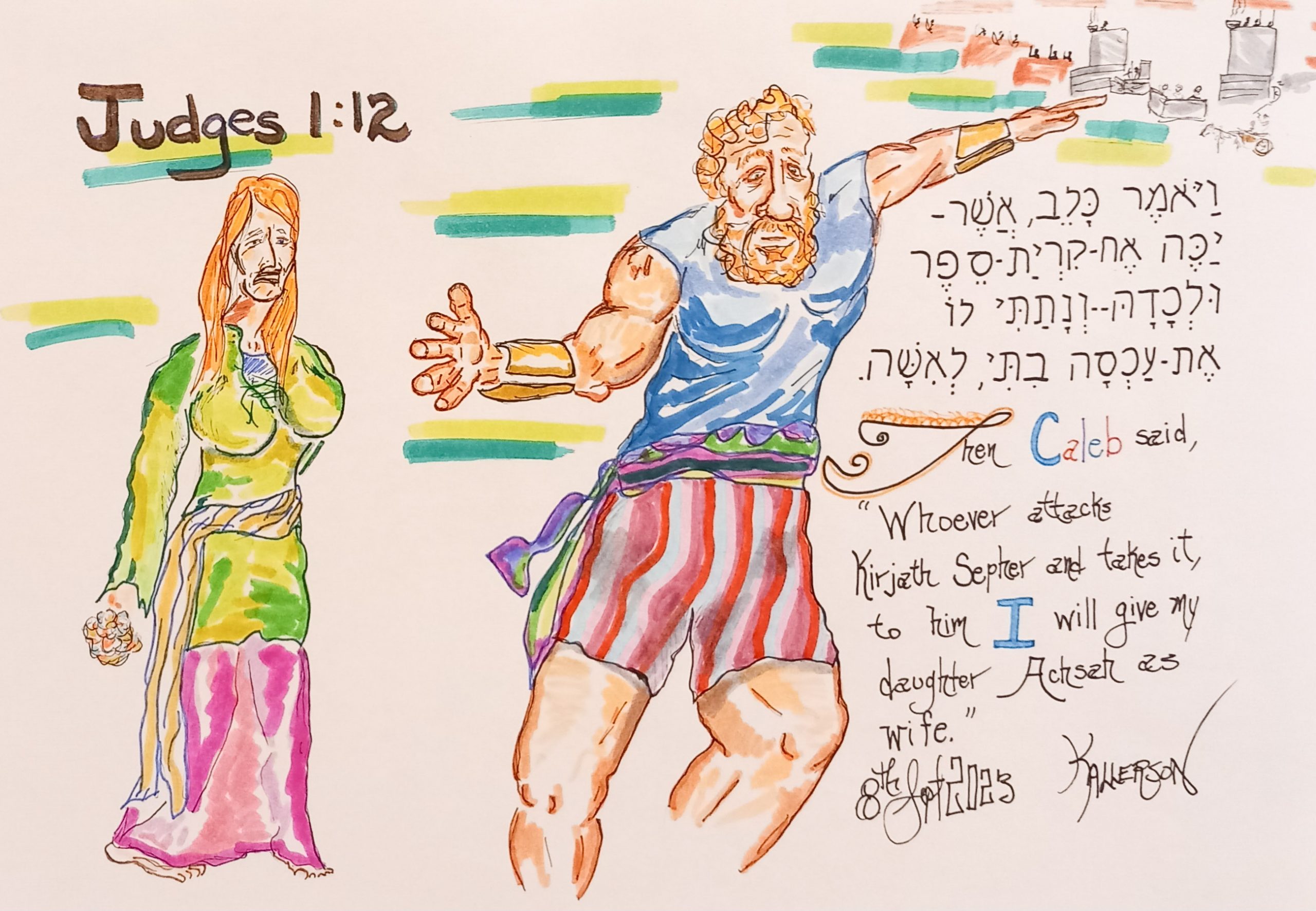
12 Then Caleb said, “Whoever attacks Kirjath Sepher and takes it,
The entire verse is a letter-for-letter copy of Joshua 15:16: va’yomer kalev asher yakeh eth qiryath sepher ul’khadah– “And said Caleb, ‘Who strikes Book City and takes her…”
Rather than Debir, Caleb notes the former name when planning its attack. This is supposition on my part, but perhaps they wanted to capture the scrolls in order to get a better understanding of the layout of the land, the structure of cities, etc., by obtaining any such documents maintained there. So important was this mission that a great honor is offered.
12 (con’t) to him I will give my daughter Achsah as wife.”
v’natati lo eth akhsah biti l’ishah – “and I will give to him Achsah my daughter to wife.” Achsah comes from ekes, meaning a fetter (Proverbs 7:22) or an anklet (Isaiah 3:18). That comes from akas, to shake bangles as seen in Isaiah 3 –
“Moreover the Lord says:
‘Because the daughters of Zion are haughty,
And walk with outstretched necks
And wanton eyes,
Walking and mincing as they go,
Making a jingling with their feet,
17 Therefore the Lord will strike with a scab
The crown of the head of the daughters of Zion,
And the Lord will uncover their secret parts.’” Isaiah 3:16, 17
The offering of a daughter in this manner is not unusual. Throughout Kings and Chronicles, intermarriages are noted where one king gives a daughter to another, such as in 1 Kings 3:1. It is also something Saul promised to the victor over Goliath –
“So the men of Israel said, ‘Have you seen this man who has come up? Surely he has come up to defy Israel; and it shall be that the man who kills him the king will enrich with great riches, will give him his daughter, and give his father’s house exemption from taxes in Israel.’” 1 Samuel 17:25
As for the prize named Achsah, she goes to…
13 And Othniel the son of Kenaz, Caleb’s younger brother, took it;
The words are similar to Joshua 15:17 with two exceptions. The first is that Othniel is noted as Caleb’s younger brother. The second is that a preposition meaning “from him” is included: va’yilkdah athniel ben qenaz akhi kalev ha’qaton mimenu – “And took her, Othniel son Kenaz, brother Caleb, the younger, from him.” This is the difference when put side by side –
“And took her, Othniel son Kenaz, brother Caleb, the younger, from him.”
“And took her, Othniel son Kenaz, brother Caleb.”
Only one translation, Smith’s Literal Translation, even bothers translating the “from him” part. But it is such a noticeable difference from Joshua that it is hard to imagine it not being translated.
By adding the word translated as “from him,” it makes much of the rest of the verse parenthetical, “And took her…from him.” One assumes that the words “from him” are speaking of the Canaanite of verse 9. He had the city, and Othniel took her from him.
As for the words, “Othniel son Kenaz, brother Caleb,” it seems to place Caleb’s father as Kenaz. That is incorrect. Caleb’s father is Jephunneh (Numbers 13:6, etc.).
The Hebrew could mean either Othniel or Kenaz is Caleb’s brother. Hence, it could mean that Othniel was “son Kenaz and brother of Caleb,” and thus Othniel marries his niece, or “son Kenaz, who was Caleb’s brother,” and thus Achsah is his cousin.
The correct reading/translation is that Othniel is Caleb’s brother, and both are sons of Jephunneh. The words ben qenaz, or “son of Kenaz,” mean “descendant of Kenaz,” and thus, Othniel is – like Caleb – a Kenizzite as noted in Numbers 32:12.
Saying “son of Kenaz” thus identifies him as belonging to the clan of Kenaz, the Edomite noted in Genesis 36:15 –
“These were the chiefs of the sons of Esau. The sons of Eliphaz, the firstborn son of Esau, were Chief Teman, Chief Omar, Chief Zepho, Chief Kenaz.”
Caleb means Dog. Othniel means either Force of God or Lion of God. The NAS uses a different root to translate it which renders it Burning of God. Because he is the one to prevail over the city, Achsah goes to her uncle as his wife.
The meaning behind Kenaz, or Hunter, is that it signifies a person who seeks after wisdom.
The purpose of the words is to show that both Caleb and Othniel are reckoned as descendants of this Gentile, Kenaz. As for Othniel’s great victory…
13 (con’t) so he gave him his daughter Achsah as wife.
The clause is letter for letter the same as the corresponding clause in Joshua 15:17: vayiten lo eth akhsah bito l’ishah – “And gave to him Achsah his daughter to wife.” Achsah is accounted under both Caleb and Othniel in this matter. Yet she will be given a set inheritance within Judah as the narrative continues…
14 Now it happened, when she came to him, that she urged him to ask her father for a field.
With one exception, the words are identical to Joshua 15:18: v’hi b’boah va’tsithehu lishol me’eth abiha ha’sadeh – “And it was in her coming and she poked him to ask from her father the field.” Joshua 15:18 says “field” without the article. This verse says, “the field.” It is a particular field she has in mind.
The word suth, translated as “urged,” comes from shayith, a thorn. Hence, it figuratively means to poke or entice. The meaning is that in her coming to Othniel as wife, she used that opportunity to get him to either ask Caleb directly or he allowed her to ask personally for this field.
What is apparent is that he didn’t heed her poking. It could be that despite being confident in battle, he was too shy to ask for a favor. Whatever caused him to not yield to her urgings, she was unafraid of poking at her father. Therefore…
14 (con’t) And she dismounted from her donkey, and Caleb said to her, “What do you wish?”
va’titsnakh me’al ha’khamor va’yomer lah kalev mah lakh – “And jumped down from upon the donkey, and said to her, Caleb, ‘What to you?’” A difficulty in the Hebrew has ended in a wide variety of translations. The word tsanakh is found in only two accounts, this one and that of Jael in Judges 4 –
“Then Jael, Heber’s wife, took a tent peg and took a hammer in her hand, and went softly to him and drove the peg into his temple, and it went down into the ground; for he was fast asleep and weary. So he died.” Judges 4:21
What seems the best explanation of this comes from Adam Clarke, where he says, “she hastily, suddenly alighted, as if she had forgotten something, or was about to return to her father’s house.”
One can imagine the scene. She is being conducted to the house of her new husband. She leans over and says, “We really need this field with the water. Let me ask him for it.” With that, she jumps down as if she refuses to go further unless she gets what she wants. Caleb is caught completely off guard and asks, “What’s the matter with you?” And then…
15 So she said to him, “Give me a blessing;
The words are slightly different than the account in Joshua 15: vatomer lo havah li v’rakha – “And said to him, ‘Give to me blessing.” The differences are seen when put side by side –
“And said, ‘Give [nathan] to me blessing.”
“And said to him, ‘Give [yahav] to me blessing.”
The words nathan and yahav both have the same meaning and they both come from roots signifying to put or set forth. It could be that both words have been used to show that the accounts are not mere copies of one another, even if they say the same thing.
In other words, with the additional information and different context, this isn’t just a repeat of Joshua 15, but it is presenting a different aspect of the same general information.
As for the words, “Give to me a blessing,” they mean, “Give to me a gift.” She wants something tangible from him. With that, she explains what…
15 (con’t) since you have given me land in the South, give me also springs of water.”
The words are identical to the corresponding clause from Joshua 15: ki erets ha’negev n’thatani v’nathatah li guloth mayim – “For land the south given me, and give to me springs water.”
There is a dual meaning being conveyed. The word negev means south, but it comes from a word meaning parched. Therefore, the land is pointless to possess unless water is available. In essence, she is saying, “For you have given me parched land, so give me springs of water.”
The word translated as springs, gullah comes from galal meaning to roll. Thus, the water comes up as round and bubbling. Stanley described it in the 1860s, saying –
“Underneath the hill on which Debir stood is a deep valley, rich with verdure from a copious rivulet, which, rising at the crest of the glen, falls, with a continuity unusual in the Judæan hills, down to its lowest depth. On the possession of these upper and lower ‘bubblings,’ so contiguous to her lover’s prize, Achsah had set her heart.” Stanley’s Lectures, i. 264.
With that noted, the next words are given…
15 (con’t) And Caleb gave her the upper springs and the lower springs.
It is surprisingly different than Joshua 15, even if it says the same thing: va’yiten lah kalev eth guloth ilith v’eth guloth takhtith – “And gave to her Caleb springs upper and springs lower.” The differences can be seen when placed side by side –
“And gave to her springs upper [iliyoth] and springs lower [takhtiyoth].”
“And gave to her Caleb springs upper [ilith] and springs lower [takhtith].”
Keil explains the difference, “The forms עלּית and תּחתּית (Judges 1:15), instead of עלּיּות and תּחתּיּות (Joshua 15:19), are in the singular, and are construed with the plural form of the feminine גּלּות, because this is used in the sense of the singular, ‘a spring.’”
As for the words themselves, the word translated as upper, ili, is only found in this account (in Joshua and Judges). It comes from alah, to ascend. Thus, it is an upper spring. The word signifying lower, takhti, comes from takhat, under. Thus it is the lower or lowest spring.
The account of Caleb, Othniel, and Achsah with the lands they possess is specifically stated here, just before the naming of the cities of Judah, to show what was rightfully theirs is to be reckoned within the overall inheritance of Judah.
The inheritance is within part of the commonwealth
And so, any can receive what it contains
But you cannot obtain it by trickery or stealth
Rather, such things can never remove your chains
To have the freedom found in the waters that bubble
You must pay heed to that word
It is the remover of every care and trouble
When you accept the message you have heard
And it is not one spring, or seven, or three
No, the streams are numbered at only two
It is in them together that you can be free
Just these two springs will work; nothing else will do
II. Explaining the Achsah Typology
This passage follows logically after the previous section where the nations were scattered by language in Genesis 11. However, they were united by the language of the Spirit again in Acts 2.
It was noted that power of the Spirit remains to this day due to the defeat of the enemy, and that the Bible is translated throughout the people groups of the world.
The passage ended with the note that Jerusalem, the city of the law and thus the city of boasting in self-achievement before God, (Galatians 6:13, etc.) was defeated with the sword (kherev).
That was a picture of Christ’s prevailing over the law given at Horeb (khorev). Both are identical in the Hebrew – חרב. In its defeat, the city was cast into the fire. The place where Christ was crucified is the place where the law ended and peace with God is established.
The verses today began with the children of Judah (Praise) going down, meaning from Jerusalem, to fight against the Canaanite (Humbled) who is in the mountain (a large centralized group of people), the Negev (Parched), and the Shephelah (Low or Abased).
It speaks about Jesus going forth from the sons of the Lord (Praise). He is 1) the gatherer of God’s people; 2) the Giver of water (life through the word) in the otherwise parched world; and 3) the One who abased Himself in order to bring the humbled to God.
Judah first (verse 10) went against the Canaanites in Hebron (Alliance), also called Kirjath Arba (City of Four). It speaks of the Alliance of the world represented by the number four explained by Bullinger –
It is “the number of Creation; of man in his relation to the world as created … Hence it is the world number, and especially the ‘city’ number.” Think of the followers of Jesus going out into the world of humbled humanity after Christ completed His work.
Next, in verse 10, it noted the striking of Sheshai, Ahiman, and Talmai. The names are given to explain the position of those who are a part of this joining together.
Ahiman, My Brother is a Gift, is the relationship of the believer to Christ who is the Gift. Sheshai, Whitish, looks to the purification of the believer because of Christ. Talmai, Plowman, looks to the one who puts his hand to the plow and doesn’t look back as he is a believer in Christ.
Verse 11 moves from this battle to Debir, Place of the Word. The subject was masculine singular. Thus, it was referring to Caleb (Dog, and thus a Gentile in type).
This sets the tone for the rest of the typology to come. He has already been shown in Joshua to have an inheritance among the sons of Judah. In other words, the Gentiles are being grafted into the commonwealth of Israel (Ephesians 2:12).
Still in verse 11, Debir was also noted as Kirjath Sepher. Jesus is the Oracle, the Place of the Word. But He is to be found in the scrolls (as seen in the City of Books) that speak of Him. Caleb determines to go there to dispossess the inhabitants and gain possession of it.
In verse 12, it notes that whoever attacks the City of the Books and takes it will get Achsah, Caleb’s daughter, as his wife. Her name means Anklet, an adornment of the foot. The foot signifies possession. She is the reward for the one who obtains the City of Books. And the victor in verse 13 is “Othniel son Kenaz, brother Caleb, the younger.”
Othniel, or Force of God, is also the son of Kenaz, or Hunter. That was explained in Joshua 14 by Abarim as a name based on a profession, similar to many of our own names. Hence it is someone who seeks a form of wisdom like any such profession would.
In his case, it would be as a hunter of men in the sense that he is seeking the wisdom not only for himself, but for others as well. Thus, Othniel is typifying those who expend themselves in the pursuit of the knowledge of God and in conveying that to others.
This then would explain why the word translated as “from him” was added. Othniel, in type a Gentile who is expending himself in order to convey the knowledge of God to others, took the city from the Canaanite. As Jews are a part of the world, represented by the Canaanite, it means that the City of Books is now something that has been taken by the Gentiles.
But more, he is also identified in the passage for the first time as ha’qaton, the younger. The word literally means small, lesser, little, unimportant, etc. Translating it as younger is for clarity. This then isn’t just referring to Gentiles but to believing Gentiles –
“For you see your calling, brethren, that not many wise according to the flesh, not many mighty, not many noble, are called. 27 But God has chosen the foolish things of the world to put to shame the wise, and God has chosen the weak things of the world to put to shame the things which are mighty; 28 and the base things of the world and the things which are despised God has chosen, and the things which are not, to bring to nothing the things that are, 29 that no flesh should glory in His presence.” 1 Corinthians 1:26-29
It is to Othniel, typical of believing Gentiles, that Achsah (Anklet) is given. As an adornment of the foot, she would indicate open and showy possession. But in receiving her after his victory over the City of the Books, he also inherits more.
At her prodding, not only will there be a possession of parched land, but there is also request for, and granting of, bubbling waters.
The whole picture can be seen: Caleb, signifying the Gentiles being brought into the commonwealth of Israel (Joshua 9), is also guaranteed the inheritance (Joshua 14). But there is more. Caleb possesses the inheritance. The City of Books is subdued (Joshua 15 and Judges 1).
It is the Bible that tells of Jesus that eventually comes under the responsibility and care of the Gentiles. This was anticipated in Genesis 9. The spiritual banner that belonged to the line of Shem, specifically going to the Jewish people, would – for a period of time – go to the line of Japheth. This is how Noah prophesied of this event –
“And he said:
‘Blessed be the Lord,
The God of Shem,
And may Canaan be his servant.
27 May God enlarge Japheth,
And may he dwell in the tents of Shem;
And may Canaan be his servant.’” Genesis 9:26, 27
It is to this line of Japheth that Paul’s epistles are addressed. It is this line of Gentiles that have predominantly carried the spiritual banner for two thousand years. Achsah is the prize, the “showy possession,” for the victory. But it is not just a lifeless inheritance that is obtained.
In verse 14, the union between Achsah, the showy possession, and Othniel, Force of God, is highlighted in the anticipation of something special. She pokes at him, urging him for a particular field. The sadeh, or field, represents the world (Matthew 13:38). It is an open place of productivity.
Without indicating, Othniel obviously approved because she immediately jumped off her donkey. The khamor, or donkey, comes from chamar, to be red. It is a picture of humanity in Adam, which the name implies. Adam (ruddy) comes from adom, to be red.
Caleb, the Gentile, asks what is wrong with her. That is when she asks for a blessing (verse 15). And that requested blessing is, “For land the south given me, and give to me springs water.” The picture is of the Gentiles being given the spiritual banner of what God is doing in the plan of redemption, but if it is simply a banner in the parched (negev) world, it will be rather unproductive.
Hence, she asked for bubbling, rolling waters – waters of liberty, as the name implies. With that, it then says, “And gave to her Caleb springs upper and springs lower.” Keil noted the use of the singular here indicating “a spring lower and a spring upper” and thus two springs. This could be inferred from Joshua 18, but it is made explicit here.
The waters given to Achsah (and thus to Othniel) are reflective of the living oracles of God, the two testaments, signified by the upper and lower springs, the New and Old Testaments. It is these that bubble up and provide life in the otherwise parched land of existence. They have become the possession of the Gentiles.
It is the Gentiles who have treasured them, maintained them, translated them, searched them out, passed on the understanding and knowledge of them, etc., during this dispensation.
And yet, this inheritance is still within the commonwealth, the borders, of Judah as was meticulously described in the Joshua sermons. And so, it cannot be said that these are denied to the Jews. The commonwealth of Israel has never ceased to exist. It is the Gentiles who have been grafted into it.
The word has never been unavailable to the Jews, but these oracles have become the passion and possession of the Gentiles. The mantle of the spiritual blessing has gone to them while Israel as a nation has fallen away, just as the blessing upon Japheth by Noah in Genesis Chapter 9 prophesied.
This is what is being conveyed in this marvelous passage. Gentiles are not subservient within Israel, and in many ways, they have taken the lead role for an extended amount of time.
While the Jews have frittered away the last 2000 years, the Gentiles have been sharing the gospel of Christ, teaching the word, searching out the riches of the word, and – above all – glorying in the Lord Jesus who is revealed in the word.
Understanding this explains why this account comes right after chopping off the thumbs and toes of Adoni Bezek in the previous account. The world, represented by the seventy nations, was left powerless, crippled, and defeated by him. He was then left powerless, crippled, and defeated through Judah’s defeat of him.
Because of Jesus, that is restored. It started with the Jews, but almost immediately went to the Gentiles, just as this passage started with Judah and almost immediately went to the account of Caleb, Othniel, and Achsah.
In Joshua 15, this same account noting the lands Caleb possessed was specifically placed just before the naming of the cities of Judah to show that what was rightfully theirs was to be reckoned within the overall inheritance of the sons of Praise, the commonwealth of Israel.
The account here in Judges doesn’t change that at all. Rather, its placement in the narrative supports it and further explains what is going on.
God is telling a story to us through this word, and He is providing insights into the future, revealing the ongoing narrative in typology, and allowing us to see and understand these things. Thus, He is confirming that we are on the right path as we continue.
As explained in the Joshua 15 sermon, Achsah was given two springs, not three. But Mormonism would necessitate there being three springs with their inclusion of “The Book of Mormon – Another Testament of Jesus Christ.” Too bad, so sad for them. God has shown, in advance, that this is not what is going on in the redemptive narrative.
He has methodically been covering every base for us to see what is and is not acceptable. Nothing is left out, nothing is overlooked, and everything finds its place later that is hinted at in advance.
Be sure to consider the stories you read as you wind your way through Scripture. Don’t jump to rash conclusions, and don’t quickly dismiss anything either. Reason things out concerning what these precious stories are trying to tell us.
There is such wonderful treasure to be found in this precious and sacred word. Seek the Lord while He may be found by seeking the Lord where He may be found. And for sure, He is to be found in this gift we call the Holy Bible.
Closing Verse: “The entrance of Your words gives light;
It gives understanding to the simple.” Psalm 119:130
Next Week: Judges 1:16-26 It rhymes with zip-a-dee-doo-dah… (So the Lord Was With Judah) (3rd Judges Sermon)
The Lord has you exactly where He wants you. He has a good plan and purpose for you. It is He who judges His people according to their deeds. So, follow Him, live for Him, and trust Him, and He will do marvelous things for you and through you.
Upper Spring and Lower Spring
And afterward the children of Judah
Went down to fight against the Canaanites, so we understand
Who dwelt in the mountains
In the South, and in the lowland
Then Judah went against the Canaanites
Who dwelt in Hebron by and by
(Now the name of Hebron was formerly Kirjath Arba)
And they killed Sheshai, Ahiman, and Talmai
From there they went against the inhabitants of Debir
(The name of Debir was formerly Kirjath Sepher, in a former life)
Then Caleb said, “Whoever attacks Kirjath Sepher
And takes it, to him I will give my daughter Achsah as wife”
And Othniel the son of Kenaz
Caleb’s younger brother
Took it; so he gave him his daughter Achsah as wife
He got her and not another
Now it happened, when she came to him
That she urged him to ask her father for a field, that cute little dish
And she dismounted from her donkey
And Caleb said to her, “What do you wish?”
So she said to him, “Give me a blessing
Since you have given me land in the South, for it my heart sings
Give me also springs of water”
And Caleb gave her the upper springs and the lower springs
Lord God, turn our hearts to be obedient to Your word
Give us wisdom to be ever faithful to You
May we carefully heed each thing we have heard
Yes, Lord God may our hearts be faithful and true
And we shall be content and satisfied in You alone
We will follow You as we sing our songs of praise
Hallelujah to You; to us Your path You have shown
Hallelujah we shall sing to You for all of our days
Hallelujah and Amen…
9 And afterward the children of Judah went down to fight against the Canaanites who dwelt in the mountains, in the South, and in the lowland. 10 Then Judah went against the Canaanites who dwelt in Hebron. (Now the name of Hebron was formerly Kirjath Arba.) And they killed Sheshai, Ahiman, and Talmai.
11 From there they went against the inhabitants of Debir. (The name of Debir was formerly Kirjath Sepher.)
12 Then Caleb said, “Whoever attacks Kirjath Sepher and takes it, to him I will give my daughter Achsah as wife.” 13 And Othniel the son of Kenaz, Caleb’s younger brother, took it; so he gave him his daughter Achsah as wife. 14 Now it happened, when she came to him, that she urged him to ask her father for a field. And she dismounted from her donkey, and Caleb said to her, “What do you wish?” 15 So she said to him, “Give me a blessing; since you have given me land in the South, give me also springs of water.”
And Caleb gave her the upper springs and the lower springs.