
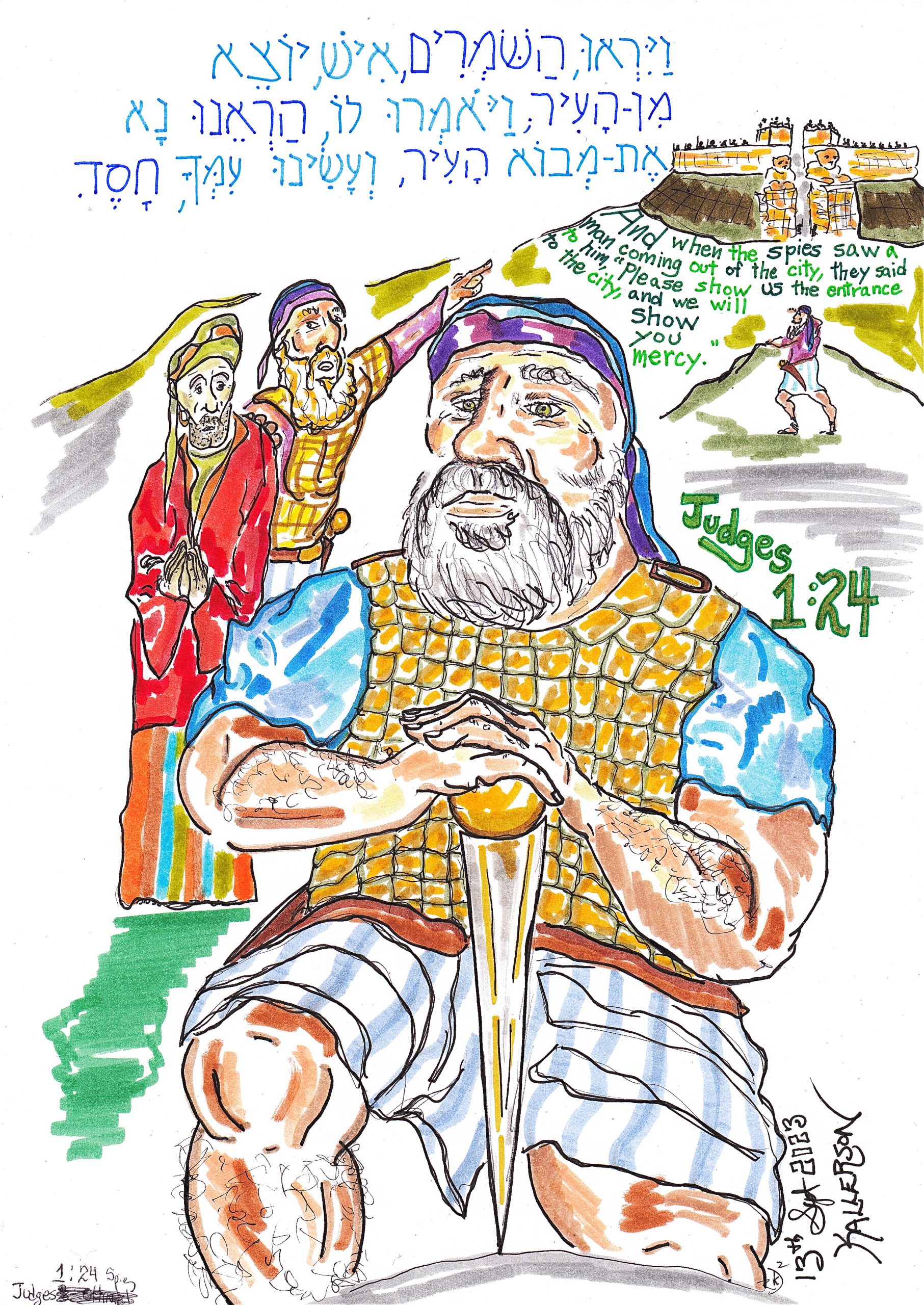
Artwork by Douglas Kallerson.
Judges 1:16-26
So the Lord Was with Judah
Despite the sermon title, there is more than just Judah referred to in today’s passage. The story of the Kenite is brought again into the biblical narrative and Simeon (who hasn’t been seen since early in the chapter) is brought back into focus. An account from the time during the wilderness wanderings is mentioned as well.
These and many other details are introduced and then quickly resolved before another short account is highlighted. Each has its own historical reference and each also develops into a typological picture of other things.
As for who compiled all these things? That was discussed in the introduction to Judges. It is worth citing two contradictory thoughts that were expressed by scholars in regard to the words of verse 21 which will be expounded upon today –
“…in Jerusalem, unto this day] There were no Israelites in Jerusalem at the time of the Levite’s visit, Jdg 19:12. The writer’s ‘day’ was after the capture of the city by David (2 Samuel 5:6-8), who spared the old inhabitants (ib. 2 Samuel 24:18 ff.); they and the new-comers continued to live side by side.” Cambridge
“Unto this day – As the Jebusites dwelt in Jerusalem till the days of David, by whom they were driven out, and the author of the book of Judges states them to have been in possession of Jerusalem when he wrote; therefore this book was written before the reign of David.” Adam Clarke
Text Verse: “’For all those things My hand has made,
And all those things exist,’
Says the Lord.
‘But on this one will I look:
On him who is poor and of a contrite spirit,
And who trembles at My word.’” Isaiah 66:2
Cambridge concluded that these accounts were compiled after the time of David. Their reason is a fallacy known as an argument from silence – “Nothing is said of this, and so it proves that such a thing never happened.”
On the other hand, Adam Clarke logically identifies what must be the case. It had to be compiled prior to David because David is the one to have driven out the Jebusites.
The reason Cambridge took the position that the account was compiled after David is evident from many of their other comments about this chapter. Whoever did this portion of their commentary doesn’t trust the biblical narrative, finds error in what is presented, picks the word apart as if he is able to know what was on the mind of the author, etc.
This person doesn’t tremble at the word of God. Rather, he thinks he can improve upon it. As we go through the verses today, consider that. I personally found nothing off with what is presented in the passage. It is logical, orderly, and insightful into other doctrines found in Scripture.
Have care when you consider the word. It is not something to be taken lightly but should be handled with the utmost respect. It is, after all, God’s superior word. And so, let us turn to that precious word once again, and… May God speak to us through His word today, and may His glorious name ever be praised.
I. He Showed Them the Entrance to the City (verses 16-26)
16 Now the children of the Kenite, Moses’ father-in-law,
u-bene qeni khoten Mosheh – “And sons Kenite, in-law Moses.” The words of this verse are complicated and the commentaries go on extensively.
As for the name Kenite, it is a patronym derived from Qayin, or Cain. That name is derived from qanah, to acquire. However, it is also etymologically connected to qayin, spear. To further complicate things, Jones’ Dictionary takes the meaning from Numbers 24:21, tying it to the word qen, or nest. Thus, various names can be considered: Acquire, People of the Spear, Nestling, etc.
As for the seemingly contradictory words, “Moses’ father-in-law,” they seem at odds with other verses already seen where the names Jethro, Reuel (Raguel), and Hobab are all said to be his father-in-law. Long lists and commentaries are set forth to explain these names and their connection to Moses.
The most reasonable explanation is that the noun khathan does not have to mean “father-in-law.” It comes from the verb khathan which signifies being a relative by marriage. Thus, the thought extends to any joining in affinity.
Therefore, it could be that the term “father-in-law” is too specific and it may simply mean “Moses’ in-law.” That is not the point of this explanation. It’s just provided for whoever is curious as to the seemingly contradictory English translation.
Regardless of these things, the line of the Kenites has been famous and will remain so throughout the Old Testament. They will be seen as late as 1 Chronicles 2:55 where they are noted as the clan of the Rechabite. That family is noted in Jeremiah 35 where they are greatly honored by the Lord for their exemplary conduct and way of life. Of this group, it says they…
16 (con’t) went up from the City of Palms
The verb is plural: alu meir hatmarim – “ascended (pl.) from City the Palms.” In other words, the clans that were living in this area went up from there together. As for the City of the Palms, this is noted as Jericho in Deuteronomy 34:3.
As Jericho was destroyed and cursed in Joshua 6, it would explain why it is not called Jericho. The name was blotted out. However, the Kenites continued to live in the area, being troglodytes or cave dwellers. There are innumerable caves in the surrounding area where they could have dwelt.
Concerning the tamar, or palm, it is a symbol of uprightness. Thus, the city could be identified as the City of Upright Ones. As for the Kenite’s going up, it was…
16 (con’t) with the children of Judah into the Wilderness of Judah,
eth bene Yehudah midbar Yehudah – “with sons Judah, wilderness Judah.” Judah means Praise. The wilderness here doesn’t mean a complete wasteland or barren desert but rather an uncultivated area. It is the area mentioned in the gospels where John baptized and where Jesus went during His time of temptation.
In the Bible, the wilderness is a place of God’s grace and of closeness to Him, but it is also a place of testing. For some, such as Israel, the testing resulted in disobedience. For others, such as Christ when He was tested, it is a place of fellowship through obedience.
The wilderness and the law are closely connected because it is by law that testing is accomplished. This is seen in the word itself, midbar. It is derived from the verb davar, to speak, and the noun davar, meaning word. The Lord spoke the Ten Commandments (words/d’varim) in the desert (midbar) of Sinai.
Thinking on these things, one can see the connection between Jesus, the Word of God, and His testing in the wilderness as well. Little details point to great pictures that are being developed. As for the account now, they went into the wilderness…
16 (con’t) which lies in the South near Arad;
asher b’negev arad – “which in Negev Arad.” The area of the king of Arad was noted as being defeated by Israel in Joshua 12:14. However, the king of Arad was also noted in Numbers 21:1 and Numbers 33:40. To really understand what is going on, you would have to go back and watch the sermon from Numbers 21.
The Negev, or South, comes from a root signifying parched.
The name Arad comes from the verb arad, to flee or be free. Thus, it means something like Fugitive or Freed One. Abarim also gives a meaning of Wild Ass.
The mentioning of the Kenites now is to help set forth a basis for understanding later events in Scripture. How did the Kenites wind up where they are? Why were they noted at this particular time and among this people group? Etc.
For example, the next words are necessary to understand events coming at the time of Saul…
16 (con’t) and they went and dwelt among the people.
It is now singular: vayelek vayeshev eth ha’am – “and went (sg) and dwelt (sg) with the people.” The reason for the change is because it is now speaking of the Kenite as a single entity –
Now the sons of the Kenite went up (pl.).
And went and dwelt (sg.) [the Kenite].
The people being mentioned here may be referring to Judah, but more likely it is referring to the Amalekites. The Kenites left the City of Palms and dwelt in this area where the Amalekites were. Thus, this explains what occurs in 1 Samuel 15 –
“Then Saul said to the Kenites, ‘Go, depart, get down from among the Amalekites, lest I destroy you with them. For you showed kindness to all the children of Israel when they came up out of Egypt.’ So the Kenites departed from among the Amalekites.” 1 Samuel 15:6
The reason for all of this is to confirm the promise of Moses to this people as they departed from Sinai in Numbers 10 –
“Now Moses said to Hobab the son of Reuel the Midianite, Moses’ father-in-law, ‘We are setting out for the place of which the Lord said, ‘I will give it to you.’ Come with us, and we will treat you well; for the Lord has promised good things to Israel.’
30 And he said to him, ‘I will not go, but I will depart to my own land and to my relatives.’
31 So Moses said, ‘Please do not leave, inasmuch as you know how we are to camp in the wilderness, and you can be our eyes. 32 And it shall be, if you go with us—indeed it shall be—that whatever good the Lord will do to us, the same we will do to you.’” Numbers 10:29-32
With this matter settled, the account next says…
17 And Judah went with his brother Simeon,
This is in accord with the words of verse 1:3, “So Judah said to Simeon his brother, “Come up with me to my allotted territory, that we may fight against the Canaanites; and I will likewise go with you to your allotted territory.” Simeon means He Who Hears.
17 (con’t) and they attacked the Canaanites who inhabited Zephath, and utterly destroyed it.
Rather: vayaku ha’k’naani yoshev tsephath vayakharimu otah – “And struck the Canaanite inhabiting Zephath and anathematized her.” Tsephath comes from tsaphah, to look out, spy, or keep watch. Thus, it means Watchtower. However, Abarim also provides a meaning of Covering. Canaanite means Humbled, Humiliated, or Subdued.
This is the fulfillment of a vow made in Numbers 21 –
“The king of Arad, the Canaanite, who dwelt in the South, heard that Israel was coming on the road to Atharim. Then he fought against Israel and took some of them prisoners. 2 So Israel made a vow to the Lord, and said, ‘If You will indeed deliver this people into my hand, then I will utterly destroy their cities.’ 3 And the Lord listened to the voice of Israel and delivered up the Canaanites, and they utterly destroyed them and their cities. So the name of that place was called Hormah.” Numbers 21:1-3
17 (con’t) So the name of the city was called Hormah.
It is singular and thus personal: vayiqra eth shem ha’ir kharemah – “And called (sg.) name the city Hormah.” The meaning is that Israel called the name of the city Hormah, meaning Devoted, Dedicated, or Anathema in Numbers 21:2. It can also mean Asylum based on the context.
Israel the people made the vow. When the vow was accomplished, Israel the people gave the name according to the vow.
18 Also Judah took Gaza with its territory, Ashkelon with its territory, and Ekron with its territory.
As cities are feminine, it more closely reads: “And took Judah: Gaza and her territory, and Ashkelon and her territory, and Ekron and her territory.” Interestingly, the Greek translation reads just the opposite, saying that they did not take these cities and the surrounding area.
That would seem to correspond to what is said in the next verse, Judges 3:3, and elsewhere. However, it could be that they took it but did not keep it, or they placed the inhabitants under tribute. Either way, the naming of the cities is the main focus.
Azah means Strong. Ashqelon comes from shaqal, to weigh, as in weighing money. Hence it is the Market. Ekron comes from aqar, to pluck up or uproot. But that is from the same as eqer, an offshoot or descendant. Hence, the name could mean either Offshoot or Uprooted.
19 So the Lord was with Judah.
vayhi Yehovah eth Yehuda – “And was Yehovah with Judah.” The meaning is based on what was just said and with what follows. The Lord was with them…
19 (con’t) And they drove out the mountaineers,
Rather than “they” it is singular: vayoresh eth ha’har – “And dispossessed [sg. Judah] the mountain.” The word yarash means both to possess and to dispossess. As the mountainous area was occupied, they dispossessed it and then possessed it.
As has been seen previously, a mountain (har) is a lot of something gathered. It is synonymous with a large but centralized group of people. As for the rest of the area of Judah…
19 (con’t) but they could not drive out the inhabitants of the lowland,
The words do not say “could not” (yaklu). Rather, they are carefully constructed to avoid such a notion: ki lo l’horish eth yoshve ha’emeq – “For no to dispossess inhabitants the valley.” The Lord was with them, but they were not with the Lord. They lacked faith in His presence…
19 (con’t) because they had chariots of iron.
It is singular: ki rekhev barzel lahem – “for chariot iron to them.” This was the complaint of the children of Joseph in Joshua 17. They claimed they could not drive out the inhabitants because they had the iron chariot. Joshua, however, said that despite having such, they were able to drive them out.
As for typology, iron represents strength, be it in binding together, in government, in hard service, or in bondage. In the immediate context, it is the faithlessness of the people, not the presence of the Lord, that caused the failure to dispossess the lowland. As for the mountain country…
20 And they gave Hebron to Caleb, as Moses had said.
Rather than “said,” the Hebrew says, “spoke.” Moses directed it to be so; Judah complied with the spoken word. This was recorded in Numbers 14 as words from the Lord. It was repeated by Moses in Deuteronomy 1. Saying that Moses spoke when it was the Lord who spoke once again reveals the process of divine inspiration –
“But My servant Caleb, because he has a different spirit in him and has followed Me fully, I will bring into the land where he went, and his descendants shall inherit it.” Numbers 14:24
As for the names, Hebron means Alliance. Caleb means Dog. Moses means He Who Draws Out.
In giving Hebron to Caleb, it then notes…
20 (con’t) Then he expelled from there the three sons of Anak.
Rather than “Then,” it simply says, “And.” This is not happening now. Rather, it has already taken place. Also, it reads, “three sons the Anak.” In other words, these are the people of Anak, just as we would say, “the twelve sons of Israel” even if they are long dead. It is those who descended from these three sons of the Anak that are being referred to.
The recording of this again is not superfluous. Rather, even if Caleb had previously driven out these people, he couldn’t truly possess it if Judah didn’t fully possess the land where Hebron was located. A process is being detailed from beginning to end. Each step is methodically recorded and repeated as needed.
Anak means Long Neck or Necklace, coming from the word anaq which means being fitted out with supplies, and thus furnished liberally, just as a necklace is generally made up of many pieces. They were a clan known for their unusually long or thick necks, or the adornments worn on their necks. Next…
21 But the children of Benjamin did not drive out the Jebusites who inhabited Jerusalem;
It is singular, referring to the people group as a whole – “And the Jebusite inhabiting Jerusalem, no did dispossess sons Benjamin.” A similar statement is made in Joshua 15 –
“As for the Jebusites, the inhabitants of Jerusalem, the children of Judah could not drive them out; but the Jebusites dwell with the children of Judah at Jerusalem to this day.” Joshua 15:63
The difference between the two is evident from a literal translation of both verses –
Judah: not able sons Judah to dispossess.
Benjamin: not did dispossess the sons of Benjamin.
Jerusalem was a border city, partly belonging to both Judah and Benjamin. There was a stronghold on Benjamin’s side of the border. Thus, Judah could not drive them out. Benjamin, however, was content to simply not drive them out.
Benjamin means Son of the Right Hand. Jebusite means Treading Down or Trodden Underfoot.
This verse foreshadows the importance of the city, being so markedly noted as the first thing mentioned in Judges concerning Benjamin. That continues with…
21 (con’t) so the Jebusites dwell with the children of Benjamin in Jerusalem to this day.
It is again singular, “And dwells the Jebusite with sons Benjamin in Jerusalem unto the day, the this.” This is a confirmation that this was not a later addition after the time of the kings when this could not have been a true statement. It was accomplished at the time of David.
It is true that even after David conquered Jerusalem in 2 Samuel 5 Jebusites continued to live there. This is attested to in 2 Samuel 24, but that is not what this is referring to. Rather, it is speaking about the unconquered city. Next…
22 And the house of Joseph also went up against Bethel, and the Lord was with them.
vayaalu beith Yoseph gam hem beith el v’Yehovah imam – “And ascended house Joseph – also they – Bethel, and Yehovah with them.” The words “also they” are in relation to Judah’s ascending to battle earlier in the chapter. What happens here is given to contrast the sons of Benjamin and the house of Joseph.
The house of Joseph is inclusive of Ephraim and Manasseh. Geographically, the tribes of Judah and Simeon are in the southern area of Canaan, and the narrative moved northward to the central area.
Bethel means House of God. Joseph means both He Shall Add and Take Away.
Bethel is a border city between Benjamin and the house of Joseph. As an inheritance, it was placed within the borders of Benjamin. However, being a border city…
23 So the house of Joseph sent men to spy out Bethel.
vayatiru beith Yoseph b’beith el – “And spied, house Joseph, in Bethel.” Nothing was said of this with Benjamin and Jerusalem. The house of Joseph is taking advantage of the situation to gain the city. With that noted, next comes a phrase seen elsewhere…
23 (con’t) (The name of the city was formerly Luz.)
This is noted at other times, but then it is also noted that Luz is separate from Bethel. It was seen in Joshua 16:2 and again in Joshua 18:13. It is a city near to, but separate from, Bethel. However, the one name is assigned to both at times.
Luz means Almond, but it comes from the verb luz, meaning to turn aside, often in a negative way. Hence, it can mean Departure, but also Twisted or Perverse. Bethel means House of God.
24 And when the spies saw a man coming out of the city, they said to him, “Please show us the entrance to the city, and we will show you mercy.”
More precisely: “And saw, the watchers, man coming from the city. And they said to him, ‘Show, we pray, entrance the city, and we have made with you mercy.’” This is a violation of the law –
“When the Lord your God brings you into the land which you go to possess, and has cast out many nations before you, the Hittites and the Girgashites and the Amorites and the Canaanites and the Perizzites and the Hivites and the Jebusites, seven nations greater and mightier than you, 2 and when the Lord your God delivers them over to you, you shall conquer them and utterly destroy them. You shall make no covenant with them nor show mercy to them.” Deuteronomy 7:1, 2
Despite their wrongdoing in relation to the law, they were able to glean the information they needed…
25 So he showed them the entrance to the city,
There was obviously a hidden entrance along a hill line, within a cave, or in some other location. For instance, the Persians were able to take Sardis by discovering a path used by a soldier who had dropped his helmet. He went out of the fortress to pick it up and the entrance was made known.
With the necessary information made known, it next says…
25 (con’t) and they struck the city with the edge of the sword;
vayaku eth ha’ir l’pi kharev – “And struck the city to mouth sword.” As always, the sword is depicted as a devouring instrument where its edge is considered a mouth that consumes the souls it meets in battle.
25 (con’t) but they let the man and all his family go.
v’eth ha’ish v’eth kal mishpakhto silekhu – “and the man, and all his family, they sent away.” Like Rahab, despite not perfectly upholding the law in making an agreement to show mercy, they upheld their promise to the man.
26 And the man went to the land of the Hittites,
It is unknown where this is. There remained Hittites in Israel long after this. Uriah, the husband of Bathsheba, was a Hittite. However, it does note this in 1 Kings 10:29 –
“Now a chariot that was imported from Egypt cost six hundred shekels of silver, and a horse one hundred and fifty; and thus, through their agents, they exported them to all the kings of the Hittites and the kings of Syria.”
Noting that things were exported means that it was outside of Canaan. It is believed by many that the land of the Hittites was north of Canaan. Hittite means Terror, Terrible, or Fearsome. Wherever this location was, he…
*26 (fin) built a city, and called its name Luz, which is its name to this day.
vayiven ir vayiqra shemah luz hu shemah ad ha’yom ha’zeh – “And built city and called her Luz. It her name unto the day, the this.” Without anything biblical to go on, Charles Ellicott notes, “The Talmud says that this Luz was famous for its purple dye, and partly on this account Thomson identifies it with Kulb Louzy, not far from Antioch. It was not uncommon in ancient days for the fugitives from a city to build another city elsewhere of the same name.”
Each foe will be defeated throughout the land
We shall prevail over all who stand against us
This is the result of the power of God’s right hand
Yes, it shall all be accomplished by the Lord Jesus
Those who stand against us are defeated
All who stand contrary to us will be no more
Their source of power shall be unseated
The Lord alone shall reign forevermore
Jesus has gained the victory!
In Him the battle is won for us
Look at His deeds! Open your eyes and see
Look at the glorious work of our Lord Jesus
II. Pictures of Christ
The first two sermons in Judges 1 dealt with 1) the matter of Adoni-Bezek who was defeated, and then 2) the subduing of foes within Judah and the taking of Kirjath Sepher. The victor over Kijath Sepher was given Achsah as his wife.
The typology was explained for each. There was the bringing together of the people groups of the world through the gospel in the first account. In the second, the completed work of Christ was seen to go from Jewish believers to Gentile believers.
The passage today follows along that same general theme. It began with the sudden introduction of the children of the Kenite, Moses’ khathan, or in-law. Despite being related to Moses, the Kenite is a Gentile group.
Of them, it says they went up from the City of the Palms or, figuratively, City of the Upright Ones, with the sons of Judah (Praise) into the Wilderness of Judah – a place of testing, but also of God’s grace and closeness to Him.
That was then said to be “in Negev Arad.” The Negev signifies the parched world that needs the water of the word. That was said to be near Arad (Fugitive or Freed One). There, it said they dwelt among the people.
The account speaks of those Gentiles who have Acquired (Kenite) salvation through Christ, the fulfillment of the law (Moses). They are united to Him by affinity through His imputed righteousness.
As already seen in Judges, a city is generally reflective of man deciding his own fate, independent of God. However, a city can also be a place of fellowship with God once again, as is seen in the New Jerusalem “whose builder and maker is God” (Hebrews 11:10). In this case, they go up from the City of the Palms or City of the Upright Ones.
Thus, it refers to those who belong to the city of God. They went with the children of Judah (Praise: Christ is the Praise of God) into the Wilderness of Praise. It signifies those who are in a close relationship with God, in His grace, even if it is in a life of testing.
Noting they were in the Negev Arad is a way of saying they are in the parched (Negev) world despite being Freed Ones (Arad). It is the state of believers in the world. With that, the section ended with, “and went (sg) and dwelt (sg) with the people.”
The Kenite, the Gentile who has acquired salvation, has gone into the parched world and dwelt among the people for two thousand years. At the same time, the Jews have remained separate from the people even while they have been exiled among them.
The passage gives a snapshot of the church age.
From there, Judah and Simeon are noted again as in verse 3. It said that together they struck the Canaanites (Humiliated) who inhabited Zaphath (Watchtower). With that, it says the city was called Hormah (Anathema).
Galatians 2 shows this typology directly. He is a Jew (Praise – Romans 2:29) writing to believers (He Who Hears) about those who stand against the faith represented by the Canaanites (Humbled because of rejecting Christ). The Zaphath (Watchtower) comes from tsaphah, to look out, spy, etc.
This is what the Jews of Galatians 2 were doing –
“Then after fourteen years I went up again to Jerusalem with Barnabas [a Jew], and also took Titus [a Gentile] with me. 2 And I went up by revelation, and communicated to them that gospel which I preach among the Gentiles, but privately to those who were of reputation, lest by any means I might run, or had run, in vain. 3 Yet not even Titus who was with me, being a Greek, was compelled to be circumcised. 4 And this occurred because of false brethren [Canaan – Humiliated] secretly brought in (who came in by stealth to spy out [tsaphah] our liberty which we have in Christ Jesus, that they might bring us into bondage), 5 to whom we did not yield submission even for an hour, that the truth of the gospel might continue with you.” Galatians 2:1-5
It would be difficult to write a single paragraph that could more perfectly fit the typology. The note that they called Zaphath Hormah (Anathema) could also not be more exactingly described by Paul as he opened the epistle –
“I wonder that ye are so quickly removed from Him who did call you in the grace of Christ to another good news;
7 that is not another, except there be certain who are troubling you, and wishing to pervert the good news of the Christ;
8 but even if we or a messenger out of heaven may proclaim good news to you different from what we did proclaim to you — anathema let him be!
9 as we have said before, and now say again, If any one to you may proclaim good news different from what ye did receive — anathema let him be!” Galatians 1:6-9 (YLT).
That section ended with the note that Judah took Gaza (Strong), Ashkelon (Market), and Ekron (Offshoot/Uprooted) along with their territories. Three separate notes of doctrine are intended –
“For the weapons of our warfare are not carnal but mighty in God for pulling down strongholds [Gaza], 5 casting down arguments and every high thing that exalts itself against the knowledge of God, bringing every thought into captivity to the obedience of Christ, 6 and being ready to punish all disobedience when your obedience is fulfilled.” 1 Corinthians 10:4-6
“For we are not, as so many, peddling [Ashkelon] the word of God; but as of sincerity, but as from God, we speak in the sight of God in Christ.” 2 Corinthians 2:17
“These are spots in your love feasts, while they feast with you without fear, serving only themselves. They are clouds without water, carried about by the winds; late autumn trees without fruit, twice dead, pulled up by the roots [Ekron]; 13 raging waves of the sea, foaming up their own shame; wandering stars for whom is reserved the blackness of darkness forever.” Jude 1:12, 13
Verse 19 said that the Lord was with Judah, that they drove out the mountain, and that they did not drive out those in the valley.
Without any particular key words to help pinpoint the meaning, and simply going by how the church normally operates, I would surmise this is referring to the church being its own entity where the masses of people (the mountain) are identified as believers, but that it is still filled with corrupt people (the emeq, or depth) who also fill it. Typologically, it fits because it is a truth seen in the church throughout the ages.
The next short section again dealt with Caleb (Dog, and thus representing the Gentile). This time, it notes that he was given Hebron (Alliance) as Moses prophesied in Deuteronomy 32 –
“Rejoice, O Gentiles, with His people;
For He will avenge the blood of His servants,
And render vengeance to His adversaries;
He will provide atonement for His land and His people.” Deuteronomy 32:43
He is said to have expelled the sons of Anak (from anaq, being fitted out with supplies). Despite having all the resources of the world at their disposal during the Gentile-led church age, those who oppose God’s purposes cannot prevail and they will be removed.
From there, it next mentioned the sons of Benjamin (Son of the Right Hand) not driving out the Jebusites (Treading Down) in Jerusalem (Foundation of Peace).
Again, I have to admit it is speculation, but it appears to be speaking of believers not overtaking the Jews who are opposed to the gospel during the church age. That is only something that will occur after the rapture of the church.
It fits the typology, but without more specific keywords to definitely say otherwise, it remains speculation. The words ended, “so the Jebusites dwell with the children of Benjamin in Jerusalem to this day.” This confirms the state in the world today.
The last five verses gave the details concerning the house of Joseph (He Shall Add/Take Away) going up against Bethel (House of God), which was formerly called Luz (Departure, often with a negative connotation as in Twisted or Perverse). Rather than saying the children of Joseph, it mentions the House. It is the collective church being identified.
In spying out the city, a person is seen leaving it and is told by the spies that they would make mercy with him if he would tell them how to gain access. He did and they took the city striking it with the mouth of the sword. From there, he left and went to the land of the Hittites (Terror) and built a new city named Luz.
The picture reveals the process of obtaining salvation. Those who are in the church are brought in through faith in Jesus, pictured by the house of Joseph – He Shall Add both Jew and Gentile and Take Away their reproach. They were once in a fallen state (Luz), but through the Lord are given access to the House of God (Bethel). And that was done through the mouth of the sword.
As seen in numerous sermons, sword and Horeb (the law) are identical in the Hebrew – חרב. The imputation of Christ’s prevailing over the law is what removes the believers’ reproach and adds them to the House of God.
But some never come to the Lord and return to Luz –
“Now the Spirit expressly says that in latter times some will depart [Luz] from the faith, giving heed to deceiving spirits and doctrines of demons, 2 speaking lies in hypocrisy, having their own conscience seared with a hot iron, 3 forbidding to marry, and commanding to abstain from foods which God created to be received with thanksgiving by those who believe and know the truth. 4 For every creature of God is good, and nothing is to be refused if it is received with thanksgiving; 5 for it is sanctified by the word of God and prayer.” 1 Timothy 4:1-5
The context of Paul’s words is not the end of the church age, but the entire church age, reflected in the words “latter times.” Unlike Rahab, the person in this story chose the world of terror (Hittite) apart from Christ rather than uniting with His people. Paul’s words exactingly describe the situation.
So far, the first chapter of Judges has been one that has carefully matched details later to be found in Christ, in His people, and in the state of His church.
We will continue the chapter next week and see what is presented there. Using Israel and their conquests, the Lord is telling us a story through types and pictures of what He would do in the world.
Seeing these things, and seeing how carefully they match the overall redemptive narrative in Scripture, I would hope, and even beg, that you would take the time to read the Bible each day.
Learn the doctrines found in the New Testament. If they are hinted at in type in the Old, it should assure you that He expects you to know them from the New. This is the sacred charge that is set before you. Take hold of it, learn it, and apply it to your life from day to day.
Think of the presentations! From the time of the law, we are given hints of the ineffectiveness of the law to save. God is asking us to trust in His grace as has been presented to us in the giving of His Son. And then, we are asked to live in that grace in a manner becoming of His people. Let us do this, to His glory. Amen.
Closing Verse: “If you instruct the brethren in these things, you will be a good minister of Jesus Christ, nourished in the words of faith and of the good doctrine which you have carefully followed.” 1 Timothy 4:6
Next Week: Judges 1:27-36 The word is giving us valuable insights… (The Boundary of the Amorites)
The Lord has you exactly where He wants you. He has a good plan and purpose for you. It is He who judges His people according to their deeds. So, follow Him, live for Him, and trust Him, and He will do marvelous things for you and through you.
So the Lord Was with Judah
Now the children of the Kenite, Moses’ father-in-law
Up from the City of Palms with the children of Judah went
Into the Wilderness of Judah, which lies in the South near Arad
And they dwelt among the people; that’s where their time
———-was spent
And Judah went with his brother Simeon
And they attacked the Canaanites who inhabited Zephath, oohrah
And utterly destroyed it
So the name of the city was called Hormah
Also Judah took Gaza with its territory
Ashkelon with its territory too
And Ekron with its territory
Lots of territory for the taking, it’s true
So the LORD was with Judah
And they drove the mountaineers out
But they could not drive out the inhabitants of the lowland
Because they had chariots of iron, strong and stout
And they gave Hebron to Caleb, as Moses had said
Then from there the three sons of Anak he expell-ed
But the children of Benjamin did not
Drive out the Jebusites who inhabited Jerusalem, sad to say
So the Jebusites dwell with the children of Benjamin
In Jerusalem to this day
And the house of Joseph also went up against Bethel
And the LORD was with them, quite obviously
So the house of Joseph sent men to spy out Bethel
(The name of the city was Luz formerly)
And when the spies saw a man
Coming out of the city, they said to him (maybe his
——-name was Percy)
“Please show us the entrance to the city
And we will show you mercy”
So he showed them the entrance to the city
And they struck the city with the edge of the sword
But they let the man and all his family go
His life was his reward
And the man went to the land of the Hittites, built a city to stay
And called its name Luz, which is its name to this day
Lord God, turn our hearts to be obedient to Your word
Give us wisdom to be ever faithful to You
May we carefully heed each thing we have heard
Yes, Lord God may our hearts be faithful and true
And we shall be content and satisfied in You alone
We will follow You as we sing our songs of praise
Hallelujah to You; to us Your path You have shown
Hallelujah we shall sing to You for all of our days
Hallelujah and Amen…
16 Now the children of the Kenite, Moses’ father-in-law, went up from the City of Palms with the children of Judah into the Wilderness of Judah, which lies in the South near Arad; and they went and dwelt among the people. 17 And Judah went with his brother Simeon, and they attacked the Canaanites who inhabited Zephath, and utterly destroyed it. So the name of the city was called Hormah. 18 Also Judah took Gaza with its territory, Ashkelon with its territory, and Ekron with its territory. 19 So the Lord was with Judah. And they drove out the mountaineers, but they could not drive out the inhabitants of the lowland, because they had chariots of iron. 20 And they gave Hebron to Caleb, as Moses had said. Then he expelled from there the three sons of Anak. 21 But the children of Benjamin did not drive out the Jebusites who inhabited Jerusalem; so the Jebusites dwell with the children of Benjamin in Jerusalem to this day.
22 And the house of Joseph also went up against Bethel, and the Lord was with them. 23 So the house of Joseph sent men to spy out Bethel. (The name of the city was formerly Luz.) 24 And when the spies saw a man coming out of the city, they said to him, “Please show us the entrance to the city, and we will show you mercy.” 25 So he showed them the entrance to the city, and they struck the city with the edge of the sword; but they let the man and all his family go. 26 And the man went to the land of the Hittites, built a city, and called its name Luz, which is its name to this day.


