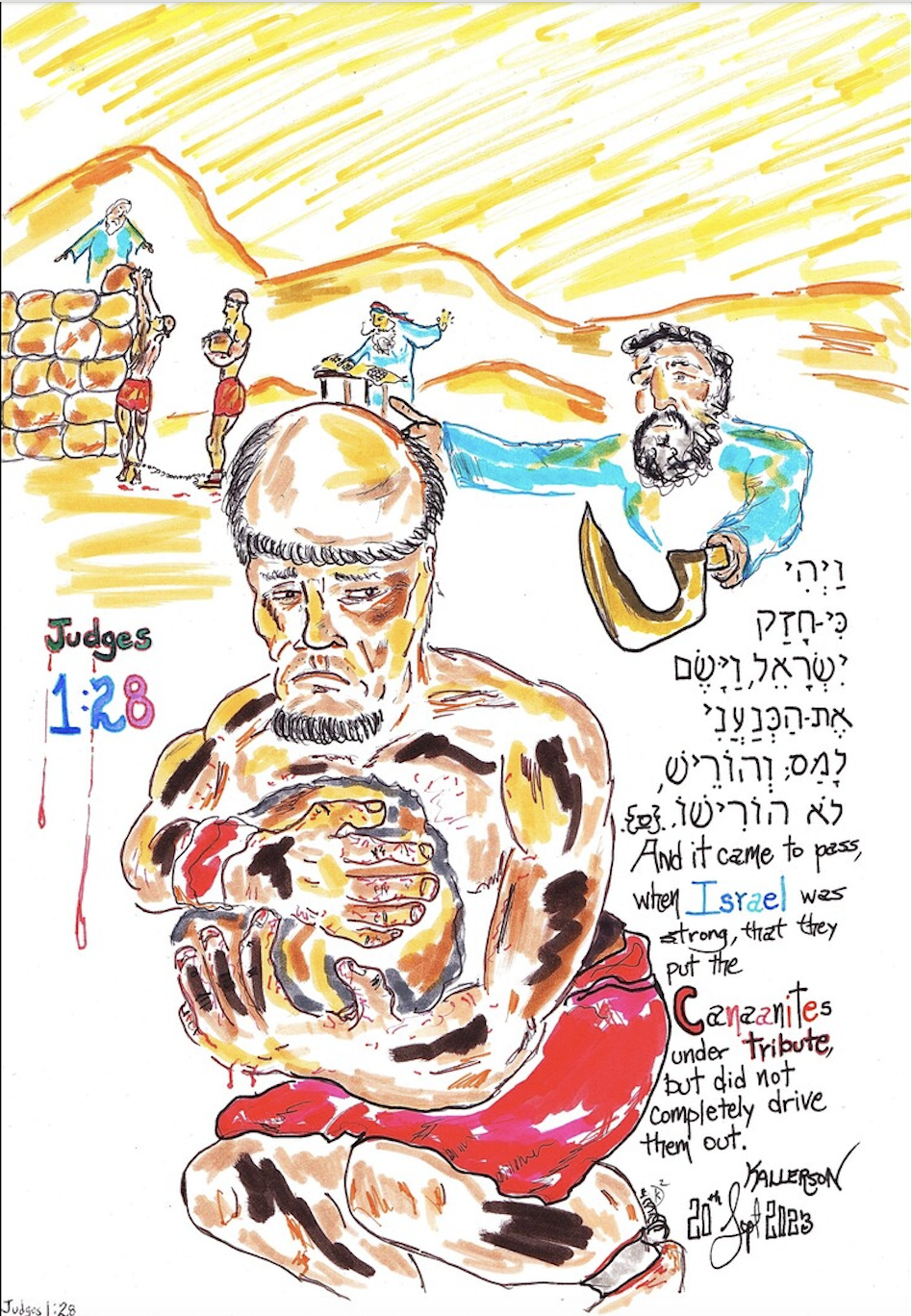
Artwork by Douglas Kallerson.
Judges 1:27-36
The Boundary of the Amorites
While typing the first half of the sermon, I was almost depressed by the state of the content of what is being presented. A tribe is introduced into the narrative and it immediately says that the tribe failed to drive out the inhabitants.
By the time my friend Sergio woke up and greeted me, which was when half the day was already over, I gave him this short reply, “Judges 1:27-36. Depressing. They didn’t dispossess. Again and again, it says this.”
Under law, they were commanded to dispossess the inhabitants. Tribe by tribe, their failure is recorded. In his commentary on verse 28, Charles Ellicott cited a lengthy article by someone named Mozley. It was as depressing to me as the narrative in Judges 1. A short portion of it says –
“As to the morality of these exterminating wars, we must bear in mind that men and nations must alike be judged by the moral standard of their own day, not by the advanced morality of later ages. We learn from unanimous testimony that the nations of Canaan had sunk to the lowest and vilest depths of moral degeneracy. When nations have fallen thus low, the cup of their iniquity is full; they are practically irreclaimable. To mingle with them would inevitably be to learn their works, for their worst abominations would find an ally in the natural weakness and corruption of the human heart. The Israelites therefore believed that it was their positive duty to destroy them, and the impulse which led them to do so was one which sprang from their best and not from their worst instincts. It must not be forgotten that the teaching of Christ has absolutely changed the moral conceptions of the world. It intensified, to a degree which we can hardly estimate, our sense of the inalienable rights of humanity and of the individual man.” (Mozley, Lectures on the Old Testament, p. 103). Ellicott 1:28
Text Verse: “They did not destroy the peoples,
Concerning whom the Lord had commanded them,
35 But they mingled with the Gentiles
And learned their works;
36 They served their idols,
Which became a snare to them.” Psalm 106:34-36
Israel was told to destroy the inhabitants of Canaan. This wasn’t simply because Israel “believed it was their positive duty.” Instead, it was because the law commanded them to do so. Thus, their failure is a violation of the law.
As for the comments about Christ absolutely changing the moral conceptions of the world, that is so out of touch with reality that it is hard to imagine Ellicott would cite the commentary. Israel was under law. We are under grace. The reason Christians don’t go killing pagans and heathens has nothing to do with moral conceptions. There is simply no allowance for it.
The church is not a nation, and it has no divine mandate for such things. Mozley even admits that nothing has changed in moral conceptions by saying, “When nations have fallen thus low, the cup of their iniquity is full; they are practically irreclaimable.”
That is the state of most of the world today. The rest that aren’t there yet are catching up quickly. The only difference between the culling of the peoples that Israel was supposed to effect and the culling of the world that will come about in the (probably near) future is who will accomplish it.
The purpose of the law was to lead people to the understanding of their need for Christ. Sin is the problem, and it must be judged. God will not overlook a single sin ever committed. The difference between believers and unbelievers is that sin in believers is judged in Christ. Unbelievers will be held accountable for their sins.
Judges 1 provides a snapshot of God’s work in Christ in a positive way. It takes real stories of real events that took place, including the disobedience of Israel, and shows us how God, through Jesus, is completing what Israel could not complete, meaning the restoration of the human family into one group.
And He is doing it in this chapter through ten named sons of Israel. Of the number ten, Bullinger states –
“Completeness of order, marking the entire round of anything, is, therefore, the ever-present signification of the number ten. It implies that nothing is wanting; that the number and order are perfect; that the whole cycle is complete.” E.W. Bullinger
God is using Israel to show us other, more wonderful, things in typology. It is a marvelous way for us to see clearly what is going on in the history of redemption. It’s all to be found in His superior word. And so, let us turn to that precious word once again, and… May God speak to us through His word today, and may His glorious name ever be praised.
I. Epic Fail (verses 27-36)
In the previous verses, the land of Judah, which includes Simeon whose inheritance is within Judah’s borders, was described (1:1-20). That was followed by a note concerning Benjamin’s failure to drive out the Jebusites from Jerusalem (1:21).
After that, we see the combined house of Joseph in a brief conquest (1:22-26). This broad brushstroke of tribal matters that started in the very southern part of the land continued northward. This continues with words that closely follow Joshua 17:11-13, beginning with…
27 However, Manasseh did not drive out the inhabitants of Beth Shean and its villages,
Literally: v’lo horish m’nasheh eth beith sh’an v’eth benotekha – “And no dispossess Manasseh Beth Shean and her daughters.” The term daughters refers to the smaller villages surrounding the main city.
Here, we have a look at the failures of the tribes west of the Jordan located north of Benjamin to properly eradicate the inhabitants of the land. The list begins with the half-tribe of Manasseh and moves northward to the central and northern areas of Canaan.
Notice the progression: First Benjamin, then the house of Joseph, and here it continues with Manasseh and then Ephraim, the two sons of Joseph. This is likely to draw attention to the success of the house of Joseph when they worked together, but when they did not, their failures are noted.
As for the names, Manasseh means both To Forget and From a Debt. Beth Shean means House of Ease or House of Security. Next…
27 (con’t) or Taanach and its villages, or the inhabitants of Dor and its villages, or the inhabitants of Ibleam and its villages, or the inhabitants of Megiddo and its villages;
The meaning of Taanach is uncertain. Some think it is derived from an Egyptian or Arabic word. There is no corresponding root word found in Scripture. Jones’ Dictionary of Old Testament Proper Names cites an equivalent Arabic verb that means to wander and thus translates it as Wandering Through.
Dor means To Dwell, but it is identical to the word translated as generation, as in the time period of one’s dwelling. Ibleam means Devouring the People or The People Flow Forth. Megiddo comes from gadad, to penetrate or cut. Hence, it signifies Invading or Intruding.
The cities just mentioned are listed as belonging to the half-tribe of Manasseh in Joshua 17:11. However, they are actually located within other tribal inheritances –
“And in Issachar and in Asher, Manasseh had Beth Shean and its towns, Ibleam and its towns, the inhabitants of Dor and its towns, the inhabitants of En Dor and its towns, the inhabitants of Taanach and its towns, and the inhabitants of Megiddo and its towns—three hilly regions.”
The meaning is probably that the tribes failed to work together. A state of spiritual lethargy has settled in. Rather than relying on the Lord and join with their brothers, they have thrown up their hands and are unwilling to do what is necessary to drive the inhabitants out. The reason for the failure, an inexcusable reason, is next provided…
27 (con’t) for the Canaanites were determined to dwell in that land.
It is singular: v’yoel ha’k’naani la’shevet ba’arets ha’zoth – “and determined the Canaanite to dwell in the land the this.” The words of this clause are taken letter for letter from Joshua 17:12. Canaanite means Humiliated, Humbled, or Subdued.
The inhabitants were determined, so Manasseh chose to live with them. This shows a lack of trust in the power of the Lord, and an unwillingness to ask the other tribes to assist them in destroying the natives. This is evident from the next words…
28 And it came to pass, when Israel was strong, that they put the Canaanites under tribute, but did not completely drive them out.
With a few minor word and spelling differences, the words are very close to those of Joshua 17:13.
And it was when strong sons Israel, and they gave the Canaanite to forced labor, and disposing [וְהוֹרֵ֖שׁ] not he dispossessed him. Joshua 17:13
And it was when strong Israel, and he put the Canaanite to forced labor, and dispossessing [וְהוֹרֵ֖ישׁ] not he dispossessed him. Judges 1:28
The differences are enough to let us know the words were not simply copied from one account to the next, and yet, the one confirms the other because of the high level of similarity between the two.
If they were able to make these people submit to forced labor, then they were able to exterminate them. They just didn’t. This became a marriage of convenience for Manasseh and of inconvenience, but acceptable tolerance, to the Canaanite. With this sad commentary concerning Manasseh complete, it next turns to his younger brother, Ephraim…
29 Nor did Ephraim drive out the Canaanites who dwelt in Gezer; so the Canaanites dwelt in Gezer among them.
It is singular in reference to both entities: v’ephrayim lo horish eth ha’k’naani ha’yoshev b’gazer vayeshev ha’k’naani b’qirbo b’gazer – “And Ephraim no dispossessed the Canaanite, the dweller in Gezer. And dwelt the Canaanite in his midst in Gezer.”
Notice that nothing is said of them being brought under forced labor. Because of this, it is common for scholars to say that they made a covenant of friendship with them or something similar. This is incorrect. It expressly says that they were put to forced labor in Joshua 16:10.
Ephraim means both Twice Fruitful and Ashes. Gezer means Part or Portion. Gezer will remain under the control of the Canaanites until the time of Solomon –
“(Pharaoh king of Egypt had gone up and taken Gezer and burned it with fire, had killed the Canaanites who dwelt in the city, and had given it as a dowry to his daughter, Solomon’s wife.)” 1 Kings 9:16
Like their brother Manasseh, this became a marriage of convenience for Ephraim and of inconvenience, but acceptable tolerance, to the Canaanite. Likewise…
30 Nor did Zebulun drive out the inhabitants of Kitron or the inhabitants of Nahalol;
v’zevulun lo horish eth yoshve qitron v’eth yoshve nahalol – “And Zebulun no dispossessed dwellers Kitron and dwellers Nahalol.” Zebulun means Glorious Dwelling Place. The name Kitron is found only here in Scripture. Nahalol is certainly the same place spelled elsewhere as Nahallal and Nahalal. Thus, both cities are probably variant spellings of the first two cities mentioned in Joshua 19:15 –
“Included were Kattath, Nahallal, Shimron, Idalah, and Bethlehem: twelve cities with their villages.”
Kitron comes from one of several possible roots. The first is qitor, thick smoke. That is derived from the verb qatar, to make sacrificial smoke. As such, it would mean something like Place of Incense Burning. It may also come from qaton, to be small. If so, it would mean Little One.
Nahalol is identical to nahalol, found only in Isaiah 7:19. There, it is translated as pastures or watering holes. Young’s says, “commendable things.” That then comes from nahal to lead or guide to a watering place or a place of rest. The most known use of that is found in Psalm 23 –
“He leads [nahal] me beside the still waters.” Psalm 23:2
Strong’s defines it as Pasture. I define it as Led to Rest.
30 (con’t) so the Canaanites dwelt among them, and were put under tribute.
More precisely: “And dwelt the Canaanite in his midst and were to force labor.” The same pattern of disobedience in driving out the inhabitants has been seen in each tribe thus far mentioned. As for Asher…
31 Nor did Asher drive out the inhabitants of Acco or the inhabitants of Sidon, or of Ahlab, Achzib, Helbah, Aphik, or Rehob.
This continues the unhappy list of disobedience. One tribe after another is failing to do what the Lord instructed through Moses.
Asher means Happy or Blessed. Acco is only found here. Where its root is from is not certain. Some say it is Egyptian, some Chaldean, some Arabic. Others think it may be Greek. Abarim gives its best shot with Serpent or Sun Struck. Strong’s suggests it comes from a root meaning to hem in.
Sidon means Hunting Place or Fishery. Akhlav is found only here. It comes from khelev, fat. Thus, it means Fertile or Abundant. Akhziv comes from akhzav, deceptive or disappointing. That comes from kazav, to be a liar. Thus, it literally means Lying or Liar, but the intent is probably Deceptive or Disappointing. Strong’s says Deceive.
Khelbah also comes from khelev, fat. Thus, Strong’s defines it as Fertility. Aphik is the same as Apheq mentioned elsewhere. It comes from aphaq, meaning to contain, refrain, or be strong. Hence, it is Fortress. Rekhov means Wide Space or Open Place.
32 So the Asherites dwelt among the Canaanites, the inhabitants of the land;
Rather, it is singular mixed with the plural: “And dwelt the Asherite in midst the Canaanite, inhabitants the land.” Instead of placing the Canaanite in the midst of whatever particular tribe, as has been seen in the previous verses, it places the Asherite in the midst of the Canaanite.
32 (con’t) for they did not drive them out.
It is referring to the Canaanite: ki lo horisho – “for no did drive him out.” Of this, Cambridge says, “Originally no doubt the text ran ‘was not able to drive them out’ (LXX).” In other words, they believe that the Greek translation, which says, “was not able to” is the original.
That doesn’t bear up at all with the first clause nor with the number of cities that were left in Canaanite hands. Rather, the Hebrew is correct. Thus, it is a resounding note of abject failure on the part of Asher. Along with them, the list of botch jobs continues…
33 Nor did Naphtali drive out the inhabitants of Beth Shemesh or the inhabitants of Beth Anath;
Naphtali followed suit with the others and failed to do as instructed.
Beith Shemesh means House of the Sun. Beith Anath comes from beith, house, and anah, a word having four distinct meanings: to answer or respond; be occupied with; to afflict, oppress, or humble; or to sing. Thus, it can mean House of Answer, House of Business, House of Affliction, or House of Singing.
33 (con’t) but they dwelt among the Canaanites, the inhabitants of the land.
Each is referred to in the singular: “And he dwelt in midst the Canaanite, inhabitants the land.” Like Asher, Naphtali is placed among the Canaanites rather than the Canaanites dwelling among him. But Naphtali at least made it hard on those around them…
33 (con’t) Nevertheless the inhabitants of Beth Shemesh and Beth Anath were put under tribute to them.
Like other cities in some of the tribes, Naphtali got the upper hand on the inhabitants and profited off of them. But they failed to do as instructed in the law. Being the first chapter of Judges, it is a depressing anticipation of the problems that lie ahead for Israel because of their faithlessness to the Lord. Next…
34 And the Amorites forced the children of Dan into the mountains, for they would not allow them to come down to the valley;
The lack of properly translating the words as given in the text is maddening. It reads, “And pressed the Amorite sons Dan the mountain-ward, for not would he give him to come down to the valley.” It carries the sense of Dan trying to come down the side of the mountain but the Amorite was so numerous and strong that they literally pressed Dan toward the mountainous area, keeping them from the emeq, or depth, below it.
Amorite means Renown. Dan means Judge. A mountain (har) is a lot of something gathered. It is synonymous with a large but centralized group of people. The reason for Dan’s failure is stated as follows…
35 and the Amorites were determined to dwell in Mount Heres, in Aijalon, and in Shaalbim;
Rather, “And was determined the Amorite to dwell in Mount Heres, in Aijalon, and in Shaalbim.” Kheres is found only here. It comes from kheres, the sun. Strong’s defines it as Shining. Abarim goes with Sun or Irritant.
Aijalon comes from ayyal or deer. Hence, it signifies Place of the Deer. However, that comes from the same root as ayil, or ram, which is derived from a word indicating strength. Hence, Place of Strength is not out of line.
Shaalbim comes from shual, fox. Thus, most commentators call it Foxes or Place of Foxes. That, however, comes from shoal, hollow hand or handful, and the meaning extends to this. The connection is that foxes will dig out a hollow to live in.
In the gospels, Jesus said, “Foxes have holes and birds of the air have nests, but the Son of Man has nowhere to lay His head” (Matthew 8:20). We also see this in Luke –
“On that very day some Pharisees came, saying to Him, ‘Get out and depart from here, for Herod wants to kill You.’
32 And He said to them, ‘Go, tell that fox, “Behold, I cast out demons and perform cures today and tomorrow, and the third day I shall be perfected.”’ 33 Nevertheless I must journey today, tomorrow, and the day following; for it cannot be that a prophet should perish outside of Jerusalem.” Luke 13:31-33
Thus, the meaning would extend to Place of Hole-diggers, meaning those who would try to trip others up.
35 (con’t) yet when the strength of the house of Joseph became greater, they were put under tribute.
The sense is correct, but it reads: “and became heavy hand house Joseph and they were to forced labor.” The house of Joseph must be speaking of Ephraim and Manasseh together. It appears to indicate that they were willing to work together and bring their combined hand down upon these inhabitants.
However, instead of destroying them, they put them to forced labor. It is a final failure in a chapter that has highlighted many failures of the tribes of Israel beginning in verse 1:19. With that complete, a final word concerning the Amorite is provided…
*36 (fin) Now the boundary of the Amorites was from the Ascent of Akrabbim, from Sela, and upward.
v’g’vul ha’emori mimaleh aqrabim meha’sela va’mae’lah – “And border the Amorite from Ascent Akrabbim, from the crag and upward.”
Maaleh Aqrabim means Ascent of Scorpions. There are scorpions in this barren area, but in Scripture, the scorpion is also used figuratively for a scourge. If Sela is the name of a location, this is the only time it is mentioned. But ha’sela means “the crag.” It speaks of a craggy rock or a cliff.
Because of this, Barnes thinks it is referring to the same location where Moses and Aaron were told to bring water from the rock (sela). Whether that is correct or not, and there is no reason to assume it is not, the sela is used to refer to Jesus typologically in Numbers 20 as the Giver of the water of life.
It is debated what these words are telling us. They are affixed at the end of the chapter and so they are summing something up. Some think it is telling us that it is a way of saying that only the southern area of the land was secured. Ellicott says –
“This notice is added to account for the obstinate resistance of the Amorites, by showing the extent of their domain, which reached far to the south of Petra [meaning Sela is referring to Petra]. … Another opinion given is, that the verse is added to sum up the chapter, by showing that neither the northern, eastern, nor western boundaries were thoroughly secured, but only that of the southern tribes.”
What I submit is that we are being told a sad truth. The Ascent of Akrabbim is at the most southern point of the land of Israel. It was referred to when the Lord determined the borders in Numbers 34:4. It was noted again in Joshua 15:3 when describing the southern boundary of Judah. This is the last time it is mentioned in Scripture.
In Joshua 24:12, the “two kings of the Amorites” were mentioned. This was not speaking of the two kings, Sihon and Og, on the eastern side of Jordan. Rather, it was collectively speaking of the inhabitants, placed under the Amorites on the east and the Amorites on the west in relation to the Jordan.
Directions are not described as north being up and south being down, as we refer to them. However, the word alah, up or above, does refer to that which follows, such as in 1 Samuel 16:13 –
“Then Samuel took the horn of oil and anointed him in the midst of his brothers; and the Spirit of the Lord came upon David from that day forward [va’mae’lah]. So Samuel arose and went to Ramah.”
As this chapter has been dealing with the tribes within Canaan beginning with Judah in the south and going forward, this final verse is essentially saying, “And the border of the Amorite is from the Ascent of Akrabbim, from the crag (a noticeable crag where the most southern tip of Canaan is located) and upward (meaning all the way north through the tribal inheritances in Canaan).”
We can first look at the victory of the Lord in Joshua as the book closed out as evidence –
“I sent the hornet before you which drove them out from before you, also the two kings of the Amorites, but not with your sword or with your bow. 13 I have given you a land for which you did not labor, and cities which you did not build, and you dwell in them; you eat of the vineyards and olive groves which you did not plant.” Joshua 24:12, 13
Immediately after these words, Judges 2 will begin with –
“Then the Angel of the Lord came up from Gilgal to Bochim, and said: ‘I led you up from Egypt and brought you to the land of which I swore to your fathers; and I said, “I will never break My covenant with you. 2 And you shall make no covenant with the inhabitants of this land; you shall tear down their altars.” But you have not obeyed My voice. Why have you done this? 3 Therefore I also said, ‘I will not drive them out before you; but they shall be thorns in your side, and their gods shall be a snare to you.’ 4 So it was, when the Angel of the Lord spoke these words to all the children of Israel, that the people lifted up their voices and wept.” Judges 1:1-4
Despite Canaan being given to Israel, and despite the Lord defeating the Amorite continuously under Joshua, the people failed to continue with what he began. The land of Canaan was filled with the Amorite.
An inheritance awaits us that is sure and true
It is given to all who come forward and receive
It was secured by Christ Jesus, who makes all things new
It is ours for the taking if we just believe
Calling on Jesus is what is good in God’s sight
The inheritance is ours, though we did nothing it to receive
Eternal life, dazzling and bright
Is ours for the taking if we just believe
Don’t fail to come forward; hear the plea
It is waiting, if you will but receive
You and all the saints, around the glassy sea
It is yours for the taking if you just believe
II. Epic Fail, Israel; Epic Achievement, Christ
The first two sermons in Judges 1 dealt with 1) the matter of Adoni-Bezek who was defeated, and then 2) the subduing of foes within Judah and the taking of Kirjath Sepher. The victor over Kijath Sepher was given Achsah as his wife.
There was the bringing together of the people groups of the world through the gospel in the first account. In the second, the completed work of Christ was seen to go from Jewish believers to Gentile believers.
In the third sermon, shorter snapshots were seen giving pictures of the church age, of doctrines both false and proper, the continued obstinacy of the Jews to come to Christ until after the church age, the process of salvation, etc.
The verses here begin with Manasseh. As always, the name anticipates Christ who forgets our sins, having paid our sin debt. In relation to Manasseh was Beth Shean, House of Security. It is the state of the believer in Christ. Taanach, Wandering Through, is our state in the world as we anticipate the rapture and glorification.
That continues to be explained by Dor, To Dwell, specifically the time of one’s dwelling. The next name, Ibleam, The People Flow Forth, speaks of the multitude who are reckoned among the church. Megiddo, Invading, refers to the progress made into the world of fallen man, even if it is not all-encompassing, signified by the determination of the Canaanites to not be dispossessed.
Finally, we see, “And it came to pass, when Israel was strong, that they put the Canaanites under tribute, but did not completely drive them out.” The church is in the commonwealth of Israel. While national Israel has been on the outs, the church has grown strong, but has not (nor will it) completely subdue the world.
Ephraim (Twice Fruitful and Ashes) was then brought in. As always, he anticipates Christ who brings in both Jews and Gentiles through the work of His afflictions. It is He who grants our Portion, signified by Gezer.
Zebulun (Glorious Dwelling Place) was next named in connection with Kitron (Place of Incense Burning). Christ is the One who grants the Glorious Dwelling Place for His people through His sacrifice. The word qatar doesn’t just signify manufactured incense, but that of sacrifices and offerings, such as –
“You shall receive them back from their hands and burn [qaatar] them on the altar as a burnt offering, as a sweet aroma before the Lord. It is an offering made by fire to the Lord.” Exodus 29:25
What we have seen in Judges 1 is a contrast between Israel under the law and the work of Christ in the church because of the grace of Christ. Through accepting His sacrifice, the next location Nahalol, Led to Rest, is realized.
After Zebulun, Asher (Happy or Blessed) was named. It is the state of the believer because of the work of Christ. The name Acco is obscure, so I won’t even attempt its meaning. However, Sidon (Fisher) logically points us to Jesus’ words about His followers being fishers of men.
Ahlab (Fertile or Abundant) follows after that in the harvest that has come. The next Achzib, Deceive, refers to those who claim the gospel but never believe. Paul speaks of such in 2 Timothy –
“But evil men and impostors will grow worse and worse, deceiving and being deceived.” 2 Timothy 3:13
Helbah (Fertility) speaks of the state of the world ready to be evangelized. Aphik (Fortress) refers to the secure state of those in Christ while Rehob (Wide Space) speaks of their freedom in Him, no longer bound by the constraints of the law and thus freedom from sin.
Naphtali (My Wrestlings) was next named. It speaks of the work of Christ on behalf of believers. In connection with that is named Beth Shemesh (House of the Sun). As seen in Joshua, it is a reference to Malachi 4:2 –
“But to you who fear My name
The Sun of Righteousness shall arise
With healing in His wings;
And you shall go out
And grow fat like stall-fed calves.” Malachi 4:2
Also, Beth Anah is a name that fully depends on one of four roots, each of which could point to the work of Christ. House of Singing is sufficient. That would be an apt description of believers in the Lord.
Lastly, Dan (Judge) was named. Christ is the One to Judge His people and to Judge for His people. In connection with Dan was noted the Amorite (Renown). As seen elsewhere, the name can be used positively about believers or negatively about nonbelievers. In this case, it is referring to those who have their renown because of Christ.
The named cities are Mount Kheres, the mount is a large but centralized group of people. Mount Kheres, or Shining, would thus refer to the glorious church Paul refers to in Ephesians 5:27.
Aijalon (Place of Strength) refers to the state of the church in Christ (Philippians 4:13, etc.). And Shaalbim, Place of Foxes and thus Place of Hole-diggers, looks to the church where Satan and those opposed to the gospel are continuously trying to trip up believers to be ineffective.
With that noted, the final part of verse 35 said, “when the strength of the house of Joseph became greater, they were put under tribute.” It speaks of the final state of the world of believers in Christ.
Joseph (He Shall Add/Take Away) will eventually completely prevail over those who have come against it. Jesus is the One to add to His church, both Jews and Gentiles, having taken away their reproach. At this time, it is a Gentile-led body with some Jews included. Someday, the house of Joseph – believers in Christ, will be fully formed from both.
With this overall snapshot of what is going on in the church as opposed to what was seen in the history of Israel, verse 36 abruptly introduced the words, “And border the Amorite from Ascent Akrabbim, from the crag and upward.”
It speaks of those in the church (Renown) who began with the work of Christ (Akrabbim), signified by His scourges and which allowed the water of life to flow from Him (ha’sela: the Rock) and then continue from that point on. It takes the flow of Judges 1 directly back to the first account in the chapter, that of Adoni Bezek.
The uniting of the family of God was realized in the pouring out of the spirit. The seventy kings (representing the seventy main families of all people on earth) who were disabled at the dividing of the tongues (Babel) are brought back together under Christ into one family because of the giving of the Spirit.
Each of these accounts of the ten named tribes has given details of the work of God in Christ and how it relates to His people. Some have given more detail, such as Judah mentioning Caleb to introduce the Gentiles, in order to complete a picture of what is going on.
The shorter accounts, such as that of Zebulun, are no less important. They just focus on a particular aspect. The really interesting part of it all is that ten sons are named in the process, even though Levi is obviously not mentioned because he has no tribal inheritance. But what about Issachar?
Those names are: Judah, Simeon, Benjamin, Joseph, Manasseh, Ephraim, Zebulun, Asher, Naphtali, and Dan. By naming Joseph separately, which is inclusive of Manasseh and Ephraim, this was made possible.
Think of it! To fit the typology, Joseph was included in this chapter along with his sons Manasseh and Ephraim. If he wasn’t, it would mean that only nine tribes were named. Nine is the number of finality and judgment. That is not the focus of Judges 1.
Likewise, if Issachar (whose name doesn’t fit the typology) was named, the number would be eleven, the number of disorder, disorganization, imperfection, and disintegration would be the result. That wouldn’t make any sense at all.
The cycle, from the account of Adoni-Bezek to the last cryptic words of the chapter, is seen to be complete in the typology presented. The overall picture is very well displayed in what has been provided.
Be confident that even such hopeless and depressing accounts of Israel’s failures are there for a greater purpose. Their failures, and ours, only highlight the incredible splendor of what God has done in Christ.
Having said that, don’t shoot for failure so that God will be magnified even more. Paul warns us about such an attitude in our closing verse today. Rather, shoot for your very best because You are then honoring the very Greatest – JESUS!
Closing Verse: “But if our unrighteousness demonstrates the righteousness of God, what shall we say? Is God unjust who inflicts wrath? (I speak as a man.) 6 Certainly not! For then how will God judge the world?
7 For if the truth of God has increased through my lie to His glory, why am I also still judged as a sinner? 8 And why not say, ‘Let us do evil that good may come’?—as we are slanderously reported and as some affirm that we say. Their condemnation is just.” Romans 3:5-8
Next Week: Judges 2:1-10 Water gushing out of them peepers… (The Weepers) (5th Judges Sermon)
The Lord has you exactly where He wants you. He has a good plan and purpose for you. It is He who judges His people according to their deeds. So, follow Him, live for Him, and trust Him, and He will do marvelous things for you and through you.
The Boundary of the Amorites
However, Manasseh did not drive out the inhabitants
Of Beth Shean and its villages, or Taanach and its villages too
Or the inhabitants of Dor and its villages
Or the inhabitants of Ibleam and its villages, this they failed to do
Or the inhabitants of Megiddo and its villages as they had planned
For the Canaanites were determined to dwell in that land
And it came to pass, when Israel was strong
But obviously not strong enough, no doubt
That they put the Canaanites under tribute
But did not completely drive them out
Nor did Ephraim drive out the Canaanites who in Gezer dwelt
So the Canaanites dwelt in Gezer among them, together
———-they did melt
Nor did Zebulun drive out the inhabitants of Kitron
Or the inhabitants of Nahalol, darnit and shoot
So the Canaanites dwelt among them
And were put under tribute
Nor did Asher drive out the inhabitants of Acco
Or the inhabitants of Sidon, or of Ahlab, Achzib, Helbah, Aphik
———-or Rehob also
So the Asherites dwelt among the Canaanites, the inhabitants
———-of the land
For they did not drive them out; they did not make them go
Nor did Naphtali drive out the inhabitants of Beth Shemesh
———-or the inhabitants of Beth Anath
But they dwelt among the Canaanites, the inhabitants of the land
Nevertheless the inhabitants of Beth Shemesh and Beth Anath
Were put under tribute to them and at their command
And the Amorites forced the children of Dan into the mountains
For they would not allow them down to the valley to come
And the Amorites were determined to dwell
In Mount Heres, in Aijalon, and in Shaalbim making Dan glum
Yet when the strength of the house of Joseph became greater
They were put under tribute, like a plucked bird
Now the boundary of the Amorites
Was from the Ascent of Akrabbim, from Sela, and upward
Lord God, turn our hearts to be obedient to Your word
Give us wisdom to be ever faithful to You
May we carefully heed each thing we have heard
Yes, Lord God may our hearts be faithful and true
And we shall be content and satisfied in You alone
We will follow You as we sing our songs of praise
Hallelujah to You; to us Your path You have shown
Hallelujah we shall sing to You for all of our days
Hallelujah and Amen…
27 However, Manasseh did not drive out the inhabitants of Beth Shean and its villages, or Taanach and its villages, or the inhabitants of Dor and its villages, or the inhabitants of Ibleam and its villages, or the inhabitants of Megiddo and its villages; for the Canaanites were determined to dwell in that land. 28 And it came to pass, when Israel was strong, that they put the Canaanites under tribute, but did not completely drive them out.
29 Nor did Ephraim drive out the Canaanites who dwelt in Gezer; so the Canaanites dwelt in Gezer among them.
30 Nor did Zebulun drive out the inhabitants of Kitron or the inhabitants of Nahalol; so the Canaanites dwelt among them, and were put under tribute.
31 Nor did Asher drive out the inhabitants of Acco or the inhabitants of Sidon, or of Ahlab, Achzib, Helbah, Aphik, or Rehob. 32 So the Asherites dwelt among the Canaanites, the inhabitants of the land; for they did not drive them out.
33 Nor did Naphtali drive out the inhabitants of Beth Shemesh or the inhabitants of Beth Anath; but they dwelt among the Canaanites, the inhabitants of the land. Nevertheless the inhabitants of Beth Shemesh and Beth Anath were put under tribute to them.
34 And the Amorites forced the children of Dan into the mountains, for they would not allow them to come down to the valley; 35 and the Amorites were determined to dwell in Mount Heres, in Aijalon, and in Shaalbim; yet when the strength of the house of Joseph became greater, they were put under tribute.
36 Now the boundary of the Amorites was from the Ascent of Akrabbim, from Sela, and upward.