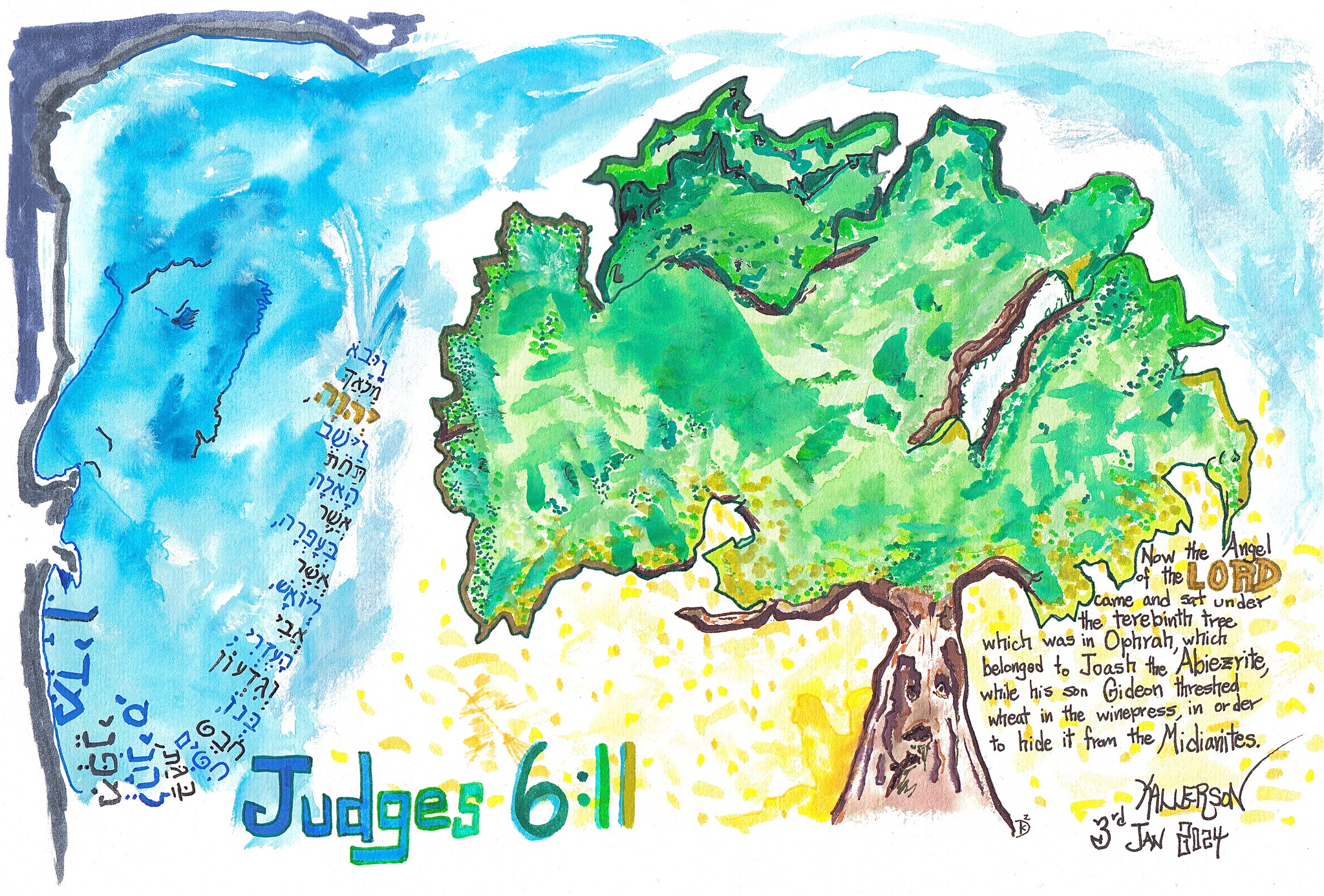
Artwork by Douglas Kallerson.
Judges 6:11-16
Gideon, Judge of Israel, Part I
This portion of the account of Gideon meeting the Person identified here will continue next week, but there is enough detail given to demonstrate, at least from the Hebrew text, that the Lord, meaning Yehovah, was truly incarnate when He appeared to Gideon.
The meaning of the word incarnate is “embodied in flesh,” specifically human form. As we proceed through the verses, it will be evident that this Person engaging Gideon is face-to-face with him. As we progress, we will be reminded that this is not the first time the Bible indicates such an occurrence.
The incarnation, however, is something denied by Jews. There are innumerable commentaries found concerning their position on why it is not possible that Jesus could be both God and Man. Here is an example from JewsforJudaism.org –
“Christians claim that in the birth of Jesus there occurred the miracle of the incarnation of God in the form of a human being. To say that God became truly a human being invites a number of questions. Let us ask the following about the alleged truly man- truly god Jesus. What happened to his foreskin after his circumcision (Luke 2:21)? Did it ascend to heaven, or did it decompose as with any human piece of flesh? During his lifetime what happened to his hair, nails, and blood shed from wounds? Did the cells of his body die as in ordinary human beings? If his body did not function in a truly human way, he could not be truly human as well as truly God. Yet, if his body functioned exactly in a human way, this would nullify any claim to divinity. It would be impossible for any part of God, even if incarnate, to decompose in any way and still be considered God.
“By definition, not mystery, the everlasting, one God, in whole or in part, does not die, disintegrate, or decompose: ‘For I the Lord do not change” (Malachi 3:6). Did Jesus’ flesh dwell in safety after his death? 1 Peter 3:18 states Jesus was ‘put to death in the flesh, but made alive in the spirit.’ 1 Corinthians 15:44-45 claims Jesus was ‘raised a spiritual body,’ that is, he ‘became a life-giving spirit.’ No mention of the survival of the flesh is alluded to. In Acts 2:31, it is claimed Peter stated that following the alleged resurrection Jesus’ body did not see decay. Paul is alleged to have also made this claim (Acts 13:34-37). However, unless Jesus’ body never underwent ‘decay’ during his lifetime he could not be God, but if it did not undergo ‘decay’ then he was not truly human.” Gerald Sigal (Jews for Judaism.org)
Text Verse: “Inasmuch then as the children have partaken of flesh and blood, He Himself likewise shared in the same, that through death He might destroy him who had the power of death, that is, the devil, 15 and release those who through fear of death were all their lifetime subject to bondage.” Hebrews 2:14, 15
The commentary by Mr. Sigal contains several presuppositions about the incarnation that are incorrect. They are not based on a proper reading of Scripture, and they construct straw man arguments. In fact, if he is using Scripture as a baseline for his words, his entire commentary is a straw man fallacy.
To assume that Jesus’ body was “a part of God” would be to misunderstand or misrepresent the idea of the incarnation. Only the poorest of theologians would claim that Jesus’ human body was a part of God. If creation (including any part of it) were a part of God, we would be dealing with pantheism or some concept similar to it.
The incarnation means that God united with His creation. As His creation is clearly fallen, it means that the Lord united in a manner that reflects the words of Hebrews 2, meaning that “in all things He had to be made like His brethren” (Hebrews 2:17).
Therefore, to assume that Jesus’ foreskin could not decay is as illogical as to say that God died on the cross. God did not die on the cross. Rather, the human Jesus did. The incorruption of Jesus’ body after death signified that He had prevailed over death because of His sinless nature.
To assume that His fingernails, which were naturally worn down or purposefully clipped from His human frame, could not decay if He is fully God is a fallacy known as a category mistake. Mr. Sigal simply does not understand, or he rejects, what the actual meaning of the incarnation is.
The hypostatic union is what defines the Person of Jesus. There is a distinction between the humanity and deity of Christ. This point of doctrine describes the union of God and Man in the person of Jesus Christ: two hyposies, or states, in one.
He didn’t possess humanity before His conception, but since His conception, He is clothed in humanity forevermore. And although He is united with human flesh in this union, His deity is not bound by human nature; He remains fully God. His two natures are not in any way separate, and yet they in no way intermingle.
This is what the Bible reveals, not only in the New Testament, but in the Old as well. The encounter of Gideon with the Lord is something that points us directly to the incarnation of Jesus. It is a reasonable and logical point of doctrine to be found in His superior word. And so, let us turn to that precious word once again, and… May God speak to us through His word today, and may His glorious name ever be praised
I. If the Lord Is with Us, Why Then…? (verses 11-13)
11 Now the Angel of the Lord came
Rather: vayavo malakh Yehovah – “And came messenger Yehovah.” There is no article before “angel/messenger.” As such, the identification is indeterminate at this point. This is important because of what occurs as we continue through the verses.
The problem with translating it as “the Angel” (with a capital) is that it is either based on a presupposition, if no further information is given, or it is based on knowledge that is not yet available in the narrative. It is correct, as will be seen, but the text is highlighting a point of theology.
This is a messenger of Yehovah (YHVH). This messenger came…
11 (con’t) and sat under the terebinth tree which was in Ophrah,
vayeshev takhath ha’elah asher b’apherah – “and sat under the terebinth which in Ophrah.” In Judges 4, Deborah was said to have sat under the palm of Deborah. The palm is a symbol of uprightness and righteousness. Here, this angel sits under the elah or terebinth. That is the feminine of ayil, or ram, coming from ul, strength.
Also, to sit implies judgment, as when a king sits for that purpose. This messenger has sat in order to communicate a judgment, just as Deborah did. The name Asherah means Female Fawn, but that comes from aphar, dust. And so, it may also mean Of the Dust.
11 (con’t) which belonged to Joash the Abiezrite,
Rather: asher l’yoash avi ha’ezri – “which to Joash father the Ezrite.” First, depending on the root, the name Joash means either Yehovah is Strong, Fire of Yehovah, Yehovah Has Bestowed, or Yehovah Has Blessed.
Next, in Joshua 17:12, Abiezer was noted. Here, the name is divided by an article. Thus, it says, “My father, the Ezrite,” or “Father of the Ezrite.” The word ezer signifies Help, coming from the verb azar, to help. Therefore, we have some picture developing.
A messenger has sat to render a judgment under a tree denoting strength, in Of the Dust, which belonged to Yehovah Has Bestowed, My Father the Helper. This messenger appeared…
11 (con’t) while his son Gideon threshed wheat in the winepress, in order to hide it from the Midianites.
v’gidon b’no khovet khitim ba’gath l’hanis mipne midyan – “and Gideon, his son, was beating wheat in the winepress to flee from faces Midian.” Gideon comes from gada, to cut down or cut asunder. Thus it means Cutter, Cutter Down, Feller, etc.
Next, the word translated as “threshed” is not the usual one where an ox pulls a cart over the wheat. Here, it signifies to beat. It is the same word used when Ruth beats out what she gleaned. In this case, Gideon is threshing the wheat by beating it, and he is doing it in the winepress.
The reason for this is because of what it said in Judges 6:1-10. The Midianites came in and plundered Israel. In order to hide from them, Gideon is threshing secretively in a vat. A winepress is the last place one would expect to be used at this time of year because it is not the season for pressing.
After beating the wheat, Gideon would thresh it by hand so that the chaff would not fly off into the open sky and be visible from a distance. Rather, as it says, it would “flee from faces Midian.”
As for the winepress, it is a place of judgment symbolized by the treading out of grapes. However, in the treading out of grapes, there is also a sense of joy because of the produce derived from the process. This is seen in the symbolism of Revelation –
“Then another angel came out of the temple which is in heaven, he also having a sharp sickle.
18 And another angel came out from the altar, who had power over fire, and he cried with a loud cry to him who had the sharp sickle, saying, ‘Thrust in your sharp sickle and gather the clusters of the vine of the earth, for her grapes are fully ripe.” 19 So the angel thrust his sickle into the earth and gathered the vine of the earth, and threw it into the great winepress of the wrath of God. 20 And the winepress was trampled outside the city, and blood came out of the winepress, up to the horses’ bridles, for one thousand six hundred furlongs.’” Revelation 14:17-20
There is judgment brought upon the enemies of God, but there is also the obvious joy connected with their destruction. When Christ was in the Garden of Gethsemane (Garden of the Oil Press), He was there enduring the suffering associated with judgment upon sin. The name Gethsemane is derived from the same Hebrew word used here, gath, or winepress.
Also, as seen in the previous sermon, Midian means Strife or Place of Judgment. Everything about the words of this verse speak of defeat, shame, and judgment. The only thing positive is the meaning of the names of Gideon and his father. This positive aspect will be advantageous for the typology being presented. That begins to be seen in the next words…
12 And the Angel of the Lord appeared to him,
Again, there is no article: vayera elav malakh Yehovah – “And appeared unto him messenger Yehovah.” Despite there being no article before “messenger,” we are now given a new insight to consider. The term vayera, or “and appeared,” has occurred thirteen times so far in the Bible. In every instance but one, it has been connected to either the Lord or God.
The one exception is when Joseph appeared to his father Jacob in Genesis 46:29, a passage that pointed to the appearance of Christ to the people of Israel. Thus, though it is not appropriate to translate this as “the angel of the Lord” because the text does not say it, we are being led to that conclusion, nonetheless.
12 (con’t) and said to him, “The Lord is with you, you mighty man of valor!”
vayomer elav Yehovah imkha gibor hekhayil – “and said unto him, ‘Yehovah with you, mighty the valor.’” This does not mean that Gideon was already known for his past acts of bravery, as many scholars claim. Verse 15 clearly refutes that. In fact, the previous verse indicated Just the opposite.
Gideon has been peevishly hiding in a wine vat, beating out a little grain for bread. And yet, the Lord prophetically addresses him in this way. It is a blessing being bestowed upon him based on what will come to pass, not an acknowledgment of what he is already.
As for the words describing him, it says gibor hekhayil. It is a phrase that is translated in various ways and needs to be properly understood. The word gibor signifies might or strength.
The word khayil signifies wealth, strength, ability, and more. In this case, what will come about in his future is what defines the word. As such, the Lord is designating him as a warrior. Thus, it speaks of a man of valor. Such is not yet the case, but it will be slowly drawn out of him as the Lord guides his movements on behalf of Israel.
13 Gideon said to Him, “O my lord, if the Lord is with us, why then has all this happened to us?
vayomer elav gidon bi adoni v’yesh Yehovah imanu v’lamah m’tsaatnu kal zoth – “And said unto him Gideon, ‘O me, my lord! And is Yehovah with us? And why found us all this?’” They are words of incredulity, spoken by a thoroughly confused soul to someone that he thinks must be off his rocker. He says this using the term adoni, my lord, meaning a human. In this case, it essentially means “Sir.”
The previous two uses of malakh, or messenger, are without the article. Gideon doesn’t know who this man is, but he is a man who has claimed to speak on behalf of Yehovah (YHVH). It is the text itself that is building up the profile of the messenger, one step at a time. As such, translations should not get ahead of the text.
As for what Gideon says to this person, it is perfectly reflected in the words of the Lord through Moses –
“Then My anger shall be aroused against them in that day, and I will forsake them, and I will hide My face from them, and they shall be devoured. And many evils and troubles shall befall them, so that they will say in that day, ‘Have not these evils come upon us because our God is not among us?’” Deuteronomy 31:17
Gideon is questioning if the Lord is even among them at all. How could he be? To support his incredulity, he next says…
13 (con’t) And where are all His miracles which our fathers told us about, saying, ‘Did not the Lord bring us up from Egypt?’
v’ayeh kal niphlotav asher sipru lanu avotenu l’mor halo mimitsrayim heelanu Yehovah – “And where all His wonders which recounted to us our fathers to say, ‘Not from Egypt ascended us Yehovah?’” The meaning is that if Yehovah is among Israel, then why isn’t He acting on their behalf?
The fathers had spoken of all Yehovah had done, performing wonders in order to bring them up from Egypt. If that is so, then shouldn’t He be doing the same now?
Gideon seems completely unaware that the disastrous state of Israel is their own fault for doing “the evil” in the eyes of the Lord. But the word, meaning the prophet of verse 8, has alerted them that they have fallen from His ways, not obeying His voice. Gideon is just not aware of that at this point. And so, he continues…
13 (con’t) But now the Lord has forsaken us and delivered us into the hands of the Midianites.”
Nobody properly translates this: v’atah n’tsanu Yehovah vayitnenu b’kaph midyan – “And now, has forsaken us, Yehovah, and given us in palm Midian.” He notes that it isn’t merely that Israel has been given into the hand of Midian, but into the palm of his hand or the sole of his foot. The word kaph can mean either.
Thus, Israel is like an object that is being squeezed in the palm of the hand or trampled under the sole of the foot. They are forsaken and totally oppressed. With his words of melancholy and dejection, a response from the Messenger is provided…
Did not the Lord bring us up from Egypt?
Were we not set before Him among the nations?
But our glory and honor have been stripped
And this, for many generations
Why has all of this come upon us?
The answer is there, recorded in Your word
We turned away when we rejected Jesus
And we crucified our Lord
Lord, restore us as in times past
Bring us to the place of Your favor once again
This seemingly endless trouble, let it no longer last
How long, Lord? We ask You, until when?
II. O My Lord, How Can I Save Israel? (verses 14-16)
14 Then the Lord turned to him
vayiphen elav Yehovah – “And turned unto him, Yehovah [YHVH].” Of these words, Albert Barnes shows his inability to accept the obvious, saying, “The change of phrase from ‘the angel of the Lord’ to ‘the Lord’ is remarkable. When messages are delivered by the Angel of the Lord, the form of the message is as if God Himself were speaking.”
Though this messenger has simply been called an angel of Yehovah until now, the reason has been to build within the narrative itself the misunderstanding of Israel to accept that God can come in human form. But there has already been precedent for this, such as in the Lord appearing to Abraham and Joshua in like form as well. For example –
“Then the Lord [YHVH] appeared to him by the terebinth trees of Mamre, as he was sitting in the tent door in the heat of the day. 2 So he lifted his eyes and looked, and behold, three men were standing by him; and when he saw them, he ran from the tent door to meet them, and bowed himself to the ground, 3 and said, ‘My Lord [Adonai], if I have now found favor in Your sight, do not pass on by Your servant.’” Genesis 18:1-3
The wording in this Genesis account clearly indicates the incarnation of the Lord. An honest evaluation of the text leaves no other option. As for this narrative with Gideon, despite the unambiguous rendering of the Hebrew, the Greek translation continues to say, “the angel of the Lord.” Ellicott states –
“The reason why the LXX. retains the phrase ‘the angel of the Lord’ throughout is because they had the true Alexandrian dislike for all anthropomorphic expressions—i.e., for all expressions which seemed to them to lower the invisible and unapproachable majesty of the Almighty.”
He is partially correct, but more specifically, it is the biased inability of Jews and others to accept that God can present Himself in human form that is the crux of the matter.
However, the text now reveals that this is exactly what is occurring. It is not the word of the Lord through another. Rather, this is Yehovah incarnate. It is the eternal Christ, Jesus…
14 (con’t) and said, “Go in this might of yours,
vayomer lekh b’khoakha zeh – “and said, ‘Go in your power, this.” The Lord indicates that the power Gideon already possesses is sufficient for the calling he is directed to. Therefore, He says…
14 (con’t) and you shall save Israel from the hand of the Midianites. Have I not sent you?”
Again, the translation is incorrect: v’hovoshata eth Yisrael mi’kaph midyan halo salakhtikha – “And shall save Israel from palm Midian. Not I sent you?” The man claims to be Yehovah. This is explicit now because this time He has not said, “The Lord has sent you.” Instead, the words are stated without any such qualifier.
He has identified Gideon, he has selected Him, and He is sending him. Notice the structure of the words. Gideon has questioned the Lord’s doings. The Lord then turned around and claimed He would perform again. Gideon (who has been rather slow on the uptake) will now realize that the Person in front of him is claiming to be Yehovah –
Not [halo] from *Egypt ascended us +Yehovah? And now, has forsaken us, Yehovah, and given us in palm [b’kaph] Midian. (Gideon)
And shall save Israel from palm [mi’kaph] *Midian. Not [halo] +I sent you? (Yehovah)
Just as the Lord sent Moses to bring Israel up from Egypt, so now He is sending Gideon to save Israel from Midian. But, just as Moses failed to understand that the Lord’s choice was the correct one, Gideon also questions the appointment…
15 So he said to Him, “O my Lord, how can I save Israel?
Gideon finally gets who he is talking to, despite the lack of confidence in himself: vayomer elav bi Adonai bamah ovoshia eth Yisrael – “And said unto Him, ‘O me, my Lord, in what I save Israel?’” Instead of adoni, my lord (as to a human), he now addresses Him as Yehovah by saying, Adonai (as to Yehovah incarnate).
The text slowly and precisely presents what is going on, developing a theme for the reader to understand and accept what is presented. It is presented this way so that someday Israel will go to the word and accept what they have denied for so long. This was clearly presented in Judges 6:1-10.
With his understanding now coming to clarity, Gideon still protests the appointment based on his perceived qualifications…
15 (con’t) Indeed my clan is the weakest in Manasseh,
hineh alpi ha’dal bimnasheh – “Behold, my thousand the dangling in Manasseh.” The form of the word alpi is found only here. It is derived from eleph, cattle. That is derived from alaph, to learn.
The connection is that when cattle are yoked, they learn obedience and are tamed. However, the word is always used in the plural to refer to cattle. This is singular. To say, “My cow is the least in Manasseh,” wouldn’t match with the parallelism of the next clause.
Hence, most scholars and many translations take this as coming from eleph, a thousand, and translate it as “my thousand.” The connection is that an ox’s head represents the first letter, aleph, of the aleph-beth and also the numeral one. Thus, the eleph is used to represent a thousand. That would then correspond to the words of the blessing of Moses upon the tribe –
“His glory is like a firstborn bull,
And his horns like the horns of the wild ox;
Together with them
He shall push the peoples
To the ends of the earth;
They are the ten thousands of Ephraim,
And they are the thousands [alphe] of Manasseh.” Deuteronomy 33:17
The NKJV paraphrases the idea of a thousand and says, “my family.” The only other meaning would be to go with the root signifying to learn and say, “My learning is the dangling in Manasseh.” But the parallelism seems to point to “thousand.”
As for the word dal, to dangle, that comes from dalal, to languish. Thus, dal means dangling, like a weak person whose arms simply hang by his sides, unable to raise them.
Gideon is describing his portion of Manasseh as the most impoverished and weakest of the tribe. Manasseh means both To Forget and From a Debt. With that, he next says…
15 (con’t) and I am the least in my father’s house.”
v’anokhi ha’tsaiyr b’beith avi – “and I the insignificant in house my father.” From the most impoverished section of Manasseh, Gideon then acknowledges that in the house of his father Joash, Yehovah Has Bestowed, he is the smallest, least, or most insignificant. Thus, he can be of little or no help at all.
Again, as we have seen, notice the lowly state of those who have been selected as Judges –
Othniel was specifically noted as Caleb’s ha’qaton or “the younger.” The word is derived from qut, to feel a loathing. The implication is that the elder is greater, and anything less is to be despised. And yet the younger, the lesser, was the first Judge.
Then came Ehud, the left-handed, a perceived weakness. Next was Shamgar, son of Anath, or There a Stranger, Son of Affliction. The name implies that he was an unlikely candidate to do anything great.
After him was Deborah, who was specifically noted as a woman to highlight her supposed inferiority. Now, Gideon, a person who believes that he is the least of the least, has been chosen. Despite his perceived inability to get out of his own way, the Lord makes a promise to bolster his confidence…
16 And the Lord said to him, “Surely I will be with you, and you shall defeat the Midianites as one man.”
vayomer elav Yehovah ki ehyeh imakh v’hikitha eth midyan k’ish ekhad – “And said unto him, Yehovah, ‘For I will be with you and shall strike Midian according to man one.’” Despite the huge number of Midianites, they will be gathered as one and destroyed. As the Lord has spoken, Gideon is to be assured.
With this verse complete, we will pause the narrative for today and continue to explore the mystery of the incarnation that is so clearly and evidently presented in the text.
Oh God! You are our Father, and we are your children
You brought us forth for Your honor and glory
You created all the children of men
We have become a part of Your redemption story
It is You who begat us, and to You we lift our praise
It is You who created so that we came forth to You
It is we who turned away for seemingly endless days
But You never abandoned us; You are ever faithful and true
O God our Father, bring us back to You
Turn our hearts so that we are right again
Lead us on paths that are righteous and true
Look with favor on Your wayward children
III. The Incarnation
In the introduction, the fallacious arguments of Gerald Sigal were briefly analyzed. To give a fuller idea of what Judaism teaches, another portion of a commentary, Against Messianic Judaism, from medium.com is provided –
“First and foremost, the divide between Judaism and Christianity has to do with the role of Jesus, not simply if he was the messiah, but whether or not he was a god. Judaism explicitly rejects Jesus as the messiah because of his failure to fulfill the requirements of the role. Judaism also rejects the idea that a human being can be God and on principle will not worship other gods. The Christian deification of Jesus violates both the concept of monotheism and the rejection of a human incarnation of God. Both principles can be found in the Bible. Furthermore, the Torah explicitly warns against false prophets, which by any rational standard Jesus (and the apostles) would fall into, even if we accepted the idea that he (they) performed miracles.
“The Jewish commitment to monotheism can be found throughout the Bible. The first and second commandments state, “I the Lord am your God who brought you out of the land of Egypt, the house of bondage: You shall have no other gods besides Me. You shall not make for yourself a sculptured image […] You shall not bow down to them or serve them” (Exodus 20:2–5). The central statement of Jewish faith can be found in Deuteronomy 6:4–5, “Hear, O Israel! The Lord is our God, the Lord alone. You shall love the Lord your God with all your heart, and with all your soul, and with all your might.” And finally, God declares his utter singularity in Isaiah 45:5, “I am the Lord and there is none else; beside Me there is no god.” These verses reveal the absolute unity of God in Jewish theology. God identifies himself as the savior of the Jews from Egyptian slavery, and declares that the Jews will worship no other gods, in fact that there are no gods beside (with) him. Jewish interpretations of these verses have led them to completely reject the Christian doctrine of the Trinity as having no basis in the Bible. Moses Maimonides, one of the greatest and most authoritative Jewish legal scholars in history, included in his 13 principles of faith belief in the absolute unity of God. Divisions like those of the Trinity are rejected.
Maimonides also included a rejection of divine incarnation as one of his principles of Jewish faith, which he grounded in the Bible. The Jewish faith rejects the idea that God would have a physical body. The prophet Hosea quotes God as saying, “I am God and not a man” (Hosea 11:9). In the Torah, the idea that God could be a human being is explicitly rejected, “God is not a man to be capricious, or mortal to change his mind. Would he speak and not act, promise and not fulfill?” (Numbers 23:19). Moving away from the Bible there is also the logical inconsistency of the idea of an infinite, eternal God truly becoming a finite, contingent human being. The concept of God is inherently mutually exclusive from that of humanity. One cannot truly become the other without totally leaving behind the nature of the former being. I.e. if God were to truly become a human being, he would cease to be God. The Incarnation not only violates the fundamental teaching of Jewish theology, but also flies in the face of logic.” medium.com
Although it would take too long to argue against every point of what is said here and in the rest of their article, a few highlights can be noted. For example, “The Christian deification of Jesus violates both the concept of monotheism and the rejection of a human incarnation of God. Both principles can be found in the Bible.”
Actually, just the opposite is true. Only through selecting verses that are taken out of the greater biblical context can this argument be made. The human incarnation is clearly identified in the passage concerning Abraham that was cited, as well as these verses in Judges 6.
One might argue that this Man is not the same as Jesus, but it is ridiculous to deny an incarnation occurred in those and other accounts. The references to monotheism provided in the commentary in no way negate an incarnation.
And more, the idea of a singularity in deity, as explained by the author, carries the same problem as that of the false god of Islam. If God was an absolute monad and not a Godhead, there would be no ability for Him to extend beyond Himself. He would be incapable of creating anything.
But more, how could a being that didn’t understand fellowship create anything beyond Himself which fellowships? The twelfth First Principle, the Principle of Analogy, states that “The cause of being cannot produce what it does not possess.”
If God does not possess – and thus understand – fellowship, He could not create that which fellowships. The principle is undeniable, and the precept that comes from the principle is irrefutable. Because of this, the mere fact that we are social beings confirms a plurality within a single essence such as the Trinity.
As proof of their incorrect idea concerning absolute monotheism, Isaiah 45:5 was cited, “I am the Lord and there is none else; beside Me there is no god.” That says nothing about a possible Trinity, nor does it refute the incarnation, especially if the Trinity is correct.
To demonstrate the illogical nature of their own analysis, the Bible in countless other verses, specifically says there are other “gods,” naming dozens, if not more, of them. The Lord is merely making a point that He is the only true God, regardless of how He has revealed Himself or how Scripture reveals Him.
In citing Hosea 11:9, where the Lord says He is God and not a man, they fail to acknowledge their own Scriptures that identify His incarnation. But more, those words do not disprove the idea of the incarnation.
As noted earlier, the hypostatic union says that God is God and that the human Jesus is a Man who is also God. There are two separate natures, eternally united but distinct from the other. There is nothing illogical about it.
As for their citation of Deuteronomy 6:4, they translate it as, “Hear, O Israel! The Lord is our God, the Lord alone.” The Hebrew uses the ordinal number (one) – “The Lord is One.”
However, the meaning of the number extends beyond an absolute oneness, such as in Genesis 2:24 –
“Therefore a man shall leave his father and mother and be joined to his wife, and they shall become one [ekhad] flesh.”
The word ekhad, or one, allows this. For example, a cluster of grapes is one. Likewise, the people Israel are one people. Both of these are made up of individual parts and yet are termed “one.”
There is another word which means one and only one – yakhid. It was used, for example, when speaking of Abraham’s one and only son, Isaac, in Genesis 22:2. It is remarkable, but not unexpected, that ekhad, rather than yakhid, was used in the Shema, because the Bible elsewhere reveals that the Godhead is a plurality within a single essence.
Also, in the commentary, they said, “Jewish interpretations of these verses have led them to completely reject the Christian doctrine of the Trinity as having no basis in the Bible.” This is known as a false dichotomy.
It is a fallacy where a set of options is presented and then the claim is made that there are only two possibilities to explain them. “The verses we have presented show that the incarnation is not possible. Therefore, we are right, and any other view is wrong.”
There are problems with that. First, even the verses cited are shown to not support their limited explanations of them. Also, they fail to encompass all potential options. They also fail to explain the obvious incarnations cited above in Genesis and Judges.
The fallacious nature of their thinking is again seen in stating, “Maimonides also included a rejection of divine incarnation as one of his principles of Jewish faith, which he grounded in the Bible.”
This is known as a genetic, or source, fallacy: “This must be true because someone we hold as important and learned says it is true.” Claiming that Maimonides grounded his principles in the Bible must be borne out by a proper analysis of the Bible, which this point concerning the incarnation does not.
The almost laughable statement that “The Jewish faith rejects the idea that God would have a physical body” is completely upended when the Lord, who is God, is shown multiple times to have a physical body right in their own Scriptures. Likewise, the final comments are equally fallacious, being straw man points. They claim that Christianity teaches something other than the hypostatic union –
“The concept of God is inherently mutually exclusive from that of humanity. One cannot truly become the other without totally leaving behind the nature of the former being. I.e. if God were to truly become a human being, he would cease to be God. The Incarnation not only violates the fundamental teaching of Jewish theology, but also flies in the face of logic.”
No reasonable teacher of the Trinity says that God became a human being. Thus, their argument is not based on reality but a rejection of what God has clearly presented in both testaments of Scripture. This rejection is exactly why the Jews have suffered the punishments of Leviticus 26 and Deuteronomy 28 for the past two thousand years.
It is also the reason for the typology that is clearly presented in the histories of the first four Judges of Israel and which continues to be presented in the fifth judge, Gideon.
To show the odd and dismissive thinking of Judaism for their Lord, Yeshua, whom they crucified but who rose again, the following words from Chosen People Ministries, a messianic body, are provided –
“In a broad sense, it is accepted that Judaism believes that God can never be represented in human form, and this remains a major obstacle for Jewish people accepting Jesus as being who He claims to be. Judaism recognizes that human beings are created in the image of God, and that God is present in the world and the nation of Israel. However, Christianity’s claim that Jesus is God is simply not within the realm of Jewish thought. Yet the concept is not foreign to mainstream and historic Judaism. Judaism believes that the Torah was created before the world, thus historic Judaism came to accept that the Word (The Torah) can be legitimately viewed as a form of incarnation. Some Jewish scholars will argue that even the nation of Israel is an incarnational process, and that Ezekiel 37 speaking of the “dry bones” addresses this.”
The ridiculous words concerning Israel being an incarnational process will be overlooked, but if the Torah, the Word of God, existed before creation, then it implies that something that is not God has always existed. It would be inane to say that the Torah is God if the Torah is not God.
But what is the Word of God that truly must have existed before Creation? It is explained not in the Old Testament but rather New –
“In the beginning was the Word, and the Word was with God, and the Word was God. 2 He was in the beginning with God. 3 All things were made through Him, and without Him nothing was made that was made. 4 In Him was life, and the life was the light of men. 5 And the light shines in the darkness, and the darkness did not comprehend it.” John 1:1-5
This is one of numerous verses that indicates the preexistence of the Word, meaning Jesus. The Word, as it says in John 1:14, became flesh. He is the incarnate Word that is revealed in Scripture. The very Word that Jews claim always existed.
For there to be a beginning, there must have been a Beginner. And if that Beginner spoke the world into existence as the Bible states (Psalm 33:9), then the Word existed with God before the beginning. But if there was only God at the beginning, then the Word was God, is God, and will forever be God.
The state of the Jewish people today is reflected in the state of Israel at the time of Gideon. They were out of favor with the Lord, they had transgressed the covenant, and they had no legitimate claim to make against Him. It is they, not He, who failed to uphold the covenant between them.
And yet, He covenanted with them as well. And in His promises to them came the unconditional word that they would forever remain before Him as a people. This has remained true without a moment of exception since their coming before Him to agree to the covenant at Sinai.
In their rejection of Jesus, they rejected their God. And yet, His infinite grace has kept them and has now reestablished them. And that grace will soon be extended to bringing them into the New Covenant that was promised in the Old.
Something better lies ahead for Israel. We are being shown this in the ongoing Judges narrative. God is ever-faithful to His people. And that now means to those of His church as well. The blood of the New Covenant now covers the sins of those who come to Him through the cross of Christ.
Let us not neglect so great a salvation. Let us accept the gospel to the saving of our souls. May it be so, to the glory of God who redeems man unto Himself. Thanks be to God for Jesus Christ our Lord.
Closing Verse: “Let all the earth fear the Lord;
Let all the inhabitants of the world stand in awe of Him.
9 For He spoke, and it was done;
He commanded, and it stood fast.” Psalm 33:8, 9
Next Week: Judges 6:17-24 More exciting than shooting a gun. And that’s pretty swell, I’m telling you… (Gideon, Judge of Israel, Part II) (19th Judges Sermon)
The Lord has you exactly where He wants you. He has a good plan and purpose for you. It is He who judges His people according to their deeds. So, follow Him, live for Him, and trust Him, and He will do marvelous things for you and through you.
Gideon, Judge of Israel, Part I
Now the Angel of the LORD came
And sat under the terebinth tree which was in Ophrah
———-maybe for a little rest
Which belonged to Joash the Abiezrite
While his son Gideon threshed wheat in the winepress
In order to hide it from the Midianites
And the Angel of the LORD appeared to him, yes to that feller
And said to him
“The LORD is with you, you mighty man of valor!”
Gideon said to Him, “O my lord, if the LORD is with us
Why then has all this happened to us? We are feeling jipped!
And where are all His miracles which our fathers told us about
Saying, ‘Did not the LORD bring us up from Egypt?
“But now the LORD has forsaken us; we face all these plights
And He has delivered us into the hands of the Midianites”
Then the LORD turned to him and said
“Go in this might of yours, so you shall do
And you shall save Israel from the hand of the Midianites
Have I not sent you?”
So he said to Him
“O my Lord, how can I save Israel, me small like a mouse?
Indeed my clan is the weakest in Manasseh
And I am the least in my father’s house”
And the LORD said to him
“Surely I will be with you
And you shall defeat the Midianites
As one man; this you shall do”
Lord God, turn our hearts to be obedient to Your word
Give us wisdom to be ever faithful to You
May we carefully heed each thing we have heard
Yes, Lord God may our hearts be faithful and true
And we shall be content and satisfied in You alone
We will follow You as we sing our songs of praise
Hallelujah to You; to us Your path You have shown
Hallelujah we shall sing to You for all of our days
Hallelujah and Amen…
11 Now the Angel of the Lord came and sat under the terebinth tree which was in Ophrah, which belonged to Joash the Abiezrite, while his son Gideon threshed wheat in the winepress, in order to hide it from the Midianites. 12 And the Angel of the Lord appeared to him, and said to him, “The Lord is with you, you mighty man of valor!”
13 Gideon said to Him, “O my lord, if the Lord is with us, why then has all this happened to us? And where are all His miracles which our fathers told us about, saying, ‘Did not the Lord bring us up from Egypt?’ But now the Lord has forsaken us and delivered us into the hands of the Midianites.”
14 Then the Lord turned to him and said, “Go in this might of yours, and you shall save Israel from the hand of the Midianites. Have I not sent you?”
15 So he said to Him, “O my Lord, how can I save Israel? Indeed my clan is the weakest in Manasseh, and I am the least in my father’s house.”
16 And the Lord said to him, “Surely I will be with you, and you shall defeat the Midianites as one man.”