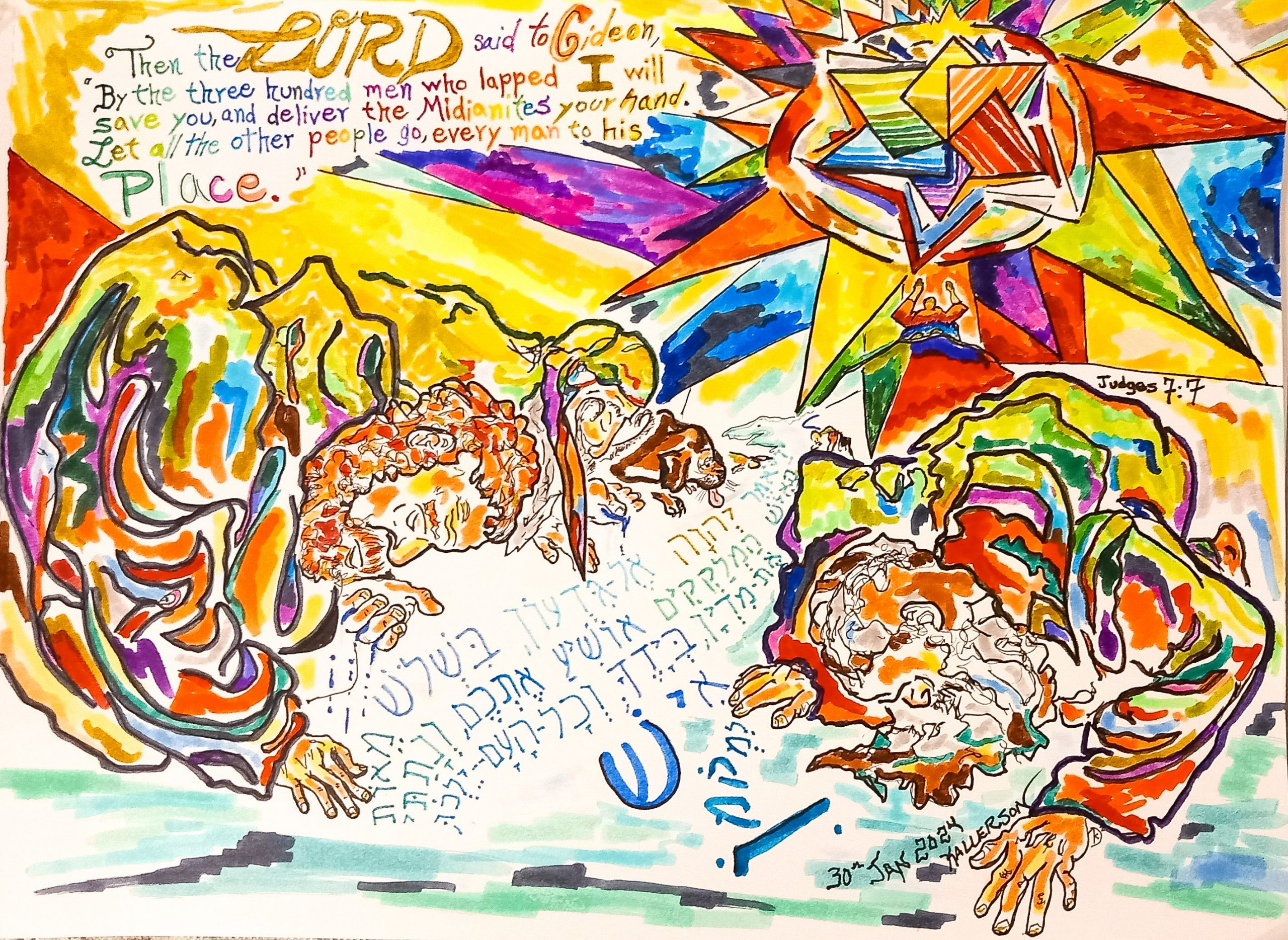
Artwork by Douglas Kallerson.
Judges 7:1-8
(Gideon, Judge of Israel, Part V)
(Typed 27 November 2023) In 480 BC, the Battle of Thermopylae occurred. It is noteworthy because of the bravery and fighting prowess of the three hundred Spartan hoplites who so valiantly fought in the battle.
Their deeds are legendary, and their bravery was seemingly unmatched in ancient history. But their battle wasn’t as remarkable as the one recorded in Judges 7.
What occurs in Judges 7 is carefully detailed for us in Scripture, but to imagine the thoughts of the men who were asked to engage the battle is beyond our ability.
They had a view from the top of a hill that allowed them to look out over the entire army they would face. It would have seemed utterly impossible for three hundred men to last even a few minutes against this massive army, much less prevail over them.
But the Lord called them to the task, and He personally made the selection concerning who would fight and who was excused from the contingent that had originally assembled. Truly, only trusting in the hand of the Lord to prevail explains how anyone would go forward to meet such a vast and terrifying force.
Text Verse: “The Lord is my helper;
I will not fear.
What can man do to me?” Hebrews 13:6
In Christ, not being afraid takes on a completely new meaning. Not only can we trust that the Lord will save us in this life according to His will, but we can trust that He will also forever deliver us from death.
It is one thing to be promised, “You won’t die in the battle today,” and it is an entirely different thing to be told, “If you trust in Me, death has no power over you, forever.” Unless the rapture happens, all of us will die, but that is not the end of the story for believers.
Because Jesus prevailed over death for those who trust Him, they too have prevailed over death. What happens to our earthly selves is not consequential in the bigger scheme of things.
Unlike whatever was on the mind of the soldiers under Gideon, we can trust that whatever comes upon us will be a temporary blip in our continued stream of existence. This is the marvelous hope we possess. Cling to it and be confident in it.
Such great truths as eternal life are proclaimed for believers in Jesus in God’s superior word. And so, let us turn to that precious word once again, and… May God speak to us through His word today, and may His glorious name ever be praised.
I. Who Is Fearful and Afraid (verses 1-3)
The sign of the fleece ended Chapter 6. However, chronologically, the passage here follows after Judges 6:35, prior to the ending of the chapter –
“Then all the Midianites and Amalekites, the people of the East, gathered together; and they crossed over and encamped in the Valley of Jezreel. 34 But the Spirit of the Lord came upon Gideon; then he blew the trumpet, and the Abiezrites gathered behind him. 35 And he sent messengers throughout all Manasseh, who also gathered behind him. He also sent messengers to Asher, Zebulun, and Naphtali; and they came up to meet them.” Judges 6:33-35
Now that Gideon has been apprised of the Lord’s intent concerning the law vs. grace in the sign of the fleece, the words of Chapter 7 follow in a logical way, beginning with…
Then Jerubbaal (that is, Gideon) and all the people who were with him rose early
The order is jumbled by the NKJV, thus tarnishing the emphatic nature of the words. This should read as two separate clauses: vayashkem yerubaal hu gidon v’kal ha’am asher ito – “And rose early Jerubbaal, he Gideon, and all the people who with him.”
Here, the name Jerubbaal, Let Baal Strive, is given prominence. It was introduced in verse 6:32 as an honorary title to Gideon, Cutter, because of his actions taken against the altar of the baal, upon which rested the image of Asherah.
It is Jerubbaal who is said to have risen early. Along with him were those who were willing to engage in the battle directed by the Lord. After having arisen, they set out for the battle…
1 (con’t) and encamped beside the well of Harod,
Rather: vayakhanu al ein kharod – “and encamped above Spring Harod.” The name Ein Kharod means Spring of Trembling or Spring of Fear, coming from kharad, to shake or tremble with fear. The name is certainly derived from the events now taking place. This will be seen in verse 3.
Rather than encamping beside the well, the men encamp above it, on a hilltop that overlooks the entire valley below.
Today, this spring is found in Ma’ayan Harod National Park. To see it in a modern video, go to the YouTube channel Sergio and Rhoda in Israel and find the video entitled “Gideon’s Cave and the Spring of Harod.”
In it, these two intrepid YouTube trekkers discuss the details of the very battle that is outlined in Judges 7. Also, one can get a sense of what the layout of the land is like.
1 (con’t) so that the camp of the Midianites was on the north side of them by the hill of Moreh in the valley.
Without checking, the translator followed the same error as the KJV. As Jerubbaal is the leader, the words focus on him alone speaking in the first-person singular: u-makhaneh midyan hayah lo mitsaphon migivath ha’moreh ba’emeq – “And camp Midian was to him from north from hill the Moreh in the valley.”
The Hill of Moreh was north of Gideon’s location, with the camp of the Midianites lying in the valley.
Midian means Place of Judgment.
As seen in previous sermons, the word tsaphon, north, signifies that which is hidden or treasured away because the north receives less light in the northern hemisphere.
The givah, hill, carries various connotations in Scripture, but the main connection in typology is that it is etymologically connected to Gabbatha in the New Testament.
Givath ha’Moreh, Hill the Moreh, means Hill of the Teacher. Moreh comes from yarah, to throw or shoot. One throws to hit a target. Thus, it is like instruction, where one teaches with a particular goal in mind.
However, the word is identical to the noun moreh, the early rain. That is found only in Psalm 84:6 and twice in Joel 2:23, a passage that refers to the end times –
“Be glad then, you children of Zion,
And rejoice in the Lord your God;
For He has given you the former rain [moreh] faithfully,
And He will cause the rain to come down for you—
The former rain [moreh],
And the latter rain in the first month.”
Another cognate word is also used for the early rains, yoreh. That is found in several Old Testament passages. Both words, moreh and yoreh, are derived from the same root, yarah. Thus, both carry the idea of instruction.
The name Givath ha’Moreh has a secondary meaning of Hill of the Early Rain.
It cannot go unnoted that James, an epistle directed to the end times Jews following the church age, refers to the rain cycle and directly associates it with the coming of the Lord –
“Therefore be patient, brethren, until the coming of the Lord. See how the farmer waits for the precious fruit of the earth, waiting patiently for it until it receives the early and latter rain. 8 You also be patient. Establish your hearts, for the coming of the Lord is at hand.” James 5:7, 8
Finally, the emeq, or valley, refers to a deep, broad valley, a depth. With the layout described, the Lord has a word for Gideon…
2 And the Lord said to Gideon, “The people who are with you are too many for Me to give the Midianites into their hands,
vayomer Yehovah el gidon rav ha’am asher itakh mititi eth midyan b’yadam – “And said Yehovah unto Gideon, ‘Many the people whom with you for giving Midian in their hand.”
As will be seen in the next verse, there are 32,0000 with Gideon. However, the Midianites are said to be as numerous as locusts (7:12) and comprise a combined force of 135,000 (8:10). Thus, it is greater than four to one in total number.
Gideon must have sarcastically thought, “Yeah, right. I get that.” But the Lord next explains to him why they were too many…
2 (con’t) lest Israel claim glory for itself against Me, saying, ‘My own hand has saved me.’
pen yith’paer alay Yisrael l’mor yadi hovoshiah – “Lest, over me Israel to say, ‘My hand saved to me.’” Of these words, the Pulpit Commentary rightly states –
“It must be remembered that this whole movement was essentially a religious one. It began with prayer (Judges 6:6, 7), it was followed up by repentance (Judges 6:27, 28), and the great purpose of it was to turn the hearts of the nation back to the God of their fathers. The Lord himself, therefore, graciously forwarded this end by making it plain that the deliverance from their oppression was his work, and his only.”
Had the entire force of 32,000 that came with Gideon gone to the battle, they could justify the victory as coming from their own hands and not the providential hand of Yehovah. Not only is this likely, but it is the normal conclusion of those who engage in such a battle.
But the people had cried out to the Lord (Judges 6:6). Therefore, his response was intended to get them to realize that He alone could provide the victory they had failed to secure up until then. In their crying out, God would respond, but only in such a way that His hand, not Israel’s, unmistakably provided for their salvation.
3 Now therefore, proclaim in the hearing of the people, saying, ‘Whoever is fearful and afraid,
v’atah qera na b’azene ha’am l’mor mi yare v’khared – “And now, proclaim, I pray, in ears the people to say, ‘Who fearful and trembling.” This is where the spring received its name Kharod, coming from kharad, to tremble with fear. Here, the adjective form, khared, is used.
The Lord first weeds out any who were originally willing to fight but who were now afraid to do so. After seeing the humongous force scattered over the countryside, their initial bravado was seriously lacking. Thus, they trembled at the prospect of the battle that lay ahead. Therefore, the Lord says…
3 (con’t) let him turn and depart at once from Mount Gilead.’”
The first verb is a jussive: yashov v’yitspor mehar ha’gilad – “He shall depart and flit from Mount Gilead.” The Lord gives an implied command to have any fearful warriors return home. It is similar to the injunction given through Moses in Deuteronomy –
“The officers shall speak further to the people, and say, ‘What man is there who is fearful and fainthearted? Let him go and return to his house, lest the heart of his brethren faint like his heart.” Deuteronomy 20:8
In the words of this verse in Judges, there is a verb found only here in Scripture: tsaphar. Of this word, Strong’s says, “perhaps depart.” The BDB Lexicon says, “dubious.” In other words, its meaning escapes them. However, it is rather apparent when considering its root, a primitive word signifying to skip about.
From there, the word is cognate to tsippar, a bird, ts’phardea, a frog, as well as other similar words. Hence, it means something like flit, leap, hop, skip, dart, etc. Today, we might say, “He shall turn and skedaddle out of there.” To keep it close to the thought of the bird, which is spelled identically, I translate it as flit.
As always, a har, or mount, is a lot of something gathered. It is synonymous with a large but centralized group of people. The Gilead means The Perpetual Fountain.
There is a seemingly insurmountable problem with the words “from Mount Gilead.” Mount Gilead is on the other side of the Jordan. Because of this, some say it is an error in the text. Ellicott, ever ready to help, provides several possibilities –
“This expression has caused great difficulty, but the Hebrew cannot mean “to mount Gilead,” nor yet ‘beyond mount Gilead.’ The only tenable solution of the difficulty is, (1) to alter the text into “mount Gilboa” (Clericus), or from meehar, “from mount,” to maheer, “speedily” (Michaelis); or (2) to suppose that ‘mount Gilead’ was a rallying-cry of the Manassites in general, for Gilead was a son of Abiezer (Numbers 26:30, where Jeezer is merely an error); and hence was derived the name ‘Gilead’ of the trans-Jordanic district which fell to the half-tribe of Manasseh (Joshua 17:5-6). If this be a true conjecture, the phrase ‘let him depart from mount Gilead’ means ‘let him leave the camp of Manasseh.’ One more conjecture is that Gilead is an ancient name for Gilboa (Schwarz).”
As such an obvious blunder in the text would be incomprehensible, Ellicott’s submission that this is a call to leave the camp of Manasseh brilliantly and correctly identifies the intent. In Judges 6:15, Gideon was identified with the tribe of Manasseh. In Judges 6:35, it said –
“And he sent messengers throughout all Manasseh, who also gathered behind him.”
Manasseh is the main tribe by which the army is identified. Mount Gilead is being used as a metonym to represent Manasseh. With his directive heard by the people, it next says…
3 (con’t) And twenty-two thousand of the people returned, and ten thousand remained.
More than two-thirds of those who heeded the original call could not bear up under the prospects of what lay ahead. Therefore, the Lord graciously instructed them to hightail it out of there. However, more will need to depart to further whittle down the numbers…
Who is fearful and afraid
Whose heart is failing at the sight
The word of the Lord, you have not obeyed
He asks you to trust, no matter the plight
The Lord is our Helper; let us not fear
He is with us through day and night
He is ever-present and always near
He asks you to trust, no matter the plight
The forces arrayed against us
Will all be swept away
Through our faith in Jesus
We are again right with God; oh, Glorious Day
II. As a Dog Laps (verses 4-8)
4 But the Lord said to Gideon, “The people are still too many;
vayomer Yehovah el gidon od ha’am rav – “And said Yehovah unto Gideon, ‘Still the people many.’” The fact is that 10,000 brave warriors can do much more without any fearful men than 32,000 most of whom are fearful. That was seen in Moses’ words from Deuteronomy 20:8, “lest the heart of his brethren faint like his heart.”
Cowardice breeds cowards, and bravery breeds heroes. This would be a powerful group of men who would later boast in their prowess. Therefore…
4 (con’t) bring them down to the water, and I will test them for you there.
hored otam el ha’mayim v’etsr’penu lekha sham – “Descend them unto the waters and I will refine them to you there.” The Lord introduces a new word to Scripture, tsaraph. It signifies to smelt. Thus, it means to refine, purify, or purge.
The Lord will personally refine those remaining brave warriors into a single, unified, and lethal fighting force, but one too small to accomplish what they are called to do without His guiding hand.
Being fearful or trembly does not necessarily mean one is cautious, responsible, or physically/mentally prepared for a task. Thus, the Lord will refine them to suit His purposes…
4 (con’t) Then it will be, that of whom I say to you, ‘This one shall go with you,’ the same shall go with you; and of whomever I say to you, ‘This one shall not go with you,’ the same shall not go.”
The decision was not left for Gideon to make. Rather, the Lord will determine who goes. The constant stream of discourse from the Lord to Gideon implies that the Lord is actively speaking in his ear. Whether this was audible or otherwise, step-by-step instruction is being conveyed, which Gideon understood to be from the Lord. Having heard these words, it next says…
5 So he brought the people down to the water.
vayored eth ha’am el ha’mayim – “And he descended the people unto the waters.” The army was “above” the spring, as noted in verse 1. Now, they have descended to the waters to be tested. From this vantage point, they could not see the entire valley where Midian was situated…
5 (con’t) And the Lord said to Gideon, “Everyone who laps from the water with his tongue, as a dog laps, you shall set apart by himself;
vayomer Yehovah el gidon kol asher yaloq bilshono min ha’mayim ka’asher yaloq ha’kelev tasig oto l’bad – “And said Yehovah unto Gideon, ‘All who laps in his tongue from the water according to laps the dog, you shall set to separation.” The Lord introduces another new word, laqaq. It is an onomatopoeia, meaning to lap.
If you are fortunate enough to have a dog, or two, or seven, you can readily hear the sound when they come to a bowl to drink, lqlqlqlqlq. Anyone of those who laqaqs the water is to be set apart. Also…
5 (con’t) likewise everyone who gets down on his knees to drink.”
v’kol asher yikra al birkav lishtoth – “And all whom crouches upon his knees to drink.” Those who crouch down to the water, resting on their knees to drink, are to likewise be separated.
There is a ton of conjecture on what is being conveyed here. Josephus and others think those who lap are the fainthearted. Others take the opposite view and say those who kneel are fainthearted or even foolhardy, not paying attention to the possibility of an attack. Rashi stupidly says that those who went to their knees were secret idolators who had “bowed the knee to Baal.”
Actually, none of these gets the point. The fainthearted have already been winnowed out. All have been called by Gideon, who was specifically named Jerubbaal. Thus, they already know that Gideon has taken the side of the Lord.
It may be true that those who got down on their knees were not mentally attentive to any dangers, while those who brought water in their hands to their mouths to lap were being cautious. But even that is conjecture. Plus, with 10,000 men, it hardly mattered because they would be drinking at different times, so there would always be people observing the area.
Rather, the Lord is making a point in the use of His words. Dogs lap, felines lap, and ruminants (cattle, sheep, antelopes, etc.) lap. All are mentioned in Scripture. However, He has specifically identified “the dog.” It is obviously a great choice for those who love dogs, but that is beside the point.
The dog has consistently pictured Gentiles. The typology follows the Gentile church age in chronology. Israel had rejected the gospel while the Gentiles drank it in copiously and carefully. The sense, then, is that those who drink are doing so like Gentiles. Those warriors who lap like the dog are next identified…
6 And the number of those who lapped, putting their hand to their mouth, was three hundred men;
v’hi mispar ha’malaqim b’yadam el pihem sh’losh meoth ish – “And was number the lappers in their hand unto their mouth three hundred men.” To conclude that these were the most cowardly, bravest, most alert, etc., because of lapping is to insert too much into the text.
In order to get water to lap, they would first have had to either crouch down and then stand back up, remain down on their haunches, kneel down (which it says they did not), or lie down facing the water and pull the water to their mouths with their hands (which actually seems to be the most likely option).
The words do not tell us which was the case. If standing as opposed to kneeling was what defined them, which many claim, then there would be no need to say they lapped like dogs. The words depend on the description in relation to the animal.
Therefore, the only distinction that can be made is that some lapped like the dog and some knelt. Lapping like the dog is what defines them, nothing more. As for the others…
6 (con’t) but all the rest of the people got down on their knees to drink water.
v’kol yeter ha’am karu al birkhehem lishtoth mayim – “And all remainder the people crouched upon their knees to drink water.” The meaning is probably that they got to the water, got down on their knees, and plowed their faces directly into the water without using their hands.
7 Then the Lord said to Gideon,
vayomer Yehovah el gidon – “And said Yehovah unto Gideon.” Again, it can be seen that the Lord is speaking to Gideon, probably directly rather than by a prophet. It was something that occurred immediately as well. Just as the Lord spoke to Deborah, so He is conveying His word to Gideon. An example of this is found in Isaiah 20 –
“And it happened, before Isaiah had gone out into the middle court, that the word of the Lord came to him, saying, 5 “Return and tell Hezekiah the leader of My people, ‘Thus says the Lord, the God of David your father: “I have heard your prayer, I have seen your tears; surely I will heal you. On the third day you shall go up to the house of the Lord.” Isaiah 20:4, 5
7 (con’t) “By the three hundred men who lapped I will save you, and deliver the Midianites into your hand.
bishlosh meoth ha’ish ha’malaqim ovoshia etkhem v’nathati eth midyan b’yadekha – “In three hundred the man, the lappers, I will save you and give Midian in your hand.”
The whole point of the process has been to get to this place. The numbers are now 450 Midianites to one Israelite. Those with the trait of the lapping dog are set apart from the rest. It is these otherwise impossible odds that will reveal the power of the Lord.
Three hundred is a multiple of three and ten. Three signifies Divine Perfection. Expanding on that, Bullinger says –
“The number three, therefore, must be taken as the number of Divine fulness. It signifies and represents the Holy Spirit as taking of the things of Christ and making them real and solid in our experience. It is only by the Spirit that we realise spiritual things. Without Him and His gracious operation, all is surface work: all is what a plane figure is to a solid.”
Of the number ten, Bullinger says –
“Completeness of order, marking the entire round of anything, is, therefore, the ever-present signification of the number ten. It implies that nothing is wanting; that the number and order are perfect; that the whole cycle is complete.”
As for the number 450, which is certainly intentional concerning the odds, it is derived from 5, 9, and 10. Ten was just explained.
Five is the number of grace.
Nine is the number of finality or judgment.
With these incredible odds set before Gideon, the Lord next instructs…
7 (con’t) Let all the other people go, every man to his place.”
v’kal ha’am yelkhu ish limqomo – “and all the people let go man to his place.” The others are not even given the choice of joining. Instead, they are directed to depart. There was to be no diluting the intentions of the Lord through some brave or reckless souls.
Instead, He has set forth the parameters. Gideon is the one to lead the minuscule force onward to the Lord’s victory.
8 So the people took provisions and their trumpets in their hands. And he sent away all the rest of Israel, every man to his tent,
The words are difficult due to the change of person and some unusual verbiage: vayiqhu eth tsedah ha’am b’yadam v’eth shophrotehem v’eth kal ish Yisrael shilakh ish l’ohalav – “And they took provision the people in their hand and their shophars. And all man Israel he sent, man to his tent.”
Scholars get upset with the wording and amend it in various ways. Some have even written pages of commentary about the words, as if they are completely indiscernible.
Such is unnecessary. The meaning is, “And they (the 300) took provision (sg.) the people (of all the army) in their hand, and their (all the army) shophars. And all man Israel (other than the 300) he (the Lord through Gideon) sent, man (the 9700) to his tent.”
There was the general provision of the army, which had been brought by all the people. The Lord directed those going to battle to take from that general supply what they needed for what lay ahead.
Even though the original is sparsely and somewhat cumbersomely worded, it is clear enough that it should not cause one to lose sleep. From there, the rest of the army was told to depart to their tents. As for the others…
8 (con’t) and retained those three hundred men.
u-bish’losh meoth ha’ish hekheziq – “And three hundred the man strengthened.” The Lord strengthened the three hundred men for the challenge ahead either directly or through Gideon. This statement is probably anticipatory of what it will say in verse 11. Even though the words of verse 11 are all in the singular, Gideon represents the whole –
“But if you are afraid to go down, go down to the camp with Purah your servant, 11 and you shall hear what they say; and afterward your hands shall be strengthened to go down against the camp.” Judges 7:10, 11
With that noted, it next says…
*8 (fin) Now the camp of Midian was below him in the valley.
v’makhaneh midyan hayah lo mitakhath ba’emeq – “And camp Midian was to him below in the valley.” The camp of Midian is set in relation to Gideon.
The 300 went back up to the top of the hill above the spring, where they were encamped. It is from that location that the valley is clearly seen. The entire army of Midian, resting within that valley, would be visible.
This would explain the reason for needing to be strengthened. Once the 300 had again ascended the hill, seeing the vast army loaded with supplies spread out as far as the eye could see, they might have begun to question the sanity of remaining to engage the battle.
Unlike in the battle of Thermopylae, the army was in an open valley where there was no protective or narrowed place to form a defense. It would be like a single battle tank going onto an open field against 450 battle tanks. Without the Lord, it would be utterly impossible to engage and prevail in such a situation.
As for the contents of the entire battle, there is the rest of this chapter and 21 verses from the next to find out the details, but we are already beginning to see the story come alive in regard to typology.
The Lord is using interesting nuances within His word to tell us not only what really happened in the past but why He directed things to occur as they did. The selection of particular words, actions, phrases, and so forth are all begging us to ask, “Why?”
If He had said to Gideon, “Everyone who laps from the water with his tongue, as a lion laps, you shall set apart by himself,” the story would have taken on a completely different aspect. The same is true if He has used a sheep or an ox as His example.
And instead of saying Mount Gilboa, which is right there in the vicinity of the Spring of Harod, He included the name of a mount that lay a significant distance from the area in a completely different land grant.
Instead of calling the text into question and accusing the copyists of error, they are to be complimented for not changing the text to what would – on the surface – seem to be a much more logical translation.
God is painting stories of other things with the brush of His words on a canvas of time and location to tell us wonderful details about what He is doing in the history of redemption. Through this approach, we can weed out all kinds of theological error and more firmly establish why we believe what we believe.
The adjective used in verse 3, khared, trembling, is only used six times in the Bible. Two of them are found in Isaiah 66. Its first use says –
“Thus says the Lord:
‘Heaven is My throne,
And earth is My footstool.
Where is the house that you will build Me?
And where is the place of My rest?
2 For all those things My hand has made,
And all those things exist,’
Says the Lord.
‘But on this one will I look:
On him who is poor and of a contrite spirit,
And who trembles [khared] at My word.’” Isaiah 66:1, 2
Instead of doubting the word, calling it into question, dismissing it as a book filled with error or corruption of the text, we should ask why it says what it says. God has painstakingly and meticulously laid it out for us. He has carefully watched over it for thousands of years.
Don’t trifle with the word. Instead, cherish it. We are being told wonderful stories of great things.
Closing Verse: “Hear the word of the Lord,
You who tremble [khared] at His word:
‘Your brethren who hated you,
Who cast you out for My name’s sake, said,
“Let the Lord be glorified,
That we may see your joy.”
But they shall be ashamed.’” Isaiah 66:5
Next Week: Judges 7:9-20 Isn’t it fun? Such a story to tell… we’ll see new tricks… (Gideon, Judge of Israel, Part VI) (23rd Judges Sermon)
The Lord has you exactly where He wants you. He has a good plan and purpose for you. It is He who judges His people according to their deeds. So, follow Him, live for Him, and trust Him, and He will do marvelous things for you and through you.
Gideon, Judge of Israel, Part V
Then Jerubbaal (that is, Gideon)
And all the people who were with him, a whole load
Rose early and encamped
Beside the well of Harod
So that the camp of the Midianites was on the north side of them
(there they did rally)
By the hill of Moreh in the valley
And the LORD said to Gideon, “The people who are with you
Are too many for Me to give the Midianites into their hands, see?
Lest Israel claim glory for itself against Me
Saying, ‘My own hand has saved me
Now therefore, proclaim in the hearing of the people, saying
‘Whoever is fearful and afraid, let him turn and depart, so I
———-have proclaimed
At once from Mount Gilead
And twenty-two thousand of the people returned
———-and ten thousand remained
But the LORD said to Gideon, “The people are still too many
Bring them down to the water, and I will test them for you there
Then it will be, that of whom I say to you
‘This one shall go with you,’ the same shall go with you
———-if he dare
And of whomever I say to you, ‘No
‘This one shall not go with you,’ the same shall not go
So he brought the people down to the water
And the LORD said to Gideon, “Everyone who from the water laps
With his tongue, as a dog laps, you shall set apart by himself
Likewise everyone who gets down on his knees to drink
———-all of those chaps.
And the number of those who lapped
Putting their hand to their mouth, was three hundred men
But all the rest of the people
Got down on their knees to drink water, and so it was then…
The LORD said to Gideon
“By the three hundred men who lapped I will save you
And deliver the Midianites into your hand
Let all the other people go, every man to his place, so you shall do
So the people took provisions and their trumpets in their hands
And he sent away all the rest of Israel, every man to his tent
———-back home to his Naomi or Sally
And retained those three hundred men
Now the camp of Midian was below him in the valley
Lord God, turn our hearts to be obedient to Your word
Give us wisdom to be ever faithful to You
May we carefully heed each thing we have heard
Yes, Lord God may our hearts be faithful and true
And we shall be content and satisfied in You alone
We will follow You as we sing our songs of praise
Hallelujah to You; to us Your path You have shown
Hallelujah we shall sing to You for all of our days
Hallelujah and Amen…
Then Jerubbaal (that is, Gideon) and all the people who were with him rose early and encamped beside the well of Harod, so that the camp of the Midianites was on the north side of them by the hill of Moreh in the valley.
2 And the Lord said to Gideon, “The people who are with you are too many for Me to give the Midianites into their hands, lest Israel claim glory for itself against Me, saying, ‘My own hand has saved me.’ 3 Now therefore, proclaim in the hearing of the people, saying, ‘Whoever is fearful and afraid, let him turn and depart at once from Mount Gilead.’” And twenty-two thousand of the people returned, and ten thousand remained.
4 But the Lord said to Gideon, “The people are still too many; bring them down to the water, and I will test them for you there. Then it will be, that of whom I say to you, ‘This one shall go with you,’ the same shall go with you; and of whomever I say to you, ‘This one shall not go with you,’ the same shall not go.” 5 So he brought the people down to the water. And the Lord said to Gideon, “Everyone who laps from the water with his tongue, as a dog laps, you shall set apart by himself; likewise everyone who gets down on his knees to drink.” 6 And the number of those who lapped, putting their hand to their mouth, was three hundred men; but all the rest of the people got down on their knees to drink water. 7 Then the Lord said to Gideon, “By the three hundred men who lapped I will save you, and deliver the Midianites into your hand. Let all the other people go, every man to his place.” 8 So the people took provisions and their trumpets in their hands. And he sent away all the rest of Israel, every man to his tent, and retained those three hundred men. Now the camp of Midian was below him in the valley.