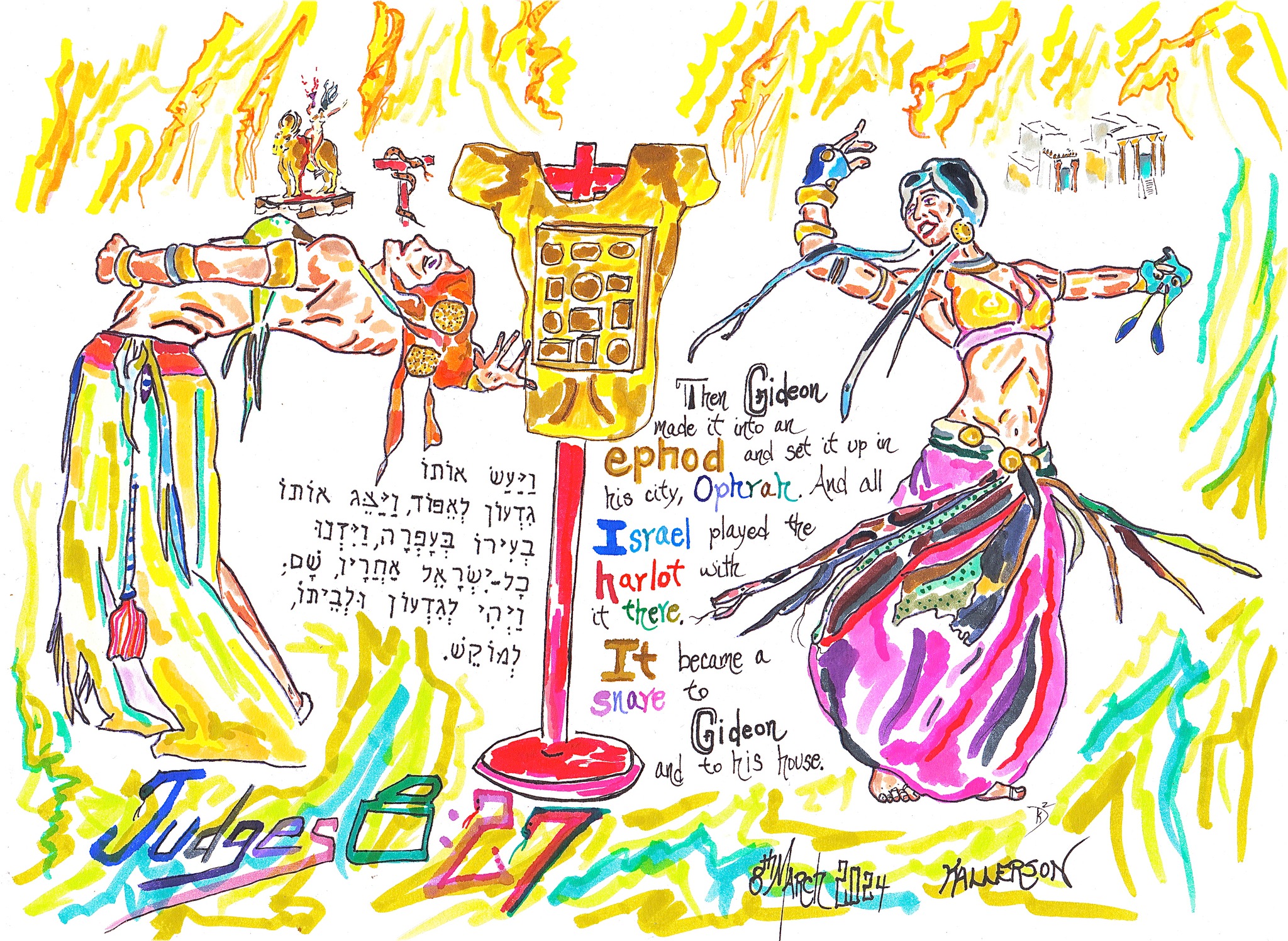
Artwork by Douglas Kallerson.
Judges 8:22-35
Gideon, Judge of Israel, Part X
(Typed 1 January 2024) The words of Gideon in these verses are also reflective of the great moral character of a person in American history. Gideon knew that ruling as a king was not appropriate and that the Lord alone should rule over Israel. That is a great mark of the man. He had the chance to grab and hold power, not only for himself but for his descendants after him. And yet, he turned it down.
George Washington was such a man. An excerpt from the Heritage Foundation article “The Man Who Would Not Be King” by Matthew Spalding, Ph.D. is quoted –
“As our first president, he set the precedents that define what it means to be a constitutional executive: strong and energetic, aware of the limits of authority but guarding the prerogatives of office. The vast powers of the presidency, as one Convention delegate wrote, would not have been made as great had not many of the members cast their eyes towards General Washington as president; and shaped their ideas of the powers to be given to a president by their opinions of his virtue.
“And the key ingredient in all of these things was moral character, something that Washington took very seriously and which gave to his decision-making a deeply prudential quality and to his authority an unmatched magnanimity. ‘His integrity was pure, his justice the most inflexible I have ever known, no motives of interest or consanguinity, of friendship or hatred, being able to bias his decision,’ Jefferson later observed. ‘He was, indeed, in every sense of the words, a wise, a good, and a great man.’
“It is no coincidence, then, that Washington’s most important legacy comes during moments of temptation, when the lure of power was before him. Twice during the Revolution, in 1776 and again in 1777 when Congress was forced to abandon Philadelphia in the face of advancing British troops, Gen. Washington was granted virtually unlimited powers to maintain the war effort and preserve civil society, powers not unlike those assumed in an earlier era by Roman dictators. He shouldered the responsibility but gave the authority back as soon as possible.
“After the war, there were calls for Washington to claim formal political power. Indeed, seven months after the victory at Yorktown, one of his officers suggested what many thought only reasonable in the context of the 18th century: that America should establish a monarchy and that Washington should become king. A shocked Washington immediately rejected the offer out of hand as both inappropriate and dishonorable, and demanded the topic never be raised again.”
How unlike so many today who can think of nothing but grabbing and holding onto power at any cost.
Text Verse: “Blessed are the meek,
For they shall inherit the earth.” Matthew 5:5
Throughout the Bible, the idea of meekness and humility in man is seen to be pleasing to the Lord. The arrogant, the proud, the haughty, the boasters, and other such people are seen as offensive to Him.
This truly reveals the greatness of God in His moral character. A god of our own making will inevitably be completely different than from how God is revealed in the Bible.
This is so foreign to our human understanding of greatness, that when Jesus came in absolute humility and submission to the will of His father, and even to those He created, the world at large rejected Him outright.
Gideon started out humble, acknowledging his insignificance, and even after doing great things, he remained humble. This is the message of the gospel as well.
It is the greatest message in the world because it is the saving message of Jesus. Nothing can be added to it without tainting it. It is simple, filled with humility in what it says about Jesus dying for our sins, and it expects a humble response that recognizes faith alone, apart from any personal merit.
Seeing the life of Gideon as a reflection of the gospel is a marvelous part of God’s superior word. And so, let us turn to that precious word once again, and… May God speak to us through His word today, and may His glorious name ever be praised.
I. Thus Midian Was Subdued (verses 22-28)
22 Then the men of Israel said to Gideon, “Rule over us, both you and your son, and your grandson also;
vayomru ish Yisrael el gidon m’shal banu gam atah gam binkha gam ben b’nekha – “And said man Israel unto Gideon, ‘Rule in us, also you, also your son, also son your son.” With the victory over Midian secured, the men of Israel have excitedly agreed among themselves that they desire Gideon to rule over them.
Most commentators claim that they are calling for a kingship that would begin with Gideon and extend to his progeny after him. But this is not necessarily the case. The word used is mashal, to rule, not malakh, to reign.
Solomon reigned (malakh – as in 1 Kings 1:35) over Israel, but he ruled (mashal) “over all kingdoms from the River to the land of the Philistines, as far as the border of Egypt” (1 Kings 4:21). The word mashal, rule, is never used concerning Saul, the first king of Israel. Rather, each time it is said that he reigned (malakh).
There is minimal overlap between the two words because they signify two different things. Having said that, the word malakh is used seven times in Judges 9 concerning Gideon’s son Abimelech. These are the only uses of the word in all of Judges when referring to a person of Israel.
As for Gideon, his name means Cutter. He has thus far pictured the gospel. Now, the men of Israel have asked him to rule, saying…
22 (con’t) for you have delivered us from the hand of Midian.”
ki hovoshatnu miyad midyan – “for you have saved us from hand Midian.” The people ascribed the salvation to Gideon when it was the Lord who selected Gideon, encouraged him in his state of weakness, and instructed him in what to do, when to do it, and how to accomplish the task.
Midian means Place of Judgment. It has thus far been typical of the tribulation period. Gideon, the gospel, was the instrument by which the Lord gained the victory for Israel in the tribulation. As for the men now in Judges, it next says…
23 But Gideon said to them, “I will not rule over you, nor shall my son rule over you; the Lord shall rule over you.”
vayomer alehem gidon lo emshol ani bakhem v’lo yimshol b’ni bakhem Yehovah yimshol bakhem – “And said unto them Gideon, ‘No ruling, I, in you; and no ruling my son, in you. Yehovah ruling in you.’” Of all of the achievements of his time as judge, this statement is the pinnacle of them all.
Gideon has deferred to the Lord, who provided the victory, to continue to be the ruler over Israel. He is turning down what almost any other person would have jumped at, knowing that such a rule by him was undeserved and would compromise the relationship that had existed between the Lord and His people.
Despite this honorable position, the very next words will lead to a blemish arising on the time of his leadership…
24 Then Gideon said to them, “I would like to make a request of you,
The words contain a cohortative: vayomer alehem gidon eshalah mikem sh’elah – “And said unto them, Gideon, ‘I will ask from you an asking.’” It is like a personal imperative. Gideon has something he greatly desires. His words then carry the weight of “I have something I would really like you to do for me.”
It appears that this verse begins a short insert that will end in verse 27. At that time, the narrative will resume. With that thought, the insert continues with…
24 (con’t) that each of you would give me the earrings from his plunder.”
It is incorrect: utnu li ish nezem shlalo – “Giving to me, man, earring his spoil.” He asks for each man to give an earring (sg.) from his plunder.
As for the word nezem, it simply signifies a ring. It may be an earring or a nose ring. The reason for the request is explained by the narrator…
24 (con’t) For they had golden earrings, because they were Ishmaelites.
ki nizme zahav lahem ki yishmelim hem – “For earrings gold to them, for Ishmaelites, they.” This explains why the translation is earring rather than nose ring. The earring was an identifying mark of the Ishmaelites. It is the fact that they are gold, however, that drives the request. As will be seen, he is using an earring from each man as a multiplier.
Ishmael means God Hears. Instead of calling them Midianites, who descend from Abraham by his wife Keturah, they are here called Ishmaelites who descend from Abraham by his concubine Hagar. The interchanging of the names is necessary for typology, but it has already been seen that the terms indicate a mixture of people –
“So Judah said to his brothers, ‘What profit is there if we kill our brother and conceal his blood? 27 Come and let us sell him to the Ishmaelites, and let not our hand be upon him, for he is our brother and our flesh.’ And his brothers listened. 28 Then Midianite traders passed by; so the brothers pulled Joseph up and lifted him out of the pit, and sold him to the Ishmaelites for twenty shekels of silver. And they took Joseph to Egypt.’” Genesis 37:26-28
As for the request, just as collecting insurance fees is a little leading to a lot, Gideon knows no one will turn down his simple request. Therefore, he will accumulate a great amount of wealth…
25 So they answered, “We will gladly give them.”
The response is excited and very willing: vayomru naton niten – “And said, giving, will give.” The men were more than happy to oblige. Gideon had led them, there were innumerable enemies defeated, and each man’s spoil would have been great. Therefore, a single gold earring was an insignificant offering for their heroic leader.
25 (con’t) And they spread out a garment, and each man threw into it the earrings from his plunder.
Rather: vayipr’su eth ha’simlah vayashliku shamah ish nezem shlalo – “And spread the garment, and cast there, man, earring his plunder.” The definite article before garment would normally speak of a particular garment, but none is specified. Probably for this reason, the Greek translation says that Gideon spread out his garment.
From there, it again refers to the earring in the singular. The sense, then, is that each man cast only one earring into the plunder. Despite this, the amount really added up…
26 Now the weight of the gold earrings that he requested was one thousand seven hundred shekels of gold,
v’hi mishqal nizme ha’zahav asher shaal eleph ushba meoth zahav – “And was weight earrings the gold which asked thousand and seven hundreds gold.” This is a large amount of gold, signifying the great number of those slain. It is reckoned by scholars as around 50-75 pounds of gold.
The general thought is that each weighed about one-half a shekel and, thus there were about 3400 dead. This is incorrect. As noted, the Hebrew says, “earring his plunder.” Thus, if each man gave one earring and each collected many, then the extent of the slaughter is more strikingly realized.
As for the number, it is a multiple of 17 and 10s. Bullinger is careful to describe seventeen, saying –
Seventeen stands out very prominently as a significant number. It is not a multiple of any other number, and therefore it has no factors. Hence it is called one of the prime (or indivisible) numbers. What is more, it is the seventh in the list of the prime numbers.
The series runs 1, 3, 5, 7, 11, 13, 17, etc. Thirteen, it will be noted, is also a prime number, and is therefore important; but it is the sixth of the series: hence it partakes of the significance of the number 6, and is indeed an intensified expression of it.
In like manner seventeen being the seventh of the series, it partakes of and intensifies the significance of the number seven. Indeed, it is the combination or sum of two perfect numbers—seven and ten—seven being the number of spiritual perfection, and ten of ordinal perfection.
Contrasted together the significance of these two numbers is clear; and when united in the number seventeen we have a union of their respective meanings, viz., spiritual perfection, plus ordinal perfection, or the perfection of spiritual order.
Of the number ten, Bullinger also says, “Completeness of order, marking the entire round of anything, is, therefore, the ever-present signification of the number ten. It implies that nothing is wanting; that the number and order are perfect; that the whole cycle is complete.”
As for Gideon’s booty, it next says…
26 (con’t) besides the crescent ornaments, pendants, and purple robes which were on the kings of Midian, and besides the chains that were around their camels’ necks.
l’bad min ha’saharonim v’hantipoth u-bigde ha’argaman se’al malkhe midyan u-l’bad min ha’anaqoth asher b’tsavare g’malehem – “to exception from the round-ornaments, and the drop-ornaments, and garment the purple upon kings Midian, and to exception from the necklaces which in necks their camels.”
There are two new words. The first is netiphah, a word coming from nataph, to drop or drip but also to prophecy via inspiration. Thus, it would signify a drop-ornament, meaning an eardrop or a pendant. The second is anaq, a necklace.
The round-ornaments were first noted in Judges 8:21. They were either round or crescent-shaped ornaments that adorned the camels’ necks. The eardrops or pendants would have been worn by the men in addition to the gold earrings already noted.
The purple garments might be those of the kings and princes who were over the various tribes. Finally, the necklaces of the camels may have been to hold the round ornaments, or there may have been other chains beside them. All in all, the amount of spoil obtained by Gideon was exceptional. Next, it says…
27 Then Gideon made it into an ephod and set it up in his city, Ophrah.
vayaas oto gidon l’ephod vayatseg oto b’iro b’aphrah – “And made it, Gideon, to ephod. And placed it in his city, in Ophrah.” The “it” appears to be referring to the gold from the earrings apart from all of the items.
Depending on what commentary you read, the opinions on this act range from scathing indictment of apostasy to an acceptable dedication to the Lord, or even some sort of noble acknowledgment of the Lord’s provision.
The idea of this being intended as an object of idolatry is nuts. Gideon just said, “I will not rule over you, nor shall my son rule over you; the LORD shall rule over you.” That was immediately followed by his request for the earrings. And those, along with the other items, are said to be made into an ephod.
It is obvious from the immediate sequence of events that he intended that this was to be a symbolic reminder that the Lord is the Ruler over Israel. The ephod was the garment worn by the high priest as described in Exodus 28.
It is the part of the priestly garment that covers the chest in front and the upper back. It may be the part of the garments described in Revelation 1 in John’s vision of the Lord Jesus –
“Then I turned to see the voice that spoke with me. And having turned I saw seven golden lampstands, 13 and in the midst of the seven lampstands One like the Son of Man, clothed with a garment down to the feet and girded about the chest with a golden band.” Revelation 1:12, 13
This ephod is thus Gideon’s acknowledgment of the Lord’s dual role as ruler and priestly leader of the people. That is a concept not really grasped nor fully considered in Israel until a prophecy by Zechariah concerning the coming Messiah –
“Then speak to him, saying, ‘Thus says the Lord of hosts, saying:
‘Behold, the Man whose name is the BRANCH!
From His place He shall branch out,
And He shall build the temple of the Lord;
13 Yes, He shall build the temple of the Lord.
He shall bear the glory,
And shall sit and rule [mashal] on His throne;
So He shall be a priest [consider the ephod] on His throne,
And the counsel of peace shall be between them both.’” Zechariah 6:12, 13
Ophrah means Of the Dust.
27 (con’t) And all Israel played the harlot with it there.
v’yiznu kal Yisrael akharav sham – “And prostituted all Israel after it there.” Israel’s actions cannot be equated to Gideon’s intent though some try to link them. For example, the Lord directed Moses to make the serpent on the pole. It then saved the people who looked to it for healing.
However, despite the original intent, we later read this concerning the actions of King Hezekiah –
“He removed the high places and broke the sacred pillars, cut down the wooden image and broke in pieces the bronze serpent that Moses had made; for until those days the children of Israel burned incense to it, and called it Nehushtan.” 2 Kings 18:4
Because of the people’s actions, however…
27 (con’t) It became a snare to Gideon and to his house.
v’hi l’gidon u-l’beitho l’moqesh – “And was to Gideon, and to his house, to snare.” The moqesh, or snare, is translated as skandalon in the Greek text. That is later used in the New Testament to indicate an offense or a stumbling block, such as –
“And I, brethren, if I still preach circumcision, why do I still suffer persecution? Then the offense [skandalon: stumbling block] of the cross has ceased. 12 I could wish that those who trouble you would even cut themselves off!” Galatians 5:11, 12
The ephod, even if made with proper intentions, became a point of tripping up Gideon and his house.
28 Thus Midian was subdued before the children of Israel, so that they lifted their heads no more.
vayikana midyan liphne b’ne Yisrael v’lo yasphu la’seth rosham – “And subdued Midian to faces sons Israel, and no added to lift their heads.” These words appear to be a closing bookend to the words of verse 23 which preceded the short inserted passage –
v.23 But Gideon said to them, “I will not rule over you, nor shall my son rule over you; the Lord shall rule over you.”
v.28 Thus Midian was subdued before the children of Israel, so that they lifted their heads no more.
Never again in Scripture is Midian said to come against Israel. However, in Isaiah, it notes that in the future the Midianites will return to Israel in multitudes. It is a time prophesied by Isaiah to come, not unsurprisingly, after the tribulation period –
“The multitude of camels shall cover your land,
The dromedaries of Midian and Ephah;
All those from Sheba shall come;
They shall bring gold and incense,
And they shall proclaim the praises of the Lord” Isaiah 60:6
With that, it next says…
28 (con’t) And the country was quiet for forty years
vatishqot ha’arets arbaim shanah – “And rested the land forty years.” It is letter for letter the same as the corresponding words found in Judges 3:11 at the time of Othniel and Judges 5:31 at the time of Deborah.
Forty is defined by Bullinger as “a period of probation, trial, and chastisement—(not judgment, like the number 9, which stands in connection with the punishment of enemies, but the chastisement of sons, and of a covenant people).”
And more, because “it relates to enlarged dominion, or to renewed or extended rule, then it does so in virtue of its factors 4 and 10.”
Four, “is the number of things that have a beginning, of things that are made, of material things, and matter itself. It is the number of material completeness. Hence it is the world number, and especially the ‘city’ number.”
Ten has already been described. With that, the next words tell us that these forty years were…
28 (con’t) in the days of Gideon.
bime gidon – “in days Gideon.” The entire remaining duration of Gideon’s life was free from any conflict, from within or without.
The Lord is your Creator and your God
To Him alone are your thanks and praises due
Throughout your life and every step you trod
The Lord alone shall rule over you
To place your hope and faith in man
Is a sad place of trust. It will never do
And if having confidence in yourself is your plan
Your thinking is certainly askew
Look to the Lord alone and accept His saving grace
In that, you can be confident in eternal happiness
Only in Him can you behold God’s face
Anything else will leave you in an eternal mess
II. Israel Again Played the Harlot (verses 29-35)
29 Then Jerubbaal the son of Joash went and dwelt in his own house.
Maybe a little more poetically: vayelekh yerubaal ben yoash vayeshev b’beitho – “And walked, Jerubbaal son Joash, and sat in his house.” To walk in Scripture signifies the conduct of one’s life. To sit means to dwell, but it implies in a peaceful and content manner. Sitting also implies one who judges.
For example, Deborah sat under the palm to judge in Judges 4. Likewise, the Angel of the Lord sat under the terebinth tree in Ophrah to render a judgment in Judges 6.
Gideon, who is Jerubbaal, conducted himself to his house where he dwelt henceforth, judging Israel. Jerubbaal means Let Baal Strive. Joash means Yehovah Has Bestowed. Of him, it next says…
30 Gideon had seventy sons who were his own offspring, for he had many wives.
u-l’gidon hayu shivim banim yotsei y’rekho ki nashim raboth hayu lo – “And to Gideon were seventy sons coming out his loin, for wives many were to him.” These words, and those of the next verse, are given to anticipate the coming chapter.
It should be noted that this doesn’t mean that all of his sons were born after he settled into his house. For example, his son Jether, the firstborn, was already noted. Thus, this is only a record of the seventy legitimate sons born to him. Bullinger says –
“Seventy is another combination of two of the perfect numbers, seven and ten. … Hence 7 x 10 signifies perfect spiritual order carried out with all spiritual power and significance. Both spirit and order are greatly emphasized.”
31 And his concubine who was in Shechem also bore him a son,
The words bear emphasis: u-pilagsho asher bishkhem yaldah lo gam hi ben – “And his concubine who in Shechem bore to him, also she, son.” The words of this verse are important in understanding what is coming. It just noted that Gideon had lots of legitimate sons from his legal wives.
However, here, it notes that his concubine in Shechem bore him a son. But it does so with an additional emphasis. This son is thus being introduced as a main figure in the coming narrative.
Shechem means Shoulder. However, that comes from shakam signifying to incline, as in inclining the shoulder to a burden. Hence, it is normally translated as to rise or start early. Abarim defines Shechem as “[Having a Sense of] Responsibility.” Of him, it next says…
31 (con’t) whose name he called Abimelech.
The translation is not correct, and it gives a completely wrong sense of what is going on: vayasem eth shemo avimelekh – “And he set his name: Abimelech.” There is no change in subject. Thus, it is not Gideon who gave this name.
Further, in the Bible, the way a person is given a name at birth is to say something like, “And he called [qara] his name Isaac.” To set a name means to give another name, like we do with a nickname.
My children and all their friends call me Skipper. But when I was born, my parents named me Emlen. On that same day, my maternal grandmother, thankfully and for a particular reason, called me Charlie. Thus, she set my name as Charlie. I set my name as Skipper for my children. Because of this, everyone but the government and the bank ignores the name my parents gave me.
As there is no change in subject, it is Abimelech who has set his name as such. Whatever his given name, it is irrelevant to the coming narrative. Abimelech means My Father is King, Father of a King, Father is King, Father Reigns, etc. It can even mean Desired Counsel. Exactly which of these is to be determined from the surrounding context.
32 Now Gideon the son of Joash died at a good old age,
Literally: vayamath gidon ben yoash b’sebah tovah – “And died, Gideon, son of Joash, in gray-hair good.” This exact expression, when referring to the death of an individual, is only used when referring to Abraham and David.
32 (con’t) and was buried in the tomb of Joash his father, in Ophrah of the Abiezrites.
vayiqaver b’qever yoash aviv b’apherah avi ha ezri – “And buried in grave Joash his father, in Ophrah father the Ezrite.” This is the last time that avi ha’ezri, or Father the Ezrite is seen in Scripture. It means Father the Helper.
33 So it was, as soon as Gideon was dead, that the children of Israel again played the harlot with the Baals,
v’hi ka’asher meth gidon vayashuvu b’ne Yisrael vayiznu akhare ha’b’alim – “And was according to which died Gideon, and turned sons Israel, and prostituted after the Baals.” The obvious meaning is that Israel did not do so during the life of Gideon. And yet, as soon as he died (according to which), the inner impulses of disobedience immediately took over again. As such…
33 (con’t) and made Baal-Berith their god.
It is the same word just used to set Abimelech’s name: vayasimu la’hem baal berith lelohim – “And set to them Baal Berith to their god.” In place of Yehovah, they have set Baal Berith as their god. The name means Master of the Covenant(s). The word Covenant is singular, but Jones’ Dictionary concludes that this construction is better rendered plural.
As a side note, the words can be translated as “They made a covenant with Baal to be their god.”
34 Thus the children of Israel did not remember the Lord their God,
v’lo zekru b’ne Yisrael eth Yehovah elohehem – “And no remembered sons Israel Yehovah their God.” These words are far too often repeated in Scripture: Israel disobeys the Lord. The Lord sends corrective measures to punish them and turn them back to Him. Israel cries out to the Lord for deliverance. The Lord delivers them. And finally, once again, Israel turns from the Lord, completely forgetting the great deliverance He brought about. As it next says…
34 (con’t) who had delivered them from the hands of all their enemies on every side;
Rather: ha’matsil otam miyad kal oyvehem misaviv – “the Deliverer them from hand all their enemies around.” The verb, being used as a noun, shows that it was the Lord who accomplished the feat. Even if it was done through Gideon, it was by His power, His Spirit, and His choosing and determination that it came about. Further…
35 nor did they show kindness to the house of Jerubbaal (Gideon)
v’lo asu khesed im beith yerubaal gidon – “And no made mercy with house Jerubbaal, Gideon.” The word khesed signifies mercy, favor, kindness, lovingkindness, etc. In this case, mercy probably captures the spirit of the word because of the next clause.
Jerubbaal’s house will be treated shamefully by the people. No mercy will be extended to his many sons. This will not at all be…
*35 (fin) in accordance with the good he had done for Israel.
k’kal ha’tovah asher asah im Yisrael – “According to all the goodness which he made with Israel.” Gideon had worked in goodness with Israel. Israel had worked without mercy with his house. The two thoughts set as a complete contrast –
And no made mercy with house Jerubbaal, Gideon.
According to all the goodness which he made with Israel.
Remember how the verses of this passage started out –
“Then the men of Israel said to Gideon, ‘Rule over us, both you and your son, and your grandson also.’” Gideon refused this and told them that the Lord would rule over them. In forgetting the Lord, they have turned away and also failed to remember the Lord’s instrument of deliverance.
Likewise, in neglecting the Lord, we neglect the word, the simple gospel, which was the instrument the Lord used to bring us back to Himself in the first place.
Gideon the son of Joash was finally laid to rest
But that is not the end of his story
Because of the Lord, he will be raised and blessed
Someday to walk with Him in eternal glory
This is the hope of the saints throughout time
That the Lord has come to restore us to God
The gospel message, ever so sublime
Is the good news to which we can applaud
Thank You, O God, for having sent Jesus
To bring us back to You through His shed blood
Such glorious things You have done for us
When we are submerged ‘neath the crimson flood
III. An Explanation of the Typology
The passage today has several different things going on in it, and thus it is complicated. The first thing presented is the conclusion to the narrative that ended with the slaying of Zebah and Zalmunna in the previous sermon. That includes these verses –
“Then the men of Israel said to Gideon, ‘Rule over us, both you and your son, and your grandson also; for you have delivered us from the hand of Midian.’
23 But Gideon said to them, ‘I will not rule over you, nor shall my son rule over you; the Lord shall rule over you.’” …
“Thus Midian was subdued before the children of Israel, so that they lifted their heads no more. And the country was quiet for forty years in the days of Gideon.” Judges 8:22, 23 & 28
This presents an acknowledgment that after the tribulation period, during the millennium, the Lord alone will be the ruler over Israel. For example, it says in Isaiah 40 –
“Behold, the Lord God shall come with a strong hand,
And His arm shall rule [mashal] for Him;
Behold, His reward is with Him,
And His work before Him.” Isaiah 40:10
The thought of the reward being with Jesus is repeated in the last chapter of the Bible –
“And behold, I am coming quickly, and My reward is with Me, to give to every one according to his work. 13 I am the Alpha and the Omega, the Beginning and the End, the First and the Last.” Revelation 22:12, 13
Until Israel goes through the tribulation period, the Lord is not their sole ruler, but once the gospel (Gideon) delivers Israel from the tribulation, the Lord will be in His rightful position of rule from that time on.
Between those verses, however, there was the difficult insert concerning the ephod. Simply stated, these verses demonstrate that any addition to the gospel (Gideon) taints the gospel.
Personally reaching back to the victory over the law as a source of inspiration, even if it is intended to glorify the Lord or represent His gospel, taints the gospel, which is something that is procured by faith alone.
Each of the verses points to man’s effort or boasting. Thus, the final words of that section say, “And was to Gideon, and to his house, to snare.” One cannot add to the gospel without tainting it. With any attempt to do so, it becomes a snare.
Gideon set up the ephod in Ophrah, Of the Dust. This means that those born during the tribulation period will still be fallen. They will need to believe and accept the untainted gospel that Christ alone atones for their sin, as has always been the case in previous dispensations. Anything else is a snare that is to be avoided.
The note of the victory over Midian and the forty years of rest during the days of Gideon is given to express the wholeness of the victory of Christ over His enemies. As long as the gospel is adhered to, there will be complete rest, and there will never again be a need for the Place of Judgment (Midian).
Verse 29 then said, “And Jerubbaal, son of Joash went and dwelt in his own house.” It is a final note confirming that the Lord will sit, as promised, in the house of the Lord during the millennium.
Jerubbaal, Let Baal Strive, speaks of Jesus. The law failed to strive against Jesus. Thus, He prevailed over it. The name Joash, Yehovah Has Bestowed, is included to clearly present that Christ is the One upon whom the Lord has bestowed all that is necessary to save man.
With that stated came the final verses concerning Gideon’s life after the battle. They are given as a foreshadowing of what lies ahead concerning Abimelech and the conduct of Israel during his time.
They are a necessary set of words to close out the literal history of Gideon and Israel. The next chapter, which is literal history, will then be used to reveal more typology.
As for Gideon, what a marvelous joy to see how God used him to reveal wonderful and amazing insights into the future of Israel’s history. At some point, hopefully soon, the rapture will occur. After that, Israel will enter into a seemingly hopeless seven years of true misery.
But during that time, they will go to the word, test it for what it proclaims concerning Jesus, and their nightmare will be ended. They will, as a nation, sit at the head of the nations for a thousand years.
However, that will only come about through humility and obedience to the gospel, accepting that Christ is their Lord and that He alone has paid their penalty for sin.
It will happen. The book is written, and it reveals to us what we need to know about what is coming. And more, it does it in such a way that we can have absolute confidence that it is reliable and true. If you are unsure about the word, test it with an open mind.
Every bit of time and effort you put into challenging it will be rewarded with greater confidence in what it says. In the end, you will find Jesus. And in finding Jesus, you will find peace, hope, and restoration.
Closing Verse: “And what more shall I say? For the time would fail me to tell of Gideon…” Hebrews 11:32
Next Week: Judges 9:1-15 What the heck. We’ll list the sermons, do ‘em and off we’ll check ‘em, until they are done… (Abimelech, King of Shechem, Part I) (28th Judges sermon)
The Lord has you exactly where He wants you. He has a good plan and purpose for you. It is He who judges His people according to their deeds. So, follow Him, live for Him, and trust Him, and He will do marvelous things for you and through you.
Gideon, Judge of Israel, Part X
Then the men of Israel said to Gideon
“Rule over us, both you and your son
And your grandson also
For you have delivered us from the hand of Midian
But Gideon said to them
“I will not rule over you
Nor shall my son rule over you
The LORD shall rule over you, so He shall do
Then Gideon said to them, “I would like to make a request of you
That each of you would give me the earrings from his plunder
For they had golden earrings
Because they were Ishmaelites: cool, like Quigley Down Under
So they answered, “We will gladly give them
And they spread out a garment (maybe from Boy Wonder)
And each man threw into it
The earrings from his plunder
Now the weight of the gold earrings that he requested
Was one thousand seven hundred shekels of gold-
———-that’s a lot of sheks
Besides the crescent ornaments, pendants, and purple robes which
———-were on the kings of Midian
And besides the chains that were around their camels’ necks
Then Gideon made it into an ephod
And set it up in his city, Ophrah – quite a distance from Laos
And all Israel played the harlot with it there
It became a snare to Gideon and to his house
Thus Midian was subdued before the children of Israel
So that they lifted their heads no more
And the country was quiet
For forty years in the days of Gideon; a time of no war
Then Jerubbaal the son of Joash went
And dwelt in his own house, so say the archives
Gideon had seventy sons who were his own offspring
For he had many wives
And his concubine who was in Shechem also bore him a son
Whose name he called Abimelech. Yes, that’s rights
Now Gideon the son of Joash died at a good old age
And was buried in the tomb of Joash his father, in Ophrah
———-of the Abiezrites
So it was, as soon as Gideon was dead
That the children of Israel, every Tom and Todd
Again played the harlot with the Baals
And made Baal-Berith their god
Thus the children of Israel
Did not remember the LORD their God, they did backslide
Who had delivered them from the hands
Of all their enemies on every side
Nor did they show kindness to the house of Jerubbaal (Gideon)
In accordance with the good he had for Israel done
Lord God, turn our hearts to be obedient to Your word
Give us wisdom to be ever faithful to You
May we carefully heed each thing we have heard
Yes, Lord God may our hearts be faithful and true
And we shall be content and satisfied in You alone
We will follow You as we sing our songs of praise
Hallelujah to You; to us Your path You have shown
Hallelujah we shall sing to You for all of our days
Hallelujah and Amen…
22 Then the men of Israel said to Gideon, “Rule over us, both you and your son, and your grandson also; for you have delivered us from the hand of Midian.”
23 But Gideon said to them, “I will not rule over you, nor shall my son rule over you; the Lord shall rule over you.” 24 Then Gideon said to them, “I would like to make a request of you, that each of you would give me the earrings from his plunder.” For they had golden earrings, because they were Ishmaelites.
25 So they answered, “We will gladly give them.” And they spread out a garment, and each man threw into it the earrings from his plunder. 26 Now the weight of the gold earrings that he requested was one thousand seven hundred shekels of gold, besides the crescent ornaments, pendants, and purple robes which were on the kings of Midian, and besides the chains that were around their camels’ necks. 27 Then Gideon made it into an ephod and set it up in his city, Ophrah. And all Israel played the harlot with it there. It became a snare to Gideon and to his house.
28 Thus Midian was subdued before the children of Israel, so that they lifted their heads no more. And the country was quiet for forty years in the days of Gideon.
29 Then Jerubbaal the son of Joash went and dwelt in his own house. 30 Gideon had seventy sons who were his own offspring, for he had many wives. 31 And his concubine who was in Shechem also bore him a son, whose name he called Abimelech. 32 Now Gideon the son of Joash died at a good old age, and was buried in the tomb of Joash his father, in Ophrah of the Abiezrites.
33 So it was, as soon as Gideon was dead, that the children of Israel again played the harlot with the Baals, and made Baal-Berith their god. 34 Thus the children of Israel did not remember the Lord their God, who had delivered them from the hands of all their enemies on every side; 35 nor did they show kindness to the house of Jerubbaal (Gideon) in accordance with the good he had done for Israel.