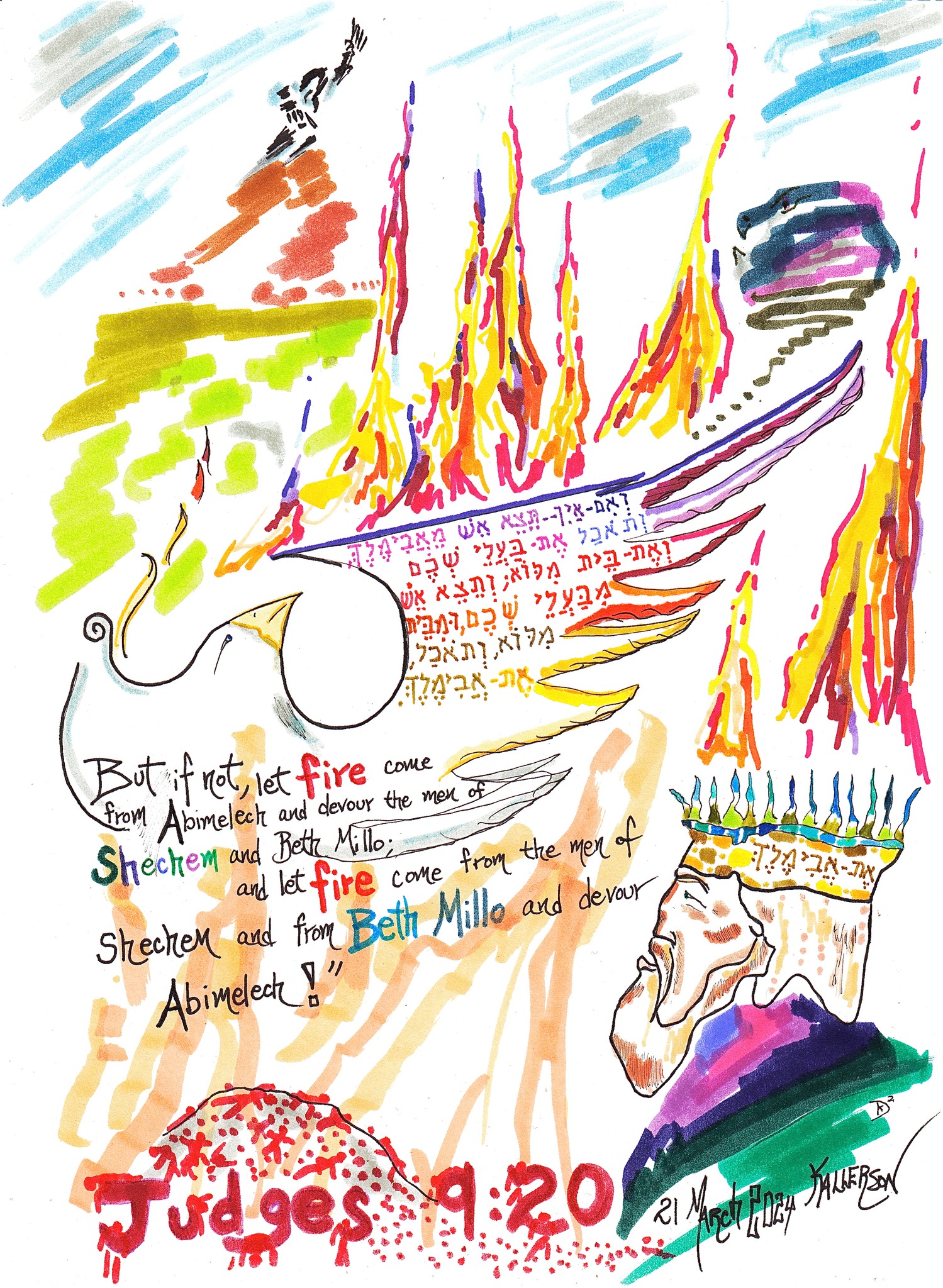
Artwork by Douglas Kallerson.
Judges 9:16-21
Abimelech, King of Shechem, Part II
(Typed 15 January 2024) In the Hebrew text, Judges 9 begins with the word vayelek, “And went.” However, rather than translating it this way, some translate the prefix as now, then, one day, or just skip the conjunction altogether.
The Hebrew prefix vav can be variously interpreted and translated depending on the context, but simply saying “and” is always preferred by me. By saying “then” as the conjunction to open Chapter 9 (like the NKJV), a presupposition is inserted into the text that may not be correct.
In other words, by translating the vav as “then,” the reader is led to assume that what is presented follows after the events of Judges 8. But this is not necessarily so. After studying a particular passage, it is not uncommon to find that translating the vav as but, then, now, furthermore, however, etc. is incorrect.
This is too bad because the reader now has a faulty idea concerning what is going on in the narrative. In the case of Judges 9, the contents do not follow chronologically after Chapter 8. Rather, they are given to explain the events of Chapter 8.
Likewise, the typology of Chapter 8 dealt with the events of the tribulation period. However, some of what is presented in Chapter 9 goes all the way back to the time of the Babylonian exile of the people of Israel.
Text Verse: “Her prophets are insolent [phakhaz], treacherous people;
Her priests have polluted the sanctuary,
They have done violence to the law.” Zephaniah 3:4
From the time of the Babylonian exile, certain events were prophesied to occur that reach forward, even to the time after the tribulation period. Through the mistranslation of a single vav, the entire panorama of what is being typologically presented is obliterated.
In the Wycliff Bible of 1382, Chapter 9 of Judges opens with “Forʃoþe Abymelech… ȝede.” The Coverdale Bible of 1535 says, “Abimelech…wente.” They just skipped the conjunction altogether. Later, the Geneva Bible of 1587 reads, “Then Abimelech…went,” thus inserting a presupposition.
The KJV went with a more literal translation, “And Abimelech…went.” However, in 1982, the NKJV reverted to the Geneva Bible, saying, “Then Abimelech…went.” In the 2024 translation by Charlie Garrett, the most literal translation possible is rendered, “And went Abimelech.”
Can incorrectly translating a single letter, the vav hook, make any difference in how you look at a passage? Yes, it can. For maximum happy and greatest biblical oomph, don’t get tied down to a single translation that might lead you to a false conclusion.
Be willing to check things out, consider what is being said, and then evaluate your conclusions. You may find out that really, really interesting things are tucked away in this precious word.
As for the word Forʃoþe used in the Wycliffe Bible, I know you are dying to know what it means. It is an old English spelling of forsothe (more recently, forsooth). With the advent of the printing press around the 15th century, the letters long S (ʃ) and thorn (þ) began to drop out of common use. The word essentially means “for truth,” but it also carries the idea of indeed, truly, in fact, etc. You now have a new squiggle for your brain.
Get ready! More squiggles are ahead as we contemplate God’s superior word. And so, let us turn to that precious word once again, and… May God speak to us through His word today, and may His glorious name ever be praised.
I. Because He Is Your Brother (verses 16-21)
In Judges 9:1-6, Abimelech’s conspiracy to reign as king was described. Having gone to Shechem, he pitted himself against the seventy sons of Jerubbaal, noting his familial connection to these men as a reason they should accept him as their ruler.
The agreement was made, the plot was carried out, and the seventy sons were executed. With that complete, the men of Shechem gathered together and made Abimelech king.
After that, Jotham went and stood on top of Mount Gerizim and spoke his parable against the men of Shechem. With that finalized, he will provide a literal interpretation of the words.
He will speak a protasis followed by an apodosis. The conditional part of this will be given in verses 16 through the first half of verse 19. The conclusion will follow at the end of verse 19. Another protasis and apodosis will then be stated in verse 20. After that, Jotham will leave the scene, not to be heard from again…
16 “Now therefore, if you have acted in truth and sincerity in making Abimelech king,
v’atah im b’emeth uvthamim asithem vatamliku eth avimelekh – “And now, if in truth and sincereness you have made and kinged Abimelech.” This begins the lengthy protasis, the conditional aspect of Jotham’s explanation. In his words, the actions of his audience are set in contrast to the actions of his father.
The words “if you have acted” encompass their actions as detailed in verses 1-6. If those deeds were done in truth and sincereness in relation to the life and conduct of Jerubbaal, there will be one conclusion he will grant.
The words “in truth and sincereness” are a modification of his words from the parable itself. In verse 15, Jotham said, “If in truth you anoint me to king over you.” This is the reason for the structure of his words now. They are based on the people’s intentions in making Abimelech king.
Abimelech means My Father is King, Father of a King, Father is King, Father Reigns, etc. It can even mean Desired Counsel.
16 (con’t) and if you have dealt well with Jerubbaal and his house, and have done to him as he deserves—
v’im tovah asithem im yerubaal v’im betho v’im kigmul yadav asithem lo – “and if good you have made with Jerubbaal and with his house, and if according to recompense his hand you have made to him.” These words introduce the contrast. There are the men of Shechem, and there is the house of Jerubbaal.
It is important to consider that Jotham never mentions the name Gideon. Rather, the name Jerubbaal alone is mentioned nine times in this chapter. According to Bullinger, nine is the number of finality and judgment.
There is the making of Abimelech king and there is what was done to Jerubbaal’s house. Were the actions of Shechem acceptable? Were they noble and just? The thoughts are carefully placed before the people to consider, but they must look at the past to ascertain the truth…
17 for my father fought for you, risked his life, and delivered you out of the hand of Midian;
asher nakham avi alekhem vayashlekh eth naphsho mi’neged vayatsel ethkhem miyad midyan – “who fought, my father, unto you, and cast his soul from front you from hand Midian.” This is the actual contrast to the actions of the men of Shechem. Jotham reminds the people of the great deeds of Jerubbaal.
It is he who defeated Midian (Place of Judgment). In the process of warring, Jotham notes vayashlekh et naphsho – “and cast his soul.” Jerubbaal considered his life as nothing. Therefore, even if he prevailed over Midian, he, in essence, died in the process of defeating it. Despite this…
18 but you have risen up against my father’s house this day,
Rather: v’atem qamtem al beith avi ha’yom – “and you, you risen upon house my father, the day.” The words are emphatic, drawing a strong contrast to the noble deeds of Jerubbaal.
Also, rather than the more common ha’yom ha’zeh, “the day, the this,” which we translate as “this day,” the words are less definitive, saying “the day.” There was a day when the men of Shechem rose up against his father’s house…
18 (con’t) and killed his seventy sons on one stone,
vatahargu eth banav shivim ish al even ekhath – “and killed his sons, seventy man, upon stone one.” Jotham reminds the men of Shechem what they had done. They gave seventy pieces of silver to Abimelech. The implication was that there was one piece of silver per life. That was recorded earlier in this chapter –
“So they gave him seventy shekels of silver from the temple of Baal-Berith, with which Abimelech hired worthless and reckless men; and they followed him. 5 Then he went to his father’s house at Ophrah and killed his brothers, the seventy sons of Jerubbaal, on one stone.” Judges 9:4, 5
With their bloody deed accomplished, it next says…
18 (con’t) and made Abimelech, the son of his female servant, king over the men of Shechem,
vatamliku eth avimelekh ben amatho al baale sh’khem – “and kinged Abimelech son his bondmaid over masters Shechem.” The word used to describe Abimelech’s mother is amah. It is variously translated as maid, handmaid, female slave, etc. It is the same word used in Genesis 21 –
“And Sarah saw the son of Hagar the Egyptian, whom she had borne to Abraham, scoffing. 10 Therefore she said to Abraham, ‘Cast out this bondwoman [amah] and her son; for the son of this bondwoman [amah] shall not be heir with my son, namely with Isaac.’” Genesis 21:9, 10
She may have been the concubine of Jerubbaal, but Jotham disdainfully points out that she was a mere slave in the house. The rebuke is a strong one which seems intentionally connected to the story of Abraham and Hagar.
Gideon had already told the people that it would not be he or his house that reigned over Israel but the Lord. However, if the people wanted a king, they could at least have appointed a son of one of Gideon’s wives, not one born of a mere slave. Instead, however, they chose this evil path…
18 (con’t) because he is your brother—
He emphatically points out the reason for their treachery: ki akhikhem hu – “for your brother, he.” By stating it this way, Jotham is implying that those who made Abimelech king are all just like him, sons of a bondwoman, and thus slaves. The words are cutting and acerbic. With that stated, the conditional words of the protasis continue…
19 if then you have acted in truth and sincerity with Jerubbaal and with his house this day,
v’im b’emeth uvthamim asithem im yerubaal v’im beitho hayom hazeh – “and if in truth and in sincereness you have made with Jerubbaal and with his house, the day, the this.” Putting this side by side with the words of verse 16, the contrast is made clear –
“And now, if in truth and sincereness you have made and kinged Abimelech.” v.16
“and if in truth and in sincereness you have made with Jerubbaal and with his house.” v.19
Jotham is restating the matter after having presented the details. The fact that they kinged Abimelech means that they have not dealt rightly with Jerubbaal. They have rejected what he stood for because they rejected who he is. Because of this, the apodosis is next stated…
19 (con’t) then rejoice in Abimelech, and let him also rejoice in you.
The words bear emphasis: simkhu ba’avimelekh v’yishmakh gam hu bakhem – “rejoice in Abimelech, and rejoice also, he, in you.” You have made your decision, and you will now have to live with it. See how that turns out! What is more likely is next stated with another protasis followed by an immediate apodosis…
20 But if not, let fire come from Abimelech and devour the men of Shechem and Beth Millo;
v’im ayin tetse esh me’avimelekh v’thokhal eth baale sh’khem v’eth beith milo – “And if else, goes fire from Abimelech, and devours masters Shechem and Beth Millo.” If there is anything less than rejoicing in one another, then there should be a horrific consequence for what has transpired.
The seventy sons that were never intended to rule over the people were given for them to learn by. Instead of seeing them as a tool of instruction to remind them that the Lord was to rule over them, they rejected Jerubbaal and his words of authority and chose a fellow slave to rule over them instead. Therefore, the kingship of Abimelech should be to their ruin. But more…
20 (con’t) and let fire come from the men of Shechem and from Beth Millo and devour Abimelech!”
v’tetse esh mi’baale sh’khem u-mi’beith milo v’thokhal eth avimelekh – “And goes fire from masters Shechem, and from Beth Millo, and devours Abimelech.” As if detonating nuclear warheads results in mutually assured destruction, there is prophesied to be fire likewise coming from the masters of Shechem and Beth Millo to destroy Abimelech.
Now, with his words complete, it next says…
21 And Jotham ran away and fled;
vayanas yotham vayivrah – “And escaped, Jotham, and fled.” Jotham, Yehovah is Upright, has uttered his parable and prophecy. With that, and in order to be kept from retribution, he made his departure from Mount Gerizim…
*21 (fin) and he went to Beer and dwelt there, for fear of Abimelech his brother.
It says nothing of fear. Rather: v’yelekh beerah va’yeshev sham mipne avimelekh akhiv – “and went Beer-ward, and dwelt there, from face Abimelech his brother.” Jotham simply escaped and fled toward Beer. One can escape and flee for a number of reasons. In this case, the account says nothing of fear.
Inserting a presupposition like this can only misdirect the reader from considering other options. Jotham could just as easily have gone there to gather an army and return to destroy the people.
As for the name Beer, it means Well. The only other time a location is simply named Beer is in Numbers 21:16. If it is the same location, it is across the Jordan. If not, it doesn’t matter because only the name is important for the typology to be presented.
Seventy sons were killed on one stone
That’s rounded up from sixty-nine
The last has been left all alone
But this was all by God’s design
What can we learn from these seventy men
How does their death reveal God’s unfolding story
Surely, whatever will be seen will once again
Detail to us His power and glory
Seventy sons from Israel’s history
A lesson for them, if they will just pay heed
In the interpretation of this mystery
God’s final decision has been decreed
Show us, O God, what we are meant to see
Reveal to us the things that will be
II. The Amazing Details Explained
The first thing to note is that this account begins with the word “And” not “Then” or something else. It is not something coming chronologically after Chapter 8. Rather, it is given to explain the consequences for those who reject Christ in the future.
To recap, the book of Joshua detailed the work of the Lord in Salvation. Chapter 1 of Judges gave the account that demonstrated the world’s access to salvation in Christ. The seventy kings that gathered scraps under Adoni-Bezek’s table reflected the fallen nature of man. That was reversed in Acts 2 with the giving of the Spirit to fallen man, reuniting humanity as one in Christ.
The Jews first received the Spirit, but eventually, they – as a nation – rejected Christ. The account of Caleb (a Gentile) giving Achsah, his daughter, to Othniel along with land containing springs of water showed how the message of God in Christ transferred to the Gentiles during the dispensation of grace.
After that, the failure of Israel, tribe by tribe, to subdue the land was noted from the end of Judges 1 through the beginning of Chapter 3. That revealed Israel’s failure to come to Christ, They have remained in a state of disobedience, apart from God.
Then the narrative of the judges began when Othniel battled Cushan-Rishathaim. It was a picture of the Gentiles carrying the message of Christ until the House of Israel and the House of Judah would accept it.
That was a type of introduction to what lay ahead in the book. It gave a snapshot of what would occur in type and picture concerning the work of Christ as seen in Judges, even before the work was detailed.
Ehud followed. He took out Eglon. That pictured the complete atonement of transgressions of the law through the work of Christ. It was also noted that this work was fully sufficient to save both Jews and Gentiles.
Shamgar next gave a brief but complementary display of how to appropriate the work of Christ.
After that Deborah, the New Testament, referred to the Dispensation of Grace, represented by the Gentile-led church.
In Judges 5, Deborah rejoices over the events of Chapter 4. They were placed into a poetic narrative, gloriously revealing the obvious pleasure the Lord takes in the work of Christ and in His church. Someday the church will end at the rapture.
The first ten verses of Chapter 6 revealed the tribulation period after the church age. It is at that time that Israel will finally accept the gospel.
After that, Gideon was introduced to provide insight into the gospel prevailing in the tribulation period resulting in Israel as a nation being saved.
Each step of the Gideon narrative detailed the progressive nature of this event. Midian (Place of Judgment – the tribulation period) will be defeated, and Israel will come to Christ through the gospel.
The account of Judges 9 backtracks in time revealing an exact timeline for Israel from Daniel 9. The Abimelech narrative is given to confirm to Israel that the typology that has previously been seen in the Judges narrative, as detailed in these sermons, is correct. It is a warning for those in the tribulation period about a failure to come to Christ.
The key point to understanding this is found in the first sentence of the chapter – “And went Abimelech son Jerubbaal Shechem-ward.” The meaning is, “And went My Father is King, son of Let Baal Strive.” The name Jerubbaal, not Gideon, is used throughout the entire account.
Who is it that Let Baal Strive? Jesus. The law failed to strive against Him. Thus, He prevailed over it. But what did Israel do with Jesus? They rejected Him. The meaning is that they, as a nation, remain under the law.
Abimelech, who gave himself this name, went to his mother’s brothers and spoke to them and all of his mother’s father’s family (verse 1). Without saying it, the narrative implies that he gave himself this name because he was united with this family (as seen in Chapter 8).
Although getting ahead in the narrative, who is his mother? A bondmaid. He has aligned with this family, implying a family of slaves as noted in verse 18.
When at Shechem (verse 2), Abimelech asks if it is better for them that all seventy of the sons of Jerubbaal reign over them or just one. Shechem means (Having a Sense of) Responsibility. The narrative also consistently calls these men baale.
The connection to Baal is being highlighted. They picture those under the law striving with it in an attempt to merit God’s favor. The seventy sons of Jerubbaal picture the seventy sevens of Daniel 9 –
“Seventy weeks [shavuim: msc. pl.] are determined
For your people and for your holy city,
To finish the transgression,
To make an end of sins,
To make reconciliation for iniquity,
To bring in everlasting righteousness,
To seal up vision and prophecy,
And to anoint the Most Holy.” Daniel 9:24
Through Daniel, the Lord gave Israel a prophetic look into their future, telling them exactly when certain things would occur in relation to their Messiah. It speaks of the final casting off of the law and reconciliation with the Lord through Jesus.
The seventieth son, Jotham (Yehovah is Upright), called ha’qaton, or the youngest, pictures the seventieth week, the tribulation period. The word qaton comes from qut, to feel a loathing. It is that which grieves, is detested, despised, etc. It is the last chance given to those of Israel to come to Christ.
Verse 2 continues with Abimelech noting that he is their own flesh and blood. He is the son of a slave as they are. In hearing the offer, (verse 3), the men’s hearts were inclined to follow Abimelech. So who is Abimelech picturing? The answer is that he anticipates the rejection of Christ. Ultimately, he can be identified with the person noted by Jesus –
“I have come in My Father’s name, and you do not receive Me; if another comes in his own name, him you will receive.” John 5:43
He will be Israel’s supposed Messiah. Just as Abimelech came in his own name (having given it to himself), this false Messiah will come in his own name. He will be a Jew or at least half-Jewish (the nationality of Abimelech’s mother cannot be sufficiently determined). However, he will claim to follow the law, but he will be a false Messiah.
Verse 4 noted that these masters of Shechem gave him seventy pieces of silver from the temple of Baal-Berith (Lord of the Covenants). The covenants speak of the Mosaic covenant and the covenant with the Antichrist.
In Israel’s rejection of Christ, they are attempting to redeem themselves from the law through their own merits, silver being a picture of redemption. Remember what Matthew Poole wrote concerning this act at the temple of Baal Berith –
“This place they chose, to signify that they still owned God, and their covenant with him; and did not worship Baal in opposition to God, but in conjunction with him, or in subordination to him.”
Israel is assuming they can rightly serve Yehovah while observing the law. But the law has been fulfilled and annulled in Christ. Unfortunately, without Christ, rightly serving the Lord is not possible.
Verse 4 continued by describing those who were hired by Abimelech using the words req, empty, and phakhaz, bubbling. The first word describes men who are not filled with the Spirit but are worthless.
The second word was in our text verse today. It is the second and last use of the word in Scripture and it describes those of Israel before the restoration of the people, meaning during the tribulation, who do violence to the law. As Christ is the fulfillment of the law, not coming to Christ perfectly describes them.
Verse 5 detailed the killing of the seventy sons of Jerubbaal on one stone by Abimelech. The act is a rejection of the detailed plan of God given to reveal the Messiah to Israel. The one stone speaks of Jesus. Peter, writing to the Jews of the end times, specifically reveals this –
“Therefore, to you who believe, He is precious; but to those who are disobedient,
‘The stone [Heb: even] which the builders rejected
Has become the chief cornerstone,’
8 and
‘A stone [Heb: even] of stumbling
And a rock of offense.’
They stumble, being disobedient to the word, to which they also were appointed.” 1 Peter 2:7, 8
Obviously, if Jotham survived, then the number excludes him, but for the sake of the narrative, he is included in the rejection. The sixty-nine sevens led to the coming of Christ. They were killed on the stone.
The final seven is, by their own actions, kept from them. There will be no restoration with God for those who follow this path. That is seen in the words of verse 5, “And remained Jotham son Jerubbaal, the youngest, for hidden.” The word khava is used by Isaiah concerning the hiding of Christ. He will only be revealed for salvation to those who believe –
“Listen, O coastlands, to Me,
And take heed, you peoples from afar!
The Lord has called Me from the womb;
From the matrix of My mother He has made mention of My name.
2 And He has made My mouth like a sharp sword;
In the shadow of His hand He has hidden [khava] Me,
And made Me a polished shaft;
In His quiver He has hidden Me.” Isaiah 49:1, 2
Verse 6 said, “And gathered all masters Shechem and all Beth Millo.” Shechem (Responsibility) looks to the people who will confirm the covenant with the Antichrist. They will see the law and renewed temple worship as their responsibility to save the people. Beth Millo (House of Filling) looks to the consecration (filling, aka consecration) of the people for temple worship.
Therefore, “And kinged Abimelech to king.” The Jews will see this person as the rightful heir to the throne of David and acknowledge him as such. Verse 6 ended with the difficult words, “with oak, standing, which in Shechem.” The oak is a symbol of strength.
As the words do not indicate a time, they could simply be a reference to what later occurs during the tribulation, referring to the Antichrist as he will be revealed –
“‘Therefore when you see the “abomination of desolation,” spoken of by Daniel the prophet, standing in the holy place’ (whoever reads, let him understand), 16 ‘then let those who are in Judea flee to the mountains.’” Matthew 24:15, 16
After this came the parable of the trees. This came from the top of Mount Gerizim. The har, or mount, is synonymous with a large but centralized group of people. Gerizim means Cutters Down. Despite being the mount from which the blessings of the law were proclaimed, Jotham prophesied a curse upon the people. This group of people will be cut down and separated from the Lord.
The words he calls out are to God, not the Lord. There is no covenant relationship to be considered. In the parable, it is clear that the appointment of a king is inappropriate. Instead of the final seven (Jotham) bringing them to God through Jesus, this appointment will be their demise.
He uses three trees as examples of rejection and one of acceptance. The first is the olive. It is a symbol of religious privilege. Romans 11:16-24 clearly indicates this –
“For if you were cut out of the olive tree which is wild by nature, and were grafted contrary to nature into a cultivated olive tree, how much more will these, who are natural branches, be grafted into their own olive tree?” Romans 11:24
There will be no religious privilege for these men. Next, is the fig tree which speaks of the spiritual connection between God and man. There will be no spiritual connection to God for these men. The third is the vine which refers to the basic expression of a thing. Their basic expression is that of the law, not grace. As the law brings condemnation, there will be no salvation for these men.
Instead of these kinds of trees, their leader is the atad, the buckthorn. The only other use of the word outside of a designated name for a place is in Psalm 58:9. The meaning there was the thorn is something taken away and burned before it is of any use at all. This will be the state of those who identify with the coming false Messiah.
In Luke 21, Jesus says this concerning the trees –
“Then He spoke to them a parable: ‘Look at the fig tree, and all the trees. 30 When they are already budding, you see and know for yourselves that summer is now near. 31 So you also, when you see these things happening, know that the kingdom of God is near. 32 Assuredly, I say to you, this generation will by no means pass away till all things take place. 33 Heaven and earth will pass away, but My words will by no means pass away.’” Luke 21:29-33
These words may be a reference to Jotham’s parable. When each tree shows its true colors in the end times, be it a spiritual connection to God (the fig) or its allegiance to the Antichrist, the state of how each is manifest will make it evident that the final hour has come, the tribulation will remove all who offend, and the kingdom of God will then be realized.
The last portion of Jotham’s parable (verse 15) tells what it will be like for those who cling to the law, “And if not, go out fire from the bramble and devour cedars the Lebanon.” As Lebanon is used as a picture of works under the law, those who remain strong in law worship will be devoured through their adherence to the law under their false Messiah.
The verses in our passage today were given in the form of a condition followed by a conclusion and are intended as a prophecy. They set a contrast between Abimelech and Jerubbaal.
The purpose is to provide a contrast between Christ’s striving with the law and theirs. Jesus came, lived out the law perfectly, and fulfilled the law for Israel. These people are rejecting God’s provision of the tribulation period which is intended to bring them to the point where they call on Jesus.
Instead, they will cling to the self-appointed supposed Messiah who comes in his own name. Jotham (Yehovah is Upright, picturing the decision of the Lord in appointing Jesus as the true Messiah) says in verse 16 that if that is acting in truth and sincerity, and if it is rightly dealing with Jerubbaal (Christ’s prevailing over the law) and his house (those who are His), there will be a particular result.
Before he says what the result is, he recounts (verse 17) the work of Jerubbaal (Jesus), saying, “He fought, my father, unto you.” What Jesus did was for His people, to save them. And more, “and cast his soul from front you from hand Midian.” He gave up His life to rescue His people from the Place of Judgment. Isaiah describes the act –
“Therefore I will divide Him a portion with the great,
And He shall divide the spoil with the strong,
Because He poured out His soul unto death,
And He was numbered with the transgressors,
And He bore the sin of many,
And made intercession for the transgressors.” Isaiah 53:12
Despite the work of Jesus, and being presented with this in the end times, most probably because of the rapture of the church leading to a right understanding of the words of Daniel 9, it says, “and killed his sons, seventy man, upon stone one.”
The work of Christ is made of no effect in Israel’s conduct. They will accept the false Messiah, attempting to obtain God’s favor through temple rites and rituals. Thus, they essentially kill the purpose of the seventy weeks granted to them. As it said in verse 18, “and you, you risen upon house my father, the day.”
The less definitive words “the day” point to the tribulation period, the day of the Lord. It is during this time that they will have once and for all cut themselves off from the grace of God in Christ. Instead, they “kinged Abimelech son his bondmaid over masters Shechem.”
The one who claims his father is king is the son of a bondmaid. Those who follow him, represented by “masters Shechem” are just like him. As Jotham said, “for your brother, he.” They are all sons of bondage. This is exactingly explained by Paul in Galatians 4 –
“Now we, brethren, as Isaac was, are children of promise. 29 But, as he who was born according to the flesh then persecuted him who was born according to the Spirit, even so it is now. 30 Nevertheless what does the Scripture say? “Cast out the bondwoman and her son, for the son of the bondwoman shall not be heir with the son of the freewoman.” 31 So then, brethren, we are not children of the bondwoman but of the free.” Galatians 4:28-31
Jotham’s words were probably intended to point out a direct connection to the story of Abraham and Hagar. Paul then provides the typological meaning in Galatians 4 for us to understand. With that understood, Jotham then gave the apodosis, “rejoice in Abimelech, and rejoice also, he, in you.”
If the false Messiah can restore them to God, they will be in the sweet spot. However, Jotham provides another statement of condition with an immediate conclusion, “And if else, goes fire from Abimelech, and devours masters Shechem and Beth Millo.”
Those who accept the false worship of a return to law observance under their false Messiah will be devoured through it. Likewise, “And goes fire from masters Shechem, and from Beth Millo, and devours Abimelech.” There will be destruction in both directions as the true nature of their wickedness in rejecting Christ is made manifest.
Understanding this, verse 21 finished with, “And escaped, Jotham, and fled, and went Beer-ward, and dwelt there, from face Abimelech his brother.”
The meaning is clear. Jotham (Yehovah is Upright, picturing the decision of the Lord in appointing Jesus as the true Messiah), who is representative of that state in the tribulation period, is removed from those who return to law worship.
Beer is a picture of where the Spirit issues from, which is not where the law is observed. Abimelech, the one who rejects Christ and returns to the law in the end times, has no access to God’s approval because he has no access to the Spirit of God. Those who follow him will be, with him, separated forever from God.
The passage we have looked at, which began in Judges 9:1, is a brilliant way of restating that which has already been clearly revealed. By going back to the seventy sevens of Daniel, it confirms other typology that reveals the ineffective nature of the law to bring about salvation.
Rather, it is a complete hindrance to a proper relationship with God. Daniel 9 is so precise that the timing of the coming Messiah is clearly presented. And yet, it then speaks of the Messiah being cut off (dying) and of false worship being instituted in the temple in Jerusalem.
If that is the case, then it means that there was something Israel missed about the coming of their Messiah. Now, after all of the amazingly clear typology of human history since Israel’s rejection of Jesus seen since the beginning of Judges, this recap of the time of the law after the Babylonian exile beautifully shows them what they have missed: Jesus.
It is Jesus’ work in defeating the power of the law that brought about the gospel, pictured by Gideon. Thus, there was no need to use that name here. In fact, it would have damaged the typology.
The seventy sevens of Daniel are not about the gospel, but about Israel’s relationship with God under the law, first leading to Jesus and then closing with a final seven that must be worked through in order for them to come to Jesus. Those who reject this reject a right relationship with God.
The point for those who have received Jesus should then be clear. Our relationship is not ever to be based on our works before God, except those done in faith. If we spend our time attempting to merit God’s favor through works, then we are not working in faith.
But if our works spring from our faith, no matter what they are, they will be rewarded by God. Paul clearly explains that to us in Romans 14:23 where he says, “whatever is not from faith is sin.” The best part of our failing in this regard is that because of Christ we are not imputed sin.
For those who fail to come to God through Christ, unfortunately, they remain under the curse of the law. Time and time again, the same thing is being revealed to us in new and exciting ways. But the point isn’t just to be excited. It is to ensure that we get it.
God has done the hard work. He has secured our salvation. And the reason why we needed it in the first place is because we put ourselves ahead of Him. We believed the devil that said we could be like God. We broke God’s law. And we were separated from Him.
Going through the Bible reveals a continuous reminder that law condemns, but God’s grace saves. Therefore, let us cling to the grace of God that is found in Jesus Christ our Lord. In this, we will always and forever remain in the sweet spot of His loving favor.
Closing Verse: “For as many as are of the works of the law are under the curse; for it is written, ‘Cursed is everyone who does not continue in all things which are written in the book of the law, to do them.’ 11 But that no one is justified by the law in the sight of God is evident, for ‘the just shall live by faith.’ 12 Yet the law is not of faith, but ‘the man who does them shall live by them.’” Galatians 3:10-12
Next Week: Judges 9:22-45 He’s a wreck. If you check’m, this you will see… (Abimelech, King of Shechem, Part III) (29th Judges sermon)
The Lord has you exactly where He wants you. He has a good plan and purpose for you. It is He who judges His people according to their deeds. So, follow Him, live for Him, and trust Him, and He will do marvelous things for you and through you.
Abimelech, King of Shechem, Part II
“Now therefore, if you have acted in truth and sincerity
In making Abimelech king
And if you have dealt well with Jerubbaal and his house
And have done to him as he deserves (if you have done this thing)
For my father fought for you, risked his life
And delivered you out of the hand of Midian (See,
———-here is a picture of it on my phone)
But you have risen up against my father’s house this day
And killed his seventy sons on one stone
And made Abimelech, the son of his female servant
———-him and not another
King over the men of Shechem, because he is your brother
If then you have acted in truth and sincerity
With Jerubbaal and with his house this day
Then rejoice in Abimelech
And let him also rejoice in you, if it will be that way
But if not, let fire come from Abimelech and devour
The men of Shechem and Beth Millo (sending them to heck)
And let fire come from the men of Shechem
And from Beth Millo and devour Abimelech!
And Jotham ran away and fled, he and none other
And he went to Beer and dwelt there, for fear of Abimelech
———-his brother
Lord God, turn our hearts to be obedient to Your word
Give us wisdom to be ever faithful to You
May we carefully heed each thing we have heard
Yes, Lord God may our hearts be faithful and true
And we shall be content and satisfied in You alone
We will follow You as we sing our songs of praise
Hallelujah to You; to us Your path You have shown
Hallelujah we shall sing to You for all of our days
Hallelujah and Amen…
16 “Now therefore, if you have acted in truth and sincerity in making Abimelech king, and if you have dealt well with Jerubbaal and his house, and have done to him as he deserves— 17 for my father fought for you, risked his life, and delivered you out of the hand of Midian; 18 but you have risen up against my father’s house this day, and killed his seventy sons on one stone, and made Abimelech, the son of his female servant, king over the men of Shechem, because he is your brother— 19 if then you have acted in truth and sincerity with Jerubbaal and with his house this day, then rejoice in Abimelech, and let him also rejoice in you. 20 But if not, let fire come from Abimelech and devour the men of Shechem and Beth Millo; and let fire come from the men of Shechem and from Beth Millo and devour Abimelech!” 21 And Jotham ran away and fled; and he went to Beer and dwelt there, for fear of Abimelech his brother.