Judges 10:1-5
Tola and Jair, Judges of Israel
(Typed 5 February 2024) In the NIV Life Application Study Bible that my mother gave me in 2001, this note is provided concerning our verses today –
“In five verses we read about two men who judged Israel for a total of 45 years, yet all we know about them besides the length of their rules is that one had 30 sons who rode around on 30 donkeys. What are you doing for God that is worth noting? When your life is over, will people remember more than just what was in your bank account or the number of years you lived?”
Well, that is why it is called a life application study Bible. It applies the Bible to your daily life, but not much more. Actually, we know a lot more about these men than the commentary cited. We know that their time of judgeship comes after Abimelech. We know their names and the names of the father and grandfather of one of them.
We also know the tribes they are from and where one of them ruled. We also see where the sons of one of them led the towns which they possessed and where those towns were located.
If we have read the Bible several times and remember what is in it, we can recall even more things about them as well based on their genealogies, etc. So, a good life application concerning the NIV’s life application comment is that we will get out of the Bible what we are willing to look for, and that not everyone, even a scholar writing a commentary, may have provided the very basics of what is presented.
In other words, read your Bible, but read it contemplatively and carefully. Consider what is presented and ask questions of the text concerning what you read.
Text Verse: “Make me understand the way of Your precepts;
So shall I meditate on Your wonderful works.” Psalm 119:27
The idea conveyed by the NIV commentary is partially right. The contents of these five verses are not as detailed as many of the Judges stories we have seen or will see. However, by the time we have finished these few verses, you will see that there is a great deal we can learn from what is said here.
In fact, even I was surprised at the amount of detail and what it is telling us about the future. The pages of Judges have thus far taken us on a journey through a great deal of redemptive history. We have seen amazing details concerning the history of Israel which includes our own dispensation and the time just after it, meaning the tribulation period.
Having evaluated that period in great detail, including a lengthy passage pointing us to the coming of the Antichrist, what is ahead? Will we have new pictures of some other era of Israel’s history, or will it continue the narrative that we began in Judges 1, moving forward in time beyond the tribulation?
I didn’t know as I entered into the verses. But by the time I was through evaluating the mechanics of them, the answer was readily apparent. With that said, let us enter into the passage and take a careful look at each verse. From there, we can then discover the typology behind them.
After reviewing seemingly innumerable passages since Genesis 1:1, I am fully convinced that typology is the main substance that is to be discovered within the pages of Scripture.
Every story, and every detail of every story, is provided not only for a literal/historical account of what has taken place, but to tell us marvelous details about what God in Christ means for the people of the world.
Such great things as this are all to be found in His superior word. And so, let us turn to that precious word once again, and… May God speak to us through His word today, and may His glorious name ever be praised.
I. A Man of Issachar (verses 1, 2)
With Abimelech (My Father is King) out of the picture, the narrative turns to two judges whose lives are almost completely overlooked. Of them, like others, Keil says –
“Of these two judges no particular deeds are mentioned, no doubt because they performed none.” Keil
It is a sentiment that fails to understand the purpose of the biblical narrative. As has been seen, even if minimal detail is given, that which is provided is there for a reason: typology. God is telling us a story and is using only the relevant details to convey that story.
These judges may have built great cities (1 Kings 12:25), led valiant battles (Judges 8:13), married lots of wives (2 Samuel 5:13), and so forth. However, those details, in regard to the lives of these men, are not relevant to the typology being provided.
Despite this, and with the sparsest details provided, it is possible to glean quite a bit from the minimal descriptions given of them…
After Abimelech there arose to save Israel Tola the son of Puah, the son of Dodo,
The words are unusual: vayaqum akhare avimelekh l’hovoshia eth Yisrael tola ben puah ben dodo – “And arises after Abimelech to save Israel Tola, son Puah, son Dodo.” The reason the words are unusual is because they include the name of the grandfather. It is a rare thing and not seen in any other judge’s genealogy.
The reason for this is probably to avoid confusion concerning the ancestry of these two. Both Tola and Puah are family names.
Having said that, one tradition says that the term ben dodo, or son of Dodo, is an appellative, not a name. The word “son” can mean a designation rather than a literal sonship. That will be explained when the name Dodo is defined.
The word used to describe Tola is qum, to arise or stand. We are not told how his judgeship came about or for what reason he arose or was raised up. He simply arose to save Israel.
Further, it notes that his ascension was after Abimelech. Thus, there was no overlap in their times of judging. But also, Abimelech’s time over Israel was one of usurpation, appointing and establishing himself as a sovereign. This is not the case with Tola.
As for the names, Tola and Puah are family names of brothers of the sons of Issachar who were first mentioned in Genesis 46:13. There, with a variant spelling of Puah, it says –
“The sons of Issachar were Tola, Puvah, Job, and Shimron.”
They are again recorded in Numbers 26:23, also with the variant spell of Puah –
“The sons of Issachar according to their families were: of Tola, the family of the Tolaites; of Puah [Puvah], the family of the Punites.”
They are listed once again in 1 Chronicles 7:1 with the same spelling as in this Judges account –
“The sons of Issachar were Tola, Puah, Jashub, and Shimron—four in all.”
The name Tola is from tola, a crimson grub worm from which is derived the scarlet (purple) colored dye used for the crimson colors of the tabernacle referred to in Exodus. That worm is used to describe the coming Messiah in Psalm 22 –
“But I am a worm [tola], and no man;
A reproach of men, and despised by the people.
7 All those who see Me ridicule Me;
They shoot out the lip, they shake the head, saying,
8 ‘He trusted in the Lord, let Him rescue Him;
Let Him deliver Him, since He delights in Him!’” Psalm 22:6-8
The name means Crimson Worm or simply Worm.
The name Puah may come from one of several roots. If from peh, it means Mouth, Utterance, Lip, etc. (Abarim). If from poh, it may mean Here (NASB). Lange describes its root this way, “Puah is Chaldee for rubia tinctorum, or madder red.” Thus, it would mean Madder.
The name Dodo is from dod, beloved, love, or uncle. It means something like Beloved, His Beloved, or Loving. Because of the unusual reference to a grandfather (as noted above), some have suggested this name is being used as an appellative. Thus, it would be “son of his uncle (or cousin).” If so, it would be referring to Abimelech mentioned in verse 1.
However, Abimelech was from Manasseh, not Issachar. Thus, this is unlikely.
1 (con’t) a man of Issachar;
ish yisaskhar – “man Issachar.” This corresponds with the family names mentioned above from the tribe of Issachar. Issachar means He is Wages.
1 (con’t) and he dwelt in Shamir in the mountains of Ephraim.
There is an emphasis in the words: v’hu yoshev b’shamir b’har ephrayim – “and HE dwelling in Shamir in Mount Ephraim.” The emphasis seems to be because, despite being of Issachar, Tola dwelt in a more centralized location.
Shamir comes from shamir, a thorn (e.g. Isaiah 10:17) or a hard stone (e.g. Ezekiel 3:9). It is from the same root as shamar, to guard or keep watch. Strong’s sees the connection between the two as a guard is the one who would prick another like a thorn or a hard pointed stone as a defense. The name thus means Guard, Adamant, or Sharp Point.
As seen many times, a har (mount) is a lot of something gathered. It is synonymous with a large but centralized group of people.
Ephraim means both Twice Fruitful and Ashes.
2 He judged Israel twenty-three years; and he died and was buried in Shamir.
vayishpot eth Yisrael esrim v’shalosh shanah vayamath vayiqaver b’shamir – “And judges Israel twenty and three year, and dies, and buried in Shamir.” The word shaphat, to judge, is used. Thus, he was a valid judge of Israel and not a usurper like Abimelech.
Bullinger does not define the number 23. This is what we learn concerning this person, Tola. He arose, judged, and died…
Twice fruitful! This is the work of the Lord
It is a defining mark of what He has done
He has taken away the enmity of the sword
And united His people, together as on
It was His afflictions that made it so
His cross, His death, and His glorious rising again
For our sakes, to the cross He did go
To redeem the souls of His children
He is the One who guards Israel
And watches over all of the sons of men
Of His glorious work, Scripture does tell
The wonderful workings of Christ, for God’s children
II. The Gileadite (verses 3-5)
3 After him arose Jair, a Gileadite;
vayaqum akharav yair ha’giladi – “And arises after him Jair the Gileadite.” Again, it notes that this judge arose, just as Tola did. Likewise, it is after Tola. Thus, there is no overlap in their times of judging Israel.
He is noted as Jair. The name is derived from or, to be or become light. Thus, his name means Enlightener, He Enlightens, He Will Diffuse Light, One Giving Light, etc.
The Gilead means The Perpetual Fountain.
This person is connected to the name mentioned in Numbers 32 and Deuteronomy 3. That will be looked at shortly. Of him…
3 (con’t) and he judged Israel twenty-two years.
vayishpot eth Yisrael esrim ushtayim shanah “and judges Israel twenty and two year.” Like Tola, the wording means he is one who judges. It is a legitimate ruling of the people under the Lord. As for the duration of his time as judge, Bullinger notes –
“TWENTY-TWO being the double of eleven, has the significance of that number in an intensified form,—disorganization and disintegration, especially in connection with the Word of God. For the number two is associated with the second person of the Godhead, the living Word.”
The main thing Jair is historically remembered for is…
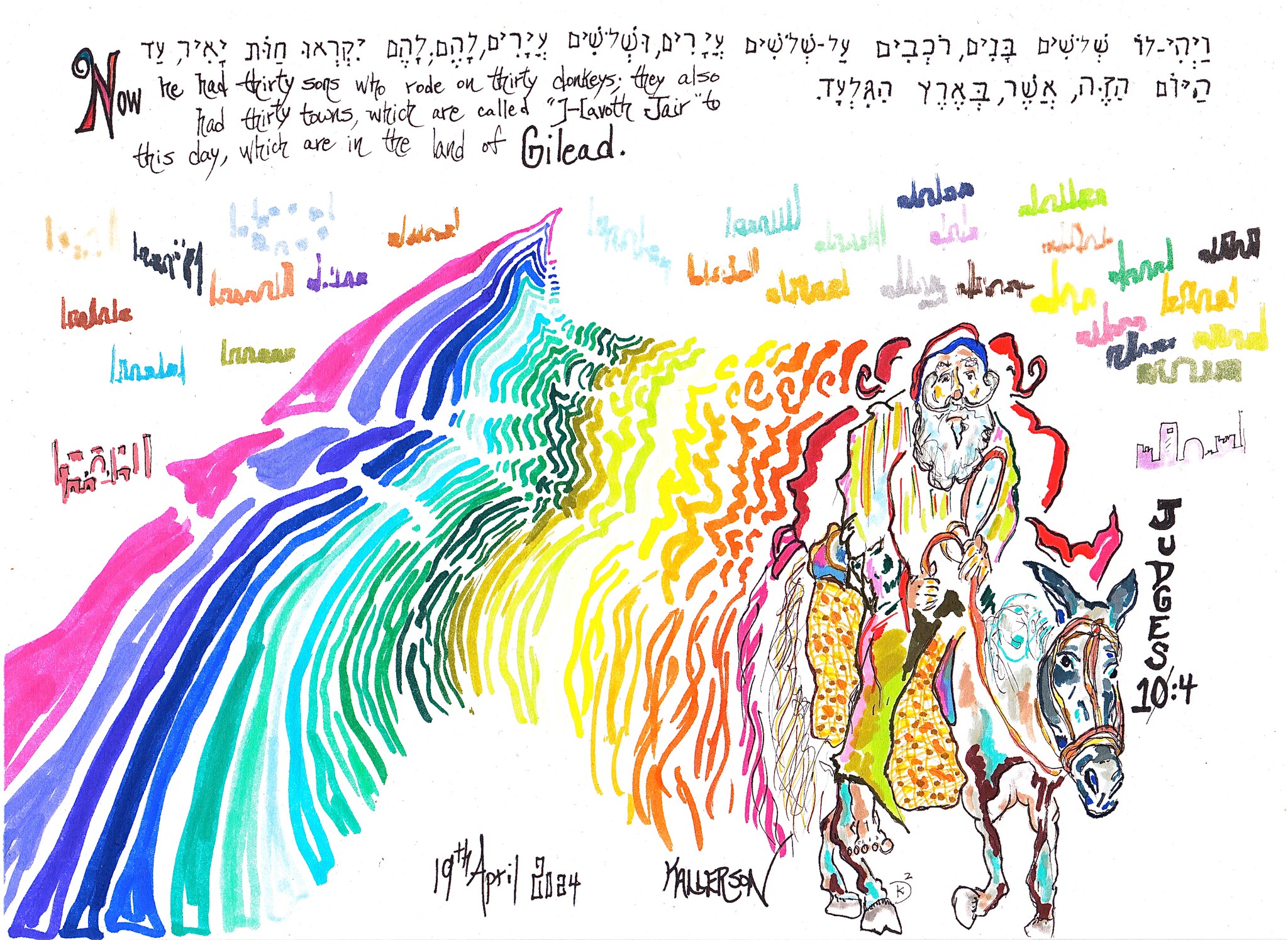
4 Now he had thirty sons who rode on thirty donkeys;
The words of verse 4 are unusual and exciting. First, to determine meaning, they will be looked at in individual clauses: v’hi lo shloshim banim rokhvim al shloshim ayarim – “And is, to him, thirty sons, riding upon thirty donkeys (villages).”
The number thirty is defined by Bullinger –
“THIRTY being 3 x 10, denotes in a higher degree the perfection of Divine order, as marking the right moment.” E.W. Bullinger
The word translated as donkey is ayir. It is a colt, a young donkey. The word comes from ur, to rouse oneself or awaken. The connection is that of raising (bearing) a burden. This type of donkey pictures ruling status. This is seen in Zechariah –
“Rejoice greatly, O daughter of Zion!
Shout, O daughter of Jerusalem!
Behold, your King is coming to you;
He is just and having salvation,
Lowly and riding on a donkey,
A colt [ayir], the foal of a donkey.” Zechariah 9:9
Thus, to us, the seemingly comical note of “thirty sons, riding upon thirty donkeys,” is actually equivalent to saying, “thirty sons who ruled.” Of these sons, it next says…
4 (con’t) they also had thirty towns,
u-shloshim ayarim lahem – “and thirty donkeys (villages) to them.” There is a play on words here. The word translated as donkey of the previous verse, and the word translated as “town” in this verse are identical except with the later added vowel points.
For fun, by transposing the thought one could say they rode upon the cities and they ruled upon the donkeys and the meaning would become clear, this is how wordplay works.
4 (con’t) which are called “Havoth Jair” to this day,
lahem yiqreu khavoth yair ad hayom hazeh – “to them called Havoth Jair unto the day, the this.” The name Khavoth is the plural of the word khavah, an encampment or village. That is the same name as Khavah, Eve, Adam’s wife. It means Life-Giving or Life. As such, the village is life-giving or a living place where the bustle of life occurs.
Therefore, the name Havoth Jair means something like Villages of the Enlightener, but with the understanding that it is Life Giving or Livings (Villages) of the Enlightener.
The surprising part of the first Jair mentioned in Numbers is his genealogy. He is reckoned as a son of Manasseh, rather than a son of Judah, despite Machir’s daughter having married Hezron, a grandson of Judah.
This could be because Hezron was old when he married her and already had other children. He may not have wanted this son to interfere with the inheritance rights of his other children, so their son was reckoned through Manasseh.
Confusion arises concerning the number of the cities. In 1 Chronicles 2, Jair is said to have twenty-three cites. However, in Deuteronomy 3, Moses says there are sixty.
This is often looked at as a contradiction, but that is because they don’t see that the term Khavoth Jair is being used in both a wider and a narrower sense. In 1 Chronicles 2, it says –
“(Geshur and Syria took from them the towns of Jair, with Kenath and its towns—sixty towns.) All these belonged to the sons of Machir the father of Gilead.” 1 Chronicles 2:23
What this means is that when Moses speaks of the sixty towns of Jair in Deuteronomy 3, he is referring to everything taken by both Jair and Nobah. In Numbers, it is used in its stricter sense, meaning only the cities captured by Jair. The wider sense used in Deuteronomy is inclusive of what Nobah took, meaning Kenath and its daughter villages.
Here in Judges 10, it says that the thirty sons have thirty villages. There is no contradiction in this. The sons of Jair were given thirty of the sixty towns in this area to rule, and they were called by the name of their father within the wider sense of the term mentioned above. Of these cities, it next says…
4 (con’t) which are in the land of Gilead.
asher b’erets ha’gilad – “which in land the Gilead.” It is the land west of the Jordan. This is the same area where the next Judge, Jephthah, will exercise his time over Israel. As noted, the Gilead means The Perpetual Fountain.
The unusual nature of the words is seen in the repetition of the word ayarim and a twice repeated lahem (to them).
v’hi lo shloshim banim rokhvim al shloshim ayarim u-shloshim ayarim lahem lahem yiqreu khavoth yair ad hayom hazeh asher b’erets ha’gilad – “And is, to him, thirty sons, riding upon thirty donkey (villages), and thirty villages (donkeys) to them, to them called Havoth Jair unto the day, the this, which in land the Gilead.”
The pun on the word donkey/village was explained. The translation of the “to them” which is often ignored by translators should not be. Rather, the translation as I gave it with the parenthetical inserts explains the meaning. It begins a new thought. It gives the idea of “Even to them, such and so.”
5 And Jair died and was buried in Camon.
vayamath yair vayiqaver b’qamon – “And dies, Jair, and buried in Camon.” Not much was recorded of him except the note about his sons and his time of ruling, but it is sufficient for him to be remembered as a judge of Israel.
The name Qamon is found only here in Scripture. It is derived from qum, to arise. Thus, it signifies Elevation, Height, or Arising.
The Enlightener! Christ is the One
His light has shown forth for all the world
The marvelous things our Lord has done
Are in the word, waiting to be unfurled
He who is the Judge of Israel
Christ the Lord leads them through the ages
Saving them and keeping them, so the word does tell
It is carefully revealed in its precious pages
And He has called out to the Gentiles too
The Enlightener has shown forth for them as well
He is the Lord our God, faithful and true
Come, let us discover what the word does tell
III. Pictures of Christ
The words vayaqum akhare avimelekh, And arises after Abimelech, necessitate that the verses we have looked are to be considered as chronological. When a passage says something like, “And it happened…” it may be chronological, categorical, etc. However, the word “after” demands a chronological approach to what is presented.
Abimelech anticipates the coming rule of the Antichrist. After that period, meaning during the tribulation period, the next dispensation is the Millennium, the thousand-year reign of Christ on earth.
It is the time when Israel will finally recognize who Jesus is and they will serve Him. The five verses we have just analyzed anticipate that time.
After Abimelech, the one to deliver Israel is Tola, the son of Puah, the son of Dodo. Said literally, Worm, son of Utterance, son of His Beloved. To explain the tola, or worm, Psalm 22 was cited, “But I am a worm [tola], and no man.”
David, under inspiration and in anticipation of the coming Messiah, proclaimed that he would be called Worm. Like the crimson grub, He is the one whose crimson blood stained the cross of Calvary.
He is the son of Puah: the Word of God, the Utterance spoken by the Creator – the Son of God.
He is the son of Dodo, the Son of His Beloved – the Son of God.
After that, Tola is noted as a man of Issachar, a man of He is Wages. Israel will recognize that Jesus is the Wages given to purchase them from the penalty of the law.
It next said that Tola was dwelling in Shamir. This explains Jesus’ rule in the Millennium. As noted, the word is from shamir, a thorn, and that is from the same root as shamar, to guard or keep watch. It is the exact description of the Lord as noted in Psalm 121:4. He is the Shomer Yisrael, the One keeping Israel –
“He will not allow your foot to be moved;
He who keeps you will not slumber.
4 Behold, He who keeps Israel [shomer Yisrael]
Shall neither slumber nor sleep.” Psalm 121:4
He maintained them throughout their history under the law, and He will maintain them as His people throughout the Millennium, even to its completion –
“Now when the thousand years have expired, Satan will be released from his prison 8 and will go out to deceive the nations which are in the four corners of the earth, Gog and Magog, to gather them together to battle, whose number is as the sand of the sea. 9 They went up on the breadth of the earth and surrounded the camp of the saints and the beloved city. And fire came down from God out of heaven and devoured them. 10 The devil, who deceived them, was cast into the lake of fire and brimstone where the beast and the false prophet are. And they will be tormented day and night forever and ever.” Revelation 20:7-10
Shamir is noted as being in Mount (a gathering) Ephraim (Twice Fruitful/Ashes). This thought has consistently referred to Jesus being the Messiah of both the Jew and the Gentile (Twice Fruitful), a right that came because of His afflictions.
That then refers to those who will reign with Him in the Millennium –
“And I saw thrones, and they sat on them, and judgment was committed to them. Then I saw the souls of those who had been beheaded for their witness to Jesus and for the word of God, who had not worshiped the beast or his image, and had not received his mark on their foreheads or on their hands. And they lived and reigned with Christ for a thousand years.” Revelation 20:4
This resurrection involves anyone, Jew or Gentile, who refuses the mark of the beast. They will live and reign with Christ Jesus during the Millennium. The reign of twenty-three years is noted. It is a period not defined by Bullinger, and for good reason. The reign of Christ during the Millennium is not fully defined by Tola.
It is certain that the period of the next judge, Jair, continues the typology because his time as judge also says vayaqum akharav yair – “And arose after him Jair.” Earthly judges die. In order to maintain the typology, the “after him” is provided.
He is noted as yair ha’giladi, He Enlightens the Perpetual Fountainite. The Light is Christ. The Perpetual Fountain is the Spirit who issues from Him. Isaiah 60 provides the Millennial light analogy –
“The sun shall no longer be your light by day,
Nor for brightness shall the moon give light to you;
But the Lord will be to you an everlasting light,
And your God your glory.
20 Your sun shall no longer go down,
Nor shall your moon withdraw itself;
For the Lord will be your everlasting light,
And the days of your mourning shall be ended.
21 Also your people shall all be righteous;
They shall inherit the land forever,
The branch of My planting,
The work of My hands,
That I may be glorified.
22 A little one shall become a thousand,
And a small one a strong nation.
I, the Lord, will hasten it in its time.” Isaiah 60:19-22
Zechariah, also referring to the Millennium, provides the fountain analogy –
“In that day a fountain shall be opened for the house of David and for the inhabitants of Jerusalem, for sin and for uncleanness.” Zechariah 13:1
Of Jair’s rule, it is twenty-two years. As noted by Bullinger, it is an intensified form of eleven: disorganization and disintegration, especially in connection with the Word of God. Two is associated with the second Person of the Godhead, the living Word.
The Millennium is certainly associated with Jesus, the second Person of the Godhead. But a time of heightened disorganization and disintegration? That seems like it is contradictory to the Millennium, but it actually isn’t.
There are numerous verses that indicate such a state. Despite being a time of Christ’s rule, there will astonishingly be those who rebel against it, both within the land and outside of it –
Within: “No more shall an infant from there live but a few days,
Nor an old man who has not fulfilled his days;
For the child shall die one hundred years old,
But the sinner being one hundred years old shall be accursed.” Isaiah 65:20
Without: “And it shall come to pass that everyone who is left of all the nations which came against Jerusalem shall go up from year to year to worship the King, the Lord of hosts, and to keep the Feast of Tabernacles. 17 And it shall be that whichever of the families of the earth do not come up to Jerusalem to worship the King, the Lord of hosts, on them there will be no rain. 18 If the family of Egypt will not come up and enter in, they shall have no rain; they shall receive the plague with which the Lord strikes the nations who do not come up to keep the Feast of Tabernacles. 19 This shall be the punishment of Egypt and the punishment of all the nations that do not come up to keep the Feast of Tabernacles.” Zechariah 14:16-19
However, because these two judges reflect the time of the Millennium, it would seem appropriate to combine the time of the two judgeships into one as well, meaning forty-five years.
It is a derivative of 9 and 5. Nine signifies finality or judgment. Finality is an exacting mark of the Millennium, the final dispensation of the seven-thousand-year span of man on earth. It is the time when judgment on sin is finally complete in mankind. However, the Millennium itself is stamped with the marvelous number five, GRACE.
Of Jair, it said that he had thirty sons, riding upon thirty donkeys. Thirty is “in a higher degree the perfection of Divine order, as marking the right moment.”
It is the “right moment” for the final dispensation to be realized. Christ’s work is completed. The nation has come to Him. Those of the tribulation, both Jew and Gentile, are raised to rule (pictured by the sons on donkeys). And, finally, harmony is realized in the land promised to Abraham, Isaac, and Jacob.
The rule of these sons is said to be in Havoth Jair, Life-Giving of the Enlightener. An exact description of this is found during the promised Millennium in Revelation 20 –
“Blessed and holy is he who has part in the first resurrection. Over such the second death has no power, but they shall be priests of God and of Christ, and shall reign with Him a thousand years.” Revelation 20:6
These words were then said to be in the land of the Gilead, the Perpetual Fountain. Just as Christ is the Perpetual Fountainite, so His people will dwell in the fellowship of the eternal Spirit of God, the Perpetual Fountain –
“Until the Spirit is poured upon us from on high,
And the wilderness becomes a fruitful field,
And the fruitful field is counted as a forest.” Isaiah 32:15
That prophecy refers to the time after the exile of Israel in the latter days, just as the typology here anticipates. It is during this timeframe that Jair was said to be buried in Qamon. As noted, the name is derived from qum, to arise. Isaiah also prophesied of that for the redeemed of the Lord –
“Arise [qum], shine;
For your light has come!
And the glory of the Lord is risen upon you.
2 For behold, the darkness shall cover the earth,
And deep darkness the people;
But the Lord will arise over you,
And His glory will be seen upon you.
3 The Gentiles shall come to your light,
And kings to the brightness of your rising.” Isaiah 60:1-3
The old adage, the devil is in the details, doesn’t quite explain the matter when it comes to Scripture. Rather, we can boldly proclaim: Christ is in the contents! These five verses, seemingly sparse in their contents, tell us about two of the judges of Israel.
And yet, they contain a marvelous tapestry of what is ahead for us in the stream of redemptive history. At the beginning of the sermon, I mentioned the commentary on these verses from the NIV Life Application Study Bible.
Their comments were not very deep, nor did they comprise everything that they claimed was in these verses. And yet, I have remembered their brief words since the first and only time I read them well over twenty years ago.
This is because what they asked is actually quite important –
“What are you doing for God that is worth noting? When your life is over, will people remember more than just what was in your bank account or the number of years you lived?”
We, like the stories that we have been evaluating from Judges, are on a trip through history. Our lives are much shorter than it seemed when we were young. As we age, we realize that more and more. My granddaughter was born just three months and one day before I typed this sermon.
But what really caught me off guard is that my little baby, Tangerine, is now thirty-seven (shhhhh! Don’t tell anyone I said so). It was only yesterday that I held her in my arms for the first time and looked at her precious face.
My son isn’t far behind. The little boy is now a man. And yes, both of them have a couple of gray hairs . Our lives are, as Moses says in Psalm 90, like grass. In the morning, it flourishes and grows up, and in the evening, it is cut down and withers.
What is it that you are doing for the cause of the Lord Jesus? Before you know it, your years will end and the time set to stand before Him will have arrived. The thought that goes through my mind daily is, “Use me up now, Lord.”
Let the Lord and His coming kingdom be the constant thought on your mind. Be filled with the desire to be a part of what He is doing now. The days are coming to their fulfillment and what is left undone will not be called back for a second chance.
Read the word. Let it fill your mind. And then let the knowledge you glean from it be what directs your feet each moment of each day. To the glory of God who placed you here at this point in time, may it be so.
Closing Verse: “So teach us to number our days,
That we may gain a heart of wisdom.” Psalm 90:12
Next Week: Judges 10:6-18 The voice of the people sounds quite chagrined… (We Have Sinned!) (32nd Judges Sermon)
The Lord has you exactly where He wants you. He has a good plan and purpose for you. It is He who judges His people according to their deeds. So, follow Him, live for Him, and trust Him, and He will do marvelous things for you and through you.
Tola and Jair, Judges of Israel
After Abimelech there arose to save Israel
Tola the son of Puah, the son of Dodo, a funny name it would seem
A man of Issachar
And he dwelt in Shamir in the mountains of Ephraim
He judged Israel twenty-three years, just short of
———-another leap year
And he died and was buried in Shamir
After him Jair, a Gileadite, arose among his peers
And he judged Israel twenty-two years
Now he had thirty sons who rode on thirty donkeys
They also had thirty towns, not too bad!
Which are called “Havoth Jair” to this day
Which are in the land of Gilead
And Jair died and was buried in Camon
And into the ground he was sown
Lord God, turn our hearts to be obedient to Your word
Give us wisdom to be ever faithful to You
May we carefully heed each thing we have heard
Yes, Lord God may our hearts be faithful and true
And we shall be content and satisfied in You alone
We will follow You as we sing our songs of praise
Hallelujah to You; to us Your path You have shown
Hallelujah we shall sing to You for all of our days
Hallelujah and Amen…
After Abimelech there arose to save Israel Tola the son of Puah, the son of Dodo, a man of Issachar; and he dwelt in Shamir in the mountains of Ephraim. 2 He judged Israel twenty-three years; and he died and was buried in Shamir.
3 After him arose Jair, a Gileadite; and he judged Israel twenty-two years. 4 Now he had thirty sons who rode on thirty donkeys; they also had thirty towns, which are called “Havoth Jair” to this day, which are in the land of Gilead. 5 And Jair died and was buried in Camon.