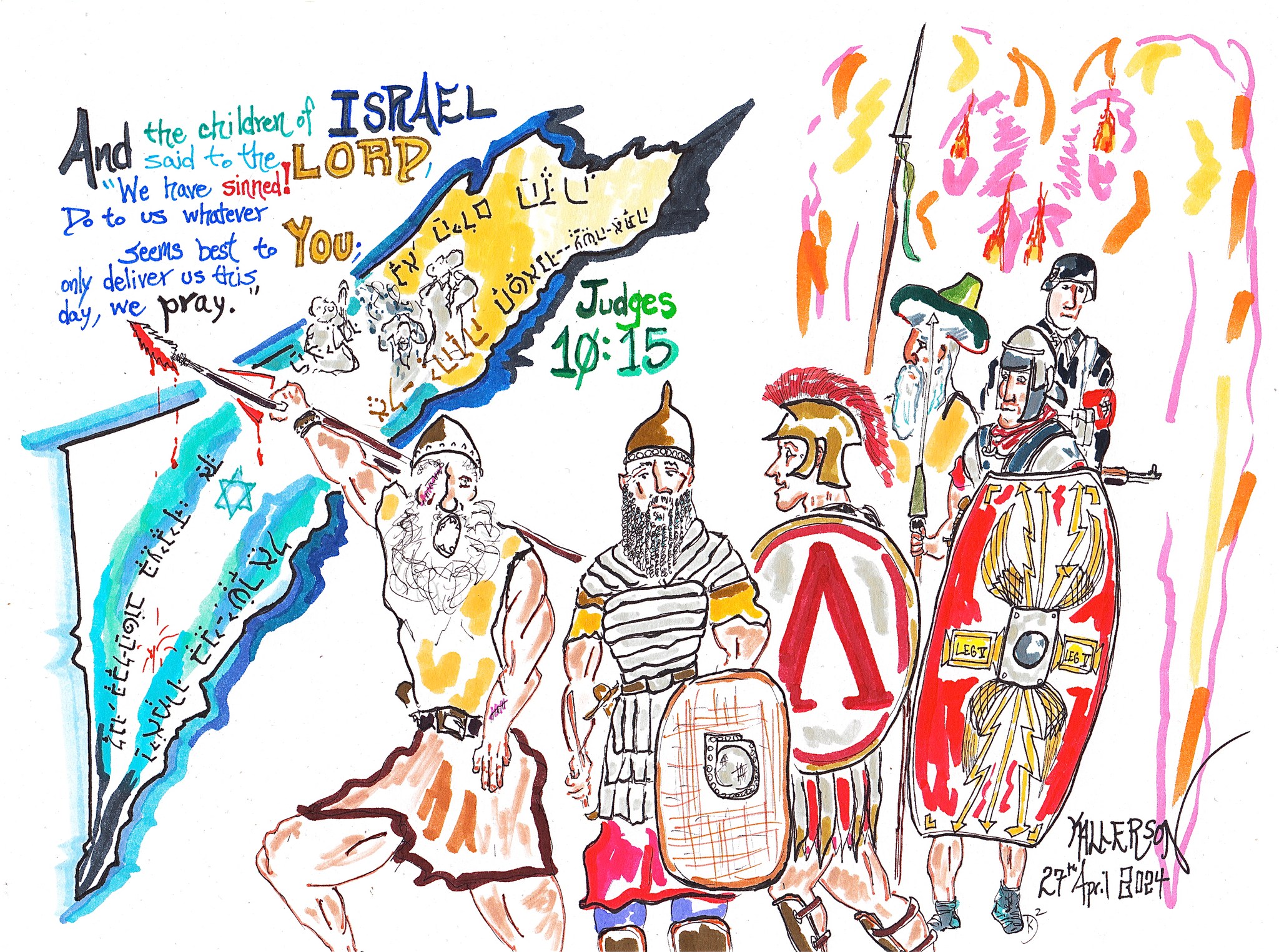
Artwork by Douglas Kallerson
Judges 10:6-18
We Have Sinned!
(Typed 12 February 2024) There will not be an explanation of typology at the end of these verses, but there will be an explanation of why that is not yet needed. As for the verses, despite translational differences from the NKJV at times, the words are simple and clear in their meaning with one exception.
In the first clause of the final verse, the words become complicated and seemingly make no sense. What scholars argue will be noted. As for the translations, every single one of them that I reviewed, a total of thirty-nine translations, all carry the same general meaning.
However, in my translation, which seemed obvious to me from the start, the thought is presented in a completely different manner. Despite this, I confidently finished the analysis of the verse under the assumption that the translation was correct.
However, I could not verify if my thinking was right because Sergio was flying home from Italy. Despite that, about an hour later he responded from the flight still traveling over the Atlantic. He asked what I needed and I sent him the contents of verse 18, waiting anxiously to see if I would have to redo an hour of typing.
Text Verse: “Then the word of the Lord came to me, saying: 6 ‘O house of Israel, can I not do with you as this potter?’ says the Lord. ‘Look, as the clay is in the potter’s hand, so are you in My hand, O house of Israel! 7 The instant I speak concerning a nation and concerning a kingdom, to pluck up, to pull down, and to destroy it, 8 if that nation against whom I have spoken turns from its evil, I will relent of the disaster that I thought to bring upon it. 9 And the instant I speak concerning a nation and concerning a kingdom, to build and to plant it, 10 if it does evil in My sight so that it does not obey My voice, then I will relent concerning the good with which I said I would benefit it.’
11 ‘Now therefore, speak to the men of Judah and to the inhabitants of Jerusalem, saying, “Thus says the Lord: ‘Behold, I am fashioning a disaster and devising a plan against you. Return now every one from his evil way, and make your ways and your doings good.’”’” Jeremiah 18:5-11
It took a while, but Sergio finally responded, “I see no other better way to translate than the way you did.” Boy did that make me happy. Then another message –
“Before I read your translation in Hebrew, it made perfect sense to me. I had no difficulty reading it. Then you started saying that others translate it differently, and I thought, ‘Why?? It’s so simple. We Hebrews say it that way all the time, even today.’”
Why something seemingly obvious was overlooked is a mystery to me, but I appreciated Sergio’s comments. He finished his words with, “Thank you for using Sergio’s Hebrew Services from the Air.” Rather, thank you, Sergio.
The text verse mirrors what is going on in today’s passage. And there is a reason for that. God is consistent in how He deals with people, including Israel. As we progress through the verses, try to keep this in mind. It pertains to individuals as much as it does to nations. Jeremiah 18 tells us this explicitly.
As for Israel’s attitude concerning their relationship with the Lord, John Lange beautifully expresses it, as well as the relationships of churches, denominations, and even nations today –
“Sin and forgiveness are the hinges of all history; especially of the history of Israel, including in that term the spiritual Israel of modern times. They follow each other like night and morning. As soon as the prayers and faith of a great man cease from among the people, and the earth is heaped over his grave, the new generation breaks loose, like an unrestrained youth.”
Other than his words about “the spiritual Israel,” he is exactly right. A church is only as sound as the leader of that church. A denomination will begin to apostatize as soon as one corrupt leader enters its body. And a nation will only follow the Lord as long as the leader of that nation is a proper example to his people.
The history of Israel is being outlined in the story of its judges. Let us consider how quickly the people departed from the Lord once a judge was gone. In learning the lesson of Israel’s judge, we can then consider our own walk before the Lord in a more perfect light.
It is the Lord, not a leader, to whom we should hold fast. Even if we are guided by a sound leader, we should never divert our attention from the Lord to the leader. He is there to motivate, direct, and teach, but only so far as it is with the Lord as the focus of the motivation, direction, and instruction
This is a certain truth that is to be found in His superior word. And so, let us turn to that precious word once again, and… May God speak to us through His word today, and may His glorious name ever be praised.
I. We Have Sinned! (verses 6-10)
6 Then the children of Israel again did evil in the sight of the Lord,
It doesn’t say either, then, or again. Rather: vayosiphu bene Yisrael laasoth ha’ra b’ene Yehovah– “And added, sons Israel, to do the evil in eyes Yehovah.” The words are identical to the opening clause of Judges 3:12 and Judges 4:1. It is as if there is a divine scale being added with weight with every evil act of Israel. And it isn’t just evil, but “the evil.” Saying this adds stress to the words.
This is the seventh of eight times it will be seen in Judges, and it will continue throughout the Old Testament, especially in the books of Kings and Chronicles.
For example, the word ra, or evil, is used nineteen times in Judges, but eight times it includes the article, ha’ra, the evil, when referring to the people’s conduct before the Lord. As here, each time, it says the evil was done b’ene Yehovah, or “in eyes of Yehovah.” The offense is personal in the relationship between the people and the Lord.
In Judges, the article ha is always used in relation to the conduct of the sons of Israel, meaning the people collectively. However, later, when kings rule the land, that same term will usually refer to the conduct of the king, being the one to do “the evil.”
Thus, during the time of the Judges, the Lord is the ultimate leader of the people. It is the judge, the Lord’s temporarily appointed leader, who is called to bring the people back from doing “the evil.” Once the kingdom is established, it is the king himself who causes the people to err or who brings them back to the Lord.
As for this instance of doing “the evil,” it next says…
6 (con’t) and served the Baals and the Ashtoreths,
Israel dines on a smorgasbord of rebellion, beginning with: vayaavdu eth habalim v’eth ha’ashtaroth – “and served the Baals and the Ashtaroth.”
The false gods already named and worshipped in Judges, and which were overthrown by past judges, are the first to be mentioned. The Baals and the Ashtaroth were first named in Judges 2:13. At the time of Gideon, he destroyed the altar of Baal and the wooden image of Asherah that was upon it.
The worship of baal has been seen several times in Judges. The word means a master, owner, lord, etc. Among other things, for example, it can refer to a husband in relation to a wife, the owner of a piece of property, a master of assemblies, or the captain of the guard.
In this context, it is used in the sense of gods. They can be general gods, such as worshiping the sun or stars, or they can be the names of specific gods, such as Baal-Zebub, Baal-Berith, etc.
Ashtaroth is a plural word. It is the name of a Sidonian deity. The Asherahs were represented by large wooden pillars or images set up in honor of Ashtaroth.
In serving other gods, they are dealing falsely with the Lord. This is reflected in the name Israel – He Strives with God. Israel strives with God (for God) or he strives with God (against God). Either way, Israel strives with God. So it is when they worship the Lord or when they worship other gods.
Along with these, it next notes…
6 (con’t) the gods of Syria, the gods of Sidon, the gods of Moab, the gods of the people of Ammon, and the gods of the Philistines;
v’eth elohe aram v’eth elohe tsidon v’eth elohe moav v’eth elohe b’ne amon v’eth elohe plishtim – “and gods Aram, and gods Sidon, and gods Moab, and gods sons Ammon, and gods Philistines.” The apostasy of Israel spreads in seemingly every direction.
Aram was not yet a nation at this time, but the people group was to Israel’s northeast. Sidon is to Israel’s northwest. Moab is to Israel’s southeast. Ammon is directly east. The Philistines lay on Israel’s southwest.
Thus, Israel reached for the false gods within and without instead of holding fast to the Lord who had granted them their land in the first place. In all, seven sets of false gods are named in this one verse.
It is a sad and scathing indictment on the state of Israel that they were so willing to abandon the Lord in their search for religious pleasure and false spirituality.
As for the names, Aram means High or Elevated. Sidon comes from tsud – to hunt. Thus, it is Hunting Place. As it is on the coast, it means to hunt fish and thus, Fishery. Moab is the people group descended from Lot through the union with his older daughter. It means From Father.
The Ammonites were descendants of Lot through his younger daughter. Thus, they stood in relation to Israel as relatives. The name Ammon means A People based on her calling her son Ben Ammi, Son of My People.
The Philistines were from the area of Phoenicia. The name comes from palash, signifying to roll in the dust as an act of mourning. They are the Grievers or Weakeners. As for Israel, it next says…
6 (con’t) and they forsook the Lord and did not serve Him.
vayaazvu eth Yehovah v’lo avaduhu – “and forsook Yehovah, and no served Him.” The words tell us that Israel simply walked away from the Lord. The people were so delighted with other gods that they left behind any part of the rites and rituals laid down in the law.
This would mean that the tabernacle was neglected, and the annual feasts were ignored. If they were observed, it would be considered serving the Lord, even if it was in conjunction with other gods, but these words clearly indicate that no service was given to the Lord, even if cultural aspects of the society – such as circumcision – may still have been practiced. Because of this…
7 So the anger of the Lord was hot against Israel;
vayikhar aph Yehovah b’Yisrael – “And burned nostril Yehovah in Israel.” It is the all-too-common expression where it is as if the Lord is standing in the midst of the people, fuming. His face is flushed, and smoke and fire come pouring out of His nose in righteous indignation. Therefore…
7 (con’t) and He sold them into the hands of the Philistines and into the hands of the people of Ammon.
vayimkerem b’yad p’lishtim u-b’yad b’ne amon – “and sold them in hand Philistines and in hand sons Ammon.” This is a general statement of what is to come in the chapters ahead. As noted, Ammon was directly east of Israel.
The coming account of Jephthah in Judges 11 & 12 will detail the struggle between Israel and Ammon. Also, it was noted that the Philistines were located to Israel’s southwest. The struggle against them will be noted in the lengthy account of Samson in Judges 13-16.
These two people groups oppressed Israel from both sides, like a vice squeezing until the pain of affliction was too much for them. Only then would they remember the Lord and turn to Him for divine assistance.
8 From that year they harassed and oppressed the children of Israel
The words make a devastating alliteration: vayiratsu vayr’otstsu eth b’ne Yisrael ba’shanah hahi – “And shattered, and crushed, sons Israel, in the year, the it.” The first word, raats, is used for the second and last time in Scripture. It signifies to shatter. The second word, ratsats, signifies to crush. Taken together, it gives the sense of a pot being cast down, shattered, and then someone stomping on the broken pieces, crushing them till they are like the fine powdery dust that blows in in the Gobi Desert.
One can imagine the land and the people being laid waste by the actions of those who came against them.
As for the words, “in the year, the it” or “in that year,” there is no explicit reference given. My best guess, because the narrative will next deal with the oppression of the sons of Ammon, is that this is referring to that account. Thus, the oppression of Ammon lasted…
8 (con’t) for eighteen years
sh’moneh esreh shanah – “Eight ten year.” It is the same period that Israel served under Eglon, King of Moab in Judges 3. Eighteen is either 2×9 or 3×6. 2×9 indicates division matched with finality or judgment. 3×6 indicates divine perfection matched with the number of man destitute of God. Both fit the situation.
Israel had the choice of serving the Lord or the false gods of the nations. They chose to serve the false gods until the finality of their judgment.
Likewise, this is the Lord’s divinely set period for Israel while they are destitute of the Lord’s favor. Israel is being instructed on what it means to serve the Lord or to serve their enemies.
8 (con’t) —all the children of Israel who were on the other side of the Jordan in the land of the Amorites, in Gilead.
eth kal b’ne Yisrael asher b’ever ha’yarden b’erets ha’emori asher bagilad – “all sons Israel who in side the Jordan in land the Amorite who in the Gilead.” The term “in side the Jordan” is given based on the reference point of the writer. In this case, it means “on the other side of the Jordan.”
The Jordan means “the Descender.” Amorite came from amar, to utter or say. It means Renown. The Gilead means The Perpetual Fountain. In addition to vexing them on the other side of the Jordan, it also says…
9 Moreover the people of Ammon crossed over the Jordan to fight against Judah also, against Benjamin, and against the house of Ephraim,
vayaavru b’ne amon eth ha’yarden l’hilakhem gam bihudah u’b’binyamin uv-veith ephrayim – “And crossed over, sons Ammon, the Jordan, to fight also in Judah and in Benjamin and in house Ephraim.” The Ammonites weren’t content to just harass the Israelites east of the Jordan, but they crossed the Jordan and attacked deep into the heart of Canaan.
Judah means Praise. It is the southern tribe of the land. Benjamin was just north of Judah. It means Son of the Right Hand. The house of Ephraim is north of Benjamin. Ephraim means Twice Fruitful and Ashes.
In the book of Hosea, Ephraim and the northern tribes of Israel are referred to synonymously several times. For example –
“I know Ephraim,
And Israel is not hidden from Me;
For now, O Ephraim, you commit harlotry;
Israel is defiled.” Hosea 5:3
It seems necessary to say this because the verses in Judges 10, especially verses 8 & 9, set up the narrative in Judges 11 and 12. In Judges 12, there is a great conflict between Jephthah and the men of Ephraim.
9 (con’t) so that Israel was severely distressed.
vatetser l’Yisrael meod – “And distressed to Israel, greatly.” The same word, yatsar, was used in Judges 2:15 to describe the events in the book of Judges. Notice how Judges 2 parallels what is now said –
2:14 – They forsook the Lord and served Baal and the Ashtoreths.
10:6 – Then the children of Israel again did evil in the sight of the Lord, and served the Baals and the Ashtoreths.
2:14 – And the anger of the Lord was hot against Israel.
10:7 – So the anger of the Lord was hot against Israel.
2:14 – and He sold them into the hands of their enemies all around.
10:7 – and He sold them into the hands of the Philistines and into the hands of the people of Ammon.
2:14 – so that they could no longer stand before their enemies.
10:8 – From that year they harassed and oppressed the children of Israel.
2:15 – And they were greatly distressed [yatsar].
10:9 – So that Israel was severely distressed [yatsar].
Judges 2 gave a broad panorama of the coming stories recorded in Judges. The greater details of those earlier verses are being provided as the book continues to unfold.
10 And the children of Israel cried out to the Lord,
vayizaqu b’ne Yisrael el Yehovah – “And cried out, sons Israel, unto Yehovah.” It is not unlike the words of Judges 6 –
“So Israel was greatly impoverished because of the Midianites, and the children of Israel cried out to the Lord.” Judges 6:6
This is the purpose of allowing the enemies of Israel to prevail over them. In serving other gods and forsaking the Lord, things don’t go well. Israel remembered the stories of the past and realized that the path they have taken is wrong. They then turn back to the God of their fathers. Their cry is accompanied by an admission of guilt…
10 (con’) saying, “We have sinned against You, because we have both forsaken our God and served the Baals!”
l’mor khatanu lakh v’ki azavnu eth elohenu vanaavod eth habalim – “to say, “Sinned to You, and because forsaken our God and served the Baals.” The words “Sinned to You” openly and unambiguously acknowledge that they were responsible for their plight. When Gideon was told he was to deliver Israel, he asked, “O my lord, if the Lord is with us, why has all this happened to us?”
As a type of the gospel, his naivete is completely understandable. The Lord remained with Israel, even in their rejection of Him. Israel cried out to the Lord, but in a general way. The Lord then responded in a specific way, providing what they had already rejected, the gospel of Jesus Christ.
In the case of this narrative, Israel has realized that the Lord has been with them, but as a Father chastising His son for disobedience. They know this and openly admit it. In their confession, they acknowledge sins of omission, “we have forsaken our God,” as well as sins of commission, “we have served the Baals.”
In response, the Lord will remind them of seven deliverances He has provided. These, then, are set in contrast to the seven apostatizing influences noted in verse 6…
Did I not deliver you on the day
When I made the long walk to Calvary?
What is it you are doing? What do you say?
This great offense you bring before Me?
I delivered you from the enemy and made you whole
Don’t you know you were bought at a price?
Your burning passions you must control
It is I who restore you to paradise
You are seated in the heavenly places
If you truly belong to Me
Remove from yourself all disgrace
And live out your days as they are intended to be
II. Go Cry Out to the Gods You Have Chosen! (verses 11-18)
11 So the Lord said to the children of Israel, “Did I not deliver you from the Egyptians and from the Amorites and from the people of Ammon and from the Philistines?
The words are purposefully anacoluthic (lacking grammatical sequence or coherence), leaving the verb unstated: vayomer Yehovah el b’ne Yisrael halo mimitsrayim u-min ha’emori u-min b’ne amon u-min p’lishtim – “And said Yehovah unto sons Israel, ‘Not from Egypt, and from the Amorite, and from sons Ammon, and from Philistines?”
For clarity, the NKJV inserts these words to complete the thought: “Did I not deliver you?” However, the Lord omits what it was that He had done as a means of getting His people to think through their past.
Israel was delivered from Egypt in the book of Exodus. They were delivered from the Amorite in Numbers 21. They were delivered from Ammon who allied with Eglon in Judges 3. They were also delivered from the Philistines under Shamgar in Judges 3.
Without specifying how or by whom the Lord spoke to Israel, He reminds them of their past deliverances. Despite this, Israel continued to walk away from Him when things stabilized and life returned to normal. Understanding this, He continues…
12 Also the Sidonians and Amalekites and Maonites oppressed you; and you cried out to Me, and I delivered you from their hand.
v’sidonim va’amaleq u-maon lakhatsu etkhem vatitsaqu elay va’ovoshia etkhem miyadam – “And Sidonians, and Amalek, and Maon oppressed you, and cried out unto Me, and I saved you from their hand.” The deliverance from the Sidonians may have been a part of the battle recorded in Joshua 11 where a great alliance came together against Joshua. In that battle, some of the enemies were chased to Greater Sidon, implying they were troops from that area fleeing to their homes.
The Lord delivered Israel from the Amalekites several times starting in Exodus 17. Of the final group, Maon, there is no recorded oppression from them. Because of this, some scholars defer to lesser texts, which read either Midian or Canaan.
There is no need for this. Maon is noted in 1 Samuel 23 and 25. There were inhabitants who oppressed Israel there and the people would have remembered that. The name means Abode or Place of Habitation. Despite all of this…
13 Yet you have forsaken Me and served other gods.
It is emphatic: v’atem azavtem oti vataavdu elohim akherim – “And you, you forsook Me, and served gods other.” The contrast is clearly stated for the people to consider their wickedness. The Lord delivered them from seven oppressors in the past. And yet they… they! forsook the Lord and served other gods despite all He had done for them…
13 (con’t) Therefore I will deliver you no more.
laken lo osiph l’hovoshia etkhem – “Thus, no adding to save you.” He had repeatedly delivered them, and they repeatedly turned away from Him. He proved Himself faithful while they had proven themselves faithless. Therefore, He was washing His hands of them. If they loved the other gods so much, then…
14 “Go and cry out to the gods which you have chosen; let them deliver you in your time of distress.”
If thought through, the words are filled with irony and sarcasm: l’ku v’zaaqu el ha’elohim asher b’khartem bam hemah yovoshiu lakhem b’eth tsarathkhem – “Go! And cry out unto the gods which chosen in them. They save to you in time your distress.”
The gods that Israel chose are identified with their oppressors. In other words, these people groups had their own gods that they invented. Israel went after those gods. In doing so, the people whose gods Israel served oppressed them.
They did nothing but bring disaster to Israel, but the Lord tells them to go cry out for deliverance to the gods of their enemies. It would be laughable if it were not so sad.
15 And the children of Israel said to the Lord, “We have sinned!
The verb itself carries the first-person construct. Thus, there is brevity being conveyed: vayomru b’ne Yisrael el Yehovah khatanu – “And said, sons Israel, unto Yehovah, ‘Sinned!” The people collectively call out their state. With that, they speak their own emphatic words in response to the Lord’s emphatic pronouncement of verse 13…
15 (con’t) Do to us whatever seems best to You; only deliver us this day, we pray.”
aseh atah lanu k’khal ha’tov b’enekha akh hatsilenu na ha’yom ha’zeh – “Do, You, to us, according to all the good in Your eyes. Only, deliver us, we pray, the day, the this.’”
The Lord said: “And you, you forsook Me.”
The people said: “Do, You, to us.”
They understand what they did and acknowledge that whatever the Lord does to them is acceptable. However, they need immediate relief from their plight.
The words of these four verses form a short chiasm. Line a provides the people’s appeal to the Lord. Line b gives the action or desired action of the Lord. Line c acknowledges the sin of the people. Line d carries the Lord’s contrast to the people’s petition. The anchor (x) provides the sarcastic admonition of the Lord to His disobedient children –

Who is Israel’s Savior? That is the question that Israel has struggled with throughout their history. It is not because the Lord hasn’t made it evident to them. It is because they have continuously failed to see evidence of the Lord’s hand in every moment of their existence.
Only when things get so bad that they have nowhere else to turn do they acknowledge the Lord and take the action necessary to be restored to Him. In this case, they have taken the first step. Here, they press forward to the next step…
16 So they put away the foreign gods from among them and served the Lord.
vayasiru eth elohe ha’nekhar miqirbam vayaavdu eth Yehovah – “And turned aside gods, the foreign, from their midst, and served Yehovah.” Israel repented. They changed their mind about their situation. Now, bearing fruits worthy of that repentance, the people removed the foreign gods.
The meaning is more than chucking out idols. Some foreign gods involved sun or star worship, sacrificing children, etc. The meaning is that the people removed the foreign gods from their presence and from their lives. They purified their hearts and devoted themselves to the Lord. Because of this…
16 (con’t) And His soul could no longer endure the misery of Israel.
va’tiqtsar naphsho baamal Yisrael – “And reaped His soul in toil Israel.” The word qatsar is used. It signifies to curtail or shorten and is often used to indicate reaping.
In Judges 16, it is used when Delilah annoyed Samson to death. Here, it is as if the endurance of the Lord to ignore Israel’s plight is shortened to the point where He has met His end of trying. Thus, the NKJV gives a good paraphrase of the intent.
17 Then the people of Ammon gathered together and encamped in Gilead. And the children of Israel assembled together and encamped in Mizpah.
The word “then” is a chronological word, something not implied in the verse: vayitsaaqu b’ne amon vayakhanu bagilad vayeasphu b’ne Yisrael vayakhanu bamitspah – “And cried out, sons Ammon, and camped in the Gilead, and gathered sons Israel, and camped in the Mizpah.”
Regardless of the timing of the event, the same word, tsaaq, that was used in verse 12 concerning Israel crying out to Yehovah is now used concerning the Ammonites crying out a gathering for war.
The details in this verse and the next prepare us for the account of Jephthah in Judges 11. There is a gathering of the sons of Ammon to engage in battle in the Gilead, the Perpetual Fountain. In response to this, the sons of Israel come together and camp in the Mizpah, meaning The Watchtower.
This location will be mentioned twice in Judges 11. It is where Jephthah’s home is. A variant spelling, Mizpeh, is also used to identify various places, including in Judges 11. The spelling of the location now may identify it as the same place where Jacob and Laban made their parting agreement in Genesis 31.
18 And the people, the leaders of Gilead, said to one another,
The words are rather difficult: vayomru ha’am sare gilad ish el reehu – “And said the people, ‘Rulers Gilead, man unto his friend.’” There is no easy way to identify what is being said. There is no “and” between the words people and rulers. Despite this, Ellicott says that people and rulers cannot be in apposition (referring to the same thing).
Other scholars, and all translations, place them in apposition, even though it is a very strange thing to do. The way I translated it, however, resolves the tension in the words. There is the main group gathered together, identified as “the people.” They speak to the rulers of Gilead collectively. In essence –
“Hey, rulers of Gilead, each of you talk to your friend and decide…”
18 (con’t) “Who is the man who will begin the fight against the people of Ammon?
mi ha’ish asher yakhel l’hilakhem bivne amon – “who the man who begins to fight in sons Ammon?” In other words, “You rulers decide among yourselves who will begin the fight against the sons of Ammon. Whoever does this…”
*18 (fin) He shall be head over all the inhabitants of Gilead.”
yihyeh l’rosh l’khol yoshve gilad – “He shall be to head to all inhabiting Gilead.” The result of their previous proposition would be, “When you rulers have appointed their ruler, that person will be our overall ruler.” If this is correct, then the rulers in this verse are to be equated to the elders of Chapter 11 –
“It came to pass after a time that the people of Ammon made war against Israel. 5 And so it was, when the people of Ammon made war against Israel, that the elders of Gilead went to get Jephthah from the land of Tob. 6 Then they said to Jephthah, ‘Come and be our commander, that we may fight against the people of Ammon.’” Judges 11:4-6
Whether this is correct or not it is exactly what comes about. It also resolves the odd verbiage found in this last verse of Chapter 10.
The verses today refer to events occurring on both sides of the Jordan. The Jordan typologically anticipates the coming of Jesus in His first incarnation. He is the Descender. Therefore, the coming narrative will deal with events both before His coming and after His coming.
The account of Jephthah in Judges 11 and 12 will center on events east of the Jordan, anticipating events that pertain to those prior to Christ’s coming. Three Judges will be mentioned in quick succession at the end of Judges 12, all west of the Jordan.
Those will be followed by the account of Samson which deals with the oppression from the Philistines west of the Jordan. Thus, we can anticipate those things will deal with events after the coming of Christ.
As for the passage today, remember that the time markers inserted by the translators, such as “then” and “again,” are not in the text.
Thus, it appears that the words of the passage are like those of Judges 2. They are given to anticipate what lies ahead. This seems logical because of how verses 7-9 are structured –
“So the anger of the Lord was hot against Israel; and He sold them into the hands of the Philistines and into the hands of the people of Ammon. 8 From that year they harassed and oppressed the children of Israel for eighteen years—all the children of Israel who were on the other side of the Jordan in the land of the Amorites, in Gilead. 9 Moreover the people of Ammon crossed over the Jordan to fight against Judah also, against Benjamin, and against the house of Ephraim, so that Israel was severely distressed.”
Israel sinned against the Lord and so their enemies, both the Philistines (west) and Ammon (east), harassed and oppressed Israel. But then the words go from east of the Jordan (vs. 8) to west of the Jordan (vs. 9). Likewise, the narrative in the coming chapters follows that pattern.
It also refers to war “in Judah and in Benjamin and in house Ephraim.” As Ephraim is later used synonymously with the northern tribes of Israel, it appears that the narrative is saying that the spiritual war that is ongoing in Israel extends from the time before Christ to the time of His coming, including the time of the divided spiritual state of Israel after that.
It will be exciting to see if this pans out as we continue through the coming chapters. As for the words within the text today, Paul says in Ephesians 4:25-32 –
“Therefore, putting away lying, ‘Let each one of you speak truth with his neighbor,’ for we are members of one another. 26 ‘Be angry, and do not sin’: do not let the sun go down on your wrath, 27 nor give place to the devil. 28 Let him who stole steal no longer, but rather let him labor, working with his hands what is good, that he may have something to give him who has need. 29 Let no corrupt word proceed out of your mouth, but what is good for necessary edification, that it may impart grace to the hearers. 30 And do not grieve the Holy Spirit of God, by whom you were sealed for the day of redemption. 31 Let all bitterness, wrath, anger, clamor, and evil speaking be put away from you, with all malice. 32 And be kind to one another, tenderhearted, forgiving one another, even as God in Christ forgave you.”
Just as Israel grieved the Lord throughout its history, we can grieve the Lord today. Israel had the law and they failed to uphold it. There are things we are asked to do and that we are asked not to do.
We are not under law, but we are still children of the Lord Jesus. We should live our lives in a manner befitting that position. When we fail, like Israel, we will not be cut off, but we are setting ourselves up for tough times if we don’t quickly turn back to Him.
Don’t let the sin that so easily besets life interfere in a close and personal walk with the Lord. Let us learn the lesson of Israel and apply it to our continued walk before this great Lord who came to redeem us and bring us back to Himself.
Closing Verse: “For the Lord will judge His people
And have compassion on His servants,
When He sees that their power is gone,
And there is no one remaining, bond or free.
37 He will say: ‘Where are their gods,
The rock in which they sought refuge?
38 Who ate the fat of their sacrifices,
And drank the wine of their drink offering?
Let them rise and help you,
And be your refuge.” Deuteronomy 32:36-38
Next Week: Judges 11:1-11 oohwah! We’ll be with him for a spell, even until his time is done… (Jephthah, Judge of Israel, Part I) (33rd Judges Sermon)
The Lord has you exactly where He wants you. He has a good plan and purpose for you. It is He who judges His people according to their deeds. So, follow Him, live for Him, and trust Him, and He will do marvelous things for you and through you.
We Have Sinned!
Then the children of Israel again did evil
In the sight of the LORD, something to which they are prone
And served the Baals and the Ashtoreths
The gods of Syria, the gods of Sidon
The gods of Moab, the gods of the people of Ammon
And the gods of the Philistines, things were lookin’ grim
And they forsook the LORD
And did not serve Him
So the anger of the LORD
Was hot against Israel
And He sold them into the hands of the Philistines
And into the hands of the people of Ammon as well
From that year they harassed and oppressed
The children of Israel for eighteen years, things were getting bad
All the children of Israel who were on
The other side of the Jordan in the land of the Amorites, in Gilead
Moreover the people of Ammon
Crossed over the Jordan to fight against Judah also
Against Benjamin, and against the house of Ephraim
So that Israel was severely distressed from the mighty blow
And the children of Israel cried out to the LORD
Saying, “We have sinned against You
Because we have both forsaken our God
And served the Baals! Such evil we are prone to do
So the LORD said to the children of Israel
“Did I not deliver you from the Egyptians, that rugged crew
And from the Amorites and from the people of Ammon
And from the Philistines too?
Also the Sidonians and Amalekites
And Maonites oppressed you as I planned
And you cried out to Me
And I delivered you from their hand
Yet you have forsaken Me and served other gods
Therefore I will deliver you no more, this is your mess
“Go and cry out to the gods which you have chosen
Let them deliver you in your time of distress
And the children of Israel said to the LORD
“We have sinned against you this day!
Do to us whatever seems best to You
Only deliver us this day, we pray
So they put away the foreign gods
From among them and served the LORD for a spell
And His soul could no longer endure
The misery of Israel
Then the people of Ammon gathered together
And encamped in Gilead
And the children of Israel assembled together
And encamped in Mizpah for a tad
And the people, the leaders of Gilead, said to one another
“Who is the man who will begin the fight
Against the people of Ammon?
He shall be head over all the inhabitants of Gilead in our sight
Lord God, turn our hearts to be obedient to Your word
Give us wisdom to be ever faithful to You
May we carefully heed each thing we have heard
Yes, Lord God may our hearts be faithful and true
And we shall be content and satisfied in You alone
We will follow You as we sing our songs of praise
Hallelujah to You; to us Your path You have shown
Hallelujah we shall sing to You for all of our days
Hallelujah and Amen…
6 Then the children of Israel again did evil in the sight of the Lord, and served the Baals and the Ashtoreths, the gods of Syria, the gods of Sidon, the gods of Moab, the gods of the people of Ammon, and the gods of the Philistines; and they forsook the Lord and did not serve Him. 7 So the anger of the Lord was hot against Israel; and He sold them into the hands of the Philistines and into the hands of the people of Ammon. 8 From that year they harassed and oppressed the children of Israel for eighteen years—all the children of Israel who were on the other side of the Jordan in the land of the Amorites, in Gilead. 9 Moreover the people of Ammon crossed over the Jordan to fight against Judah also, against Benjamin, and against the house of Ephraim, so that Israel was severely distressed.
10 And the children of Israel cried out to the Lord, saying, “We have sinned against You, because we have both forsaken our God and served the Baals!”
11 So the Lord said to the children of Israel, “Did I not deliver you from the Egyptians and from the Amorites and from the people of Ammon and from the Philistines? 12 Also the Sidonians and Amalekites and Maonites oppressed you; and you cried out to Me, and I delivered you from their hand. 13 Yet you have forsaken Me and served other gods. Therefore I will deliver you no more. 14 “Go and cry out to the gods which you have chosen; let them deliver you in your time of distress.”
15 And the children of Israel said to the Lord, “We have sinned! Do to us whatever seems best to You; only deliver us this day, we pray.” 16 So they put away the foreign gods from among them and served the Lord. And His soul could no longer endure the misery of Israel.
17 Then the people of Ammon gathered together and encamped in Gilead. And the children of Israel assembled together and encamped in Mizpah. 18 And the people, the leaders of Gilead, said to one another, “Who is the man who will begin the fight against the people of Ammon? He shall be head over all the inhabitants of Gilead.”