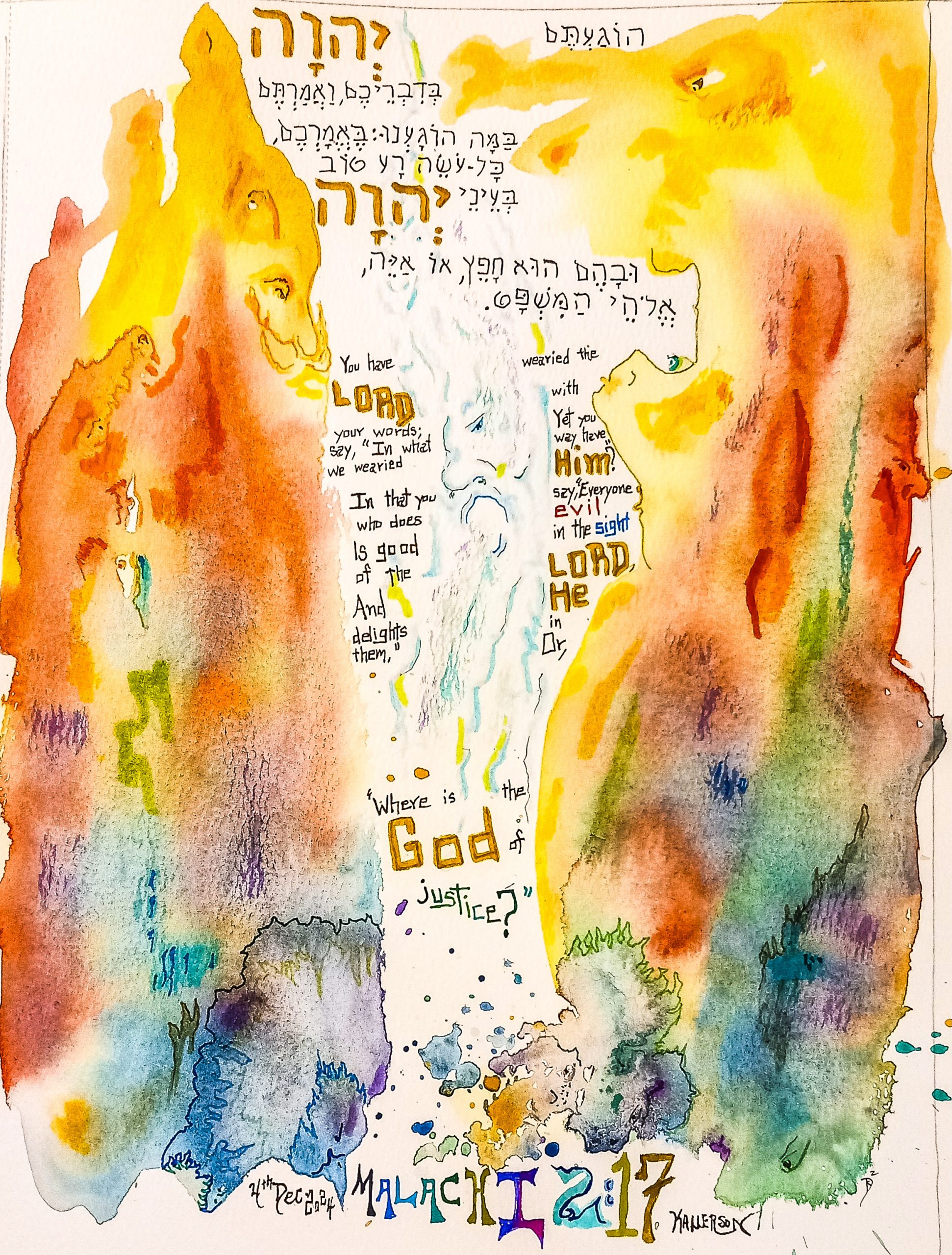
Malachi 2:10-17
Violence Upon His Garment
(Typed 9 Sep 2024) Translating can be a difficult thing, even in creating a literal translation. There is just so much involved in the process, in linguistic nuances that need to be considered, in the surrounding context of what is being presented, and so forth.
A mistranslation, or a misunderstanding in the context, can result in an entirely different meaning for the reader who is trying to appreciate God’s word. Malachi is filled with difficult words and phrases that require a vast knowledge of the rest of Scripture to pin down intent.
As an example, the opening clause of verse 15 is comprised of three simple words in the Hebrew text: v’lo ekhad asah – “And not, one, made?” As easy as the words appear, almost all of the translations I check render them a bit differently. Some of them are vastly different –
Has not the one God made you? / Didn’t the LORD make you one with your wife? / Did he not make them one, / Has not the LORD made them one, / But not one has done so / Didn’t God make them one / Didn’t the one God make us / Didn’t God create you and your wife to become like one person? / Didn’t God make you one body / Didn’t [God] make you one? / No one … does this. / And did not he make one? / But did He not make them one, / And did not he make them one? / Did he not make one, / Did he not make you one, / And did He not make you one? / And did not one make [them]? / So dyd not the one, / And He did not make one [only], / And He did not make one only, / And did he not make one? / Did not one make her, / Was there not one man / And not one hath done so / And did he not do well?
There are other variations but I got sleepy and stopped. It’s a real problem. What causes three simple Hebrew words to be so complicated in meaning or intent?
Text Verse: “You who judged your sisters, bear your own shame also, because the sins which you committed were more abominable than theirs; they are more righteous than you. Yes, be disgraced also, and bear your own shame, because you justified your sisters.” Ezekiel 16:52
As I was going through the verses, I couldn’t help but think of the utterly depraved, far-left Jews who are in Congress. People like Chuck Schumer and Jerry Nadler, among numerous others, appear to be demon-possessed.
But it could be the same syndrome seen in the people of Israel at the time of Malachi… well, at pretty much any time. They have no fear of God because they think God loves them simply because of who they are.
One of my Jewish friends from high school assured me that all Jews go straight to heaven, well, except maybe murderers and stuff. This type of thinking makes it easy to feel it’s ok to do whatever you want as there will be no consequences for your actions.
This is known as a presupposition. People believe the world around them works by what they already suppose to be true. This is why there are so many variations in the translation of the three Hebrew words we looked at a minute ago.
Having presuppositions may be one of the most damaging things of all in regard to theology, our relationship with God, job promotions, how smart someone is, or an unlimited number of other things. Unless you are certain about something important, it is better to check it out rather than go with your suppositions.
This is especially so when dealing with the God of the Bible. We will all stand before Him someday. We should know, not suppose, what will occur on that day.
Such truths as this are to be found in His superior word. And so, let us turn to that precious word once again, and… May God speak to us through His word today, and may His glorious name ever be praised.
I. The Daughter of a Foreign God (verses 10-12)
The words take a new direction. Verses 10-15 are words of the prophet rebuking Israel. In verse 16, he will cite the Lord again, and then he will continue speaking to the people.
10 Have we not all one Father?
halo av ekhad l’khulanu – “Not Father one to us all?” As always with a sentence like this, there is debate about who the “one Father” is. Is it Adam, the father of humanity? Is it Abraham, the father of the faith, or Jacob, the father of the nation, etc.? The debate fails to understand the parallelism found in the verse itself as well as the reference established earlier.
The Father is God, the subject of the next parallel clause. It is also He who was referred to in Chapter 1 –
“A son honors his father,
And a servant his master.
If then I am the Father,
Where is My honor?
And if I am a Master,
Where is My reverence?
Says the Lord of hosts.” Malachi 1:6
The words follow suit with what has already been set forth in the law. In the Song of Moses, the matter was established –
“Do you thus deal with the Lord,
O foolish and unwise people?
Is He not your Father, who bought you?
Has He not made you and established you?” Deuteronomy 32:6
Understanding this, the prophet continues with parallelism…
10 (con’t) Has not one God created us?
halo el ekhad b’raanu – “Not God one created us?” It is speaking of the Lord, the God of Israel, as it looks back to the word of the Lord through Isaiah –
“But now, thus says the Lord, who created [bara’] you, O Jacob,
And He who formed you, O Israel:
“Fear not, for I have redeemed you;
I have called you by your name;
You are Mine.” Isaiah 43:1
As such, the words here are not speaking of the general fatherhood of God in relation to man, but the specific fatherhood of the Lord in relation to Israel. Because of this, Malachi asks…
10 (con’t) Why do we deal treacherously with one another
By profaning the covenant of the fathers?
Rather: madua nivgad ish b’akhiv l’khalel berith avotenu –
“Why deal covertly man in his brother,
To profane covenant our fathers?”
Profaning the covenant is the result of the act (to) rather than the profaning leading to the act (by). The act is found in the first of these two clauses. That is what brought about the profaning of the covenant.
The word bagad is used. It is derived from a primitive root signifying to cover with a garment. Thus, figuratively, it means to act covertly. From there, the idea of dealing treacherously is the meaning.
A person who wants to bring harm to another will cover himself in order to work out his evil unrecognized. Though not a common word, it will be used five times in this chapter. In this case, the meaning is that in dealing wrongly with one’s brother, he is profaning the covenant.
As noted, the Lord is Israel’s Father, and Israel was created by the Lord to be His people. Therefore, it is an abomination that one Israelite member of the covenant would deal covertly against his brother.
And yet, it was a common occurrence, indicated by the use of the plural verb which gives the sense of “Why are we dealing covertly, one man against his brother?” This same thought is seen in 1 Thessalonians as well –
“that no one should take advantage of and defraud his brother in this matter, because the Lord is the avenger of all such, as we also forewarned you and testified.” 1 Thessalonians 4:6
Next, the Lord focuses on the collective nation dealing covertly against Him. The words explain how those of the previous verse dealt covertly against their neighbors in profaning the covenant…
11 Judah has dealt treacherously,
And an abomination has been committed in Israel and in Jerusalem,
bagdah y’hudah v’thoevah neesthah b’yisrael u-virushalim –
“Dealt covertly, Judah,
And abhorrence done in Israel and in Jerusalem.”
The lines are again set in parallel. Judah is equated to Israel and Jerusalem. Again, the word bagad is used, but it is in the feminine form. Judah refers to the people of Israel at this point in time, just as the all-encompassing term Jew does today. But it is as if the land itself is being described in the acts of its inhabitants.
Israel is the nation and Jerusalem is its capital. The “dealt covertly” is set in parallel to the “abhorrence done in.” Thus, the wickedness being committed in Israel and in Jerusalem is spoken of as the land dealing treacherously against the Lord.
As a side note, one can see the absolute unity of the land in relation to the people. This is why when they are exiled from the land, they are not God’s people, as noted by Moses in Deuteronomy 32 –
“They have corrupted themselves;
They are not His children,
Because of their blemish:
A perverse and crooked generation.” Deuteronomy 32:5
This is explained more fully by Paul and Peter in the New Testament. There is a point where the sonship is ended. At that time, exile is to be expected. Malachi is warning against that happening again, just as it did when Babylon carried them away. To show how they are doing this, he continues…
11 (con’t) For Judah has profaned
The Lord’s holy institution which He loves:
He has married the daughter of a foreign god.
ki hilel y’hudah qodesh Y’hovah asher ahev uvaal bath el nakhar –
“For profaned, Judah, holy Yehovah – which loved,
And married daughter god foreign.”
The idea is that Judah, spoken of collectively as a single entity, has profaned the people and their worship of the Lord (the holy Yehovah) which is considered a marriage contract with Him.
Judah has done this through marriage to the daughter of a foreign god. In other words, it is through the people’s intermarriages with those who do not worship the Lord but instead worship other gods. This is how they are dealing covertly “man in his brother” in verse 10. It is what Solomon was faulted for –
“But King Solomon loved many foreign women, as well as the daughter of Pharaoh: women of the Moabites, Ammonites, Edomites, Sidonians, and Hittites— 2 from the nations of whom the Lord had said to the children of Israel, ‘You shall not intermarry with them, nor they with you. Surely they will turn away your hearts after their gods.’ … 6 Solomon did evil in the sight of the Lord, and did not fully follow the Lord, as did his father David. 7 Then Solomon built a high place for Chemosh the abomination of Moab, on the hill that is east of Jerusalem, and for Molech the abomination of the people of Ammon. 8 And he did likewise for all his foreign wives, who burned incense and sacrificed to their gods.
9 So the Lord became angry with Solomon, because his heart had turned from the Lord God of Israel, who had appeared to him twice, 10 and had commanded him concerning this thing, that he should not go after other gods; but he did not keep what the Lord had commanded.” 1 Kings 11:1-5 & 6-10
This is what Ezra and Nehemiah spoke against. For example –
“Did not Solomon king of Israel sin by these things? Yet among many nations there was no king like him, who was beloved of his God; and God made him king over all Israel. Nevertheless pagan women caused even him to sin. 27 Should we then hear of your doing all this great evil, transgressing against our God by marrying pagan women?” Nehemiah 13:26, 27
In this, they were dealing covertly against their brothers in the covenant and against the Lord with whom the covenant was made. Malachi, a prophet somewhat contemporary with these men, is rebuking the nation for their actions in this regard. Thus…
12 May the Lord cut off from the tents of Jacob
The man who does this, being awake and aware,
Yet who brings an offering to the Lord of hosts!
The words contain a jussive: yakhreth Y’hovah la’ish asher yaasenah er v’oneh meahole yaaqov u-magish minkhah la’Y’hovah ts’vaoth –
“May cut off, Yehovah!
(To the man who does it – awakening and heeding)
From tents Jacob,
And approaches offering to Yehovah Sabaoth.”
The words “May cut off” are connected to the words “From tents Jacob,” making the intervening words parenthetical. The prophet is calling for the Lord to personally cut off a person who does these things.
The expression “awakening and heeding” is thought to be proverbial. It is only found here and it is debated exactly what it means. But the intent is still discernible. An Israelite who is purposefully defiling the covenant in this way, and yet then comes to the altar of the Lord to make an offering, is intentionally putting his actions in the face of the Lord.
This is essentially what happened in the account of Numbers 25 –
“And indeed, one of the children of Israel came and presented to his brethren a Midianite woman in the sight of Moses and in the sight of all the congregation of the children of Israel, who were weeping at the door of the tabernacle of meeting. 7 Now when Phinehas the son of Eleazar, the son of Aaron the priest, saw it, he rose from among the congregation and took a javelin in his hand; 8 and he went after the man of Israel into the tent and thrust both of them through, the man of Israel, and the woman through her body. So the plague was stopped among the children of Israel. 9 And those who died in the plague were twenty-four thousand.” Numbers 25:6-9
Right in the sight of the tabernacle, he brought this pagan woman into the congregation as if his actions were acceptable.
Although the parallel may be hard to see, it is what originally occurred in Eden. Adam was given a command from the Lord. However, the serpent came forward telling his wife that what Adam was told was incorrect. Who would Adam listen to?
He turned from the Lord to what was essentially the daughter of a foreign god, one whose allegiance had been decided through her actions. It shows the repetitive pattern of abuse by man towards his necessary obedience and devotion to the Lord.
Next, Malachi turns to another issue that was displeasing to the Lord…
You spend your youth with her
But now you are looking for another
Look at the wrinkles she did incur
While tending to you. You’re cold-hearted, brother
The years have taken their toll on her
And it’s no different for you
Finding someone new isn’t the cure
Think about the thing you intend to do
Your children will see and hearts will be hardened
The line will start to turn another way
Eventually, none of them will ever be pardoned
Because of the actions you’re taking today
II. Watch in Your Spirit (verses 13-17)
13 And this is the second thing you do:
v’zoth shenith taasu – “And this second do.” The words can mean either a second in a series or a second time, as if they are doing what they used to do. It seems likely that this is the second offense after the one just named – “You are also doing this wrong…”
13 (con’t) You cover the altar of the Lord with tears,
With weeping and crying;
The word “You” is not in the text: kasoth dimah eth mizbakh Y’hovah b’khi vaanaqah – “Covering tears altar Yehovah – a weeping and a shrieking.” Because the word you is not there, and because the previous charge (verse 11) stated the reprehensible nature of the sin before the sin itself is named, many take this in the same light.
As such, they say that the covering of the altar in a weeping and a shrieking is the result of their actions, and therefore, it is referring to the weeping and shrieking of the divorced wives. It is possible, but it seems that the weeping and shrieking are from those committing the transgression when they get to the altar.
The reason for their consternation is next stated. There will be an assertion by the prophet, then an objection, and finally a rebuttal…
13 (con’t) So He does not regard the offering anymore,
Nor receive it with goodwill from your hands.
meen od p’noth el haminkhah v’laqakhath ratson miyedkhem –
“From naught again turning unto the present,
And to taking a delight from your hands.”
The people came forward with offerings (the present) to the Lord, but the prophet asserted that the Lord would not turn to accept it as an acceptable offering from their hands. Again, it is what happened in an early Genesis account –
“And the Lord respected Abel and his offering, 5 but He did not respect Cain and his offering. And Cain was very angry, and his countenance fell.” Genesis 4:4, 5
The Lord had no respect for Cain’s offering because Cain’s offering lacked the faith of Abel’s. These people, demonstrating a lack of faith in the Lord through their actions, find that the Lord will not accept their offerings. He is treating them like Cain and they feel slighted…
14 Yet you say, “For what reason?”
The people object to the assertion: v’amartem al mah – “And said, ‘Upon what?’” The idea is, “Upon what is the Lord basing His rejection of our offerings?” This would be in conjunction with their covering the altar with their tears. “You are treating us like Cain? What have we done to deserve this treatment?” With that stated, the Lord, through the prophet, makes His rebuttal.
14 (con’t) Because the Lord has been witness
Between you and the wife of your youth,
With whom you have dealt treacherously;
The words contain the third use of bagad, to deal covertly, in the passage: al ki Y’hovah heid ben’kha u-ven esheth n’urekha asher atah bagadta –
“That Yehovah repeated between you and between wife your youths,
Whom you dealt covertly in her.”
Some scholars say that the word witness is being used as a standing witness between the two parties in the rite of marriage. That does not fit the context. The Lord has rejected their offerings. Thus, He has gone from a standing witness to an avenging witness. A standing witness would be the noun ed.
Rather, it is the verb ud, to repeat or duplicate. It is a way of showing stress. One might say, “I told you once, now I am telling you again.” It would then mean, “I warned you.” In this case, the Lord is repeating, making a judgment, between each individual and his wife.
As for the word naur, youths, it is like water or blood in that it is a plural word. Thus, the idea is “the years of your youth.” At some point, he tired of her. Maybe it was the wrinkles. Instead of treating her as a wife worthy of respect because of the time he spent with her during his good years, which were also her good years, he was willing to forsake her due to her advancing age.
She would be left destitute. It was unlikely she would be wanted by other men, thus consigning her to a lonely, poor, and tragic existence…
14 (con’t) Yet she is your companion
And your wife by covenant.
bah v’hi havertkha v’esheth b‘rithekha – “And she, your consort and wife, your covenant.” Here is a word found only once in Scripture, khavereth. It is the feminine of khaver, a friend or companion. Thus, it is a consort or companion.
The prophet has built upon history to form this conclusion. Adam was given a wife by the Lord with a special note concerning the union, that they would become one. The example of Israel as the bride of the Lord showed that the Lord considered their union a binding covenant.
Only when the northern tribes were wholly unfaithful to Him did He write her a bill of divorce (Jeremiah 3:8). Judah is said to have acted worse than Israel, and yet He still kept them as His bride.
Also, while talking about an adulterous wife, Proverbs 2:17 notes that in her actions, she has forsaken the companion of her youth and the covenant of her God.
These examples tell us that the actions of the people in divorcing their wives in a random and undeserved manner were what brought about the Lord’s rejection of their offerings at the altar. To further bolster the rebuttal, he next says…
15 But did He not make them one,
Of verse 15, John Lange says, “We come now to the most difficult verse of all others in the prophecy.”
v’lo ekhad asah – “And not, one, made?” It would be hard to find anything other than the creation story to explain these words. God formed Adam and breathed life into him. From Adam, He took a rib and formed the woman as seen in Genesis 2:24 –
“Upon thus leaves man his father and mother and clinged in his wife, and became flesh one [ekhad]” (CG).
Unfortunately, these three words have been so widely translated that, of course, there is disagreement. Each is based on presuppositions that form how we view things. As the narrative speaks of dealing covertly with one’s wife through divorce (as will be seen), it would logically follow that it is referring to the union that formed the marriage in the first place.
Malachi has repeatedly taken his audience back to Genesis. The Lord is bridging the span of time to convey truths that had been forgotten or rejected. The manner in which God formed the man and the woman made them one.
In Genesis 2:24, it didn’t say that Adam became one flesh with his wife. That was already understood. Rather, it said that a man and a woman who marry become one flesh. Leaving a father and a mother, which every person since Adam has had, implies all males who marry women. Adam merely set the pattern which is then followed as noted in the words “Upon thus.” That is the result of marriage. Next, it says…
15 (con’t) Having a remnant of the Spirit?
ush’ar ruakh lo – “And remainder Spirit to him?” The “to him” refers to Adam, but it is inclusive of Eve based on the principle of being one flesh. The last part of the creation narrative of Genesis 1 was that of the creation of man –
“Then God said, ‘Let Us make man in Our image, according to Our likeness; let them have dominion over the fish of the sea, over the birds of the air, and over the cattle, over all the earth and over every creeping thing that creeps on the earth.’ 27 So God created man in His own image; in the image of God He created him; male and female He created [bara] them. 28 Then God blessed them, and God said to them, ‘Be fruitful and multiply; fill the earth and subdue it; have dominion over the fish of the sea, over the birds of the air, and over every living thing that moves on the earth.’” Genesis 1:26-28
In Genesis 2, which fills in the details of Genesis 1, it explains that only one woman was made for the man. That is the remainder of the Spirit. In other words, God could have created lots of wives for Adam. He also could have created lots of people and lots of wives for them all. But God created one man and finished up His creative efforts with one woman.
The words of Genesis 2:24 state that the two became one. The pattern is set and all who follow after that are one in God’s eyes. It speaks of the union. We know this because Paul cites the Genesis account when referring to a person uniting with a harlot. They are one. From there, the next words confirm what has been stated…
15 (con’t) And why one?
umah ha’ekhad – “And why the one?” It would be illogical to suppose the word ekhad referred to anything other than the ekhad of the first clause. With the article, the one (ha’ekhad), it is speaking of a particular one, the reference of which should be perfectly understood.
The union of the man and his wife is the one based on the original pattern set forth in the creation story. And why was there the one?
15 (con’t) He seeks godly offspring.
m’baqesh zera elohim – “Seeking seed God.” God knew exactly what would happen if He created lots of women for Adam or if he created lots of people at the start. It would not have worked out. But by setting the pattern at the beginning, it was intended to reveal the proper workings of a family.
There is a head of a house. He is united as one to the female in the house. The children are under the headship of the father first and then the mother. When this gets out of balance, the inevitable result will be a chaotic existence.
Eve began this chaotic state by usurping the order in her proclamation “acquired man, Yehovah” (Genesis 4:1). She had relations with Adam but claimed that Cain was her acquisition from Yehovah.
Chaos ensued and an entire line of ungodly offspring resulted, highlighted only 2 chapters later when the sons of the God went into the daughters of men –
“Now it came to pass, when men began to multiply on the face of the earth, and daughters were born to them, 2 that the sons of God saw the daughters of men, that they were beautiful; and they took wives for themselves of all whom they chose.” Genesis 6:1, 2
The “seed God,” the godly offspring that existed, did exactly what Israel was repeating at the time of Malachi. The result: chaos. The Lord is ensuring that humanity can be saved. How will that come about if there is nothing left of humanity to save?
Israel was called to be a holy people and to retain a right knowledge of the true God until the coming of Christ to redeem man from sin. Through their actions, they were failing in this calling.
15 (con’t) Therefore take heed to your spirit,
And let none deal treacherously with the wife of his youth.
v’nishmartem b’rukhakhem uvesheth n’urekha al yivgod –
“And watch in your spirit,
And in wife his youths not dealt covertly.”
Again, the verses are set in parallel, but the first refers back to Spirit of the second clause. The remnant of the Spirit that created Eve for Adam as the final act of the creation narrative continues in the union between men and women since. Watching in their spirits means monitoring the union that was established before God.
The parallel words instruct how that is accomplished, which is by dealing properly, not covertly through divorce, with their wives…
16 “For the Lord God of Israel says
That He hates divorce,
For it covers one’s garment with violence,”
Says the Lord of hosts.
ki sane shalakh amar Y’hovah elohe Yisrael v’khisah khamas al l’vusho amar Y’hovah ts’vaoth –
“‘For hate ‘sending away’
Said Yehovah God Israel.
‘And covered – violence upon his garment,’
Said Yehovah Sabaoth.”
The clauses need to be taken together because they are set in parallel. To “send away” means divorce as in Deuteronomy 24:1 –
“When a man takes a wife and marries her, and it happens that she finds no favor in his eyes because he has found some uncleanness in her, and he writes her a certificate of divorce, puts it in her hand, and sends her out of his house…”
Some translations actually use Deuteronomy 24 as the basis for their translation here, such as, “When thou shalt hate her put her away, saith the Lord the God of Israel.” Douay-Rheims
That is completely against the tenor of the passage and it destroys the parallelism. Despite having given the allowance in the law for divorce, Yehovah hates the attitude and what results from it. Thus, to do what they were doing was as if they were covered in violence.
The word al, upon, is used after the subject (violence) and preceding the object (garment) being covered.
16 (con’t) “Therefore take heed to your spirit,
That you do not deal treacherously.”
v’nishmartem b’rukhakhem v’lo tivgodu –
“And watch in your spirit,
And no deal covertly.”
As with verse 15, the words are set in parallel. They convey the same thought but are shortened. Dealing covertly with the wife of one’s youths has been explained. The brevity here thus becomes a point of emphasis.
This is the fifth and last use of the word bagad, deal covertly, in Malachi. The Lord wants the people to deal openly and fairly with Him, between one another, and with their wives. Anything less is unacceptable. So much so that another assertion comes forth…
17 You have wearied the Lord with your words;
hogatem Y’hovah b’divrekhem – “Gasped, Yehovah in your words.” The word “words,” is not to be taken literally. Quite often in Scripture, a word refers to one’s actions. That is what is being conveyed here. It is as if Yehovah is utterly shocked at their conduct. He gasps at what He sees, equating what they are doing to their words because it is as if they are openly proclaiming with their mouths what they are doing.
17 (con’t) Yet you say,
“In what way have we wearied Him?”
The objection is: vaamartem bamah hoga’nu – “And said, “In what gasped?” Their response is like a little child that has chocolate all over his face and hands and yet says, “What? I haven’t done anything wrong!” So, Malachi has to explain it to them in his rebuttal…
17 (con’t) In that you say,
“Everyone who does evil
Is good in the sight of the Lord,
And He delights in them,”
b’emar’khem kal oseh ra tov b’ene Y’hovah uvahem hu khaphets –
“In your saying, ‘All doing evil good in eye Yehovah.’
‘And in them, He inclined.’”
It is again a pair of parallel clauses. The Israelite’s actions, which are evil, shout out that they think they are good in the eyes of Yehovah simply because of who they are despite the wickedness they do. In fact, they are so good, even when they do evil, that the Lord inclines, khaphets, toward them.
It is the Schumer, Nadler, et al, attitude of people who are so lost in their supposed righteousness before God because of their culture and heritage that God simply adores them.
Being a perfect verb, inclined, He leaned in and He will never be uninclined from them. And then we come to a corresponding thought based on that…
*17 (fin) Or, “Where is the God of justice?”
o ayeh elohe ha’mishpat – “Or, ‘Where God the verdict?’” The mishpat is a verdict or judgment, coming from shaphat, to judge or govern. Many scholars take these words as, “If the Gentiles are all getting away with wickedness, where is God who judges them?” That is completely the opposite of what is being conveyed.
It is their ways that are being evaluated. They have been told in their law that when they don’t heed, God will respond. After returning from exile, the people must have thought, “God really loves us. Here we are back in our land again.” And then, off they went returning to lives of wickedness.
Nothing has changed in the world today in regard to the Jewish people, who are a microcosm or snapshot of the general tenor and nature of all people. As for their conduct being highlighted and called out by Malachi, Adam Clarke has appropriate words to close out the passage –
“All these things show that this people were horribly corrupt. The priests were bad; the prophets were bad; the Levites were bad; and no wonder that the people were irreligious, profane, profligate, and cruel.”
As I stated earlier, the attitude among many Jews is that they stand righteous before God because of who they are. This is not limited to them, but it sure is highlighted in them. The Bible and what it says about sin is like a high-intensity light shining at them and what they do.
When we read the word, it should convict us by highlighting the sin in our lives and getting us to turn from it. Unfortunately, that is not how it is for most of Israel at this time. Paul explains that when they read the Old Testament, a veil remains.
Only in Christ is that veil lifted. When we compare ourselves to Him, everything about who we are comes into clarity of focus. Our state before God is not a happy one without Jesus. And so, let us use God’s standard, check ourselves out, and then make the right call by coming to Him through Jesus.
It is His perfection that God grants to us. Let us not stand before Him without it.
Closing Verse: “They said, ‘Moses permitted a man to write a certificate of divorce, and to dismiss her.’
5 And Jesus answered and said to them, ‘Because of the hardness of your heart he wrote you this precept. 6 But from the beginning of the creation, God “made them male and female.” 7 “For this reason a man shall leave his father and mother and be joined to his wife, 8 and the two shall become one flesh”; so then they are no longer two, but one flesh. 9 Therefore what God has joined together, let not man separate.’” Mark 10:4-9
Next Week: Malachi 3:1-4 Way better than Nixon sending Kissinger… (Behold Me – Sending My Messenger) (6th Malachi Sermon)
The Lord has you exactly where He wants you. He has a good plan and purpose for you. He has sent His Messenger to carry the good news to all people. Jesus! God promised, and God delivered. The time of the law has ended, and grace has come. Praise God for Jesus.
Malachi 2:10-17
10 Not Father one to us all?
Not God one created us?
Why deals covertly man in his brother,
To profane covenant our fathers?
11 Dealt covertly, Judah,
And abhorrence done in Israel and in Jerusalem.
For profaned, Judah, holy Yehovah – which loved,
And married daughter god foreign.
12 May cut off, Yehovah!
(To the man who does it – awakening and heeding)
From tents Jacob,
And approaches offering to Yehovah Sabaoth.
13 And this second do:
Covering tears altar Yehovah – a weeping and a shrieking,
From naught again turning unto the present,
And to taking a delight from your hands.
14 And said, “Upon what?”
That Yehovah repeated between you and between wife your youths,
Whom you dealt covertly in her,
And she, your consort and wife, your covenant.
15 And not, one, made?
And remainder Spirit to him?
And why the one?
Seeking seed God.
And watch in your spirit
And in wife his youths not dealt covertly.
16 “For hate ‘sending away’
Said Yehovah God Israel.”
“‘And covered – violence upon his garment,’
Said Yehovah Sabaoth.”
And watch in your spirit,
And no deal covertly.
17 Gasped, Yehovah in your words
And said, “In what gasped?”
In your saying, “All doing evil good in eye Yehovah.
And in them, He inclined.”
Or, “Where God the verdict?”
Have we not all one Father?
Has not one God created us?
Why do we deal treacherously with one another
By profaning the covenant of the fathers?
11 Judah has dealt treacherously,
And an abomination has been committed in Israel and in Jerusalem,
For Judah has profaned
The Lord’s holy institution which He loves:
He has married the daughter of a foreign god.
12 May the Lord cut off from the tents of Jacob
The man who does this, being [d]awake and aware,
Yet who brings an offering to the Lord of hosts!
13 And this is the second thing you do:
You cover the altar of the Lord with tears,
With weeping and crying;
So He does not regard the offering anymore,
Nor receive it with goodwill from your hands.
14 Yet you say, “For what reason?”
Because the Lord has been witness
Between you and the wife of your youth,
With whom you have dealt treacherously;
Yet she is your companion
And your wife by covenant.
15 But did He not make them one,
Having a remnant of the Spirit?
And why one?
He seeks godly offspring.
Therefore take heed to your spirit,
And let none deal treacherously with the wife of his youth.
16 “For the Lord God of Israel says
That He hates divorce,
For it covers one’s garment with violence,”
Says the Lord of hosts.
“Therefore take heed to your spirit,
That you do not deal treacherously.”
17 You have wearied the Lord with your words;
Yet you say,
“In what way have we wearied Him?”
In that you say,
“Everyone who does evil
Is good in the sight of the Lord,
And He delights in them,”
Or, “Where is the God of justice?”