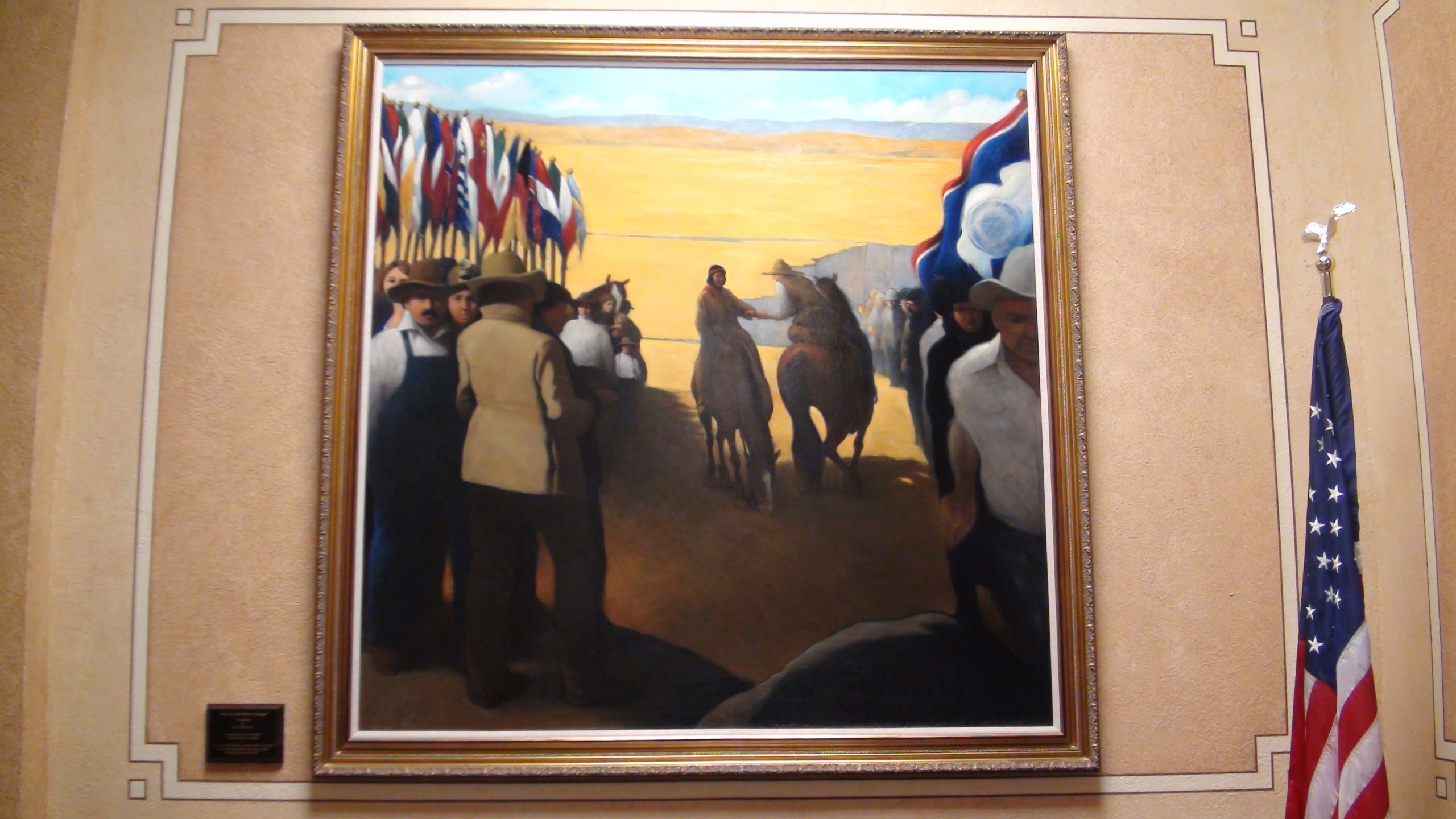
Artwork by Doug Kallerson
Judges 11:34-40
Jephthah, Judge of Israel, Part IV
(Typed 5-7 March 2024) As I was typing this sermon, a person in the Veterans Administration, RimaAnn Nelson, published a memo calling for the VJ Day photo known as the Victory Kiss to be removed from all VA medical buildings. She did this despite having no authority to write the memo.
She explained her actions, stating that “it doesn’t foster a more trauma-informed environment that promotes psychological safety.” Her actions have nothing to do with keeping people from psychological trauma. Ironically, this mirrors the main intent of the democrat party of late: to ensure more psychological trauma is brought upon the people of the nation rather than less.
This was simply another communist attempt to destroy any remaining vestige of America’s great heritage. However, the heritage of the nation of Israel is permanently inscribed in the pages of Scripture and it cannot be erased.
Despite the “psychological trauma” that reading the story of Jephthah’s daughter must bring to such people, it is a part of God’s word. Because of this, it will never be erased from history. A vow was made, the Lord brought about the requested victory, and the vow was fulfilled accordingly.
One wonders, “What purpose does this story hold?” If it is not telling us something in typology, it certainly seems like something that could have just been left out of the biblical narrative. But it is, in fact, telling us something more.
Text Verse: “What shall I render to the Lord
For all His benefits toward me?
13 I will take up the cup of salvation,
And call upon the name of the Lord.
14 I will pay my vows to the Lord
Now in the presence of all His people.” Psalm 116:12-14
Thankfully, republican lawmakers immediately stepped in and contacted the Secretary of Veteran Affairs over the matter of the Victory Kiss photo. The memo was rescinded. And more, the lawmakers called for the removal of this communist Undersecretary.
That probably will not happen. But at least there was a small victory in the ongoing assault by the communist left to destroy every remaining tradition and value of American heritage and replace it with deviancy and perversion.
The Bible is silent on what will happen to the U.S. However, the state of Israel as a nation is carefully recorded in Scripture. From its inception to present-day times and even through the millennium, Israel will stand because the Lord has covenanted with them.
Despite this, there have been and there will be times of trouble for them. How does the sacrifice of a young virgin daughter anticipate these things? Today we will see. It’s all to be found in His superior word. And so, let us turn to that precious word once again, and… May God speak to us through His word today, and may His glorious name ever be praised.
I. Jephthah’s Daughter (verses 34-40)
34 When Jephthah came to his house at Mizpah,
va’yavo yiphtakh ha’mitspah el beito – “And comes, Jephthah, the Mizpah, unto his house.” Here the term “the Mizpah” is used as in 10:17 and 11:11. It is not the same location as Mizpeh noted twice in verse 11:29. This is the moment that will decide the outcome of the vow he made to the Lord. The result of that vow is…
34 (con’t) there was his daughter, coming out to meet him with timbrels and dancing;
v’hineh vito yotseth liqrato b’tupim u-bimkholoth – “And behold, his daughter coming out to meet him in timbrels and in dances.” This is a common thing, be it in Israel of the past or after any war even today. People rejoice in the victory, even in a Victory Kiss in Times Square. For Israel, it is what Miriam did after the victory of the Lord over Egypt –
“Then Miriam the prophetess, the sister of Aaron, took the timbrel in her hand; and all the women went out after her with timbrels and with dances. 21 And Miriam answered them:
‘Sing to the Lord,
For He has triumphed gloriously!
The horse and its rider
He has thrown into the sea!’” Exodus 15:20-21
Hundreds of years later, the nation continued to celebrate –
“Now it had happened as they were coming home, when David was returning from the slaughter of the Philistine, that the women had come out of all the cities of Israel, singing and dancing, to meet King Saul, with tambourines, with joy, and with musical instruments. 7 So the women sang as they danced, and said:
‘Saul has slain his thousands,
And David his ten thousands.’” 1 Samuel 18:6, 7
In the Psalms, the mighty acts of the Lord continued to be proclaimed in this manner as well, such as in the 68th Psalm, a Psalm that begins with the Lord in battle as a warrior –
“Let God arise,
Let His enemies be scattered;
Let those also who hate Him flee before Him.
2 As smoke is driven away,
So drive them away;
As wax melts before the fire,
So let the wicked perish at the presence of God.”
…
“They have seen Your procession, O God,
The procession of my God, my King, into the sanctuary.
25 The singers went before, the players on instruments followed after;
Among them were the maidens playing timbrels.” Psalm 68:1, 2 & 24, 25
As for Jephthah’s daughter, it says…
34 (con’t) and she was his only child. Besides her he had neither son nor daughter.
The Hebrew is tender and mournful, anticipating the inevitable exchange that will soon take place: v’raq hi y’khidah ein lo mimenu ben o bath – “And except she, only. None to him, from him, son or daughter.” The word yakhid is used. It is the same word used to describe Isaac three times in Genesis 22.
As for the masculine word mimenu, from him, meaning “other than him (but implying her),” various suggestions have been raised as to why it is in the masculine rather than feminine form. Ellicott sees it as an idiomatic expression. Lange says, “the neutral conception ‘child’ floats before the writer’s mind.” Neither of these seems adequate.
One other suggestion is that it is referring to Jephthah, meaning there were no other children from him. But most agree that this is not what the Hebrew is conveying.
Despite that, the text is clear that this daughter is his only child. John Lange concludes that it would have been totally unexpected to have a virgin daughter come out to meet him, saying, “It never even occurred to him that she might come forth to meet him; for that was usually done only by women (נָשִׁים, Ex. 15:20; 1 Sam. 18:6), not by maidens, who remained within the house; and Jephthah’s daughter was yet a בְּתוּלָה, virgin.”
This doesn’t seem likely based on what it will say later in Judges 21 –
“Therefore they instructed the children of Benjamin, saying, ‘Go, lie in wait in the vineyards, 21 and watch; and just when the daughters of Shiloh come out to perform their dances, then come out from the vineyards, and every man catch a wife for himself from the daughters of Shiloh; then go to the land of Benjamin.’” Judges 21:20, 21
It doesn’t seem reasonable to suggest that these daughters were anything but virgins. Jephthah made his vow, and it was all-encompassing. The fact that his daughter is the one who came out to meet him may have been surprising and anguishing, but he had to take that into consideration when he made his vow.
35 And it came to pass, when he saw her, that he tore his clothes,
vayhi khirotho othah vayiqra eth b’gadav – “And was, in his seeing her, and tears his garments.” Depending on the context, the tearing of a garment is a sign of great distress, anguish, horror, sadness, etc. In this case, it seems to be all of these and more. Jephthah is utterly laid low by what has happened…
35 (con’t) and said, “Alas, my daughter! You have brought me very low! You are among those who trouble me!
There is the epitome of distress in his words which are emphatically stated: vayomer ahah biti hakhrea hikhratini v’at hayith b’okhrai – “and says, “Ahah, my daughter! Bowing, you have bowed me, and you, you became in my troublings.’” He first says ahah. It is an interjection essentially meaning alas. It expresses a state of woe or pain exclamatorily.
Next, the word translated as bow was used in Judges 5 when Jael wiped out Sisera. When she sent the peg through his skull, it said –
“Between her feet curled, fallen, lain.
Between her feet curled, fallen.
In which curled, there fallen, pulverized.” Judges 5:27 (CG)
Jephthah is as if he has been sucker punched and is completely doubled over in anguish. One can imagine him hardly being able to catch his breath. Finally, the words, “you became in my troublings” is a way of expressing that her very presence before him has debilitated him.
As for the word akhar, or trouble, it is used in exceptionally strong situations. For example, Joshua said this to Achan in Joshua 7 –
“And Joshua said, ‘Why have you troubled us? The Lord will trouble you this day.’ So all Israel stoned him with stones; and they burned them with fire after they had stoned them with stones.” Joshua 7:25
This is the type of distress that Jephthah felt in himself over the revelation that he would have to sacrifice his daughter to the Lord.
35 (con’t) For I have given my word to the Lord, and I cannot go back on it.”
The emphatic nature of his words continues: v’anokhi patsithi pi el Yehovah v’lo ukhal la’shuv – “and I, I opened my mouth unto Yehovah, and no able to return.” The word translated as opened, patsah, comes from a primitive root meaning to rend. So far, it has only been used when referring to the earth opening, such as to receive Abel’s blood or to swallow up the households of Korah, Dathan, and Abiram.
The words he spoke were intentional, and he purposefully opened his mouth. As his words were in the form of a vow, they cannot be taken back. This is explicitly stated in Numbers 30 –
“If a man makes a vow to the Lord, or swears an oath to bind himself by some agreement, he shall not break his word; he shall do according to all that proceeds out of his mouth.” Numbers 30:2
What is stated here is not unlike what the psalmist says in Psalm 66 –
“I will go into thine house with burnt-offerings: I will repay to thee my vows [neder],
14Which my lips opened [patsah] and my mouth spake in straits to me.” Psalm 66:13, 14 (SLT)
Jephthah made a vow when he opened his mouth. Now, his vow of the burnt offering must be accomplished. Completely understanding the situation, and demonstrating the most incredible devotion to the word of her father and his duty to the Lord, she responds…
36 So she said to him, “My father, if you have given your word to the Lord, do to me according to what has gone out of your mouth,
Adding the word “if” does a disservice to the tenor of her reply: vatomer elav avi patsithah eth pikha el Yehovah aseh li kaasher yatsa mipikha– “And says unto him, ‘My father, opened your mouth to Yehovah. Do to me according to which gone from your mouth.’” It is like the response of a king or a nobleman coming from a young virgin. They are words of personal authority over the situation –
“Then Festus, when he had conferred with the council, answered, ‘You have appealed to Caesar? To Caesar you shall go!’” Acts 25:12
And more, her words don’t bear any timidity or fearfulness. She fully understands the situation and has no compunction about allowing it to happen, exactly as the situation demands.
As for her next words, they clearly convey her knowledge of the matter and what it means for her. This is unlike innumerable scholars and teachers who waffle on what is conveyed, attempting to somehow change the outcome of her situation…
36 (con’t) because the Lord has avenged you of your enemies, the people of Ammon.”
akhare asher asah l’kha Yehovah n’qamoth meoyvekha mib’ne amon – “after which done to you, Yehovah – vengeances from your enemies, from sons Ammon.” The word asah, to do, is restated in this clause, after having been used in the previous clause –
*Do to me according to which gone from your mouth.
*…after which done to you, Yehovah – vengeances from your enemies, from sons Ammon.
This young virgin clearly understands the meaning of the vow. Yehovah gave victory over the lives of Jephthah’s enemies. She knows that her life is now forfeit because of that. And yet, she humbly acknowledges her sentence without any sort of personal right to protest. Rather, she makes a simple request, one that will in no way affect the matter of the vow that Jephthah has made…
37 Then she said to her father, “Let this thing be done for me: let me alone for two months,
vatomer el aviha yeaseh li ha’davar hazeh harpeh mimeni sh’nayim khodashim – “And said, unto her father, ‘To be done to me the word, the this: slacken from me two months.’” The young girl asks nothing inappropriate and nothing that would cause Jephthah to violate his vow.
Rather, she has already firmly and willingly offered herself up to the Lord based on his vow. A two-month reprieve for her to have a suitable time to grieve over the matter was more than acceptable, and it is quite appropriate to the situation. As for how she will use the two months…
37 (con’t) that I may go and wander on the mountains
The words are poetic: v’elkha v’yaradti al heharim – “and I am walking and descending upon the mountains.” The words seem incongruent. One must go up a mountain in order to descend upon it. To lighten the effect, some versions incorrectly state “that I may go up and down upon the mountains” (KJV et al).
Keil says, “that I may go down to the mountains (i.e., from Mizpeh, which stood upon an eminence, to the surrounding mountains and their valleys).” That seems forced concerning the words she chooses. What it appears to be saying is that she is equating her descending upon the mountains with what she next says…
37 (con’t) and bewail my virginity, my friends and I.”
v’evkeh al bethulay anokhi v’raiti – “and I am bewailing upon my virginities, I and my companions.” The word “virginity” is a masculine plural noun, bethulim, like the word mayim, or water. Water flows downward, descending on mountains and hills. And so she is bewailing the fact that her virginities will never flow –
“If any man takes a wife, and goes in to her, and detests her, 14 and charges her with shameful conduct, and brings a bad name on her, and says, ‘I took this woman, and when I came to her I found she was not a virgin [bethulim: virginities],’ 15 then the father and mother of the young woman shall take and bring out the evidence of the young woman’s virginity [bethulim: virginities] to the elders of the city at the gate.” Deuteronomy 22:13-15
Her “descending upon the mountains” seems to be a poetic way of saying, “If my virginities will never flow, then I will flow as I wish they did.” Her youthful actions as she walks with her friends as they accompany her in her final months will be a token of her dedication to her father, her nation, and the Lord.
In her words is a new word in Scripture, rayah. It signifies a female companion. It is found only here and nine times in the Song of Songs where it refers to Solomon’s darling.
Understanding her request, and probably wishing he could be the one to be with her instead, Jephthah agrees…
38 So he said, “Go.” And he sent her away for two months;
vayomer lekhi vayishlakh othah sh’ne khodashim – “And said, ‘Walk.’ And sent her two months.” It would be hard to approve such a request, and it would also be impossible to not do so. Jephthah’s two months would be like Abraham’s three days of turmoil, multiplied by twenty.
As for the number two, it is the number of division or difference. Depending on the perspective, when there are two, there is a first and a last. There is one that begins and one that ends. There is a front and a back. They contrast, and yet they confirm the whole.
38 (con’t) and she went with her friends, and bewailed her virginity on the mountains.
The words bear emphasis: vatelekh hi v’reotheha vatev’kh al bethuleha al heharim – “And walked, she, and her attendants, and bewails her virginities upon the mountains.” The hope of every godly Hebrew female was to be ancestor of the coming Messiah. It was a hope that would not be realized in her. This is the reason for bewailing her virginity, even over her death.
Despite this, she has found her own special place in redemptive history along with the other great women of faith that adorn Scripture’s pages. Though unnamed, she is remembered for her actions and faith-filled devotion to her father and her people.
She obviously understood that if she could be spared her fate, the Lord would make it happen, just as He did for Isaac. This story would have been well-known. It would certainly take much of the fear out of what lies ahead to know that the Lord could intervene. And if He didn’t, she understood that He had his reasons for not doing so.
The verse uses another new word, similar to the one in the previous verse, reah. It also signifies a companion, but to show a distinction, I translate it as attendant. It is found only elsewhere in Psalm 45 –
“The princess looks absolutely magnificent, decked out in pearls and clothed in a brocade trimmed with gold.
14In embroidered robes she is escorted to the king.
Her attendants [reah], the maidens of honor who follow her,
are led before you.
15They are bubbling with joy as they walk in procession
and enter the royal palace.” Psalm 45:13-15 (NET)
Her friends attended to her as she bewailed her virginity for two months…
39 And it was so at the end of two months that she returned to her father, and he carried out his vow with her which he had vowed.
Out of the sake of propriety, the words are reserved and purposefully vague, providing no unnecessary descriptors: vayhi miqets sh’nayim khodashim vatashav el aviha vayaas lah eth nidro asher nadar – “And was, from end two months, and returned unto her father, and does to her his vow which he vowed.” The proclamation of the vow by Jephthah is as clear and unambiguous as anything else in Scripture –
“And is, the coming which comes from door my house to meet me, in my returning in peace from sons Ammon, and is to Yehovah, and I have ascended it – burnt offering.” (CG).
It was only at the time of Rabbi Kimkhi, a full millennium after the coming of Christ, that these words were taken to mean anything other than her death. There is no other place in Scripture where perpetual virginity was some type of class bestowed upon women. But it certainly would have been noted if it were an acceptable allowance or practice.
And more, Scripture elsewhere has noted times when a child would be devoted to the Lord, meaning slain. This includes the obvious example of Abraham and Isaac. But it also was something Saul vowed to perform upon his own son, Jonathan, even if it was not carried out.
Jephthah made a vow, the Lord allowed the events following that vow to take place, and Jephthah did according to the vow he had uttered. And…
39 (con’t) She knew no man.
It is a Hebrew idiom meaning she was a virgin at the time of her sacrifice: v’hi lo yad’ah ish – “And she no knew man.” Of these words, John Lange (as an example of numerous others) states the following –
“Had she been put to death, that fact must here have been indicated in some way. The narrator would have said, ‘and he presented her as a sacrifice at the altar in Mizpah,’ or, ‘and she died, having known no man,’ or some other similar formula.”
There is a problem with this thinking. It is so obvious in fact, that as he continues, he fails to acknowledge that it rests in his own conclusion…
“The truth is, the whole narrative derives its mighty charm only from the mysterious, and at that time in Israel very extraordinary fact, that the daughter of the great hero, for whom a life of brilliant happiness opened itself, spent her days in solitude and virginity. Death, even unnatural, was nothing uncommon. But a life such as Jephthah’s daughter henceforth lived, was at that time unparalleled in Israel, and affords therefore profound instruction, not to be overlooked because issuing from the silence of retirement.”
If this daughter had not been offered as a burnt offering but was instead dedicated to the Lord as a perpetual virgin, living at the temple in that state, the lack of affirming it as such is absolutely no different than failing to state how and when she was offered as a burnt offering. And yet, not even a few extra words, such as “she knew no man all her days” are provided.
The only difference between the two is that Jephthah did not say he would fulfill his vow by offering up a perpetual virgin. He said he would offer her up as a burnt offering. The proposition is an argument from silence mixed with a necessary manipulation of the intent concerning what has been provided.
But more to the point, she had asked for a two-month reprieve to bewail her virginity. If she was offered up to the Lord as a perpetual virgin, she would not have needed two months to bewail her virginity. She would have had all the remaining days of her life, living in sequestered devotion to the Lord, to do so.
The twisting of the outcome of this passage into something wholly unintended diminishes every aspect of it. It leaves the outcome void of the very purpose for which it is included in Scripture.
39 (con’t) And it became a custom in Israel
Rather: vathi khoq b’Yisrael – “And became statute in Israel.” The word khoq comes from khaqaq, to inscribe or decree. This was a decree or statute that was followed. Whether it was throughout Israel, only east of the Jordan, or only in the immediate area isn’t stated, but it was statute. And this statute is based on the act.
It would be the most pointless statute of all if the daughter was only locked up as a virgin. Rather, the statute is one of remembrance to a young girl whose life was vowed as a burnt offering to the Lord by her father for the sake of those threatened by A People who were not of the people of God. Therefore…
*40 (fin) that the daughters of Israel went four days each year to lament the daughter of Jephthah the Gileadite.
miyamim yamimah telakhna b’noth Yisrael l’thanoth l’bath yiphtakh ha’giladi arbaath yamim ba’shanah – “From days her days, walks daughters Israel to celebrate to daughter Jephthah the Gileadite four days in the year.
In order to completely eradicate any correct meaning at all from the event, Charles François Houbigant translates this verse as, “But this custom prevailed in Israel that the virgins of Israel went at different times, four days in the year, to the daughter of Jephthah, that they might comfort her.”
It is not even a close translation. It is a paraphrase, injected with presuppositions and biases. Why would a statute need to be decreed for such a ridiculous proposition? But more, why would Jephthah’s daughter have asked to bewail her virginity if she was to have people coming to her for the rest of her life to bewail her virginity?
The custom, probably local in scope, was an honorary event for the daughters of the land to remember that Jephthah’s daughter willingly agreed with her father that his vow superseded any claim of her own hopes or desires, and even of her life itself.
Also, this is the second and last use of the word tanah, celebrate, in Scripture. The first was in Judges 5:11, where the people celebrated the righteous acts of the Lord in the battle against Sisera.
As for the number four, Bullinger defines it, saying –
“It is emphatically the number of Creation; of man in his relation to the world as created; while six is the number of man in his opposition to and independence of God. It is the number of things that have a beginning, of things that are made, of material things, and matter itself. It is the number of material completeness. Hence it is the world number, and especially the ‘city’ number.”
Israel means He Strives With God. Jephthah means He Opens. The Gileadite means The Perpetual Fountainite. Curiously, the name of the daughter is never stated.
Victory against the foe now calls for a proffering
A life is given up acknowledging His victory
For Jephthah, it is a mournful offering
He wonders to himself, “How can this be?”
Why did the Lord allow it to be this way?
He knew what would happen all along
Knowing that on that fateful day
Jephthah’s daughter would come forth with a song
Surely, the Lord’s ways are right
The outcome came by His design that day
Victory over Ammon by the Lord’s powerful might
And so Jephthah’s vow he did pay
II. The Virgin Daughter
Here, we have a record of Jephthah’s vow being fulfilled according to the providence of the Lord. The entire scenario could have been terminated at one of innumerable times. For example, Jephthah could have lost the battle. The battle could have been won, but Jephthah could have died in it.
It could have been that something or someone else came out of Jephthah’s doors to meet him. Or it could have been that Jephthah’s daughter immediately refused and ran away or committed suicide. She also could have died from being bitten by a snake or tumbling down the side of a mountain. On and on go the possibilities.
And yet, the battle was won, Jephthah returned home, and his daughter was first out the door to meet him. Therefore, she was offered to the Lord as a burnt offering.
The battle was won against Ammon, A People. They are the enemies of the people of God. Specifically, in typology, these people of God being on the east side of the Jordan picture those who were saved during the time under the law, meaning before the coming of Christ.
They are the people of God who anticipated Christ’s coming. However, A People, those who are not God’s people (a reflection of those referred to by Paul in Romans 9), are attempting to obtain an inheritance they have no right to. As seen, they picture those who have rejected Jesus but still claim to be God’s people.
Once Christ came, the people of God, My People, are those who have come to Christ in faith, whether Jews or Gentiles. A People have no right to the inheritance, and yet they have battled to obtain it. Jesus, He Opens, is the Perpetual Fountainite. He is the One who opens the Spirit to those of faith.
The vow of Jephthah is to devote his virgin daughter as a burnt offering to ensure the salvation of the people of God. Who is the virgin daughter? It is the tribe of Judah, a term applied to them several times in Isaiah, Jeremiah, and Lamentations. (See Isaiah 37:22, Jeremiah 14:17, Lamentations 1:15, etc.).
In essence, Jesus is speaking: “If you will give me the victory of saving the inheritance for those who were of faith under the law, I will offer up my virgin daughter (Judah).”
In verse 34, Jephthah came to his house at the Mizpeh, the Watchtower. Jesus came to Jerusalem, the place where the people of God watched for the coming of their Messiah. His daughter recognizes him and comes out to meet him with timbrels and dances. Judah recognized their Messiah. They came out to meet Him –
“And a very great multitude spread their clothes on the road; others cut down branches from the trees and spread them on the road. 9 Then the multitudes who went before and those who followed cried out, saying:
‘Hosanna to the Son of David!
“Blessed is He who comes in the name of the Lord!”
Hosanna in the highest!’” Matthew 21:8, 9
Verse 34 continues with the note that his daughter is his only child. But there is a gender discord in the word mimenu, from him, meaning “other than him.” It is referring to Israel, by this time in history summed up by the term Jew (from Judah) –
“O daughter of my people,
Dress in sackcloth
And roll about in ashes!
Make mourning as for an only son, most bitter lamentation;
For the plunderer will suddenly come upon us.” Jeremiah 6:26
In Jeremiah, the Lord uses the term daughter but then implores them to mourn as an only son. It matches what the typology is conveying perfectly. In verse 35, Jephthah is in great distress when his daughter comes joyously dancing to greet him. Jesus, likewise, mourned over Jerusalem –
“O Jerusalem, Jerusalem, the one who kills the prophets and stones those who are sent to her! How often I wanted to gather your children together, as a hen gathers her chicks under her wings, but you were not willing! 38 See! Your house is left to you desolate; 39 for I say to you, you shall see Me no more till you say, ‘Blessed is He who comes in the name of the Lord!’” Matthew 23:37-39
Jephthah’s daughter sealed her own fate by coming out to meet her father. Judah sealed their own fate by coming out to meet Jesus. They openly acknowledged Him as their Savior. But the leaders of Jerusalem, the Watchtower, failed to do so.
They had become A People to God, even though they were God’s people, His virgin daughter. To save the people of God, the Lord was willing to allow His daughter to be sacrificed. This doesn’t mean as an atonement but as a pleasing aroma. Something that satisfies.
If God were to allow the Jewish people who had rejected Jesus to be saved, it would mean that Jesus’ atoning sacrifice was pointless. There must be something that gives. In the case of Jephthah’s battle, it was his virgin daughter. In the case of God’s people, it meant that He would have to give up on His people.
Jephthah’s daughter was the price to save God’s people. The Jews who rejected Jesus are the price of securing those who came to Him under the law. This price includes the final seven years of the law, known as the tribulation period. Any who fail to come to Christ will be a part of this process of release.
Jephthah acknowledged that he had opened, patsah, his mouth to the Lord, and he could not go back on it. Jesus likewise opened His mouth to the Lord, as prophesied in Psalm 66 –
“I will go into Your house with burnt offerings [olah];
I will pay You my vows [neder],
14 Which my lips have uttered [patsah]
And my mouth has spoken when I was in trouble.” Psalm 66:13, 14
The words of this psalm nearly mirror Jephthah’s state and words. It is a messianic psalm about God’s kingship to the nations. It reveals the gospel of Christ. The point of focus here concerns those of Israel who were under the law but who are brought into the family of God through the work of Christ.
The virgin daughter accepts that the vow must be paid and never argues against it. This shows that without Jesus, there is no salvation. If God did not let go of the virgin daughter, Judah, none would be saved. Therefore, the exchange is made –
*Do to me according to which gone from your mouth.
*…after which done to you, Yehovah – vengeances from your enemies, from sons Ammon.
The daughter must be given up because of the victory over A People. Judah must be given up because victory over those who have rejected Jesus has taken place.
Therefore, the daughter asks for two months (verses 37 & 38) to wander on the mountains. As has been seen many times, a mountain is a lot of something gathered. It is synonymous with a large but centralized group of people.
Her descending on the mountains means on many large groups of people. It speaks of the message going out to the Jews beyond Israel. Paul, speaking of the Jews hearing the message writes –
“But they have not all obeyed the gospel. For Isaiah says, ‘Lord, who has believed our report?’ 17 So then faith comes by hearing, and hearing by the word of God.
18 But I say, have they not heard? Yes indeed:
‘Their sound has gone out to all the earth,
And their words to the ends of the world.’” Romans 10:16-18
The request is a reprieve for two months, the number of division or difference. This indicates two groups, those who believe and those who fail to believe. There is salvation and there is condemnation. They contrast, but they confirm the totality of the Jews.
However, that time had to come to an end. The Jews were given the timeline in Daniel 9. Jesus told them it would come in forty years (when referring to the sign of Jonah). The temple was destroyed and A People who are not God’s people were exiled.
They will be given seven more years to come to Christ during the tribulation. Those who come to faith will be saved, and those who do not will perish.
Verse 39 said that at the end of the two months, she returned, and her father carried out the vow he had made. Saying “she knew no man” means the daughter, standing as representative of Jephthah’s vow, had no husband. Judah, without Christ, remains unmarried.
Some must be given up for others to be saved. The Lord covenanted with Judah that they would be a people before Him forever. But this does not mean all of them. The people of God are people of faith. This was alluded to by Jesus in His parables.
Those who were of faith before the cross during the time of the Mosaic Covenant were only saved based on the coming fulfillment of the law in Christ. There can be no end around for those who have rejected Him. This is pictured by Ammon, A People, coming against the people of God to obtain an inheritance to which they are not entitled.
They picture those who want the inheritance after Christ’s coming, but based on the law that was only given to anticipate Christ. With Christ’s completion of the law, it is no longer a tool acceptable to bring people to God.
Judah, the virgin daughter, had to be given up in order to secure the true people of God from all people. Christ, pictured by Jephthah, He Opens, was the One who brought this about.
The final verse noted that the daughters of Israel went four days each year to celebrate the daughter of Jephthah. Four speaks of man in his relation to the world as created. To celebrate this daughter is to celebrate what God has done in Christ.
It is the righteous acts of the Lord that brought about the victory over A People. Without Jesus, none would be saved. The Lord had to give up on Judah to bring about the salvation of many. This is what occurred. This thought is probably best summed up in the words of Zechariah –
“‘And it shall come to pass in all the land,’
Says the Lord,
‘That two-thirds in it shall be cut off and die,
But one-third shall be left in it:
9 I will bring the one-third through the fire,
Will refine them as silver is refined,
And test them as gold is tested.
They will call on My name,
And I will answer them.
I will say, “This is My people”;
And each one will say, “The Lord is my God.”’” Zechariah 13:8, 9
Judah must go through the fire for the people to be saved. As contradictory as that sounds, that is how it is. The word olah, or burnt offering, is translated by the Greek Septuagint and the New Testament Greek as holokautóma, a holocaust.
That is exactly what A People who are not God’s people have experienced. It is what will be finalized in the tribulation period. Jesus is the remedy to this. He gave up on His virgin daughter to save His virgin daughter. When it says that the daughters of Israel celebrated Jephthah’s daughter, it is a celebration of their faith in the providence of God’s Messiah.
Jephthah’s daughter was a woman of faith in the Lord. Thus, she will be raised at the resurrection. Those of Judah who are of faith will also be raised because of the work of Christ. Those who are not of faith in God’s Messiah, Jesus, will be a part of the eternal holocaust that lies ahead.
God used this story from Israel’s past to show us details of what has been and what lies ahead for the Jewish people. But the same truth applies to every one of us. God sent His Son into the world to save sinners. As all have sinned, all need Jesus. It is those who accept this premise and believe who will be saved.
There are no end-arounds given. This passage in Judges 11 clearly shows us this, even if it is referring to the people of Israel under different circumstances than we today find ourselves during the dispensation of grace. Those who remained under the law after Jesus came are not a part of God’s salvation. What all people need is to trust in Jesus. This is the key to your being reconciled to God.
Closing Verse: “I will pay my vows to the Lord
Now in the presence of all His people,
19 In the courts of the Lord’s house,
In the midst of you, O Jerusalem.
Praise the Lord!” Psalm 116:18, 19
Next Week: Judges 12:1-7 With this one, that’s all there is to tell, ain’t no jive… (Jephthah, Judge of Israel, Part V) (37th Judges Sermon)
The Lord has you exactly where He wants you. He has a good plan and purpose for you. It is He who judges His people according to their deeds. So, follow Him, live for Him, and trust Him, and He will do marvelous things for you and through you.
Judges 11:34-40 (Jephthah, Judge of Israel, Part IV)
When Jephthah came to his house at Mizpah
There was his daughter, coming out to meet him with timbrels
———-and dancing, rejoicing over the slaughter
And she was his only child
Besides her he had neither son nor daughter
And it came to pass, when he saw her, that he tore his clothes
And said, “Alas, my daughter! You have brought me very low!
———-This I must admit
You are among those who trouble me!
For I have given my word to the LORD, and I cannot go back on it
So she said to him, “My father, if you have given your word
———-to the LORD
Surely, then, He has known
Do to me according to what has gone out of your mouth
Because the LORD has avenged you of your enemies
———-the people of Ammon
Then she said to her father, “Let this thing be done for me
Let me alone for two months, and here is why
That I may go and wander on the mountains
And bewail my virginity, my friends and I
So he said, “Go”
And he sent her away for two months to roam the vicinity
And she went with her friends
And on the mountains bewailed her virginity
And it was so at the end of two months
That she returned to her father according to the plan
And he carried out his vow with her
Which he had vowed. She knew no man
And it became a custom in Israel
That the daughters of Israel went
Four days each year
The daughter of Jephthah the Gileadite to lament
Lord God, turn our hearts to be obedient to Your word
Give us wisdom to be ever faithful to You
May we carefully heed each thing we have heard
Yes, Lord God may our hearts be faithful and true
And we shall be content and satisfied in You alone
We will follow You as we sing our songs of praise
Hallelujah to You; to us Your path You have shown
Hallelujah we shall sing to You for all of our days
Hallelujah and Amen…
34 When Jephthah came to his house at Mizpah, there was his daughter, coming out to meet him with timbrels and dancing; and she was his only child. Besides her he had neither son nor daughter. 35 And it came to pass, when he saw her, that he tore his clothes, and said, “Alas, my daughter! You have brought me very low! You are among those who trouble me! For I have given my word to the Lord, and I cannot go back on it.”
36 So she said to him, “My father, if you have given your word to the Lord, do to me according to what has gone out of your mouth, because the Lord has avenged you of your enemies, the people of Ammon.” 37 Then she said to her father, “Let this thing be done for me: let me alone for two months, that I may go and wander on the mountains and bewail my virginity, my friends and I.”
38 So he said, “Go.” And he sent her away for two months; and she went with her friends, and bewailed her virginity on the mountains. 39 And it was so at the end of two months that she returned to her father, and he carried out his vow with her which he had vowed. She knew no man.
And it became a custom in Israel 40 that the daughters of Israel went four days each year to lament the daughter of Jephthah the Gileadite.