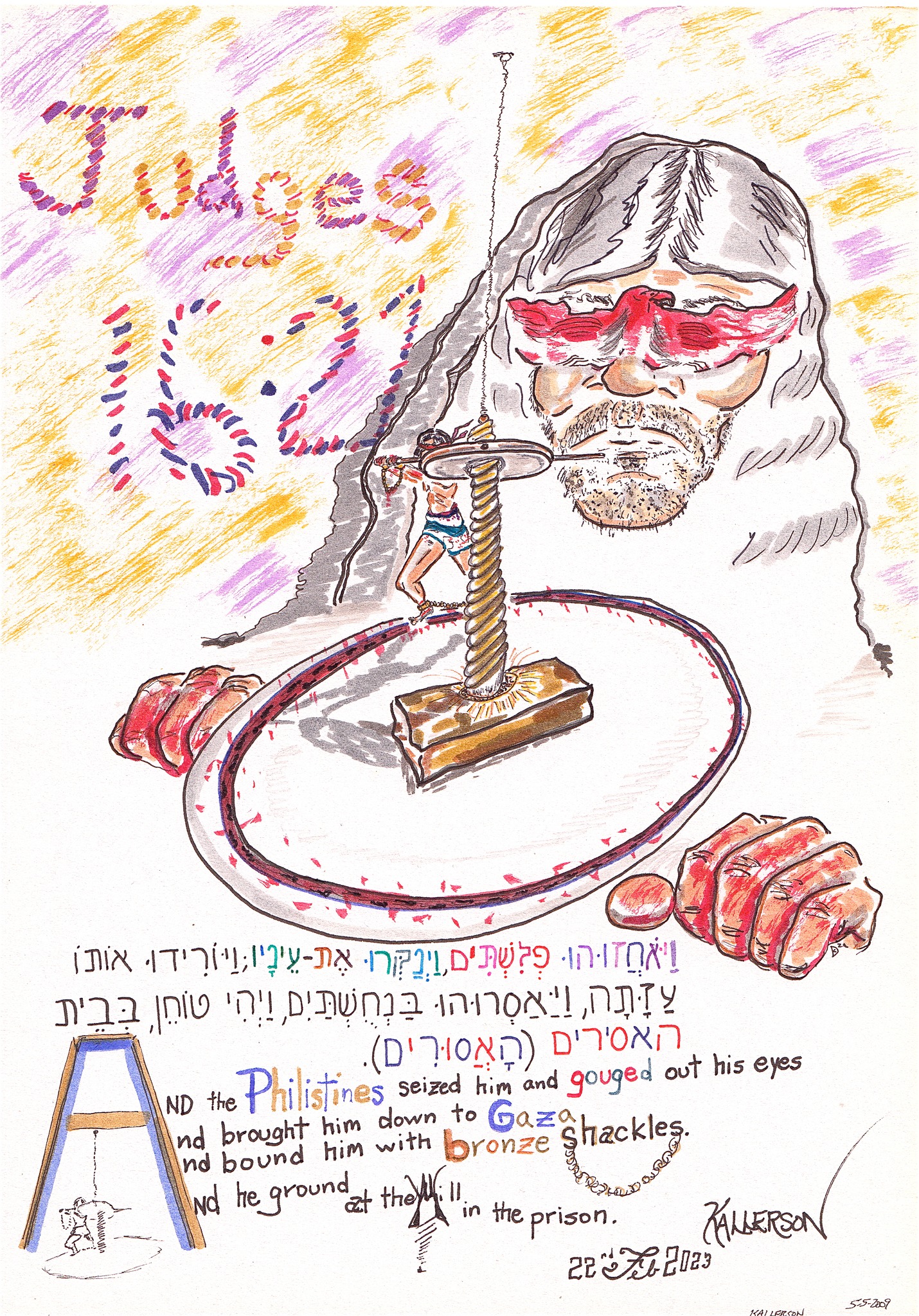
Artwork by Douglas Kallerson.
Judges 16:10-22
Samson, Judge of Israel, Part VIII
(Typed 13 May 2024) The Hebrew in the passage that we will look at today has some interesting nuances. In one verse, it will take more time to explain what is being said in just a few words of the text than might seem necessary, but little variations in how something is considered or concerning its translation can make a world of difference in what is ultimately being pictured.
Because of that, care towards the intent of what is being presented needs to be given. Despite this, however, there are some great life lessons that can be drawn out from a casual reading. For example, Matthew Henry says –
“Samson had been more than once brought into mischief and danger by the love of women, yet he would not take warning, but is again taken in the same snare, and this third time is fatal. Licentiousness is one of the things that take away the heart. This is a deep pit into which many have fallen; but from which few have escaped, and those by a miracle of mercy, with the loss of reputation and usefulness, of almost all, except their souls. The anguish of the suffering is ten thousand times greater than all the pleasures of the sin.” Matthew Henry
As I read his thoughts, Donald Trump and Stormy Daniels immediately came to mind. Regardless of what actually happened between the two, they have both spent an inordinate amount of time and money trying to get past it.
In fact, they are still trying to put it behind them, and it will probably hound one or both of them for years to come. The same is true with innumerable politicians, pastors, and plumbers throughout the years. They are in jobs intended to help others with their problems, and yet many end up flushing their families, finances, and careers right down the drain.
Text Verse: “And it shall be that the elders of the city nearest to the slain man will take a heifer which has not been worked and which has not pulled with a yoke.” Deuteronomy 21:3
It may seem like an odd text verse for evaluating the life of Samson, or for a moral lesson about making bad choices, but it’s not really. Someone had to kill the person who lay slain in the field. And the person in the field may have done something to deserve getting whacked.
Consequences will arise from such things. At the same time, a heifer that has never been worked is specified for the atonement process being explained in Deuteronomy 21.
Likewise, Samson said that if he is bound in ropes that were never used for work, he would be like any other man. Even though he wasn’t telling the truth, there is a reason he said this. In Scripture, concepts build upon other concepts. Similarly, one story will, at times, be used to explain things going on in other stories.
We should pay heed to the subtleties. They can give us marvelous insights into what is going on in any given passage. For now, let us get into evaluating the verses. Great things are to be found in His superior word. And so, let us turn to that precious word once again, and… May God speak to us through His word today, and may His glorious name ever be praised.
I. How Can You Say, ‘I Love You?’ (verses 10-14)
In the previous sermon, the Philistines came to Delilah and asked her to allure Samson in an attempt to find out where his great strength lies. He gave her a false answer. When she tried it, her attempt failed. With that remembered, the account now provides her response to his deception…
10 Then Delilah said to Samson, “Look, you have mocked me and told me lies.
vatomer d’lilah el Shimshon hineh hethalta bi vatdaber elay k’zavim – “And says, Delilah, unto Samson, ‘Behold, deceived in me and speaking unto me lies.’” It is apparent that the Philistines lords’ presence was not made known to him.
Rather, Delilah bound him and made it look like she was pretending. When he broke the cords, she playfully came back with her pitiful response. “Oh poor me. You’re just making fun of me with your lies.” He would have thought playing a trick on the object of his affection was a fun thing to do.
Despite this, she tries again…
10 (con’t) Now, please tell me what you may be bound with.”
atah hagidah na li bameh teaser – “Now declaring, I pray, to me, in what binding?” This is probably after a period of time, be it the next day or a few days later. He broke the bonds, and she probably said something like, “Oh, you… such a bad boy.”
Later, she acted offended. Then after revealing how her poor heart was broken over the deception, she asked again what made him so strong. And so, once again, he has a bit of fun with her…
11 So he said to her, “If they bind me securely with new ropes that have never been used, then I shall become weak, and be like any other man.”
vayomer eleha im asor yaasruni baavothim khadashim asher lo naasah bahem m’lakha v’khalithi v’haythi k’akhad ha’adam – “And says, unto her, ‘If binding they bind me in ropes new, which not worked in them, and weakened, and became according to one the man.’” Samson responds with an obvious lie because in Judges 15, we read this, using the same word for rope, avoth, as here –
“So they spoke to him, saying, ‘No, but we will tie you securely and deliver you into their hand; but we will surely not kill you.’ And they bound him with two new ropes [avoth] and brought him up from the rock.
14 When he came to Lehi, the Philistines came shouting against him. Then the Spirit of the Lord came mightily upon him; and the ropes [avoth] that were on his arms became like flax that is burned with fire, and his bonds broke loose from his hands.” Judges 15:13, 14
It didn’t work with the men of Judah. Thus, we can be confident of the outcome here as well…
12 Therefore Delilah took new ropes and bound him with them, and said to him, “The Philistines are upon you, Samson!”
vatiqah d’lilah avotim khadashim vataasrehu bahem vatomer elav plishtim alekha Shimshon – “And takes, Delilah, ropes new, and binds him in them. And says unto him, ‘Philistines upon you, Samson.’” Following his instructions exactingly, she binds him with the new ropes, hoping she will chance to cash in on the big money. With him securely bound, she lets out her cry of hoped-for riches…
12 (con’t) And men were lying in wait, staying in the room.
v’ha’orev yoshev bekhader – “And the lying-in-wait sitting in the chamber.” The same word, the verb arav, that was used in verse 9, is used again. It comes from a primitive root signifying to lurk. The Philistines were lurking, waiting for a chance to overcome Samson…
12 (con’t) But he broke them off his arms like a thread.
vaynatqem meal zerootav kakhut – “And tears them from upon his arms according to the thread.” The unworked cords became like mere thread. The word is khut, the same word used when Rahab was told to tie a scarlet thread in her window. It is a thread also used to indicate a measuring line, such as in 1 Kings 7:5.
Samson once again kept Delilah from knowing the source of his strength, but the account has been giving us clues concerning it in the process. As for the viperous vixen…
13 Delilah said to Samson, “Until now you have mocked me and told me lies. Tell me what you may be bound with.”
vatomer d’lilah el Shimshon ad henah hethalta bi vatdaber elay k’zavim hagidah li bameh teaser – “And says, Delilah, unto Samson, ‘Until here deceived in me and speaks unto me lies. Declaring, her, to me in what binding.’” The deceitful dragon again plays the offended party.
This is probably on a later date. At the time he broke the bonds, she may have laughed or snorted at him as if it was a joke. But later she pretends like she has thought about it and is offended that he wouldn’t trust her with his secret. And again, Samson sees it as funny enough to spin another yarn…
13 (con’t) And he said to her, “If you weave the seven locks of my head into the web of the loom”—
His words form an ellipsis: vayomer eleha im taargi eth sheva makhl’photh roshi im ha’masakheth – “And says unto her, ‘If weaves seven locks my head with the warp.’” Samson’s words get closer to the source of his strength but still without revealing it.
The word arag signifies to weave. It can be literal but still used in a metaphorical way, such as in Isaiah 59 –
“No one calls for justice,
Nor does any plead for truth.
They trust in empty words and speak lies;
They conceive evil and bring forth iniquity.
5 They hatch vipers’ eggs and weave [arag] the spider’s web;
He who eats of their eggs dies,
And from that which is crushed a viper breaks out.” Isaiah 59:4, 5
Also, there are two new words used here. The first is makhalaphah, a ringlet of hair and thus a lock. It is derived from khalaph, to pass away or pass through. The idea is that locks glide over one another, forming a full head of hair.
The next new word is masseketh, the warp of a loom. It is derived from nasak, to weave. This root is found only in Isaiah 25 –
“And He will destroy on this mountain
The surface of the covering cast over all people,
And the veil that is spread [nasak] over all nations.
8 He will swallow up death forever,
And the Lord God will wipe away tears from all faces;
The rebuke of His people
He will take away from all the earth;
For the Lord has spoken.” Isaiah 25:7, 8
Leaving the sentence elliptical, Samson tells her that if she weaves his hair in the loom, she will receive the desired result. The reason for the ellipsis is simple enough. He is in her home and she obviously had a loom. He would have simply nodded in the direction of it as he spoke. The rest would be perfectly understood by her.
As for the number, seven is the number of spiritual perfection. What seems likely is that Samson had purposefully plaited his hair into seven locks, somewhat like Viking braids. It is these seven locks that he is referring to.
Also, as a side note, the Greek translation completes the thought, thus removing the ellipsis. Hence, some translations include the words of that text – “If thou shouldest weave the seven locks of my head with the web, and shouldest fasten them with the pin into the wall, then shall I be weak as another man.”
This is unnecessary, but the Greek adds it because of what is in the next verse…
14 So she wove it tightly with the batten of the loom,
The Hebrew is way less descriptive: vatitqa bayated – “And blasts in the peg.” The words essentially say the same thing as when Jael killed Sisera. There, it said vatitqa eth ha’yathed, “and blasts the peg.” There, Jael took a tent peg and blasted through the temple of Sisera, pinning his head to the ground.
Here, however, Delilah, the traitorous temptress, blasted the peg while weaving. The debate on what this means is long, and there is no firm resolution. I lean towards the words of the Pulpit Commentary that this refers to the weaver’s shuttle. Others completely disagree.
But this is what Delilah was told to do, which is to use his hair as the woof and weave it into the warp that was preset in her loom. Thus, she affixes his locks to the shuttle, here called a peg, and blasts it through the warp to form a mesh. Once her task was complete…
14 (con’t) and said to him, “The Philistines are upon you, Samson!” But he awoke from his sleep, and pulled out the batten and the web from the loom.
vatomer elav p’listim alekha Shimshon vayiqats mishnatho vayisa eth haythad ha’ereg v’eth hamasakhet – “And says unto him, ‘Philistines upon you, Samson.’ And awakens from his sleep, and pulls up the peg, the loom, and the warp.”
Here is another rare word, ereg. It comes from arag, the word used which indicates to weave. It is used only one more time, in Job 7:6. Most translations say, “weaver’s shuttle,” implying the speed of the shuttle in a loom. That may or may not be correct. It may simply refer to the loom itself. If so, then the verse would read –
“My days receded from a loom.” The meaning would then be “My days receded faster than the speed of a loom.” Therefore, the words are describing what happened when Samson arose from his sleep. The loom was sitting on the ground, his hair was woven into the warp, and the peg was still in the loom. In rising, he pulled all of this up and out. The whole shebang fell apart from the force of his rising.
What is it that will bind you?
And where is it that the source of your strength lies?
How are you able such great things to do?
Won’t you tell me? Please apprise!
There must be something behind your great power
I would like to know what keeps you so strong
A person could get tired just observing you, hour by hour
And who could keep it up all day long?
I long for the strength you possess
Tell me your secret so I know it too
How I wish you’d confide, this I confess
Is this strength that the Lord has given to you?
II. He Has Told Me All His Heart (verses 15-22)
15 Then she said to him, “How can you say, ‘I love you,’ when your heart is not with me?
vatomer elav ekh tomar ahavtikh v’libkha ein iti – “And says, unto him, ‘How saying, “I love you,” and your heart not with me?’” This is not unlike what he has already faced. In Chapter 14, his Philistine wife accused him of hating, not loving, her. Delilah questions his love and notes that his heart isn’t geared toward her. How can he love her if he keeps telling her untruths…
15 (con’t) You have mocked me these three times, and have not told me where your great strength lies.”
zeh shalosh p’amim hethalta bi v’lo higadta li bameh kokhakha gadol – “This three beats deceived in me, and not declared to me in what your strength, great.’” Like three beats on an anvil as it is being used to pound out metal, Samson has steadily refused to allow Delilah to be united to him. Instead, he has deceived her each time.
Three signifies Divine Perfection. Expanding on that, Bullinger says –
“The number three, therefore, must be taken as the number of Divine fulness. It signifies and represents the Holy Spirit as taking of the things of Christ and making them real and solid in our experience. It is only by the Spirit that we realise spiritual things. Without Him and His gracious operation, all is surface work: all is what a plane figure is to a solid.”
16 And it came to pass, when she pestered him daily with her words and pressed him, so that his soul was vexed to death,
v’hi ki hetsiqah lo bidvarekha kal hayamim vatalatsehu vatiqtsar naphsho lamuth – “And is when compressed to him in her words all the days, and presses, and reaps his soul to death.” The words here confirm that the three instances so far were spread over a period of time. She continues with her incessant moaning about not being privileged enough to know his secret.
There is a word found only here in Scripture as well, alats. It signifies to urge or press, coming from a primitive root meaning to press. She compressed him with her words and she pressed him with her insinuations.
She kept nagging him while probably cooking him some pretty swell meals and telling him all the stories of her life. Each time she did something nice for him, she would remind him that he was not reciprocating. Also, the word qatsar is used. It signifies to curtail or shorten and is often used to indicate reaping.
It is the same word used to describe the Lord’s attitude towards Israel as they worked to be harmoniously in line with Him in Judges 10 –
“So they put away the foreign gods from among them and served the Lord. And His soul could no longer endure the misery of Israel.” Judges 10:16
There, it literally says, “And reaped His soul in toil Israel.” They ingratiated themselves to Him by repenting of their ways and serving Him. Eventually, His soul was reaped through their pleas.
The same tactic is used here by Delilah, finally bringing Samson to the point where he can’t stand it any longer, and a state of uxoriousness takes over. He was finally overcome so…
17 that he told her all his heart,
vayaged lah eth kal libo – “And declares to her all his heart.” In the Bible, the heart is not the seat of emotion. Rather, it is the seat of reasoning and understanding. He was so drained from her tactics that he reasoned she could be no threat at all to him.
Unlike the previous times when she had attempted to remove his source of strength, he must have thought, “This is a permanent change. I’ve opened my heart to her because she is so desirous to know, so she would never even contemplate really cutting my hair.”
Such a notion is unthinkable to him. But Calmet rightly states, “The weakness of Samson’s heart in the whole of this history, is yet more astonishing than the strength of his body.” And so, letting his seat of reasoning slip, he told her all he knew…
17 (con’t) and said to her, “No razor has ever come upon my head, for I have been a Nazirite to God from my mother’s womb.
vayomer lah morah lo alah al roshi ki n’zir elohim ani mibeten imi – “And says to her, ‘Razor not ascended upon my head, for Nazirite God, I, from womb my mother.’” Here is the second of three uses of morah, razor, in the Bible.
Two uses are in relation to Samson and one is at the announcement of the coming birth of Samuel. It is derived from mur, to change or exchange. The connection is that when one uses a razor, there is a change in appearance.
As for what changes in the use of a razor, it is the removal of hair. Hair in the Bible signifies awareness, but in particular it speaks of the awareness of sin. As sin comes through a violation of the law, it is the law itself that introduces and brings about the imputation of sin. Samson is about to give away this important information…
17 (con’t) If I am shaven, then my strength will leave me, and I shall become weak, and be like any other man.”
im gulakhti v’sar mimeni khokhi v’khalithi v’khayithi k’kal ha’adam – “If shaved, and departs from me my strength. And weakened, and became according to all the man.” His power is not in his hair. It is in the connection to God that is upon him. The hair is the sign of this covenant between the two. In cutting his hair, he will bear the appearance of all men, stained with sin. Thus, he will be “according to all the man [ha’adam].”
18 When Delilah saw that he had told her all his heart, she sent and called for the lords of the Philistines, saying, “Come up once more, for he has told me all his heart.”
vatere d’lilah ki higid lah eth kal libo vatishlakh vatiqra l’sarne p’lishtim l’mor alu ha’paam ki higid lah eth qal libo – “And sees, Delilah, that declared to her all his heart. And sends, and calls to lords Philistines to say, ‘Ascending the beat,’ (for declared to her all his heart).” It is apparent that she is absolutely certain he is telling the truth.
The third time he fooled her, it never mentioned those Philistine lords lying in wait. They may have been there, but the account doesn’t mention them, implying that she didn’t call them. However, Samson has brought God into his words, and his sincerity is otherwise evident.
Before she takes any action, however, she wants to be sure the money is there when Samson is subdued.
18 (con’t) So the lords of the Philistines came up to her and brought the money in their hand.
v’alu eleha sarne p’lishtim vayaalu ha’keseph b’yadam – “And ascend unto her, lords Philistines, and ascend the silver in their hand.” This is the eleven hundred per man of silver promised in verse 5. She waited for them to bring the money up first. With them at hand, along with the promised silver…
19 Then she lulled him to sleep on her knees,
It is an unnecessary paraphrase. The words are much simpler: vatyashnehu al birkeha – “And sleeps him upon her knees.” Using her as his personal pillow, Samson goes off to la la land. Once he was out, it then says…
19 (con’t) and called for a man and had him shave off the seven locks of his head.
Though this is possible, I think it is an unlikely translation: vatiqra laish vatgalakh eth sheva makhl’photh rosho – “And calls to the man, and shaves (fem. sing.) seven locks his head.” The question is, “Who is the man?” No additional person has been identified and yet it uses the definite article. It isn’t “a man,” but “the man.”
The meaning is one of three things. The first option, which I affirm but no translation or scholar agrees with, is that she called to Samson. He is both the nearest antecedent and subsequent in the account. Thus, she is determining if he is still awake, “Samson, oooh deary Samson, are you up?”
The text, not Delilah, calls him “the man.” Thus, it cannot be said that she has changed wording. Rather, it is how the narrative is preparing for a change in circumstances. He has repeatedly said that if his power was taken from him, he would be like any other man (ha’adam).
The text appears to be showing that he is a man, even if not like every other man, but that is about to change. Grasping the overall context makes the odd verbiage of this verse understandable. Therefore, after calling to him and getting no response, she shaves his head.
The same form of verb is used in the first clause, “And sleeps him” as is used here “and shaves him.” It is indisputable that she is the one who put him to sleep on her knees. It is she who calls to the man. It is she who will afflict him in the coming clause as well. It makes no sense to say that someone else shaves him.
For example, Lange agrees with the verb of her shaving. But he then has to wonder why a man is called. And so, he gives an excuse as to why he would be there –
“… ‘and she shaved.’ The piel [verb form] is not causative here; … Delilah calls on him, in order to have somebody near to defend her should Samson wake during the shearing process.” John Lange
In this, he has to insert something that is not in the text to make the wording make sense. To me, it only makes the narrative more complicated.
A second option, however, is that she may have called to a Philistine and made the scissor sign with her fingers, indicating the thought, “Bring me a pair of scissors.” From there, she shaved him. Seeing as she had a loom, why she wouldn’t have them there with her kind of kills that thought though.
Or she may have called to a Philistine, had him come, and she then caused him to shave Samson, even though Lange says the verb is not causative. This is, however, the prevalent view, and the Hebrew allows it, but it is not indisputable. It also requires scholars to conclude things that are not explicit.
In each previous instance, she did all of the work, and only then did the Philistines get called. Why she would leave this simpler task to one of them is hard to figure. It would also put their lives in jeopardy without knowing if it worked. And more, the next clause is clearly her, not another person, doing the action…
19 (con’t) Then she began to torment him, and his strength left him.
vatakhel l’anotho vayasar kokho mealav – “And begins (fem. sing.) to afflict him. And departs his strength from upon him.” It is referring to Delilah. She is the one to afflict him. Despite this, it is debated what “afflict him” means.
If it means that in each cut of his locks he was afflicted, then it is certainly she who is also the one to cut his locks. If it was after he was shaved, it could be that she started pinching him or slapping his face, egging him on.
I would go with the former. It is his hair by which the Spirit rested upon him. If his hair was cut, and then she afflicted him, and then the Lord departed from upon him, it means that there is a step in the process which is superfluous. However, if afflicting him is an explanation of her cutting his locks, then there is nothing superfluous. One thing is the consequence of the other.
20 And she said, “The Philistines are upon you, Samson!” So he awoke from his sleep, and said, “I will go out as before, at other times, and shake myself free!”
The NKJV is more of a paraphrase, but it gets the sense: vatomer p’lishtim alekha Shimshon vayiqats mishnato vayomer etse k’paam b’paam v’inaer – “And says, ‘Philistines upon you, Samson.’ And awakens from his sleep, and says, ‘Going out according to beat, in beat, and shake.’”
The words here tend to indicate that the afflicting mentioned in the previous verse was, in fact, the shaving. Otherwise, he would be awake from her afflictions and would not need to be called. But he was still deeply asleep. Only in calling him was he then roused. Then he proclaimed to himself that he would go out in the same manner as previously. Tragically, however…
20 (con’t) But he did not know that the Lord had departed from him.
v’hu lo yada ki Yehovah sar mealav – “And he not known that Yehovah departed from upon him.” In verse 17, he said, “If shaved, and departs from me my strength. And weakened, and became according to all the man.”
He has equated his hair to his strength. He noted that he was a Nazirite to God in that verse, but it is the presence of the Lord from which his strength was derived. In cutting his hair, the symbol of his consecration, he was no longer a Nazirite to God.
His strength had departed from him because the Lord had departed from upon him. Keil’s commentary includes this quote –
“The whole of Samson’s misfortune came upon him, therefore, because he attributed to himself some portion of what God did through him. God permitted him to lose his strength, that he might learn by experience how utterly powerless he was without the help of God. We have no better teachers than our own infirmities.” Berleb Bible
21 Then the Philistines took him and put out his eyes, and brought him down to Gaza. They bound him with bronze fetters, and he became a grinder in the prison.
vayokhazuhu p’lishtim vaynaqru eth enav vayoridu otho azzatah vayaasruhu bankhushtayim vayhi tokhen b’beith haasirim – “And grasp him, Philistines, and bore his eyes, and descend him Gaza-ward, and bind him in the bronzes, and is grinding in house the bonds.”
Each clause is an added embarrassment laid upon Samson. Before, the Philistines couldn’t touch him without harm. Now they grasp him without effort. Next, they bored out his eyes, taking away his ability to effectively fight against them ever again and also taking away the delights of his eyes, as he had customarily looked upon the form of women.
They took him toward Gaza, the very place he had symbolically defeated when he pulled up the doors of the gate of the city along with its gateposts, bar, and all. As we saw, he had proclaimed boldly and openly that he had arrived in Gaza. Now, he would be taken there as a captive.
Next, it says he was bound in the bronzes. The dual nature of the noun means that they were fetters made of two parts that joined together, or that he was bound in both legs, or both his hands and his feet were bound. Whichever is the intent, he was shackled in bronze, a metal weaker than iron, of which the Philistines possessed (1 Samuel 17:7 & 2 Samuel 12:31).
Further, grinding is a task accomplished in Scripture by women, captives, and slaves. It is a repetitive, menial, tedious task that was unfit for a regular workman. And more, his work was accomplished in the house of bonds, meaning confinement.
Where he once freely roamed and did according to his own will, he was now completely subjugated to a humiliating, degrading existence.
As for the name, Gaza is a feminine form coming from az, strong. It signifies Strong or Strong Place. Bronze in Scripture signifies judgment.
*22 (fin) However, the hair of his head began to grow again after it had been shaven.
The word “however” is more exciting and tends to get us thinking about what is coming. Despite this, the Hebrew simply says “and.” And yet, it bears the same powerful and hopeful effect: vayakhel sear rosho l’tsameakh kaasher gulakh – “And begins, hair his head, to sprout according to which shaven.”
The “and” is definitely used as an exciting introduction to what lies ahead. But more, it is supplemented with other words intended to excite. The first is tsamach, to sprout. It is not the same word as was used in Numbers 6 when referring to the Nazirite –
“All the days of the vow of his separation no razor shall come upon his head; until the days are fulfilled for which he separated himself to the Lord, he shall be holy. Then he shall let the locks of the hair of his head grow [gadal].” Numbers 6:5
The word tsamach is purposefully used to indicate that something is happening, which is “according to which shaven.” In other words, it didn’t take long for his hair to be cut off. It happened while he lay sleeping on Delilah’s knees.
But as quickly as his hair was removed from him in a time of sleep, so his hair began to sprout in a time of toil. The contrast is purposeful to elicit the imagination of the reader. Don’t expect the end of Samson’s life to be spent keeled over a grinding mill in a dirty Gazan prison.
With this hope-filled verse, we are finished for today. Samson had to learn the lesson that it is the Lord, not his own strength or effort, that allows him to win the battles of life. It’s a good lesson for each of us as well.
When we rely on ourselves, we get arrogant and cocky. And how easy that is. I had friends some years ago that were in desperate times. They posted things about Jesus on social media all the time. I thought their lives were focused on Him.
However, once the troubles were behind them, they got into self-promotion and openly bragged that they were creating their own empire. Jesus was never mentioned by them. It was a terribly sad testimony to their true values.
There was literally nothing we held in common any longer. Loving the Lord is not something to do just when things are hard. Rather, we should find happiness and closeness to Him in every situation and in all seasons of life.
Samson had to learn this in a costly way. I hope my old friends will reconsider and return to the Lord wholly and permanently. Life is short, but eternity is not. The rewards or losses that we face will be reflected in how we live our lives now. Hold fast to the Lord always. Amen.
Closing Verse: “I can do all things through Christ who strengthens me.” Philippians 4:13
Next Week: Judges 16:23-31 It’s super fun! It’s really swell! It’s even divine! (Samson, Judge of Israel, Part IX) (47th Judges Sermon)
The Lord has you exactly where He wants you. He has a good plan and purpose for you. It is He who judges His people according to their deeds. So, follow Him, live for Him, and trust Him, and He will do marvelous things for you and through you.
Samson, Judge of Israel, Part VIII
Then Delilah said to Samson
“Look, you have mocked me and told me lies
Now, please tell me
What you may be bound with, please apprise!
So he said to her
“If they bind me securely with new ropes, if that is the plan
That have never been used, then I shall become weak
And be like any other man
Therefore Delilah took new ropes and bound him with them
And said to him, “The Philistines are upon you, Samson!
And men were lying in wait, staying in the room
But he broke them off his arms like a thread (tee hee, still fun)
Delilah said to Samson, “Until now you have mocked me
———-and told me lies
Tell me what you may be bound with, I’m in a gloom
And he said to her
“If you weave the seven locks of my head into the web
———-of the loom
So she wove it tightly with the batten of the loom
And said to him, “The Philistines are upon you, Samson!
But he awoke from his sleep
And pulled out the batten and the web from the loom (so, so fun)
Then she said to him
“How can you say, ‘I love you,’ when your heart is not with me?
You have mocked me these three times, and have not told me
Where your great strength lies. How can this be?
And it came to pass, when she pestered him daily
With her words and pressed him, tearing him apart
So that his soul was vexed to death
That he told her all his heart
And said to her, “No razor has ever come upon my head
For I have been a Nazirite to God from my mother’s womb
If I am shaven, then my strength will leave me
And I shall become weak, and be like any other man
———-in the lunchroom
When Delilah saw that he had told her all his heart
She sent and called for the lords of the Philistines, saying
———- (as they had planned)
“Come up once more, for he has told me all his heart
So the lords of the Philistines came up to her and brought the
———-money in their hand
Then she lulled him to sleep on her knees
And called for a man and had him shave off
———-(the story is getting grim)
The seven locks of his head
Then she began to torment him, and his strength left him
And she said, “The Philistines are upon you, Samson!
So he awoke from his sleep, and said – yes, he started
“I will go out as before, at other times, and shake myself free!
But he did not know that the LORD from him had departed
Then the Philistines took him and put out his eyes
And brought him down to Gaza (bad times had arisen)
They bound him with bronze fetters
And he became a grinder in the prison
However, the hair of his head began to grow
Again after it had been shaven. Trouble lies ahead doncha know
Lord God, turn our hearts to be obedient to Your word
Give us wisdom to be ever faithful to You
May we carefully heed each thing we have heard
Yes, Lord God may our hearts be faithful and true
And we shall be content and satisfied in You alone
We will follow You as we sing our songs of praise
Hallelujah to You; to us Your path You have shown
Hallelujah we shall sing to You for all of our days
Hallelujah and Amen…
10 Then Delilah said to Samson, “Look, you have mocked me and told me lies. Now, please tell me what you may be bound with.”
11 So he said to her, “If they bind me securely with new ropes that have never been used, then I shall become weak, and be like any other man.”
12 Therefore Delilah took new ropes and bound him with them, and said to him, “The Philistines are upon you, Samson!” And men were lying in wait, staying in the room. But he broke them off his arms like a thread.
13 Delilah said to Samson, “Until now you have mocked me and told me lies. Tell me what you may be bound with.”
And he said to her, “If you weave the seven locks of my head into the web of the loom”—
14 So she wove it tightly with the batten of the loom, and said to him, “The Philistines are upon you, Samson!” But he awoke from his sleep, and pulled out the batten and the web from the loom.
15 Then she said to him, “How can you say, ‘I love you,’ when your heart is not with me? You have mocked me these three times, and have not told me where your great strength lies.” 16 And it came to pass, when she pestered him daily with her words and pressed him, so that his soul was vexed to death, 17 that he told her all his heart, and said to her, “No razor has ever come upon my head, for I have been a Nazirite to God from my mother’s womb. If I am shaven, then my strength will leave me, and I shall become weak, and be like any other man.”
18 When Delilah saw that he had told her all his heart, she sent and called for the lords of the Philistines, saying, “Come up once more, for he has told me all his heart.” So the lords of the Philistines came up to her and brought the money in their hand. 19 Then she lulled him to sleep on her knees, and called for a man and had him shave off the seven locks of his head. Then she began to torment him, and his strength left him. 20 And she said, “The Philistines are upon you, Samson!” So he awoke from his sleep, and said, “I will go out as before, at other times, and shake myself free!” But he did not know that the Lord had departed from him.
21 Then the Philistines took him and put out his eyes, and brought him down to Gaza. They bound him with bronze fetters, and he became a grinder in the prison. 22 However, the hair of his head began to grow again after it had been shaven.