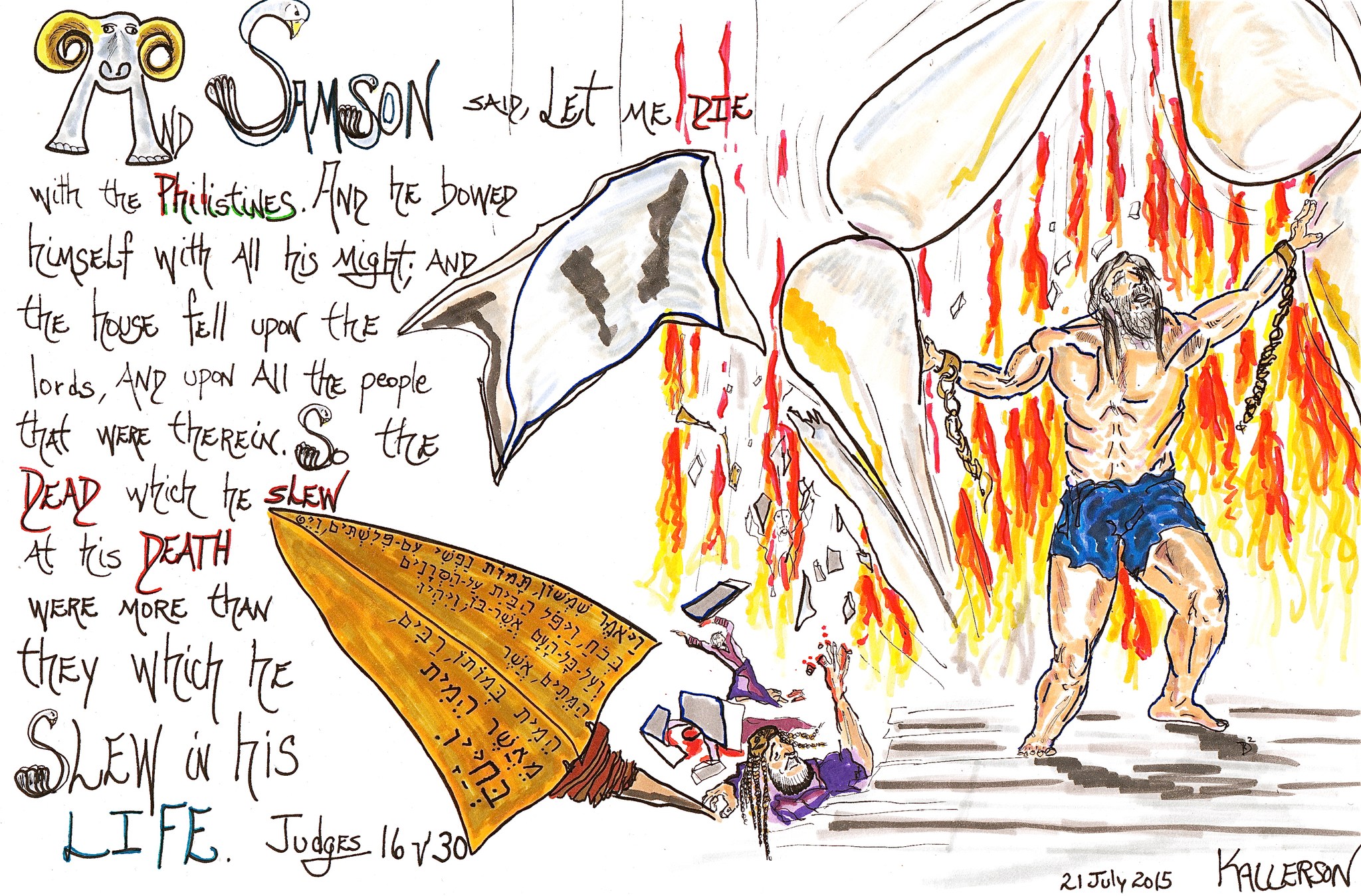
Heroic artwork by Douglas Kallerson.
Judges 16:23-31
Samson, Judge of Israel, Part IX
(Typed 20 May 2024) There are various views on what it means to be justified before God. Within those views, people often get caught up in semantics in order to justify their own position on a point of doctrine.
In an article by Bob Wilkin, where he argues for Free Grace, he writes about an opposing doctrine, “It seems reasonable to call this process progressive justification. After all, Evangelicals already speak of progressive sanctification. If progressive sanctification is necessary to obtain final justification then progressive justification is another name for progressive sanctification.”
The Bible doesn’t teach that progressive sanctification is needed to obtain final justification. Paul says, “But you were washed, but you were sanctified, but you were justified in the name of the Lord Jesus and by the Spirit of our God” (1 Corinthians 6:11).
We are sanctified. We are also justified. Paul speaks of justification in a legal sense. That is known as forensic justification. A person is declared righteous because of the merits of Christ. On the other hand, this is not what James speaks of.
In James 2:21, he says, “Was not Abraham our father justified by works when he offered Isaac his son on the altar?” Was that before or after Isaac’s birth? Long before. Therefore, he cannot be saying that Abraham had to prove something to be justified. He goes on to say…
Text Verse: “Do you see that faith was working together with his works, and by works faith was made perfect? 23 And the Scripture was fulfilled which says, “Abraham believed God, and it was accounted to him for righteousness.” And he was called the friend of God. 24 You see then that a man is justified by works, and not by faith only.” James 2:23, 24
James cites Genesis 15:6 saying that God counted it to Abraham for righteousness. He stood justified. So what is the point James is making about his willingness to offer Isaac? He cannot be speaking of forensic justification. Therefore, he must be saying that Abraham in his state of humanity, is justified by works.
If God came to Abraham and asked him to sacrifice his son Zimran, that would be a test of obedience. He had no promises from God concerning that son. If God said to do it, he would either be obedient or disobedient. He would not be justified in his humanity for his disobedience, even if he stood justified by God through the declaration of righteousness.
However, God promised Abraham that Isaac would carry on his name. When God asked him to sacrifice Isaac, that was not a test of obedience as much as it was of his faith. The reason for this is that God cannot lie.
Therefore, in asking Abraham to sacrifice Isaac, the child of promise, it must be a test of faith that somehow Isaac would still receive the promise. This is verified by Hebrews 11:17-19 –
“By faith Abraham, when he was tested, offered up Isaac, and he who had received the promises offered up his only begotten son, 18 of whom it was said, ‘In Isaac your seed shall be called,’ 19 concluding that God was able to raise him up, even from the dead, from which he also received him in a figurative sense.”
How is justification relevant to what we will see in the verses about Samson? It is because of who the Philistines picture. They are those who weaken the faith of others or completely steal it from those who have no faith.
If a saved person is told he needs to do something to be saved, if he believes that, his faith is weakened. The same is true if he is told he needs to continue to do something in order to stay saved. God never said to Abraham, “If you don’t sacrifice Isaac, you are no longer righteous.”
Abraham’s trial was one of faith in his salvation, not for his salvation. If you are saved, you are saved. Don’t let anyone weaken your faith! The Philistines are out there! Don’t let them rob you of your joy in Christ.
It’s all to be found in His superior word. And so, let us turn to that precious word once again, and… May God speak to us through His word today, and may His glorious name ever be praised.
I. Remember Me, I Pray (verses 23-31)
23 Now the lords of the Philistines gathered together to offer a great sacrifice to Dagon their god, and to rejoice.
v’sarne plishtim neespu lizboakh zebakh gadol l’dagon elohehem u-l’simkhah – “And lords Philistines gathered to sacrifice, sacrifice great, to Dagon their god, and to gladness.” Because the narrative is condensed, it may seem like this gathering was held because of the capture of Samson. However, it may simply be an annual feast or a sacrifice for some particular event.
Because it says, “to their god and to gladness,” it is hard to be dogmatic about any further reason for it. Israel had their annual pilgrim feasts. Other nations had feasts around the equinoxes and solstices. The rest of this verse, however, seems to tie the feast to their triumph over Samson. Whatever the reason for calling the feast, Dagon, their god, was the center of the worship.
Dagon comes from dag, fish which signify abundance. Hence, the word daga means to multiply or increase. The word dagan refers to cereal crops in general, thus natural abundance. Therefore, Dagon can mean Fish, Increase, or Cultivation of Natural Abundance.
Being coastal cities, having a fish as their deity is logical, at least from a fallen human standpoint. The idol representing Dagon was believed to have the upper half reflecting a man and the lower half reflecting a fish.
One Assyrian depiction has a man somewhat wrapped up in a fish with the mouth of the fish looking like one of the pointy hats of Catholic bishops. The rest of the fish hung like a garment around the man.
23 (con’t) And they said:
“Our god has delivered into our hands
Samson our enemy!”
vayomru nathan elohenu b’yadenu eth Shimshon oyvenu – “And they said, ‘Given, our god, in our hand Samson our enemy.’” As just noted, these words seem to make the reason for the gathering as the victory over Samson, but it also may be that he was the subject of people’s conversation. If so, then it would be that these words are parenthetical –
Now the lords of the Philistines gathered together to offer a great sacrifice to Dagon their god, and to rejoice. (And they said: “Our god has delivered into our hands Samson our enemy!” 24 When the people saw him, they praised their god; for they said: “Our god has delivered into our hands our enemy, The destroyer of our land, And the one who multiplied our dead.”) 25 So it happened, when their hearts were merry, that they said, “Call for Samson, that he may perform for us.” So they called for Samson from the prison, and he performed for them. And they stationed him between the pillars.
This seems like a logical order of how the narrative is structured. However, whatever the flow of the narrative actually is, the people’s victory over Samson was a point of conversation and joy…
24 When the people saw him, they praised their god; for they said:
vayiru otho ha’am vayhal’lu eth elohehem ki amru – “And see, him, the people, and praise their god, for they said…” As noted, the lines seem out of place because only later do the people call for Samson. For this reason, it has been suggested that the words “And sees him” are speaking of Dagon, not Samson.
However, Samson is the nearest antecedent, and so my suggestion that the lines are parenthetical sufficiently explains the matter. It also fits well with other such instances in the book of Judges where the narrative breaks and then catches up with the chronological events. For example, this was seen at the introduction of Jephthah into the narrative in Judges 11. As for their praises…
24 (con’t) “Our god has delivered into our hands our enemy,
The destroyer of our land,
And the one who multiplied our dead.”
The words form four lines, each ending with the nun/vav suffix indicating “our.” The first line also contains its own internal nun/vav suffix. Thus, they form a poetic effect: nathan elohenu b’yadenu eth oyvenu v’eth makhariv artsenu vaasher hirbah eth khalalenu – “Given our god, in our hand: our enemy, and desolating our land, and who multiplied our pierced.”
It is like a song that the people learned and sang together just as people do at rallies and demonstrations all the time. It is intended to easily call to mind the heroic acts of their god.
25 So it happened, when their hearts were merry, that they said, “Call for Samson, that he may perform for us.”
vayhi ki tov libam vayomru qiru l’shimshon visakheq lanu – “And is when good their heart, and they say, ‘Call to Samson and laughs to us.’” If the previous verses are parenthetical, then this is where the narrative meets up with the earlier narrative –
“Now the lords of the Philistines gathered together to offer a great sacrifice to Dagon their god, and to rejoice. … So it happened, when their hearts were merry, that they said, ‘Call for Samson, that he may perform for us.’”
A new word, sakhaq, is used. It signifies to laugh in either pleasure or derision. In this case, it signifies to have him amuse them. This could be from them deriding him, beating on him, spitting on him, etc. It could also mean that they ordered him to do things like dance, bow down, and so forth. Whatever it was that made them happy, that is what Samson was called to do…
25 (con’t) So they called for Samson from the prison, and he performed for them. And they stationed him between the pillars.
vayiqru l’shimshon mibeith haasirim vaytsakheq liphnehem vayaamidu otho ben ha’amudim – “And call to Samson from house the bonds, and laughs to their faces. And stands him between the pillars.’” Here, a similar but different verb is used, tsakhaq. It is the thirteenth and last time that it is used in the Bible. It carries essentially the same meaning as sakhaq. Interestingly, one word is finished in Scripture when the other is just beginning to be used.
The structure of the words in this sentence indicates active performance by Samson. The people demanded that Samson perform for them, probably in dancing or some other activity. The great hero is reduced to embarrassing subjugation and degradation before their eyes.
But it may be that Samson then uses this as a pretext to act as stated in the following words…
26 Then Samson said to the lad who held him by the hand,
vayomer Shimshon el ha’naar hamakhaziq b’yado – “And says, Samson, unto the lad, the strengthening in his hand…” It is of note that a mere lad is used to guide Samson around. A single youth directs where the once-great Samson – who slayed a thousand men with the jawbone of a donkey – went. And not only is he guided by a youth, but in his blindness, he is totally dependent on the lad to identify the place he desires to go.
26 (con’t) “Let me feel the pillars which support the temple, so that I can lean on them.”
The first verbs are imperative and the last is cohortative: hanikhah oti vahemisheni eth ha’amudim asher ha’beith nakhon alehem v’eshanen alehem – “Resting, me, and I am feeling the pillars which the house support upon them, and I will lean upon them.” If Samson actively performed for the people, he could pretend to be tired from the efforts. After all, the great champion of Israel lost his power and endurance.
In these words is a verb found only here in Scripture, yamash, to feel, coming from a primitive root meaning to touch. Because he is blind, he is asking for the lad to guide his hands so that he can feel the supporting pillars…
27 Now the temple was full of men and women. All the lords of the Philistines were there
The NKJV makes the whole verse seem like one category of people, all on the roof. That is not the intent: v’habayith male ha’anashim v’hanashim v’shamah kol sarne p’listim – “And the house filled the men and the women, and there-ward all lords Philistines.” In other words, the temple itself was filled with the ruling class, here designated by the plural of the words enosh and ishah, men and women. These people are within the walls of the temple, and…
27 (con’t) —about three thousand men and women on the roof watching while Samson performed.
v’al ha’gag kishlosheth alaphim ish v’ishah ha’roim biskhoq Shimshon – “And upon the roof according to three thousands man and woman, the seeing in laughing Samson.” This is another category, ish and ishah, cumulatively numbered with the plural “three thousands,” and thus they are designated in the singular.
Of the number, it is a multiple of three and ten. Three signifies Divine Perfection. Expanding on that, Bullinger says –
“The number three, therefore, must be taken as the number of Divine fulness. It signifies and represents the Holy Spirit as taking of the things of Christ and making them real and solid in our experience. It is only by the Spirit that we realise spiritual things. Without Him and His gracious operation, all is surface work: all is what a plane figure is to a solid.”
Of the number ten, Bullinger says –
“Completeness of order, marking the entire round of anything, is, therefore, the ever-present signification of the number ten. It implies that nothing is wanting; that the number and order are perfect; that the whole cycle is complete.”
With this great number of people standing there enjoying his humiliation, Samson has a plan that he is about to execute…
28 Then Samson called to the Lord, saying, “O Lord God, remember me, I pray! Strengthen me, I pray, just this once, O God,
Samson doesn’t merely call out to God, but to the God: vayyiqra Shimshon el Yehovah vayomar adonay Yehovah zakhreni na v’khazqeni na akh ha’paam hazeh ha’elohim – “And calls, Samson, unto Yehovah, and says, ‘Adonai Yehovah, remember me, I pray, and strengthen me, I pray, surely the beat, the this, the God.’”
When speaking of the true God, the term elohim, or “God” has been seen twelve times in the Samson series. Of them, six have been preceded by the definite article, ha’elohim, or “the God.” The first five times were in Chapter 13 when his parents interacted with the man of “the God” in verses 13:6-9. This is the only instance by Samson.
He first acknowledges Him as Adonai Yehovah, or Lord Yehovah. He then acknowledges Him, before all these people who have thought their god greater than Samson’s God, as the one true God. He knows that Yehovah is the source of His strength. With the hair again on his head, the Lord is being asked to again acknowledge his state as a Nazirite to God…
28 (con’t) that I may with one blow take vengeance on the Philistines for my two eyes!”
The verb is cohortative: v’inaqmah n’qam akhath mishthe enay miplishtim – “and I am avenging vengeance, one from two – my eyes – from Philistines.” The meaning cannot be as most translations read, one vengeance for two eyes. The word naqam, vengeance, is masculine. But the form of the word one, akhath, is feminine. The word eye, however, is feminine. What he is saying is “I am avenging vengeance for one of my two eyes.”
Only the God’s Word translation got the sense, even if it is a bit of a paraphrase – “Let me get even with the Philistines for at least one of my two eyes.” The sense is that his vengeance is hardly compensation for one of his eyes, much less two.
29 And Samson took hold of the two middle pillars which supported the temple, and he braced himself against them, one on his right and the other on his left.
vayilpoth Shimshon eth sh’ne amude hatavekh asher ha’bayith nakhon alehem vayisamekh alehem ekhad bimino v’ekhad bismolo – “And wrenches, Samson, two pillars the midst which the house supporting upon them, and propped upon them, one in his right and one in his left.”
Here is a new and rare word, laphath. It signifies to twist, turn, or grasp with a twisting motion, and, thus, to wrench or wring. It is a verb that gives the sense of sudden and excited motion. It is used in Ruth when Ruth startled Boaz as he slept –
“Now it happened at midnight that the man was startled, and turned himself [laphath]; and there, a woman was lying at his feet.” Ruth 3:8
Samson was probably standing there calmly resting against a pillar, maybe with his head down as if he was exhausted, but he suddenly wrenches himself so that he is now directly between the pillars where he props himself into a fully extended position between them, and…
30 Then Samson said, “Let me die with the Philistines!”
vayomer Shimshon tamoth napshi im plishtim – “And says, Samson, ‘Dies my soul with Philistines.’” Samson knows that this is his end, but it is worth his death to destroy the Philistines, the Weakeners, in the process. In this, they would not be able to afflict Israel as they once had…
30 (con’t) And he pushed with all his might, and the temple fell on the lords and all the people who were in it.
vayet b’koakh vayipol habayith al hasranim v’al kal ha’am asher bo – “And stretches in strength. And falls the house upon the lords and upon all the people who in it.” It is thought impossible that the temple could collapse in this manner with just two pillars being pushed over. However, depending on the construction, which is unknown, and with the weight of three thousand people on the roof, the act was sufficient to bring it down. (See Sergio’s opening comments on 16 June 2024 for archaeological evidence of such a temple and its design).
Those inside would have been crushed like Crimson Seedless grapes under the foot of an African elephant. Those on top would tumble into the falling debris and be broken to pieces like a pile of shortbread cookies in a hydraulic press… what a mess.
30 (con’t) So the dead that he killed at his death were more than he had killed in his life.
vayihyu hamethim asher hemith b’motho rabim measher hemith b’khyav – “And is the dying which killed in his death greater from which killed in his life.” Samson’s great deeds with his eyes didn’t match the great act he brought about without them. By the power of the Lord strengthening him, his final battle was accomplished…
31 And his brothers and all his father’s household came down and took him, and brought him up and buried him between Zorah and Eshtaol in the tomb of his father Manoah.
vayerdu ekhav v’khal beith avihu vayisu otho vayaalu vayiqbru otho ben tsarah u-ben Eshtaol beqever manoakh abiv – “And descend his brothers and all house his father. And take him, and ascend, and bury him between Zorah and between Eshtaol in grave Manoah, his father.” Based on the wording, it appears Manoah and his wife had other children.
The term brothers can extend to others within a tribe, but because it mentions brothers and then the extended members of the household of his father, it seems that Samson had actual brothers as well. Either way, they came to Gaza, gathered up his body, and carried him back to be buried in his father’s grave.
Zorah (Tsorah) means Affliction. It comes from either tsirah, a collective word meaning hornets, or tsaraath, leprosy. Thus, it literally means either Hornet(s) or Leprosy. However, both are a type of affliction because the hornet is metaphorically used as an instrument of war, driving out enemies.
Eshtaol is listed by Strong’s under the root shaal, to ask for or inquire. Thus, he defines it as Entreaty. However, Sergio noted that the word Eshtaol without the vowel points, which were added much later, would say Bride of God, Wife of God, Woman of God, etc.
Manoah means Rest or Quiet.
*31 (fin) He had judged Israel twenty years.
v’hu shaphat eth Yisrael esrim shanah – “And he judged Israel twenty years.” This is a general repeat of Judges 15:20 –
“And he judged Israel twenty years in the days of the Philistines.”
Of the number twenty, Bullinger notes –
It “…is the double of ten, and may in some cases signify its concentrated meaning. But its significance seems rather to be connected with the fact that it is one short of twenty-one, 21 – 1 = 20; that is to say, if 21 is the three-fold 7, and signifies Divine (3) completion as regards spiritual perfection (7), then twenty, being one short of 21, it would signify what Dr. Milo Mahan calls expectancy.”
The Philistines are there, working out their evil
Ready to rob your joy in Christ
They work the works of their father, the devil
Telling you that by works your soul is priced
But God’s gift of life is one of grace
It comes by trusting His word
Only through faith will you see God’s face
In the radiant glow of Jesus our Lord
Have faith! Don’t be duped by the Philistines
God has done it all through Jesus our Lord
The devil will try to deceive you through any means
So hold fast to the truth of grace, found in the word
II. Pictures of Christ
Judges 15 revealed to us the work of Christ in atonement and how that allowed for the Spirit to come forth. The Fountain of the Caller was opened and it remained open.
The first three verses of Chapter 16 detailed Samson’s symbolic victory over Gaza. While Israel is in a state of national apostasy, pictured by the harlot, Samson (Place of the Sun meaning the Word of God in Christ) pulled up the doors of the gate of Gaza.
That symbolically represents Christ completely removing the state, ability, authority, etc. of Weakeners to afflict God’s people through law observance. Taking them and placing them before Hebron (the Alliance of God in Christ with His people) shows the effectiveness of Christ’s power, recorded in His word, over the Weakeners. It is Christ, not the law, that prevails.
After that, the account immediately (verse 4) turns to the narrative of the harpy hellcat Delilah who dwelt in the Valley of Sorek. The words nakhal and soreq together would signify the Inheritance of the Choice Vine.
This is a picture of the inheritance of the church which came from the atoning work of Christ (seen in Chapter 15) and which bears the power of God in Christ (seen in the short Gaza narrative that opens Chapter 16). The name Delilah means something akin to Languisher, Debilitator, etc. I translated her name as Drawer Out which would be the cause leading to the effect where she draws out in order to afflict.
She is used by the Philistines in an attempt to harm Samson. Their intent is to bind him in order to afflict him. If she prevails the five lords promise (verse 5) eleven hundred of silver from each of them.
As noted, 1100 is a derivative of 10 and 11. Bullinger says ten is the number of “Completeness of order, marking the entire round of anything, is, therefore, the ever-present signification of the number ten. It implies that nothing is wanting; that the number and order are perfect; that the whole cycle is complete.”
Eleven is the number that marks “disorder, disorganization, imperfection, and disintegration.”
If she prevails, it will have come about after a cycle of time which will bring about disorder and so forth. Starting in verse 6, Delilah, the dangerous dragon, begins her series of entreaties. Samson’s responses are not true, but each gives hints about what causes God’s people to stumble. In verse 7, his first response was –
‘If binding me in seven cords [yether], fresh [lakhim], which not dried [kharav], and weakened, and became according to one the man.’”
The cord, yether, signifies excess, abounding, or preeminence. The words “fresh, which not dried” are the opposite of what can hurt. The lakhim, or fresh, signifies the time of God’s favor (see Ezekiel 17:24 and Luke 23:31).
The word dried, kharav, is identical to the spelling of Horeb, the mountain of the law. It was used in the account of Gideon and the fleece in the same manner.
Whatever is preeminent is the state of the thing. The dry law will harm but the fresh gospel will not. This is more certain because the form of the verb kharav is khorvu. That is identical in spelling to kharvo, [חרבו] His sword. It speaks of the law that only Christ can fulfill.
The first attempt failed, so she tried again. In verse 11, his next answer was –
“If binding they bind me in ropes [avoth] new [khadash], which not worked [asah] in them, and weakened, and became according to one the man.”
Here Samson uses the word avoth, ropes. They are strands woven together which are used for binding, drawing, holding, etc. For example, in Isaiah 5, it says –
“Woe to those who draw iniquity with cords of vanity,
And sin as if with a cart rope [avoth];
19 That say, ‘Let Him make speed and hasten His work [maaseh, from asah],
That we may see it;
And let the counsel of the Holy One of Israel draw near and come,
That we may know it.’” Isaiah 5:18, 19
In this case, however, they are never to have “done in them work.” In other words, like the fresh, not dried cords of the previous attempt. It again provides a picture of the opposite. The gospel of the New [khadash] Covenant says, “no work.”
That attempt also failed, and so she tried a third time. In verse 13, Samson’s next answer was –
“And says unto her, ‘If weaves seven locks [machalaphah, noun, fem.] my head with the warp.’”
This time, he actually reveals the source of his strength to Delilah, but he doesn’t reveal how it is his strength. Samson is the Place of the Sun, the word of God in Christ. That is currently revealed in the church, of which there are seven individual churches (noun fem.) noted in Revelation 1-3.
They represent the state of all churches of the church age at any given time. In other words, one may be like the church of Laodicea and another like the church at Thyatira. It is ironic that Christ is called the head of the church and the locks on his head are being compared to the seven churches which form the church.
These seven locks (noun fem.) have not been noted until this verse. As his unshaved hair is the connection to the Source of his strength, this is sufficient to mirror the other two accounts. Blasting it with the peg, as she did, doesn’t change its status. Like the first two attempts, the secret is left undiscovered.
In verse 15, Delilah noted his three mockings. It is the number of Divine Perfection, but Bullinger says further –
“The number three, therefore, must be taken as the number of Divine fulness. It signifies and represents the Holy Spirit as taking of the things of Christ and making them real and solid in our experience. It is only by the Spirit that we realise spiritual things. Without Him and His gracious operation, all is surface work: all is what a plane figure is to a solid.”
God’s favor is realized in trusting Christ’s fulfillment of the Old Covenant, not in our works. His grace is found woven into the New Covenant, based on what He has done, not in what we do. And these are then on display in His church.
This is the state of the true church from its inception. It has been one of trusting in Christ. However, Delilah continued to harass Samson until his soul was reaped (verse 16). Eventually he blabbed (verse 17) and gave up his secret that the connection was in his hair. It had never been cut.
Samson’s mother was to participate in the Nazirite vow until his birth. The line leading to Christ brought forth Christ who brought forth the church. Hair in Scripture consistently symbolizes awareness, particularly an awareness of sin. That reflects the state of the church.
Using a morah, or razor, on him means there will be a change in appearance. The root of it, mur, means to change or exchange. Thus, there will no longer be the awareness of sin. It is the state of man noted by Paul in Romans 1:18-32 where he explains how man suppresses the knowledge of God and no longer has shame or an awareness of sin. That is why the words of verse 17 say –
“If shaved, and departs from me my strength. And weakened, and became according to all the man [ha’adam].”
When shaved bald, there is no longer this consciousness of sin. It is the carnal man, the unregenerate Adam, ha’adam, without the Spirit. That is why he kept saying, “If you do XXX, I will be like any other man (ha’adam).” In verse 19, the Philistine lords brought the silver for payment. The time for the promise of redemption is ending.
I would deduce that the rapture of the church fits in at this point. This is because Delilah, the Debilitator hired by the Philistines (the Weakeners), is about to completely remove the consciousness of sin from the church, just as Paul explains in 2 Thessalonians 2.
She “sleeps” him on her knees, meaning she calls to him and he is asleep, and then she shaves away his consciousness of sin, as is perfectly described by the sleeping church in 1 Thessalonians 5:1-10.
The place of the word of God in Christ is disarmed through her afflicting him, “And he not known that Yehovah departed from upon him.” He no longer has the Spirit upon him.
The rapture, the snatching of the church, is akin to the grasping and cutting away of the locks. Anything left of the church is without the Spirit and without the connection to Christ.
As such, the true church is gone even if the word of God in Christ remains. Verse 21 said that they put out Samson’s eyes and brought him down to Gaza, bound him in bronze, and he was grinding wheat in the bonds.
For a time, there will be no knowledge of the truth. The world will be blinded and there will only be works, judgment, and bondage. However, immediately, it said in verse 22 that Samson’s hair began to sprout. As quickly as his hair was cut off, so also an awareness of sin began to arise again, just as Revelation shows in the tribulation saints.
Law observance and bondage are celebrated and will multiply (verse 23), symbolized by the Philistines worshiping Dagon, Increase. They will celebrate their supposed victory over Samson (Place of the Sun, which is the word of God in Christ) while God is building up his believers during the tribulation.
The spiritual battle is being described by the events of Samson’s life. Noting that the Philistines call for Samson that he may perform for them anticipates what Daniel says –
“I was watching; and the same horn was making war against the saints, and prevailing against them, 22 until the Ancient of Days came, and a judgment was made in favor of the saints of the Most High, and the time came for the saints to possess the kingdom.
23 “Thus he said:
‘The fourth beast shall be
A fourth kingdom on earth,
Which shall be different from all other kingdoms,
And shall devour the whole earth,
Trample it and break it in pieces.
24 The ten horns are ten kings
Who shall arise from this kingdom.
And another shall rise after them;
He shall be different from the first ones,
And shall subdue three kings.
25 He shall speak pompous words against the Most High,
Shall persecute the saints of the Most High,
And shall intend to change times and law.
Then the saints shall be given into his hand
For a time and times and half a time.’” Daniel 7:21-25
However, there is a time when this persecution will end. The narrative notes three thousand on the roof. The roof, gag, comes from gaah, to rise up or (figuratively) exalt. The time of divine fulness where the whole cycle is complete will come when all those who exalt themselves will be brought down.
Understanding this, Samson prepared himself as stated in verses 28 & 29, calling out, “and I am avenging vengeance, one from two – my eyes – from Philistines.” The highly unusual wording shows the totally devasting nature of what had taken place.The eye is the channel of information into a person. Jesus said –
“No one, when he has lit a lamp, puts it in a secret place or under a basket, but on a lampstand, that those who come in may see the light. 34 The lamp of the body is the eye. Therefore, when your eye is good, your whole body also is full of light. But when your eye is bad, your body also is full of darkness. 35 Therefore take heed that the light which is in you is not darkness. 36 If then your whole body is full of light, having no part dark, the whole body will be full of light, as when the bright shining of a lamp gives you light.” Luke 11:33-36
Samson, Place of the Sun, is the word of God in Christ. By taking away his eyes, even if one, there was only darkness. How can a lamp that is dark bring others to the light?
The Philistines, the Weakeners, are those who take away the light of Christ. At the time determined by God, that will come to an end. He will, for all intents and purposes, bring down the house around them.
The two main pillars of the temple (verse 29) represent the two pillars of the end times apostasy, the Antichrist and the False Prophet. In bringing them down, the rest of the house of apostasy will collapse with them.
The final verse said his brothers and all the house of his father “buried him between Zorah and between Eshtaol in grave Manoah his father.” Literally, it would mean “between Affliction and between Entreaty/Bride of God, in grave Rest his father.”
Samson, the man, had to die. Ignoring that for the sake of the narrative, these words mean that the place of the Word of God in Christ stands between the state of the people waiting to be glorified and the Bride of God.
The dual meaning of Eshtaol, which includes Entreaty, then looks to the believer’s life of affliction while awaiting their final glorification. Rest being in the middle of the two confirms that they possess God’s rest as an assurance. Hebrews 4:3 notes, “we who have believed do enter that rest.”
The seventh day millennium, which follows the tribulation, is a picture of that. God created in six days, followed by His rest. That follows in the six thousand years awaiting the thousand-year reign of Christ, something our closing verse will refer to.
Once again, as has been the case time and again in Judges, we have been shown picture after picture of the contrast between the law and grace. The law is what makes sin possible. In violating the law, there is the imputation of sin.
For those who come to Christ, we are told, “For sin shall not have dominion over you, for you are not under law but under grace” Romans 6:14. The choice belongs to each person. Will we live in the grace of God that comes through faith in Christ, or will we try to work our way back to God through our own effort?
The Weakeners are out there. A spiritual battle is going on all around us. It is insistent and constant. Its mantra is, “It can’t be that simple. You must earn your way back to God.”
The world is filled with this notion. Every religion on the planet insists that you must perform, you must do, you cannot trust what God has done in Christ. Unfortunately, much of the church is filled with this same doctrine. But what God wants from you is faith.
Trust Him for your salvation and then trust Him in your salvation. His word has things that you are to do, but they are things that come after you have been saved. Doing the same things before you are saved won’t get you an inch closer to God.
And because once you are saved you are in Christ, doing them after salvation won’t get you one inch closer to Him either. Rather, they will be reckoned for rewards or losses. Abraham could have decided to not go up Mount Moriah with Isaac.
But he had faith in the sure promises of God. And so he went. Be people of faith, living out your salvation in the ever-increasing knowledge of God in Christ. And that will come by staying in His word, so read it daily!
Closing Verse: “They shall not hurt nor destroy in all My holy mountain,
For the earth shall be full of the knowledge of the Lord
As the waters cover the sea.
10 “And in that day there shall be a Root of Jesse,
Who shall stand as a banner to the people;
For the Gentiles shall seek Him,
And His resting place shall be glorious.” Isaiah 11:9, 10
Next Week: Judges 17:1-6 It’s a sad story to tell, but we’ll get it done… (No King In Israel, Part I) (48th Judges Sermon)
The Lord has you exactly where He wants you. He has a good plan and purpose for you. It is He who judges His people according to their deeds. So, follow Him, live for Him, and trust Him, and He will do marvelous things for you and through you.
Samson, Judge of Israel, Part IX
Now the lords of the Philistines gathered together
To offer a great sacrifice to Dagon their god, and to rejoice
And they said: “Our god has delivered into our hands
Samson our enemy! Everyone raise your voice!
When the people saw him, they praised their god
For they said: “Our god has delivered our enemy into our hands
The destroyer of our land
And the one who multiplied our dead, and now, here he stands
So it happened, when their hearts were merry
That they said, “Call for Samson, that he may perform for us
———-(how sad and grim)
So they called for Samson from the prison, and he performed
———-for them
And they between the pillars stationed him
Then Samson said to the lad
Who held him by the hand
“Let me feel the pillars which support the temple
So that I can lean on them while here I stand
Now the temple was full of men and women
All the lords of the Philistines were there, a big gathering
———-had formed
About three thousand men and women
On the roof watching while Samson performed
Then Samson called to the LORD, saying
“O Lord GOD, remember me, I pray! May Your Spirit arise
Strengthen me, I pray, just this once
O God, that I may with one blow take vengeance on the Philistines
———-for my two eyes!
And Samson took hold of the two middle pillars
Which supported the temple (of which it would soon be bereft)
And he braced himself against them
One on his right and the other on his left
Then Samson said, “Let me die with the Philistines!
And he pushed with all his might (as if urged on by a midwife)
And the temple fell on the lords and all the people who were in it
So the dead that he killed at his death were more than he had
———-killed in his life
And his brothers and all his father’s household came down
And took him, and brought him up and buried him
———–certainly with many tears
Between Zorah and Eshtaol in the tomb of his father Manoah
He had judged Israel twenty years.
Lord God, turn our hearts to be obedient to Your word
Give us wisdom to be ever faithful to You
May we carefully heed each thing we have heard
Yes, Lord God may our hearts be faithful and true
And we shall be content and satisfied in You alone
We will follow You as we sing our songs of praise
Hallelujah to You; to us Your path You have shown; Hallelujah we shall sing to You for all of our days
Hallelujah and Amen…
23 Now the lords of the Philistines gathered together to offer a great sacrifice to Dagon their god, and to rejoice. And they said:
“Our god has delivered into our hands
Samson our enemy!”
24 When the people saw him, they praised their god; for they said:
“Our god has delivered into our hands our enemy,
The destroyer of our land,
And the one who multiplied our dead.”
25 So it happened, when their hearts were merry, that they said, “Call for Samson, that he may perform for us.” So they called for Samson from the prison, and he performed for them. And they stationed him between the pillars. 26 Then Samson said to the lad who held him by the hand, “Let me feel the pillars which support the temple, so that I can lean on them.” 27 Now the temple was full of men and women. All the lords of the Philistines were there—about three thousand men and women on the roof watching while Samson performed.
28 Then Samson called to the Lord, saying, “O Lord God, remember me, I pray! Strengthen me, I pray, just this once, O God, that I may with one blow take vengeance on the Philistines for my two eyes!” 29 And Samson took hold of the two middle pillars which supported the temple, and he braced himself against them, one on his right and the other on his left. 30 Then Samson said, “Let me die with the Philistines!” And he pushed with all his might, and the temple fell on the lords and all the people who were in it. So the dead that he killed at his death were more than he had killed in his life.
31 And his brothers and all his father’s household came down and took him, and brought him up and buried him between Zorah and Eshtaol in the tomb of his father Manoah. He had judged Israel twenty years.