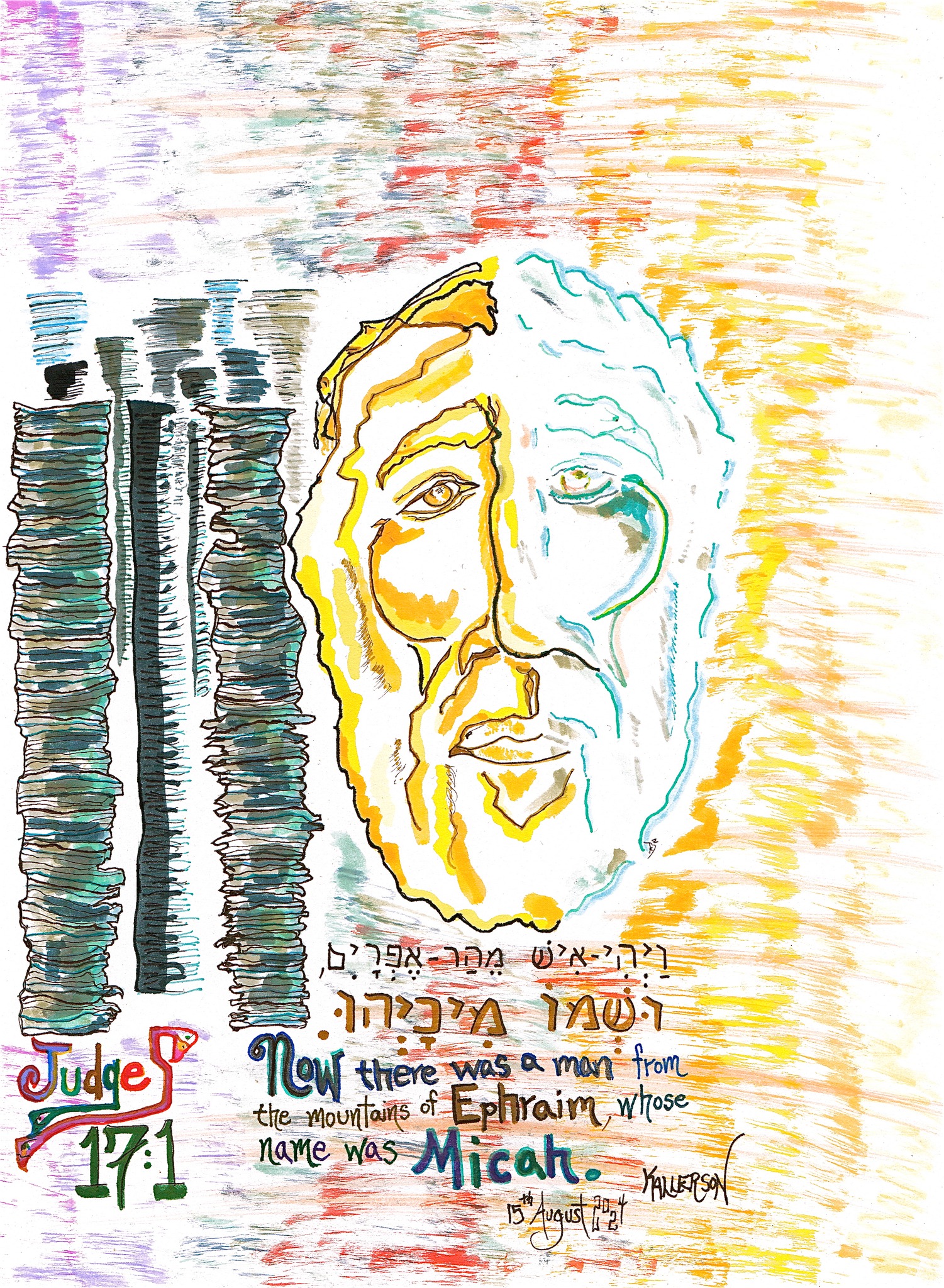
Artwork by Douglas Kallerson.
Judges 17:1-6
No King In Israel, Part I
(Typed 27 May 2024 – Memorial Day and miserably sick) Without checking Exodus 20, I bet you can already spot several violations of the Big Ten in our passage today. In just five verses, Micah and his mother not only broke several of the Ten Commandments, but they broke other laws that further explain those ten or that define other aspects of the religious laws of Israel.
If you have followed the sermons on the books of Moses for the past few years, you must almost want to cringe at what is recorded here. You might even ask yourself, “How can anyone be so stupid?”
But if you think it through, it is nothing uncommon or unusual. The people are living in a time without TV, internet, cars, and so forth. There weren’t even local synagogues to walk to.
Today, we have churches on every street corner, the Bible in print in our homes, TV with Christian (well…) stations, and the internet to search for information on anything we want to know about our relationship with the Lord.
We can’t defend the actions of the people in today’s verses, but if we condemn them, we are really condemning ourselves. We have laws in the land and the Bible expects us to live by them in order to live in harmony with the government set over us.
And yet, I will bet that many of us got here today by breaking a law or two in the process. I don’t mean, “Well, cops won’t pull you over in a 40 zone if you are doing 45.” I mean that a 40mph speed zone is a 40 zone. If the police don’t enforce the law, it doesn’t mean that the law doesn’t exist. It probably means they are enjoying their donuts and can’t be bothered.
Text Verse: “And the Lord spoke to you out of the midst of the fire. You heard the sound of the words, but saw no form; you only heard a voice. 13 So He declared to you His covenant which He commanded you to perform, the Ten Commandments; and He wrote them on two tablets of stone.” Deuteronomy 4:12, 13
After saying this to the people, Moses again forbid the idolatry of making images, even if they were to worship Yehovah, because the people have no idea what He looks like. And more, it would be taking something that He had made and forming into something to represent Him.
The process itself is illogical when thought through. Isaiah speaks of the illogical nature of idolatry in several key passages. John warns against idolatry as he closes out his first epistle. Anything that diverts our attention away from the Lord can easily become an idol.
Once He is out of the picture, we are prone to fill up our existence with other things that simply replace Him. Thank God for Jesus who actually helps resolve this for us. When we read the gospels about Jesus, our minds form a picture of the Man.
Some of us may be a bit more precise in how we perceive Him, but the notion of Him as a man comes through. When my great-grandfather left China after his years as a medical missionary, the Chinese people he tended to gave him some paintings that they had made from the gospels.
The depictions of Jesus and those with Him were of Chinese men. I have passed churches where Jesus is depicted as black. This is true in any place where Jesus has been proclaimed. People form a picture in their minds of Jesus based on their own culture and experience. No, this is not idolatry. It is the human connection of God in Christ that we form.
Jesus is our way of understanding what God has done. We don’t have any paintings of the true Jesus. Therefore, God has allowed us to consider Him in our own way. He is the Christ of the nations.
Even though we know that Jesus was from the Mideast and we have an idea of what people there look like, there are millions of Mideast people and none of them look just like Jesus. Again, thank God for Jesus. He is our connection to the unseen God. Because of His human nature fulfilling the Law of Moses, we can be free from the burdens that so heavily weigh us down.
This is a truth that is to be found in His superior word. And so, let us turn to that precious word once again, and… May God speak to us through His word today, and may His glorious name ever be praised.
I. Sanctifying, I Sanctified, the Silver (verses 1-3)
With the narrative of Samson complete, the narrative of individual judges is also complete. Rather than focus on a judge, the book will now focus on events that occurred during the time of the judges, before any king reigned.
As Saul will be the first king, these events occur before his reign. That will be seen in verse 6. As for the events themselves, two specific stories are given. The first will comprise chapters 17 and 18. The second will finish the book in chapters 19-21.
These stories are not to be considered chronologically. For example, a grandson of Moses will be noted in Judges 18:30 and Phineas will be noted as the high priest in Judges 20:28. These place both stories very early in the time of the Judges.
Thus, these stories are selected out of this period to tell us things we need to know in the greater story of redemption. They are stories like Ruth, even if they are contained within the book of Judges itself. As for the first of these accounts, it begins with…
Now there was a man from the mountains of Ephraim,
vayhi ish mehar ephrayim – “And is man from mount Ephraim.” The narrative begins within the tribe of Ephraim. The tribe is north of Judah, Benjamin, and Dan and stretches from the Jordan to the Mediterranean Sea.
What is interesting is that the same words, with some local information added, are used to begin the narrative of Samuel, “And is man…from mount Ephraim.” The apostacy of Israel is highlighted in this early narrative in of the time of the judges which necessitated the calling forth of a judge. That continues through the life of Samuel, Israel’s last judge, and eventually leads to Israel calling for a king.
The name Ephraim means Twice Fruitful and also Ashes.
In Scripture, a har, mountain, is a lot of something gathered. In typology, it is synonymous with a large but centralized group of people.
1 (con’t) whose name was Micah.
ushmo mikhay’hu – “and his name Micayehu.” The name Micayehu is given here, but it will take another form soon. This secondary form will continue throughout the narrative. The name, as it now stands, means Who is Like Yehovah.
2 And he said to his mother, “The eleven hundred shekels of silver that were taken from you, and on which you put a curse, even saying it in my ears—here is the silver with me; I took it.”
The Hebrew is complicated: vayomer l’imo eleph umeah ha’keseph asher luqakh lakh v’athi alith v’gam amart b’aznay hineh ha’keseph iti ani l’qakhtiv – “And says, to his mother, ‘Thousand and hundred the silver which taken to you, and you adjured, and also said in my ears – behold the silver with me. I, I took it.”
The l (ל – lamed) prefix indicates motion toward something. The most literal rendering is to simply say “to” each time it is used, but then the context must be determined. At times, it can signify “for,” “from,” etc. In this case, it probably means “from.” As such, “which was taken from you.”
The Greek translation conveys the sense of “for” or “of” rather than “from,” saying, “And he said to his mother, ‘The eleven hundred pieces of silver which thou tookest of thyself.’”
In other words, they place the theft on the part of the mother. However, “from” seems more likely based on the rest of the narrative. The mother had eleven hundred pieces of silver that were taken. When she realized it was stolen, she pronounced an alah, or curse.
This is the first time the word is used in Scripture. It comes from a primitive root and signifies to adjure. For example, and usually in a bad sense, to pronounce an imprecation.
The mother found the money missing, and so in front of her son, she pronounced an imprecation. In hearing it, he was frightened. This is because of the spirit of the words of Leviticus 5 –
“If a person sins in hearing the utterance of an oath, and is a witness, whether he has seen or known of the matter—if he does not tell it, he bears guilt.” Leviticus 5:1
The context of Leviticus is a bit different, but the sense is still obtained. He has stolen from his mother, he hears her curse, and he then acts to correct his conduct by admitting he is the one who took it. The fact that she said it right in his hearing may be an indication that she suspected him all along.
If so, then rather than “curse,” she may have simply adjured him to tell the truth. If he lied, then he would be accountable to the Lord. Either way, he feels convicted and comes clean.
Of the number eleven hundred, it is a multiple of 10 and 11. Of ten, Bullinger says, “Completeness of order, marking the entire round of anything, is, therefore, the ever-present signification of the number ten. It implies that nothing is wanting; that the number and order are perfect; that the whole cycle is complete.”
Eleven is the number that marks “disorder, disorganization, imperfection, and disintegration.”
It is probably significant that this amount of silver is the same as that promised to Delilah by each of the rulers of the Philistines. That was in the previous chapter, but it is like a set of bookends in Judges from a chronological perspective. This is early in the history of the book, and that came towards the end of the time of the judges.
As for silver, it signifies redemption.
2 (con’t) And his mother said, “May you be blessed by the Lord, my son!”
vatomer imo barukh beni l’Yehovah – “And said, his mother, ‘Blessed, my son, to Yehovah.” Rather than leaving a curse upon her son, she accepts his confession and pronounces a blessing upon him. With that, the family goes from one sin to another…
3 So when he had returned the eleven hundred shekels of silver to his mother,
The words “So when” simply read “and”: vayashev eth eleph u-meah ha’keseph l’imo – “And returns thousand and hundred the silver to his mother.” The son heard the adjuration or the curse and, being guilt stricken, admitted his wrongdoing. After that, he returns the entire sum to his mother. During this process of giving her the money, which will actually take place in the next verse…
3 (con’t) his mother said, “I had wholly dedicated the silver from my hand to the Lord for my son,
vatomer imo haqdesh hiqdashti eth ha’kespeh l’Yehovah miyadi livni – “And says, his mother, ‘Sanctifying, I sanctified, the silver to Yehovah from my hand to my son.’” There are two ways to read this. The first is in the past perfect, as if it was in the past, anticipating the future – “I had sanctified it.” The other is that she is now making a vow to sanctify it – “I have now sanctified it.”
If the words are past perfect, then there are again two possibilities. She had the money and had decided at some point in the past that she would sanctify it to the Lord for a particular purpose. Or it could be that when the money was stolen, she promised that she would sanctify it to the Lord if it was recovered.
If the words are simply a reflection of her joy at getting the money back, then she decided to sanctify it to the Lord after her son confessed and returned it. No matter which of the three options, she has emphatically vowed (sanctifying, I sanctified) that it was to be dedicated to the Lord…
3 (con’t) to make a carved image and a molded image;
laasoth pesel u-masekhah – “to make carved image and molten image.” The words here are debated. Does this mean a carved image that is then covered with a layer of metal, or a carved image along with a molten image? It must be the latter based on what is said in the next chapter –
“Then the five men who had gone to spy out the country of Laish answered and said to their brethren, “Do you know that there are in these houses an ephod, household idols, a carved image, and a molded image? Now therefore, consider what you should do.” 15 So they turned aside there, and came to the house of the young Levite man—to the house of Micah—and greeted him. 16 The six hundred men armed with their weapons of war, who were of the children of Dan, stood by the entrance of the gate. 17 Then the five men who had gone to spy out the land went up. Entering there, they took the carved image, the ephod, the household idols, and the molded image. The priest stood at the entrance of the gate with the six hundred men who were armed with weapons of war.” Judges 18:14-17
By placing the ephod and the household idols in the narrative between the carved image and the molded image, it specifies that two images were made.
The pesel is a carved image, coming from pasal, to hew. The masekhah, or molten image, comes from nasak, to pour out. Thus, it is an image that is poured out. It can signify the covering of a hewn image, but that is not the case here. Because of her words, we read the next words which are probably the son speaking…
3 (con’t) now therefore, I will return it to you.”
v’atah ashivenu lakh – “And now, I return it to you.” Contextually, it seems that these words are the son speaking to the mother, not the mother speaking to the son, although it could be either.
After hearing his mother’s words, he excitedly says that he is returning it so that she can whip up some household gods. Before that, a brief poetic interlude…
No other gods before Me, that is one
How many more can you blow today
Do not steal, but this you have done
You are not following the proper way
No carved images… whoops, that makes three
How hard your head is for sure
No coveting! Yet, your heart I can see
You blew it again, but I have the cure
How about if I do it all for you
And then you just trust in Me
That is all you need to do
And yet you turn it down! How can it be?
II. A Shrine, Images, Idols, Etc. (verses 4-6)
4 Thus he returned the silver to his mother.
This is a confirmation that he is now handing it back to his mother: vayashev eth ha’keseph l’imo – “And returns the silver to his mother.” Verse 3 says he returned the money to her. This repetition explains that so that the coming words logically follow. It is she, not he, who takes the action with the silver.
There is confusion because many translations say something like, “from my hand for my son to make a carved image and a molten image.” But that is probably not what is said.
Rather, it more likely says, “from my hand, to my son, to make carved image and molten image.” The sanctification vow was for her, not him, to make these images. The images would then be given to her son as the leader of the household.
This is why determining the meaning of l (ל – lamed) isn’t always easy. The context has to be considered. For example, various psalms begin with l’David. Does that mean “to David” as if the song were written to him? Does it mean “of David” as it is written about him? Or does it mean “from David” (which “of” often also means), as if it is written by him?
The context indicates that David is writing the psalms, especially when he refers to himself in many of them and speaks of things that are recorded elsewhere in Scripture that he did or participated in.
However, rabbis who disagree that David wrote a psalm for one reason or another will argue that the psalm is written “to David.” That takes care of theological boxes about Christian beliefs that they don’t want to be stuck in.
Here in Judges, Micah is the man of the house now. Thus, it is likely his father has died. Naming him mikhay’hu, Who is Like Yehovah, showed that his father was probably a sound worshipper of Yehovah, or at least he had the Lord on his mind.
His mother determined that this money would be dedicated to the Lord to make these images in order to serve the Lord, and she is doing it with the thought that Micah will be the one who was to oversee the worship rites. Therefore…
4 (con’t) Then his mother took two hundred shekels of silver and gave them to the silversmith,
Rather than a noun, it is a masculine verb: vatiqakh imo matayim keseph vatitnehu latsoreph – “And takes, his mother, two hundred silver, and gives it to the smelting [guy].” The mother is the one who dedicated the silver and is having the silver fulfill its vowed purpose.
Of the number two hundred, Bullinger says that it is tenfold of twenty. Twenty is the number of expectancy. Ten indicates that the whole cycle is complete. As such, it is as if the expectancy is never realized and thus, he says –
“The significance of this number is suggested by John 6:7, where we read, ‘Two hundred pennyworth of bread is NOT SUFFICIENT for them.’ And so we find this number stamping various things with insufficiency.”
Thus, in short, it signifies insufficiency.
4 (con’t) and he made it into a carved image and a molded image; and they were in the house of Micah.
vayaasehu pesel u-masekhah vayhi b’veith mikhay’hu – “And he makes it carved image and molten image. And is in house Micayehu.” The smelting guy made the images. The amount is curious because the mother dedicated the entire sum to Yehovah, but it says she only gave two hundred to the silversmith.
Various suggestions have been made as to why. Some seem reasonable. But the words are focused on the number, and thus insufficiency. That is what is being tied into the narrative concerning these images.
Another issue arises in Judges 18. Despite both the carved image and the molten image having been carried away by the Danites, it will later say –
“Then the children of Dan set up for themselves the carved image; and Jonathan the son of Gershom, the son of Manasseh, and his sons were priests to the tribe of Dan until the day of the captivity of the land.” Judges 18:30
Because only the carved image is set up, this begs the question: Where is the molten image? Some scholars think they are one unit where the molten image is the base of the carved image. But because the carved image is always mentioned first, noting it was set up could simply be a note that everything else was set up with it.
Regardless, at this time, it says…
5 The man Micah had a shrine,
v’ha’ish mikhah lo beith elohim – “And the man, Micah, to him house gods.” Of verse 5, Keil interestingly says the following –
His mother did this, because her son Micah had a house of God, and had had an ephod and teraphim made for himself, and one of his sons consecrated to officiate there as a priest. מיכה האישׁ (the man Micah) is therefore placed at the head absolutely, and is connected with what follows by לו: ‘As for the man Micah, there was to him (he had) a house of God.’ The whole verse is a circumstantial clause explanatory of what precedes, and the following verbs … are simply a continuation of the first clause, and therefore to be rendered as pluperfects.”
In other words, he is placing this verse after verse 1 and saying all the rest of what we have analyzed fills in the blanks –
“And is man from Mount Ephraim, and his name Micayehu. … The man Micah had a shrine.”
This is an interesting take on the narrative and it is not without precedent in Judges. We have seen two narratives overlap and later meet up to continue on as one narrative. However, I think there is a problem with that in this story which is seen in the name of the man.
His name changes permanently here: v’ha’ish mikhah lo beith elohim – “And the man, Micah, to him house gods.” The name in verses 1 & 4 was mikhay’hu and here it is mikhah. It is hard to imagine that the name change would happen chronologically before the narrative aligns as Keil suggests.
Here is what his suggestion looks like chronologically –
1. And is man from Mount Ephraim, and his name Micayehu.
5. And the man, Micah, to him house gods [already filled with gods].
4. And he makes it carved image and molten image. And is in house Micayehu.
As his name is changed, information is being assigned to that name. The assignment of the information isn’t contingent on chronology, but it appears that the change of information assigns chronology. Micah comes from the word mi, who, and the [כה] kah at the end becomes debatable.
The letters correspond to the word koh, a demonstrative adverb indicating manner, place, or time. It specifically means “like this.” The name could then read Who’s Like This, Who is Thus, Who’s Here, Who Now, etc. Less likely, but still possible, the כה could also be from one of a couple of similar roots which would lead to possibilities such as Who is Disheartened, Who is a Coward, Who is Afraid, etc.
The name mikhay’hu was used twice. This new name, mikhah, will be used seven times in this chapter and twelve in the next. He has built a house of gods for his images. It is not uncommon to read commentaries that say it should read House of God, as if the images were to worship only the true God, Yehovah.
If that was the case, one might assume that it would be called Beith Yehovah, House of Yehovah rather than house of gods. And more, if there is more than one image, that option could in no way be considered as such. There is one Yehovah.
If someone incorrectly had a single god and associated it with Yehovah, he might get away with that as Aaron tried to do with the golden calf. But there is no way two or more idols could be equated to the sole worship of Yehovah.
Adam Clarke thinks that Micah’s shrine is a replica of the tabernacle and he has set up a little ark with a mercy seat and all the other tabernacle furniture. There is nothing to suggest this.
As for the money, if the two hundred of silver was for the two images, then it is possible that the rest may have gone into the things mentioned here, such as the shrine and what follows…
5 (con’t) and made an ephod and household idols;
vayaas ephod utraphim – “And makes ephod and teraphim.” An ephod is a priestly garment set apart for ministering to the gods of the house.
This is comparable to what is seen in the Roman Catholic Church with their supposed priestly garments that are used when ministering to the ten thousand images and idols they have set up. One might say that is the House of God, but it is a house of gods.
As for the teraphim, it is unknown what they are. It is a plural word and the singular is never used. They were first seen in Genesis 31:19 where Rachel stole her father’s teraphim. In verse 31:30, Laban specifically calls them his gods.
In 1 Samuel 15, the word is used in a truly negative sense –
“So Samuel said:
‘Has the Lord as great delight in burnt offerings and sacrifices,
As in obeying the voice of the Lord?
Behold, to obey is better than sacrifice,
And to heed than the fat of rams.
23 For rebellion is as the sin of witchcraft,
And stubbornness is as iniquity and idolatry [teraphim].
Because you have rejected the word of the Lord,
He also has rejected you from being king.’” 1 Samuel 15:22, 23
There are fifteen uses of teraphim in the Old Testament but none of them clearly define what they are. Whatever they are, they can in no way be considered in the proper worship of the Lord. It is no wonder that the name of Micah changes in this verse.
He has gone from Who is Like Yehovah to Who is Like This. We could pick up one of his little gods and toss it on the ground where it would shatter into the nothingness that it always was.
5 (con’t) and he consecrated one of his sons, who became his priest.
vaymale eth yad akhad mibanav vayhi lo l’khohen – “And fills hand one from his sons. And is, to him, to priest.” To fill the hand signifies to consecrate. In the case of Aaron and his sons, that was done with the sacrificial offerings –
“Also you shall take the fat of the ram, the fat tail, the fat that covers the entrails, the fatty lobe attached to the liver, the two kidneys and the fat on them, the right thigh (for it is a ram of consecration), 23 one loaf of bread, one cake made with oil, and one wafer from the basket of the unleavened bread that is before the Lord; 24 and you shall put all these in the hands of Aaron and in the hands of his sons, and you shall wave them as a wave offering before the Lord. 25 You shall receive them back from their hands and burn them on the altar as a burnt offering, as a sweet aroma before the Lord. It is an offering made by fire to the Lord.” Exodus 29:22-25
The mother sanctified the silver to be used for this purpose. She followed through for her son to receive charge of the ministry to these images. He now delegates the actual service of these things to a son whom he has consecrated to be his priest for this purpose.
During these four verses, there has been an explicit violation of at least half of the Ten Commandments –
You shall have no other gods before Me. Fail.
You shall not make for yourself a carved image. Fail.
You shall not take the name of the Lord your God in vain. Possible fail.
Honor your father and your mother. Fail.
You shall not steal. Fail.
You shall not covet. Fail.
There are also violations of other parts of the Mosaic Code as well. This is one house out of the innumerable homes in Israel at the time. It is a time of lawlessness despite being under the law. The sad state of affairs leads the author to implicitly state what he feels is the remedy for this situation.
Unfortunately, what is stated will simply lead to other problems. That point begins with the words…
6 In those days there was no king in Israel;
bayamim ha’hem ein melekh b’Yisrael – “In the days, the those, naught king in Israel.” These words tell us that the narrative was either written or compiled and edited during the time of the kings. Until there was a king, there was no king. To write that this was in the days when there was no king acknowledges that there was a king when the narrative is being presented.
The words imply that a king would rectify the situation. And this is just what the author (compiler or editor) next presents…
*6 (fin) everyone did what was right in his own eyes.
ish ha’yashar b’enav yaaseh – “Man the straight in his eyes does.” As there was no king in Israel, everyone saw his own path as the straight or right one and then took it.
We are being reintroduced to a thought that was already presented in Genesis. From those first events in Genesis, a dispensational model developed within the pages of Scripture. But here we find a set of dispensations within the dispensation of the law.
It began in Exodus, but these words show us that this is what has been going on.
What is straight to one person won’t be straight to another. And what is straight to most people is not what the Lord sees as straight. If a king is appointed over these people, what would be the result?
This is what these words are asking us to consider. The answer would logically be, “Whatever is straight in the king’s eyes.” This will be borne out in the coming books, from 1 Samuel to 2 Chronicles, along with the prophets which fill in detail concerning the time of the kings.
And another point, if Jesus is the King of Israel, and this is typologically anticipating something else, then what is this time with no king anticipating? This will be fleshed out as we continue through these final chapters of Judges.
The covenant was cut and the law was set
“Do these things and you will live.”
Be sure that My word, you don’t forget
And the blessings of heaven I will give
But when you fail in this, that is sin
And with that, My law is broken
Without mercy, you would be done in
But mercy I give as a faithful token
And on the day when the law is done
You no longer need to follow that path
All is accomplished in the giving of My Son
It’s either Jesus or all those laws, you do the math
III. Right In His Own Eyes
In Genesis, God gave a law to Adam. Adam did what was straight to him, regardless of what the Lord said. He thought it was a blast. And because of what he did, out of the garden he was cast.
Without any further instruction from God, but simply living under the law of conscience, fallen man did what was straight in his own eyes as if spiritually asleep. That lasted till the year 1656 Anno Mundi and then down came the rains and up broke the fountains of the great deep.
From there, God set up the nations under various governments of peoples through the manipulation of their speech. This was based on his words to Noah in Genesis 9, but it was most fully realized when the nations were divided in Genesis 11, in humanity came the language breach.
People had minimal instruction on what the Lord expected, and they were structured to set up their own laws and live within governments and territories that were carefully monitored by the Lord, as can be inferred from Daniel –
“Blessed be the name of God forever and ever,
For wisdom and might are His.
21 And He changes the times and the seasons;
He removes kings and raises up kings;
He gives wisdom to the wise
And knowledge to those who have understanding.” Daniel 2:21, 22
This same thought is expressed elsewhere in various ways. The Lord is guiding human history. But during that time of government, which continues today, He called out a group of people to preserve a proper understanding of Him through a set and detailed worship of Him, showing them His way.
He gave them His law, just as He had done for Adam. It was a bit more detailed than Adam’s, but it was nonetheless a law that He expected to be obeyed, even if He knew they would not obey it.
From there, mini-dispensations have been introduced. Like Adam, the Israelites immediately failed at Sinai by rejecting Him and His law, even while Moses was on the mountain receiving more of it.
There was the time of Moses’ stewardship of the law, which was a time of disaster as well, both by the people’s failing to adhere to it and Moses failing to do as he was told at one key point. There was the transition to Joshua where there were setbacks, such as with Aachan. But things went reasonably well.
However, at the end of the final chapter of Joshua, we saw these words –
“Israel served the Lord all the days of Joshua, and all the days of the elders who outlived Joshua, who had known all the works of the Lord which He had done for Israel.” Joshua 24:31
By reading that verse, one can tell that trouble is just the turn of a page away.
And sure enough, after that, there was the time of the Judges. They were localized in their rule and they met with some degree of success, but there was no overall king to guide the nation. And so, everyone did what was straight for them, ignoring the fact that God had already set forth His commandments for them to live by.
Israel found itself in a time not unlike that of conscience that preceded the flood. They did have the law, but there was no mechanism to enforce it. Without that, the law was essentially forgotten.
The last story in Judges, even if it chronologically dates to early in the time of the Judges, shows us that it was a time of rule where the majority made the decisions while at least consulting the Lord. And even when a judge was appointed, there was very little to enforce any meaningful rule he may have determined.
When the kings are introduced, the nation will be expected to abide by the laws of the king who reigns at that time. Governments were even set up under the king to ensure it would be so. But the problem is that it was up to each king to determine if he would follow the Lord or not.
And more, when the nation divided, there were even more complications in ruling the people of God. But each story within the time of the law and each situation in which the people found themselves was, supposedly, to help prepare them for the coming Messiah.
If a Messiah was coming, however, what was the point of all of the failed history? Why didn’t God just send the Messiah at the beginning and be done with it? It is the same reason why the dispensation in Eden failed.
Human beings cannot appreciate what they have not experienced. Without a minute record of the failings, we could not know that the better way given by God is truly the best way.
This is what makes law observance by people in the world today so maddening to consider. Man has already gone that route. And not just once under ideal circumstances as in Eden. It has been repeatedly brought forth in one situation or another since then. These accounts are showing us that law is not what man needs.
The words of the final verse today say, “In the days, the those, no king in Israel. Man the straight in his eyes does.” This is not God telling us that a king will resolve the situation. It is Him telling us that another attempt at fixing the problem of man under law is forthcoming but which will be no remedy at all. Well, at least in relation to a king who is not the Lord.
If you have read those books, you already know this. If you haven’t, pick up your Bible and read it. Things do not go well for the people under the kings. A good king with a proper-running and God-honoring society is a rare thing. And as soon as he is gone, things will normally devolve in the turn of a single page.
After the time of the kings, Israel will be ruled by foreign governments. That era of Israel’s history didn’t pan out well either. What man needs is something entirely different, something not initiated or maintained by himself.
What we need is grace. Grace comes from outside ourselves as God is the One who lavishes it upon us. But we are so prone to law, even if it means going under it so that we can break it, that is the path that most choose. It is hard to set self aside and simply yield to God, but that is what He asks us to do.
Jesus came and took care of the law problem. Now, He offers us God’s grace. Are you ready to accept the grace and give up on self? If so, God has a place for you in His kingdom. Receive His gift by faith and it will be yours forever.
Closing Verse: “I will extol You, my God, O King;
And I will bless Your name forever and ever.” Psalm 145:1
Next Week: Judges 17:7-13 Things are not looking swell. Yes, it’s true… (No King In Israel, Part II) (49th Judges Sermon)
The Lord has you exactly where He wants you. He has a good plan and purpose for you. It is He who judges His people according to their deeds. So, follow Him, live for Him, and trust Him, and He will do marvelous things for you and through you.
No King in Israel, Part I
Now there was a man
From the mountains of Ephraim
Whose name was Micah
This guy was a bit extreme
And he said to his mother
“The eleven hundred shekels of silver that were taken from you
And on which you put a curse, even saying it in my ears
Here is the silver with me; I took it. Sad but true
And his mother said in her state of stun
“May you be blessed by the LORD, my son!
So when he had returned the eleven hundred shekels of silver
To his mother, his mother said about what was done
“I had wholly dedicated the silver
From my hand to the LORD for my son
To make a carved image and a molded image, yes, it’s true
Now therefore, I will return it to you
Thus he returned the silver to his mother
Then his mother took two hundred shekels of silver
———-(amazing but true)
And gave them to the silversmith
And he made it into a carved image and a molded image too
And they were in the house of Micah
Idolatry all day, zippedeedoodah
The man Micah had a shrine
And made an ephod and household idols, an idolatry feast
And he consecrated one of his sons
Who became his priest
In those days there was no king in Israel
Everyone did what was right in his own eyes
———-a sad story to tell
Lord God, turn our hearts to be obedient to Your word
Give us wisdom to be ever faithful to You
May we carefully heed each thing we have heard
Yes, Lord God may our hearts be faithful and true
And we shall be content and satisfied in You alone
We will follow You as we sing our songs of praise
Hallelujah to You; to us Your path You have shown
Hallelujah we shall sing to You for all of our days
Hallelujah and Amen…
Now there was a man from the mountains of Ephraim, whose name was Micah. 2 And he said to his mother, “The eleven hundred shekels of silver that were taken from you, and on which you put a curse, even saying it in my ears—here is the silver with me; I took it.”
And his mother said, “May you be blessed by the Lord, my son!” 3 So when he had returned the eleven hundred shekels of silver to his mother, his mother said, “I had wholly dedicated the silver from my hand to the Lord for my son, to make a carved image and a molded image; now therefore, I will return it to you.” 4 Thus he returned the silver to his mother. Then his mother took two hundred shekels of silver and gave them to the silversmith, and he made it into a carved image and a molded image; and they were in the house of Micah.
5 The man Micah had a shrine, and made an ephod and household idols; and he consecrated one of his sons, who became his priest. 6 In those days there was no king in Israel; everyone did what was right in his own eyes.