Genesis 35:16-29
The Circle of Life
Introduction: The verses for our sermon today include both joy at new life and sadness at the death of a still young woman and wife. They also include the death of one of the patriarchs after a long and full life. The details are no different, in and of themselves, than those of billions of people who have lived since then.
And yet God has chosen these specific details because they provide us with moral lessons and helpful insights into the establishment of His covenant people. But more than this, they provide pictures of what is ahead, of the marvel of His entrance into the stream of humanity in order to redeem us from our fallen state.
The Bible demonstrates such wisdom and that it could only have come from the hand of the Creator who is outside of time and sees the end from the beginning. Let’s explore today’s passage and see the intricacy of what these verses are telling us.
Text Verse: “A voice was heard in Ramah,
Lamentation, weeping, and great mourning,
Rachel weeping for her children,
Refusing to be comforted,
Because they are no more.” Matthew 2:18
Rachel died in giving birth and yet more than 1700 years later, she is said to mourn for her children – as if rising from the grave to weep for them. The Bible is a collection of stories which share the details of the lives of many people.
They are brought to remembrance, even after their deaths as if they were alive because to God they are alive. The Bible teaches that the soul of man is eternal and it will spend its eternity in one of only two places. And as incredible as it may seem, God allows us to choose our destiny.
Let’s make sure we choose wisely. It is the word which shows us the path we need to take and so… May God speak to us through His word today and may His glorious name ever be praised.
I. One Son, Two Names
16 Then they journeyed from Bethel. And when there was but a little distance to go to Ephrath, Rachel labored in childbirth, and she had hard labor.
As occurs throughout Genesis, we come across stories which are interesting, maybe sad, or maybe uncomfortable, but they are just stories which in and of themselves don’t really teach us anything other than a bit of history. We may wonder why the details are mentioned at all, but there is always a purpose.
This story about Rachel has the immediate purpose of telling us about the birth of the 12th son of Israel, Benjamin. But the details about Rachel are seemingly otherwise unnecessary unless they are showing us a picture of something else. No mention of Rebekah’s death is given, and of all of the sons of Israel, only Joseph’s death has any details recorded.
Why Rachel? Why the details? These are questions we need to ask as we read the Bible. Never stop asking questions as you read. Let’s read it again – 16 Then they 1) journeyed 2) from Bethel. “And when there was but a little distance to go to 3) Ephrath, 4) Rachel 5) labored in childbirth, and she had 6) hard labor.”
Why is Bethel mentioned? Bethel means “House of God.” They are on a journey from one place to another. They are headed to where Isaac is. Jacob is now going to assume his role as the patriarch of the family and his authority over Isaac’s camp.
On the way there, Rachel has labor and gives birth. The verse says it is on the way to Ephrath. Why is that mentioned? Ephrath means “Fruitful.” Rachel is mentioned. Her name means “Ewe lamb.” She is in labor and the labor is hard.
Who is it that directs the womb? God does. He is in charge of all things and He is directing them for His purposes. In the case of Rachel, He is directing this to show us other things – using her life, even her difficult childbirth and death, for our learning.
Before we go on, let’s go back and read Genesis 30:1 –
“Now when Rachel saw that she bore Jacob no children, Rachel envied her sister, and said to Jacob, “Give me children, or else I die!”
Rachel wanted to either have children or die. She had one son, Joseph and lived, but now that another is coming, the consequences of her words are coming true. She will have children and she will die. This isn’t meant to say that every idle word we say will come about as we say them, but it is meant to show that God does, in fact, remember every idle word. Jesus tells us this in Matthew 12 –
“But I say to you that for every idle word men may speak, they will give account of it in the day of judgment. 37 For by your words you will be justified, and by your words you will be condemned.” (36, 37)
If for no other reason than knowing that our words are recorded, we should be careful of how we speak them in the Lord’s presence. It is quite possible that, like Rachel, he may bring them to account even before the day of judgment.
As a little squiggle for your brain, the word translated as “a little distance” is the Hebrew word kivrat. It’s only used three times in the Bible, twice about this story and once in 2 Kings 5:19. Nobody is sure exactly what it means. We can only speculate. It is a word which perplexes scholars.
17 Now it came to pass, when she was in hard labor, that the midwife said to her, “Do not fear; you will have this son also.”
From the previous verse, we know that Rachel’s labor was hard. From the words of the midwife, we can be certain that Rachel was in real anguish and probably knew she might die.
The midwife sees that the baby is finally coming and so she says, “Do not fear.” And then she adds the good news, “You will have this son also.” The child will be a boy and he will live. Deborah, Rebekah’s wet nurse, has died and so this is the first recorded child in two generations to be born and raised without her.
18 And so it was, as her soul was departing (for she died), that she called his name Ben-Oni; but his father called him Benjamin.
Here in verse 18 of Genesis 35, we have a true indication of the eternality of the human soul. In Hebrew it says, v’hi beset napshah ki metah, “And so it was, as her soul was departing, for she died.” The verse shows us that the body and the soul are separate entities. If it was merely her breath, a different word would have been used.
The New Testament teaches this as well. In the opening verses of 2 Corinthians chapter 5, Paul shows us that a soul without a body is naked. Jesus’ parables show us this too. The two are joined during life, but the soul continues on after death, in an unintended state.
God who is directing both the means and the timing of Rachel’s death, allows her to live long enough after the child’s birth to give him a name. And so she calls him Ben-Oni, “Son of my suffering.” And God, who knew this name was unsuitable to Jacob, shows us that he changed the name from the grief of suffering to the bond of absolute closeness. And so Jacob renames him Benjamin, “Son of my right hand.”
19 So Rachel died and was buried on the way to Ephrath (that is, Bethlehem).
Once again, the very rare occurrence of the death and burial of a woman is noted in the Bible. Not only is her name given, but a general location as well – it is on the way to Ephrath. And then, as an explanation of the name, the Bible adds “that is, Bethlehem.”
This was necessary to avoid confusing Ephrath with any other location of that name, and Bethlehem with any other location with that name. There is only one Bethlehem Ephrata and God wants us to be sure and not miss the significance of it.
20 And Jacob set a pillar on her grave, which is the pillar of Rachel’s grave to this day.
Just six verses earlier, in verse 14, Jacob had set up a pillar in honor of his meeting with God at Bethel. It was a time of joy and fellowship with God. Now in verse 20, he erects another pillar in a time of sadness and hope in God.
The pillar has since been a monument of faith in the resurrection of the dead. Jacob anticipates this during his time of sadness. The pillar’s location was still known at the time of Moses when he wrote the book of Genesis, and it was still known at the time of Samuel about 400 years later as it is recorded in 1 Samuel 10:2.
21 Then Israel journeyed and pitched his tent beyond the tower of Eder.
This is the very first time that the name Israel is applied to the person Jacob in the Bible. In just the last verse, it said that Jacob set a pillar on Rachel’s grave. But now Israel is formally introduced with the name he was given by God. I would suggest two reasons for this.
The first is that Benjamin was just born, thereby completing the family who is known by his name, Israel. And the second is because of who and what he is picturing in this verse. Now let’s shed some light on why such detail is recorded in what we’ve looked at so far.
The journey of these six verses began in Bethel, the House of God. As before, this represents heaven, where God dwells. A journey is made from there toward Mamre, which is also called Kirath Arba and Hebron. Mamre means “bitter” or “strong.” The idea of bitterness being a strong taste or experience.
Kirjath Arba means “City of the Four.” Mamre represents the bitter, fallen world which Jesus is coming to reclaim. Kirjath Arba, also represents the earth. The number four consistently designates the earth in the Bible – four corners or directions of the earth – “north, south, east, west;” the four elements – “earth, air, fire, water;” the four seasons – “spring, summer, autumn, winter;” etc.
The place is also called Hebron. This means “conjunction” or “joining” and is telling us that what Christ will do will be for both Jew and Gentile. There will be joining of the two into one. Something which Paul explains in Ephesians chapter 2 –
14 For He Himself is our peace, who has made both one, and has broken down the middle wall of separation, 15 having abolished in His flesh the enmity, that is, the law of commandments contained in ordinances, so as to create in Himself one new man from the two, thus making peace, 16 and that He might reconcile them both to God in one body through the cross, thereby putting to death the enmity. (14-16)
In order for Jesus to reclaim the earth, He must participate in it. And so He leaves Bethel, the House of God, or heaven. In John 3:13, we see this mission mentioned by Jesus –
“No one has ascended to heaven but He who came down from heaven, that is, the Son of Man who is in heaven.”
Jesus came down from heaven (Bethel) and was born in Bethlehem Ephrata as is recorded in both testaments of the Bible. In Micah, His coming was prophesied –
“But you, Bethlehem Ephrathah,
Though you are little among the thousands of Judah,
Yet out of you shall come forth to Me
The One to be Ruler in Israel,
Whose goings forth are from of old,
From everlasting.” Micah 5:2
In Matthew His coming is realized. When Herod the king asked where the Messiah would be born, they went directly to that verse and quoted it to him.
Bethlehem means, “House of Bread.” This house pictures Jesus. In John 6:48, He said “I am the bread of life.” Later in the same chapter, He even more clearly explains Himself –
“This is the bread which came down from heaven—not as your fathers ate the manna, and are dead. He who eats this bread will live forever.” (58)
He is heaven’s Bread, having come from the House of God (Bethel) to the House of Bread (Bethlehem). But Bethlehem is given another name, Ephrath, meaning “Fruitful.” This pictures Jesus’ work in the saving of men. He explains it in John 15:5 –
“I am the vine, you are the branches. He who abides in Me, and I in him, bears much fruit; for without Me you can do nothing.”
It is Rachel who bears the son. Rachel means “Ewe Lamb.” The child of a lamb is a lamb. This is fulfilled in John the Baptist’s exclamation recorded in John 1:29, “Behold! The Lamb of God who takes away the sin of the world!”
John prophesied concerning Jesus’ work. It would be one of substitutionary death – a sacrifice – for the people of the world. The word he used for “lamb” was amnos, a sacrificial lamb. It is the same word that was used speaking of the coming Christ in the Greek translation of Isaiah 53:7. There it says,
“He was led as a lamb to the slaughter,
And as a sheep before its shearers is silent,
So He opened not His mouth.”
However, this same word for “lamb” in the original Hebrew was rachel – the name of Rachel. Rachel’s death is recorded to show us that the Messiah will also die, as a sacrificial lamb. This is confirmed by John the Baptist’s words in the New Testament.
Her death and the birth of Benjamin produces a dual picture – from the death of the lamb, Rachel, comes the birth of the son, Benjamin. But also from the death of the Lamb, Jesus, comes the birth of the son – each of us. Thus it is a picture of life from death.
Next it said that Rachel labored in childbirth, and she had hard labor. This is the expectancy of the completed work of the Messiah which Paul writes about in Romans 8:21-22 –
“…because the creation itself also will be delivered from the bondage of corruption into the glorious liberty of the children of God. For we know that the whole creation groans and labors with birth pangs together until now.”
And as she lay dying, the maidservant tending to the mother spoke these words, “Do not be afraid.” (NLT) It is the same thing the angel Gabriel spoke to Mary at the announcement of the coming Redeemer –
“Do not be afraid, Mary, for you have found favor with God. And behold, you will conceive in your womb and bring forth a Son, and shall call His name JESUS.” Luke 1:30, 31
Next the story tells us that as she was dying she called her son “Ben-Oni”- “Son of My Suffering.” This is a picture of Jesus, the Son of man and the Son of God, the suffering Servant prophesied in Isaiah and noted in Hebrews 5:8 – “though He was a Son, yet He learned obedience by the things which He suffered.”
And so it says that Rachel died, repeating the fact again, Rachel pictures the Age of Grace, she pictures those who have come to Christ and through His cross of suffering. Paul explains it in Romans 6:6 –
“…knowing this, that our old man was crucified with Him, that the body of sin might be done away with, that we should no longer be slaves of sin.”
After Rachel’s death, it says “his father” called him Benjamin. It leaves the name of the father out so that we have a clear picture of the Father of the Son – God the Father. Because of the suffering and death, the Son is exalted to be called Benjamin, Son of the Right Hand.”
Of course this is Jesus after His resurrection as He is noted time and again in the New Testament, such as in Mark 16:19 –
“So then, after the Lord had spoken to them, He was received up into heaven, and sat down at the right hand of God.”
And to get a clearer picture of this, we can remember what happened at Bethel when Jacob was first there. He saw a ladder stretching to heaven with angels ascending and descending on it. This ladder is pictured by the journey from Bethel to Bethlehem from Jesus’ heavenly home to the place of His earthly birth. Jesus says in John 1:51
“Most assuredly, I say to you, hereafter you shall see heaven open, and the angels of God ascending and descending upon the Son of Man.”
He is the Ladder.
The pillar which was set up on Rachel’s grave is the promise of eternal life for those in Christ – those who have received His offer of grace, pictured by Rachel. The pillar is the hope of Christ and our promise of the resurrection. After erecting it we read that Israel journeyed and pitched his tent beyond the tower of Eder
As I said, this is the very first time that the name Israel is applied to the person Jacob in the Bible. I said one of the reasons is because of who and what he is picturing in this verse. He pictures Jesus traveling from heaven to the earth. And it says, he journeyed and pitched his tent beyond the tower of Eder.
To “pitch one’s tent” means to come and reside. Jesus is said to have pitched His tent by coming to earth because he put on a tent of flesh. Jacob pictures Jesus who pitched his tent “beyond the tower of Eder” – in Hebrew Migdal Eder. This means, “The Tower of the Flock.” It is the same term used to describe where the Messiah would be hailed in Micah 4:8 –
“And you, O tower of the flock, (Migdal Eder)
The stronghold of the daughter of Zion,
To you shall it come,
Even the former dominion shall come,
The kingdom of the daughter of Jerusalem.”
This tower of the flock would have been the place where the shepherds were first told of the coming of the Lord, as noted in Luke 2:8 –
“Now there were in the same country shepherds living out in the fields, keeping watch over their flock by night.”
Imagine being one of those shepherds on that cold autumn night when the sky light up and the glory of the Lord shone around them in heavenly splendor – there at Migdal Eder, the tower of the flock. Every word used is pointing to Jesus.
II. The Sons of Israel
22 And it happened, when Israel dwelt in that land, that Reuben went and lay with Bilhah his father’s concubine; and Israel heard about it.
Although this verse is intriguing and gives us ample opportunity for life applications of what not to do, there is a straightforward reason why it’s included and why it is included right here. We have just seen the work of Messiah recorded. In this same verse it will begin to list the 12 sons of Israel.
Although all 12 sons are inheritors of the land blessing, and though Joseph will be given the birthright, only one son can have the pre-eminence leading to the Messiah. We’ve already seen that the second and third sons, Simeon and Levi, would be excluded – they, with malice, killed an entire town of people.
Up until this point, the first son, Rebuen, hasn’t been excluded. However, that wouldn’t allow for God’s plans to happen in the way that would lead correctly to Jesus. And so, in a moment of human weakness reminiscent of the Garden of Eden where man fell through the devil’s use of the woman, Reuben also falls through a bad decision concerning Jacob’s concubine Bilhah, Rachel’s maid.
As I’m sure you remember from the Genesis 29 sermon, Bilhah means “foolish.” The only New Testament connection with Bilhah is in 2 Corinthians 6, where it says –
14 Do not be unequally yoked together with unbelievers. For what fellowship has righteousness with lawlessness? And what communion has light with darkness? 15 And what accord has Christ with Belial? Or what part has a believer with an unbeliever?
The name Belial is connected to the name Bilhah. It means “beyond purpose;” something that is useless. Interestingly, in 1 Corinthians 5:1, Paul writing to the same group of people, highlights an identical situation which had occurred there –
“It is actually reported that there is sexual immorality among you, and such sexual immorality as is not even named among the Gentiles—that a man has his father’s wife!”
The sin of sexual immorality caused Reuben to lose the right to be the bearer of the Messiah. Instead, as a tribe he faded into obscurity. And the same sin caused a member of the church in Corinth to be excommunicated for his actions. Such is the nature of temptation leading to fornication.
And so, to show the transfer of the Messianic blessing from Reuben, Simeon, and Levi to Judah, I’d like to take a moment and read you Israel’s blessings upon these sons before his death –
“Reuben, you are my firstborn,
My might and the beginning of my strength,
The excellency of dignity and the excellency of power.
4 Unstable as water, you shall not excel,
Because you went up to your father’s bed;
Then you defiled it—
He went up to my couch.
5 “Simeon and Levi are brothers;
Instruments of cruelty are in their dwelling place.
6 Let not my soul enter their council;
Let not my honor be united to their assembly;
For in their anger they slew a man,
And in their self-will they hamstrung an ox.
7 Cursed be their anger, for it is fierce;
And their wrath, for it is cruel!
I will divide them in Jacob
And scatter them in Israel.
8 “Judah, you are he whom your brothers shall praise;
Your hand shall be on the neck of your enemies;
Your father’s children shall bow down before you.
9 Judah is a lion’s whelp;
From the prey, my son, you have gone up.
He bows down, he lies down as a lion;
And as a lion, who shall rouse him?
10 The scepter shall not depart from Judah,
Nor a lawgiver from between his feet,
Until Shiloh comes;
And to Him shall be the obedience of the people.
11 Binding his donkey to the vine,
And his donkey’s colt to the choice vine,
He washed his garments in wine,
And his clothes in the blood of grapes.
12 His eyes are darker than wine,
And his teeth whiter than milk.
22 (con’t) Now the sons of Jacob were twelve:
Right here, in the middle of the same verse where Reuben is demonstrated to be unworthy of the Messianic blessing, there is a pause in the original Hebrew text. It ends what is called a parashah or a “portion.” There is a ton of speculation by scholars, Jewish and Christian alike, why the division appears right here.
None of them that I found give the reason that I think is right. Why would a pause come after Jacob hearing about what Reuben did and before it saying, “Now the sons of Jacob were twelve?” The reason is because the line to the Messiah was decided here in this verse. It is the obvious conclusion.
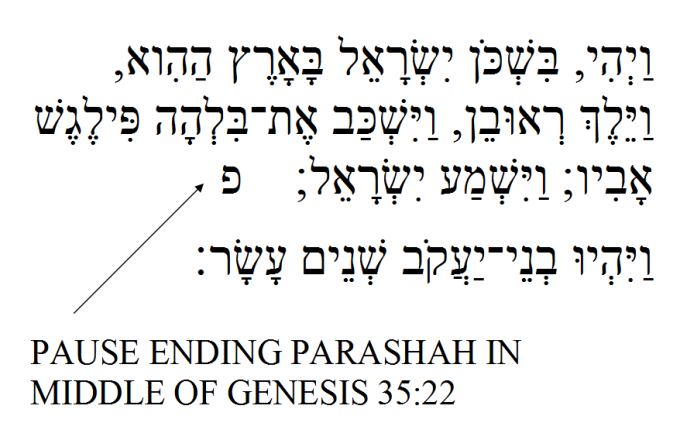
Before naming the sons of Israel, the decision has been made so that when we read their names, we will be able to determine where this Messiah, that has been pictured dozens of times in this chapter, will come from. And so now the list is given –
23 the sons of Leah were Reuben, Jacob’s firstborn, and Simeon, Levi, Judah, Issachar, and Zebulun; 24 the sons of Rachel were Joseph and Benjamin; 25 the sons of Bilhah, Rachel’s maidservant, were Dan and Naphtali; 26 and the sons of Zilpah, Leah’s maidservant, were Gad and Asher. These were the sons of Jacob who were born to him in Padan Aram.
The order of the sons is given not by birth, but by mother and then by birth. Leah is mentioned first. She pictures the law and so her sons are given. Christ will come under the law. And from her sons, the first three have been excluded, therefore, we can see that Judah will be the one to bear the Messianic line.
Then the sons of Rachel, who pictures grace, are named. And then the two maidservants are listed with their sons, Rachel’s maid first and then Leah’s. But two more questions arise, “Why are the sons listed at all?” And, “Why are they listed here?”
The answer is that all of the sons of Israel are now born with the coming of Benjamin. In this chapter, we saw the renaming of Jacob to Israel for the second time. The first time he was renamed on the night he wrestled with the unnamed Man, and the name and blessing of Israel applied to Jacob the man.
In this chapter, the name and blessing of Israel applies to Jacob the people. Unlike Isaac and Jacob who alone held the blessing, Israel is now a collective group of people, all sharing in the covenant blessings. And the reason for the naming of them here is because of what we will see next, in our final thought of the day…
III. The Death of Isaac
27 Then Jacob came to his father Isaac at Mamre, or Kirjath Arba (that is, Hebron), where Abraham and Isaac had dwelt.
Jacob now comes to the home of his father because he will assume the role as leader of the clan which has gone from Abraham through Isaac. The sons of Israel were listed by name to indicate that all of them will participate in the inheritance of the clan, not just one of them. They will be a united group of people.
Hebron is the third major place of note that Abraham took up residence, and it is where both he and Sarah died and were buried. Isaac has resided there all along, blind and waiting for his time to end. When Jacob left there many long years before, he left with his staff and this blessing of his father –
“May God Almighty bless you,
And make you fruitful and multiply you,
That you may be an assembly of peoples;
4 And give you the blessing of Abraham,
To you and your descendants with you,
That you may inherit the land
In which you are a stranger,
Which God gave to Abraham.”
The blessing has been fulfilled. God Almighty, El Shaddai, has blessed him (Gen 35:11). He has been fruitful and multiplied. He has become an assembly of people. He has received the blessing of Abraham. He and his descendants are now the inheritors of the land in which he is a stranger and which God gave to Abraham.
This then is the second reason for the listing of the sons of Israel in this place and at this time. The word of God is very precise in how it is detailed and why it is in the order it follows. It is an amazing record of the wisdom of God in His unfolding plan of redemption.
Every part of the blessing given by Isaac was fulfilled literally and completely. The names of the sons are given before Jacob’s meeting with Isaac to show this. But guess what, Isaac won’t die for another 12 years after Jacob’s move to Haran.
It’s a complicated calculation which I won’t bother you with, but we can tell that Isaac will be alive when Joseph is sold by his brothers and he will actually live until 10 years before Jacob and his family move to Egypt. Why is it important to know this? The answer is because of the next verses.
28 Now the days of Isaac were one hundred and eighty years.
Isaac outlived his father Abraham by 5 years, but he was blind for many of them. Thus the quantity of his years was exceeded by the quality of Abraham’s. The year of his birth was 2109 Anno Mundi. After a long and blessed life, Isaac will die in the year 2289 AM.
However, during the twelve years from Jacob’s arrival until Isaac’s death, nothing it mentioned. Understanding this makes what the Bible does record much more important to know. God isn’t recording the detailed life of these people. He is recording details of their lives. And the reason is because He is trying to wake us up and to search out His Son Jesus in the details.
29 So Isaac breathed his last and died, and was gathered to his people, being old and full of days.
The last time Isaac was mentioned directly was approximately 40 years earlier. In those years, nothing of his life is recorded. God gave him life and used that life, including his prolonged blindness, to tell us about Himself. One might say that it wasn’t fair that God allowed him to be blind just to show us pictures about Jesus.
But God is the Potter and we are the clay. How He uses us is up to Him. As Paul asks –
“But indeed, O man, who are you to reply against God? Will the thing formed say to him who formed it, “Why have you made me like this?” 21 Does not the potter have power over the clay, from the same lump to make one vessel for honor and another for dishonor?” Romans 8:20-21
When we read and understand the details of these stories, we find the sovereignty of God, but also His great grace. Why else would He show us these things, all telling about Jesus, unless He wanted us to focus on Jesus. And why would He send Jesus to die, unless He wanted us to receive that offering?
The complexity of this book is a demonstration of the love of God for each one of us. Every person recorded is there in an attempt to get us to wake up and see that God has done all of this… for us. How can we turn our back on such a gift? How can we not accept it when we see men such as Isaac used as he was so that we are the recipient of the vision that he lacked.
And Isaac, Isaac of all people will someday stand before his Redeemer and say, “Surely, once I was blind, but now I see.”
29 (con’t) And his sons Esau and Jacob buried him.
The chapter ends with this final thought. The struggle between two boys that began in their mother’s womb and which was a source of grief to their parents is now behind them. Together they lay their father to rest in the dust from which he came.
Esau – picturing fallen man, and Jacob, picturing the risen Christ, together bury the enmity between each other and they bury the man whose name means “Laughter” – both rejoicing at a life well lived and in the hope of the resurrection of the righteous, among whom their father is counted.
A final thought for us is that when we too are resurrected because of the merits of Christ, Laughter will be there with us.
If you’ve never rejoiced in the joy of the salvation of the Lord, and if you’ve never had a moment where you can definitively say “I belong to Jesus,” then please give me just another moment to call to your heart and explain to you your need for Him.
Closing Verse: By faith Isaac blessed Jacob and Esau concerning things to come. Hebrews 11:20
Next Week: Genesis 36:1-14 (The Generations of Esau) (90th Genesis Sermon). Make sure to read and study those verses.
The Lord has you exactly where He wants you and He has a good plan and purpose for you. Call on Him and let Him do marvelous things for you and through you.
The Circle of Life
Then they journeyed from Bethel
And when there was but a little distance to go
To Ephrath, Rachel labored in childbirth as well
And she had hard labor in a painful throe
Now it came to pass and it did appear
When she was in hard labor, a painful throe
That the midwife said to her, “Do not fear
You will have this son, yes, this one also
And so it was, as her soul was departing
(for she died)
That she called his name Ben-Oni
But his father called him Benjamin
He is the one at his right side
So Rachel died, her life they couldn’t save
Near to Ephrath (that is, Bethlehem), she was buried on the way
And Jacob set a pillar there on her grave
Which is the pillar of Rachel’s grave to this day
Then Israel journeyed and pitched his tent
Beyond the tower of Eder is where he went
And it happened, when Israel dwelt in that land
That Reuben went and with Bilhah lay
His father’s concubine, this was out of hand
And Israel heard about it, bringing him dismay
Now the sons of Jacob twelve they were:
The sons of Leah were Reuben, born to Jacob first
And Simeon, Levi, Judah, these through her
Also Issachar and Zebulun by Leah they were nursed
The sons of Rachel were Joseph and Benjamin
Surely these two boys often made Jacob grin
The sons of Bilhah, Rachel’s maidservant
Were two – Dan and Naphtali
And the sons of Zilpah, Leah’s maidservant
Were Gad and Asher – that rounds out the 12 you see
These were the sons of Jacob a very fruitful man
They were those born to him in Padan Aram
Then Jacob came to his father Isaac at Mamre
Or Kirjath Arba (that is, Hebron)
Where Abraham and Isaac had dwelt
He would now settle in and not move on
Now one hundred and eighty years were Isaac’s days
So Isaac breathed his last and died
And was gathered to his people, being old and full of days
His sons Esau and Jacob buried him, it was by Rebekah’s side
There is a time for all of us when our life will end
A time when we will be buried in the grave
How will each of us our short lives spend?
Will we trust in Jesus, or continue to misbehave?
God has done all the work to reconcile us
All that is needed is to call out and receive Jesus
When we do, the deal is done, once for all time
Eternal life is offered to each, so don’t let a moment pass
And at our end we will receive the reward sublime
Together we can walk on streets of gold, clear as glass
Accept the pardon, the offering of grace
And for eternal days behold the splendor…
The majestic splendor of God’s glorious face
Hallelujah and Amen…