
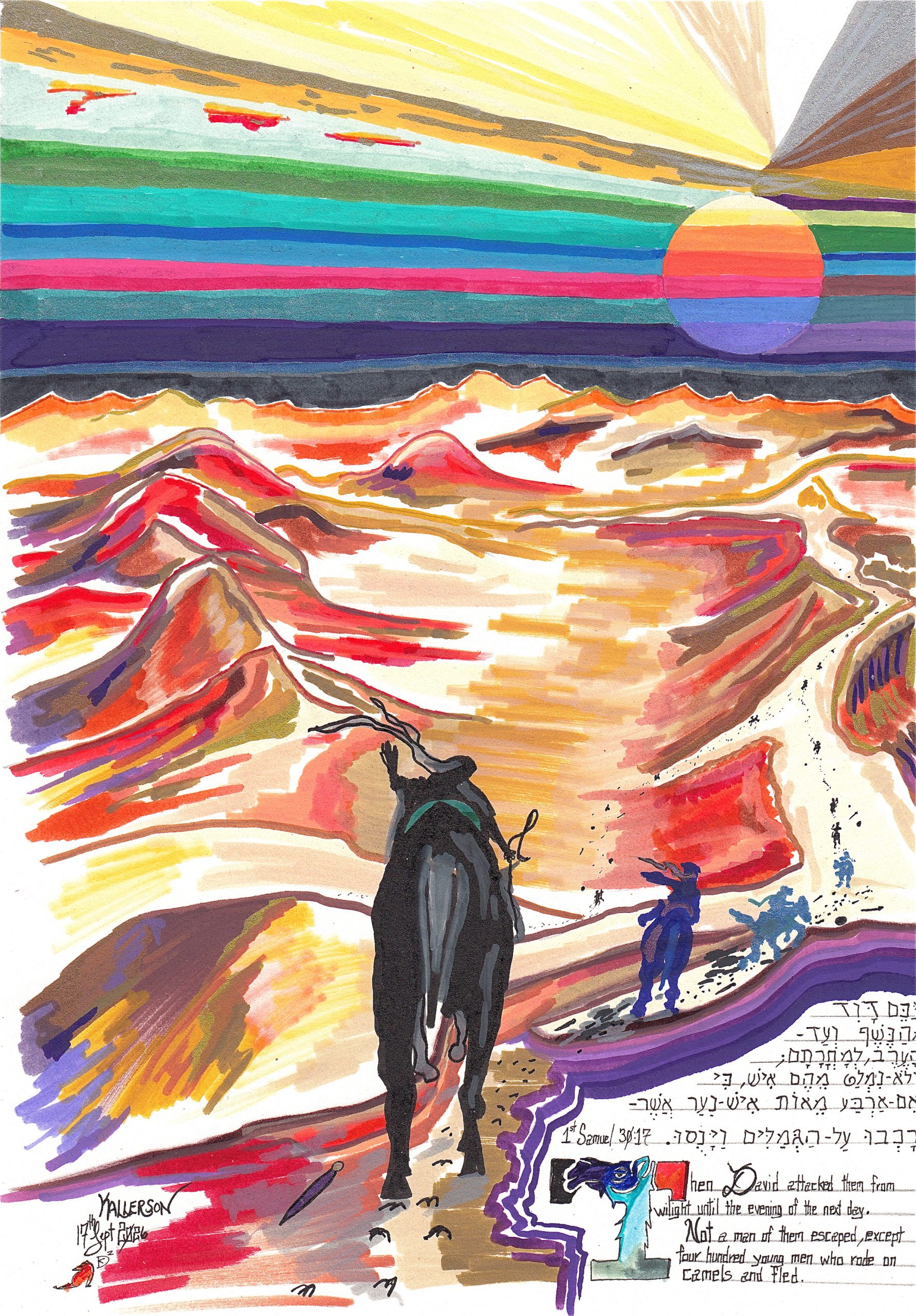
Artwork by Douglas Kallerson
1 Samuel 30:13-20
Wadi, the Besor, Part II
(Typed 25 May 2026 – Memorial Day) There are promised blessings and assured curses in the law concerning Israel. It says in Leviticus 26:7, “You will chase your enemies, and they shall fall by the sword before you.”
That was a promise when Israel was obedient to the Lord. Another word from the books of Moses said, “Then the Lord said to Moses, ‘Write this for a memorial in the book and recount it in the hearing of Joshua, that I will utterly blot out the remembrance of Amalek from under heaven.’” Exodus 17:14
Taken together, with the Lord’s promise to David when he consulted the ephod to determine the Lord’s will, it was certain that David would prevail in this battle.
We read such words, look at their fulfillment in the Bible, and we applaud God for His faithfulness. We also remark about David’s confidence in the Lord.
And yet, what is our outlook on life as we live it? When a loved one is taken from us, do we get upset at God? If we suffer physical or emotional distress, do we blame Him?
And what happens to our walk when we stumble and do something so incredibly stupid that we fear God might pull His love from us or decide to stop saving us?
Text Verse: “For by You I can run against a troop;
By my God I can leap over a wall.” 2 Samuel 22:30
We are in a lifelong battle against the biggest spiritual troop imaginable. Satan is hot on our heels, trying to trip us up. He is working to steal our joy, cause us to question God’s goodness, and whisper in our ears that we are deluded to think that God loves us and will never forsake us.
He is a miserable foe, always putting obstacles in our way to stop us from advancing in any and every area.
Unless we want to be a part of the defeated masses, we should bolster our walk with Bible reading, increase our stamina by consulting properly handled analyses of His word, and stay doggedly in prayer, communicating with Him over every aspect of our lives.
Avoiding Bible studies for a week or two makes it easier to find something else to fill our time dedicated to that. Skipping a day of reading the word will quickly lead to not reading the word at all. Anything positive that we do with and for the Lord will find something to easily replace it if we allow ourselves to be redirected from it.
David engaged the battle against a troop, and he tirelessly jumped over the obstacles that got in his way. Yes, he failed the Lord at times. Those failures are recorded for our benefit, because when he failed, he gathered himself up, redoubled his efforts in the proper direction, and got back on track.
Church may seem less exciting than Sunday morning at the beach, but it is where you will be fed, reminding you of what is really important. You have eternity to sit on the beach, or do whatever it is God has in store for us.
Spend your time wisely, and may your efforts be properly directed all the days that you walk before the Lord who saved you. Let this be a reminder to you to hold fast to such truths that are to be found in His superior word. And so, let us turn to that precious word once again, and… May God speak to us through His word today, and may His glorious name ever be praised.
I. Eating, and Drinking, and Roundelaying (verses 13-16)
13 Then David said to him, “To whom do you belong, and where are you from?”
vayomer lo David lemi atah vee mizeh atah – “And he said to him, David, ‘To whom, you? And where, from this, you?’” Verse 11 already identified this person as an Egyptian. That was either an advanced note by the chronicler, or he was identifiable by some characteristic which the men recognized when they found him.
Either way, David interrogates him to find out if there is any connection between him and those taken from Ziklag. David means Beloved. He has typologically been used to refer to accepting the doctrines of Christ. The man responds to David carefully…
13 (con’t) And he said, “I am a young man
vayomer naar – “And he said, ‘Lad.’” The word lad seems odd to apply to oneself. Translations say “youth”, “boy”, “young man,” etc. Some translations skip over the word, as if it is out of place. Others incorrectly give up on it as being part of his words and make it a part of the introduction: “‘I’m from Egypt,’ the young man answered.”
The reason it is odd is that anyone looking at him would know his general age. Thus, it seems like a superfluous addition. At times, the word naar, lad, is rendered as a servant, such as –
“Now the donkeys of Kish, Saul’s father, were lost. And Kish said to his son Saul, ‘Please take one of the servants [naar] with you, and arise, go and look for the donkeys.’” 1 Samuel 9:3
There are instances where this word is used of a servant old enough to have his own sons. However, naar is not used in the sense of a servant here. This is because he specifically calls himself a servant as he continues. He next says…
13 (con’t) from Egypt,
mitsri – “Egyptian.” As noted, he has already been identified as an Egyptian. He would probably look like an Egyptian, and unless he was a servant for an extended period, his accent would sound Egyptian as well. Egypt means Double Trouble. Next, he says…
13 (con’t) …
anokhi – “I myself.” There are different ways to identify oneself. The simplest is to have the verb carry a first-person identifier, such as taking the word adon, lord, and making it possessive, adoni, my lord. There is also the word ani, I. It is always plain: ani Charlie, “I, Charlie.” It is the common word used in Israel today.
A third way is to use anokhi, a fuller/heavier form. Quite often, it appears where the speaker’s personal presence, identity, responsibility, or distinction from another party is prominent. In this case, it signals that this Egyptian lad’s presence in relation to the surrounding narrative is at issue.
So, taken with the last word, he is setting himself apart from the surrounding situation, mitsri anokhi – “I myself, Egyptian.” He continues his carefully chosen words…
13 (con’t) servant
eved – “servant.” Saying eved here means he could not have used naar, lad, in any other sense than a purposeful use similar to, “I’m just a young guy.” Adding in that he is a servant is like having a pity party, “I’m just a young guy, a servant. I am unimportant.” This has all been introduced before getting to his next words…
13 (con’t) of an Amalekite;
leish amaleqi – “to ‘man, Amalekite’.” He could have just said “to an Amalekite”, but he adds in “man” to reflect a distinction between his being a lad and the one he was a servant to who is a man. As odd as his response may sound, each word has been carefully chosen because of the last word, Amalekite.
As a servant of an Amalekite, he understood that they were at constant war with Israel. It would be a part of their culture and conversation. This person is standing among Hebrews, and he is doing everything in his power to elicit sympathy and to distinguish himself from those with whom he was, until just recently, allied.
He is trying to absolve himself of responsibility. Step back and look at the whole thing. He is a youth identified by nationality, “Egyptian,” and only then by servile association, “servant to a man, an Amalekite.”
Thus, he is connected to the Amalekite company, but he is not an Amalekite. The use of anokhi helps bring his personal identity to the front: “An Egyptian lad — I myself.”
Amalek is derived from am, people, and malaq, to nip or wring off the head of a bird with or without severing it from the body. They are The People Who Wring Off. They are those who are disconnected from the body and who strive to disconnect the body.
The lad’s response to David has been carefully worded thus far. He continues, saying…
13 (con’t) and my master left me behind, because three days ago I fell sick.
vayaazveni adoni ki khalithi ha’yom sheloshah – “And he relinquished me, my lord, for I rubbed, the day, three.” Whatever he was hoping to convey previously, here he tries to elicit maximum pity from those who have found him. In essence, “I am such a miserable person that by simply falling sick, my master abandoned me.”
This may be true. The Amalekites may have abandoned him as too much trouble when he fell sick. It would show extreme coldness of heart. It would also show that he was not a valued servant or that he wasn’t worth any inconvenience at all.
As will be seen, the plunderers will be engaged, and there will be a great slaughter. Despite this, four hundred will get away on camels. That means the camp of plunderers would be in the thousands. Along with them, they had camels and all other types of animals. And yet, they didn’t bother to sling him over a donkey and take him along.
There is another possibility which cannot be known, but which may account for his careful separation of himself from those he was with. He could have attempted an escape from their camp, gotten lost in the wilderness, and run out of water. If so, his excuses are a fabrication to keep him from being considered a deserter.
As for the word khalah, rubbed, it is used in various contexts. When something is rubbed, it can show favor, like rubbing someone’s face. It can show sickness, like being worn down in health, as in this case. It can also apply in a spiritual sense, like being worn down in spirit, grieved, etc. He continues…
14 We made an invasion of the southern area of the Cherethites,
His words bear emphasis: anakhnu pashatnu negev ha’kerethi – “We, we stripped ‘parchedland, the Cherethite’.” He adamantly includes himself in the plundering, noting that the band of raiders he was with “stripped” the southern area of the Cherethite.
The idea is that of a person having all his clothing stripped off or a person or an animal being skinned. It is a raid where everything that can be plundered is taken. In this case, it is the Cherethite, a new designation in Scripture.
The name, depending on the context, is derived from karath, to cut off, or from the name of Crete. Without the vowel points, the words Cherethite and Cretan are the same.
Various options for the meaning of the name are Executioners, Exiles, Cretans, or Outcasts. It is the same word as when one cuts a covenant, so I would call ha’kerethi, the Cutter.
This group dwelt on the seacoast in the south of the land. They are thought to be either Philistine or from the same general group as the Philistines.
When David was stripping the land, it never said he came against these people. Later, when he is king, he will have them as his own warriors along with the Pelethites, as noted in 2 Samuel
It is possible that he met them during his time in Ziklag and was impressed with their military capabilities. As for the plundering, it was also…
14 (con’t) in the territory which belongs to Judah,
veal asher lihudah – “and upon ‘which to Judah’.” This area was east of the Cherethite. The land grant of the southern area of Judah included where the Cherethite was and continued east. Judah is from yadah, to use the hand. In the case of Judah, it signifies raising the hands as a means of praise. Hence, it is rendered Praise. Next, he says…
14 (con’t) and of the southern area of Caleb;
veal negev kalev – “and upon ‘parchedland, Caleb’.” The area of Caleb is further east. He was granted the land around Hebron because of his faithfulness to the Lord when the other spies who went into Canaan gave a bad report of the land.
In Joshua 15, that area was designated as his. Hebron itself was designated as a priestly city, but all of the surrounding area belonged to Caleb. The parchedland of Caleb would include the area granted to Caleb’s daughter Achsah, as also seen in Joshua 15.
Caleb means dog. In the passages where he was mentioned, he was consistently used as a picture of the Gentiles, being faithful like dogs.
Having carefully set a distinction between himself and his Amalekite master, he admits he was a part of the company that came against David’s city…
14 (con’t) and we burned Ziklag with fire.”
veeth tsiqlag saraphnu baesh – “and Ziklag we burned in the fire.” Ziklag is the city where David and his men lived with their families. This is the only city the lad mentions as being burned with fire. David knew it was burned, and the Egyptian couldn’t deny it, so he openly states that he was among those who did it.
As noted in 1 Samuel 27, Ziklag signifies Measure of Pressure. With the information he needs at hand to regain his people and his goods, David sees his opportunity to act…
15 And David said to him, “Can you take me down to this troop?”
Rather: vayomer elav David hathorideni el ha’gedud ha’zeh – “And he said unto him, David, ‘You will cause to descend me unto the cohort, the this.’” It is not a question. Rather, it is an order. David knows that he can use this person to direct him to the plunderers. And so, he speaks determinedly that this is what will happen.
There is natural reticence on the part of the Egyptian though…
15 (con’t) So he said, “Swear to me by God that you will neither kill me
vayomer hishaveah li belohim im temiteni – “And he said, “You must be (surely) sevened to me in God if you will cause to kill me.” Before he will agree to take them, he wants a solemn oath that David or his men will not kill him.
The Aramaic versions known as the Peshitta and the Lamsa say Lord JEHOVAH and Lord respectively instead of God. That seems unlikely. As an Egyptian, this lad would probably not be a follower of the Lord or know anything about the Lord.
He wants a general vow based on the God David followed as an assurance that he will be protected. He understands that being a part of the raiders, David and his men would be inclined to kill him. But he is equally concerned about another possibility…
15 (con’t) nor deliver me into the hands of my master,
ve’im tasgireni beyad adoni – “and if you will cause to shut me in ‘hand, my lord’.” Not knowing David’s intentions, the lad wants an oath that he will not be delivered into the hand of his lord. If he escaped from his master, his request is something the law prescribed as well –
“You shall not give back to his master the slave who has escaped from his master to you. 16 He may dwell with you in your midst, in the place which he chooses within one of your gates, where it seems best to him; you shall not oppress him.” Deuteronomy 23:15, 16
He told David that he fell sick and was abandoned, so this verse may not apply. But based on his treatment, it should. Either way, he worries that his life will be severely shortened or incomprehensibly misery-filled if he were to be given back to his owner. Thus, in making an oath concerning these two conditions…
15 (con’t) and I will take you down to this troop.”
veoridkha el ha’gedud ha’zeh – “And let me cause to descend you unto the cohort, the this.’” The word gedud, cohort, was used in verse 8 when David asked the Lord if he would overtake the raiders. It is used twice in this verse and one more time in verse 23.
In the stories of David’s life, the only other two times it is used will be in relation to his men as they are arranged into cohorts. This makes it likely that the text verse, which is repeated in Psalm 18:29, is probably written about this account.
David was likely told about the size of the force, their tactics, the specialties of fighters they had, and so forth. All of this is omitted from the narrative, but it would have all been disclosed before the attack.
And more, it has already been acknowledged by the Lord that David would prevail in this endeavor –
“And he asked, David, in Yehovah, to say, I will pursue after the cohort, the this? I will cause to reach him?
And He said to him, You must pursue, for causing to reach, you will cause to reach, and causing to snatch, you will cause to snatch.’” 1 Samuel 30:8 (CG)
The lad uses a jussive (let me cause to descend you), indicating his firm resolve to perform the action if his requests are granted. Without noting David’s acceptance, it is implied in the next words…
16 And when he had brought him down,
vayoridehu – “And he caused to descend him.” With obvious assurances made in accord with his petitions, the Egyptian was able to follow the track he knew would take them to the plunderers. Being marauders, they probably didn’t have a city. Rather, they would spread out in tents in an area they claimed as home. With this understanding, the narrative next notes…
16 (con’t) there they were, spread out over all the land,
vehineh netushim al pene khal ha’arets – “And behold! Let-go upon ‘faces, all the land’.” The word natash, signifies to pound. By implication, it signifies to disperse, as if something is expanding because of being pounded. Saying “let-go” suits the various contexts of all forty uses in the Old Testament.
They were spread out all over the place, covering all the land where they holed up after raiding. They were…
16 (con’t) eating and drinking and dancing,
okhelim veshotim vekhogegim – “eating, and drinking, and roundelaying.” The Amalekites stripped communities across a vast swath of land extending from the Mediterranean practically to the Dead Sea. They would have tons of supplies, including livestock, harvested goods, people, and everything else one could imagine.
Knowing they could go out and plunder more anytime they needed, they got right into the business of consuming their spoil. The word khagag was used when Israel went into the wilderness to hold a feast to the Lord in Exodus.
It was also used of the mandated feasts of the Lord in Leviticus, Numbers, and Deuteronomy. It signifies “to move in a circle.” In the case of a feast of the Lord, it would be a sacred procession. To understand a comparable use today, one might think of the Muslims when they go to Mecca and circle around their black idol stone, the Kaaba.
In the case of these raiders, they too would be doing what people do at celebrations. In the US, we call it a circle dance, but the more official term is a roundelay. The people would be a’drinkin’, a’hootin’ n’ a’hollerin’, and a’kickin’ up the dust in excited roundelays. This was…
16 (con’t) because of all the great spoil which they had taken from the land of the Philistines and from the land of Judah.
bekhol ha’shalal ha’gadol asher laqehu meerets pelishtim u-meerets Yehudah – “in all the ‘booty, the great’, which they took from ‘land, Philistines’, and from ‘land, Judah’.” This tells us that the Cherethite people belonged within Philistine territory.
At the time, this would have included Ziklag. After David returned to Judah, Ziklag would be considered Judah’s territory. In this excited state of partying, the raiders left themselves open to trouble. Ironically, the Egyptian lad they left behind as worthless was the impetus for their downfall…
Satan has taken what belonged to us
A life of goodness and fellowship with God
To snatch it back from him, God sent Jesus
To share in that, give the gospel a favorable nod
Through Jesus’ cross, the victory is gained
He prevailed over sin, opening the way
Through His work, access to heaven is attained
Now comes the anticipation of that glorious day
Reconciliation with God with joy and peace
Eternity in His presence because of Jesus
Come to the cross and find release
See what great things God has done for us
II. The ‘All’, He Caused to Return, David (verses 17-20)
17 Then David attacked them from twilight until the evening of the next day.
vayakem David mehanesheph vead ha’erev lemakhoratham – “And he caused to strike them, David, from the breeze and until the evening to their morrow.” A new word is seen, nesheph, a breeze. By implication, it refers to dusk or dawn when the breeze blows because of the temperature change from hot to cool or cool to hot.
It is derived from nashaph, to blow up fresh. That is seen only twice when the Lord is said to blow, such as at the parting of the Red Sea in Exodus 15. Of the word nesheph, the Topical Lexicon says –
“Scripture employs this liminal moment to underscore vulnerability, secrecy, expectancy, and the suddenness of divine intervention.”
The word “twilight” is misleading because it can refer to either the dawning light or the evening light, but it generally signifies the evening light. This was probably the early morning light, meaning that the people were partying all night long.
Many of them would be incredibly drunk. Others would have passed out from fun or exhaustion. Those still awake would be in no shape to effectively engage in battle.
Thus, they were strategically attacked by David and his men in the very earliest hours, with the battle lasting the entire day, as it says, “to their morrow.” The evening is the biblical beginning of the next day.
Some scholars, such as Keil, disagree with this, saying that the battle was over 24 hours long. Keil says, “Nesheph signifies the evening twilight here, not the dawn, – a meaning which is not even sustained by Job 7:4.” That is completely incorrect. Job 7:4 says –
“If I laid, and I will say, ‘When I will arise and it will be fluttered evening, and I will sate tossing until breeze [nesheph].” Job 7:4 (CG)
In other words, Job went to bed, and he wondered how long he would toss and turn until the time of the morning breeze. Keil notably left out Psalm 119, which also speaks of this time of day –
“I arose in the breeze [nesheph] and I (surely) helpcalled.
To your words [k.], I waited.” Psalm 119:147 (CG)
One gets up in the morning. This is what the psalmist did, crying out to God for help, pouring out his heart and looking to the promises of the Lord for the new day.
The number of those slain in the battle must have been incredible based on the next words…
17 (con’t) Not a man of them escaped, except four hundred young men who rode on camels and fled.
velo nimlath mehem ish ki im arba meoth ish naar asher rakhevu al ha’gemalim vayanusu – “And not he was eluded from them man, for if four hundreds man – lad, whom they rode upon the camels, and they fled.” If four hundred got away on camels, there must have been thousands in the camp.
This also tells us the battle commenced at the beginning of the day, not in the darkening night. If they fought all night, nobody would have seen people fleeing.
As for the number four hundred, it is a derivative of four, the number of creation and the world (and city) number. Ten signifies “Completeness of order, marking the entire round of anything, is, therefore, the ever-present signification of the number ten. It implies that nothing is wanting; that the number and order are perfect; that the whole cycle is complete” (Bullinger).
Four hundred is also a derivative of forty and ten. Bullinger says of forty –
“It is the product of 5 and 8, and points to the action of grace (5), leading to and ending in revival and renewal (8). This is certainly the case where forty relates to a period of evident probation. But where it relates to enlarged dominion, or to renewed or extended rule, then it does so in virtue of its factors 4 and 10, and in harmony with their signification.”
The gamal, camel, comes from the verb gamal, to deal fully or adequately with. Thus, it can mean to wean, repay, require, reward, ripen, and so forth. It refers to the treatment, either well or ill, that a person will receive.
With the battle complete and the enemy subdued…
18 So David recovered all that the Amalekites had carried away, and David rescued his two wives.
vayatsel David eth kal asher laqekhu amaleq veeth shete nashav hitsil David – “And he caused to snatch, David, all which they took, Amalek. And ‘two, his wives’, he caused to snatch, David.” Using the word natsal, to snatch, gives the mental image of David snatching his goods and wives from whatever catastrophe, such as selling off, that they would otherwise have faced.
This is a general statement of complete success for David’s men. Nothing that was raided and hoped to be retrieved was lost. One might say, “What about all the partying, drinking, and eating?”
The answer is that these raiders had gone over an entire swath of land. The portion belonging to David would have been an insignificant part of the total booty taken. This will be seen later as the chapter ends. The total scope of recovery is reiterated…
19 And nothing of theirs was lacking, either small or great,
velo nedar lahem ha’qaton vead hagadol – “And not it was arranged to them from the diminutive and until the great.” A new word is seen: adar, to arrange, such as in a battle. In this case, nothing was arranged, meaning lacking, as if they had to rearrange their possessions to form a new arrangement. This included…
19 (con’t) sons or daughters, spoil or anything which they had taken from them; David recovered all.
vead banim u-vanoth u-mishalal vead kal asher laqekhu lahem ha’kol heshiv David – “and until sons, and daughters, and booty, and until all which they took to them. The ‘all’, he caused to return, David.” The list is all-inclusive. Boys weren’t used for target practice or sold on the road as slaves. Daughters were spared from being sold off in forced marriages or some other horror, etc.
Of everything entrusted to David as the leader, nothing was lost.
20 Then David took all the flocks and herds
Where to separate the clauses of this verse is confusing: vayiqakh David eth kal ha’tson veha’baqar – “And he took, David, all the flock and the cattle.” Even if the clause division is complicated, the words are readily understandable.
It means that all of the captured livestock, which would have been an immense amount taken from all over the southern areas that were raided, was taken by David. Although the animals were valuable, it was more favorable to the men than if he had taken all the gold and silver.
David probably told them what he planned to do with the flocks, which would have been well received by them. As will be seen later, he wasn’t keeping them for himself. With this much understood, it next says…
20 (con’t) they had driven before those other livestock,
nahagu liphne ha’miqneh ha’hu – “They drove to ‘faces, the livestock’, the it.” It seems like there is a word missing. The KJV adds the word “which”, something some scholars argue against, along with the word “other”. The NKJV drops the “which” and keeps the “other.”
Both words seem ok. Taken together, the meaning is probably, “And David took all the flock and the cattle that they drove before the livestock which was theirs.”
The only exception to all of the animals David got was what belonged to the men of Ziklag. They had their animals separated. Those, meaning David’s plunder, were driven before the livestock of the men of Ziklag.
The unstated meaning is that everything else would have been divided up as spoil between all the men. That would include people, gold, silver, and whatever else was of value that had been stripped by the raiders. It would have been an incredible haul.
As for the animals mentioned, the tson, flock, is from a root meaning to migrate. The baqar, cattle, is from the verb baqar, to plow, but by extension, to search, seek out, inquire, etc. The livestock is from qanah, to acquire.
To explain why David’s animals were out front, the final clause says…
*20 (fin) and said, “This is David’s spoil.”
vayomeru zeh shelal David – “they said, ‘This ‘booty, David’.’” Think of an army coming home from battle with all their spoil, but the leader’s spoil being on display in front of everything else. That is what the structure of the words conveys.
David secured everything that was taken, while at the same time, he amassed an incredible amount of booty. Also, the enemy was completely defeated. For four hundred men, it would have been an astonishing victory.
Nothing is said about how many of his men may have been injured or killed in the battle. Instead, the verses focus on the magnitude of the victory, not mentioning the casualties.
Without determining any typology, we can still make a sound connection between these verses and life in Christ. The enemy, the devil, came between God and man. He plundered humanity and took the best of what was intended for us.
However, God in Christ came to lead the battle and bring restoration of everything lost, as seen in verses 18 and 19 –
“And he caused to snatch [natsal], David, all which they took, Amalek. And ‘two, his wives’, he caused to snatch, David. 19And not it was arranged to them from the diminutive and until the great, and until sons, and daughters, and booty, and until all which they took to them. The ‘all’, he caused to return [shuv], David.”
Satan took away man’s chance at life, fellowship with God, and existence without pain, suffering, sadness, or loss. Jesus, through His ministry and on His cross, was able to snatch right from the devil’s hands everything Satan plundered from us.
And He didn’t just get it and keep it for Himself! He returned it to the masses of humanity willing to follow Him in the spiritual battle being played out in redemptive history. All are welcome to participate by simple belief in what Jesus has done.
Through accepting the premise of the gospel, we have full rights to everything Jesus accomplished. From there, we are given the right to decide what we will do with that gift. Will you sit on your hands and wait for the rapture (or your death) to come? That is your right.
Or, will you share the gospel, become a missionary, or seek ordination and preach the word? There are opportunities for everyone to do something. Churches need members doing the business of the church.
Without reliable support, missionaries cannot just get up and go, expecting things to fall into place. Waitresses may never hear the gospel unless someone opens his mouth and speaks or leaves behind a tract.
The battle for restoration by Christ is done. Who will be a part of it? The answer is largely up to us. We are to be the hands and feet of sharing the good news that there are restoration and reconciliation. Let us be about the business of doing our part.
Closing Verse: “How then shall they call on Him in whom they have not believed? And how shall they believe in Him of whom they have not heard? And how shall they hear without a preacher? 15 And how shall they preach unless they are sent? As it is written:
‘How beautiful are the feet of those who preach the gospel of peace,
Who bring glad tidings of good things!’” Romans 10:14, 15
Next Week: 1 Samuel 3:21-31 Big fun ahead, that’s for shore, just wait and see... (Wadi, the Besor, Part III) (64th 1 Samuel Sermon)
The Lord has you exactly where He wants you. He has a good plan and purpose for you. He is the One who abases the haughty and exalts the humble. He regards the lowly, and the proud, He knows from afar. So yield yourself to Him, trust Him, and believe His word. In this, He will do great things for you and through you.
1 Samuel 30:13-20 (CG)
And he said to him, David, “To whom, you? And where, from this, you?”
And he said, “Lad, Egyptian, I myself, servant to ‘man, Amalekite’. And he relinquished me, my lord, for I rubbed, the day, three. 14We, we stripped ‘parchedland, the Cherethite’, and upon ‘which to Judah’, and upon ‘parchedland, Caleb’, and Ziklag we burned in the fire.”
15And he said unto him, David, “You will cause to descend me unto the cohort, the this.”
And he said, “You must be (surely) sevened to me in God if you will cause to kill me, and if you will cause to shut me in ‘hand, my lord’. And let me cause to descend you unto the cohort, the this.”
16And he caused to descend him. And behold! Let-go upon ‘faces, all the land’, eating, and drinking, and roundelaying in all the ‘booty, the great’, which they took from ‘land, Philistines’, and from ‘land, Judah’. 17And he caused to strike them, David, from the breeze and until the evening to their morrow. And not he was eluded from them man, for if four hundreds man – lad, who they rode upon the camels and they fled. 18And he caused to snatch, David, all which they took, Amalek. And ‘two, his wives’, he caused to snatch, David. 19And not it was arranged to them from the diminutive and until the great, and until sons, and daughters, and booty, and until all which they took to them. The ‘all’, he caused to return, David. 20And he took, David, all the flock and the cattle they drove to ‘faces, the livestock’, the it. And they said, “This ‘booty, David’.”
1 Samuel 30:13-20 (NKJV)
13 Then David said to him, “To whom do you belong, and where are you from?”
And he said, “I am a young man from Egypt, servant of an Amalekite; and my master left me behind, because three days ago I fell sick. 14 We made an invasion of the southern area of the Cherethites, in the territorywhich belongs to Judah, and of the southern area of Caleb; and we burned Ziklag with fire.”
15 And David said to him, “Can you take me down to this troop?”
So he said, “Swear to me by God that you will neither kill me nor deliver me into the hands of my master, and I will take you down to this troop.”
16 And when he had brought him down, there they were, spread out over all the land, eating and drinking and dancing, because of all the great spoil which they had taken from the land of the Philistines and from the land of Judah. 17 Then David attacked them from twilight until the evening of the next day. Not a man of them escaped, except four hundred young men who rode on camels and fled. 18 So David recovered all that the Amalekites had carried away, and David rescued his two wives. 19 And nothing of theirs was lacking, either small or great, sons or daughters, spoil or anything which they had taken from them; David recovered all. 20 Then David took all the flocks and herds they had driven before those other livestock, and said, “This is David’s spoil.”