
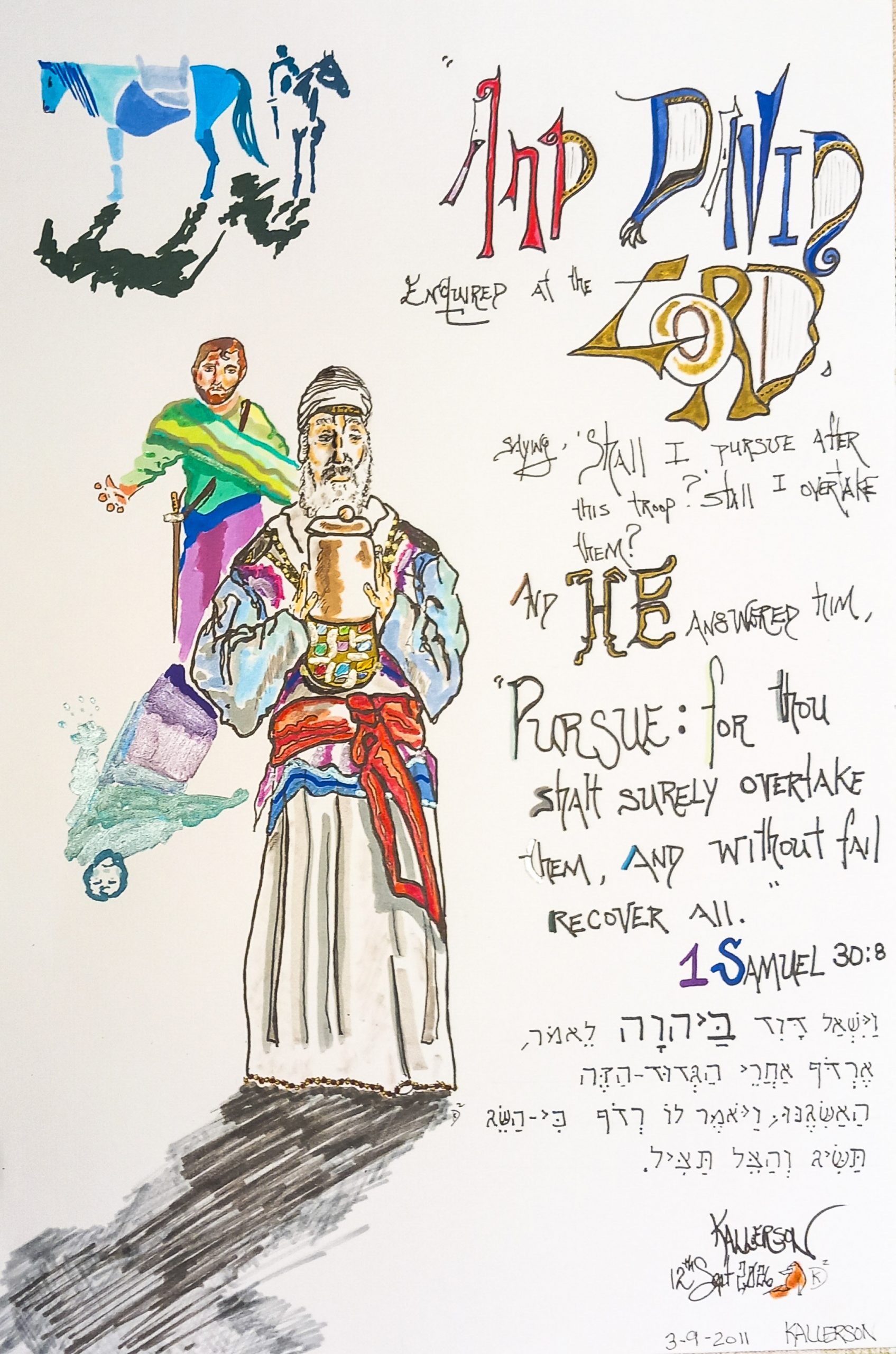
Artwork by Douglas Kallerson
1 Samuel 30:1-12
Wadi, the Besor, Part I
(Typed 18 May 2026) Years ago, I went to Alaska for a summer to mine gold. The work was on the Forty Mile River, and the claim was in the middle of nowhere. Bears were a problem. Despite that, we never had any run-ins with them.
Some years later, I went bear hunting in Idaho. It was a pretty exciting experience, and it gave me a chance to get more personal with bears than I had in Alaska. We hunted them with a pack of specially bred hunting dogs.
They were amazing animals that could sniff out a bear and chase it up a tree with seemingly no effort at all. They were obedient to a T, and the guy who owned them was a master of his art. He took great care of his dogs and treated them like family, even though he had many of them.
What amazed me, however, was the distinction that he made between them, and between them and the bears. If a dog wouldn’t learn, the guy that I walked with said, “That dog was done.” One can imagine what that means. Bear hunting is a business, and an incompetent dog is as worthless as most politicians.
One time, he told a bit about his best hunting dog. The thing took off after a bear. When the bear jumped into a river to get away, the dog went after him. That was a mistake. Bears and dogs in the water together mean the bear has the advantage.
The dog had a collar to track him, and his owner found the sad remnants of the duel. He still broke down in tears over his dog when the story was told. It seemed contradictory to me at first. He shoots bears all season, and hunts other animals as well. And if he had a stupid dog, it was “done.”
And yet, that one dog still moved him to tears…
Text Verse: “Therefore say to them, ‘Thus says the Lord of hosts: “Return to Me,” says the Lord of hosts, “and I will return to you,” says the Lord of hosts.” Zechariah 1:3
The reason for the bear and dog story is that familiarity breeds affection. In today’s passage, we have David and his war-hardened men returning to their city, Ziklag, and being literally overcome with anguish at what they returned to: total loss.
And yet, these are the same men of whom it said in Chapter 27 –
“Whenever David attacked the land, he left neither man nor woman alive, but took away the sheep, the oxen, the donkeys, the camels, and the apparel, and returned and came to Achish.” 1 Samuel 27:9
Such accounts seem contradictory until the “familiarity” equation is introduced. Once we realize that we treat those with whom we are more closely associated or more in tune with differently than we would treat others, the brutal side fades away.
Think of Israel. Despite being in the same state of disobedience to God that the rest of the people of the world are in, the Lord continued to call to them to return. There was the familiarity of the covenant, the fathers, and the promise of the Messiah.
Because of such things, the Lord was willing to tolerate so much from them that He would not tolerate from the world at large. And this continues today.
As a nation seeking the Lord, they are as far from being right with Him as were Sodom and Gomorrah. And, truthfully, they are further from Him in that regard because they have the covenant, the fathers, and the since-arrived Messiah.
The Mosaic covenant has brought them all the disaster they have faced, and yet, that covenant has been what has kept them as a people, despite their conduct.
When we look at Israel, we should consider ourselves. We have the greater and surer covenant, with more precious promises, and yet, what is our conduct like? It may be, depending on who we are, that we deserve a sterner hand than Israel.
But because of Jesus, we are given continued grace. I, for one, am eternally grateful. Where would I be today or any given day without it? Thank God for Jesus.
The Bible is the book where we find Him. Yes, great things are to be found in His superior word. And so, let us turn to that precious word once again, and… May God speak to us through His word today, and may His glorious name ever be praised.
I. And He Seized Himself, David (verses 1-6)
Now it happened, when David and his men came to Ziklag, on the third day,
vayhi bavo David vaanashav tsiqlag bayom ha’shelishi – “And it was, in ‘coming’, David and his mortals – Ziklag, in the day, the third.” This is based on what was said in verse 28:1 or 29:10 –
“And it was, in the days, the those, and they assembled, Philistines, their camps to the host to be fought in Israel. And he said, Achish, unto David, “Knowing, you must know, that with me, you will go out in the camp, you and your mortals.” 1 Samuel 28:1 (CG)
“And now you must cause to rise early in the morning, and ‘servants, your lord’, who they came with you. And you caused to rise early in the morning, and it lighted to you, and you must walk.” 1 Samuel 29:10 (CG)
The first verse was when Achish and David were ready to join the Philistines while still in Gath. The latter is when Achish dismissed David because the Philistines did not want David to turn on them during the coming battle. It is hard to pin down which fits the timeline.
Either way, if they came to Ziklag on the third day, they did not march all the way to Shunem, where the battle was to be engaged against Saul. That is about ninety miles away. Thus, the march back would have been longer than three days.
In Scripture, the number three signifies that which is solid, real, substantial, complete, and entire. In essence, it refers to divine perfection. Expanding on that, Bullinger says –
“The number three, therefore, must be taken as the number of Divine fulness. It signifies and represents the Holy Spirit as taking of the things of Christ and making them real and solid in our experience. It is only by the Spirit that we realise spiritual things. Without Him and His gracious operation, all is surface work: all is what a plane figure is to a solid (John 3:6).”
David means Beloved. He has pictured accepting the doctrines of Christ. Ziklag is derived first from tsuq, to pour out or melt, or to oppress or distress, such as putting pressure on someone to give up information or to lay siege to a city. It is used in Job 29 –
“When my steps were bathed with cream,
And the rock poured [tsuq] out rivers of oil for me!” Job 29:6
The second part is from log, a small amount poured into a hollow, like the hand. Thus, it signifies Measure of Pressure or Measure of Pouring.
Upon their return to Ziklag, it says…
1 (con’t) that the Amalekites had invaded the South and Ziklag, attacked Ziklag and burned it with fire,
vaamaleqi phashetu el negev veel tsiqlag vayaku eth tsiqlag vayisrephu otah baesh – “and Amalekite, they stripped unto parchedland, and unto Ziklag, and they caused to strike Ziklag, and they burned her in the fire.” Once again, the ancient enemy of Israel, Amalek, raises his head against Israel.
It is possible that they heard of the coming battle between the Philistines and Israel, figured the fighting men from both sides were heading north to the battle, and saw an opportunity to plunder the villages in that area.
Therefore, they headed northward to the southern areas of Judah, which was in the area of Ziklag to strip is to plunder. It is what David did to the surrounding people groups, as noted in 1 Samuel 27. He would plunder the villages, leaving no person alive for word to get back to Achish.
Amalek is derived from am, people, and malaq, to nip or wring off the head of a bird with or without severing it from the body. They are The People Who Wring Off. They are those who are disconnected from the body and who strive to disconnect the body.
The negev, parchedland, comes from an unused root signifying being parched, as occurs when the south wind blows.
Ziklag, David’s city granted to him by Achish, was raided by Amalek and then burned. This may have been purposeful destruction of the city against David in retaliation for his battles against them, as noted in 1 Samuel 27:8.
Unlike David, who killed all those he raided to protect himself from being exposed, the Amalekites did not have such worries. The people were an asset to them. Therefore, they spared them.
The next two verses provide information about the event, and then the narrative will continue in verse 4.
2 and had taken captive the women and those who were there, from small to great;
vayisbu eth ha’anashim asher bah miqaton vead gadol – “And they subjugated the women who in her, from diminutive and until great.” All the women were taken captive, spoil of the attack. Their lives, from that time on, would be unhappy ones unless they were rescued. And more…
2 (con’t) they did not kill anyone, but carried them away and went their way.
lo hemitu ish vayinhagu vayelekhu ledarkam – “Not they caused to kill man. And they drove, and they walked to their road.” None of the men were killed either. There was no need to kill them all as David did. Therefore, these men, from little boy to old man, could be put into slavery. Their futures would likewise not be happy ones.
3 So David and his men came to the city, and there it was, burned with fire;
vayavo David vaanashav el ha’ir vehineh serupha baesh – “And he came, David, and his mortals, unto the city. And behold, burned in the fire!” The repetition sets the stage for what is coming in the next verses. There is the shock value of coming to the city and seeing it burned. Thus, the thoughts of the men would be shock and horror at such a scene. And more…
3 (con’t) and their wives, their sons, and their daughters had been taken captive.
u-neshehem u-venehem u-venothehem nishbu – “And their wives, and their sons, and their daughters, they were subjugated.” Seeing that everyone was gone from the city would be as terrible as finding all their dead bodies. In one sense, it may be worse as the people pondered the fate of their loved ones with no closure.
The horrors of them being taken captive would be known to each man. To consider what their loved ones would go through in the days and years ahead would be torture in itself. Next, the words of verse 1 pick up at this point…
4 Then David and the people who were with him lifted up their voices and wept, until they had no more power to weep.
vayisa David veha’am asher ito eth qolam vayivku ad asher ein bahem koakh livkoth – “And he lifted, David, and the people who with him, their voices. And they wept until which ‘naught in them vigor to weep’.” This is a situation that has been repeated innumerable times in human history.
It continues on in parts of Africa to this day. The grief of each person left to ponder the fate of their loved ones is overwhelming as the memories flood their minds and engulf their emotions.
Despite being battle-hardened warriors who had taken many lives in war, such a personal loss would be more than they could bear. One can see the purposeful literary structure that is given to highlight the matter –
And it was, in ‘coming’, David and his mortals – Ziklag, in the day, the third, and Amalekite, they stripped unto parchedland, and unto Ziklag, and they caused to strike Ziklag, and they burned her in the fire.
2And they subjugated the women who in her, from diminutive and until great.
Not they caused to kill man.
And they drove, and they walked to their road.
3And he came, David, and his mortals, unto the city.
And behold, burned in the fire!
And their wives, and their sons, and their daughters, they were subjugated.
4And he lifted, David, and the people who with him, their voices. And they wept until which ‘naught in them vigor to weep’.
All of the force set up in verse 1 is built upon in verses 2 and 3. From there, verse 4 is the emotional spigot that has been opened and floods out of the overwrought men, including their leader…
5 And David’s two wives, Ahinoam the Jezreelitess, and Abigail the widow of Nabal the Carmelite, had been taken captive.
u-shete neshe David nishbu akhinoam ha’yizreelith vaavigayil esheth naval ha’karmeli – “And two ‘wives, David’, they were subjugated – Ahinoam the Jezreelitess, and Abigail, ‘wife, Nabal the Carmelite’.” David is personally affected by the raid. He could only sit and wonder what was happening to his wives and mourn their fate until he gained his senses.
Ahinoam means Kindred to Sweetness. Jezreel comes from zara, to scatter seed or sow, and el, God. Thus, it means God Sows. Abigail is derived from av, father, and giyl, joy or exultation. That is derived from gil, to spin around, which gives the sense of rejoicing. Her name means Father of Joy, she being the source of the joy. Nabal means Dolt. Carmel means Vineyard of God.
6 Now David was greatly distressed, for the people spoke of stoning him,
vatetser ledavid meod ki ameru ha’am lesaqelo – “And it pressed to David, vehemently, for they spoke, the people, to stone him.” The “it” here refers to the situation. The verb, being feminine, refers to the abstract idea, such as “the circumstance” pressed to him. Specifically, that circumstance is that the men with him were upset enough to take their losses out on him.
Sitting in their misery, they would be pondering all kinds of bad thoughts. David was their leader. He should have directed men to stay behind. He should have known that their absence would be noticed. He should have secured the city for a long siege. He should have… He should have… He should have…
This situation pressed upon him because of their intentions, but it was understandable. He was, after all, their leader, and they were now left without any desire to be led…
6 (con’t) because the soul of all the people was grieved,
Rather: ki marah nephesh kal ha’am – “for it embittered ‘soul, all the people’.” This looks back to the previous clause (for) as well as in anticipation of the next clause. The people considered stoning David based on the bitterness they felt toward him because he let them down. Thus, in their collective mourning, they were also in a state of bitterness…
6 (con’t) every man for his sons and his daughters.
ish al beno veal benotav – “man upon his son [k.], and upon his daughters.” The written Hebrew says “son,” whereas the oral changes it to read “sons.” All translations I checked follow the oral, but none footnote the written, which is too bad.
It is common for the singular to be used when a plural is expected. Using the singular is a means of highlighting an event. As an example, I would defer to Genesis 49:3 where Jacob said –
“Reuben, my firstborn: You – my vigor, and ‘first, my potency*’.
‘Excess*, elevation’ and ‘excess, forceful’.” Genesis 49:3 (CG)
Each man’s firstborn would be on his mind as he grieved. This is the one he put his hope of continuance in, somewhat akin to the “loss” of Reuben, whom Jacob removed from the birthright because of his wicked deed (as noted in 1 Chronicles 5:1).
The structure of the singular would then produce a natural emotional asymmetry –
“…my boy!”
“…and my daughters too…”
The singular intensifies the personal nature of the anguish. As for their leader, the next words are as indicative of David’s greatness as any found in Scripture…
6 (con’t) But David strengthened himself in the Lord his God.
vayitkhazeq David beYehovah elohav – “And he seized himself, David, in Yehovah his God.” David was falling apart from the emotion of his loss, combined with the distress of dealing with his embittered men.
Therefore, it was as if he grabbed his carnal self from his spiritual self and reconstituted them as one. His Source of strength to do this was Yehovah, and he reminded himself of that. Once his clarity of thought and confidence were reestablished from his time of weeping, he determined to act…
When all goes wrong, and life is out of control
Where will you look for sense and hope?
Will you your troubles on the Lord roll?
Or will a pity party prove you are a dope?
Life is coming one way or another
And it won’t always go as you planned
Don’t forget this truth, brother
Prepare in advance where you will stand
The Lord is there to get you through it all
If only you will cast your cares on Him
If you don’t, well, that’s your call
But things for you will turn sour and grim
Hold fast to the Lord, and He will guide you
This is what the word implores you to do
II. The ‘Being Remained’ (verses 7-12)
7 Then David said to Abiathar the priest, Ahimelech’s son, “Please bring the ephod here to me.”
vayomer David el evyathar ha’kohen ben akhimelekh hagishah na li ha’ephod – “And he said, David, unto Abiathar the priest, son Ahimelech, ‘You must cause to near it, pray, to me, the ephod.’” Abiathar was last seen in Chapter 23. The ephod has not been mentioned since then.
Because of this, it is speculated that David failed to use it when he went to be with Achish and at other times since Chapter 23. That is an argument from silence, and there is no reason to assume it. For all we know, he could have been told to go down to the Philistines.
The text at times gives matter-of-fact information without telling the details. Otherwise, the typology would be marred. This is especially to be considered because Abiathar also hasn’t been mentioned since Chapter 23. And yet, we can be confident they remained together as indicated in 1 Samuel 22:23 –
“You must (surely) sit with me. Not you will fear. For whom he will seek my soul, he will seek your soul. For guarding, you, with me.”
As for David’s request for Abiathar to “near’ the ephod,” it is doubtful Abiathar would have worn the ephod at all times. Rather, when it was necessary to inquire of the Lord, telling him to “near” the ephod would mean, “Go get the ephod and put it on. We need to inquire of the Lord.”
Abiathar means Father of Superfluity. Ahimelech means My Brother Is King.
7 (con’t) And Abiathar brought the ephod to David.
vayagesh evyathar eth ha’ephod el David – “And he caused to near, Abiathar, the ephod unto David.” With the ephod on, he came near to David to consult the Lord. There is nothing to tell us the mechanics of how the request is made or how the Lord responds.
The Urim and Thummim are never mentioned in association with David. So it is unknown if he and Abiathar had one or the other or if it was only the ephod by which they consulted the Lord.
The ephod was the sign of priestly authority, so it may be that David asked the question and the Lord responded by Abiathar’s mouth. All we can do is speculate. No matter what, the process was available to David, and it worked. This is the way David was able to seize himself in Yehovah his God…
8 So David inquired of the Lord, saying, “Shall I pursue this troop? Shall I overtake them?”
vayishal David beYehovah lemor erdoph akhare ha’gedud ha’zeh haasigenu – “And he asked, David, in Yehovah, to say, ‘I will pursue after the cohort, the this? I will cause to reach him?’” Two possibilities arise. Either David directly asked while facing Abiathar (who is wearing the ephod), and then the Lord responded through Abiathar, or David, as the subject, asked by first asking Abiathar, who then actually asks and then receives the word from the Lord.
Either way, it appears that the word of the priest, when in such an official capacity, was taken as the word of the Lord. This is seen in John 11 –
“And one of them, Caiaphas, being high priest that year, said to them, ‘You know nothing at all, 50 nor do you consider that it is expedient for us that one man should die for the people, and not that the whole nation should perish.’ 51 Now this he did not say on his own authority; but being high priest that year he prophesied that Jesus would die for the nation, 52 and not for that nation only, but also that He would gather together in one the children of God who were scattered abroad.” John 11:49-52
Regarding the questions from David, they are basic and expected. The Lord would know if the people had been taken out, slaughtered, and left in the desert, or if they had already been sold off to traders on their way to Egypt. It would be futile to pursue in either situation.
The Lord would also know if the raiders were such an overwhelming force that David and his men would be defeated. David is first asking for knowledge as to whether the pursuit should take place at all. If so, is it worth bothering? If they were to pursue and not reach them, the first point would be moot.
As for the response, both questions are answered…
8 (con’t) And He answered him, “Pursue, for you shall surely overtake them and without fail recover all.”
vayomer lo redoph ki haseq tasig vehatsel tatsil – “And He said to him, ‘You must pursue, for causing to reach, you will cause to reach, and causing to snatch, you will cause to snatch.’” The response is favorable on both accounts. They will overtake the raiders, and they will be able to recover what was taken. Therefore, getting after them is the right approach to take…
9 So David went, he and the six hundred men who were with him,
vayelekh David hu veshesh meoth ish asher ito – “And he walked, David, he and six hundreds man who with him.” They headed out, obviously accepting David’s continued leadership after his report that they would be able to overtake the enemy.
As for the army of men, six hundred is a multiple of six and tens. Bullinger says –
“Six is either 4 plus 2, i.e., man’s world (4) with man’s enmity to God (2) brought in: or it is 5 plus 1, the grace of God made of none effect by man’s addition to it, or perversion, or corruption of it: or it is 7 minus 1, i.e., man’s coming short of spiritual perfection. In any case, therefore, it has to do with man; it is the number of imperfection; the human number; the number of MAN as destitute of God, without God, without Christ.” In short, it speaks of fallen man.
Ten signifies “Completeness of order, marking the entire round of anything, is, therefore, the ever-present signification of the number ten. It implies that nothing is wanting; that the number and order are perfect; that the whole cycle is complete.”
This sizeable force went…
9 (con’t) and came to the Brook Besor,
vayavou ad nakhal ha’besor – “And they came until ‘Wadi, the Besor’.” This chapter is the only time Wadi the Besor is mentioned in the Bible. It is derived from basar, to be fresh and thus full. That word was introduced in 1 Samuel 4:17, where it was used to describe the person “announcing” what occurred in the battle.
The word gives the sense of announcing good news. Therefore, Strong defines the name of Besor as Cheerful. Abarim sees the root as possibly basar, flesh. Because of this, they provide as an option Place of Flesh or Place of Glad Tidings. Jones and Young go with an Arabic nuance and say Cold or Cool Brook.
As for the word wadi, the Hebrew is nakhal. It signifies a winter torrent where the waters rush through after the rains. During the times of no rain, it remains an empty bed. It is derived from the verb nakhal, to inherit. The connection is that the waters “inherit” the inheritance of the land where they flow.
Once the men arrived there…
9 (con’t) where those stayed who were left behind.
veha’notarim amadu – “And the ‘being remained’ they stood.’’ So far, this doesn’t explain anything about the men. The reason will be found in the next verse. For now…
10 But David pursued, he and four hundred men;
vayirdoph David hu vearba meoth ish – “And he pursued, David, he and four hundreds man.” The force dwindled by a third, but the rest pressed on.
Four hundred is a derivative of four, the number of creation and the world (and city) number. Ten was explained earlier. Four hundred is also a derivative of forty and ten. Bullinger says of forty –
“It is the product of 5 and 8, and points to the action of grace (5), leading to and ending in revival and renewal (8). This is certainly the case where forty relates to a period of evident probation. But where it relates to enlarged dominion, or to renewed or extended rule, then it does so in virtue of its factors 4 and 10, and in harmony with their signification.”
The number two hundred signifies insufficiency. As for these two hundred…
10 (con’t) for two hundred stayed behind, who were so weary that they could not cross the Brook Besor.
vayaamdu matayim ish asher pigeru meavor eth nakhal ba’besor – “And they stood, two hundreds man whom they death-spent from traversing ‘Wadi, the Besor’.” A new word is seen here, pagar, to relax in the sense of being exhausted and thus faint.
However, it is the root of peger, a carcass. The meaning is that the men were practically carcasses already. Thus, “death-spent” exactly fits the intent. The word is seen only here and in verse 21. This explains why they stayed behind at the wadi.
They travelled for three days, arrived back to find their city burned and their families and goods taken, and then they started out after the raiders. By the time they were set to cross the wadi, they were just too dead to continue.
Pressing on, the four hundred made a connection to the raiders…
11 Then they found an Egyptian in the field, and brought him to David;
vayimseu ish mitsri basadeh vaiqehu oto el David – “And they found ‘man, Egyptian’ in the field. And they took him unto David.” Putting the facts of who the man is ahead of his circumstance anticipates more information. He is a man from Egypt, Double Trouble, and he is found in “the field.”
The article seems pointless unless typology is being conveyed. Concerning the field, in typology it points to the world at large, as is seen in Matthew 13:38. Having found him in the field, they took him to David, but we need more information to discern what is going on. That continues with…
11 (con’t) and they gave him bread and he ate, and they let him drink water.
vayitenu lo lekhem vayokhal vayashquhu mayim – “And they gave to him bread. And he ate, and they caused to quaff, him, waters.” Until now, we don’t know if he was a spy, a runaway, or someone lost and ambling around to the point of exhaustion.
Seeing how the men treat him, we can deduce he was in bad shape and needed to be tended to. Thus, they fed him and gave him water. With a bit of repetition, the next words are stated…
12 And they gave him a piece of a cake of figs and two clusters of raisins.
vayitenu lo phelakh develah u-shene tsimuqim – “And they gave to him slice fig-cake, and two raisin-cakes.” Both words were introduced in Chapter 25. The first is the develah, a fig-cake. It is derived from an unused root probably meaning “to press together.” The second is the tsimuqim, raisin-cakes. The word is derived from tsamaq, to dry up.
The number two is the number of division or difference. It is also a number signifying contrast. When there are two, they will contrast, but they will also confirm a whole. Next…
12 (con’t) So when he had eaten, his strength came back to him;
vayokhal vatashav rukho elav – “And he ate, and it returned, his spirit, unto him.” The meaning, without a full explanation yet, is that he was as bad off or worse than the two hundred who had been left behind at Wadi, the Besor. However, with a bit of food, he was on the mend…
12 (con’t) for he had eaten no bread nor drunk water for three days and three nights.
ki lo akhal lekhem velo shatah mayim sheloshah yamim u-sheloshah leloth – “For not he ate bread, and not he drank waters three days and three nights.” As we will see in the coming verses, not eating or drinking for three days may have been the best thing for him. His body would have gone into autophagy during this time, helping remedy his situation.
Seventy-two hours is the point at which autophagy peaks. They found him at that point, and with a little bit of food, he was on the mend.
It’s a great spot to stop for the day. It will keep us in antici… pation as to what lies ahead. There has been lots of interesting information conveyed so far, and there is more to come. Eventually, we’ll see how it all fits into the greater picture the Bible presents.
We already know that Jesus and what He has done for us is the central point of focus from which everything else branches. So think about what you have heard, consider the information, and we will continue with the passage next week.
As for David, many scholars have given him low ratings based on his past conduct and how the narrative has unfolded. Hopefully, the analysis in the verses so far has cleared up some of their misgivings.
For example, we can’t make assumptions about something that the Bible doesn’t detail. We have no idea if David consulted the Lord through the ephod in many of the past stories, while making no mention of it. Therefore, to impute wrongdoing to David as if he didn’t is completely inappropriate.
That goes for his conduct in destroying the cities around him and killing every person who breathed. For all we know, David consulted the Lord through the ephod before every city he destroyed.
Our job is to read the stories, consider what is being conveyed, and attempt to understand why they are given, not insert our biases and presuppositions into the narrative. This is God’s word, and it is our job to accept it at face value, only condemning what He condemns.
The main thing He condemns is sin. And so, our main goal should be condemning it as well. The way to do that is to be right with Jesus. In Him, sin is condemned in man. This is the great blessing of knowing and being a part of what God in Christ has done for us.
Closing Verse: “God, who at various times and in various ways spoke in time past to the fathers by the prophets, 2 has in these last days spoken to us by His Son, whom He has appointed heir of all things, through whom also He made the worlds.” Hebrews 1:1, 2
Next Week: 1 Samuel 30:13-20 It’s a wide body, for sure, yes, it’s true… (Wadi, the Besor, Part II) (63rd 1 Samuel Sermon)
The Lord has you exactly where He wants you. He has a good plan and purpose for you. He is the One who abases the haughty and exalts the humble. He regards the lowly, and the proud, He knows from afar. So yield yourself to Him, trust Him, and believe His word. In this, He will do great things for you and through you.
1 Samuel 30:1-12 (CG)
And it was, in ‘coming’, David and his mortals – Ziklag, in the day, the third, and Amalekite, they stripped unto parchedland, and unto Ziklag, and they caused to strike Ziklag, and they burned her in the fire. 2And they subjugated the women who in her, from diminutive and until great. Not they caused to kill man. And they drove, and they walked to their road. 3And he came, David, and his mortals, unto the city. And behold, burned in the fire! And their wives, and their sons, and their daughters, they were subjugated. 4And he lifted, David, and the people who with him, their voices. And they wept until which ‘naught in them vigor to weep’. 5And two ‘wives, David’, they were subjugated – Ahinoam the Jezreelitess, and Abigail, ‘wife, Nabal the Carmelite’. 6And it pressed to David, vehemently, for they spoke, the people, to stone him, for it embittered, ‘soul, all the people’, man upon his son [k.], and upon his daughters. And he seized himself, David, in Yehovah his God.
7And he said, David, unto Abiathar the priest, son Ahimelech, “You must cause to near it, pray, to me, the ephod.” And he caused to near, Abiathar, the ephod unto David. 8And he asked, David, in Yehovah, to say, “I will pursue after the cohort, the this? I will cause to reach him?”
And He said to him, “You must pursue, for causing to reach, you will cause to reach, and causing to snatch, you will cause to snatch.”
9And he walked, David, he and six hundreds man who with him. And they came until ‘Wadi, the Besor’. And the ‘being remained’ they stood. 10And he pursued, David, he and four hundreds man. And they stood, two hundreds man whom they ‘death-spent*’ from traversing ‘Wadi, the Besor’.
11And they found ‘man, Egyptian’, in the field. And they took him unto David. And they gave to him bread. And he ate, and they caused to quaff, him, waters. 12And they gave to him slice fig-cake and two raisin-cakes. And he ate, and it returned, his spirit, unto him. For not he ate bread, and not he drank waters three days and three nights.
1 Samuel 30:1-12 (NKJV)
Now it happened, when David and his men came to Ziklag, on the third day, that the Amalekites had invaded the South and Ziklag, attacked Ziklag and burned it with fire, 2 and had taken captive the women and those who were there, from small to great; they did not kill anyone, but carried them away and went their way. 3 So David and his men came to the city, and there it was, burned with fire; and their wives, their sons, and their daughters had been taken captive. 4 Then David and the people who were with him lifted up their voices and wept, until they had no more power to weep. 5 And David’s two wives, Ahinoam the Jezreelitess, and Abigail the widow of Nabal the Carmelite, had been taken captive. 6 Now David was greatly distressed, for the people spoke of stoning him, because the soul of all the people was grieved, every man for his sons and his daughters. But David strengthened himself in the Lord his God.
7 Then David said to Abiathar the priest, Ahimelech’s son, “Please bring the ephod here to me.” And Abiathar brought the ephod to David. 8 So David inquired of the Lord, saying, “Shall I pursue this troop? Shall I overtake them?”
And He answered him, “Pursue, for you shall surely overtake them and without fail recover all.”
9 So David went, he and the six hundred men who were with him, and came to the Brook Besor, where those stayed who were left behind. 10 But David pursued, he and four hundred men; for two hundred stayed behind, who were so weary that they could not cross the Brook Besor.
11 Then they found an Egyptian in the field, and brought him to David; and they gave him bread and he ate, and they let him drink water. 12 And they gave him a piece of a cake of figs and two clusters of raisins. So when he had eaten, his strength came back to him; for he had eaten no bread nor drunk water for three days and three nights.