
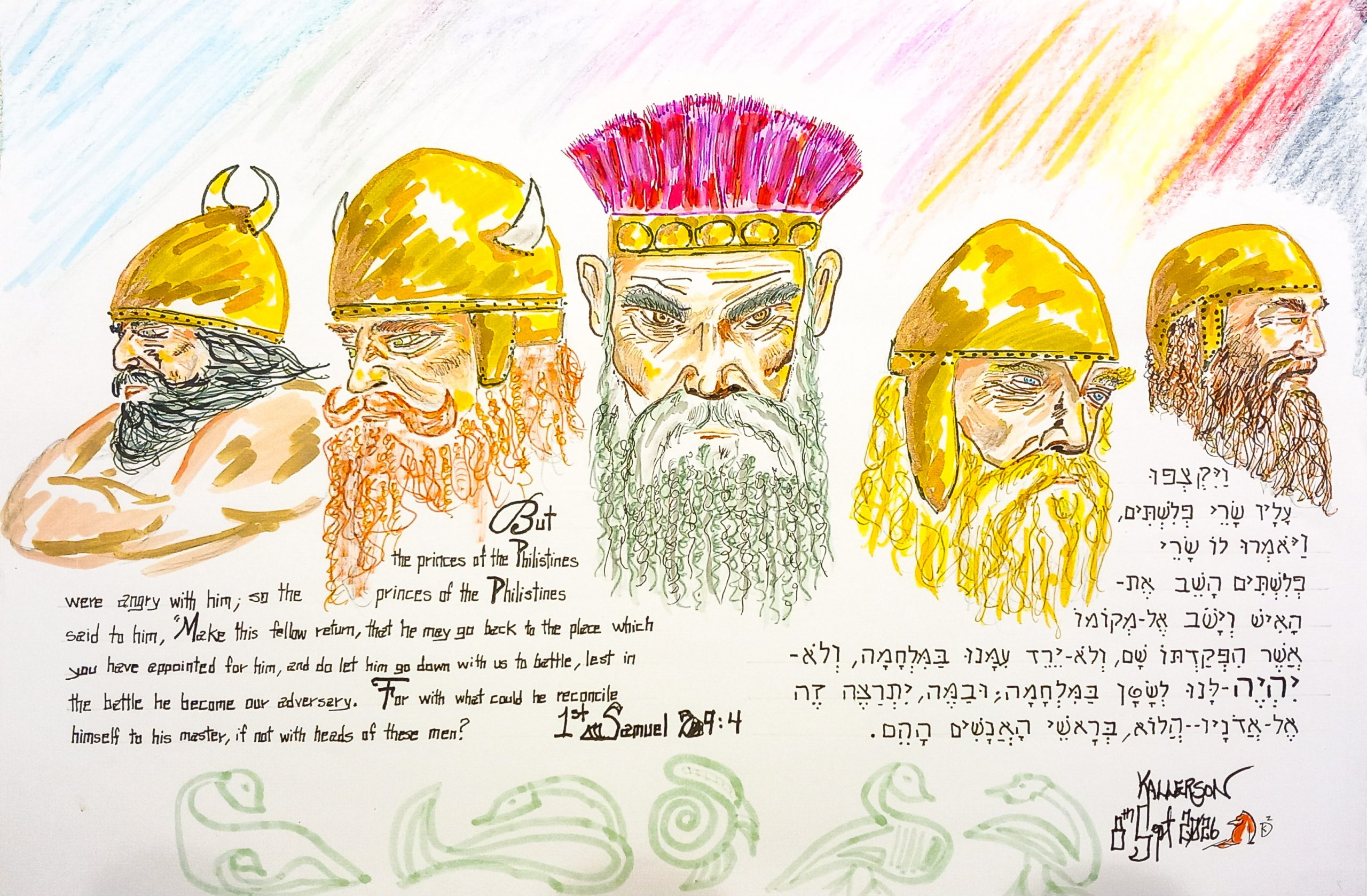
Artwork by Douglas Kallerson
1 Samuel 29:1-11
The Spring Which Is in Jezreel
(Typed 11 May 2026) The narrative in this chapter conveys its own typology, which is understandable without going to other books in the Bible to discover its meaning. On the other hand, that doesn’t mean other places in the Bible aren’t connected to what is said here.
We have seen some psalms dealing with events in David’s life as recorded in 1 Samuel. Likewise, prophecies made in Genesis anticipated a kingdom coming from Judah, not Benjamin, when the Messiah arrives.
The interconnected nature of the Bible reveals a hidden hand guiding what is recorded throughout it. Everything is woven together like a marvelous tapestry.
There is an interesting addition to this chapter found in 1 Chronicles 12. It’s the kind of thing you might read over a dozen times and never really pin down where it fits in the overall narrative of David’s life unless you read slowly and consider the words.
After having read it over, one day you do just that, and you say, “Oh yeah, I know when that took place!” That’s what happened with me. One day, it suddenly fit into the bigger picture…
Text Verse: “And some from Manasseh defected to David when he was going with the Philistines to battle against Saul; but they did not help them, for the lords of the Philistines sent him away by agreement, saying, “He may defect to his master Saul and endanger our heads.’” 1 Chronicles 12:19
In 1 Samuel 29, David was “going with the Philistines to battle against Saul.” However, 1 Samuel never mentions that some from Manasseh defect to David at this time. Unless you read through the rest of the Bible and consider what it says, you will never know all of these hidden treasures.
Be sure to read your Bible! As for David’s words, there is one verse that has an interesting ambiguity in it. Depending on David’s tone of voice, it could mean one thing or another. If he said it deadpan, you might not be able to tell what he was referring to.
Take the following sentence: “I didn’t say he said she did it to him yesterday.”
It is one of my favorite sentences. Sometimes, when I am bored with myself, I will call it to mind and go through the various ways it could be taken. I will add to it sometimes to see how many other variations of the same thought I can make up. To me, it is a fun way to get my mind off other things.
Change the stress on any word in the sentence and the meaning will change. Go ahead. Give it a shot. Add on more words if you want, like “morning” at the end. Add “at church” after that.
Fun things, such as ambiguous sentences, are to be found in His superior word. And so, let us turn to that precious word once again, and… May God speak to us through His word today, and may His glorious name ever be praised.
I. They Were Enraged (verses 1-5)
With the insert story of Saul’s journey to En Dor complete, the narrative from 1 Samuel 28:1, 2 resumes –
“And it was, in the days, the those, and they assembled, Philistines, their camps to the host to be battled in Israel. And he said, Achish, unto David, ‘Knowing, you must know, that with me, you will go out in the camp, you and your mortals.’
2And he said, David, unto Achish, ‘To thus, you, you will know what he will do, your servant.’”
Then the Philistines gathered together all their armies at Aphek,
vayiqbetsu phelishtim eth kal makhanehem apheqah – “And they amassed, Philistines, all their camps Aphek-ward.” David was with Achish in Gath. The call was made for the “camps” of the Philistines to engage in battle with the Israelites. That would mean the five lords of the Philistines.
With that call made, they headed to the designated location, which, according to 1 Samuel 28:4, was in Shunem. At the same time, Saul and his forces gathered at the Gilboa. Despite being in Shunem, here the location is called Aphek.
The name Aphek was first seen in Joshua 12:18. There are also various locations named Aphek. Because of this, Abarim says, “…we surmise that even though the name may have been attached to several different settlements, the name Aphek was rather proverbial for the place where enemy armies collected in order to stage an attack on Israel.”
Whether or not that is correct can only be speculated. Joshua 12:18 notes the king of Aphek, which points to that particular Aphek as a set location. If Abarim is right, the Philistines inclined in Shunem which would be Aphek-ward, meaning “toward the location of the battle.”
Aphek is derived from the verb aphaq, to contain. Reflexively, it would mean to restrain or force oneself. Because of this, some identify it as Strength, Enclosure, or Fortress. Others identify it as the action itself, and thus, Control, Restraint, or Discipline.
Philistine means Weakener with a secondary meaning of Griever.
1 (con’t) and the Israelites encamped by a fountain which is in Jezreel.
veyisrael khonim baayin asher beyizreel – “And Israel ‘inclining in the spring’ which in Jezreel.” Ellicott says, “It is a large spring which flows from under the cavern in the rock which forms the base of Gilboa.” Having a spring would be essential for soldiers in battle, especially if it continued for an extended period, as with the battle with Goliath in 1 Samuel 17.
Israel means He Strives with God. Jezreel comes from zara, to scatter seed or sow, and el, God. Thus, it means God Sows.
2 And the lords of the Philistines passed in review by hundreds and by thousands,
vesarne phelishtim overim lemeoth velaalaphim – “And ‘axles, Philistines’ traversing to hundreds and to thousands.” They are on their way from the Philistine enclave to the place of battle (traversing). The term seren, axel, is used to describe the lords. It is as if each individual enclave rotated around the leader.
As for the numbers, they are both derived from ten –
Ten signifies “Completeness of order, marking the entire round of anything, is, therefore, the ever-present signification of the number ten. It implies that nothing is wanting; that the number and order are perfect; that the whole cycle is complete.” Bullinger
On their march north, they are in military ranks of hundreds and thousands…
2 (con’t) but David and his men passed in review at the rear with Achish.
vedavid vaanashav overim baakharonah im akhish – “And David, and his mortals, traversing in the hinder-ward with Achish.” This is the honor that Achish said to David as they were gathering to the call for battle, “And he said, Achish, unto David, ‘To thus, ‘guarder to my head’ I will put you all the days’” (1 Samuel 28:2).
Achish, as the king of Gath, traveled in the rear of the marching ranks. David, as his designated guarder, is with him in the rear.
The name Achish is so obscure I will refrain from guessing at its meaning. David means Beloved. He has typologically pictured “accepting the doctrines of Christ” to this point.
As the ranks from the various enclaves coalesced on the march north, Achish’s choice of guarder is questioned…
3 Then the princes of the Philistines said, “What are these Hebrews doing here?”
vayomeru sare phelishtim mah ha’ivrim ha’eleh – “And they said, ‘commanders, Philistines’, ‘What the Hebrews, the these?’” Here, the designation of the lords changes. As they are in battle array, they are called sar, commander, instead of seren, axle. The word refers to a head person, be it a captain, governor, steward, etc.
A sense of contempt can be inferred from the other commanders’ abrupt words, “What the Hebrews, the these?.” These guys are not.
Hebrew is from Eber a great-grandson of Shem who is in the line of Abraham. His name is from ever, the region across. Thus, Hebrew signifies those who have crossed over.
3 (con’t) And Achish said to the princes of the Philistines, “Is this not David, the servant of Saul king of Israel, who has been with me these days, or these years?
vayomer akhish el sare phelishtim halo zeh David eved shaul melekh Yisrael asher hayah iti zeh yamim o zeh shanim – “And he said, Achish, unto ‘commanders, Philistines’, ‘(Indeed) not this David, servant Saul, ‘king, Israel’, who he was with me this ‘days’ or this ‘years’?’” Achish stands up for David. His selection of David as his guarder was based on his supposed past knowledge of David’s faithfulness.
Achish called David the servant of Saul, king of Israel, which seems to be equivalent to saying, “Whom he defected from.” It is understood from the context that David had become Achish’s servant.Each time he went out to plunder, David would bring some of his spoil to Achish, telling him it was plunder from attacks against Israel and Israel’s allies. Achish had watched all this, concluding that David was a loyal subject. Saying, “this ‘days’ or this ‘years’” means an indeterminate but significant amount of time.
1 Samuel 27:7 gave the total time David was with Achish as one year and four months. Thus, Achish had sufficient time to put together a full evaluation of David’s service and found it exceptional. Added to that, David had already gone to Gath some time before, as seen in 1 Samuel 21.
Achish saw him as a madman then, but it was apparent that David was out of Saul’s favor at that time. Achish was certain that David had been alienated from Saul for an extended period.
Saul means Asked, but his name is identical in spelling to Sheol, the place of the dead.
3 (con’t) And to this day I have found no fault in him since he defected to me.”
velo matsathi vo meumah miyom naphelo ad ha’yom hazeh – “and not I found in him speck from ‘day, his fall’ until the day, the this.’” The “day, his fall” means David’s defection, as if David’s lot in life had fallen from Saul and was now under the authority of Achish. During that entire time, not a speck of indiscretion was noted in David’s service…
4 But the princes of the Philistines were angry with him;
vayiqtsephu alav sare phelishtim – “And they were enraged upon him, ‘commanders, Philistines’.” This is a four-against-one decision. The other commanders had not been apprised of David’s defection, nor had they been privy to his dealings since that day. Therefore, they remain unconvinced of his faithfulness…
4 (con’t) so the princes of the Philistines said to him, “Make this fellow return, that he may go back to the place which you have appointed for him,
vayomeru lo sare phelishtim hashev eth ha’ish veyashov el meqomo asher hiphqadto sham – “And they said to him, ‘commanders, Philistines’, ‘You must cause to return, the man, and may he return unto his place which you caused to visit him there.” The meaning is just as the NKJV says. They want David to scram and go back to wherever in Gath Achish designated for him. They fear he will be a liability rather than the asset Achish thinks he is…
4 (con’t) and do not let him go down with us to battle,
velo yered imanu bamilkhamah – “And not he will descend with us in the battle.” This tells us that this dispute is happening on the way to the battle. The Philistine enclave is in the lowland along the shore. They are in an elevated area somewhere above the Jezreel Valley, probably where the five main camps came together. From this location, they will continue to ascend until they descend into the valley to fight. It is there that they fear David’s attitude will change…
4 (con’t) lest in the battle he become our adversary.
velo yihyeh lanu lesatan bamilkhamah – “And not he will be to us to adversary in the battle.” It is not just David they fear, but his six hundred well-trained fighting men, along with any others who later joined with him. If he signaled to those men to attack the Philistines, they would be surrounded. Such a chaotic scenario was entirely unacceptable, but they felt was likely…
4 (con’t) For with what could he reconcile himself to his master, if not with the heads of these men?
uvameh yitratseh zeh el adonav halo berashe ha’anashim ha’hem – “And in what he will ‘accept himself’, this, unto his lord? (Indeed) not in ‘heads, the mortals’, the these?” The word ratsah signifies to be pleased with. Specifically it gives the sense of satisfying a debt.
If David wanted to make amends with Saul, he would turn and attack the Philistines, thus, “accepting himself” in the eyes of Saul. The commanders are looking at the men marching to battle and know that such a disturbance from within their ranks could lead to catastrophe. They are unwilling to take such a chance. This is especially so, because…
5 Is this not David, of whom they sang to one another in dances, saying:
‘Saul has slain his thousands,
And David his ten thousands’?”
halo zeh David asher yaanu lo bamekholoth lemor hikah shaul baalaphav vedavid berivoto – “(Indeed) not this David whom they will answer to him in the dances, to say, ‘He caused to strike, Saul, in his thousands, and David in his myriad [k.]?’” The written Hebrew says myriad, but the oral changes it to myriads.
The song as recorded in the written Hebrew of 1 Samuel 18:7 said thousand and myriads, exactly the opposite of what the women originally proclaimed. The commanders speak in general terms, maybe even purposefully diminishing David’s triumph. There is no need to divert from what the written Hebrew says.
Despite the number, the commanders’ point is that the people of Israel saw David as a hero. Therefore, they don’t want to make him more of a hero in Israel’s eyes at the expense of their own soldiers during the coming battle.
I can earn it! It’s within my control
Perpetual life is mine to attain
I will work off the debt of my soul
At the end, there will be great gain
Staying alive, it’s a snap, you see
When you are good enough and do what is right
I’m telling you quite plainly
That perpetual life is there in my sight
Sheol can’t get me, I’m too good for that
I’m earning my way, just watch n’ see
*
No. NO! You can’t do that
Only through Jesus can you live perpetually
II. According to ‘Messenger, God’ (Verses 6-11)
6 Then Achish called David and said to him, “Surely, as the Lord lives, you have been upright, and your going out and your coming in with me in the army is good in my sight.
vayiqra akhish el David vayomer elav khai Yehovah ki yashar atah vetov beenay tsethekha u-voakha iti bamakhaneh – “And he called, Achish, unto David. And he said unto him, ‘Alive Yehovah! For straightened, you, and good in my eyes, your going out and your coming with me in the camp.” Achish is setting David up for the bad news by paying him compliments.
The reason Achish swore in the name of Yehovah is debated, but he would have been aware of David’s belief. He may have said this to bolster the impact of his words like someone saying, “On the grave of my mother…” There is no reason either way to assume he trusted Yehovah as his own God or that he didn’t.
Regardless, Achish found no fault in David, and he never questioned David’s faithfulness in his interactions with those under his authority…
6 (con’t) For to this day I have not found evil in you since the day of your coming to me. Nevertheless the lords do not favor you.
ki lo matsathi vekha raah miyom boakha elay ad ha’yom ha’zeh u-veene haseranim lo tov atah – “For not I found in you evilness from ‘day, your coming unto me’ until the day, the this. And in ‘eyes, the axles’ not good, you.” Achish pits his opinion of David against those of the other lords of the Philistines. His view of David is that he has been reliable and faithful since the day of his arrival. However, he cannot stand against the other lords…
7 Therefore return now, and go in peace,
veatah shuv velekh beshalom – “And now, you must return, and you must walk in peace.” At times, the wording will be different when dealing with one’s “peace.” Here it says, lekh beshalom – “walk in peace.” At other times, it will say xxx leshalom, “xxx to peace.” The difference is that “in peace” looks to the condition or state during the action, whereas, “to peace” speaks of the goal, result, or outcome.
Thus, Achish is telling David to be safe on his journey home. The reason for this is…
7 (con’t) that you may not displease the lords of the Philistines.”
velo taaseh ra beene sarne phelishtim – “and not you will do evil in ‘eyes, axles, Philistines’.” In other words, “You need to go. Have a safe trip back. That way, you won’t miff the other leaders because they will be watching you, looking for trouble and not focusing on the battle.”
8 So David said to Achish, “But what have I done? And to this day what have you found in your servant as long as I have been with you, that I may not go and fight against the enemies of my lord the king?”
vayomer David el akhish ki meh asiti u-mah matsatha veavdekha miyom asher hayithi lephanekha ad ha’yom ha’zeh ki lo avo venilkhamti veoyeve adoni ha’melekh – “And he said, David, unto Achish, ‘For what I did, and what you found in your servant from ‘day which I was to your faces’ until the day, the this, that not I will go, and I will be battled in ‘hatings, my lord’ the king?’” It is a long run-on sentence that contains a significant ambiguity in the final clause.
Who are the “‘hatings, my lord’ the king?” David called himself “your servant” to Achish, but he could be speaking of Achish or Saul in the final clause.
The whole statement is one of feigned offense, and yet, it is probably the biggest relief David could have imagined. He was spared from a most uncomfortable situation that could have gone badly for him and his men.
The fact that he never raided any of Judah’s settlements shows without a doubt that David had no intention of bringing harm to his own nation. This would include fighting them in battle. Regardless of the actual intent behind David’s words, Achish takes them as a compliment and replies in kind…
9 Then Achish answered and said to David, “I know that you are as good in my sight as an angel of God;
vayaan akhish vayomer el David yadati ki tov atah beenay kemalakh elohim – “And he answered, Achish, and he said unto David, ‘I know that good, you, in my eyes, according to ‘messenger, God’.” We can’t read too much into this. Earlier, Achish said, “Alive Yehovah,” but his intention can only be speculated on. The same is true here. He could be saying, “according to ‘messenger, gods’.”
The word elohim allows either rendering. What is known is that Achish sees David as trustworthy as a divine messenger, whether from the true God or any other supposed god. Either way, it is a high compliment. Despite his favorable view of David…
9 (con’t) nevertheless the princes of the Philistines have said, ‘He shall not go up with us to the battle.’
akh sare phelishtim ameru lo yaaleh imanu bamilkhamah – “Surely, ‘commanders, Philistines’ they said, ‘Not he will ascend with us in the battle.’” The terminology now changes from “descend” in verse 4 to “ascend” in this verse. The meaning is their ascent from the area of the coastal plains to the area of battle. They must ascend in order to descend. The wording tells us that they are still en route to where they will encamp.
10 Now therefore, rise early in the morning with your master’s servants who have come with you.
veatah hashkem baboqer veavde adonekha asher bau itakh – “And now, you must cause to rise early in the morning, and ‘servants, your lord’, who they came with you.” The words are perplexing. Who is “your lord” that Achish is referring to?
One possibility is that Achish is speaking of himself. If so, he considered the men with David as his, but they came with David. An interesting possibility is that Achish is referring to those of Manasseh mentioned in our text verse who defected to David at this time.
These Manassites may have been what brought suspicion to the other lords. They had not responded to Saul’s call to battle, but the Philistine lords may have thought they were plants from Saul to help David in an attack against the Philistines instead of against Israel.
Whether this is what Achish is referring to or not, his words are in the singular to David, “you (sg.) must cause to rise early.” That changes to plural in the next clause…
10 (con’t) And as soon as you are up early in the morning and have light, depart.”
vehishkamtem baboqer veor lakhem valekhu – “And you (pl.) will cause to rise early in the morning, and it will illuminate to you (pl.), and you (pl.) must walk.’” He repeats the necessity to rise early. At the break of dawn, long before the sun rises, they should all get up and head out.
The morning generally signifies the time when a change takes place or is realized. With Achish’s words stated, David is released from serving in the battle…
11 So David and his men rose early to depart in the morning, to return to the land of the Philistines.
vayashkem David hu vaanashav lalekheth baboqer lashuv el erets pelishtim – “And he caused to rise early, David, he and his mortals, to walk in the morning to return unto ‘land, Philistines’.” Depending on how far north they have trekked by this point, they could be as much as 70 to 80 miles from Gath, which is the total distance between Gath and Jezreel.
Thus, it all depends on where they were when this account took place. As for the fact that it was still along the route, it next says…
*11 (fin) And the Philistines went up to Jezreel.
u-phelishtim alu yizreel – “And Philistines, they ascended – Jezreel.” The words continue to speak of ascending. They must first ascend in order to then descend to the battle. David is freed from a real pickle and heads back to Philistia.
Sheol is defeated through the work of Christ
We may go there, but it is just a stop
Jesus’ shed blood is how our soul is priced
Someday, out of Sheol, the faithful will pop
We do not need to be concerned about it
As if we may never rise from the dead
Don’t let death bother you, not even a bit
Trust in Christ, who suffered and bled
His blood covers every sin
They are no longer remembered by the Lord
The power of Sheol is over. It’s done in
This truth is found in God’s precious word
III. Shunned by the Weakeners
Chapter 28 gave the insert information concerning Saul’s hike to En Dor to meet with the witch and consult Samuel. In that account, Saul reverted to previously held typology as those seeking the truth.
At the same time, David has remained in the same typological timeframe as given in Chapter 27, which was during the tribulation period. At that time, the question was asked, “How does one elude Sheol’s call during the tribulation?”
David was in the land of the Philistines, eluding Saul. It was a chapter that dealt with holding to the doctrines of Christ while the surrounding world is filled with those who are there to weaken the faith of others. That time must come to an end. This chapter deals with its conclusion and leads into the next account of David’s life.
In this chapter, David goes with Achish to join in the battle against Saul. In verse 1, it said that the Philistines assembled Aphek-ward. Reflexively, Aphek signifies to constrain. The Weakeners are there to constrain Israel, who is said to be inclined in the spring which is in Jezreel, God Sows.
This points to the time in the tribulation referred to in Hosea 2 –
“‘It shall come to pass in that day
That I will answer,’ says the Lord;
‘I will answer the heavens,
And they shall answer the earth.
22 The earth shall answer
With grain,
With new wine,
And with oil;
They shall answer Jezreel.
23 Then I will sow her for Myself in the earth,
And I will have mercy on her who had not obtained mercy;
Then I will say to those who were not My people,
“You are My people!”
And they shall say, “You are my God!”’” Hosea 2:21-23
The spring points to the giving of the Spirit at the end of the tribulation, which is noted in several Old Testament passages, but Zechariah 13:1 sufficiently describes it –
“In that day a fountain shall be opened for the house of David and for the inhabitants of Jerusalem, for sin and for uncleanness.”
In verse 2, the Philistines were traversing toward the battle area in hundreds and thousands. That anticipates the point in time when nothing is wanting, that the number and order are perfect, and that the whole cycle is complete. This is what one would expect from the tribulation period.
While the Philistines were traversing, David was in the hinder part of the assembly with Achish. Achish believed that David was on his side, just as those who hold to law observance and temple worship in the tribulation will think those who hold to the doctrines of Christ are aligned with them.
However, in verse 3 the bulk of the Philistines, the Weakeners, did not trust David, calling him and those with him Hebrews. They understood that they are those who have “crossed over.” When one has crossed over, it is a done deal.
Thus, the Hebrews will be contrary to their purpose of fighting Saul (Sheol). Like the young ruler who came to Jesus and asked what he needed to do to obtain perpetual life, they are resolute in working their way to life, to avoid being defeated by Sheol.
In verse 3, Achish defends David, “(Indeed) not this David, servant Saul, ‘king, Israel’, who he was with me this ‘days’ or this ‘years’?” Achish sees David as a servant of Saul who is no threat to them. On the surface, it seems contradictory, but if David is a servant of Saul, then he is already defeated by Sheol. Thus, he is no threat to their mission, which is to weaken the faith of others.
Achish continues, telling the other lords that David had been with him for an extended period and there was no fault in him. Despite his protestations, however, they were enraged at him. They told Achish to have David go back to where he was appointed to be. They could not allow him to join them in the battle, lest he become their adversary.
The other lords had total confidence that David was a Hebrew and would be loyal to the Hebrews. He had crossed over. Thus, he needed to go. Their reasoning was that David would earn favor with Saul by killing them in the battle.
Stepping back and looking at the situation is needed. Saul pictures man destined for the pit. It is as if the pit is calling out for the souls of men. The Philistines are those who weaken the faith of others, relying on self and law observance. If David, accepting the doctrines of Christ, came against them, he could then find Sheol’s favor.
Their approach is flawed because they misunderstand that those who accept the doctrines of Christ have already overcome Sheol. Even during the tribulation, they may go there, but they will be brought out of there, just as those at the rapture were –
“And I saw thrones, and they sat on them, and judgment was committed to them. Then I saw the souls of those who had been beheaded for their witness to Jesus and for the word of God, who had not worshiped the beast or his image, and had not received his mark on their foreheads or on their hands. And they lived and reigned with Christ for a thousand years. 5 But the rest of the dead did not live again until the thousand years were finished. This is the first resurrection. 6 Blessed and holy is he who has part in the first resurrection. Over such the second death has no power, but they shall be priests of God and of Christ, and shall reign with Him a thousand years.” Revelation 20:4-6
In verse 5, the lords cited the song about David to show that he was a real threat to their cause. After that, Achish conceded and called David to tell him the bad news about not joining in the battle. His reasoning and trust in David were explained through verse 6.
David’s supposed alliance with Achish over the past year plus was effective. He had no idea that David was always on Israel’s side, taking out Israel’s enemies, not the people of Israel.
In verses 7 and 8, Achish reiterated that David had to go while David strongly protested, questioning the cause for his dismissal, and why he could not engage the fight with the Philistines. These verses contained the ambiguous wording about fighting against the enemies of the king.
David would fight against the Weakeners if given the chance, but that opportunity would not arise. It is not something that will take place during the tribulation. This is exactly what one would expect because anyone who openly stands against the authority during that time will be beheaded.
This account confirms the way things will be during the tribulation. In verse 10, Achish told David he was to rise early in the morning along with “servants, your lord.” It is the same idea as verse 3 where Achish called David Saul’s servant. Despite the other Philistine lords’ opinions, he sees David as no threat because he is a servant of Saul (Sheol).
Not knowing the meaning of Achish’s name leaves a void in understanding what he pictures, but the overall picture is discernible. Being the king of Gath, Winepress, he, in part, pictures judgment during the tribulation.
In verse 11, it said that David and his men rose early in the morning to return to the land of the Philistines. The morning symbolizes the time when change takes place. As David will no longer engage the Philistines after this in 1 Samuel, this may be referring to the middle of the tribulation when the Antichrist sits in the temple.
If so, from that time on in relation to those who hold to the doctrines of Christ, there will no longer be any contact between them and the Weakeners. That is speculation, but it does fit with the overall thought of the chapter.
The chapter ends as the Philistines ascended to Jezreel, God Sows. Although Paul is writing to the church age in Galatians, the thought is true at any time when he says –
“Do not be deceived, God is not mocked; for whatever a man sows, that he will also reap. 8 For he who sows to his flesh will of the flesh reap corruption, but he who sows to the Spirit will of the Spirit reap everlasting life.” Galatians 6:7, 8
Just as we reap what we sow, God sows both life and death, symbolized by Jezreel. Those who set about to weaken the faith of God’s people will receive what they deserve.
David’s time in the land of the Philistines is essentially over. He will return to Ziklag, but in 1 Samuel 27:6, it said that Ziklag belonged to the kings of Judah from that time forward. Thus, when David gets there, he is, for all intents and purposes, in the land of Judah.
The main lesson of this chapter is, once again, to show the distinction between those who want to weaken the faith of others through law observance and those who hold to the doctrines of Christ. Those who hold to the doctrines of Christ will elude Sheol to be raised at the rapture or the first resurrection.
Those who do not hold to the doctrines of Christ will be held by Sheol until the final judgment. God has promised release for His faithful people. It is a release that will exempt them from that final judgment.
The battle with Israel will be in Chapter 31. That passage will not deal with this. We can know this because Jezreel is never mentioned there. There needs to be a transition from Saul’s kingship to David’s. That will come in the final chapter. Before that, Chapter 30 will give us more typology concerning other things.
God has given us all kinds of doctrine related to Sheol since Chapter 17. Each point has helped us to see what God is doing and what it means to those who hold to the doctrines of Christ. Be wise, call on Jesus, and be saved by His precious blood.
Learn the Bible so that you can adequately explain to others what the proper doctrines of Christ are. There is a spiritual battle going on in the world. Let us be ready to engage it when the need arises.
Closing Verse: “Then the children of Judah and the children of Israel
Shall be gathered together,
And appoint for themselves one head;
And they shall come up out of the land,
For great will be the day of Jezreel!” Hosea 1:11
Next Week: *1 Samuel 30:1-12 What does the name mean? What is it for? I wonder a ton… (Wadi, the Besor, Part I) (62nd 1 Samuel Sermon)
The Lord has you exactly where He wants you. He has a good plan and purpose for you. He is the One who abases the haughty and exalts the humble. He regards the lowly, and the proud, He knows from afar. So yield yourself to Him, trust Him, and believe His word. In this, He will do great things for you and through you
1 Samuel 29:1-11 (CG)
1 And they amassed, Philistines, all their camps Aphek-ward. And Israel ‘inclining in the spring’ which in Jezreel. 2And ‘axles, Philistines’ traversing to hundreds and to thousands. And David, and his mortals, traversing in the hinder-ward with Achish. 3And they said, ‘commanders, Philistines’, “What the Hebrews, the these?”
And he said, Achish, unto ‘commanders, Philistines’, “(Indeed) not this David, ‘servant, Saul’, king Israel, who he was with me this ‘days’ or this ‘years’, and not I found in him speck from ‘day, his fall’ until the day, the this.”
4And they were enraged upon him, ‘commanders, Philistines. And they said to him, ‘commanders, Philistines’, “You must cause to return, the man, and may he return unto his place which you caused to visit him there. And not he will descend with us in the battle. And not he will be to us to adversary in the battle. And in what he will ‘accept himself’, this, unto his lord? (Indeed) not in ‘heads, the mortals’, the these? 5(Indeed) not this David whom they will answer to him in the dances, to say, ‘He caused to strike, Saul, in his thousands, and David in his myriad [k.]?’”
6And he called, Achish, unto David. And he said unto him, “Alive Yehovah! For upright, you, and good in my eyes, your going out and your coming with me in the camp. For not I found in you evilness from ‘day, your coming unto me’ until the day, the this. And in ‘eyes, the axles’ not good, you. 7And now, you must return, and you must walk in peace, and not you will do evil in ‘eyes, axles, Philistines’.”
8And he said, David, unto Achish, “For what I did, and what you found in your servant from ‘day which I was to your faces’ until the day, the this, that not I will go, and I will be battled in ‘hatings, my lord’ the king?”
9And he answered, Achish, and he said unto David, “I know that good, you, in my eyes, according to ‘messenger, God’. Surely, commanders Philistines, they said, ‘Not he will ascend with us in the battle.’ 10And now you must cause to rise early in the morning, and ‘servants, your lord’, who they came with you. And you will cause to rise early in the morning, and it will illuminate to you, and you must walk.”
11And he caused to rise early, David, he and his mortals, to walk in the morning to return unto ‘land, Philistines’. And Philistines, they ascended – Jezreel.
Verse 5 – Qeri: “his myriads.”
1 Samuel 29:1-11 (NKJV)
1 Then the Philistines gathered together all their armies at Aphek, and the Israelites encamped by a fountain which is in Jezreel. 2 And the lords of the Philistines passed in review by hundreds and by thousands, but David and his men passed in review at the rear with Achish. 3 Then the princes of the Philistines said, “What are these Hebrews doing here?”
And Achish said to the princes of the Philistines, “Is this not David, the servant of Saul king of Israel, who has been with me these days, or these years? And to this day I have found no fault in him since he defected to me.”
4 But the princes of the Philistines were angry with him; so the princes of the Philistines said to him, “Make this fellow return, that he may go back to the place which you have appointed for him, and do not let him go down with us to battle, lest in the battle he become our adversary. For with what could he reconcile himself to his master, if not with the heads of these men? 5 Is this not David, of whom they sang to one another in dances, saying:
‘Saul has slain his thousands,
And David his ten thousands’?”
6 Then Achish called David and said to him, “Surely, as the Lord lives, you have been upright, and your going out and your coming in with me in the army is good in my sight. For to this day I have not found evil in you since the day of your coming to me. Nevertheless the lords do not favor you. 7 Therefore return now, and go in peace, that you may not displease the lords of the Philistines.”
8 So David said to Achish, “But what have I done? And to this day what have you found in your servant as long as I have been with you, that I may not go and fight against the enemies of my lord the king?”
9 Then Achish answered and said to David, “I know that you are as good in my sight as an angel of God; nevertheless the princes of the Philistines have said, ‘He shall not go up with us to the battle.’ 10 Now therefore, rise early in the morning with your master’s servants who have come with you. And as soon as you are up early in the morning and have light, depart.”
11 So David and his men rose early to depart in the morning, to return to the land of the Philistines. And the Philistines went up to Jezreel.