
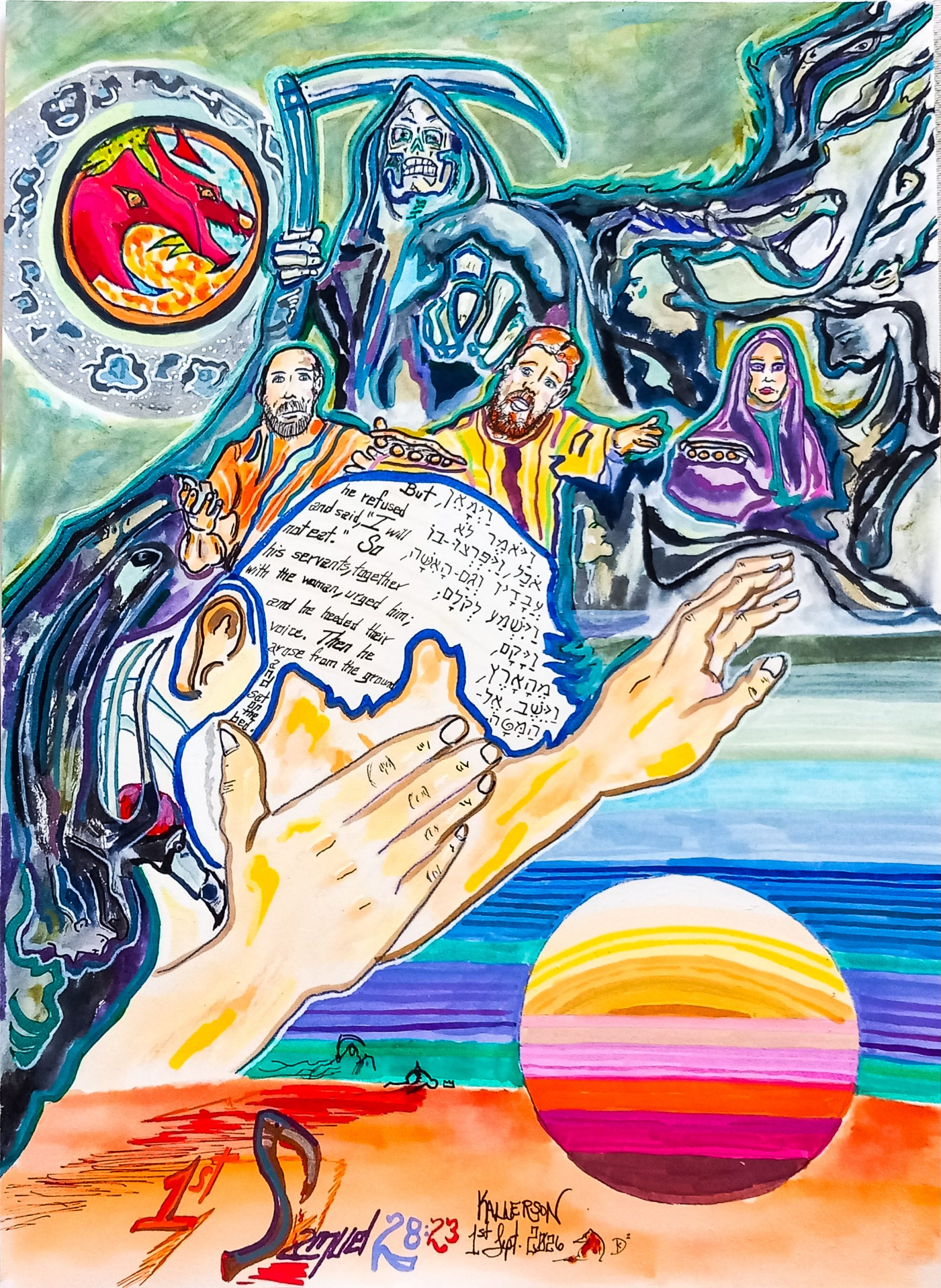
Artwork by Douglas Kallerson
1 Samuel 28:18-25
‘Mistress, ov’,
The Witch of En-dor, Part II
(Typed 4 & 5 May 2026) There is a world of diversity around us. People come in a variety of colors. Cultures have a seemingly limitless number of variations. There are jobs to fill every need, from wastewater operators, plastic surgeons, and postal workers to corporate executives and computer analysts.
Mixed into all of this variety are people who claim to be witches. Some of them work right alongside us in our jobs, bragging about their powers and enlightenment. For some, sorcery and witchcraft is their job. People come to them seeking answers they think such people have access to.
As Christians, we tend to look at people like them as the goners of society. There is no hope for them. And yet, if you Google “former witch comes to Christ,” there are innumerable articles and videos of people all around the world who have proven they aren’t goners at all.
In reading the Bible, when we see stories like the witch of En Dor, we may think, “How stupid could these people be? They are the people of the Lord, and yet they have witches? Why didn’t they pay attention to their law?”
Text Verse: “Also he caused his sons to pass through the fire in the Valley of the Son of Hinnom; he practiced soothsaying, used witchcraft and sorcery, and consulted mediums and spiritists. He did much evil in the sight of the Lord, to provoke Him to anger.” 2 Chronicles 33:6
Manasseh definitely falls into the category, “That guy is a goner for sure.” His life was as mixed up in the occult as any person you could possibly imagine. Because of his deeds, he was exiled to Babylon. And yet, in the same chapter, we find that he humbled himself and was restored to the Lord and to his kingdom.
How could Israel be so stupid? How could we? They lived in a land where Scripture was available to only a select few. Everyone else only heard about the Lord by word of mouth. Travel was slow, and external influences would have come at them with every false god available.
Again, the real question is: How can we be so stupid? We, meaning the world today, including Israel. We have word, we have evidence in a thousand ways concerning its reliability, including fulfilled prophecy, and we have the means of obtaining the word right at our fingertips.
And yet, there are palm readers in every town, mystics, false prophets, and witches galore. We even have churches that claim the name of Jesus and yet allow every perversion that can be dreamt up where people gladly attend, stewing themselves in corruption.
What we need to do is carry the truth of Jesus to these people. Handing out tracts, speaking excitedly about our faith, and letting people know of God’s goodness. Jesus should exude out of us at all times.
Saul is in En Dor to seek what the law forbids. What is it that he will find? Great stories such as this are to be found in His superior word. And so, let us turn to that precious word once again, and… May God speak to us through His word today, and may His glorious name ever be praised.
I. You and Your Sons – With Me (verses 18-20)
Previously, Saul explained to Samuel why he came to seek his advice, followed by Samuel’s response to his petition –
“And he said, Samuel, unto Saul, ‘To why you caused to quiver me to cause to ascend me?’
And he said, Saul, ‘It cramped to me, vehemently. And Philistines being fought in me. And God, He veered from upon me. And not He answered me again, also, in hand the prophets, also, in the dreams. And I (surely) called to you to cause me to know what I will do.’
16And he said, Samuel, ‘And to why you will ask me? And Yehovah, He veered from upon you, and He became your foe! 17And He did, Yehovah, to Him according to which He spoke in my hand. And He rent, Yehovah, the kingdom from your hand, and He gave it to your associate, to David.” 1 Samuel 28:15-17
Samuel continues speaking to Saul…
18 Because you did not obey the voice of the Lord
kaasher lo shamata beqol Yehovah – “According to which not you ‘heard’ in ‘voice, Yehovah.’” There are two times specifically mentioned concerning Saul’s disobedience. The first was in Chapter 13, when Saul sacrificed to petition the Lord’s favor before battling the Philistines.
In 1 Samuel 10:8, when Saul was anointed as king, a specific command was given to him to ensure that he did not do this. And yet, he failed to uphold the word of the Lord. Because of that –
“And he said, Samuel, unto Saul, ‘You were silly. Not you guarded ‘commandment, Yehovah’ your God which He enjoined you. For now – He caused to establish, Yehovah, your kingdom unto Israel until vanishment. 14And now – your kingdom, not it will rise. He sought, Yehovah, to Him man according to His heart, and He enjoined him, Yehovah, to commander upon His people, for not you guarded which He enjoined you, Yehovah.’” 1 Samuel 13:13, 14 (CG)
The second time he was disobedient to the Lord was in Chapter 15. That is next noted by Samuel…
18 (con’t) nor execute His fierce wrath upon Amalek,
velo asita kharon apo baamaleq – “and not you did ‘burning, His nostril’, in Amalek.” There, the Lord through Samuel said –
“Now, you must walk, and you caused to strike Amalek, and you caused to anathematize them, all which to him. And not you will commiserate upon him. And you caused to die, from man until woman, from suckling and until ‘being suckled’, from ox and until sheep, from camel and until jack.” 1 Samuel 15:3 (CG)
However, just a few verses later, it said –
“And he commiserated, Saul, and the people, upon Agag, and upon ‘best, the flock’, and the cattle, and the doubles, and upon the plumpness, and upon all the good, and not they acquiesced – caused to anathematize them. And all the deputyship – disesteemed and being wasted, it they cause to anathematize.” 1 Samuel 15:9 (CG)
Saul failed to uphold the word of the Lord…
18 (con’t) therefore the Lord has done this thing to you this day.
al ken ha’davar ha’zeh asah lekha Yehovah ha’yom ha’zeh – “Upon thus, the word, the this, He did to you, Yehovah, the day, the this.” Notice Samuel’s use of the same verb to contrast Saul’s sin with the Lord’s rejection of him –
“…and not you did [asah] burning, His nostril, in Amalek.”
“Upon thus, the word, the this, He did [asah] to you, Yehovah, the day, the this.”
One is the consequence of the other. Saul failed to honor the Lord by personally sacrificing to him against the Lord’s specific command. He also failed to uphold the word of the Lord to anathematize Amalek. Therefore, the Lord has brought the Philistines against him, and the Lord refuses to give him guidance…
19 Moreover the Lord will also deliver Israel with you into the hand of the Philistines.
veyiten Yehovah gam eth Yisrael imekha beyad pelishtim – “And He will give, Yehovah, also Israel with you in ‘hand, Philistines’.” The meaning is obvious to Saul. The battle will be lost. That could mean any range of things from subjugation under the Philistines as a vassal king paying tribute, being carried away as an exile and kept on display like Samson, even to being utterly routed and being killed in battle.
To clarify the matter, Samuel continues…
19 (con’t) And tomorrow you and your sons will be with me.
u-makhar atah u-vanekha imi – “And tomorrow, you and your sons – with me.” There is no doubt what this means. Being the word of Samuel, it would carry the weight of the word of the Lord. Thus, there could be no changing His mind.
Being “with” Samuel means they will all be killed and in Sheol with him. It is another confirmation that this is truly Samuel. The wording leaves no other choice. And more…
19 (con’t) The Lord will also deliver the army of Israel into the hand of the Philistines.”
gam eth makhaneh Yisrael yiten Yehovah beyad pelishtim – “Also, ‘camp, Israel’ He will give, Yehovah, in hand Philistines.” Not only will the army be routed, suffering total defeat at the hand of the Philistines, but their camp will be sacked. All of their supplies will be plundered, leaving a void in the military capabilities of the nation until it could be rebuilt at some point.
The prospect of what is coming upon Saul’s kingdom would be overwhelming to him. But the matter has been decided…
20 Immediately Saul fell full length on the ground,
vaymaher shaul vayipol melo qomatho artsah – “And he hurried, Saul, and he fell ‘fulness, his height’ earthward.” In other words, he was already prostrate as noted in verse 14. Now, he completely leveled himself to the ground like a person having a seizure or who is dead.
Concerning his state, John Gill says he was 🎶thunderstruck 🎶. In that position…
20 (con’t) and was dreadfully afraid because of the words of Samuel.
vayira meod midivre shemuel – “And he feared vehemently from ‘words, Samuel’.” Every bad thing that could come upon him was coming within the next 24 hours. His kingdom would end, his nation would be delivered into the hand of the enemy, and his sons would be killed along with him.
The words were spoken, and his fate was sealed. The march to battle in the morning would be difficult as he talked with his sons, knowing it would be the last time he would ever do so…
20 (con’t) And there was no strength in him, for he had eaten no food all day or all night.
gam koakh lo hayah vo ki lo akhal lekhem kal ha’yom vekhal ha’layelah – “Also vigor not it was in him, for not he ate bread all the day, and all the night.” Saul had seen the Philistine camps readied for battle, then he sought the word of the Lord, and finally he asked his men if any knew of a medium to consult.
Finding out that there was one in En Dor, he made the journey either on foot or on an animal, but through it all, he failed to stop and eat. So, he was completely enervated from the efforts of the day and distressed by Samuel’s words.
All he could do was lie on the ground, collapsed like a bunch of broccoli, or a sack of potatoes, or maybe even like a disobedient king about to meet his Maker, with his thoughts consuming the rest of his strength.
The Lord won’t speak to me anymore
Where do I go to know what to do?
I know! I’ll head to the witch at En Dor
Surely the word will be spot on true
Bring up for me the one I ask
Bring up Samuel, so I know what to do
It will be a simple task
I know what he says will be spot on true
Sure enough, Samuel spoke to me
He knows the future, every word
If that is so, then I’m beginning to see
That… it was the word of the Lord I heard
II. And They Breached in Him (verses 21-25)
21 And the woman came to Saul and saw that he was severely troubled,
vatavo ha’ishah el shaul vatere ki nivhal meod – “And she came, the woman, unto Saul, and she saw that he was shuddered, vehemently.” Despite being a medium, the motherly instinct in the woman remained ready to assist such a helpless creature as Saul had become…
21 (con’t) and said to him, “Look, your maidservant has obeyed your voice,
vatomer elav hineh shameah shipkhatekha beqolekha – “And she said unto him, ‘Behold! She heard, your maidservant, in your voice.” She is referring to verses 12 and 13. Once she realized he was Saul, she accepted his assurances that calling up the dead would not result in her execution…
21 (con’t) and I have put my life in my hands and heeded the words which you spoke to me.
Rather: vaasim naphshi bekhapi vaeshma eth devarekha asher dibarta elay – “And I put my soul in my palm, and I heard your words which you spoke unto me.’” As seen elsewhere, a palm, kaph, is not a hand, yad. They have different meanings, both in the text and metaphorically.
The, kaph, palm (and sole) signifies possession and/or the state of something. The woman took her soul, meaning her being, and set it in her possession. Think of something precious and fragile being set in the palm. Without care, it could tumble out and crash to the floor, shattering it.
If the text said hand, it would signify power and authority. The two thoughts, though similar in intent, have completely different ultimate signification.
22 Now therefore, please, heed also the voice of your maidservant,
Her words are emphatic: veatah shema na gam atah beqol shiphkhatekha – “And now, you must hear, pray, also you, in ‘voice, your maidservant’.” She sees the situation, has evaluated what must be done, and emphatically tells Saul what will rectify his immediate distress…
22 (con’t) and let me set a piece of bread before you; and eat, that you may have strength when you go on your way.”
veasimah lephanekha path lekhem veekhol vihi vekha koakh ki thelekh badarekh – “And let me set to your faces ‘bit, bread’, and you must eat, and may it be, in you, vigor when you will walk in the road.” Her motherly instinct is still firing away, as if she is dealing with a helpless little boy, and so she admonishes him to eat. Otherwise, he will never have the strength to get where he needs to go.
The word bread extends beyond literal bread to any meal, just as it does in English when we speak of sitting down and breaking bread. In Scripture, it refers to that which sustains a person. Despite her admonishment, Saul is stubborn…
23 But he refused and said, “I will not eat.”
vaymaen vayomer lo okhal – “And he refused, and he said, ‘Not I will eat.’” It’s not surprising that after hearing the bad news, Saul had no appetite. Because of the coming situation, the sadness of the moment would keep anyone from thinking about food. Despite his protestations…
23 (con’t) So his servants, together with the woman, urged him; and he heeded their voice.
vayiphretsu vo avadav vegam ha’ishah vayishma leqolam – “And they breached in him, his servants, and also the woman. And he heard to their voice.” The word parats, to break out (and thus to breach), carries many significations. The intent here is that Saul has put up a wall of refusal.
Their emphatic urging was able to breach through that wall, convincing him that eating was the right thing to do. With his obstinate wall breached, he agreed to their pleas…
23 (con’t) Then he arose from the ground and sat on the bed.
vayaqam mehaarets vayeshev el hamitah – “And he arose from the earth, and he sat unto the bed.” The mitah, bed, is from natah, to stretch or spread out. This could mean he sat on the edge of her bed, or maybe she had a couch or a Mideastern divan. Whatever the layout, it was a place for stretching out and relaxing. While he was…
24 Now the woman had a fatted calf in the house,
velaishah egel marbeq babayith – “And to the woman, ‘calf, stall’, in the house.” A new and rare word is seen, marbeq, stall. It is from an unused root meaning to tie up. As such, it refers to a stalled animal that is given food specifically to fatten it up. Saying “fatted” is an explanatory paraphrase.
As for the type of animal, it is an egel, calf. It is derived from agol, to revolve or circular. A young calf will dance around excitedly, often prancing in a circular manner. The four times the marbeq, stall, is seen in Scripture, it is in conjunction with this type of animal, the egel.
This is the animal that was used in the incident of the golden calf at Sinai. It is also the type of calves set up for worship in the northern kingdom of Israel. It is almost always used in a negative sense.
In Leviticus 9, the egel was used as a sin offering for the priests at their ordination, something that also carries a negative connotation. In Malachi 2, it is used to signify the sense of joy at restoration through the Messiah, where those who fear the name of the Lord will trample the wicked.
The Topical Lexicon says, “Its youth underscored the need for purity, while its vigor anticipated full-grown strength transferred to the worshiper through atonement.”
As the animal has been stalled and is ready, it’s time for its graduation…
24 (con’t) and she hastened to kill it.
vatemaher vatizbakhehu – “And she hurried, and she sacrificed it.” The word used is zavakh, to slaughter, but it is consistently used when referring to sacrifice. Only Smith’s translation renders it this way. Some say slaughter, but that doesn’t necessarily give the sense of a sacrifice. The probable meaning is that her sacrifice is for the sake of the king. Along with the calf…
24 (con’t) And she took flour and kneaded it, and baked unleavened bread from it.
vatiqakh qemah vatalash vatophehu matsoth – “And she took flour, and she kneaded, and she baked it – unleavened.” The qemakh, flour, is from a root signifying to grind. It would rightly be translated as “ground” because it is only used when referring to grains. Therefore, the word “flour” is a suitable explanation.
The matstsah, unleavened, is from matsats, to suck, as in milk. Thus, it signifies greedily devouring for sweetness. It is bread not soured or bittered with yeast. Yeast is emblematic of sin. Thus, matstsah signifies separation from sin and moral cleansing. With the meal prepared…
25 So she brought it before Saul and his servants, and they ate.
Rather: vatagesh liphne shaul veliphne avadav – “And she caused to near to ‘faces, Saul’, and to ‘faces, his servants’.” The verb nagash signifies to draw near. It is more intense than simply bringing it to them. The word is used in a variety of ways, all of which give the sense of approaching with intent and purpose where a result is anticipated.
In this case, the result is that Saul will eat the meal that was prepared. He did, along with his servants…
*25 (fin) Then they rose and went away that night.
vayokhelu vayaqumu vayelekhu valaylah ha’hu – “And they ate, and they arose, and they walked in the night, the it.” There is a sense of finality in how the chapter closes. After this, Saul will not be mentioned except in relation to David until Chapter 31, the final chapter of the book.
It’s hard to imagine what was on his mind as he headed back to Gilboa to join the army in preparation for the following day of battle.
Is there hope for the wayward soul
Who has departed from his God?
His life, it spins out of control
And to evil, he gives a favorable nod
Can things be made right for him?
Or has he lost the chance of getting it right?
If so, for him things will be gloomy and grim
Blackness ahead, like the darkest night
Rather, to those who have called on Jesus
Debt for every sin has been paid
Such a glorious thing God has done for us
In Christ, God’s wrath has been stayed
III. An Explanation of the Typology
Verses 1 and 2 continued the account of David being aligned with Achish, king of Gath. While in Gath in verse 1, the Philistines, the Weakeners, assembled to fight Israel, He Strives with God. During this time of assembling, Achish informed David that he expected him and his men to go out with his camp to fight against Israel.
In verse 2, David agreed that he would show Achish what he was capable of. Then Achish told David he would be the “guarder to my head” all of his days. That sets up the narrative coming in the next chapter.
Verse 3 gave the parenthetical note concerning Samuel’s death, which previously occurred, and that Saul had removed the necromancers and the conjurers from the land. That information was provided to set up the coming narrative.
The account then turned in verse 4 to the narrative about Saul and what prompted him to go to En Dor. This account necessarily needs to go somewhere, so this break in the flow from verse 28:2 until verse 29:1 is placed here.
In verse 4, it said the Weakeners assembled in Shunem, Two Resting Places. The Weakeners, those who weaken the faith of others, look to find their rest in both the law and grace.
At the same time, it said Saul, Asked, gathered all Israel “in the Gilboa,” The Rolling Fountain. Regardless of whether Israel is right with the Lord or not, the fountain of grace is derived from them.
Saul, whose name is identical to Sheol without the later added vowel points, has typologically pictured man destined for the pit. One can think of Sheol calling out for the souls of men.
Saul’s lack of faith was highlighted in verse 5, saying he greatly feared the sizeable force of the Philistines. Therefore, in verse 6, he asked the Lord in various ways for divine assistance in knowing what to do, but the Lord did not answer.
Therefore, in verse 7, Saul sought out a ‘mistress, ov’ a necromancer, so that he could ask her to inquire from the ov instead. As noted, Leviticus 20 specifically prohibited this –
“And the person who turns to mediums and familiar spirits, to prostitute himself with them, I will set My face against that person and cut him off from his people.” Leviticus 20:6
Still in verse 7, Saul was informed by his servants that there was a necromancer at En Dor, Spring of a Generation, where the end of the generation of Saul’s dynasty would be prophesied. In preparation for that, in verse 8, Saul looked himself over and changed his clothing to conceal his identity. He then went with two men, arriving at night.
Once there, he asked the woman to “distribute in the ov” in order to bring up the one he desired to talk to. That meant Saul would have the ability of the ov apportioned to him to identify a particular individual.
In verse 9, the woman protested, saying that Saul had cut off all the mediums and spiritists from the land. As such, she suspects the men are there to set a trap for her. Why would she admit to being such a mistress and jeopardize her life?
To console her, in verse 10, Saul swore an oath in the name of Yehovah that no harm would come to her. Therefore, in verse 11, she acquiesced and asked who she should bring up for Saul, not yet knowing it was him. Saul requested she bring up Samuel, Asked from God.
In verse 12, the woman saw Samuel and cried out in a great voice, indicating that she never expected to see him. She was a conniver who had never actually conjured a spirit. Nevertheless, she is seeing him now. In seeing him, she realized that Saul is the one who petitioned her to raise Samuel.
Because of that, she asked why he had deceived her. He had promised on oath that nothing would happen to her. Therefore, in verse 13, Saul reassured her and asked what she saw. Her answer was that she saw “gods” ascending from the earth. The verb was plural, so this was her intent.
The reason for the plural verb is that Samuel, although an individual, typologically pictures humanity asking from God for sons of grace (Jesus and His people) until Chapter 16, when he pictures humanity asking God for the Seed of grace (Jesus) to fulfill the necessary role as His Anointed.
In verse 14, Saul redirects the picture to Samuel the individual, asking with a singular verb, “What its form?” She said it was a man aged and wrapped in a robe, confirming that it was Samuel. With that, Saul hunched over and prostrated himself.
In verse 15, Samuel asked, “To why you caused to quiver me to cause to ascend me.” The implication is that Samuel was resting quietly in Sheol. That ought to be a comfort to anyone on his way there and who is right with God. It is a nice inference that can be made from this ancient and unique passage.
Still in verse 15, Saul told Samuel he was distressed because the Philistines, the Weakeners, were making war against him and because God had departed from answering him in various ways, such as dreams and prophets. As such, he had called for Samuel to reveal to him what to do.
Samuel set Saul straight in verse 16 through a question. He essentially asked, “If Yehovah has left you and become your foe, why are you asking me for advice?” Saul’s thinking at this point made as much sense as opening a store to sell sand in Saudi Arabia.
In verse 17, Saul was told that the Lord did for Himself exactly what He spoke through Samuel. He rent the kingdom from Saul’s hand and gave it to his associate, David. The kingdom of man destined for the pit is to be replaced with a new kingdom of the state of accepting the doctrines of Christ.
In verse 18, Samuel gave two reasons why the Lord had done this. The first was that Saul didn’t obey the voice of the Lord, and the second was that he failed to take out the Lord’s vengeance upon Amalek, the ancient enemy of Israel.
Those events, however, go back to when Saul typologically represented those seeking the truth, even to the point of being saved. Saul, despite his relationship with the Lord, was unwilling to align his values with the Lord’s values.
Because of that, the Lord anointed David, accepting the doctrines of Christ. The kingdom does not belong to those who are merely willing to seek the truth without acting, but it goes to those who accept and act upon the doctrines of Christ.
Because Saul had failed to do as instructed, the Lord turned from him, giving the kingdom to David. And more, in verse 19, Samuel said that the Lord would also deliver Israel into the hand of the Philistines, also noting that Saul and his sons would join him the next day.
In verse 20, the news from Samuel so distressed Saul that he fell earthward, full length, terrified at what he heard. He had no strength left because he had not eaten bread, that which sustains life, all day or all night.
He was a man who squandered his opportunities pursuing misguided priorities. To help get him on the right path, in verse 21, the woman noted that she had placed her soul in her palm and did what Saul had asked.
Therefore, in verse 22, she wanted him to hear her voice and allow her to set a bit of bread before him. This would give him vigor to walk in the road. Saul refused until both his servants and she (verse 23) broke through his wall of stubbornness, and he arose from the ground and sat “unto the bed.”
In verse 24, it said that the woman had an egel marbeq, ‘calf, stalled’, in her house. The other three times these words are used together, they give the sense of “what goes around comes around.” This even seems to be derived from the words themselves.
The egel is from agol, to revolve or circular. The marbeq signifies to be tied. As such, there is a sense of staying put while circumstances come back around. As for the calf, the woman sacrificed it, using the word that means exactly that, zavakh, to slaughter in sacrifice.
Along with that, she made unleavened bread from flour she kneaded and baked. After that, verse 25 said that she brought the meal before Saul and his servants. They then ate and departed that night.
What is going on here is that Saul has represented two separate typologies in the chapters where he is seen. The first was those seeking the truth, even to the point of being saved. The second came after David was anointed. He then represented man destined for Sheol as it called out, asking for the souls of men.
Because this story deferred back to the time when Saul failed to honor the Lord, both meanings of his name must be considered. The kingdom cannot go to those who merely seek the truth, whether saved or not. Instead, it will go to those who have accepted the doctrines of Christ.
That is why Samuel mentions David’s name here. It is the first time Saul has been specifically told that David will succeed him. However, under David’s rule, the power of Sheol is also destroyed for those who accept the doctrines of Christ.
Saul’s typological salvation was seen in an earlier 1 Samuel sermon. Because of this, the introduction of this woman, the ‘mistress, ov’, is seen. It is apparent from her reaction to Samuel rising that Sheol is a real place where people who die really go. As this is so, it validates that the Word of God concerning Sheol is true.
The question is, how do you end the two separate typologies that Saul has been used to represent while also handing the kingdom over to his successor while also ensuring his record is cleared? That is what has happened with her inclusion in the account.
She prepares unleavened bread (that which sustains a person) and an egel marbeq, ‘calf, stalled’. The “what goes around comes around” is sacrificed. Thus, it is a petition that what goes around comes around, for Saul, does not come to pass.
The bread pictures Christ, the sinless flour offering that is ground out, picturing his afflictions, which is kneaded into bread without yeast, picturing his sinless state as the Bread of Life.
In other words, even though Saul was rejected by the Lord and became His foe, and he will die in battle because of it, his salvation that was pictured before remains effective. The story, though bringing up very disturbing practices, reveals the beautiful grace of God for those He has saved.
Another thing that has come about is that since Chapter 17, when David slew Goliath, doctrinal points have been presented. These have reached through the dispensation of grace and into the tribulation period.
By reintroducing what Saul pictured earlier in his life, this account has allowed the direction of the narrative to be reset so that the battles with the Philistines that lie ahead, first for Saul and then for David, can present new typology. This chapter is a key turning point that allows this pivot to take place.
Further, something which can only be inferred but seems likely from the few verses concerning her is that the witch of En Dor realized that the Lord is God because of what transpired. Her willingness to assist the king seems to be a hopeful note of her turning onto a new path.
One can only speculate on that, but how many like her have seen the evidence that the word of God is true and then turned onto a new path? The Bible leaves any further mention of her out. But there is enough of her story given for us to anticipate someday meeting up with her. We’ll see.
The plan from eternity past was that Jesus would descend from the line of David. In order to fulfill many points of typology, which in turn provides evidence of proper doctrine and theology, Saul was anointed as the first king of Israel.
The end of his line is coming soon. This chapter has been a great way of beginning the account of that ending while at the same time providing more points of doctrine through the events that have taken place.
One key doctrinal point that can be taken away from this account is assurance for those who have saved people in their lives but who have later walked away from a right relationship with the Lord. Saul did just that, but he remained secure in the Lord.
In coming to Christ, all sin is forgiven. And once in Christ, sin is not imputed. As sin is what separates us from God, the doctrine of eternal salvation stands. It is not possible that God will renege on what He has granted when someone comes to Him through Christ.
The Spirit is given as a seal and a guarantee until the day of redemption. Thank God for His faithfulness to His people.
Closing Verse: “But also for this very reason, giving all diligence, add to your faith virtue, to virtue knowledge, 6 to knowledge self-control, to self-control perseverance, to perseverance godliness, 7 to godliness brotherly kindness, and to brotherly kindness love. 8 For if these things are yours and abound, you will be neither barren nor unfruitful in the knowledge of our Lord Jesus Christ. 9 For he who lacks these things is shortsighted, even to blindness, and has forgotten that he was cleansed from his old sins.” 2 Peter 1:5-9
Next Week: 1 Samuel 29:1-11 What will it bring? What will the story tell?… (The Spring Which Is In Jezreel) (61st 1 Samuel Sermon)
The Lord has you exactly where He wants you. He has a good plan and purpose for you. He is the One who abases the haughty and exalts the humble. He regards the lowly, and the proud, He knows from afar. So yield yourself to Him, trust Him, and believe His word. In this, He will do great things for you and through you.
1 Samuel 28:18-25 (CG)
According to which not you heard in ‘voice, Yehovah’, and not you did ‘burning, His nostril’, in Amalek. Upon thus, the word, the this, He did to you, Yehovah, the day, the this. 19And He will give, Yehovah, also Israel with you, in ‘hand, Philistines’. And tomorrow, you and your sons – with me. Also, ‘camp, Israel’ He will give, Yehovah, in ‘hand, Philistines’.”
20And he hurried, Saul, and he fell ‘fullness, his height’ earthward. And he feared vehemently from ‘words, Samuel’. Also vigor, not it was in him, for not he ate bread all the day, and all the night.
21And she came, the woman, unto Saul, and she saw that he was shuddered, vehemently. And she said unto him, “Behold! She heard, your maidservant, in your voice. And I put my soul in my palm, and I heard your words which you spoke unto me. 22And now, you must hear, pray, also you, in ‘voice, your maidservant’. And let me set to your faces ‘bit, bread’, and you must eat, and may it be, in you, vigor when you will walk in the road.
23And he refused, and he said, “Not I will eat.”
And they breached in him, his servants, and also the woman. And he heard to their voice. And he arose from the earth, and he sat unto the bed. 24And to the woman, ‘calf, stall’, in the house. And she hurried, and she sacrificed it. And she took flour, and she kneaded, and she baked it – unleavened. 25And she caused to near to ‘faces, Saul’, and to ‘faces, his servants’. And they ate, and they arose, and they walked in the night, the it.
1 Samuel 28:18-25 (NKJV)
18 Because you did not obey the voice of the Lord nor execute His fierce wrath upon Amalek, therefore the Lord has done this thing to you this day. 19 Moreover the Lord will also deliver Israel with you into the hand of the Philistines. And tomorrow you and your sons will be with me. The Lord will also deliver the army of Israel into the hand of the Philistines.”
20 Immediately Saul fell full length on the ground, and was dreadfully afraid because of the words of Samuel. And there was no strength in him, for he had eaten no food all day or all night.
21 And the woman came to Saul and saw that he was severely troubled, and said to him, “Look, your maidservant has obeyed your voice, and I have put my life in my hands and heeded the words which you spoke to me. 22 Now therefore, please, heed also the voice of your maidservant, and let me set a piece of bread before you; and eat, that you may have strength when you go on your way.”
23 But he refused and said, “I will not eat.”
So his servants, together with the woman, urged him; and he heeded their voice. Then he arose from the ground and sat on the bed. 24 Now the woman had a fatted calf in the house, and she hastened to kill it. And she took flour and kneaded it, and baked unleavened bread from it. 25 So she brought it before Saul and his servants, and they ate. Then they rose and went away that night.