
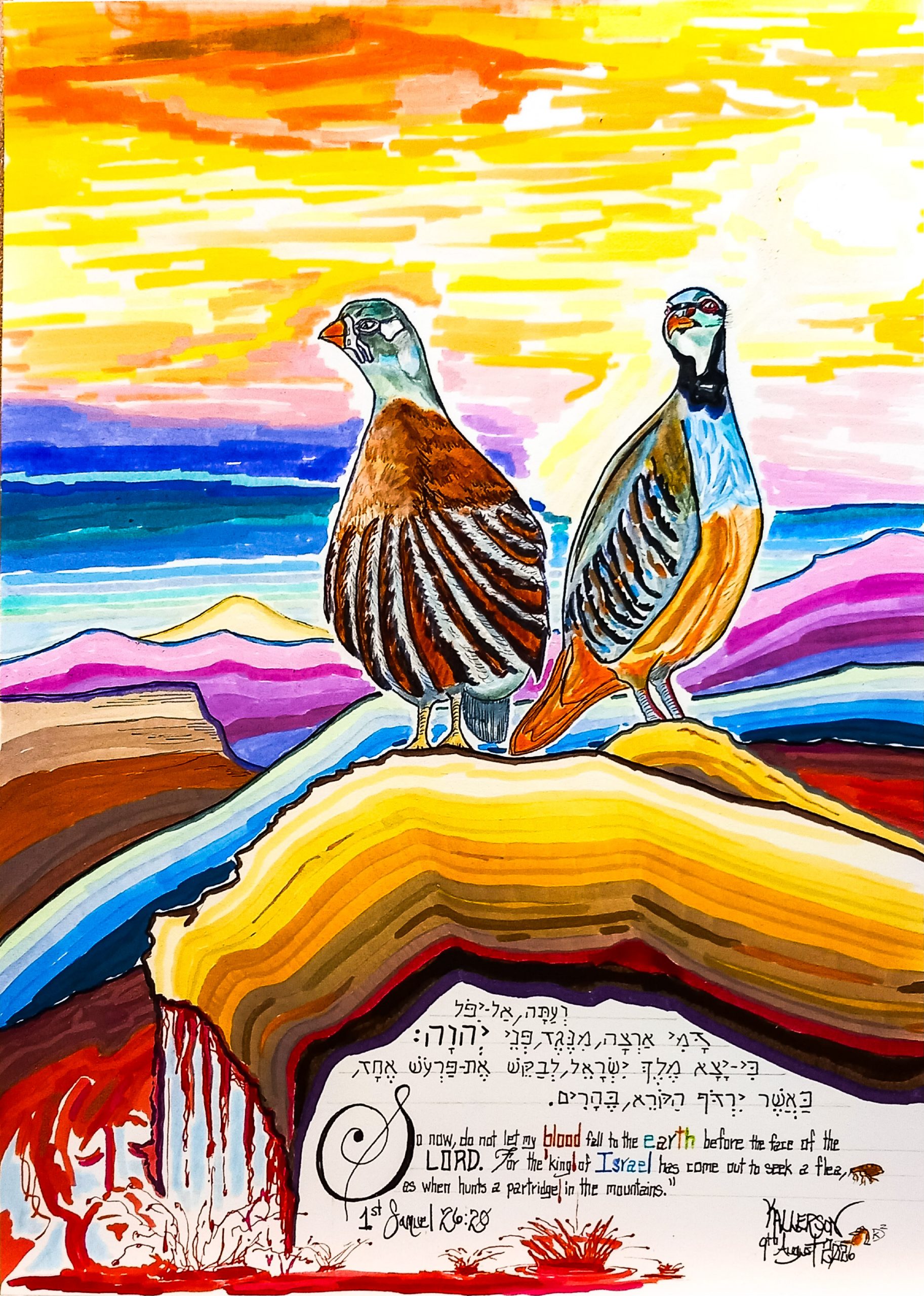
Artwork by Douglas Kallerson
1 Samuel 26:17-25
He Caused to Snatch Me from All Strait, Part II
(Typed 13 April 2026) So far in this chapter, we have seen details that seem repeated from Chapter 24. There are differences, and yet, they are so similar that some great scholars of the past are certain they are the same account.
I have defended why they cannot be the same account. And thankfully so. Once I sat down and tried to figure out the typology, things started to come into focus.
Here is what Albert Barnes said about this chapter –
“The incident related in this chapter of the meeting between Saul and David bears a strong general resemblance to that recorded in 1 Samuel 24, and is of a nature unlikely to have occurred more than once. Existing discrepancies are explained by the supposition that one narrative relates fully some incidents on which the other is silent. On the whole the most probable conclusion is that the two narratives relate to one and the same event. (Compare the two narratives of the Creation, Genesis 1; Genesis 2:4 ff; the two narratives of David’s war, 2 Samuel 8; and 2 Samuel 10; and those of the death of Ahaziah, 2 Kings 9:27 ff; and 2 Chronicles 22:9.).”
Text Verse: “And the rest were killed with the sword which proceeded from the mouth of Him who sat on the horse. And all the birds were filled with their flesh.” Revelation 19:21
Just before Revelation 19:21, it said that the beast and the false prophet were captured and cast alive into the lake of fire burning with brimstone. Doesn’t it make you wonder why the Lord didn’t just chuck all of those people allied with them into the same place?
What happens when a person is killed with the sword? Where does he go? He goes to the same place that all humanity has gone since the first person who ever died.
Think about what the last couple of sermons pictured. Maybe you can figure out why the Lord put two accounts that are so similar into his word before we finish up the verses.
I was stunned at the reason, but I should not have been, because it is His superior word. And so, let us turn to that precious word once again, and… May God speak to us through His word today, and may His glorious name ever be praised.
I. My Son David (verses 17-20)
17 Then Saul knew David’s voice, and said, “Is that your voice, my son David?”
vayaker shaul eth qol David vayomer haqolekha zeh beni David – “And he caused to scrutinize, Saul, ‘voice ,David’. And he said, ‘The ‘your voice,’ this, my son David?’” As before, this is similar to the account in verse 24:16 –
24:16 – “And it was, according to ‘finish, David’ to speak the words, the these, unto Saul, and he said, Saul, ‘The ‘your voice’, this, my son, David?’”
26:17 – “And he caused to scrutinize, Saul, voice David. And he said, ‘The ‘your voice,’ this, my son David?’”
The difference is obvious from the context. In Chapter 24, David was right before Saul making his appeal. It was probably daytime during that encounter. Here, it is night and there is a distance between them. Therefore, Saul has to “scrutinize” the voice, concluding it is David. And as he suspected…
17 (con’t) David said, “It is my voice, my lord, O king.”
vayomer David qoli adoni ha’melekh – “And he said, David, ‘My voice, my lord the king.’” David confirms the situation. Because of what he has already said about the missing spear and cruse of water, the soldiers around Saul would stand there thoroughly humiliated.
David walked through the entire encampment, right to the center, picked up Saul’s things, and walked back out completely unnoticed. But David is done taunting Abner over that. Instead, he gets to the heart of the matter…
18 And he said, “Why does my lord thus pursue his servant? For what have I done, or what evil is in my hand?
vayomer lamah zeh adoni rodeph akhare avdo ki meh asithi u-mah beyadi raah – “And he said, ‘To why this? My lord pursuing after his servant! For what I did, or what in my hand evilness?’” The words are an open question concerning motive, nothing more. And the manner in which he speaks is reverent but frank.
Instead of defending himself, David asks questions, calling for Saul to probe his own intentions and motives. Along with that, he will give possible reasons that Saul might have pursued him. But by doing this, and knowing that his reasons are not why Saul is after him, it will bring to light the fact that there is no valid reason for Saul to pursue him…
19 Now therefore, please, let my lord the king hear the words of his servant: If the Lord has stirred you up against me,
veatah yishma na adoni ha’melekh eth divre avdo im Yehovah hesithekha vi – “And now, he will hear, pray, my lord the king, words his servant. If Yehovah, He caused to prick you in me.” Many scholars think David is referring to the evil breath from the Lord that afflicts Saul. That seems unnecessary.
David is giving a hypothetical example to open Saul’s eyes to his own evil intentions toward David. He first asks Saul to consider what he says. He then presents the first possible reason as to why Saul is pursing him. Perhaps he was divinely led by the Lord. If this was the case…
19 (con’t) let Him accept an offering.
yarakh minkhah – “may He cause to smell present.” In other words, if Yehovah needled Saul into chasing David, an offering should be made to Him for appeasement so that He will refrain from pressing Saul further.
The “smell” David refers to is as if the Lord has a nose and smells the offering that was made to petition Him. Obviously, both men know the Lord didn’t press Saul to act against David. Another option is…
19 (con’t) But if it is the children of men, may they be cursed before the Lord,
veim bene ha’adam arurim hem liphne Yehovah – “And if sons the human, execrated, they, to ‘faces, Yehovah’!” The meaning is, “If the Lord didn’t prick you, maybe there are sons of adam, fallen humans, who have wickedly conspired to needle you into pursuing me.” If so, David says they are cursed before the Lord. The unstated reason is, “Because I have done nothing wrong to justify such attacks.”
They both know that no one else pricked Saul. Thus, David’s words are a subtle rebuke of Saul whose own mental machinations have caused the trouble. And because of this, there is a result that David wants him to consider. Therefore, he will continue to make it seem as if it is some unknown group poking Saul, but they both know the truth…
19 (con’t) for they have driven me out this day from sharing in the inheritance of the Lord, saying, ‘Go, serve other gods.’
ki gereshuni ha’yom mehistapeakh benakhalath Yehovah lemor lekh avod elohim akherim – “For they disinherited me, the day, from eking myself in ‘inheritance, Yehovah’, to say, ‘You must walk! You must serve ‘gods, other’.’” David uses the word saphakh, to scrape out. If someone finishes a bowl of oatmeal and is still hungry, he will scrape out everything he can, as if eking out his existence through the remaining oatmeal.
David is saying, “I cannot even live my life trying to please Yehovah, eking out His favor because I have been disinherited by these bad men who have told you to pursue me.” Instead, their words in Saul’s ears have caused him to be removed from the presence of the Lord (where His temple is).
In effect, it would be like saying that he has been excommunicated from Yehovah and must go serve other gods in other lands.” Again, they both know this is not the case. David is tactfully asking Saul about why he, not Yehovah or some unnamed people, was incited against his loyal subject. As such, the implied message is –
“We both know Yehovah didn’t prick you to chase after me. So there is no point in making an offering to supplicate Him to grant me relief. We also know there isn’t anyone spurring you on to pursue me. It is you who are taking away my right to simply exist in Israel and live my life before Yehovah.”
Understanding this, David continues…
20 So now, do not let my blood fall to the earth before the face of the Lord.
Rather: veatah al yipol dami artsah mineged pene Yehovah – “And now, not it will fall, my blood, earthward from afront ‘faces, Yehovah’.” All translations but the SLT make this a petition (let not…), but the words are rather an adamant proclamation. David is not asking Saul to spare him. Rather, he is affirming that he will not be killed. And there is a reason for this…
20 (con’t) For the king of Israel has come out to seek a flea, as when one hunts a partridge in the mountains.”
ki yatsa melekh Yisrael levaqesh eth parosh ekhad kaasher yirdoph ha’qore beharim – “For he went out, king Israel, to seek ‘flea, one’ according to which he will pursue the caller in the mountains.” Again, this is similar to 1 Samuel 24:14 where David compared himself to a single flea.
David is saying that it would be pointless for Saul to kill him. Why would he waste his time chasing a flea as he would chase a caller in the mountains? This “caller” is a new word found only here and in Jeremiah 17:11. It is from the verb qara, to call. It signifies a partridge. If you want to know why, go to YouTube and type in something like “Sound of a partridge call.”
Some scholars dispute it is referring to a partridge because partridges are nummy to eat. Their logic is that a flea is useless and so whatever bird is referred to must also be useless and not worth eating.
Such an analysis misses the point. It is referring to the hunt, not what is hunted for. One must actively pursue a partridge. And more, partridges are found most often in the fields where they live. Chasing a partridge in the mountains is, therefore, a waste of time and effort.
David equates himself to a flea and says that Saul is spending the same effort to find David, a flea, as someone would to find a partridge in the mountains. His words have been direct and pointed, but also polite and non-confrontational.
The Church is gone, what will happen to us?
Is there no chance of life, no hope left?
What about if we call on Jesus?
Will we of hope still be bereft?
What are we to do, and how are we to know?
Should we just party until our days are done?
Let’s go to the word! Maybe it will show
What we are to do with God’s only Son
Surely the answer is there for us to know
And surely there is hope for people like us
To the word! Certainly it will show
What we should do about the Lord Jesus
II. Doing, You Will Do (verses 21-25)
21 Then Saul said, “I have sinned. Return, my son David.
vayomer shaul khatathi shuv beni David – “And he said, Saul, ‘I sinned. You must return, my son David.” Saul acknowledges that he alone has been in the wrong. The Lord didn’t prick him to chase David, and neither did any person. David is vindicated. As such, Saul asks for peace and for David to return…
21 (con’t) For I will harm you no more, because my life was precious in your eyes this day.
ki lo ara lekha od takhath asher yaqerah naphshi beenekha ha’yom ha’zeh – “For not I will cause to spoil to you again, under which it weighed, my soul, in your eyes, the day, the this.” The NKJV, despite being a complete paraphrase, gets the sense of the Hebrew.
Saul proclaims he is through giving David grief. David was careful to give weight (importance) to Saul’s soul and not kill him, so how could Saul act differently toward David? And more…
21 (con’t) Indeed I have played the fool and erred exceedingly.”
Saul’s words concerning his negative actions are superlative: hineh hiskalti vaeshgeh harbeh meod – “Behold! I caused to be silly, and I strayed, causing to increase, vehemently.’” It is like saying, “I did this. I pushed myself to do it, and I continued like a madman as I did it.”
Saul, in front of all his men, admits his failings toward David. We know this, because of the distance David put between them. Saul would have to elevate his voice significantly for it to reach David’s ears…
22 And David answered and said, “Here is the king’s spear.
vayaan David vayomer hineh ha’khanith ha’melekh – “And he answered, David, and he said, ‘Behold! The ‘spear [k.], the king’.’” The oral here says, “Spear, the king.” The scribes dropped off the article before “spear” due to the clunky nature of having two articles before two nouns in a row. As for the spear, it is the symbol of Saul’s authority.
Therefore, David is essentially saying, “Behold, I have the symbol of your kingship. You could be dead if I wished, and your time of being king would be over.” David doesn’t even bother mentioning the cruse of waters in relation to the spear.
22 (con’t) Let one of the young men come over and get it.
veyaavor ekhad mehanearim veyiqakheha – “And he will traverse, one from the lads, and he will take it.” David desires to return this symbol of authority. His continued words indicate, “I have no intentions of usurping your authority. You are the king. Take what is rightfully yours.”
To accomplish this, Saul is to send a runner from the lads to traverse the distance between them and retrieve it. To confirm his unwavering allegiance to the king, David continues…
23 May the Lord repay every man for his righteousness and his faithfulness;
Rather: vaYehovah yashiv laish eth tsidqato veeth emunatho – “And Yehovah, he will cause to return to the man his rightness and his firmness.” As before, this is not a petition. David is stating it as a point of fact.
And even though he will speak of himself in the next clause, he is not specifically speaking of himself in this one. This is a general statement. When a man does rightness and firmness, the Lord will actively cause it to return to that man. Understanding this, the words do bear on what he next says…
23 (con’t) for the Lord delivered you into my hand today, but I would not stretch out my hand against the Lord’s anointed.
asher netanekha Yehovah ha’yom beyad velo aviti lishloakh yadi bimshiakh Yehovah – “which he gave you, Yehovah, the day, in hand, and not I acquiesced to send my hand in ‘anointed, Yehovah’.” David does not say that the Lord gave Saul into his hand. He says, “in hand.” It is a way of saying that Saul was under the general authority of another because the Lord allowed it to be that way.
Despite that allowance, David did not take the opportunity the Lord laid before him. “I did not use my hand against the one who was in my hand.” And the reason for this is that Saul is the Lord’s anointed. The wording means, “I was tested with your life today. It was exposed for any to take and I refused to take it.”
Despite Saul being open to attack, the anointing oil of the Lord was on him, and David knew it would be wrong to act against him. David is doing everything possible to convince Saul that not only did he not bear any ill will toward him, but he is also explaining the reasons behind his actions…
24 And indeed, as your life was valued much this day in my eyes, so let my life be valued much in the eyes of the Lord,
Again, it is an affirmation, not a petition: vehineh kaasher gadelah naphshekha ha’yom ha’zeh beenay ken tigdal naphshi beene Yehovah – “And behold! According to which it grew, your soul, the day, the this, in my eyes, thus it will grow, my soul, in ‘eyes, Yehovah’.” The words “it grew” and “it will grow” are rightly explained by the NKJV.
It is a way of saying, “I placed a high value on your soul, and the Lord will place a high value on my soul.” This is an explanation of the previous words –
“And Yehovah, he will cause to return to the man his rightness and his firmness.”
“And behold! According to which it grew your soul, the day, the this, in my eyes, thus it will grow, my soul, in eyes Yehovah.”
David did what was right and proper in esteeming the life of Saul. As such, the Lord will return that same esteeming toward the life of David. He next petitions for that to be expanded upon…
24 (con’t) and let Him deliver me out of all tribulation.”
veyatsileni mikal tsarah – “And may He cause to snatch me from all strait.” David’s petition is that the Lord would continue to deliver him from all such instances. Saul next speaks what will be his last recorded words to David…
25 Then Saul said to David, “May you be blessed, my son David! You shall both do great things and also still prevail.”
vayomer shaul el David barukh atah beni David gam asoh taaseh vegam yakhol tukhal – “And he said, Saul, unto David, ‘Blessed you, my son David. Also, doing, you will do, and also, able, you will be able.” This is a general blessing which scholars take to unrealistic extremes. However, there is one point that is probably on Saul’s mind.
The last time they had such an interaction in Chapter 24, there is no indication that anyone but Saul and David were around to hear. This time, Abishai is with David and Saul is surrounded by three thousand men. Therefore, it would be inappropriate for Saul to repeat his words from Chapter 24. However, this may be his way of confirming what he previously said when they parted –
24:20 – “And now, behold! I knew that reigning, you will reign, and it rose in your hand ‘kingdom, Israel’.”
26:25 – “Also doing you will do, and also able you will be able.”
If this is the case, David would know exactly what he meant without directly saying it before the entire camp. David will “do” the kingdom and he will “be able” to do it. With that, their final interaction is complete…
*25 (fin) So David went on his way, and Saul returned to his place.
vayelekh David ledarko veshaul shav limqomo – “And he walked, David, to his road. And Saul, he returned to his place.” David remained on his road of life which will not find him returning to any set place in Judah for the time being. Saul’s place is Gibeah. To avoid any unrelated typology, that is not recorded this time, as it was when Chapter 24 ended.
What would happen if there were no Sheol?
Could that happen after the rapture?
If it is no more, what would happen to my soul?
Would it be ‘off to the Lake of Fire’, it, my soul to capture?
Does the Bible even speak of such things?
Can we know what is on God’s mind?
Curiosity to my mind, the question brings
We should study up and not get behind
But better yet, we should all be ready
When the trumpet is blown, then off we’ll go
Because our faith was accepted as sure and steady
We’ll be on the rapture express, doncha know!
III. Amazing Typology
The typology since Chapter 17 has dealt with doctrinal issues. Whether chronological or not, Chapter 24 logically followed after Chapter 23 in matters of timing in relation to the redemptive narrative. For example, they referred to surety in Christ and, without specifically dealing with the rapture, they dealt with doctrinal issues related to the rapture.
Chapter 25 moved into doctrinal issues that will arise during the tribulation. Here in Chapter 26, we have details that closely mirror many of the details in Chapter 24. But if this chapter logically follows after Chapter 25 in timing of events, why would it so closely mirror events from Chapter 24?
The question is, does this chapter follow after the beginning of the tribulation? If so, then what happens then must somehow mirror doctrine that occurs before the tribulation. It is a logical deduction. It is also correct.
And yet, I had no idea about any of that until I almost completed the typology for the chapter. Only after working on it from a broad view of what each thing means (as things must be kept consistent or I would just be making stuff up) did I realize what is going on.
Why is this important? We can talk about that before we finish.
In verse 1, the words were similar to those of Chapter 23. The Ziphites came unto Saul in the Gibeah-ward. Ziph signifies an outflowing, as in pitch melting. Thus, these would be Out-flowers.
Their doctrine is what outflows from the church age, even if the church age has ended. In other words, if this is referring to the time of the tribulation, which logically follows from the contents of Chapter 24, then those in the tribulation still have the church age doctrine to refer to.
Saul signifies Sheol calling out for the souls of men. Being Gibeah-ward means they have not arrived at Gibeah. Thus, as in Chapter 23, they reflect those who have not accepted the doctrines of Christ, even if they know them.
Still in verse 1, it said, “Not David hiding himself in ‘Hill, the Hachilah’ upon ‘faces, the wasteland’?” The words are also similar to Chapter 23.
The Hill the Hachilah, or Hill the Crimson, speaks of the judgment rendered at Gabbatha, resulting in the cross of Christ. David, Beloved, is typical of accepting the doctrines of Christ. He is before the wasteland, the place of desolation because of sin and its consequences.
In verse 2, Saul arose and went down to ‘Wilderness, Ziph’. Ziph represents the effects of the church age where the church is flowing out, hunting for souls to save. Because Ziph is in the wilderness, it signifies being in a land of testing and yet closeness to God.
In going, it noted that three thousand of the selected of Israel went to seek David there. It is the same number as in Chapter 24, picturing the time during the church age. The typology for the events remains the same, even if the timing is different.
If David represents accepting the doctrines of Christ, then Israel (He Strives with God) continues striving against God at this time. It is what one would expect during the tribulation.
Three thousand speaks of Divine Perfection paired with “completeness of order where nothing is wanting, the number and order are perfect, and the whole cycle is complete” (Bullinger). Just as the church age, the tribulation will be a set time that will come to a perfect resolution.
In verse 3, Saul inclined “in ‘Hill, the Hachilah’, which upon ‘faces, the wasteland’, upon the road.” The typology points to accepting the doctrines of Christ as was seen in verse 1.
The only difference is that it noted the derekh, road. The road refers to the path to salvation, as in the Hebrew translation of John 14:6, (ani ha’dererkh – I am the way). Jesus is the derekh.
Saul, pursuing David, is encamped on the way. One can see Sheol trying to frustrate the path to salvation during the tribulation. Will it succeed?
Still in verse 3, David was “sitting in the wilderness” when he saw that Saul came the wilderness-ward. It is the place of testing and yet closeness with God. Because Saul came in verse 4, it said, “And he sent, David, ‘walkings’, and he knew that he came, Saul, unto ‘being established’.”
Sheol is established in the spot where Christ died (the Crimson Hill) which is before the place of desolation because of sin and its consequences. It is on the road to salvation (think of Sheol, trying to block the path to salvation in Christ).
Because Saul is inclined there, it says in verse 5 that David went there and noted where Saul lay along with Abner, Father of Light, the son of Ner, Lamp. In this case, the lamp is that which speaks of continuance and ability to rule. That is seen several times, such as –
“Yet the Lord would not destroy Judah, for the sake of His servant David, as He promised him to give a lamp to him and his sons forever.” 2 Kings 8:19
Remember, Saul is encamped upon the derekh (again, think of the road to Jesus). David has come to this location. Who will prevail, Saul/Sheol or David/accepting the doctrines of Christ?
Along with that thought, for the first of five times, one of two words that are normally plural is stated in the singular. Each time one of these words is used, the only difference is that a yod, the tenth letter and representing a hand (yad), is missing.
As the hand signifies authority and power, it is as if the authority and power of Saul is lacking in all five instances. His surroundings were not sufficient to protect him, and his headpiece, his symbol of rule and headship, was compromised.
David was with Ahimelech the Hittite and Abishai, son of Zeruiah, brother of Joab. This Ahimelech is only seen here in the Bible. In Genesis 23, the Hittites were seen to represent fallen Adam, living in terror of death.
When David asked which would go with him, Abishai emphatically declared he would go. His name means My Father Yehovah Exists, son of His Edgerock Is Yah (or Balsam of Yah), brother of Yehovah Is Father. The very name of this guy reveals he is typologically the opposite of Ahimelech. Instead of terror of death, he is confident in Yehovah.
In verse 7, they went into the circular and saw Saul sleeping. The circular had a dual meaning in Chapter 17. It spoke of the incarnation of Christ in the circular world.
It also points to the circular nature of Scripture, where man is cast out of paradise and the presence of God, but he will eventually be brought back there again. Sheol lay unprotected since Christ’s incarnation.
Verse 7 also noted that Saul’s spear was “pressed in the earth – his headpiece. And Abner, and the people, ‘lying his around’.” Two more times the yod is missing from the words related to Saul.
The khanith, spear, is Saul’s symbol of authority. It is identical to the feminine word meaning grace. One might ask why Sheol’s symbol of authority would be grace during the tribulation, but it is.
Instead of man going directly to the Lake of Fire, there is a place of grace for God’s redeemed until they are raised and the others are judged and condemned.
In verse 8, Abishai noted that God had shut Saul/Sheol in David’s hand. Accepting the doctrines of Christ has the ability to destroy Sheol. Abishai says that he will take the spear and in a single beat, he would strike Saul “in the spear and in the earth.”
It seems like a reasonable proposition, but David in verse 9 prohibits it. Sheol is “the Lord’s anointed” for humanity until it is no longer needed. To destroy Sheol before it is time would upset the redemptive plans of God.
Despite its power being defeated in Christ’s resurrection, it continues to have a proper place until God’s plans are complete. What would happen to the dead if there were no Sheol? It would be catastrophic! Zombies! Night of the Living Dead! Whatever comes to your mind.
Therefore, in verse 10, David mused over what might happen to Saul at some point. The Lord might strike him, he may just die, or he may go into battle and be killed. The Lord, not David (or us!) can decide the plans of the Lord. David understood this. Likewise, we must accept His plans. This is true during the tribulation, for example –
“Then a white robe was given to each of them; and it was said to them that they should rest a little while longer, until both the number of their fellow servants and their brethren, who would be killed as they were, was completed.” Revelation 6:11
God’s plan is being worked out in His timing. David knew this concerning Saul. We must also learn it concerning what Saul typifies. However, to show that David, accepting the doctrines of Christ, has authority over Sheol (verse 11), he told Abishai to take “the spear which – his headpiece, and ‘cruse, the waters’.”
Again, the yod is missing from headpiece. Sheol’s power and authority have been removed (the yod), even if they are allowed to continue for a pre-determined span. The khanith symbolizes grace. The tsaphkhath is from an unused root signifying “to expand.” The grace of Sheol for humanity, and its ability to expand from humanity, is totally under the authority of David.
For each person who accepts the doctrines of Christ, those things belong to them because of Christ. It is an amazing symbolic presentation. Despite Abishai taking those implements at David’s order, verse 12 said that David took them. One cannot have his father as Yehovah until he accepts the doctrines of Christ. There is an orderliness to the wording that is marvelous.
Still in verse 12, it noted that Saul/Sheol and all with him were under “trance, Yehovah”. Sheol is incapable of acting against the will of Yehovah. It is completely stupefied towards those who have come to Christ.
In verse 13, it was careful to note that “he traversed, David, the side. And he stood upon ‘head, the mount’ from remote. Great, the place, between them.” The great distance between them is specific. A har, mountain, in the Bible symbolizes a large, centralized group of people.
As this is dealing with the tribulation, this is reflective of Revelation 7 –
“After these things I looked, and behold, a great multitude which no one could number, of all nations, tribes, peoples, and tongues, standing before the throne … These are the ones who come out of the great tribulation, and washed their robes and made them white in the blood of the Lamb.” Revelation 7:9 & 14
In verse 14, David called out to Abner, not Saul. Sheol’s continuance and ability to rule was asleep on the job. David essentially mocks him for several verses, noting that Sheol was left completely exposed because Abner had failed at his duties.
David notes that he deserved to die because of his dereliction of duty. And like Saul, it is true that he could have been killed by David, or that Saul could have him executed, but he will continue according to the Lord’s plans. The point is made that Sheol’s continuance is solely at the Lord’s decision.
At this time, Saul (verse 17) scrutinized David’s voice. David confirmed it was he. In verse 19, David asks Saul if the Lord was stirring him up or if it was one of the sons of men.
It was obvious from the context that neither was the case. They both knew Saul was the one pursuing David. Saul’s authority and time of rule would end unless he was able to stop David. But David noted in verse 20 that his blood would not fall earthward before the Lord.
Translations that wrongly made this an appeal “Do not let my blood fall…” obliterate any possibility of obtaining the proper typology. David has prevailed. Saul has no authority over him. David’s response was not hoped for. Rather, it was an assertion based on holding to the doctrines of Christ.
David then spoke of the futility of seeking him. Saul was wasting time on such a frivolous pursuit. The understood meaning in typology is that there is total salvation in Christ. Sheol would be wasting its time trying to destroy those who hold to the doctrines of Christ. It will never happen.
In verse 21, Saul told David to return, and he would no longer pursue David. Sheol has its place, position, and authority. It does not extend its authority over those who are Christ’s, even if they temporarily reside there. This should be understood by all who face death in any dispensation.
With that assurance, David offered to return the spear, the symbol of Sheol’s authority because of grace. Nothing is said about the cruse of water. The authority of Sheol will continue until whatever point God decides, but its ability to expand and assimilate humanity is totally under the authority of who David pictures.
Whoever accepts the doctrines of Christ is completely free from the permanent bondage of Sheol. Christ alone possesses authority over them. Verse 23 magnificently said, “Yehovah, he will cause to return to the man his rightness and his firmness.”
As I noted, it was a general statement. Whoever does rightness and firmness is included in this proclamation. Only then did David speak of himself specifically as not stretching out his hand against the anointed of Yehovah.
Likewise, only the Lord has the authority over Sheol’s continuance. The believer has surety in Christ, and our times are set by Him. Those who believe and go to Sheol are to accept it as His will (as noted in Revelation 6).
That was perfectly reflected in verse 24 –
“And behold! According to which it grew your soul, the day, the this, in my eyes, thus it will grow, my soul, in ‘eyes, Yehovah’. And may He cause to snatch me from all strait.”
The NKJV uses the word “tribulation” instead of strait. It is a perfect link to what is being pictured in these verses. Next, it said in verse 25 that Saul blessed David and said, “Also, doing, you will do, and also, able, you will be able.”
That returns to the thought in verse 24:20 where Saul spoke of David and the kingdom rule. It is an amazing connection to the coming millennium, confirming that those who are the Lord’s in the tribulation will rule, exactly as stated in Revelation 20:4.
After that, the chapter closed with a sense of harmony, saying, “And he walked, David, to his road. And Saul, he returned to his place.”
Incredibly, the typology explains the reason for the two strikingly similar accounts found in Chapters 24 & 26. It is because they are dealing with the exact same issue but one is reflective of the church age, and one of the tribulation.
The same lesson is to be derived from both. Sheol has no authority over those who have come to Christ. This doesn’t mean we don’t go there when we die, but because of Jesus, Sheol’s power is only that of a temporary holding place, not a permanent residence.
Understanding the typology, we can now see that there had to be two similar and yet contrasting accounts to give us the same information, differing only in relation to the circumstances of the timeframe in which they are realized.
As I noted before, only after working on the typology from a broad view of what each thing means (because things must be kept consistent), did I realize what is going on.
This is important because whatever the typology reveals must be what is correct in a set doctrine of future events. In other words, if I wanted this to be about the tribulation, I would just make stuff up and plug in what I think I know about tribulation and call the sermon done.
But because I had no idea what the passage was telling us until after I almost finished all the typology, then what is presented determines what I should believe about the issue, whether I believed that before or not.
If typology reveals a pretribulation rapture, then a pretribulation rapture is what we can expect. If a passage is evaluated at face value and it reveals a mid-trib rapture, then that is what we should expect. God is showing in advance what to expect. This should solidify our doctrine on various matters.
If we properly handle typology, we can know whether our doctrine is correct or not by looking at the end result. This is especially so after putting things that we had no idea about before starting.
For example, if we put the pieces of a puzzle together without ever looking at the picture, the final picture would be unknown to us until we stepped back and looked at it. That is what happens with understanding typology. It is what happened with this sermon.
Therefore, if what comes out of the puzzle matches what I already believe, that is a real bonus. Confidence in doctrine is the result.
Be sure to read and study your Bible. The more you do, the more likely you too will have confidence in your doctrine. Trusting what others say without checking is not a smart place to be. So read, contemplate, check, and verify. Do all this to the glory of God.
Closing Verse: “And I saw thrones, and they sat on them, and judgment was committed to them. Then I saw the souls of those who had been beheaded for their witness to Jesus and for the word of God, who had not worshiped the beast or his image, and had not received his mark on their foreheads or on their hands. And they lived and reigned with Christ for a thousand years.” Revelation 20:4
Next Week: 1 Samuel 27:1-12 Funny title, but we will find out what it means… (He Sat in ‘Field, Philistines’) (58th 1 Samuel sermon)
The Lord has you exactly where He wants you. He has a good plan and purpose for you. He is the One who abases the haughty and exalts the humble. He regards the lowly, and the proud, He knows from afar. So yield yourself to Him, trust Him, and believe His word. In this, He will do great things for you and through you.
1 Samuel 26:17-25 (CG)
17And he caused to scrutinize, Saul, ‘voice, David’. And he said, “The ‘your voice’, this, my son David?”
And he said, David, “My voice, my lord the king.” 18And he said, “To why this? My lord pursuing after his servant! For what I did, or what in my hand evilness? 19And now, he will hear, pray, my lord the king, ‘’words, his servant. If Yehovah, He caused to prick you in me, may He cause to smell present. And if ‘sons, the human’, execrated, they, to ‘faces, Yehovah’! For they disinherited me, the day, from eking myself in ‘inheritance, Yehovah’, to say, ‘You must walk! You must serve ‘gods, other’.’ 20And now, not it will fall, my blood, earthward from afront ‘faces, Yehovah’. For he went out, king Israel, to seek ‘flea, one’ according to which he will pursue the caller* in the mountains.”
21And he said, Saul, “I sinned. You must return, my son, David. For not I will cause to spoil to you again, under which it weighed, my soul, in your eyes, the day, the this. Behold! I caused to be silly, and I strayed, ‘causing to increase’, vehemently.”
22And he answered, David, and he said, “Behold! The ‘spear [k.], the king’. And he will traverse, one from the lads, and he will take it. 23And Yehovah, he will cause to return to the man his rightness and his firmness: which he gave you, Yehovah, the day, in hand, and not I acquiesced to send my hand in ‘anointed, Yehovah’. 24And behold! According to which it grew your soul, the day, the this, in my eyes, thus it will grow, my soul, in ‘eyes, Yehovah’. And may He cause to snatch me from all strait.”
25And he said, Saul, unto David, “Blessed you, my son David. Also, doing, you will do, and also, able, you will be able.”
And he walked, David, to his road. And Saul, he returned to his place.
*Verse 20 – Hebrew: ha’qore, the caller, a partridge (from its cry). Take time to listen online.
Verse 22 – Qeri: “spear” (no article).
1 Samuel 26:17-25 (NKJV)
17 Then Saul knew David’s voice, and said, “Is that your voice, my son David?”
David said, “It is my voice, my lord, O king.” 18 And he said, “Why does my lord thus pursue his servant? For what have I done, or what evil is in my hand? 19 Now therefore, please, let my lord the king hear the words of his servant: If the Lord has stirred you up against me, let Him accept an offering. But if it is the children of men, may they be cursed before the Lord, for they have driven me out this day from sharing in the inheritance of the Lord, saying, ‘Go, serve other gods.’ 20 So now, do not let my blood fall to the earth before the face of the Lord. For the king of Israel has come out to seek a flea, as when one hunts a partridge in the mountains.”
21 Then Saul said, “I have sinned. Return, my son David. For I will harm you no more, because my life was precious in your eyes this day. Indeed I have played the fool and erred exceedingly.”
22 And David answered and said, “Here is the king’s spear. Let one of the young men come over and get it. 23 May the Lord repay every man for his righteousness and his faithfulness; for the Lord delivered you into my hand today, but I would not stretch out my hand against the Lord’s anointed. 24 And indeed, as your life was valued much this day in my eyes, so let my life be valued much in the eyes of the Lord, and let Him deliver me out of all tribulation.”
25 Then Saul said to David, “May you be blessed, my son David! You shall both do great things and also still prevail.”
So David went on his way, and Saul returned to his place.